Device23 · Q optimizer physical-trust rebuild
Loading live campaign state…
Status
—
Accepted steps
—
Surrogate Q
—
Latest FDTD Q
—
FDTD checkpoint
—
FDTD budget
—
Q versus accepted boundary step
Blue: tracked-pole FEM Q on the persistent frozen reference connectivity. Gold circles: qualified Tidy3D median Q across three monitors and three fit windows. The old trajectory is rejected because these trends have opposite signs.
Physical transfer diagnosis
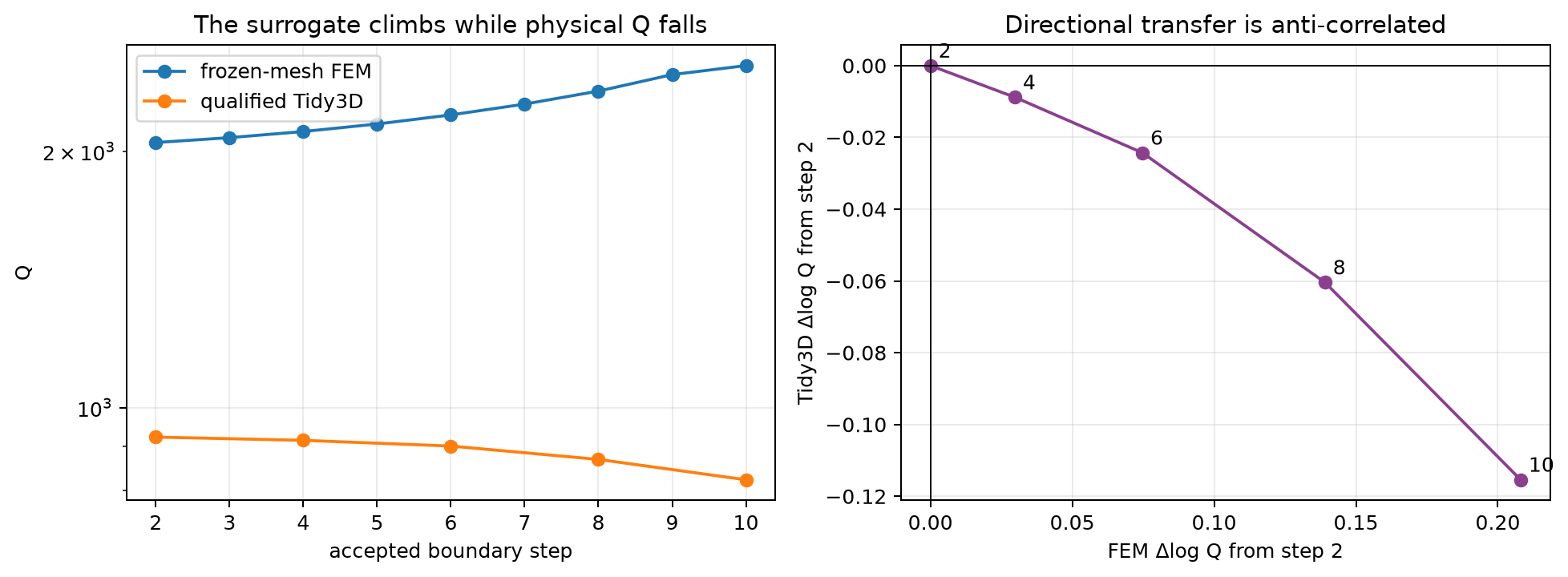
Matched canonical checkpoint evaluations. The replacement optimizer is held at step 2 while its eight smooth hole/sidewall directions are measured on fresh meshes.
Line-search diagnosis and correction
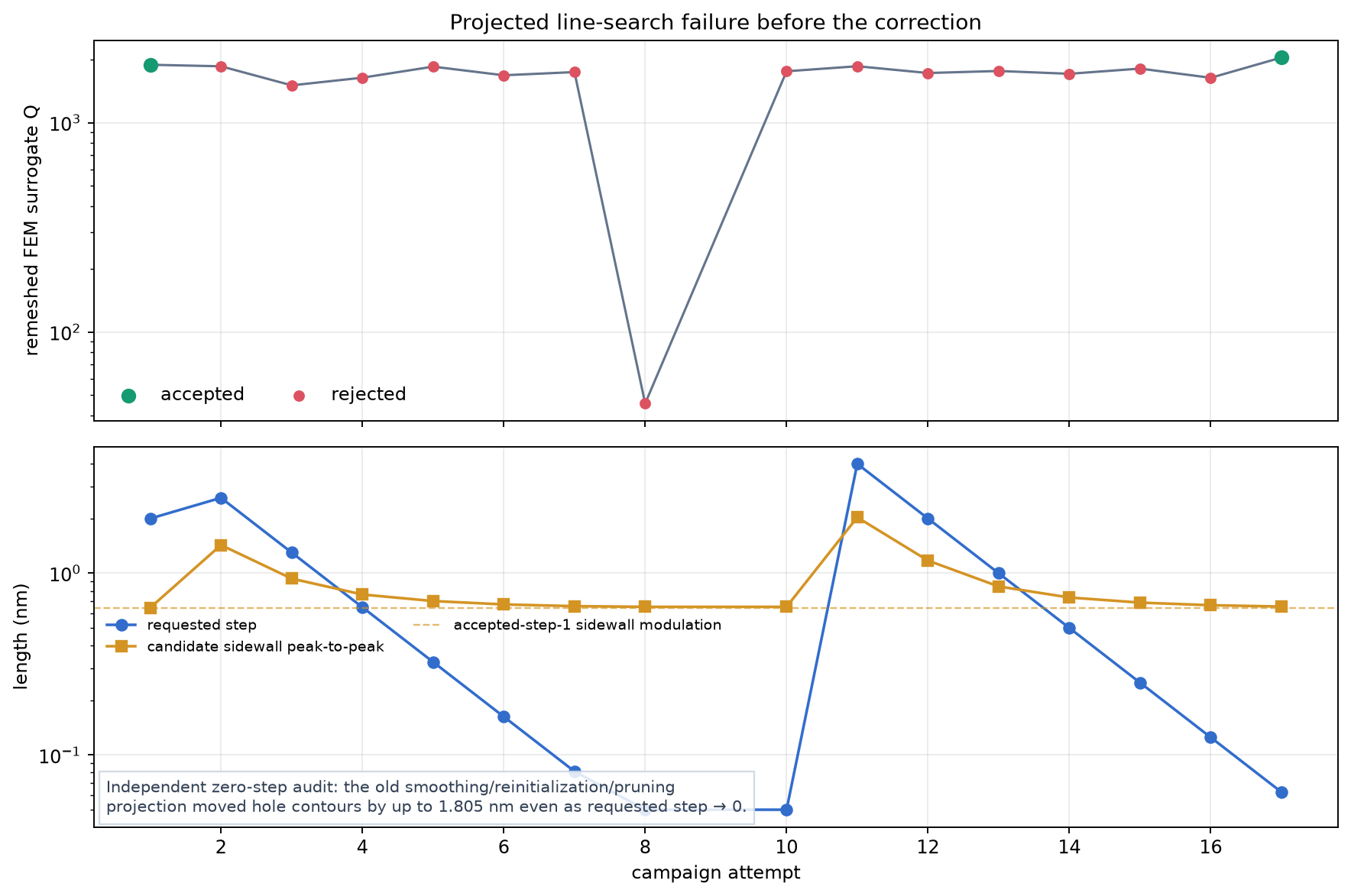
The superseded trial projection moved hole contours by 1.805 nm at nominal zero step. The corrected line search is bitwise identity at zero, applies only the pure log(Q) gradient, calibrates realized normal motion, and records predicted versus measured gain.
Historical remesh failure
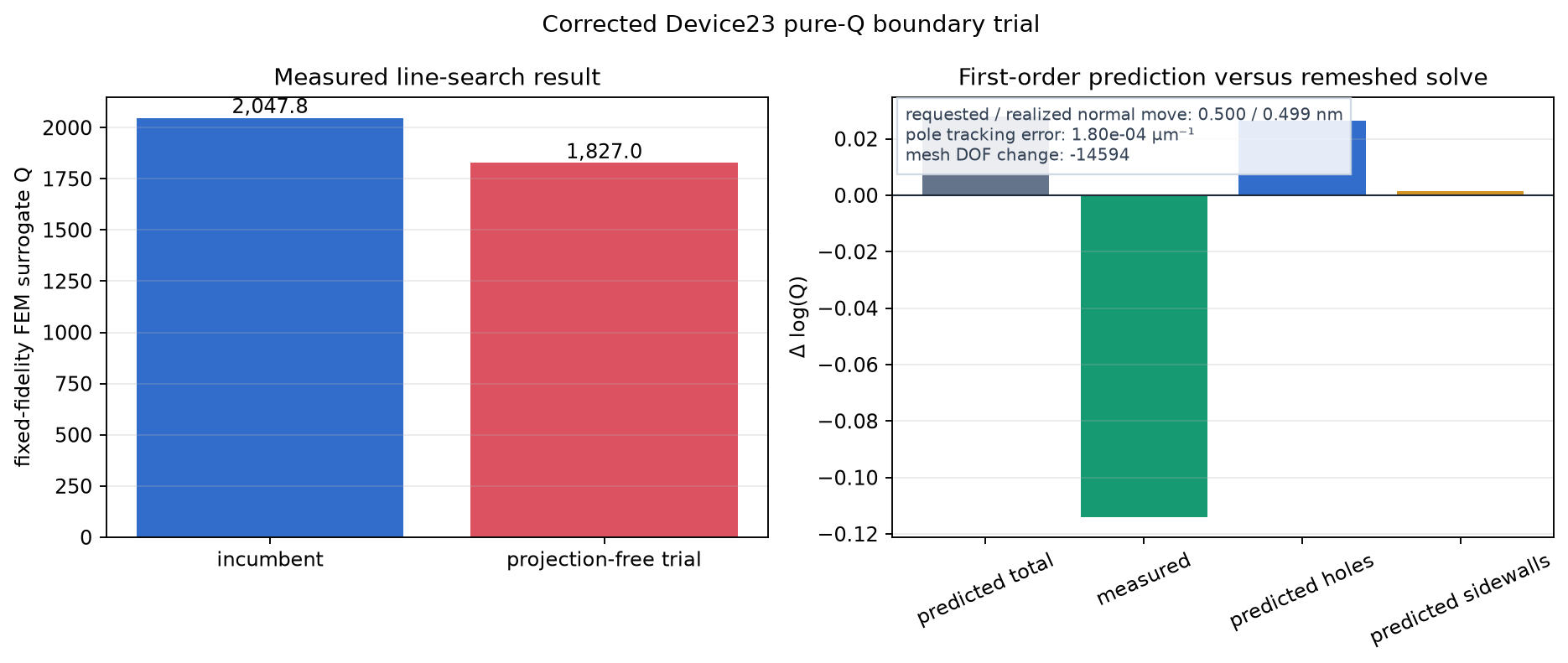
This probe isolated the original failure: the first-order gain was positive, but the saved level-set candidate lost Q after rebuilding the million-DOF mesh.
Historical ALE-only gate
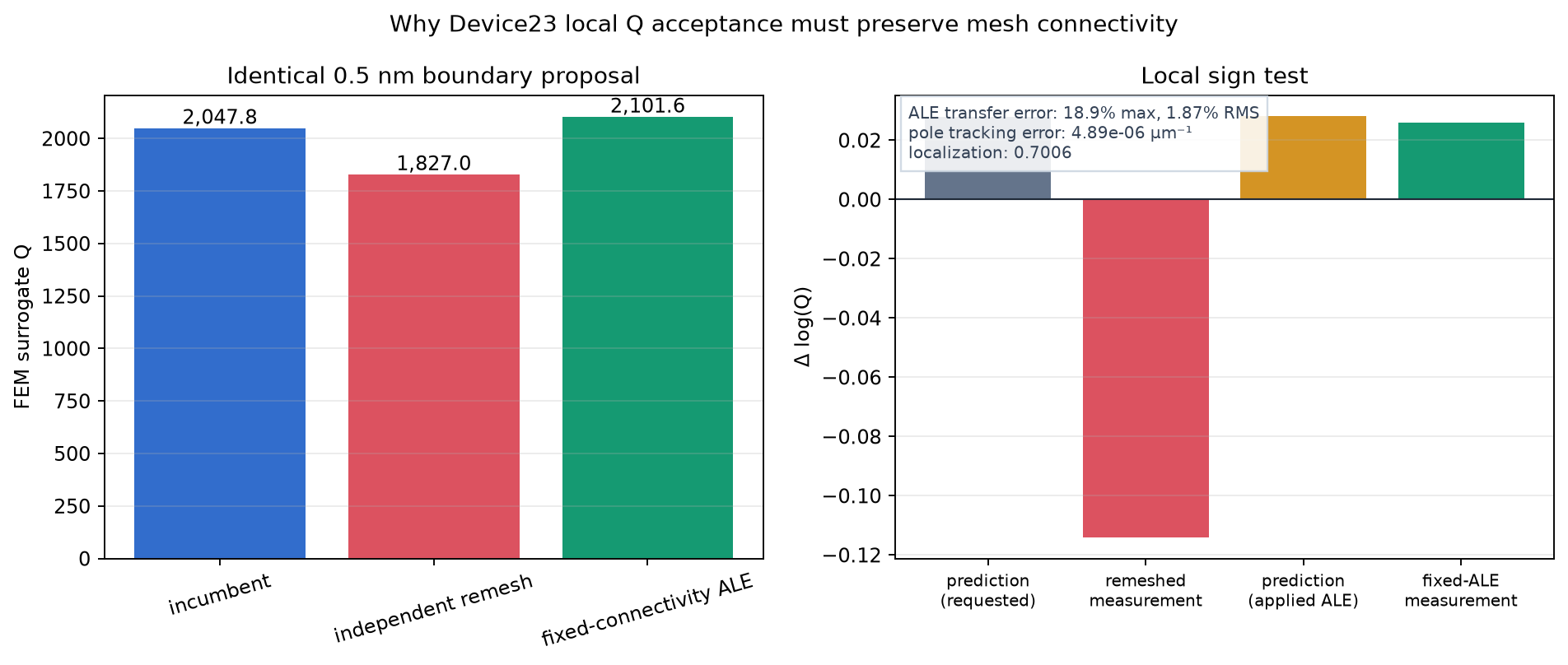
The fixed-connectivity ALE solve agreed with the local prediction, but this was not sufficient: its smoothed displacement differed from the saved boundary. This led first to the exact-checkpoint remesh gate below, and then to the persistent-reference formulation used by the live optimizer.
Exact-checkpoint line search
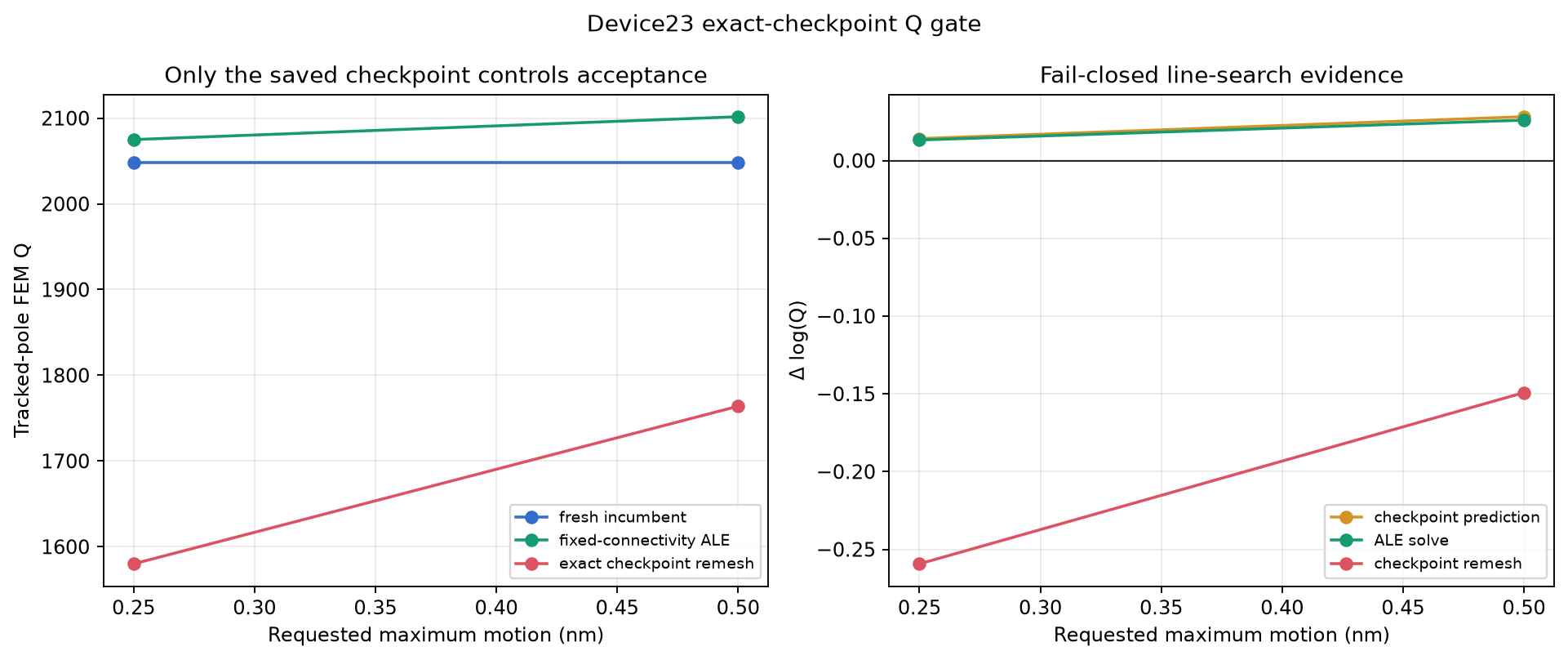
Production-fidelity gate decisions versus requested boundary motion. Positive ALE gains cannot promote a saved checkpoint whose paired fresh-remesh gain is negative.
Persistent-reference acceptance
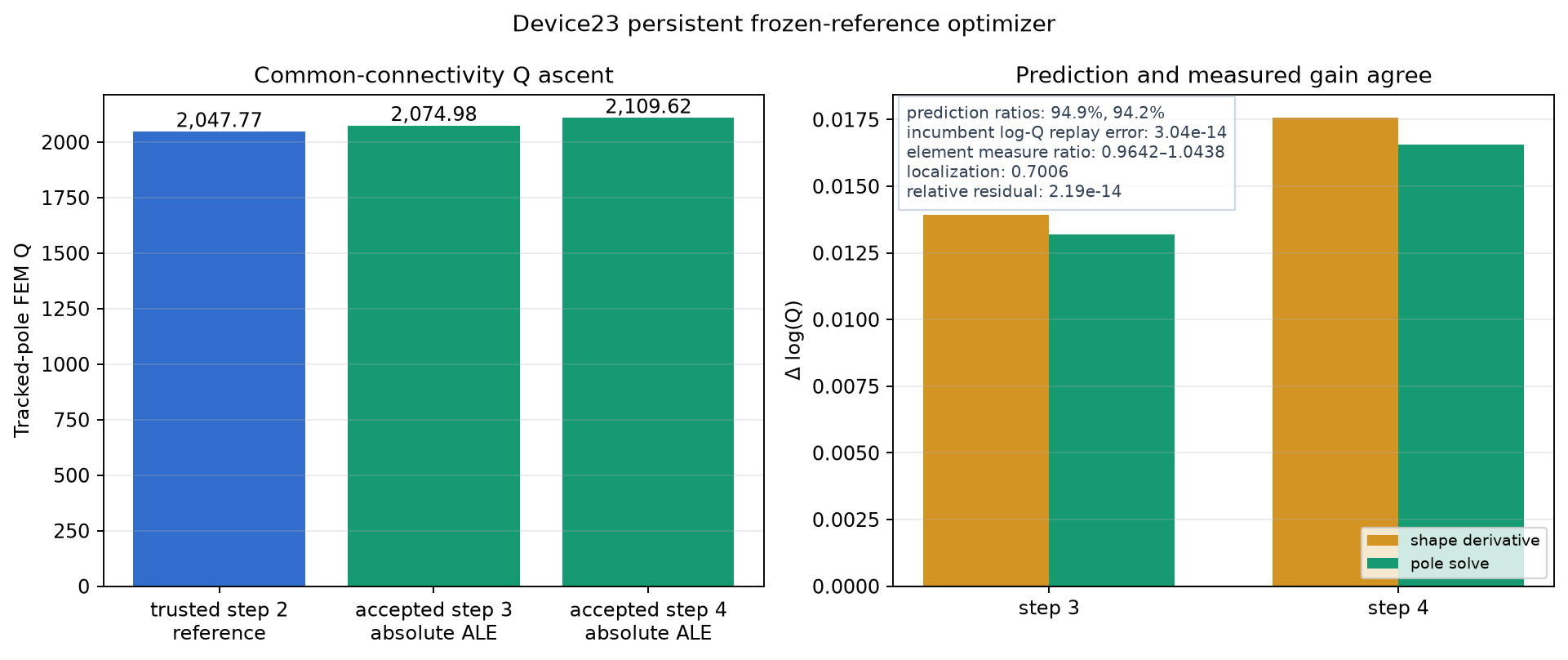
The repaired optimizer freezes trusted step 2 connectivity and represents every later boundary as an absolute ALE deformation. Steps 3 and 4 consecutively improve tracked Q on that common operator family with 94.9% and 94.2% derivative agreement; replay, mode, residual, boundary transfer, feature, and element-distortion gates all pass.
Persistent reference → current geometry

Frozen step-2 boundary used to generate the persistent reference connectivity.

Current level-set geometry exported from the persistent-reference trajectory, shown at matched axes.
Geometry · matched axes

Initial complete-material level set: 40 holes plus the straight outer sidewalls.
Current accepted hole-and-sidewall checkpoint, same axes and legend.
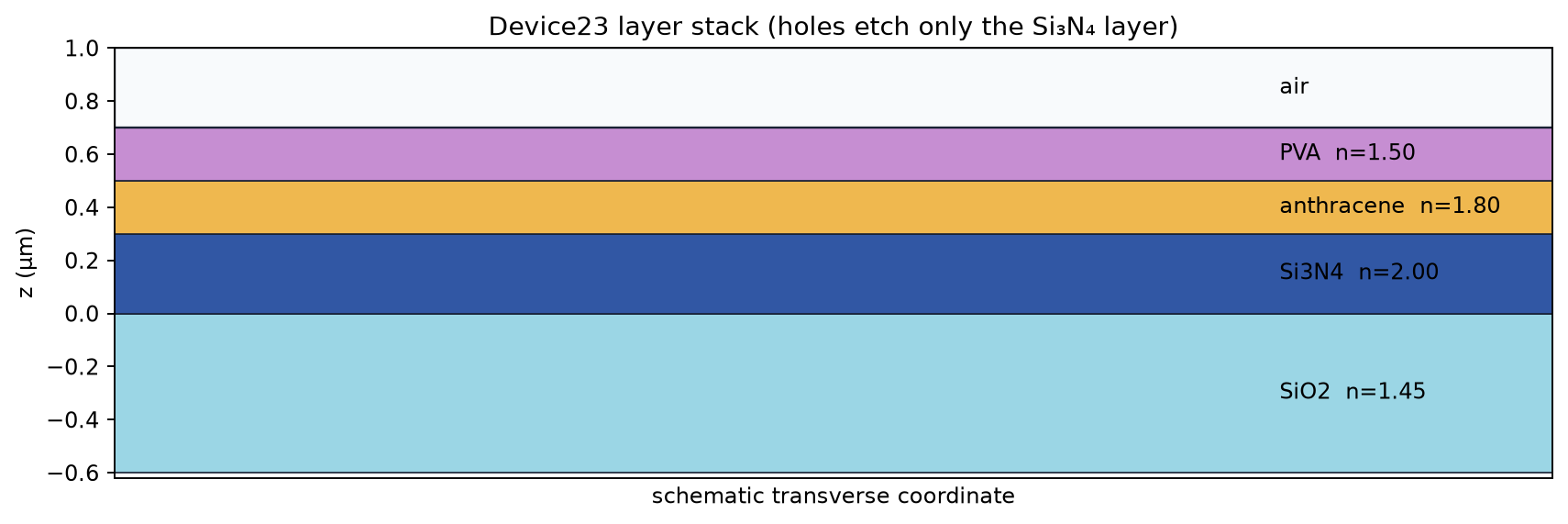
Layer cross-section: SiO₂ / patterned Si₃N₄ / anthracene / PVA / air.
Most recent diagnostic FDTD field
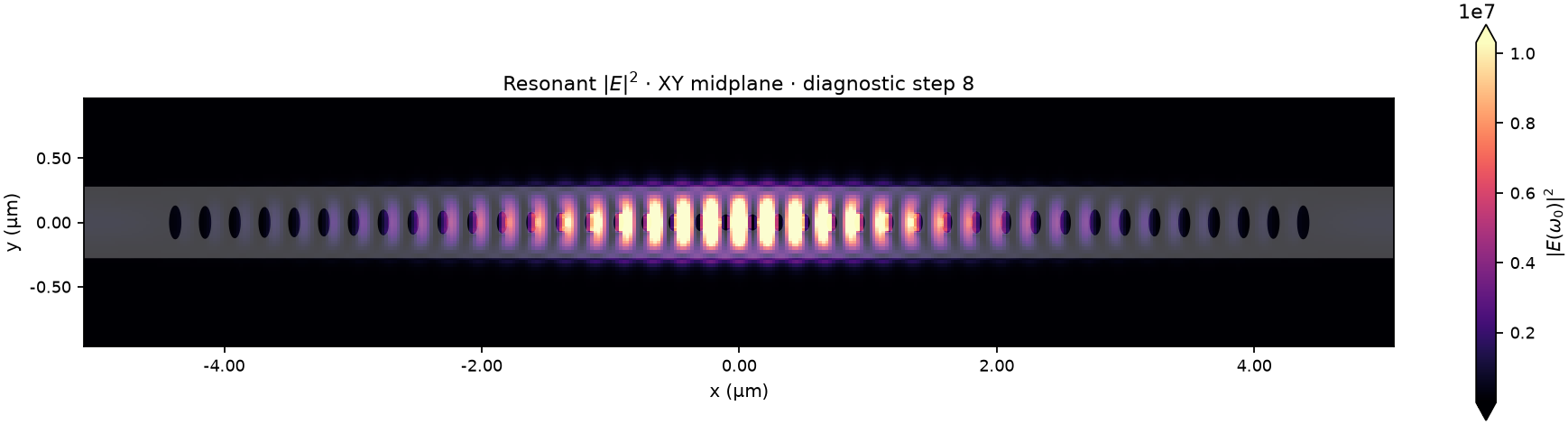
XY midplane, Hann-projected resonant vector |E|²; robust per-panel scale.
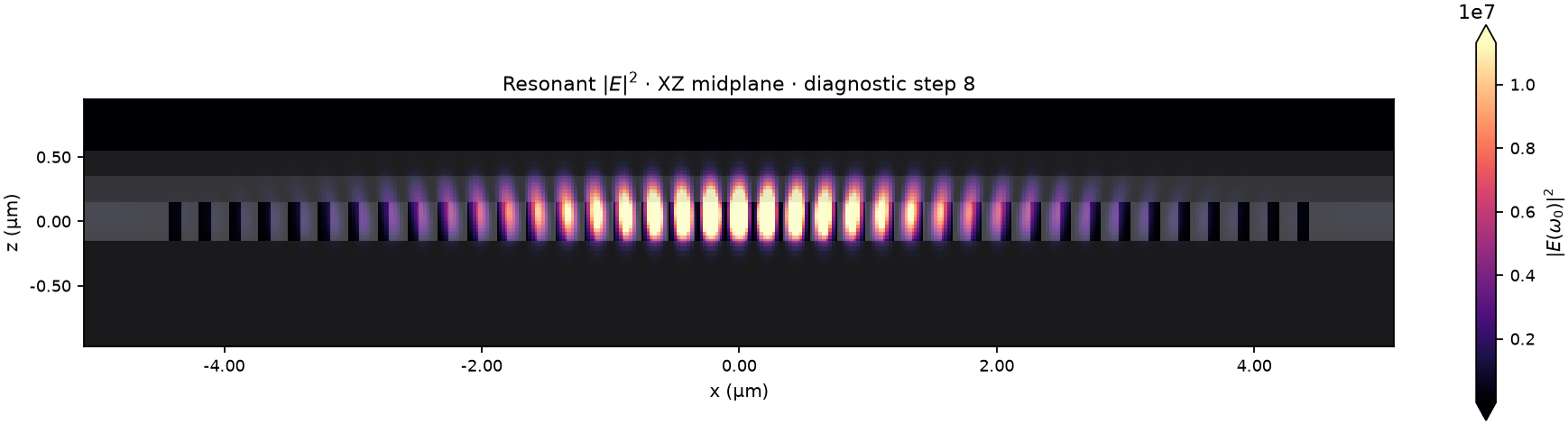
XZ midplane, same resonance and temporal projection.
Before the first new diagnostic, these panels show the FDTD-qualified launch seed.
Recent attempted boundary steps
| Attempt | Accepted step | Decision | Surrogate Q | Actual Δlog Q | Predicted | Realized move | λ | Reason |
|---|
Live JSON refreshes every 30 s. The old service is stopped; the independent-remesh trust scan is resumable. Updated —.