2.5D LDOS cavity optimizerhoodlab · 780 nm

2026-08-17 · Qualified production grid; every-step direct gates and periodic Q validation

Persistent full-vector 780 nm atom-coupling optimization

checkpointed currentartifacts updated 2026-09-05 14:21 UTC

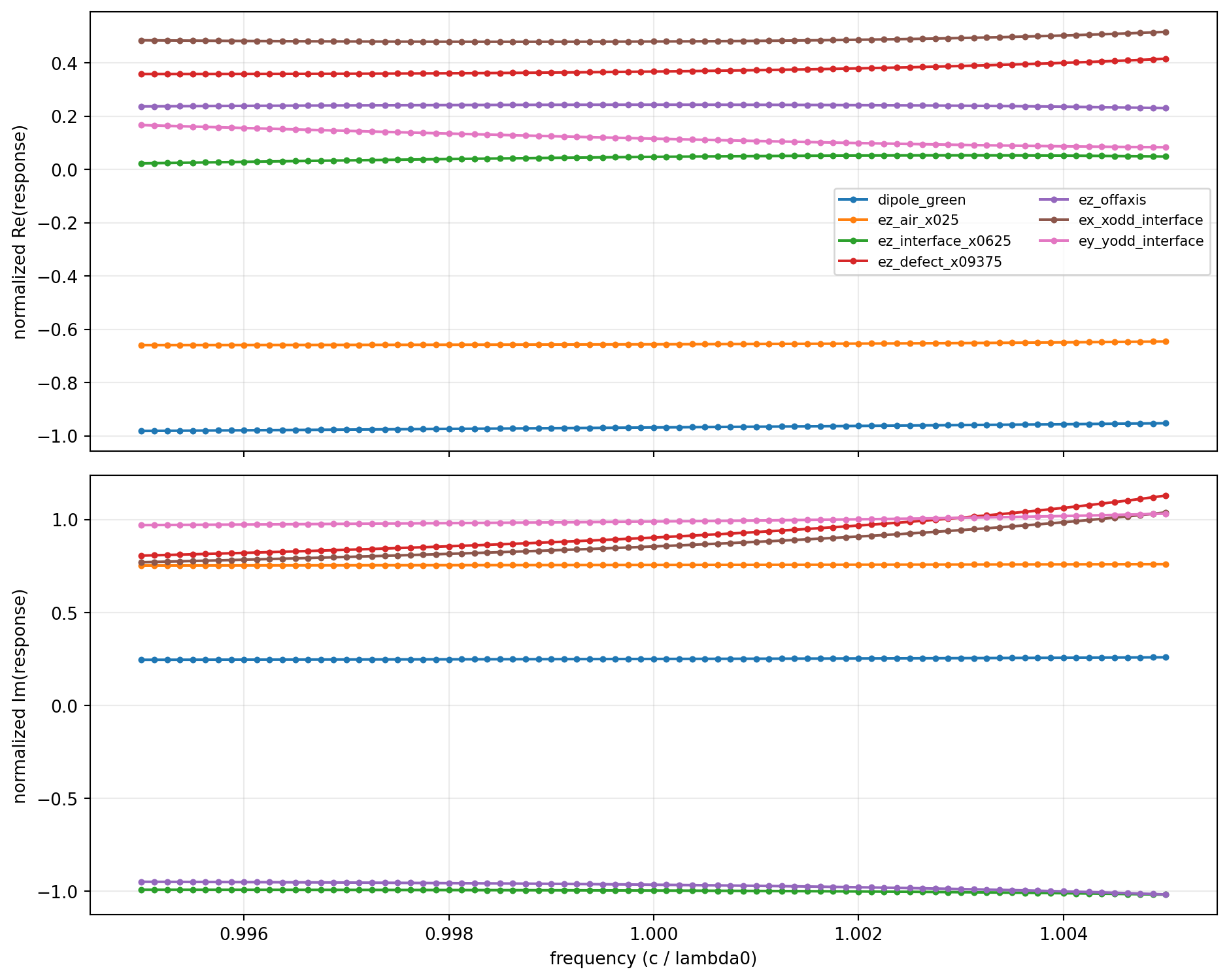
The qualified 40 x 70 x 28 component-symmetry-reduced Maxwell solver is optimizing the centered z-dipole response at exactly 780 nm without a preset iteration count. Direct gates run every step; the independent 81-point, seven-probe Q diagnostic runs every tenth step and intervening checkpoints are provisional.

Centered-emitter LDOS
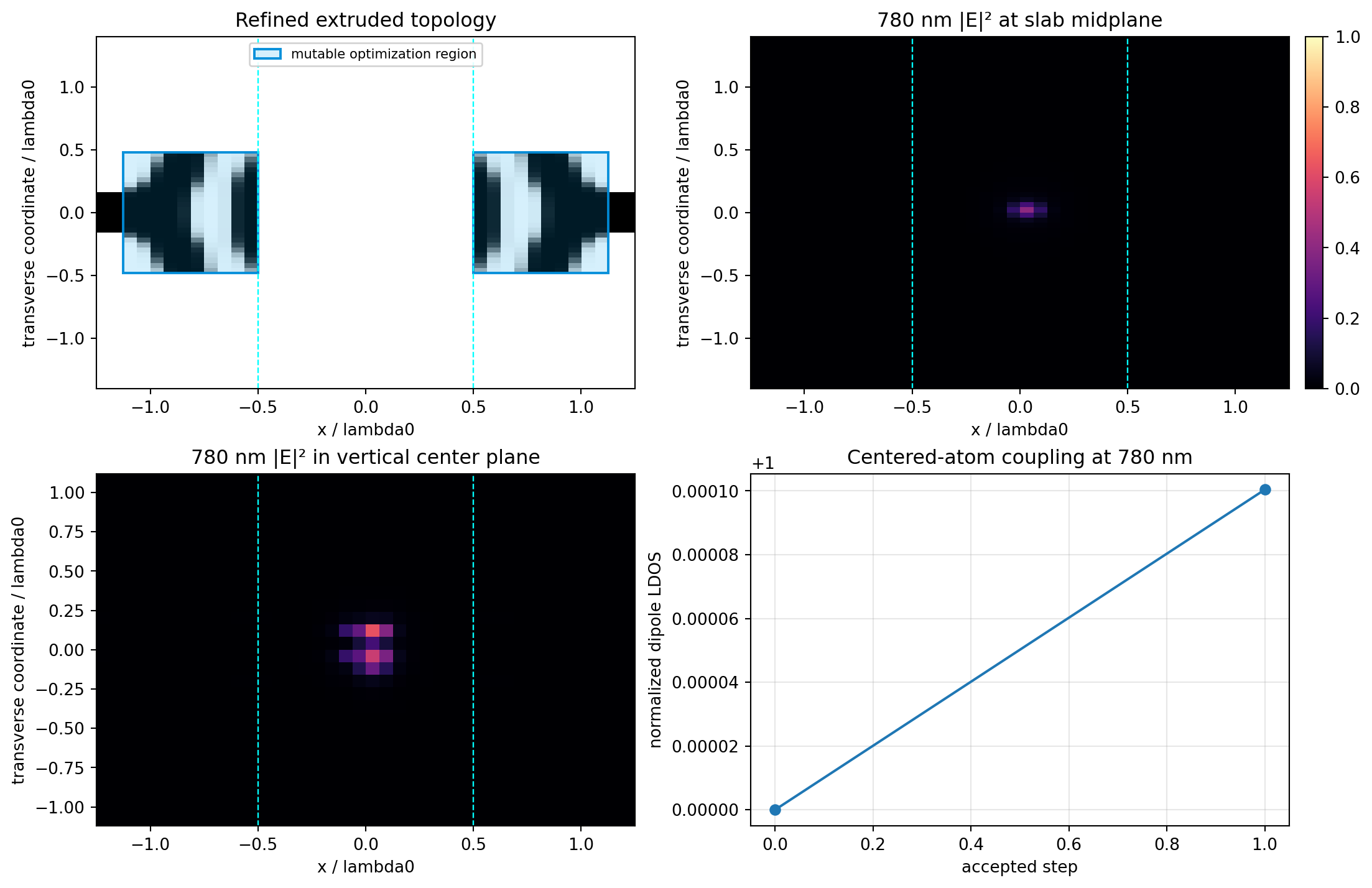
1494.465 → 2075.734
Cumulative gain
+38.895%
Retained steps
37
Checkpoint Q
no physical lower-half-plane pole in 0.995--1.005
Q sweep progress
0 → 81
Protected air density
0.000e+00

Decision. Continue while every-step direct gates pass. Run the full 81-point Q validation at iterations 10, 20, 30, and so on; label intervening retained checkpoints provisional. Pause for nonlinear mode reacquisition as soon as a physical target-window pole candidate appears.
Persistent full-vector 780 nm atom-coupling optimization
Latest retained topology, 780 nm field energy, and cumulative centered-emitter coupling trajectory.
Persistent full-vector 780 nm atom-coupling optimization
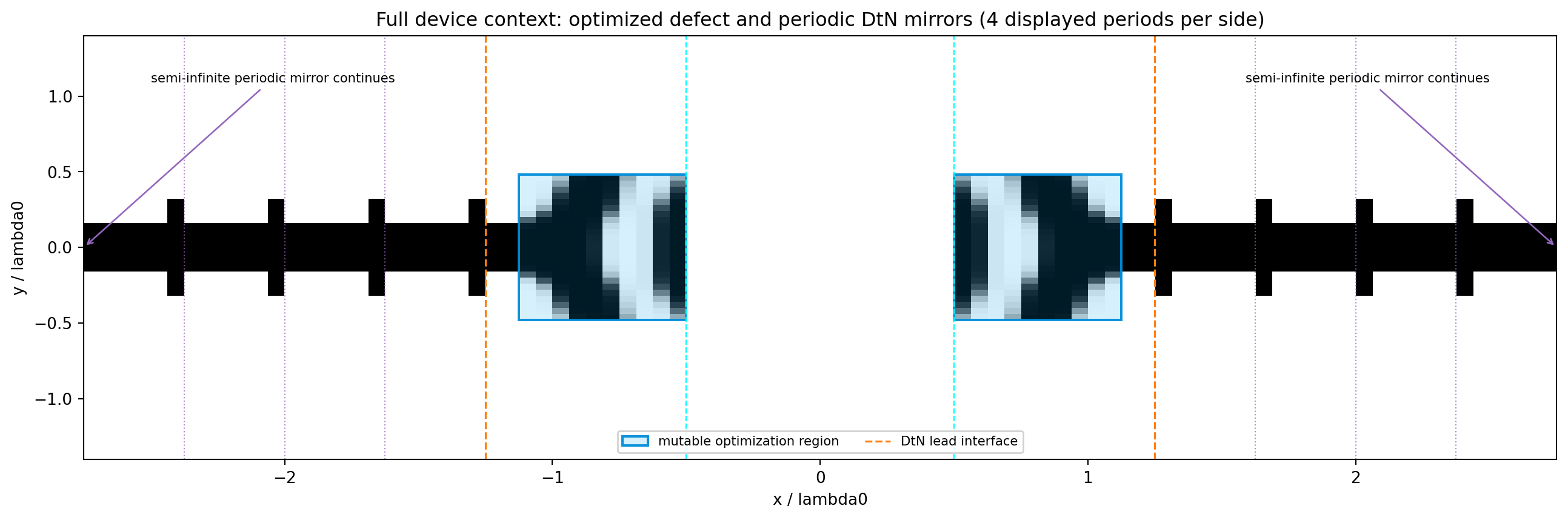
Full device context showing the optimized defect, exact mutable regions, four representative periodic mirror cells per side, and the interfaces where semi-infinite mirrors are eliminated into DtN boundary conditions.
Persistent full-vector 780 nm atom-coupling optimization
Latest exact 81-point, seven-probe target-window Q diagnostic for the current retained topology.

Reproducibility artifacts

Reports, raw metrics, configurations, checkpoints, and validation data retained for this attempt.

status.jsonfullvector_atom_780_production_refined.jsonmetrics.json2026-08-17-production-optimization.md
← All runsRejected interpretations