2.5D LDOS cavity optimizerhoodlab · 780 nm

Radiation-aware topology discovery · full-vector continuation

A cavity optimizer with an evidence trail.

Free-form in-plane design for a 780 nm nanophotonic air-strip cavity. The fast 2.5D model discovers topology; independent basis and 3D Maxwell checks decide what survives.

checkpointed production atom optimization updated 2026-08-18T22:51:15.573063+00:00

Persistent full-vector 780 nm atom-coupling optimization

topology trial rejected by an acceptance gate

Centered-emitter LDOS
1494.465 → 2075.734
cumulative gain +38.895% at exactly 780 nm
Retained topology steps
37
currently working on iteration 38
Last validated Q
No pole
iteration 30 · no physical lower-half-plane pole in 0.995--1.005
Q validation cadence
Every 10 steps
next scheduled at iteration 40 · 81 frequencies, seven probes
Current checkpoint status
PROVISIONAL
current checkpoint provisional
Live solver stage
iteration 38
evaluating 780 nm topology trial
Adaptive trust step
0.00050
requested 0.03200 · accepted 0.03200 · next 0.03200 · model ratio 0.475
Full-vector symmetry basis
235,200 → 29,499
component-correct x/y/z sector
Protected air density
0.000e+00
required exactly zero
Same-basis field overlap
0.99998411
reacquired after each topology proposal

The last retained checkpoint is preserved; no rejected topology was promoted.

Accepted full-vector linewidth step
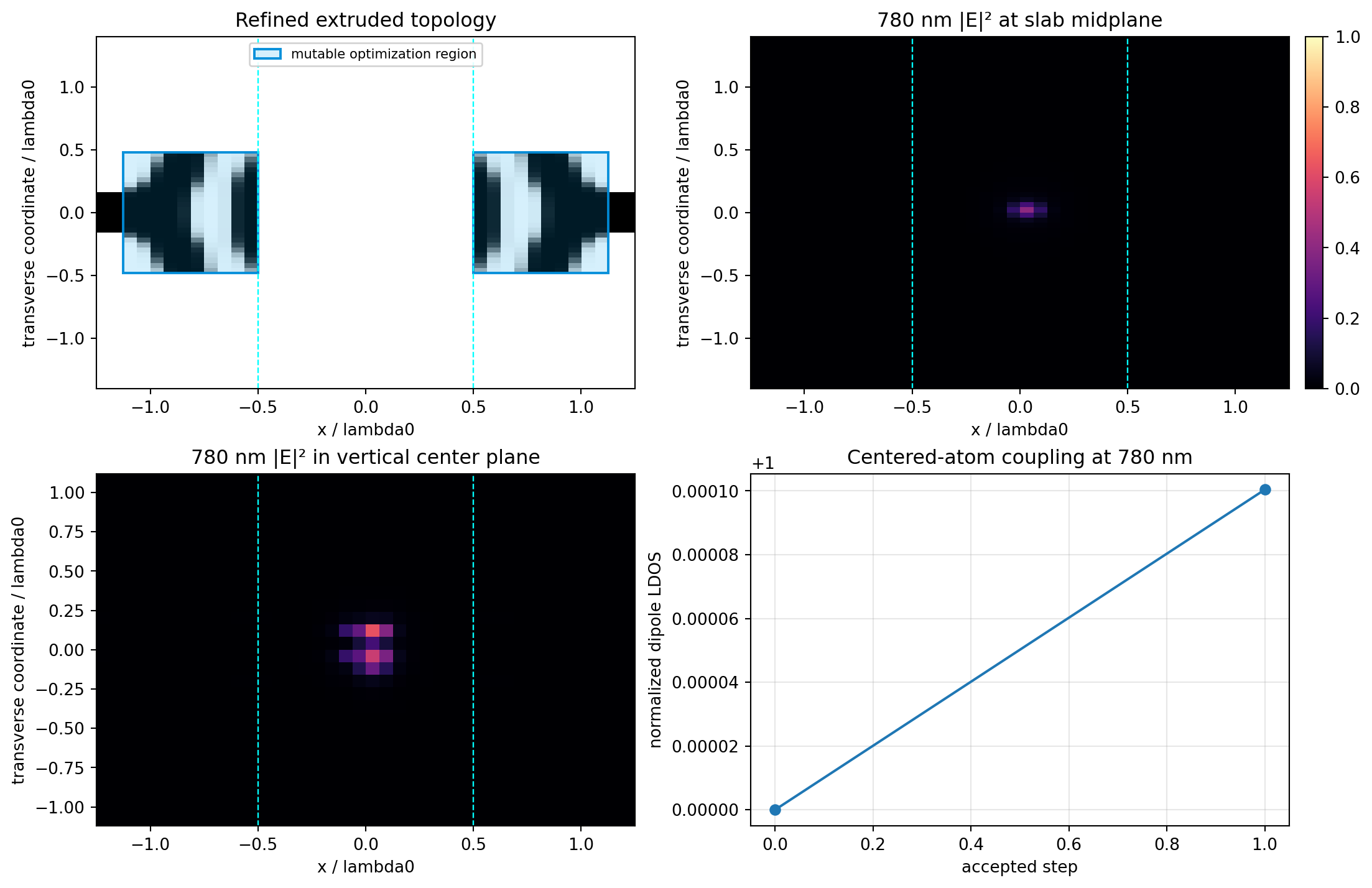
Latest retained topology, 780 nm field energy, and cumulative centered-emitter coupling trajectory.

What is established

Results, ordered by strength of evidence

Full production optimization is active

Iteration 38 is running on the qualified 40 × 70 × 28 grid. 37 topology steps have passed every direct gate; only scheduled checkpoints receive full Q validation.

01

Atom response is the objective

The centered-emitter LDOS has moved from 1494.465 to 2075.734 at exactly 780 nm. Q remains an independent diagnostic.

02

Topology updates are fail-closed

Every proposal must improve coupling, preserve same-basis field identity and localization, and keep the one-wavelength protected gap exactly empty.

03

Q is reacquired every tenth step

The last validated checkpoint is iteration 30; the next scheduled sweep is iteration 40. Intervening checkpoints are provisional, and a newly visible pole triggers backfill and nonlinear mode reacquisition before Q is assigned.

Claim boundary. This is a live fixed-frequency atom-coupling search. A larger driven response is not yet a resonant-cavity, Purcell-factor, useful-port beta, tweezer-scattering, fabrication, or device claim.

Attempt archive

Every retained and rejected campaign

2026-08-17 · Symmetry-reduced, grid/domain-converged fixed-frequency launch gates

780 nm production qualification

All five launch gates pass for the fixed-frequency 780 nm atom-coupling optimizer. Component-correct parity cuts the production system from 235,200 physical unknowns to 29,499, grid/domain changes are 0.36%/1.19%, and an exact-grid trial improves coupling. The exact production-grid Q diagnostic reports no pole in the target window.

accepted Open record →
2026-08-16 · Exact reduced-basis equivalence and derivative validation

2.5D parity qualification

The symmetric scalar Fourier/FEM atom solve was restricted to its exact even x/y/z sector, reducing the launch basis from 1,701 to 275 unknowns while preserving response, field, and gradient to roundoff.

accepted Open record →
2026-08-15 · Radiation-aware 2.5D driven response; pole gates pending

780 nm atom proposal

The optimizer directly increased the centered-emitter Green-response proxy at exactly 780 nm on a 76 x 40 topology grid with sixteen cells across the protected gap.

proposal Open record →
2026-08-15 · Refined-grid attempt; no Maxwell field returned

780 nm vector blocker

A 40 x 20 x 20 full-vector profile fixed the z-extrusion and geometry resolution, but the propagating semi-infinite lead did not return an initial 780 nm field within 30 minutes.

blocked Open record →
2026-08-15 · 2.5D acceptance attempt; no residual returned

780 nm mode blocker

The direct objective was coupled to strict nonlinear residual, mode identity, localization, and frequency-window gates, but pole reacquisition did not return within the 80-minute cutoff.

blocked Open record →
2026-08-15 · Controlled-grid full-vector

Linewidth step 001

A differentiable topology step improved the directly resolved Fano linewidth Q and passed all 15 physical and spectral gates, including fresh interleaved-frequency validation.

accepted Open record →
2026-08-15 · Controlled-grid full-vector diagnostic

Upper-pole diagnostic

The rational shared-pole estimate and real-axis linewidth estimate disagreed, so the optimizer stopped before attempting a topology update.

rejected Open record →
2026-08-15 · 3D candidate; pole gate not accepted

Paired 3D transfer

Initial and optimized 2.5D densities were fitted independently to the same 3D topology map and their vector modes were reacquired on a common Yee grid.

qualified Open record →
2026-08-15 · Basis-stable 2.5D candidate

Cross-basis validation

The initial and optimized modes were reacquired from scratch on a 3,025-unknown basis, preserving field identity and the Q improvement.

accepted Open record →
2026-08-15 · Reduced-model optimization

Scalar 2.5D run

Four accepted trust-region steps more than doubled the tracked scalar Q while preserving localization, mode identity, the protected air strip, and reflection symmetry.
accepted Open record →