Comparing the 2D LDOS approaches
This page is the scorecard for every 2D campaign that led to the 3D slab-gap optimizer. Numbers are verified rebuilds unless noted: ε is reconstructed from the saved density p, the source-coupled eigenmode is re-picked, and LDOS is re-evaluated at Re ω*. Dark / PML modes with huge fake Q are discarded.
Length unit is λ₀. The 2D slot uses λ₀ = 1 μm, so a 1 μm vacuum gap is
| x | < 0.5. Silicon nitride is ε = 4 (n = 2). Filter + SSP and |
|---|
erosion / dilation (when used) are the same machinery throughout.
What actually worked
| Approach | Best run | LDOS/vac | Q | Geometry | Verdict | ||||||
|---|---|---|---|---|---|---|---|---|---|---|---|
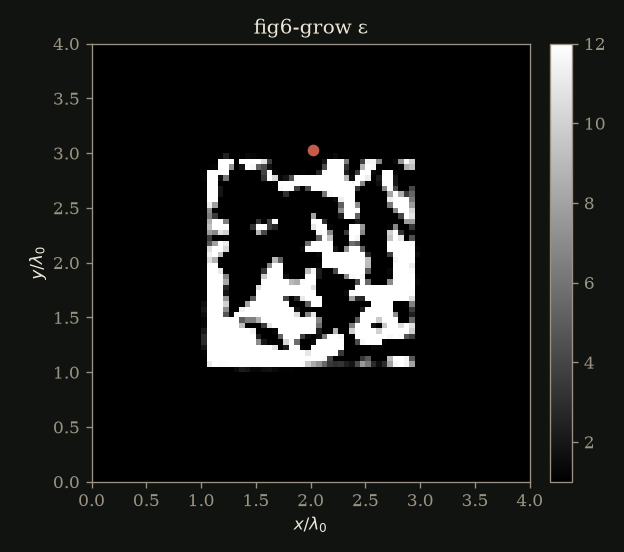
| Fig. 6, successive enlarge | fig6-grow | 500 | 7.40×10⁴ | 2λ Si-like (ε=12), source above the block | Paper target hit. Not a slot. | ||||||
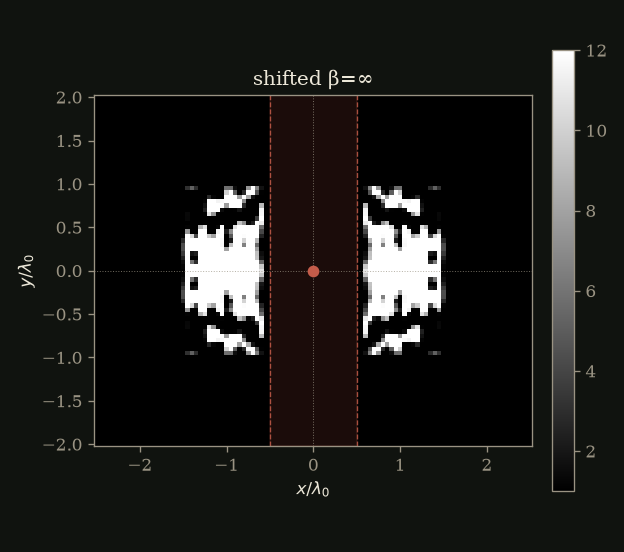
| Compact slot, 4-fold | gap-sym | 1155 | 5.11×10⁴ | \ | x\ | <0.5 vacuum, design to \ | x\ | ≤1.5, \ | y\ | ≤1 | First slot cavity. Works. Unregularized. |
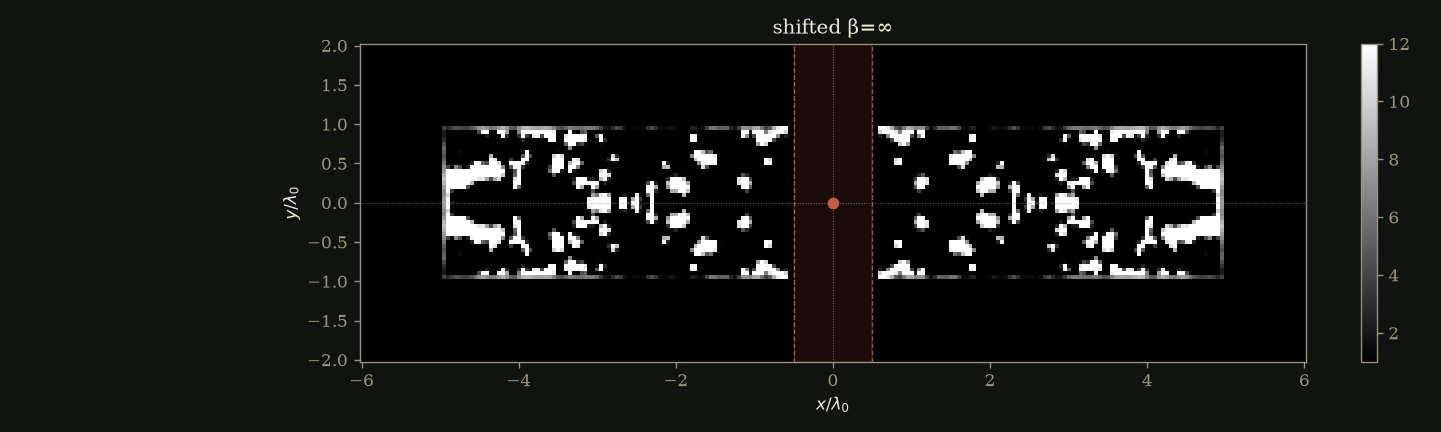
| Wide slot, no fab | gap-wide | 2.02×10⁶ | 5.25×10⁷ | \ | x\ | ≤5, \ | y\ | ≤1 | Highest raw Q. Speckle (82 islands). Not fabricable. | ||
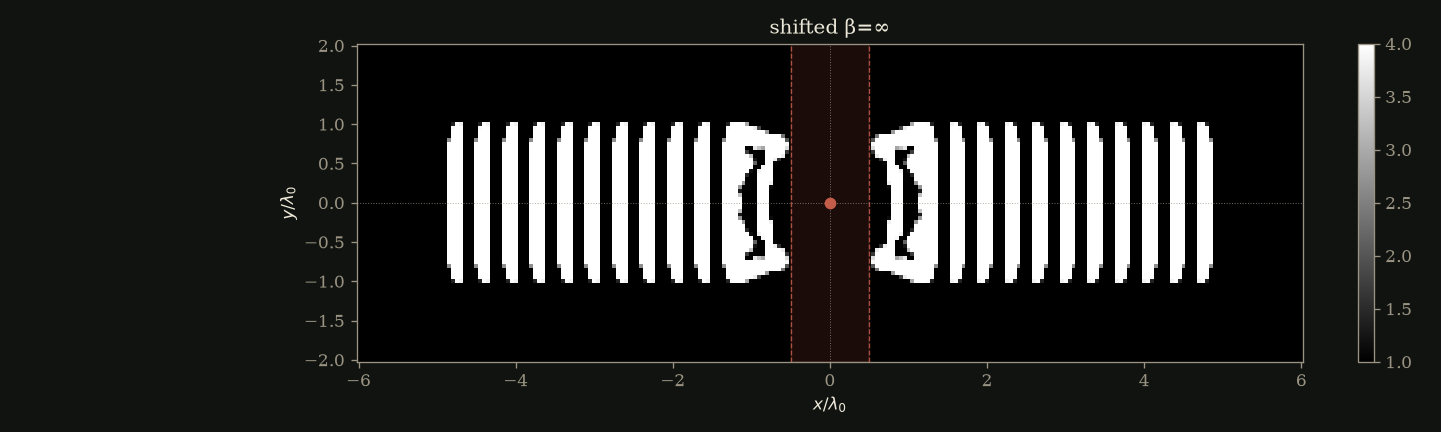
| Erosion/dilation bake-off | fab-r15 | 1895 | 6.16×10⁴ | same wide cell, R=0.15, λ=3 | Only setting that moved the geometry. R=0.1 froze p. | ||||||
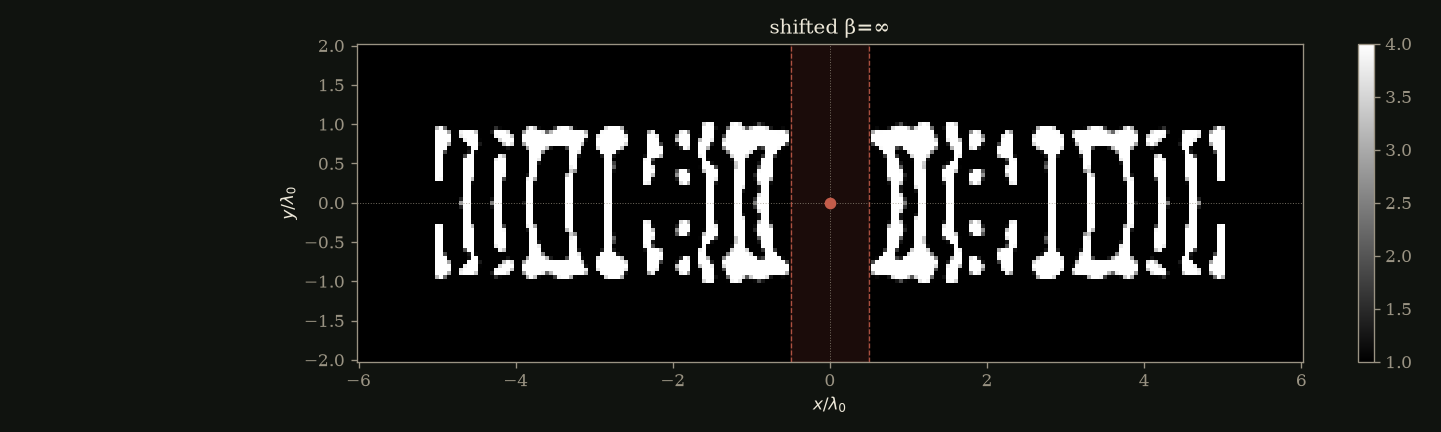
| SiN slow enlarge | sin-slow-s4 | 1.29×10⁵ | 9.93×10⁵ | SiN, ΔL=0.25λ, outer-period tile, \ | x\ | ≤5 | Q grew with size. Still not a clean crystal. | ||||
| Hard-tied crystal (track A) | phc-A-a35 | 5333 | 9.51×10⁴ | a=0.35, defect + tiled slats, A-a35 fab | Regular, analytic-looking, fabricable *intent*. Template for 3D. | ||||||
| Soft periodicity (track B) | phc-B-s4-a35 | 1.39×10⁵ | 1.07×10⁶ | penalty ⟨(ρ(x)−ρ(x−a))²⟩ on s4 | Keeps s4's Q; does not clean the geometry. | ||||||
| Frozen-inner enlarge (C) | phc-C-s1 | 7.26×10⁴ | 5.46×10⁵ | freeze the cavity, grow the ring | Works as a grower, not a regularizer. | ||||||
| Hole lattice (D) | phc-D-a45 | 28 | 1.35×10³ | 2D holes, assembled crystal | Weak. Did not form a useful defect mode. | ||||||
| Contrast homotopy (E) | phc-E-d10 | 2.3 | 107 | n=1.5±δ, then raise contrast | Orderly only at tiny Δn; evaporated at n=1/2. | ||||||
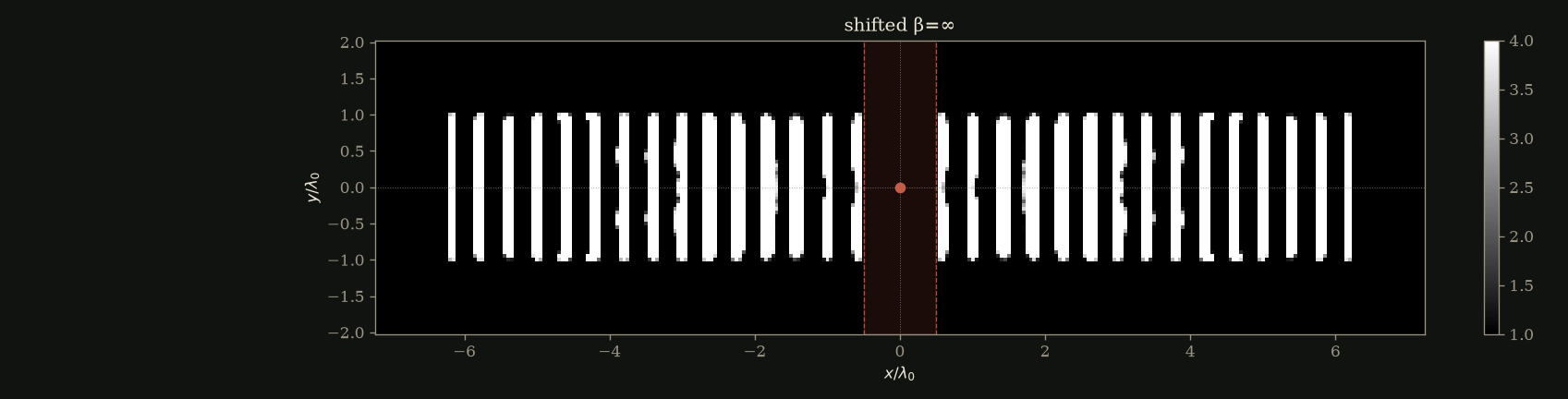
| Bragg slat enlarge | phc-slat-s3 | 996 | 8.95×10⁵ | 1D slats, \ | x\ | ≤6.2 | Cleanest proof that Q scales with mirror count. |
A-a35 and slat-s3 are the two designs that look like something you would draw on purpose. A-a35 is the one we copy into 3D: same filter, same erosion / dilation, same hard-tied period.
Campaign by campaign
1. Fig. 6 reproduction (Shaker et al.)
2D Ez Helmholtz, reciprocal SC-PML, unshifted then shifted max log LDOS. Design 1.5λ × 1.5λ, ε ∈ [1, 12], R = 0.1λ, SSP. Success bar from the paper: LDOS/vac ≥ 500 and Q ≥ 50,000.
The 1.5λ cell reached LDOS/vac = 544 at Q = 3.42×10⁴ (not quite the Q bar). Successive enlargement to 2λ (fig6-grow) hit both: 500.2 and 7.40×10⁴, independently rebuilt on 0.5λ and 0.75λ PML, Lorentzian peak on Re ω*, PML energy < 0.1%.
Lesson: the solver is correct. Enlargement works if you do not destroy the resonance.
2. Slot-gap, 4-fold symmetry
Dipole at the origin. Vacuum strip |x| < 0.5 for all y. Design only outside. Density lives in the first quadrant and is mirrored through x = 0 and y = 0.
- Compact (gap-sym): LDOS/vac = 1155, Q = 5.11×10⁴.
Gap |ε−1| = 0, 4-fold residual ~ 10⁻¹³.
- Wide (gap-wide): LDOS/vac ~ 2×10⁶, Q ~ 5×10⁷.
82 solid pieces, 12 islands smaller than 4 px. A demonstration that unconstrained TO will take every speckle it can.
Lesson: symmetry and a frozen gap are cheap constraints that the optimizer respects exactly. They do not buy fabricability.
3. Erosion / dilation bake-off
Penalty P = ⟨(ρ_dilate − ρ_erode)²⟩ + 4w ⟨ρ_f(1−ρ_f)⟩ at η = 0.5 ± Δη. Physics at β = ∞; the penalty uses a finite morphological β so it still has a gradient.
| Arm | R | λ | Result |
|---|---|---|---|
| fab-l1 / l3 / l10 | 0.1 | 1, 3, 10 | p frozen. Filtered density sat at ~0.5. Penalty gradient too small against the high-Q basin. |
| fab-r15 | 0.15 | 3 | Islands 82 → 26. LDOS/vac = 1895, Q = 6.2×10⁴. Winner. |
| opened-init from speckle | 0.15 | 3 | Killed the cavity. |
Lesson: the conic filter alone is not a length-scale constraint. At high Q you need a penalty that can actually move p (larger R, and/or a grayness term). Opening a speckle field as the start destroys the resonance.
SiN designs later sat at ~0.08λ minimum width (1.6 px at 20/λ) — that is the grid floor, not a comfortable λ/10.
4. SiN λ/10 and slow successive enlargement
Same slot, ε = 4, R = λ/10. Phase 1 varied seeds and Δη. No arm fully cleared λ/10. Winner of that bake-off was a gray start with Δη = 0.25.
Phase 2 grew that cell. Two tiling rules:
- from-gap (wrong): the new ring copies the cavity defect. Q
collapsed on 0.5λ jumps.
- outer-period (right): the new ring repeats the outermost period
of the previous design. Combined with ΔL = 0.25λ / ~400 steps, Q went 7.3×10⁴ → 1.2×10⁵ → 4.9×10⁵ → 9.9×10⁵ at |x| ≤ 5 (sin-slow-s4, LDOS/vac = 1.29×10⁵).
Lesson: enlarge slowly, and tile the mirror, not the defect.
5. Photonic-crystal campaign
The s4 geometry is a good cavity and a bad drawing. Five tracks tried to force a crystal around the slot.
A — hard-tied unit cell. Mirror |x| ≥ defect_xmax shares one period of parameters. Seed: s4 defect + assembled slats.
- a = 0.35: LDOS/vac = 5333, Q = 9.51×10⁴. Defect + Bragg slats.
This is the fabricable / regular template.
- a = 0.40, 0.45: weaker (the period is off the stop-band).
B — periodicity penalty. Soft ⟨(ρ(x)−ρ(x−a))²⟩ on top of s4. LDOS/Q stay huge (~1.4×10⁵ / 10⁶) because the design barely changes. A free periodic slat seed (B-slat) is much cleaner and much lower LDOS until you enlarge it.
C — freeze the inner cavity, grow the ring. A valid enlargement strategy. Does not create periodicity by itself.
D — hole lattice, assembled. Never found a strong source-coupled mode. Abandoned.
E — contrast homotopy. Start at n = 1.45 / 1.55 on a large domain, optimize, raise Δn. The first stages were only weakly ordered; at n = 1 / 2 the order evaporated. Track dropped.
Slat enlarge (the useful B-slat continuation):
| Stage | \ | x\ | max | LDOS/vac | Q |
|---|---|---|---|---|---|
| B-slat-a40 | 5.0 | 72 | 6.61×10⁴ | ||
| slat-s1 | 5.4 | 234 | 2.13×10⁵ | ||
| slat-s2 | 5.8 | 608 | 5.47×10⁵ | ||
| slat-s3 | 6.2 | 996 | 8.95×10⁵ |
Q scales with the number of Bragg pairs on a geometry you can read by eye. That is the 1D-crystal existence proof.
Principles we are keeping
These are the constraints the 3D optimizer is built to obey.
1. Reciprocal (complex-symmetric) FDFD and vacuum-normalized discrete LDOS −Im[e†b]. Report ratios, not raw Im G. 2. Unshifted, then shifted max log LDOS(Re ω*), with Re ω* ≥ ω₀. Appendix A adjoints. No extra Maxwell solve beyond the LDOS solve and one shift-invert factorization. 3. Source-coupled eigensolve. “Nearest to ω₀” latches onto dark and PML modes with fake Q. Score candidates by |e| at the dipole. 4. Exact symmetries, not a penalty. 2D: 4-fold in xy. 3D: octant (PMC / PMC / PEC) for a z-dipole. 5. Frozen vacuum gap. Design cells are not allowed to enter |x| < 0.5. 6. Filter + SSP, then erosion / dilation + grayness at finite β_morph. A-a35 numbers: R = 0.1λ, λ_fab = 3, Δη = 0.25, w_gray = 1, β_morph = 8. 7. Hard-tied crystal (track A) when we want a geometry a human would draw. Soft periodicity keeps Q and keeps the mess. 8. Enlarge the mirror, not the defect. Outer-period tile, small ΔL. 9. Rebuild from p before believing Q. Every number on this page was re-picked that way.
What we are not taking into 3D
- Unregularized wide-slot speckle (gap-wide). Impressive LDOS, useless object.
- Opened-init from a speckle field.
- Fast 0.5λ enlargement that copies the defect.
- Contrast homotopy as a path to a crystal (failed at useful Δn).
- Hole-lattice seeds without a working 2D existence proof.
3D problem this comparison is aiming at
A constrained slab version of the same slot:
- z-dipole at the origin, 1 μm gap (|x| < 0.5 λ₀)
- Si₃N₄ domains on either side, thickness 0.15/0.78 λ₀, ε = 4
(the first 3D attempt at 3/7.8 λ₀ asymptoted at LDOS/vac ≈ 1.54, Q ≈ 30)
- 2.5D (extruded) design so the result is lithographically fabricable
- octant symmetries, A-a35 fab, hard-tied a = 0.35 if the octant fits
- SuperLU on one 61 GB workstation; the grid is sized to the fill-in
The 3D run lives on the live dashboard and under 3D. It succeeds when LDOS/vac rises enough, under these constraints, to show the 3D optimizer is doing the same job as the 2D one — ideally on a high-Q, erosion-dilation-robust, crystal-like slab.
Geometries