Source
engines/atom_fishbone_coupler/notes/2026-07-28_atom_accessible_cavity_campaign.md · assembled 2026-07-29 15:57 UTC.
2026-07-28 — Atom-accessible fishbone cavity campaign
Read this first
Urgent geometry-semantics erratum — 2026-07-29
The saved canonical connected-profile MPB model did not represent the declared 0.75 µm slot. Its polygon was positioned using a Shapely area centroid, while MPB's prism handling recenters the polygon using the arithmetic mean of its vertices. Because the smooth outline is sampled nonuniformly, those centers differ. The MPB run declared a 0.75 µm full slot, but its printed/effective full slot is only approximately 0.07492 µm.
This invalidates every old canonical connected-profile MPB interpretation as a claim about the finite 0.75 µm-slot FDTD geometry. The corrected local results are documented separately below and do not rehabilitate any of these old values. Do not use:
- the connected-MPB atom-overlap metrics near 0.974–1.0;
- the connected-MPB mirror
γ,γ×M, mirror-gap, light-line-margin, or taper transfer as properties of the FDTD cross-section; - the connected-MPB field plots or the claim that the canonical MPB and FDTD transverse geometries matched.
The historical MPB files remain published as an audit trail; they are not deleted or silently rewritten. The serialized Tidy3D geometries are separate and preserve their explicit two-PolySlab 0.75 µm open slot. Therefore the FDTD Auto-20/22/24 and expanded-domain/PML convergence result, and the exact-pole v2 negative-overlap result, remain valid for the actual FDTD geometry. What is withdrawn is the MPB explanation and design-transfer claim, not the measured FDTD outcome. No new paid run has been started for this erratum.
Machine-readable centroid-semantics erratum
Corrected-semantics redesign — local MPB lead, paid FDTD failures
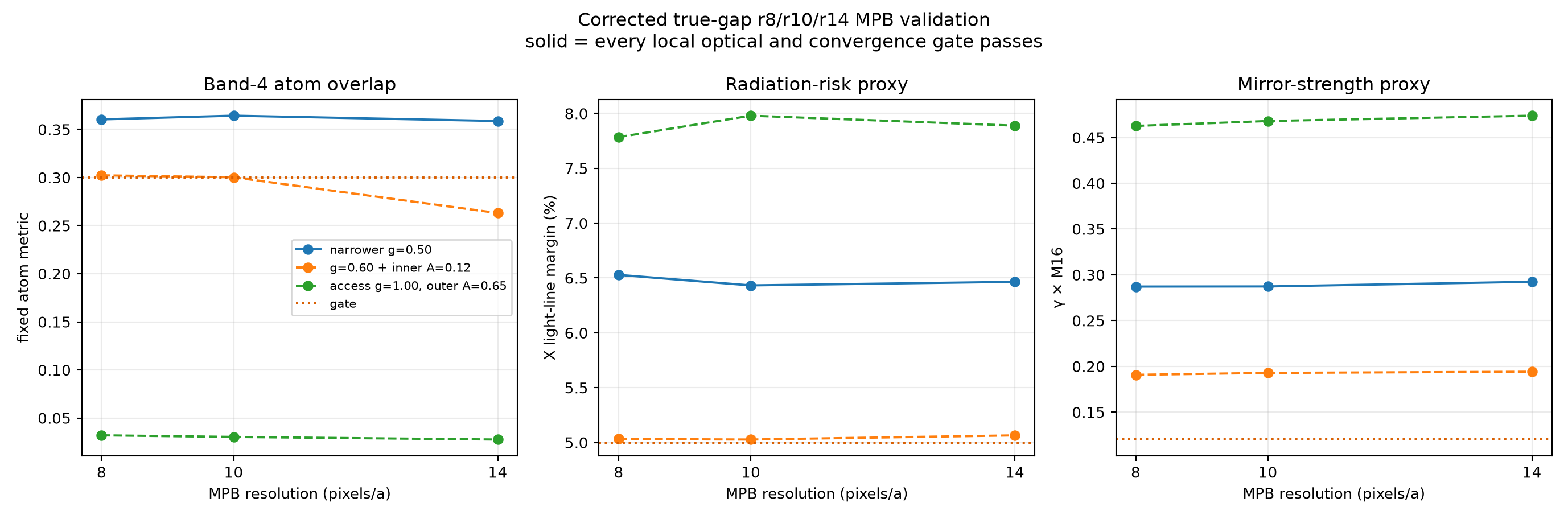
Evidence label: completed local MPB screen and separated r8/r10/r14 validation; zero cloud actions and 0 FC. These are unit-cell field, light-line, and mirror-strength proxies. They are not finite-cavity Q, mode volume, tweezer scattering, heating, or atom-cavity coupling.
The geometry fix is now tested rather than assumed. A zero-inner-modulation
control gives identical bands and identical sampled ε in the canonical and
new profile implementations: maximum band difference 0, maximum ε difference
0, and zero changed voxels at 1e-12. Its declared 0.75 µm full slot prints
as 0.7500014 µm. The corrected control's band-4 atom metric falls from the
invalid old 0.97438 to 0.14822, qualitatively consistent with the independently
saved finite-FDTD value 0.1642 and its large atom-referenced mode volume. This
is the expected consequence of reopening the actual slot, not a loss of a
real old design.
The corrected screen then retained three deliberately different trade
branches. The atom metric in the table is the fixed-phase unit-cell proxy
|Ey(atom)|² / max[ε|E|²], not mode volume, Purcell enhancement, or β. Every
listed printed gap matches its declaration within 5 nm; the actual errors are
below 4 nm and normally much smaller.
| Corrected branch | Guaranteed clear corridor | r8/r10/r14 atom metric | X light-line margin | γ×M16 |
Local verdict |
|---|---|---|---|---|---|
optical overlap, gap050 |
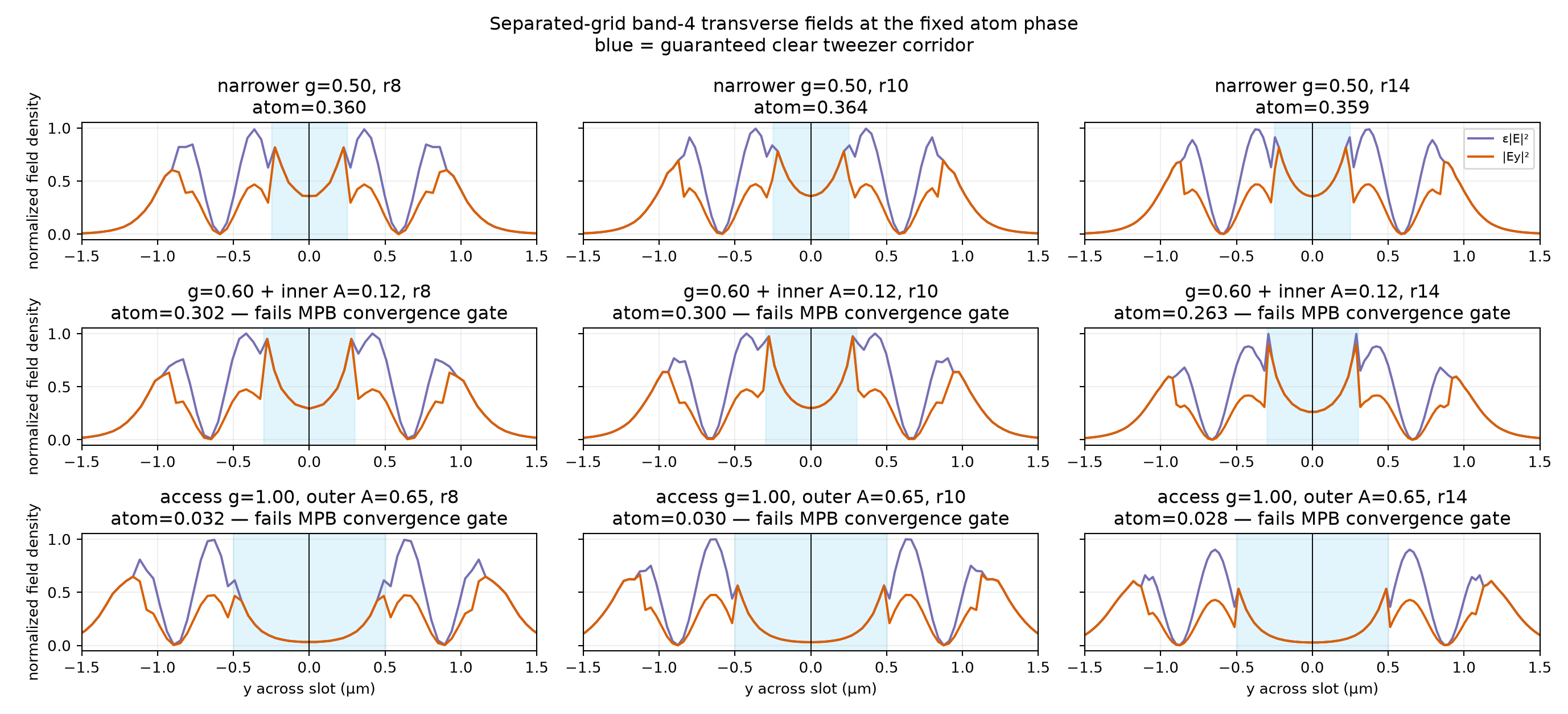
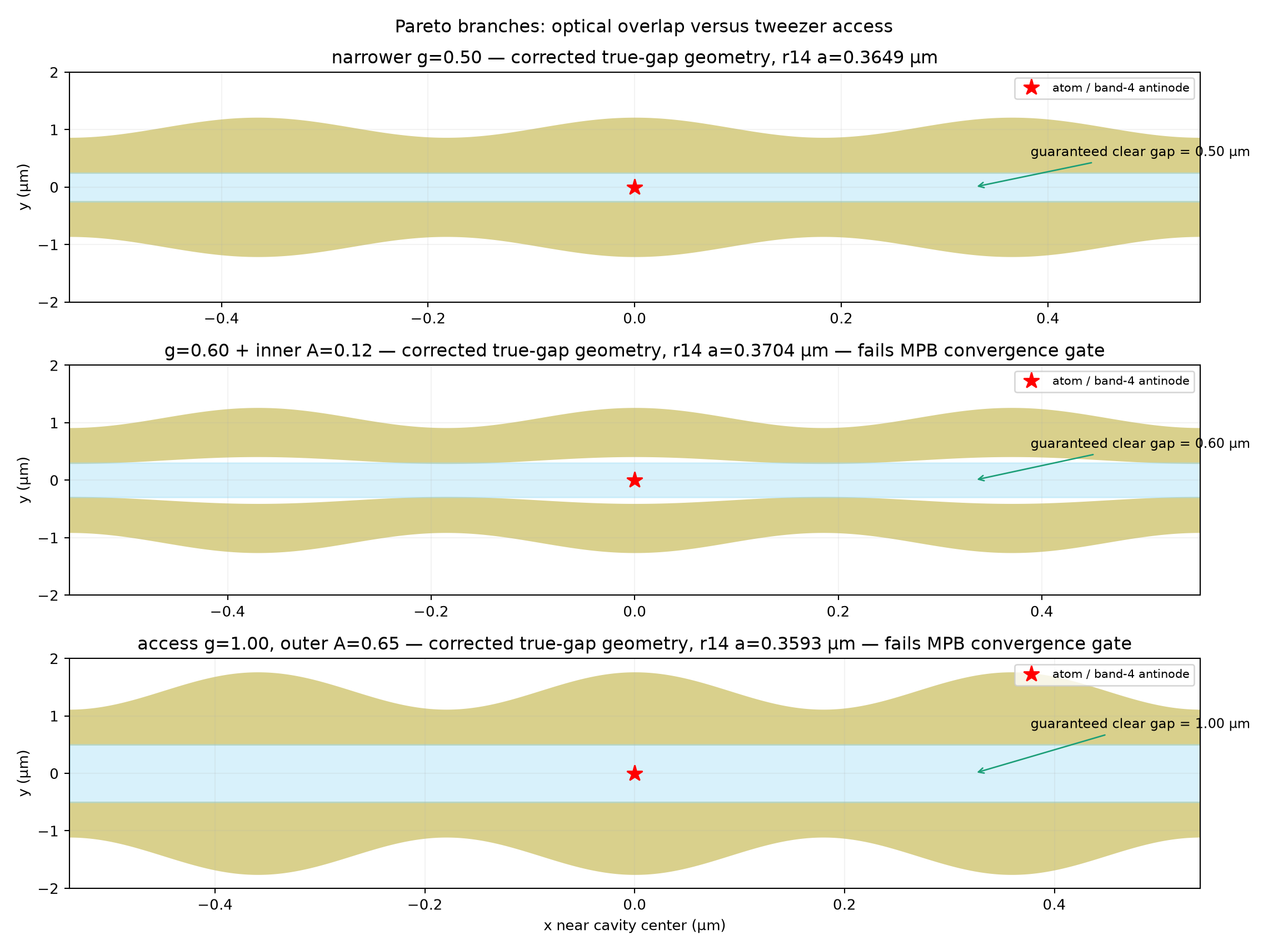
0.50 µm | 0.3604 / 0.3643 / 0.3587; 1.53% span | 6.528 / 6.432 / 6.465% | 0.2871 / 0.2872 / 0.2924 | passes all declared local optical and convergence gates |
modulated inner wall, gap060_inner012 |
0.60 µm minimum; opens to 0.84 µm | 0.3023 / 0.3002 / 0.2630; 13.60% span | 5.032 / 5.027 / 5.065% | 0.1907 / 0.1928 / 0.1941 | fails: r14 atom metric <0.30 and span >10% |
access first, gap100_outer065 |
1.00 µm | 0.0320 / 0.0303 / 0.0276; 14.58% span | 7.784 / 7.979 / 7.889% | 0.4626 / 0.4680 / 0.4738 | fails optical promotion despite strong local mirror/radiation proxies |
For the sole passing gap050 branch, the retuned center periods are
0.364653/0.365024/0.364899 µm at r8/r10/r14. The printed full gaps are
0.5000002/0.5000002/0.4999998 µm. The target field is almost purely Ey at
the fixed atom phase on all three grids. The 0.60 µm branch is rejected rather
than rounded up to a promoted optical pass: its two coarser values sit on the
0.30 gate and the r14 result resolves below it. It is retained only as an
explicit exploratory access/Q diagnostic. Adding mirror cells to the 1.00 µm
branch might alter finite-cavity Q, but cannot repair its failed local
atom-field metric.
Independent mirror curves and finite-cavity handoff
Evidence label: completed local r14 MPB curves and local simulation serialization; zero cloud uploads, estimates, submissions, starts, or FC. Serialization proves what would be run. It is not a Tidy3D result.
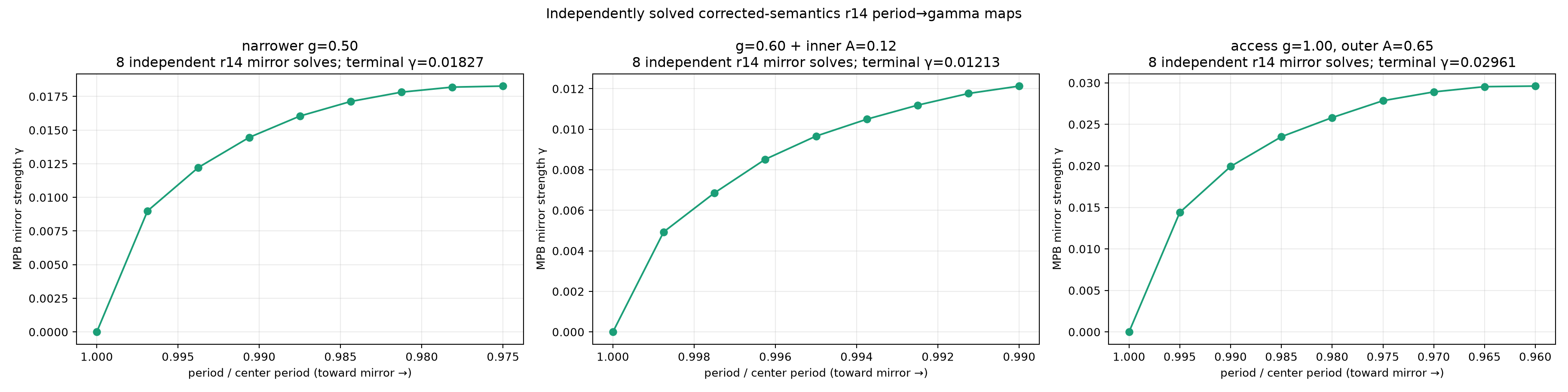
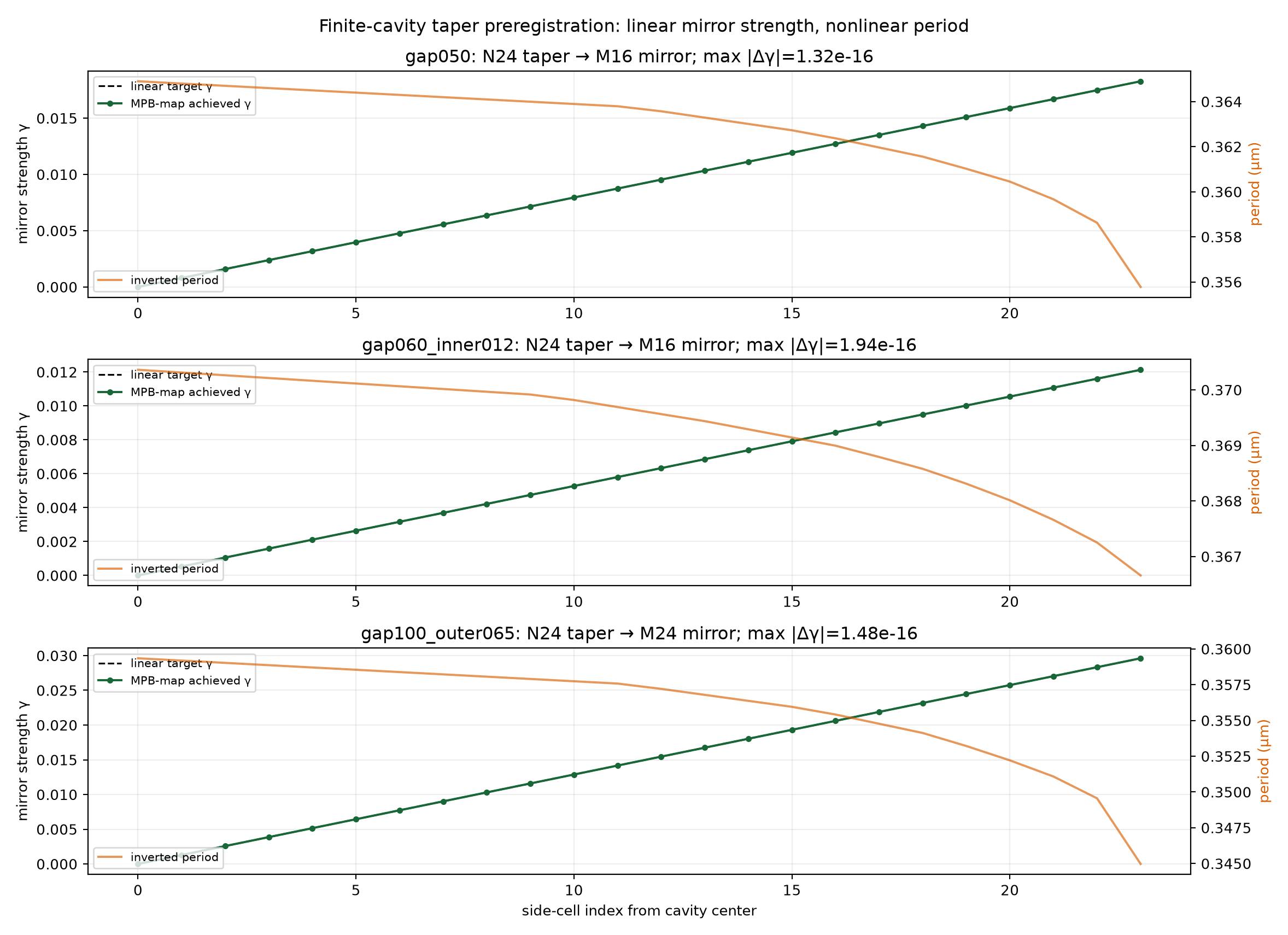
Eight independent r14 mirror solves per branch confirm that γ increases
strictly from the retuned cavity center toward the terminal mirror, with every
noncenter point inside the tracked band-3/band-4 gap. Terminal γ is 0.01827,
0.01213, and 0.02961 for gap050, gap060_inner012, and
gap100_outer065, respectively. These independently solved curves—not a
linear-period assumption—are inverted to make γ increase linearly across
24 taper cells. The prepared terminal mirrors use M16/M16/M24 cells per side.
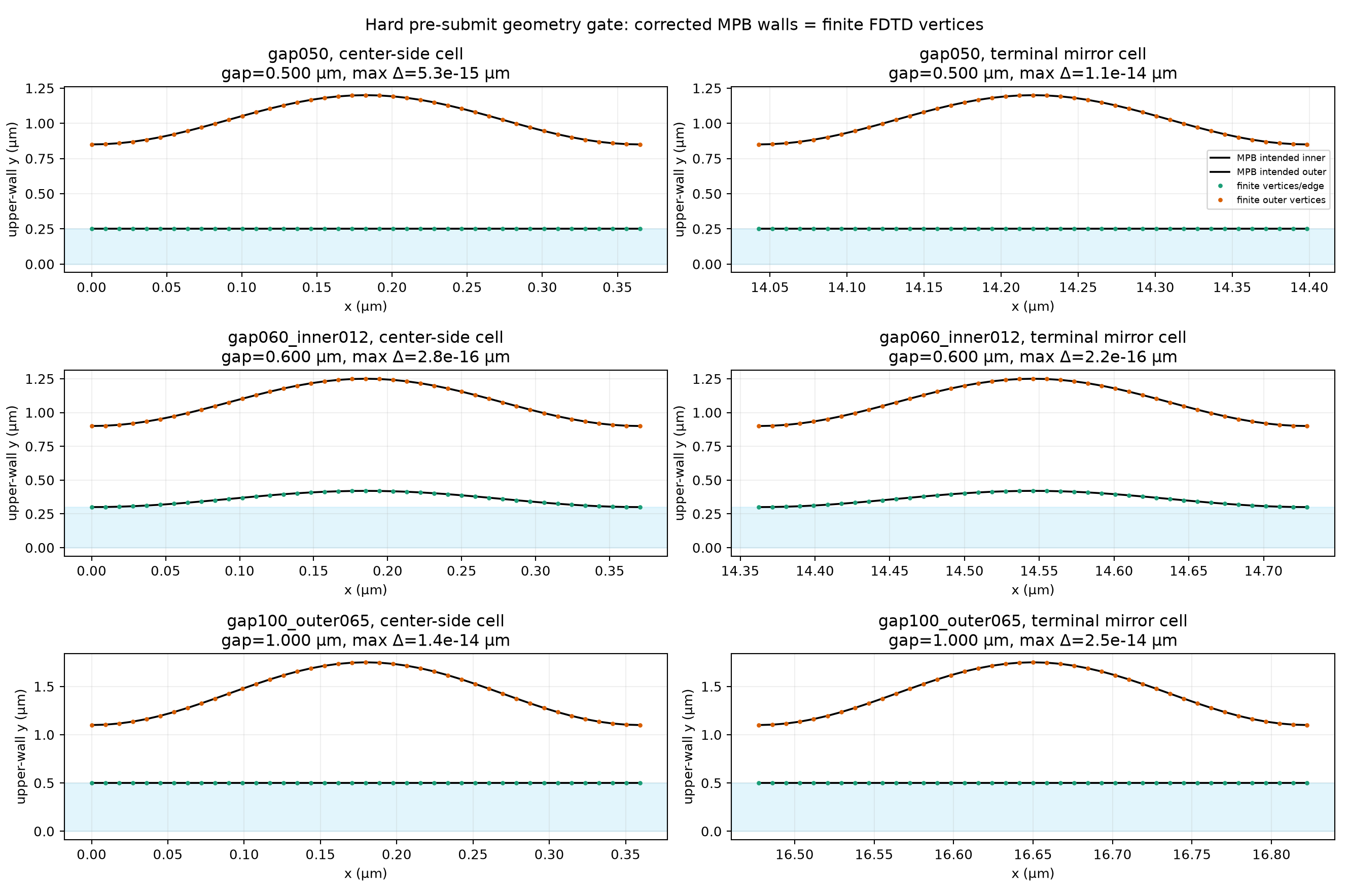
The handoff reproduces the user's requested first-diagnostic policy:
AutoGrid-14, 16 ps maximum time, automatic shutoff 1e-9, and zero mesh
overrides. It also performs a hard MPB-to-FDTD vertex audit. Across all
three full polygons, the maximum coordinate difference is numerically zero;
representative center and terminal cells agree within
2.49×10⁻¹⁴ µm, and their measured minimum slots are exactly 0.50, 0.60, and
1.00 µm at the saved precision.
| Serialized branch | Finite layout | Auto-14 grid | Offline planning envelope | Pre-submit status |
|---|---|---|---|---|
gap050 |
N24 taper + M16 mirror | 830×134×84 = 9.342M | 0.114 FC | passed local gates; paid diagnostic now returns no target-band pole |
gap060_inner012 |
N24 taper + M16 mirror | 848×136×84 = 9.688M | 0.118 FC | local atom-metric convergence failed; exploratory paid diagnostic also returns no target-band pole |
gap100_outer065 |
N24 taper + M24 mirror | 956×160×84 = 12.849M | 0.157 FC | local atom-metric convergence gate failed; access/Q study only |
The cost values are 25%-margin extrapolations from a completed analogous job,
not cloud estimates or charges. The preparer itself authorizes no paid
submission. Safety/protocol eligibility is deliberately separate from
scientific promotion: all three serialized branches pass the hard geometry
and runner-policy checks, while only gap050 passes the local MPB optical
promotion checks. The 0.60 µm diagnostic is the explicitly chosen next
exploratory step despite its failed promotion gate; its result must be
reported as such, not used to rewrite the local failure.
The guarded runner handles only one named branch per invocation. Submission requires a separate task-specific estimate, explicit root approval, no other active ledger task, and a conservative ledger total below the 25 FC cap. It never advances to another branch automatically. A successful first diagnostic would still require separated-mesh convergence before an Auto-22 exact two-window mode-volume/flux calculation.
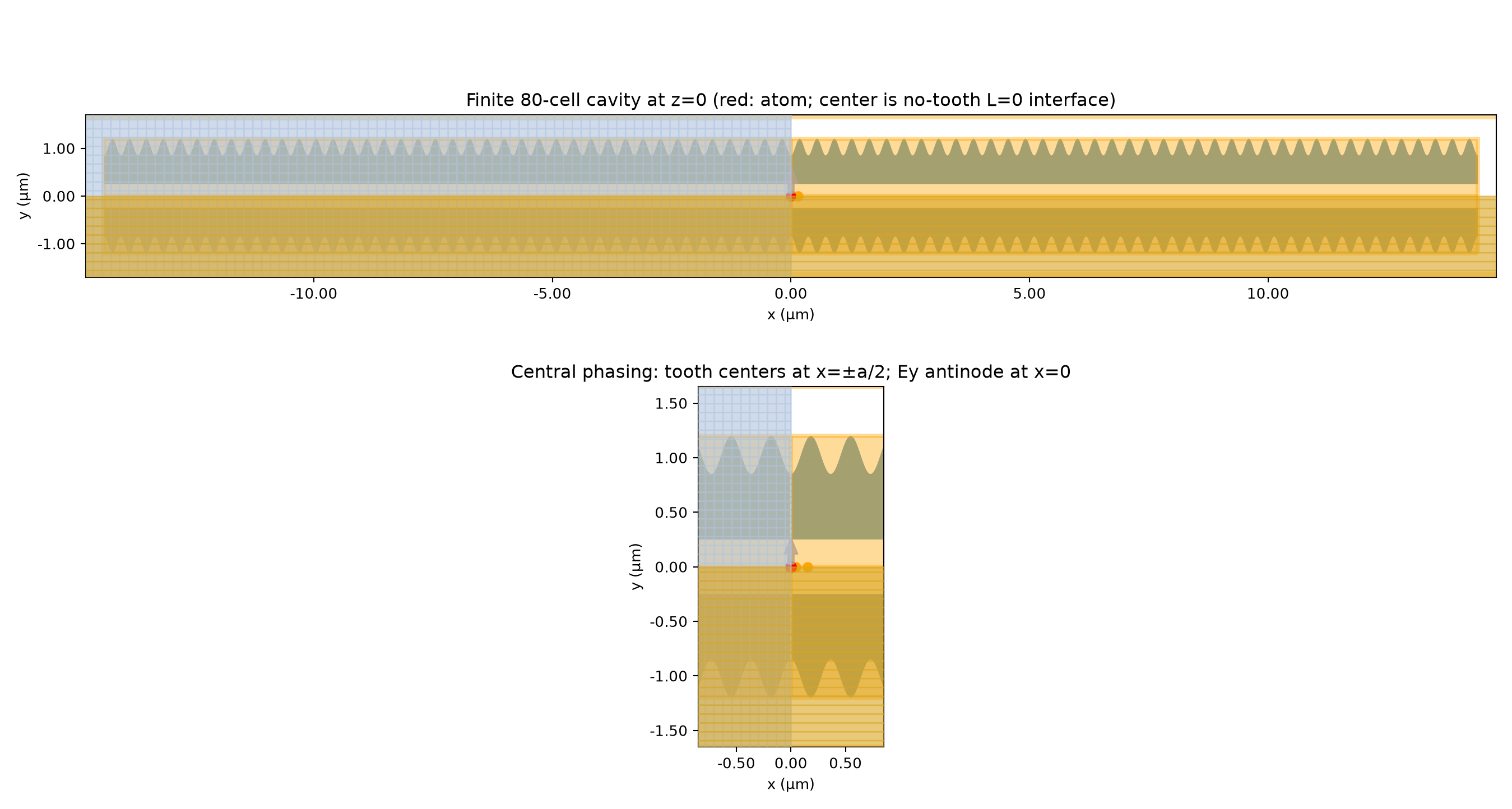
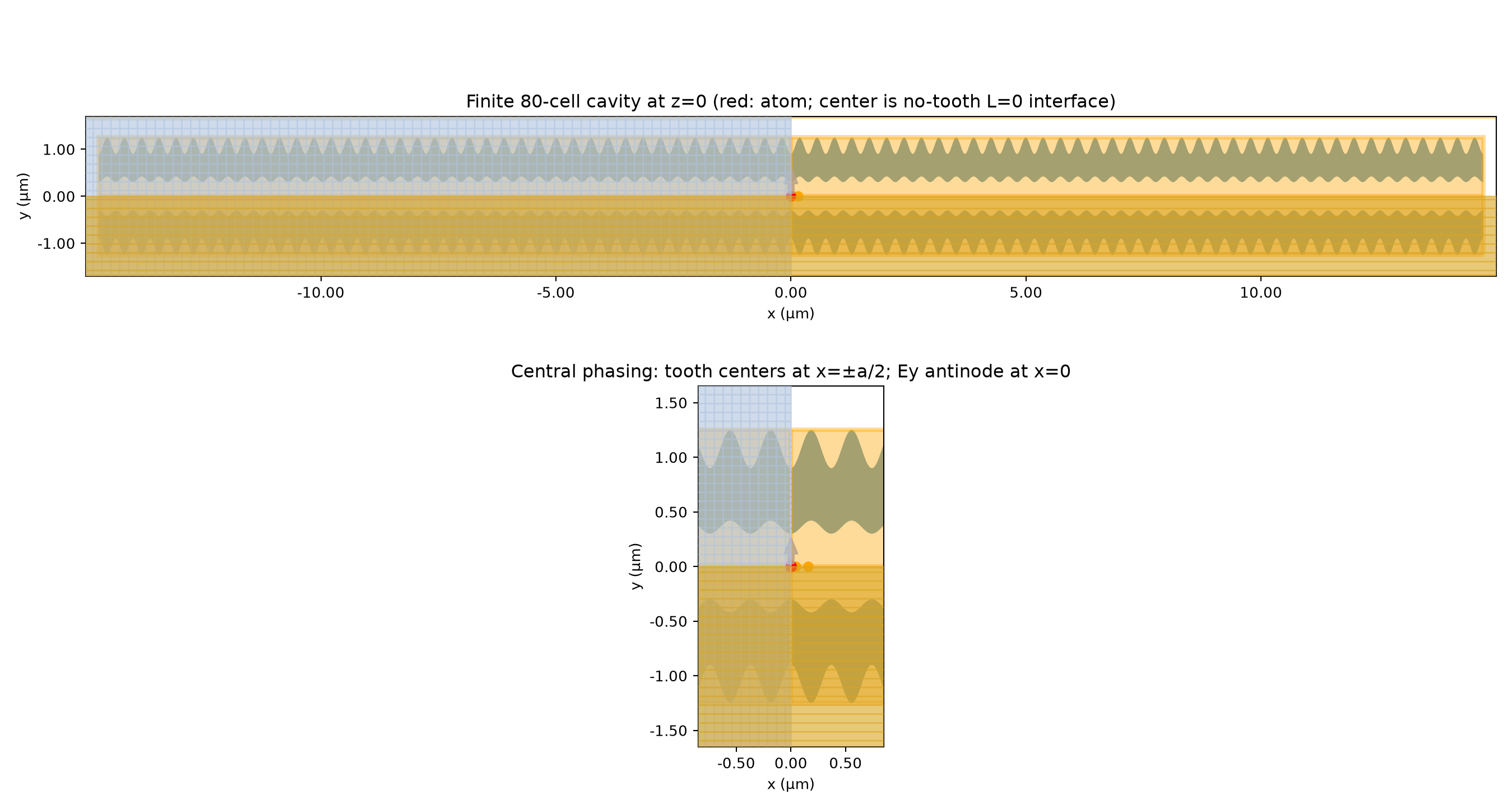
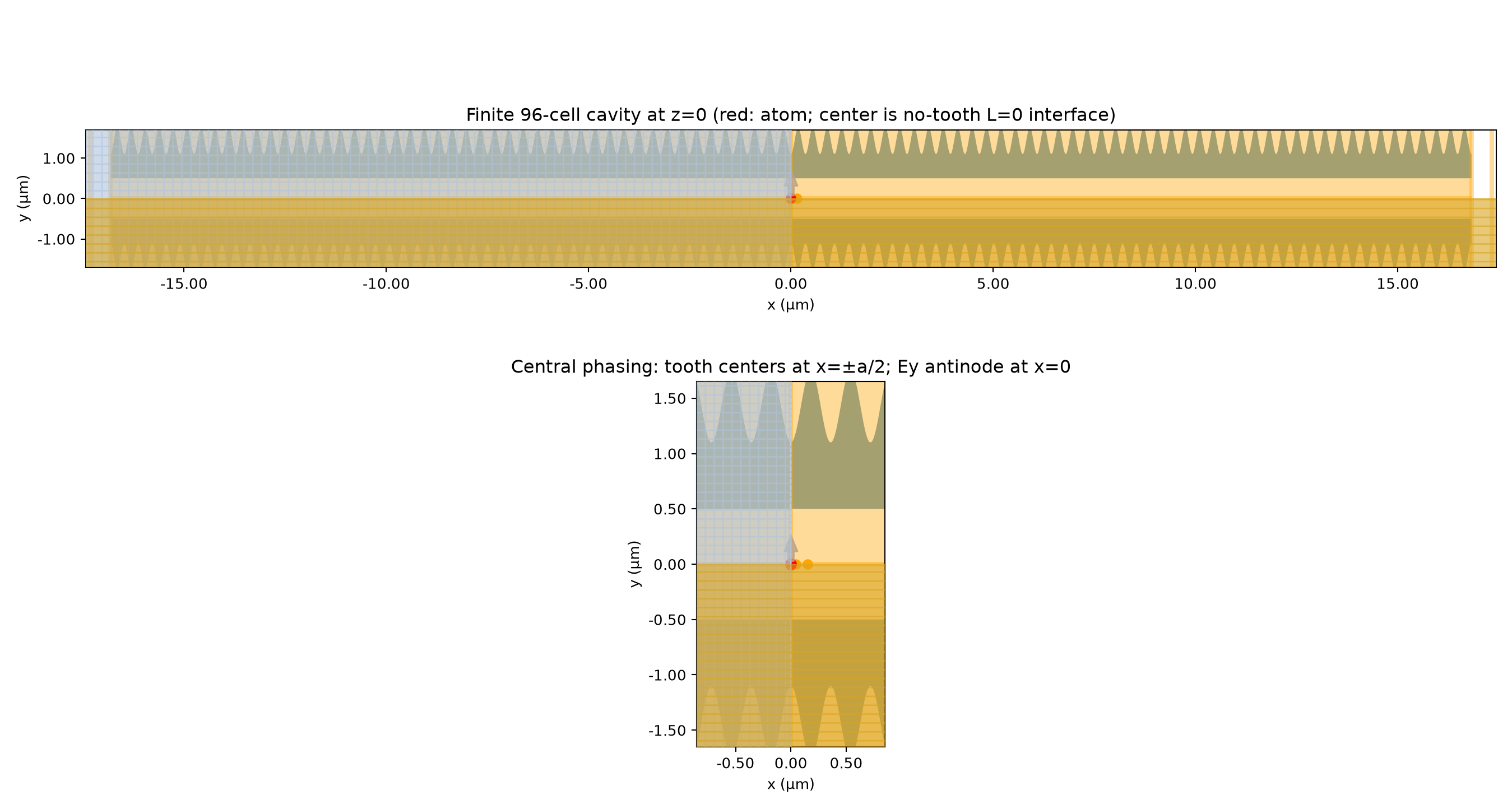
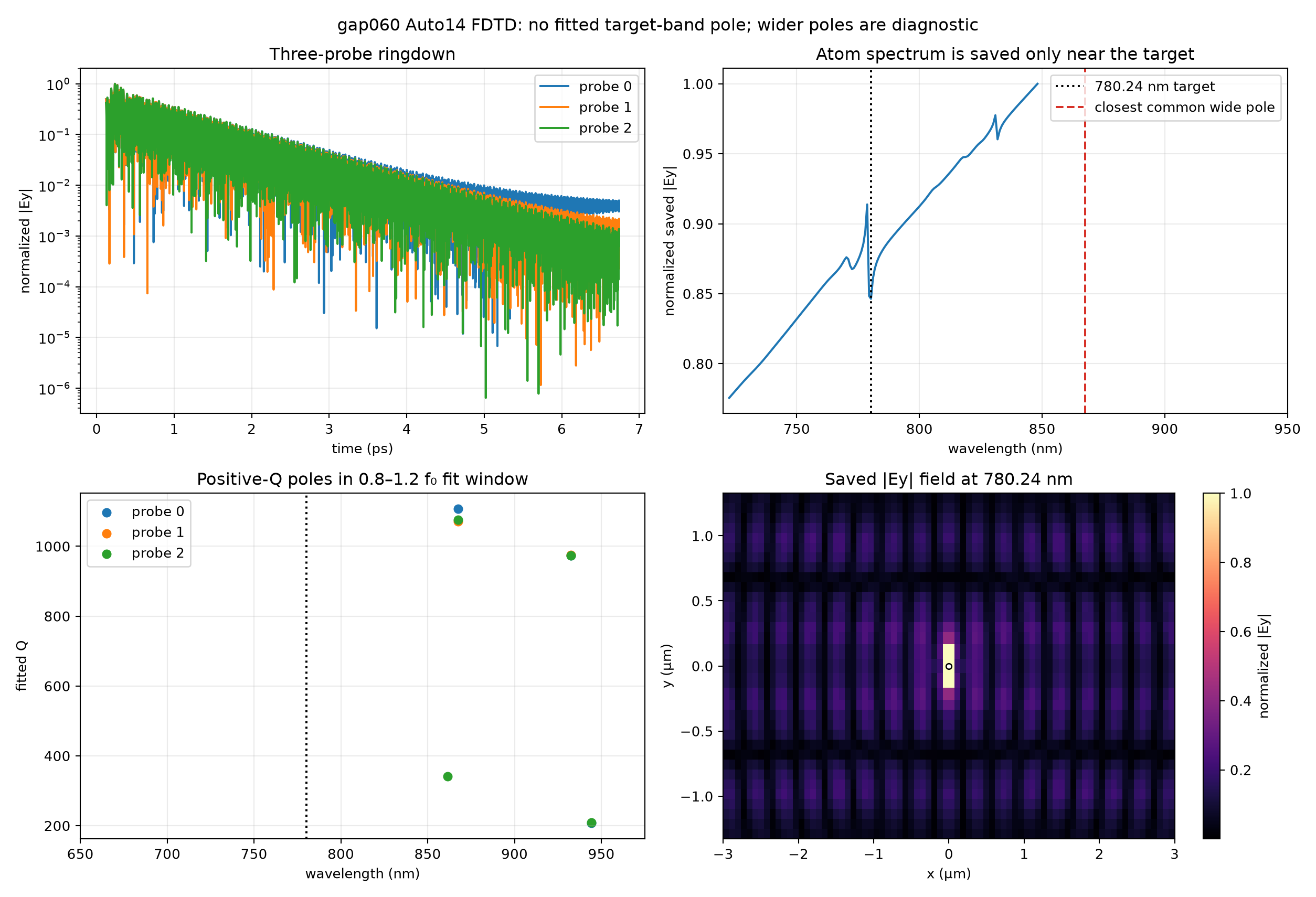
Exploratory 0.60 µm Auto-14 FDTD — target-band FAIL
Evidence label: completed paid exploratory broadband diagnostic. This is a preregistered negative result, not a promoted off-target Q result. The branch's failed local MPB atom-metric convergence label remains in force.
Task fdve-edb532d7-45f0-43d4-a4bd-de64a75d90d3 used the serialized
Auto-14 grid, 16 ps maximum, automatic shutoff 1e-9, no mesh overrides, and
the exact two-PolySlab 0.60 µm minimum slot. Automatic shutoff ended the run
at 6.7402 ps. It cost 0.0387885 FC actual against a
0.0920721 FC maximum estimate.
The preregistered target-band analyzer found no positive-Q pole around
780.24 nm. Therefore the aggregate strict trade-study verdict is FAIL,
and no mesh-convergence or exact-pole task is justified for this geometry.
This is not explained by an obvious source-parity mistake: the centered Ey
dipole and configured simulation symmetry both use (even x, odd y, even z) =
(1, -1, 1).
A deliberately wider ringdown diagnostic finds common three-probe poles well outside the target:
| Wider diagnostic pole | Q | Probe-Q span | Frequency span | Interpretation |
|---|---|---|---|---|
| 867.4707 nm | 1,084.58 | 3.290% | 0.000833% | clean off-target ringdown indication; not promoted |
| 932.5001 nm | 973.99 | 0.0988% | 0.0000229% | second off-target indication; not promoted |
The 867 nm fit observes 6.63 fitted field-amplitude lifetimes. That makes it a useful wavelength-retargeting diagnostic, but not a 780 nm cavity result. The saved atom-spectrum monitor covers only 722.44–848.09 nm, so neither common wide pole lies inside its saved range. Moreover, the field and flux monitors were sampled at 780.24 nm, not coherently at either wide pole.
At 780.24 nm the broadband field snapshot gives
|Ey(atom)|²/max[ε|E|²]=0.77865, above the branch's numerical threshold.
That number is not accepted as cavity overlap or mode-volume evidence:
there is no target-band pole, the point source is located at the same atom
coordinate, and the snapshot can contain driven/source field. Mode volume, β,
and decay branching remain unmeasured.
Machine-readable exploratory gap060 result
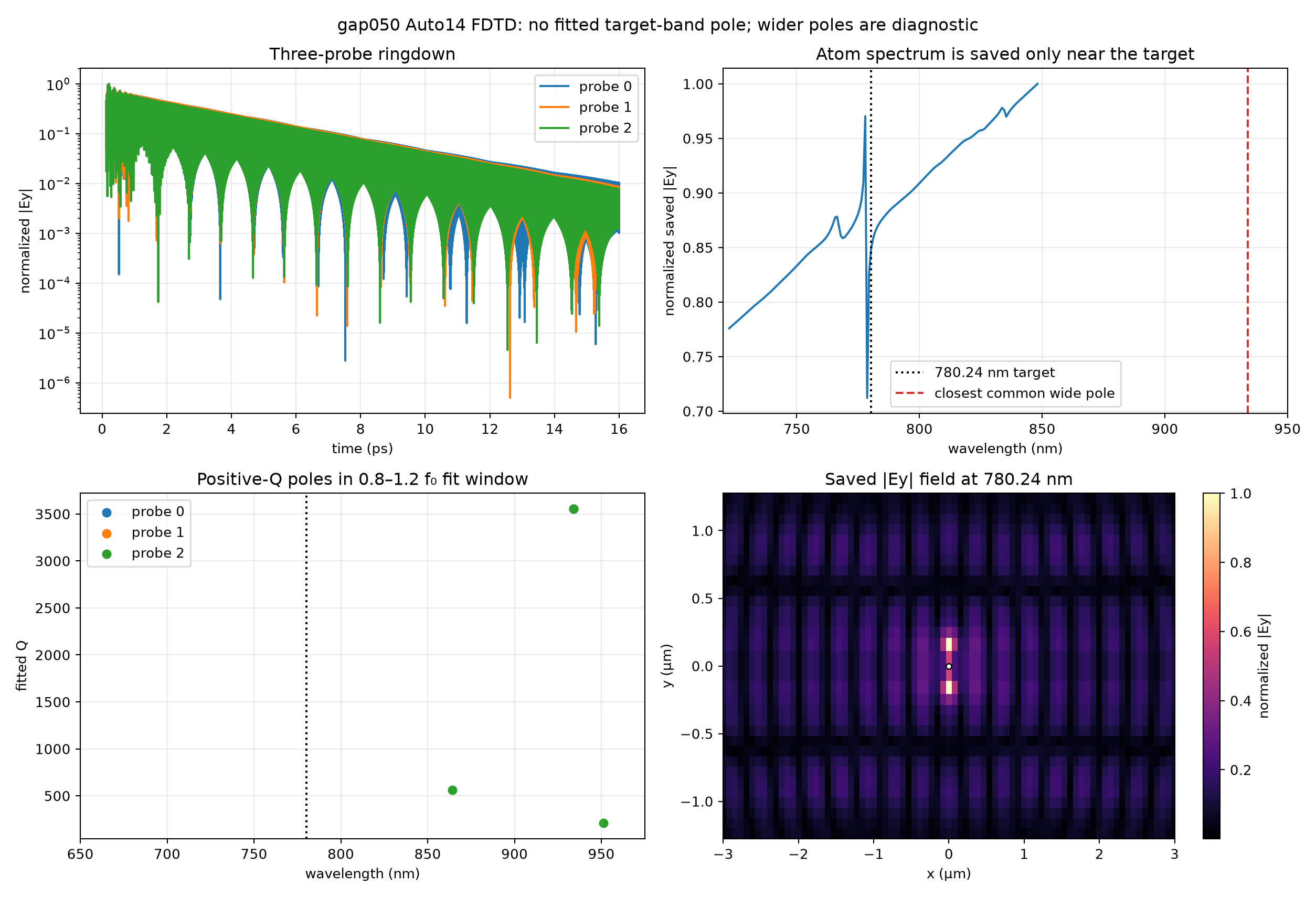
Locally promoted 0.50 µm Auto-14 FDTD — target-band FAIL
Evidence label: completed paid broadband diagnostic on the only branch that passed every local MPB optical/convergence gate. Its target-band failure falsifies the current MPB-to-finite-cavity promotion logic; the wide pole is not a promoted replacement.
Task fdve-d5ec4382-ea29-4c92-a54d-8f6863152a6b used Auto-14, 16 ps,
automatic shutoff 1e-9, no overrides, and the exact connected 0.50 µm slot.
It ran the full 16.00004 ps and cost 0.0888272 FC actual and maximum.
The preregistered analyzer again finds no positive-Q target-band pole.
The aggregate strict verdict is FAIL.
The wider three-probe diagnostic contains one especially clean but irrelevant pole at 933.8378 nm with Q=3,553.95, relative probe-Q span 0.00482%, frequency span 0.00000251%, and 4.506 fitted amplitude lifetimes. It lies beyond the saved 722.44–848.09 nm atom-spectrum range; the 777.906 nm spectrum bump is not a recovered positive-Q pole. The saved field and flux monitors are at 780.24 nm, so none of them characterizes the 933.84 nm mode.
The target-frequency field ratio is only 0.18725, below the branch's
preregistered 0.3284 threshold. It is also sampled at the point-dipole source
and may contain source self-field, so it cannot establish mode volume even
apart from the failed numerical gate. The source/simulation parity matches
the intended (1, -1, 1) sector, leaving no obvious symmetry mismatch as an
explanation.
Machine-readable paid gap050 result
Combined decision: both paid corrected-transverse branches fail to recover
a 780 nm pole. This includes the 0.50 µm branch that passed every local MPB
gate. Further paid FDTD on this promotion logic is paused. The next work is
offline diagnosis of finite-cavity phasing, band/pole identity, and the
unit-cell-to-finite-cavity transfer—not another mesh or exact-pole run.
gap100_outer065 is paused before submission.
Full-k guided-gap audit — gap100 disqualified; FDTD failures clarified
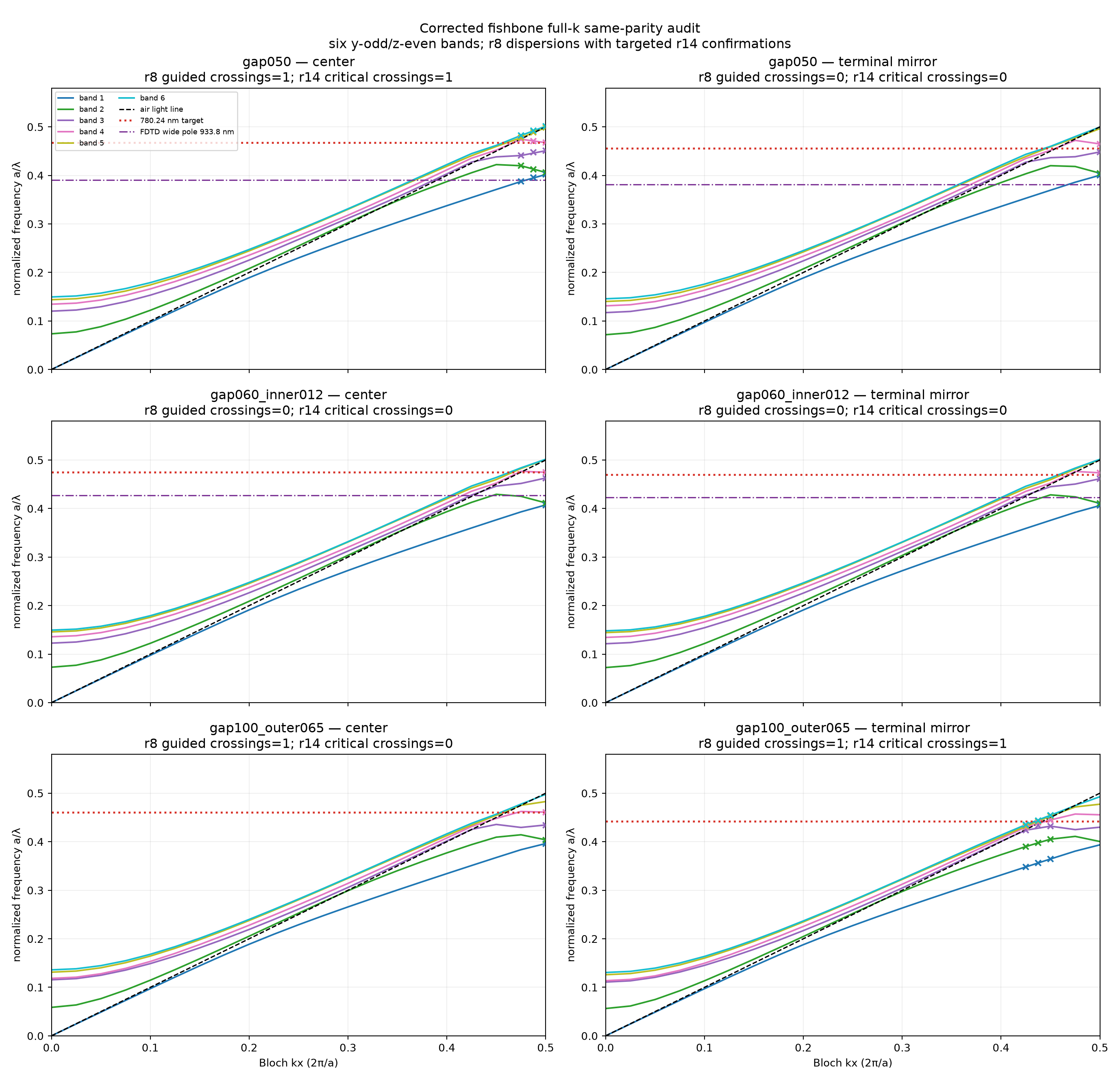
Evidence label: completed local-only MPB failure diagnosis; six y-odd/z-even bands, 21 Γ→X points at r8 for the center and terminal mirror of all three corrected branches, followed by r14 solves at the critical near-X brackets. Zero cloud actions and 0 FC.
In plain language, asking for a literal empty frequency interval across every Γ→X point is too strict for this open low-index structure. Radiation- sector bands fill that literal all-k interval at small k. The physically useful question is narrower: among same-parity branches that are below the air light line and therefore guided, does the cavity center have an allowed target branch while the terminal mirror has a complete guided gap?
| Branch | Center at 780.24 nm | Terminal mirror at 780.24 nm | Full-k verdict |
|---|---|---|---|
gap050 |
real guided band-4 branch at the X edge; r14 crossing at k=0.499996 | no guided target crossing; complete guided same-parity gap | unit-cell center/mirror logic survives this audit |
gap060_inner012 |
r14 target merely touches the band-4 X edge; no sampled guided continuation | complete guided same-parity gap | weak/ambiguous center state, consistent with its failed local convergence gate |
gap100_outer065 |
X-edge target condition only | guided band-4 crossing confirmed at r14 k=0.443641, below the light line | disqualified: the supposed mirror can propagate the target |
Thus, the old literal “no all-k gap” statement is not by itself a useful
rejection criterion. The complete guided same-parity gap is the applicable
test. By that test, gap100_outer065 must not be submitted. Its strong
X-point γ did not reveal the guided mirror crossing away from X.
For gap050, however, the full-k omission does not explain the paid FDTD
failure: it has the intended guided center branch and a complete guided mirror
gap. The phase/taper audit also finds no simple construction mistake. All
three new cavities use the same x=0 cell-boundary phase, outer-profile minimum
at the center plane, and decreasing center-to-mirror period as the successful
physical 0.75 µm control. Therefore neither “X-only screening” nor “wrong
taper direction/phase” is a sufficient explanation for the missing 780 nm
finite pole. gap060_inner012 remains weaker: its center condition is only
an ambiguous X-edge touch.
The paid wide poles are now identified more specifically:
- the
gap050933.8378 nm pole has propagating guided same-parity lower bands in both its center and mirror cells; - the
gap060_inner012867.4707 nm pole has the same property.
They are consequently lower-family finite-length/Fabry–Perot-like resonances, not the intended band-4 defect modes. This is a diagnostic classification, not an exact-pole field identification.
Machine-readable full-k diagnosis
No additional paid job was run for this audit. Further paid work remains paused. A broader local redesign with wider rails/thicker silica and larger light-line margin is in progress before any new finite-cavity submission.
Conventional wider/thicker band-4 screen — no promotion
Evidence label: completed local-only MPB resolution-8 diagnostic. All 50/50 tuned cells received an exact-geometry field audit; four gap-wise shortlist rows received full Γ→X center and terminal-mirror audits. Zero rows pass every gate, zero are proposed for r10/r14 validation, and there was no FDTD, cloud action, or FC spend.
This screen asked whether the conventional sorted band-4 family could be rescued by wider rails and thicker SiO₂. It covered gaps 0.50, 0.60, 0.75, and 1.00 µm; rail widths 0.65, 0.80, and 1.00 µm; outer amplitudes 0.35 and 0.50 µm; inner amplitudes 0 and 0.12 µm; and thicknesses 0.50 and 0.65 µm. All 50 center-cell periods were tuned locally, all 50 met the 9% X-point light-line-margin eligibility threshold, and every geometry was checked for its printed slot and band-4 field at the atom-side slot boundary.
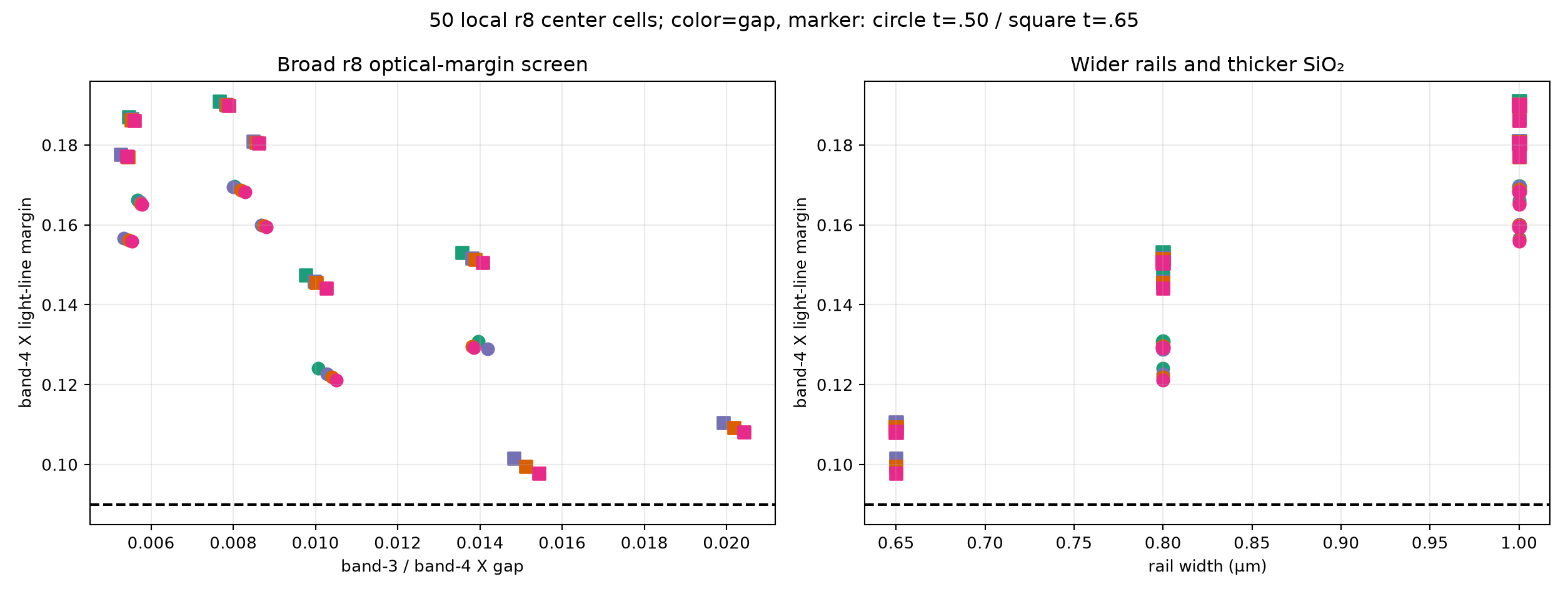
The wider/thicker dimensions do improve the band-4 light-line margin, but none of the four best gap-wise compromises survives the complete gate set:
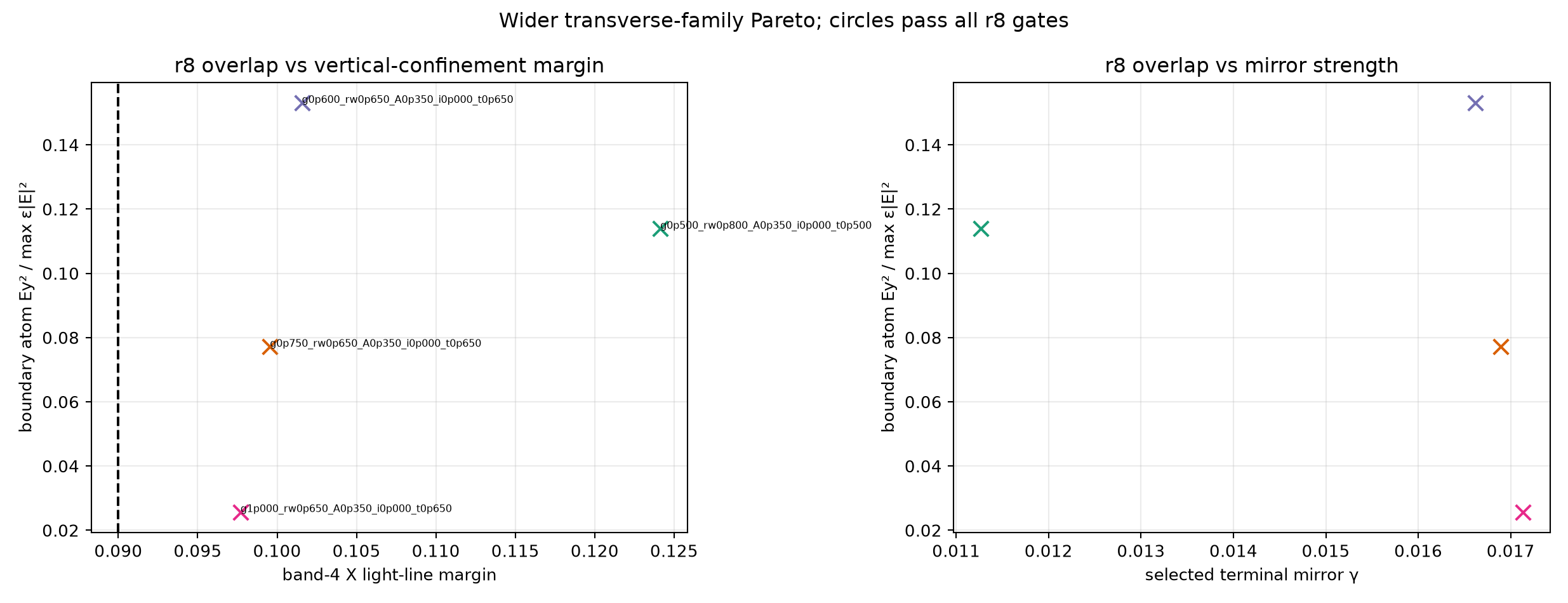
| Gap-wise shortlist | X margin | Band-4 atom proxy | Full-k/mirror result | Decision |
|---|---|---|---|---|
| g=0.50, rail=0.80, t=0.50, A=0.35 | 12.4128% | 0.113864 versus 0.360419 baseline | guided center band 4; mirror has no guided target crossing | reject: atom proxy is worse and mirror γ is nonmonotonic |
| g=0.60, rail=0.65, t=0.65, A=0.35 | 10.1560% | 0.153054 versus 0.251785 baseline | center target crossing sorts as band 5; mirror leaks through guided band 4 | reject |
| g=0.75, rail=0.65, t=0.65, A=0.35 | 9.9548% | 0.077129 versus 0.148220 baseline | center target crossing sorts as band 5; mirror leaks through guided band 4 | reject |
| g=1.00, rail=0.65, t=0.65, A=0.35 | 9.7694% | 0.025685 versus 0.061046 baseline | center target crossing sorts as band 5; mirror leaks through guided band 4 | reject |
The two endpoint cases explain the result in plain terms. The 0.50 µm gap retains the intended band-4 center and a non-leaking mirror, but widening the rail moves too much field away from the atom and its period scan does not give the required monotonic mirror-strength ramp. The access-first 1.00 µm gap is worse: although its 9.7694% margin clears the confinement gate, its atom proxy falls to 0.025685, the target branch reorders to sorted band 5 in the center, and the terminal mirror still propagates guided band 4. It cannot be promoted as a band-4 cavity.
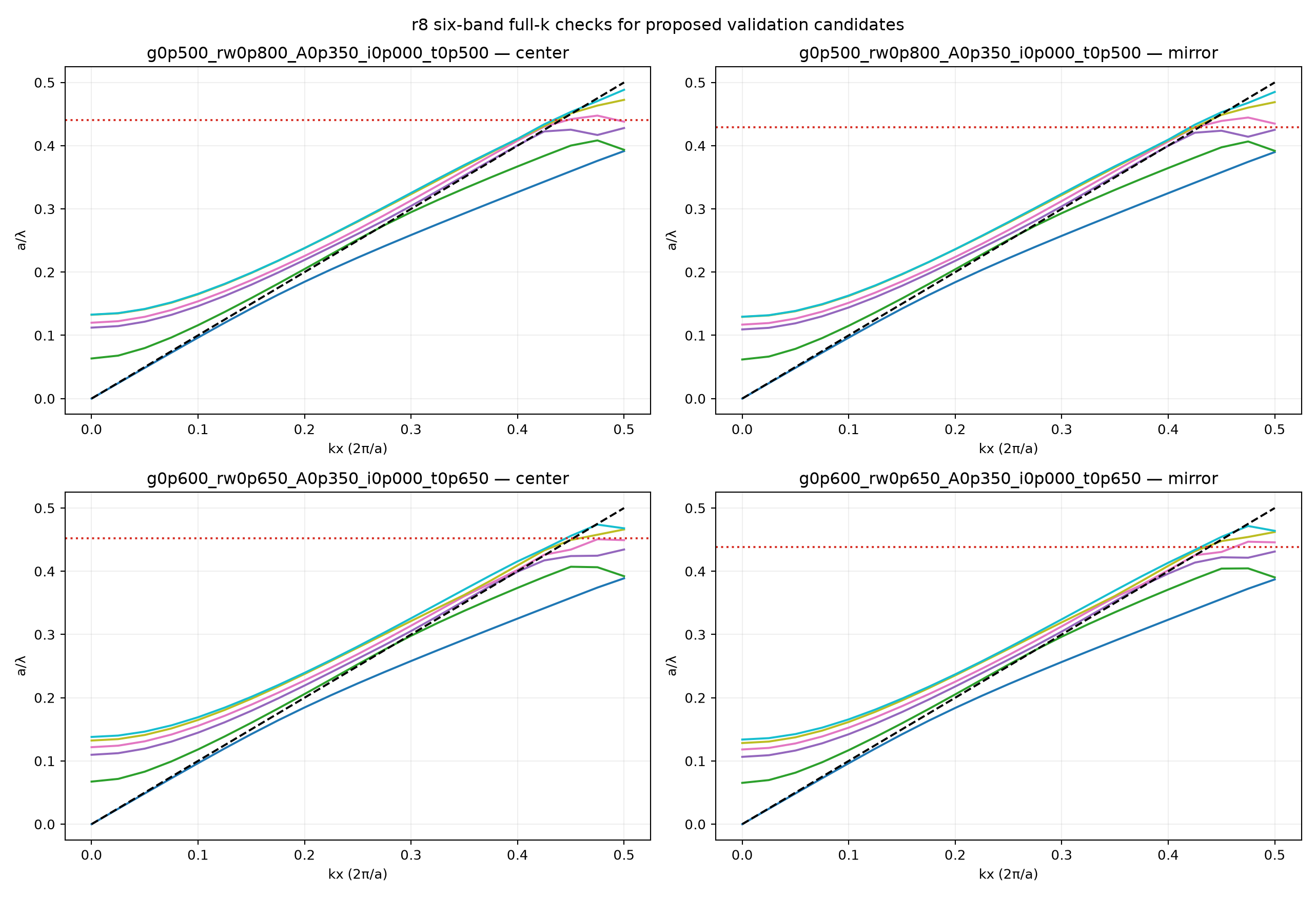
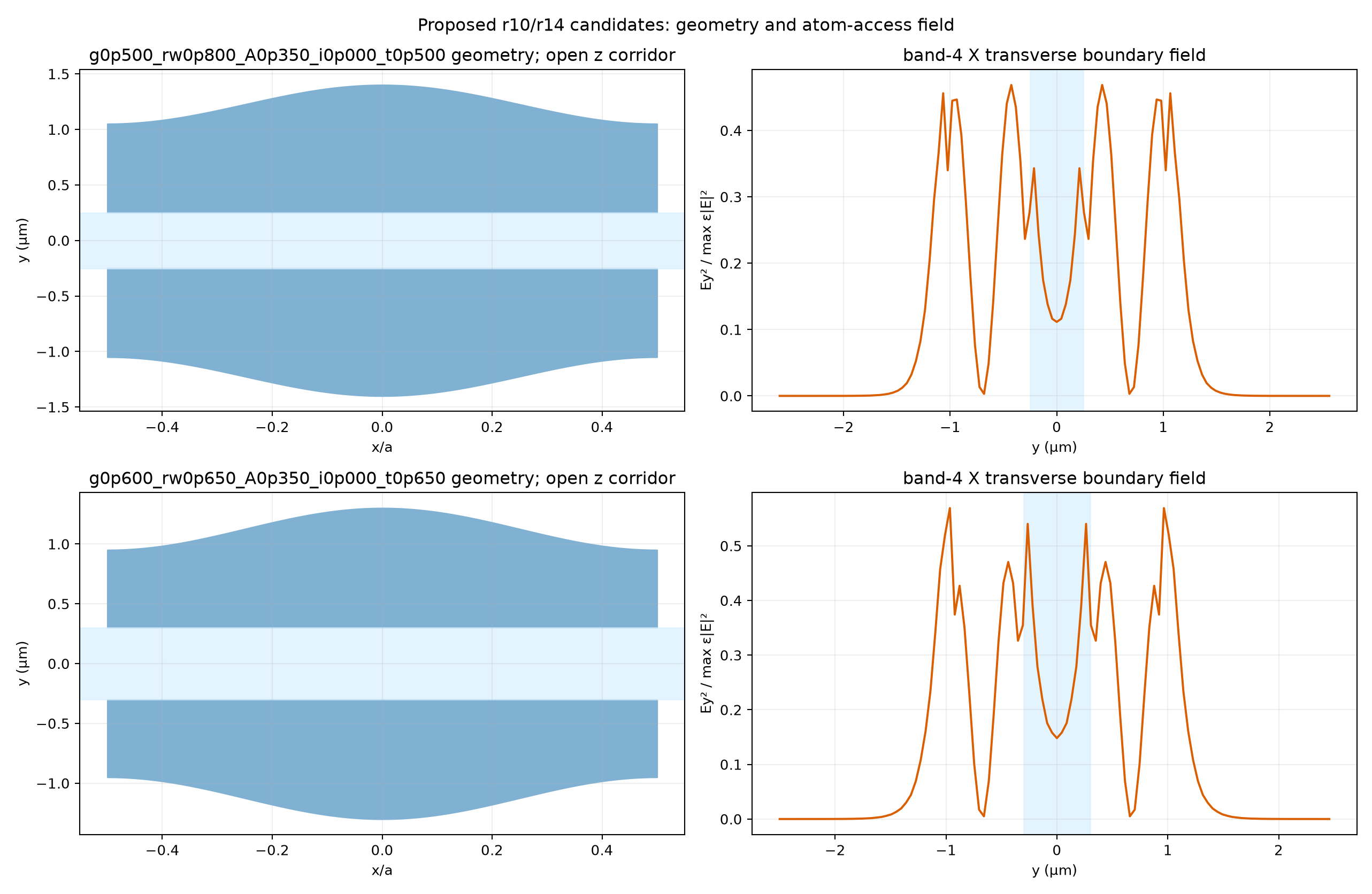
The schematic figure retains its pre-audit “proposed candidate” title because it records when those rows entered the four-case shortlist. The subsequent full-k/mirror gate rejected every row; the authoritative proposal list is empty.
This result rejects a fixed sorted band-4 design rule, not every optical branch in the same geometry. Sorted band labels can change when branches approach and reorder, so this 50-case screen is diagnostic. The decision path is the field-tracked g=1 screen below, which selects a branch by slot-field character and atom polarization before applying the full-k test.
- Machine-readable 50-case tune screen
- Machine-readable 50/50 field audit
- Machine-readable four-case full-k/mirror decision
One-micron-slot multiband controls — follow the field, not the band number
Evidence label: completed local-only audit of cached MPB controls. No new FDTD job, no cloud action, and 0 FC.
Wider 1.0 µm rails around the 1.0 µm open slot do recover vertical
confinement. That alone is not enough. At thickness 0.50 µm, the original
band-4 solution sits 16.61% below the X-point air light line, but its
atom-site Ey²/max(ε|E|²) proxy is only 0.00205: the field has moved into the
silica rails. In plain words, this mode is well confined but nearly useless
at the atom.
The useful slot-like field appears on a higher sorted band. Its band number changes as the silica thickness changes, from band 6 at 0.50 µm to band 8 at 0.65–0.80 µm. Those numbers are merely the order in which MPB sorts the eigenfrequencies at one k point; they are not persistent mode identities. The branch must therefore be followed by its field shape and atom-site polarization, then checked over the complete Γ→X path.
| Control | X-point atom proxy | X light-line margin | Full-k result |
|---|---|---|---|
| t=0.50 µm, original band 4 | 0.00205 | 16.61% | rail-localized; not the atom-coupling branch |
| t=0.50 µm, slot-like band 6 | 0.11663 | 3.65% | center has no guided target crossing; mirror leaks through guided band 5 |
| t=0.65 µm, slot-like band 8 | 0.06039 | 6.49% | X-point control only; not promoted |
| t=0.80 µm, slot-like band 8 | 0.03211 | 8.81% | X-point control only; not promoted |
| t=0.80 µm, exact-retuned band 8 | 0.04213 | 7.90% | real guided target crossing, but only 0.003393 guided clearance |
The t=0.50 µm higher branch is the clearest X-point false optimum: it has the best atom proxy in this comparison, yet its center has no guided target continuation and its supposed mirror still propagates a guided target mode. It cannot form the intended center/mirror cavity.
The exact-retuned t=0.80 µm control is a more informative near-miss. The slot-like field selected as band 8 at X reappears as sorted band 9 along the full path and crosses the 780.24 nm target at k=0.466373. This is a real guided crossing, but its maximum guided clearance is only 0.003393, below the preregistered 0.005 minimum. It is therefore rejected rather than promoted. The result is also a concrete demonstration that tracking a fixed band number would silently lose or misidentify the physical mode.
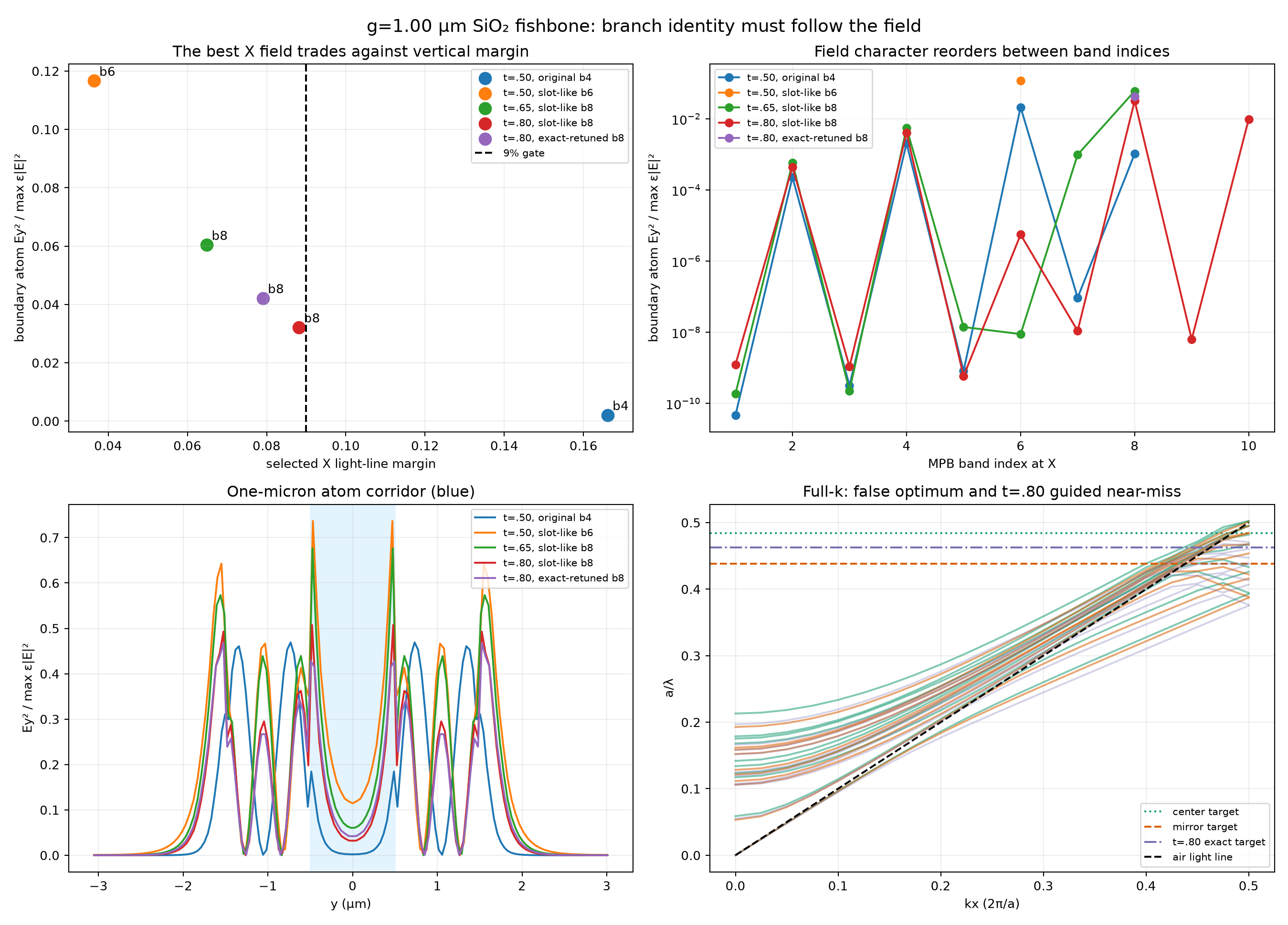
Machine-readable multiband controls
Field-tracked r8 seed screen — complete, but seed-only
A separate all-band X-point seed screen completed all 15/15 planned one-micron-slot geometries at MPB resolution 8. It records the field-selected slot-like branch across rail width, silica thickness, and inner modulation. The plot is useful for seeing where atom overlap and X-point light-line margin trade against each other, and it shows why band labels alone are unsafe.
This is seed-only evidence, not a cavity result. It has no full-k center/mirror proof, taper, finite cavity, Q, mode volume, or emitter β, and none of its rows is promoted to FDTD. It used no cloud compute and spent 0 FC.
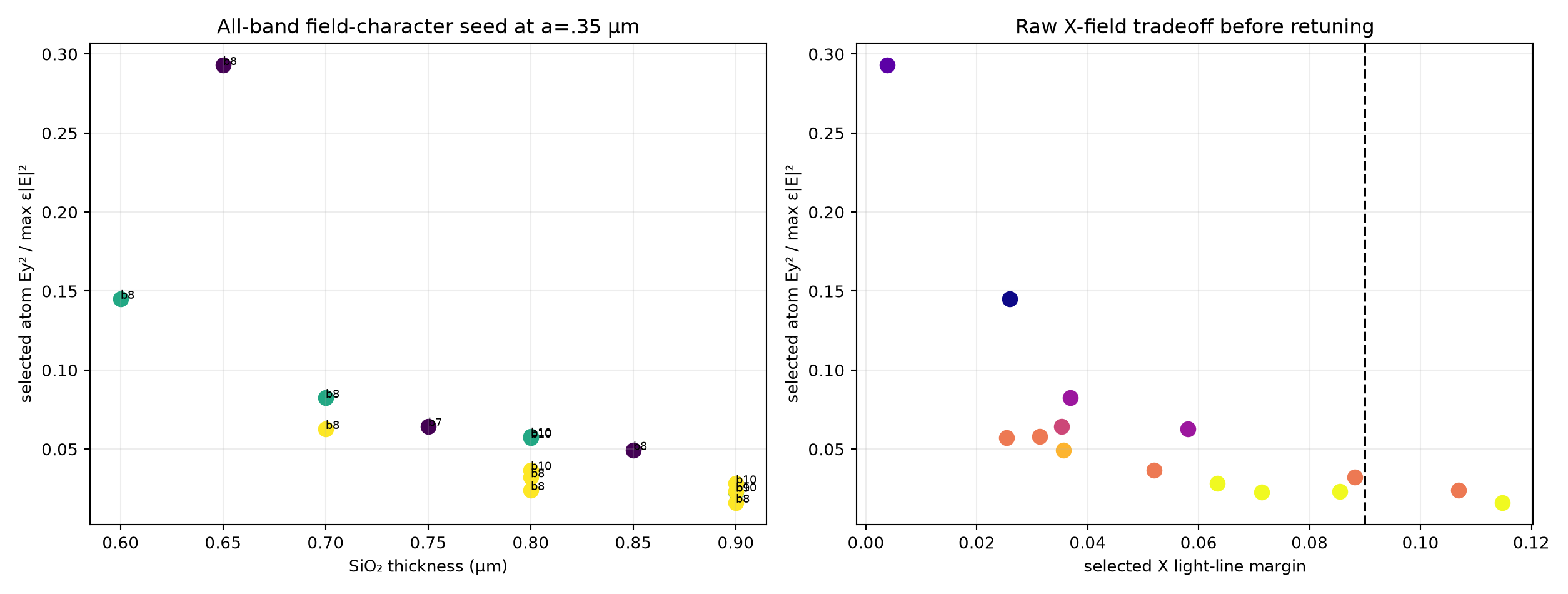
Machine-readable field-tracked r8 seed screen
Field-tracked v3 identity checkpoint — 13 valid, two unresolved
Evidence label: completed local-only A=0.35 MPB r8 tuning checkpoint. Fifteen of fifteen planned rows were attempted; 13 have a valid retune and two are explicitly unresolved. The first full-k control is complete and disqualified. No FDTD or cloud task has started, and no FC has been spent since 2026-07-29 06:42 UTC.
Why v2 was invalidated
The v2 tracker compared intensity profiles. Intensity discards the complex field phase, so a low-overlap first jump could select a different mode and then appear self-consistent on later iterations. Three partial v2 rows are retained only as diagnostics; none counts toward the v3 completion.
V3 compares the complete complex vector electric field (Ex,Ey,Ez) in three
dimensions. It interpolates the fields to common physical y/z coordinates,
weights the inner product symmetrically by the two permittivity fields,
normalizes it, and takes the magnitude. Identity is registered only at the
same unit-cell geometry phase, with a preregistered overlap gate of 0.75.
The cached controls show why this is fail-closed:
| Identity control | Same-cell-phase complex-E score | Decision |
|---|---|---|
| same H5 file, same band-7 mode | 1.000000 | pass |
| invalid v2 seed-band-10 → final-band-7 jump | 0.001529 | reject as a different mode |
A cyclic half-period (a/2) comparison is saved only as a diagnostic. It
cannot rescue an identity failure because a half-cell translation changes
which physical geometry phase is placed at the atom. If that translation is
desired in a finite cavity, the dielectric geometry must be shifted
explicitly and recorded—it cannot be introduced silently as an overlap
registration.
Atom plane and geometry phase
For each tracked branch, the atom proxy is evaluated at both the cell boundary
x/a=-0.5 and cell center x/a=0, then the stronger longitudinal phase is
stored as the chosen atom plane. This is not a harmless plotting choice.
Several branches put the Ey antinode at the boundary while others put it at
the cell center. A finite cavity with the atom fixed at x=0 must therefore
apply the corresponding explicit cell-phase shift to the geometry and bind
that phase in the candidate manifest.
For example, both ≥9% margin controls select the boundary plane. The
rw=1.10/t=0.80 row has atom proxy 0.024697 at the boundary but only
7.43×10⁻¹⁰ at cell center. The rw=1.10/t=0.90 row has 0.015578 at the
boundary versus 1.23×10⁻⁸ at cell center. Building either candidate with
the wrong phase would move the atom onto a longitudinal node.
Completed A=0.35 Pareto result
All 13 valid rows pass the exact target-depth and same-phase complex-identity gates. The two unresolved rows are rw=0.65/t=0.65/inner=0 and rw=0.80/t=0.80/inner=0.12; bounded tracking did not simultaneously establish same-phase identity to the preceding/original seed and the exact target depth.
Only two valid rows clear the 9% X light-line-margin gate, and both pay for it with weak atom field:
| Control | Tracked band at X | X margin | Chosen atom plane | Atom proxy |
|---|---|---|---|---|
| rw=1.10 µm, t=0.80 µm, A=0.35 µm | 8 | 10.675% | boundary | 0.024697 |
| rw=1.10 µm, t=0.90 µm, A=0.35 µm | 8 | 11.729% | boundary | 0.015578 |
The higher-overlap rows lie well below the 9% confinement gate. Thus the completed A=0.35 screen exposes a real Pareto trade rather than a cavity lead.
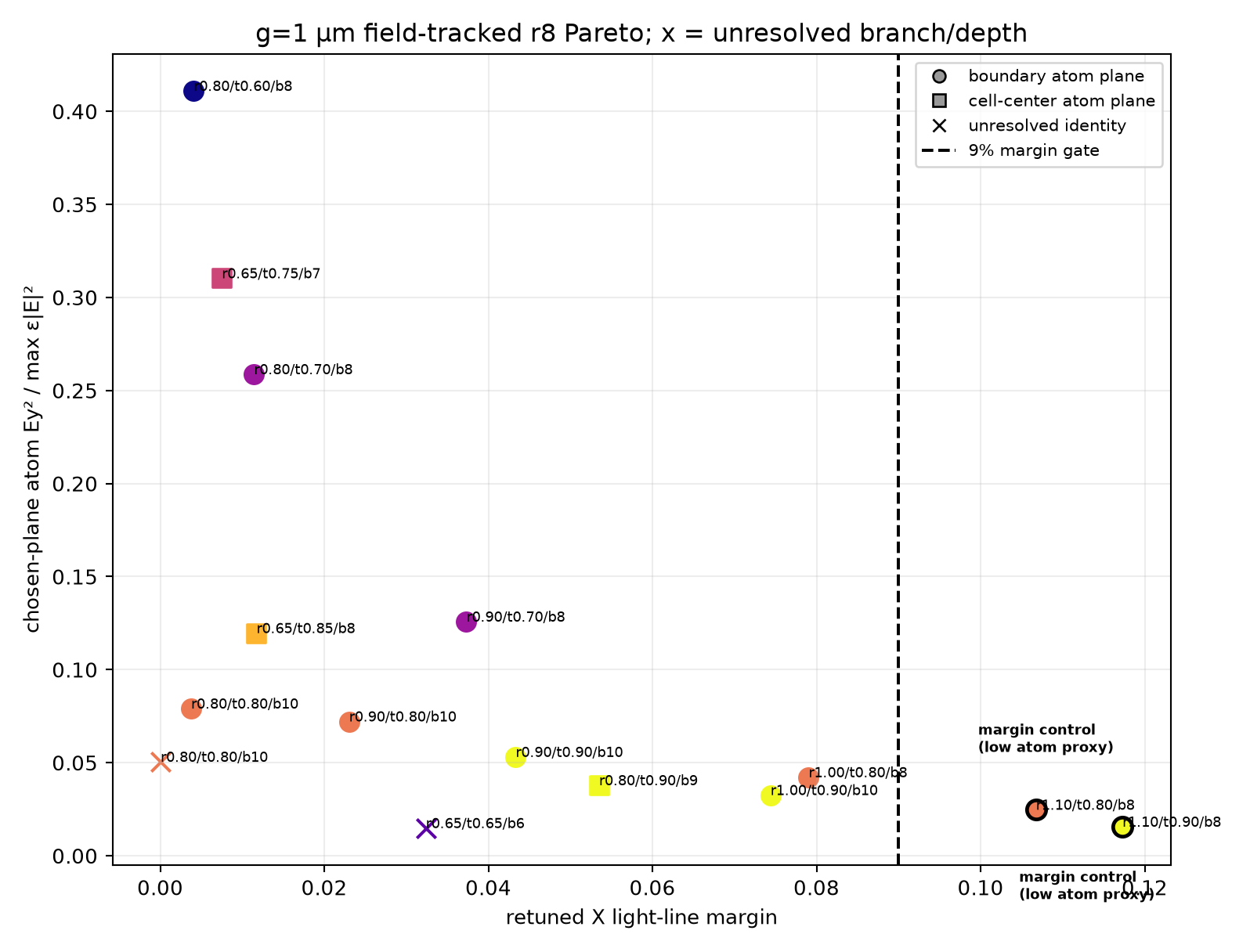
Machine-readable v3 retune checkpoint
First full-k control fails; g=1 refinements now close 0/7
The first full Γ→X test used rw=1.10 µm, t=0.80 µm, A=0.35 µm and target
a/λ=0.4492581412. It finds target-frequency crossings on sorted band 9 at
k=0.448417159 and band 10 at k=0.440848052. Both crossings have
k < a/λ and are therefore above the air light line, not guided. The center
has zero guided target crossings, so it cannot supply the intended guided
cavity state. The mirror calculation was deliberately skipped after that
center failure.
The follow-ups are now complete. They are local r8 MPB calculations using the same v3, same-cell-phase, full-3D complex-vector-E identity test. They caused zero Tidy3D uploads, estimates, submissions, starts, or FC, and neither the fishbone campaign ledger nor the separate 5 FC trustworthy-observables ledger changed. The last cloud action remains the task completed at 2026-07-29 06:42:06 UTC.
Outer-amplitude refinement: better margin costs atom field
All six A=0.45/0.55/0.65 µm cases completed and passed the v3 X-point
retuning and identity checks. Increasing outer-wall amplitude improves the
X light-line margin monotonically on both backbones, but it reduces the
chosen atom-plane field proxy monotonically:
| Rail width / thickness (µm) | A (µm) | X margin | Atom proxy |
|---|---|---|---|
| 0.90 / 0.70 | 0.45 | 4.4162% | 0.109748 |
| 0.90 / 0.70 | 0.55 | 5.1718% | 0.093716 |
| 0.90 / 0.70 | 0.65 | 5.8424% | 0.079118 |
| 1.00 / 0.80 | 0.45 | 8.4830% | 0.040830 |
| 1.00 / 0.80 | 0.55 | 9.0370% | 0.038139 |
| 1.00 / 0.80 | 0.65 | 9.6684% | 0.034112 |
Every row selects the cell-boundary atom plane and tracked band 8 at X. The two ≥9% rows therefore enter the full-k audit with weak atom proxies rather than becoming cavity leads.
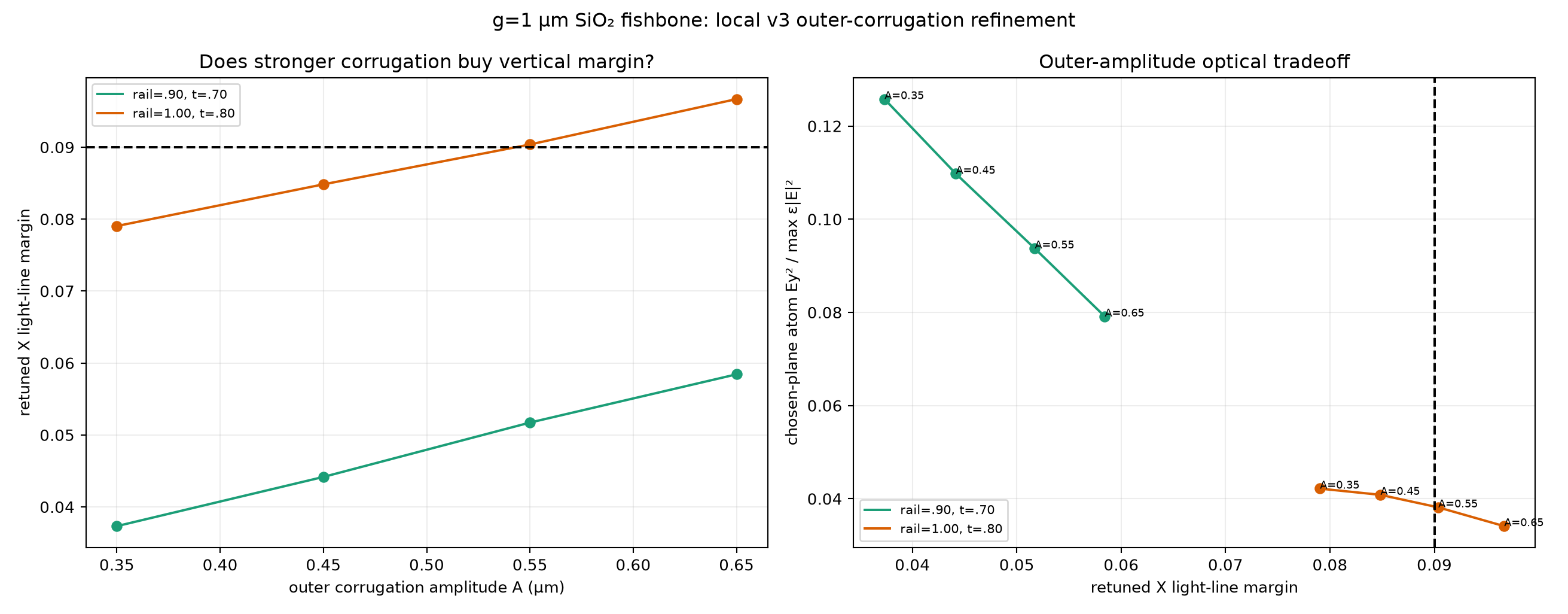
Machine-readable outer-amplitude refinement
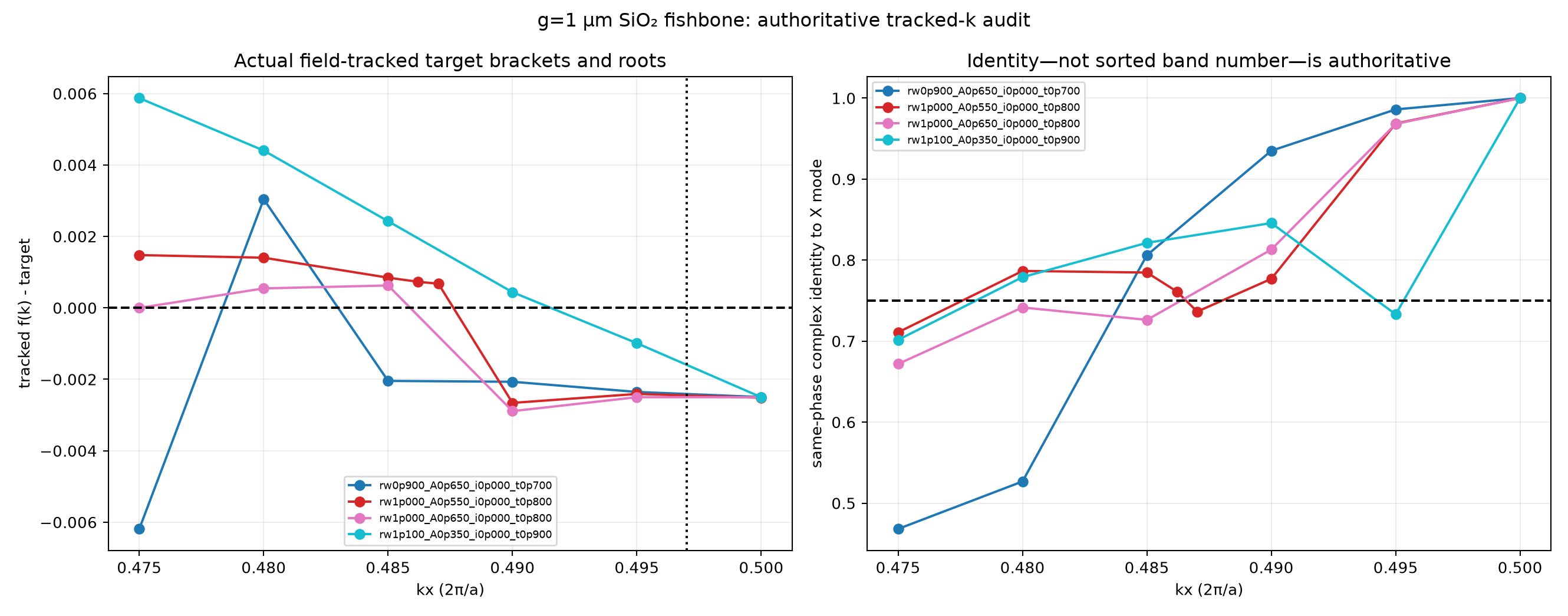
Authoritative tracked-k audit: 0/4 pass
The four selected center cells were then tracked from X over
k=0.475…0.500. A target root counts only if its frequency is bracketed by
adjacent k anchors that both retain complex-field identity ≥0.75. An
identity-failed anchor breaks the bracket: the calculation may not jump over
it and pretend that points on different sides of an avoided crossing are one
continuous mode. Sorted-band crossings remain diagnostic only.
| Center control | X margin / atom proxy | Exact fail-closed result |
|---|---|---|
| rw=.90, t=.70, A=.65 | 5.8424% / 0.079118 | apparent sign changes occur only where identity is 0.468–0.527; all identity-valid anchors from k=.485 to X are below target |
| rw=1.00, t=.80, A=.55 | 9.0370% / 0.038139 | adjacent valid anchors bracket an avoided crossing, but the returned k=.486205 point misses target by 0.000730, far above the 1e-5 tolerance |
| rw=1.00, t=.80, A=.65 | 9.6684% / 0.034112 | the positive-side k=.480/.485 anchors fail identity; all valid anchors from k=.490 to X are below target |
| rw=1.10, t=.90, A=.35 | 11.7290% / 0.015578 | the only negative point adjacent to the valid positive branch, k=.495, has identity 0.733; bridging from k=.490 to X across it is forbidden |
The second row is especially instructive. Its root solver returns a same-phase identity of 0.761 and adequate light-line clearance, but the frequency residual is 73 times the allowed tolerance. That is an avoided-crossing/discontinuity diagnostic, not an exact guided root. With all four center cells rejected, all four mirror calculations were deliberately skipped. The authoritative proposal list is empty.
Machine-readable four-case tracked-k audit
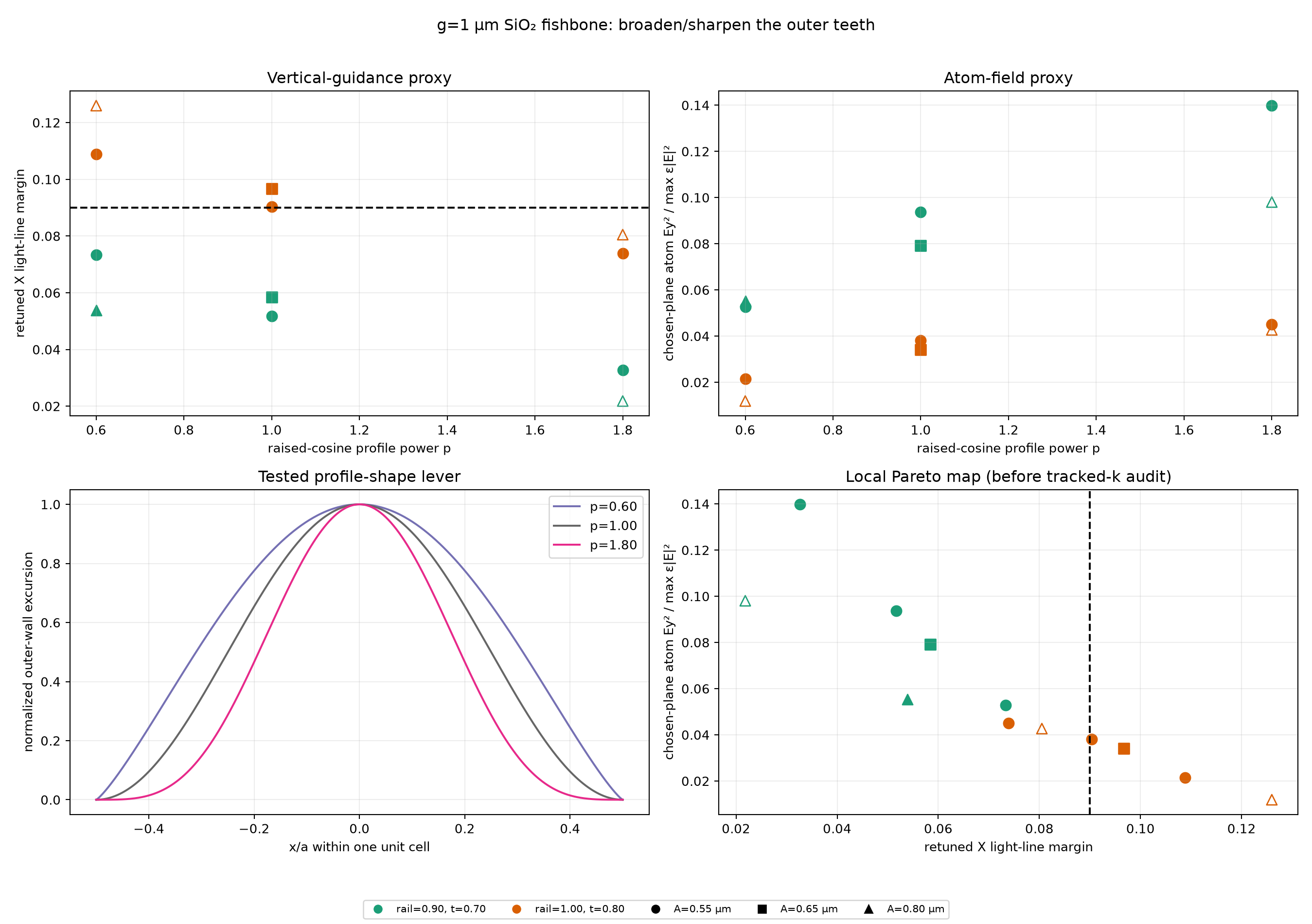
Profile-shape screen: ⅝ identity-valid, one high-margin trade point
The next local screen changed the outer-tooth profile to
[0.5(1+cos(2πx))]^p, while holding the exact inner walls at ±0.5 µm.
p=0.6 broadens the teeth and p=1.8 sharpens them. The cache key and MPB
command both bind p, and all exact geometry/cache checks pass. Five of eight
cases are v3-valid:
| Rail width / thickness (µm) | A (µm) | p | X margin | Atom proxy |
|---|---|---|---|---|
| 0.90 / 0.70 | 0.55 | 0.6 | 7.3296% | 0.052764 |
| 0.90 / 0.70 | 0.55 | 1.8 | 3.2674% | 0.139808 |
| 0.90 / 0.70 | 0.80 | 0.6 | 5.3876% | 0.055269 |
| 1.00 / 0.80 | 0.55 | 0.6 | 10.8834% | 0.021512 |
| 1.00 / 0.80 | 0.55 | 1.8 | 7.3898% | 0.045141 |
The three unresolved identities are rw=.90/t=.70/A=.80/p=1.8, rw=1.00/t=.80/A=.80/p=.6, and rw=1.00/t=.80/A=.80/p=1.8. Only the rounded rw=1.00/t=.80/A=.55/p=.6 row clears the 9% margin gate, and it does so with the weakest valid atom proxy. The sharp rw=.90/t=.70/A=.55/p=1.8 row gives the highest atom proxy, but only 3.2674% margin. Broadening the teeth therefore buys confinement at the atom-field cost; this figure is a pre-audit Pareto map, not a cavity result.
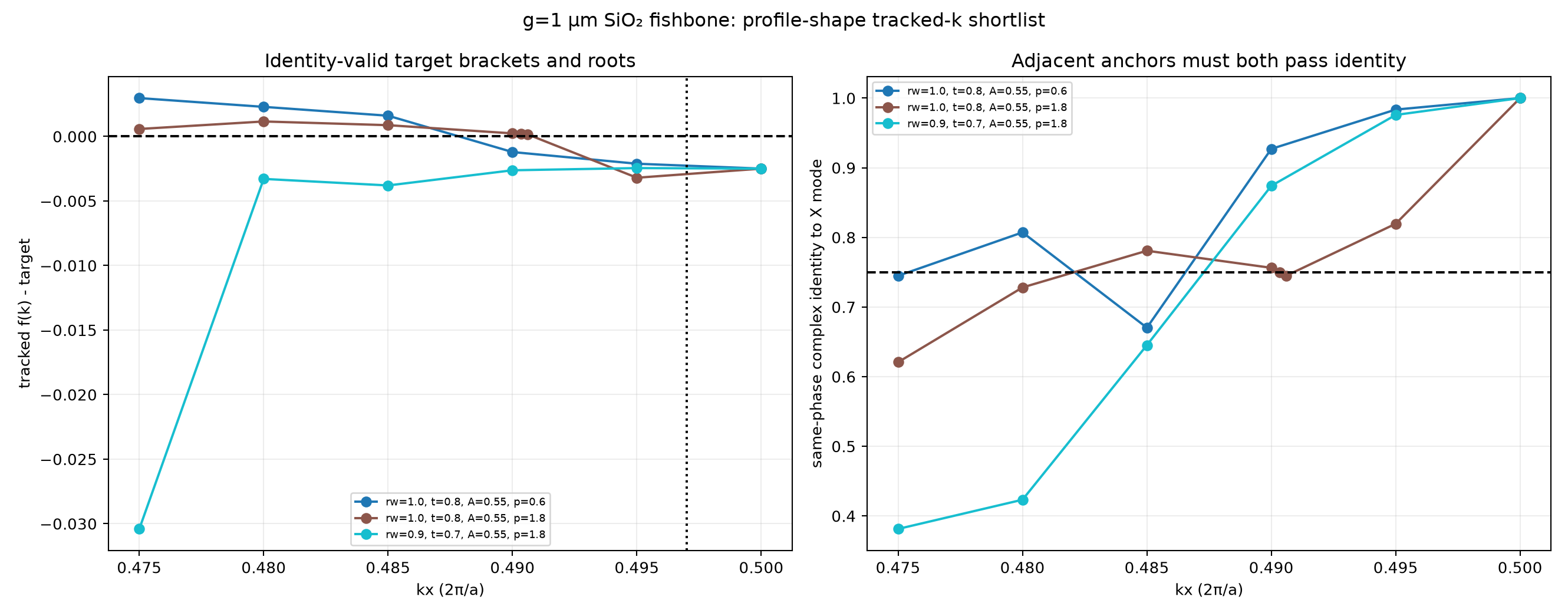
Profile tracked-k shortlist: 0/3 pass
The rounded high-margin, sharp higher-atom, and overall highest-atom rows all fail the same authoritative tracked-k gate:
| Candidate | Exact failure |
|---|---|
| rounded, rw=1.00/t=.80/A=.55/p=.6 | k=.480 is positive and identity-valid; k=.490 is negative and valid, but intervening k=.485 has identity 0.670, so no adjacent identity-valid bracket exists |
| sharp, rw=1.00/t=.80/A=.55/p=1.8 | a root candidate at k=.490344 has identity 0.750 and adequate clearance, but misses the target by 0.000192, above the 1e-5 tolerance; it is an avoided-crossing discontinuity and also starts below 9% X margin |
| highest atom, rw=.90/t=.70/A=.55/p=1.8 | every identity-valid near-X anchor from k=.490 to X lies below target; there is no sign change and no root |
All three mirrors were again skipped after their center failures. The profile proposal list is empty: 0/3 pass, making the completed g=1 follow-up total 0/7 authoritative tracked-k passes.
Machine-readable three-case profile tracked-k audit
Decision: compact open-corridor local pivot
The one-micron-slot amplitude and profile-shape branches are closed locally; no finite cavity and no paid FDTD task is promoted from them. Research has moved to a compact 0.75 µm guaranteed open corridor, still inside the user-authorized 0.5–1.0 µm interval. That pivot begins with local MPB only. It is not yet a validated geometry, guided-gap result, finite-cavity result, or reason to change either FlexCredit ledger.
Exact 0.75 µm corridor prefilter — local X-point evidence only
Evidence label: completed local r8 MPB prefilter using the v3 same-cell-phase complex-field identity test. These rows are pre-tracked-k candidates, not demonstrated guided crossings, mirror gaps, cavities, Q, mode volume, or β. This checkpoint caused zero Tidy3D/cloud actions and 0 FC; both FlexCredit ledgers are unchanged.
The geometry contract is exact in the input and sampled ε: the two inner
walls remain fixed at transverse coordinates y=±0.375 µm for every x.
Thus the full straight air corridor is exactly 0.75 µm throughout every cell,
independent of the outer tooth amplitude or profile power. Printed MPB gaps
are rounded diagnostics; the input geometry and ε audit are authoritative.
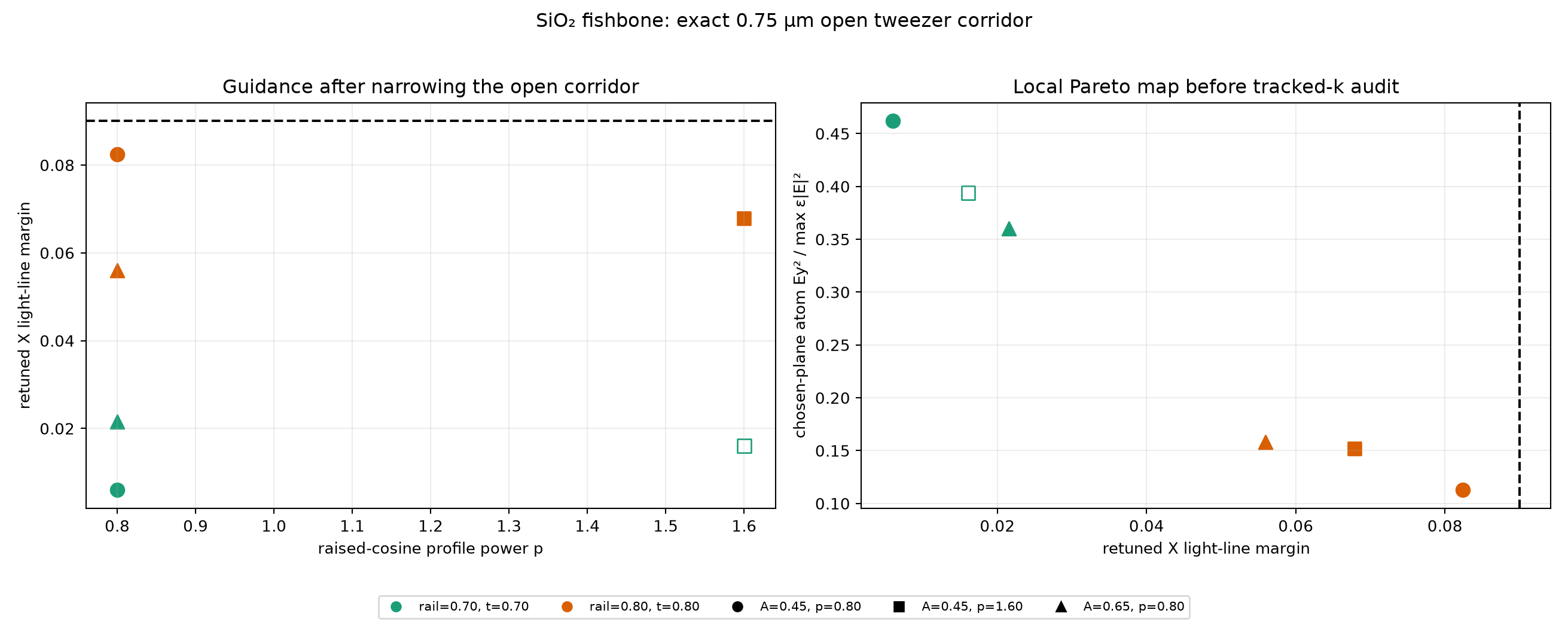
Six-cell profile screen: ⅚ v3-valid, none clears 9%
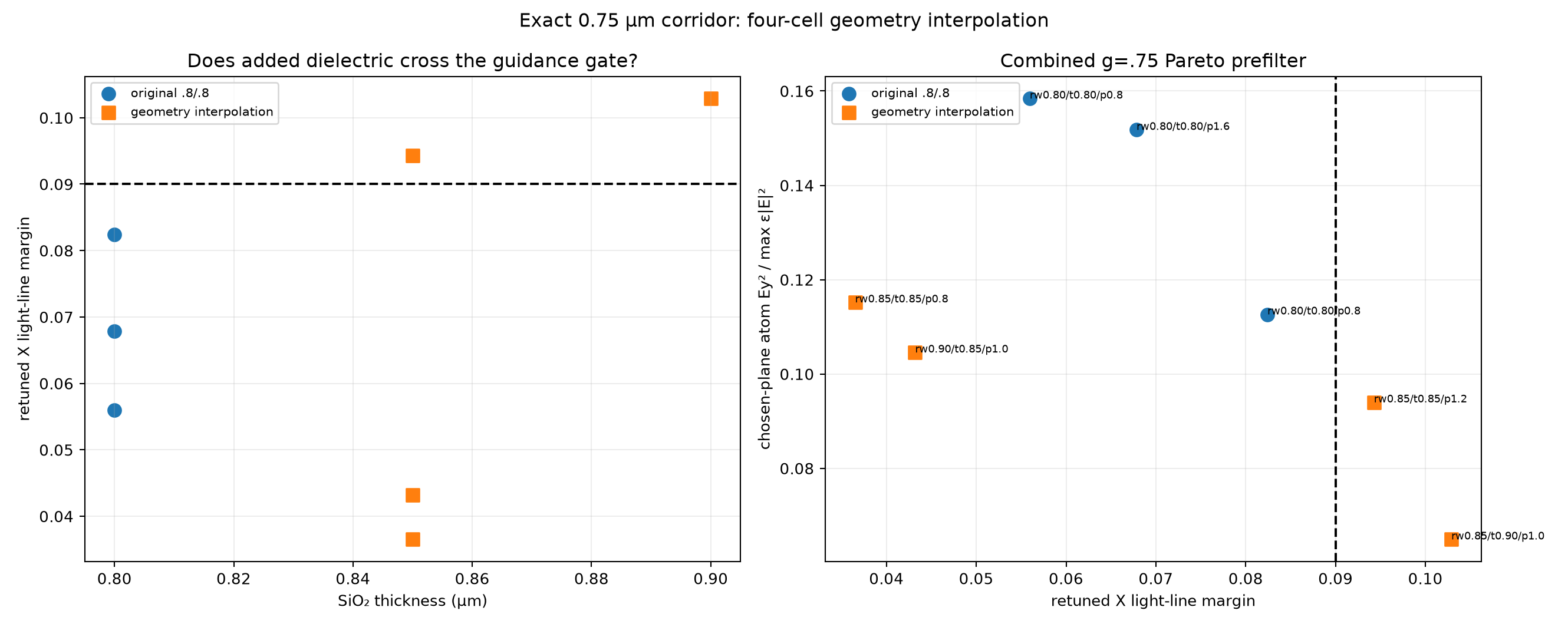
The first compact-corridor screen varied rail width, thickness, outer amplitude, and the raised-cosine profile power p. All six calculations completed; five retain same-phase v3 branch identity and one is explicitly unresolved. The full Pareto values are:
| Rail width / thickness (µm) | A (µm) | p | X margin fraction (percent) | Atom proxy | V3 status |
|---|---|---|---|---|---|
| .70 / .70 | .45 | .8 | .005964 (0.5964%) | .461821 | valid |
| .70 / .70 | .45 | 1.6 | .016080 (1.6080%) | .394009 | unresolved; diagnostic only |
| .70 / .70 | .65 | .8 | .021500 (2.1500%) | .360177 | valid |
| .80 / .80 | .45 | .8 | .082410 (8.2410%) | .112639 | valid |
| .80 / .80 | .45 | 1.6 | .067840 (6.7840%) | .151760 | valid |
| .80 / .80 | .65 | .8 | .055954 (5.5954%) | .158400 | valid |
The unresolved rw=.70/t=.70/A=.45/p=1.6 row did not simultaneously reach the exact target depth and identity ≥0.75 to both the previous and original seed; its plotted values cannot be used for selection. None of the five valid rows reaches the 9% X light-line-margin prefilter. Narrowing from 1.00 to 0.75 µm restores substantial atom field, but the thinner cells remain too close to the light line. The atom-rich rw=.80/t=.80/A=.45/p=1.6 row is kept only as a below-margin trade control for the combined shortlist.
Four-cell geometry interpolation: 4/4 valid, two clear 9%
The interpolation then tested where to place a modest amount of additional silica while keeping the exact inner walls and 0.75 µm corridor fixed. All four rows retain v3 identity:
| Rail width / thickness (µm) | A (µm) | p | X margin fraction (percent) | Atom proxy | V3 identity |
|---|---|---|---|---|---|
| .85 / .85 | .45 | .8 | .036508 (3.6508%) | .115180 | .977965 |
| .90 / .85 | .45 | 1.0 | .043192 (4.3192%) | .104559 | .982713 |
| .85 / .85 | .45 | 1.2 | .094272 (9.4272%) | .093985 | .999729 |
| .85 / .90 | .45 | 1.0 | .102886 (10.2886%) | .064923 | .999534 |
At fixed A=.45 and p=1, moving 0.05 µm of material from thickness into rail width changes rw/t=.85/.90 to .90/.85: margin falls from .102886 to .043192, while atom proxy rises from .064923 to .104559. In this local prefilter, vertical thickness buys light-line separation much more effectively than lateral rail width, but it costs atom field. The balanced rw/t=.85/.85, p=1.2 row is the strongest observed compromise: it clears 9% while retaining an atom proxy of .093985.
Adaptive original-band tracked-k audit: 0/3
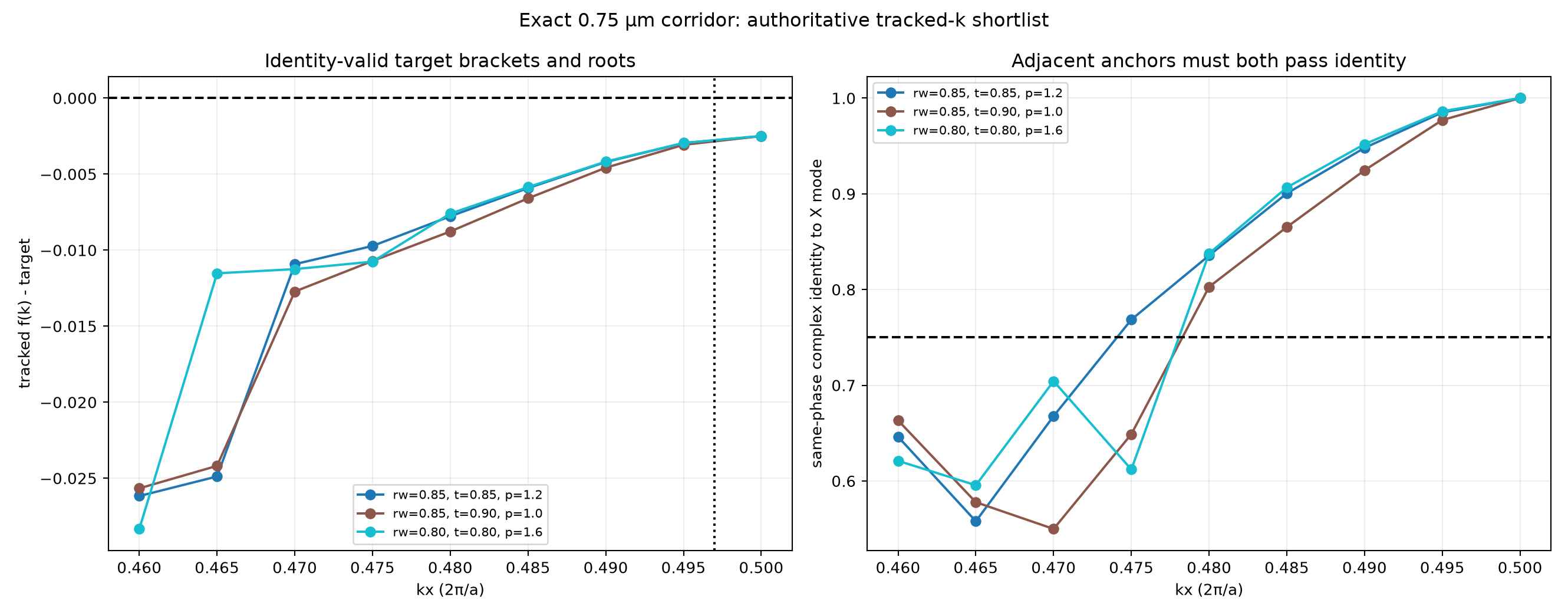
The two ≥9% interpolation rows and the atom-rich rw/t=.80/.80/A=.45/p=1.6 control were audited with the original X-selected band-7 identity. The k window was adaptive rather than copied blindly from the g=1 work: it starts at least 0.010 below the lowest coarse guided crossing or the target-plus-clearance fallback, never starts later than k=.465, and then samples every .005 continuously back to the immutable X seed. All three rows therefore used k=.460…500 rather than relying only on the inherited .475…500 window.
The result is 0/3. Every original-band failure is exact:
| Original X selector | Identity-valid anchor range | Exact failure | Diagnostic sorted crossing |
|---|---|---|---|
| rw/t=.85/.85, p=1.2 | k=.475…500 | all tracked detunings are negative, from −.009724 to −.002499; no sign-changing target bracket | sorted band 8 at k=.481075 |
| rw/t=.85/.90, p=1.0 | k=.480…500 | all tracked detunings are negative, from −.008774 to −.002499; no sign-changing target bracket | sorted band 8 at k=.487746 |
| rw/t=.80/.80, p=1.6 | k=.480…500 | all tracked detunings are negative, from −.007594 to −.002493; no sign-changing target bracket; the row was also below 9% | sorted band 8 at k=.477792 |
The selected band-7 mode has the wrong curvature: moving away from X makes its frequency fall farther below a target that already sits approximately .0025 above its X edge. It therefore cannot create the intended crossing. The coarse sorted-band crossings belong to other field branches, not to the same-phase complex-vector-E continuation of the X-selected atom mode. Sorted band number alone cannot rescue any row. Since every center fails, all three mirrors are skipped and the proposal list is empty.
Machine-readable adaptive original-band tracked-k audit
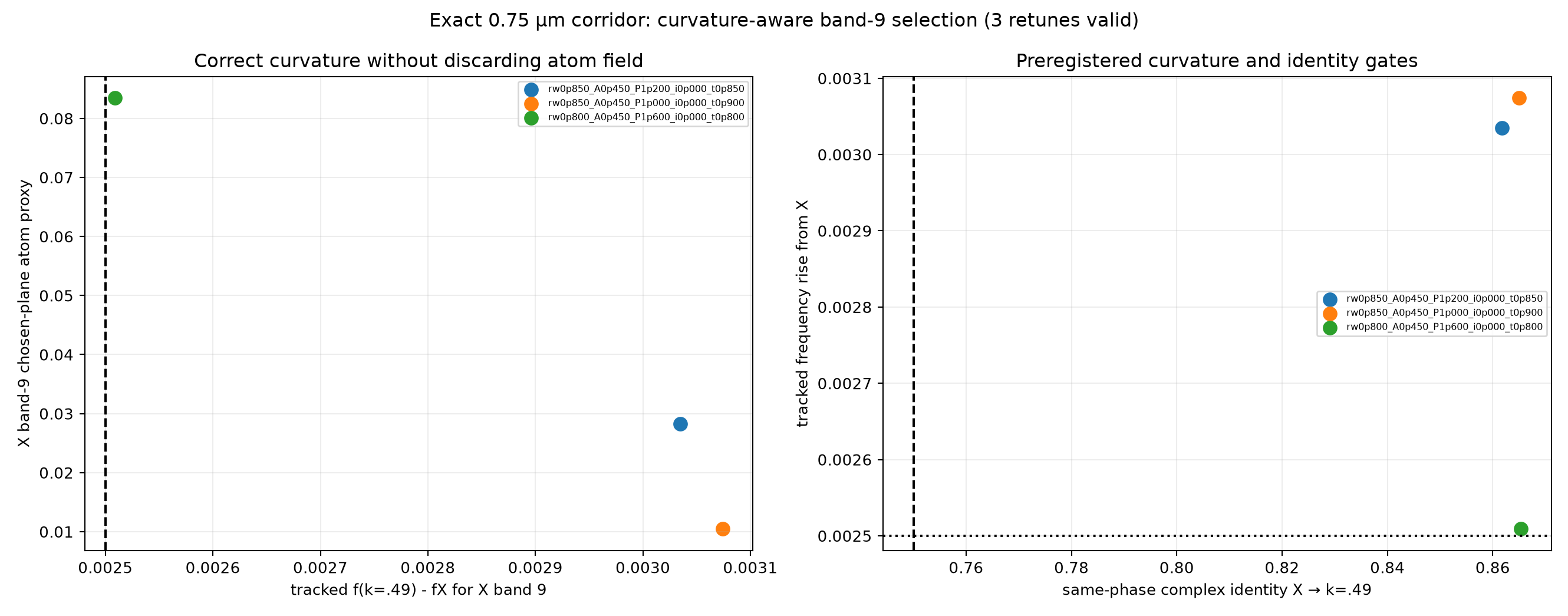
Curvature-aware full-vector restart: one-based X band 9
The failure motivated a fail-closed selector change. Before retuning, each geometry was searched by full-vector field identity for an X mode that rises toward the target when moving to k=.49. The preregistered requirements were: one-based MPB band number recorded explicitly, frequency rise ≥.0025, same-phase complex identity ≥.75, and guided clearance ≥.005 at k=.49.
The physical seed is one-based MPB band 9, not band 10. All three prechecks pass:
| Geometry | X band-9 atom proxy | Rise f(.49)-f(X) |
X→.49 identity | Guided clearance at .49 |
|---|---|---|---|---|
| rw/t=.85/.85, p=1.2 | .028262 | .003035 | .861749 | .020801 |
| rw/t=.85/.90, p=1.0 | .010459 | .003074 | .865015 | .028057 |
| rw/t=.80/.80, p=1.6 | .083444 | .002509 | .865331 | .005419 |
This establishes the local branch direction and identity at the original periods. It does not establish a target root, a retuned margin, or a mirror.
Machine-readable curvature-aware band-9 precheck
Physical-band-9 retunes: 3/3 stable, 0/3 clear 9%
All three one-based band-9 retunes reach the exact target-depth condition and remain v3-stable. Their post-retune Pareto values are:
| Geometry | Retuned atom proxy | Retuned X margin | V3 identity to original seed |
|---|---|---|---|
| rw/t=.80/.80, p=1.6 | .178321 | .021576 | .973477 |
| rw/t=.85/.85, p=1.2 | .059356 | .052628 | .992973 |
| rw/t=.85/.90, p=1.0 | .016948 | .071000 | .998520 |
No row clears the 9% post-retune guidance gate. The precheck margins cannot be inherited: retuning changes the period and target normalization, so light-line separation must be recomputed on the retuned physical band. The correct-curvature restart repairs the branch-selection error, but has not yet produced a guidance-eligible center.
Machine-readable physical-band-9 retunes
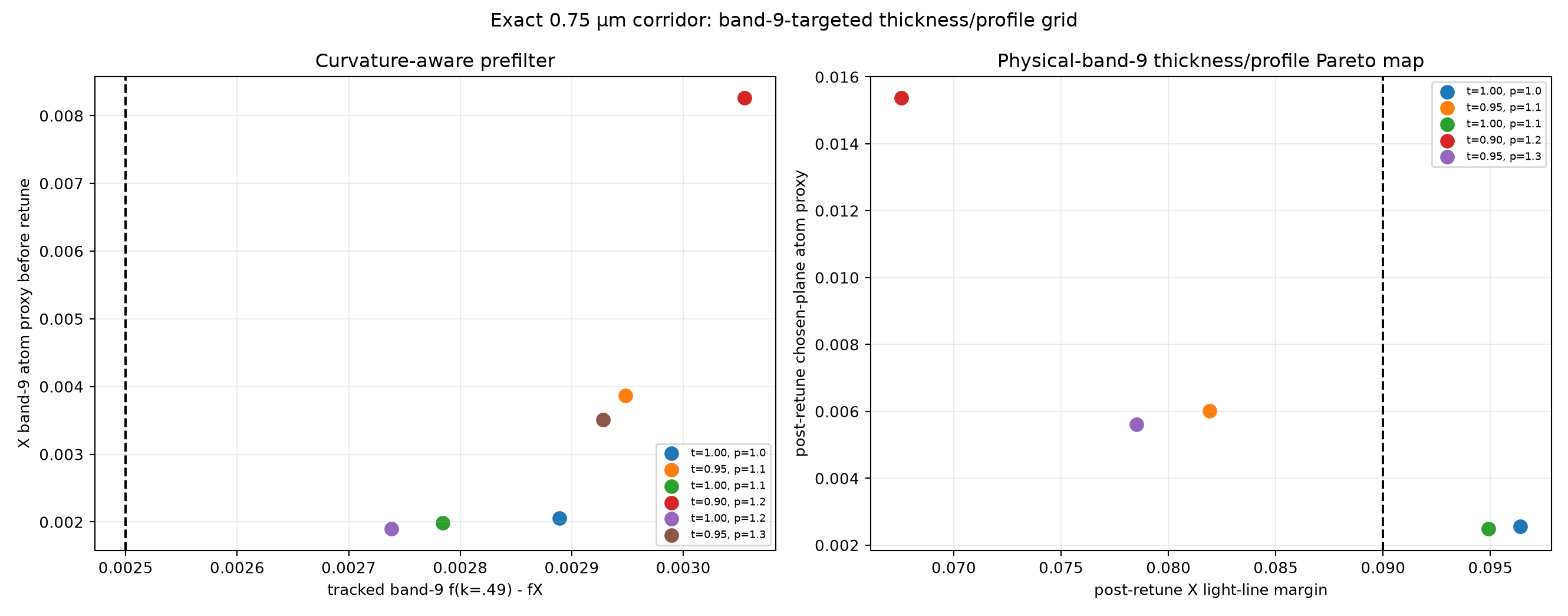
Targeted band-9 thickness/profile screen: first post-retune margin passes
The compact local r8 screen is complete: 5/5 attempted cells are valid
one-based physical-band-9 retunes, with the exact inner walls still fixed at
y=±0.375 µm. Two rows are the first genuine post-retune candidates to
clear the preregistered 9% X light-line-margin gate:
Thickness/profile t,p |
Exact retuned period (µm) | X→target depth | Post-retune X margin | Boundary-plane atom proxy | Phase | V3 seed identity |
|---|---|---|---|---|---|---|
| 1.00, 1.00 | .35446373798808195 | .0024949048345149216 | .096388 | .002565969679086497 | boundary | .999240061 |
| .95, 1.10 | .36011968287617150 | .0025028857738279564 | .081906 | .006020039098979226 | boundary | .998743100 |
| 1.00, 1.10 | .35504323786225310 | .0025016248619054160 | .094916 | .002483771306174425 | boundary | .999257794 |
| .90, 1.20 | .36570969308207850 | .0024923610710531063 | .067556 | .015365246942385556 | boundary | .997817500 |
| .95, 1.30 | .36144272602230904 | .0024985731855698410 | .078506 | .005609945968604174 | boundary | .998707000 |
These are guidance-eligible center-cell hypotheses, not cavities. Their atom proxies remain weak, are normalized local-field screening quantities, and are not mode volumes, Purcell factors, or emitter β values.
Machine-readable targeted band-9 thickness/profile screen
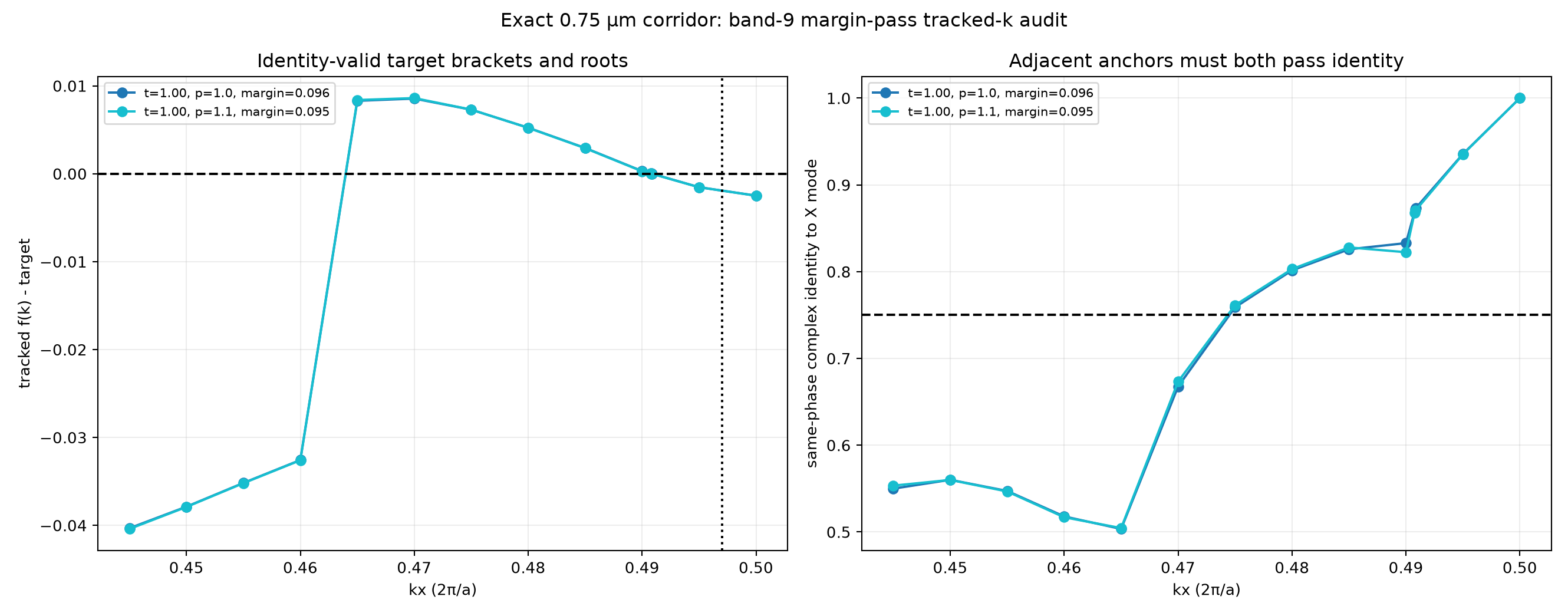
Both authoritative center roots pass; both period-only mirrors fail
The final authoritative tracked-k artifact contains both post-retune margin passes. Each adaptive identity-tracked center solve finds a guided physical band-9 target root:
t,p |
Root k |
Absolute normalized detuning | Same-phase identity | Guided clearance |
|---|---|---|---|---|
| 1.00, 1.00 | .49086690118539084 | 9.516548510335454e-8 | .873247987181431 | .03656599635087593 |
| 1.00, 1.10 | .4908317904465669 | 3.751380945882232e-7 | .8702898866527531 | .03578816558466147 |
Both rows clear the .75 same-phase identity gate and .005 guided-clearance
gate. For each candidate the seven promotion gates are
true,true,true,true,false,false,false: exact corridor, target depth,
identity-tracked center root, and ≥9% margin pass; mirror gap/identity path,
monotonic mirror strength, and no guided target leakage fail.
The center modes are therefore trustworthy at local r8 for the implemented
identity and guidance gates. The period-only mirrors are not. For each
candidate, all five mirror identity anchors at period ratios .995, .959,
.923, .887, and .860 pass both previous-cell and center-cell identity.
Nevertheless, all 16 period-reduction points from .995 through .860 fail
target_inside_selected_X_gap; every point has gamma=0, and each mirror
terminates with no eligible tracked X gap. Final passing_count=0, the
proposed r10/r14 list is empty, and no finite-cavity build or FDTD is
authorized. This rejects period chirping, not either center root.
Machine-readable authoritative center/mirror audit
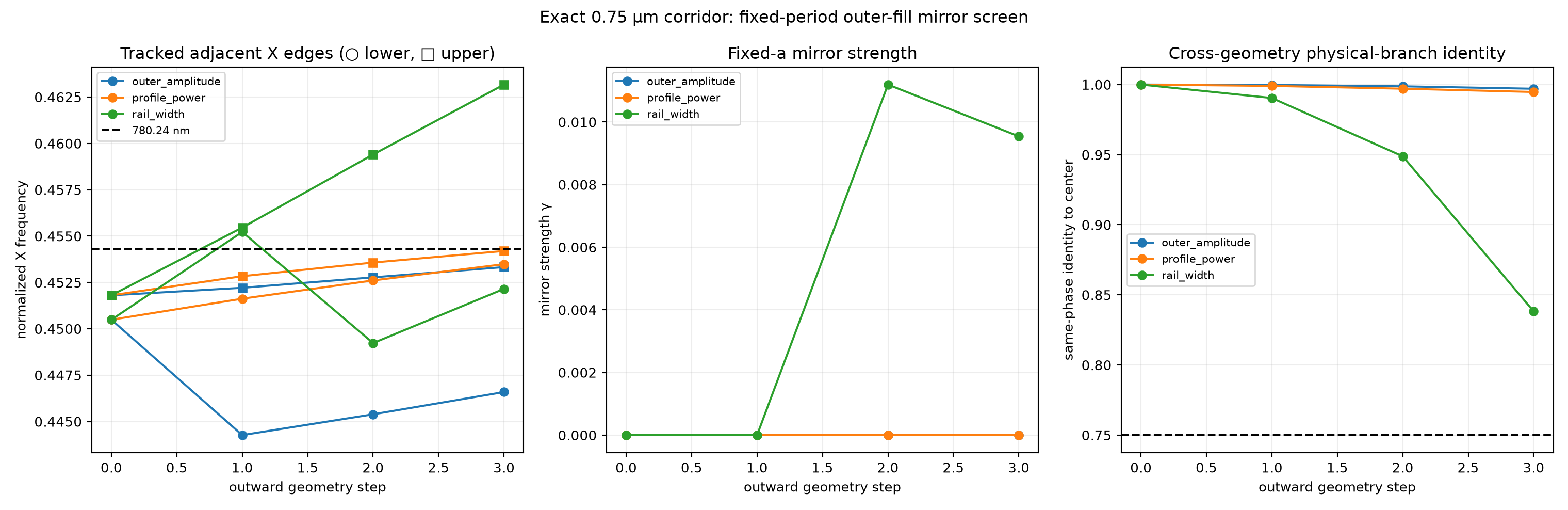
Fixed-period outer-geometry mirror screen: rail-width near-path only
The Quan–Loncar design recipe keeps the
periodicity fixed while tapering filling geometry, then uses the resulting
mirror-strength trend to construct a Gaussian-like cavity envelope. That
specific construction motivated the completed local r8 pivot: hold
a=.35446373798808195 µm, t=1.00 µm, and the exact 0.75 µm corridor fixed,
then screen outer amplitude, profile power, and rail width as separate mirror
coordinates. The preregistered screen contains exactly nine cells:
A=.40/.35/.30, p=1.2/1.4/1.6, and
rail=.80/.75/.70 µm. Cross-geometry complex overlap is evaluated on the
separate physical coordinate domains.
| Fixed-a path | Target-in-gap result | Mirror strength / identity | Decision |
|---|---|---|---|
Outer amplitude .40/.35/.30 |
0/3 eligible | γ=0 throughout; every identity anchor passes | reject this sampled direction |
Profile power 1.2/1.4/1.6 |
0/3 eligible | p=1.6 is the closest miss: upper edge .454197 versus target .4543009048 |
bounded near-miss, not a mirror |
Rail width .80/.75/.70 µm |
.75 and .70 eligible |
at .75: γ=.011195979001138343 and identity-to-center=.9488170013832239; at .70: γ=.009540087465512773 |
γ decreases outward, so monotonic gate fails |
Thus recommended_path=null: no sampled geometry coordinate provides the
required contiguous, outward-monotonic positive-γ mirror path. The next local
step is a bounded preregistered rail-width interpolation around the onset
between .80 and `.75 µm, seeking a monotonic ramp without extrapolating
beyond the measured branch.
Even a future mirror pass will not be sufficient by itself. The surviving
center and mirror-cell atom proxies are only about .001–.003. Before any
paid simulation, a locally assembled finite cavity must therefore prove the
intended boundary-plane atom antinode and pass an atom-referenced
volume/field-overlap proxy gate; otherwise a strong mirror could still produce
a poor atom cavity.
Machine-readable fixed-a outer-geometry screen plan
Machine-readable completed fixed-a outer-geometry screen
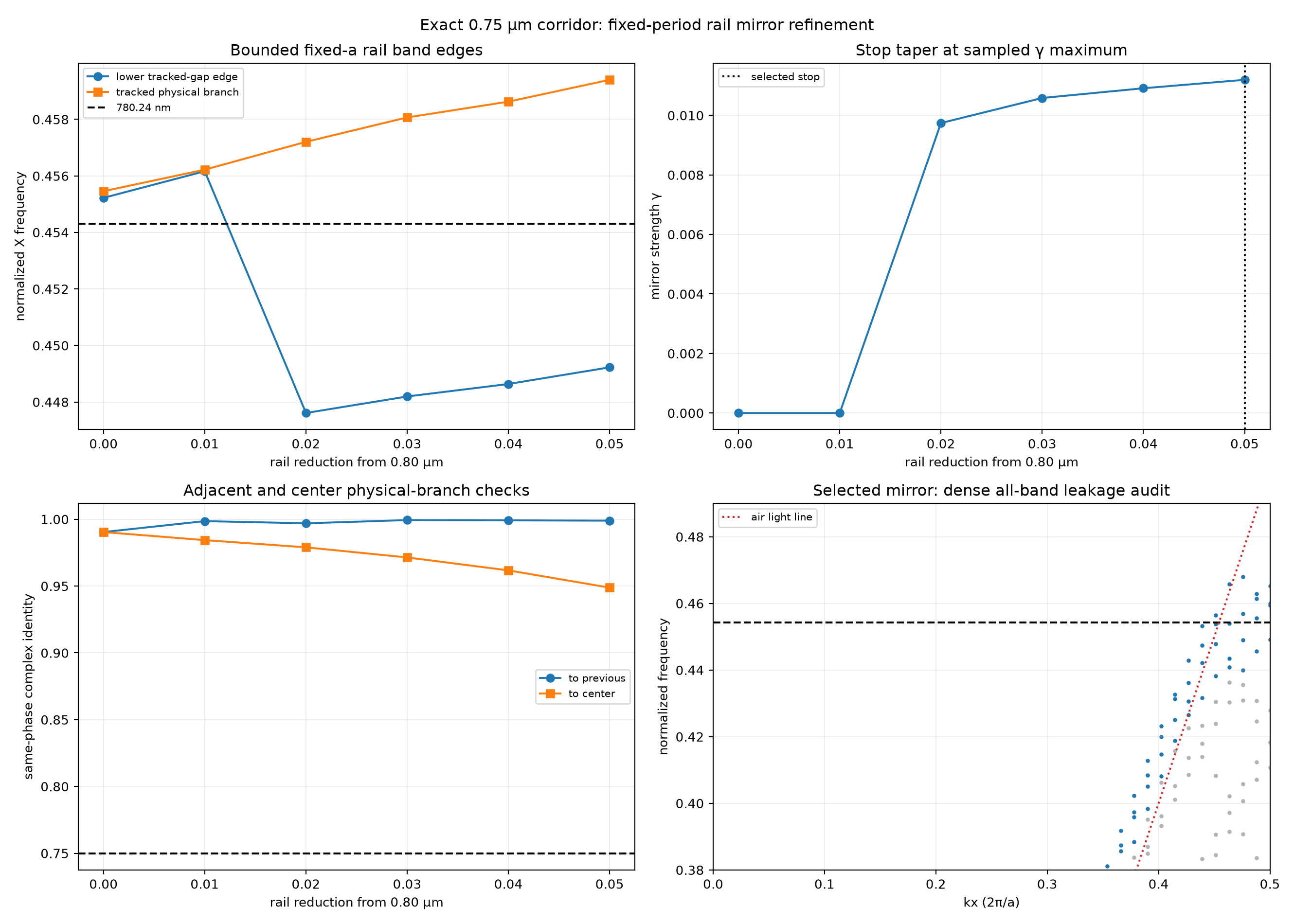
Bounded rail refinement: X-gap path passes, dense-k leakage veto fails
The preregistered fixed-a rail interpolation reuses the .80 and .75 µm
endpoints and adds .79, .78, .77, and .76 µm. It finds a contiguous
eligible onset at rw=.78 µm; same-phase identity passes from the center
through the selected .75 µm stop, and γ rises monotonically over the
selected interval:
| Rail width (µm) | Target in tracked X gap? | γ | Identity to center |
|---|---|---|---|
| .80 | no | 0 | .990402856 |
| .79 | no | 0 | .984379249 |
| .78 | yes; onset | .009742829800473946 | .978993257 |
| .77 | yes | .010584617498594828 | .971404923 |
| .76 | yes | .010911948946442223 | .961729833 |
| .75 | yes; sampled γ maximum | .011195979001138343 | .948817001 |
That is a successful X-point mirror-strength seed, but it is not a
complete mirror. The mandatory 41-k Γ→X all-band audit of the selected
.75 µm cell finds two real guided target crossings:
| Guided leakage channel | Interpolated k |
Field-identity conclusion |
|---|---|---|
| sorted band 8 | .4853478429817799 | does not match the tracked X branch |
| sorted band 9 | .46483271609699095 | does not match the tracked X branch |
The fact that neither leakage mode is the tracked X branch does not make it
safe: both are guided, lie in the same computed symmetry sector, and provide
real target-frequency propagation channels. Therefore
all_local_mirror_gates_pass=false. There is no r10/r14 proposal, supercell,
finite cavity, FDTD, or cloud action. This result is retained only as an
X-gap-engineering seed.
Machine-readable bounded rail-refinement plan
Machine-readable bounded rail-refinement result and dense-k veto
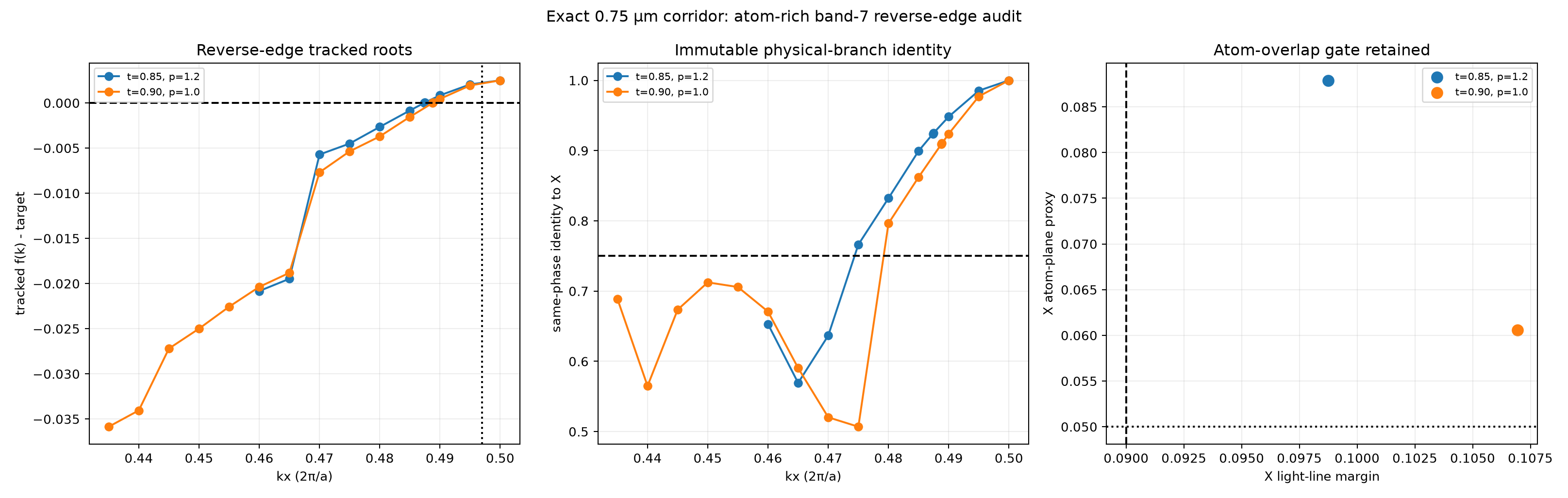
Preregistered atom-rich reverse-edge center pivot
The next local experiment returns to the atom-richer one-based physical
band 7, whose X point is a local maximum. Instead of putting the target
.0025 above X, the reverse-edge retune preregisters
X frequency − target = +.0025, so the downward-curving branch can cross the
target away from X.
Exactly two seeds are admitted:
Seed t,p |
Band | Existing atom proxy | Existing X margin | Longitudinal phase |
|---|---|---|---|---|
| .85, 1.20 | 7 | .09398494757495487 | .09427200000000002 | cell center |
| .90, 1.00 | 7 | .06492298642978424 | .10288600000000003 | cell center |
Because both atom antinodes are at the cell center, any later finite geometry
must be shifted by a/2 to put the atom at that antinode. After an
identity-valid guided center root, a conditional dense 41-k all-band audit
must find exactly one guided target crossing in the computed symmetry
sector, and that crossing must be the tracked physical branch. This stage
contains no mirror scan, supercell, Tidy3D, or paid cloud action.
Machine-readable atom-rich reverse-edge plan
Atom-rich reverse-edge result: one complete center passes
Both exact-gap band-7 retunes remain identity-stable, cell-center-phase, and
above the 9% X-margin and .05 atom-proxy gates. The stronger
t=.85,p=1.2 row is the first center in this campaign to pass the complete
six-gate local audit:
| Center candidate | Exact retuned period (µm) | Atom proxy | X margin | Tracked root k |
Root identity / clearance | Dense 41-k result |
|---|---|---|---|---|---|---|
| t=.85,p=1.2 | .3496489818206768 | .08790495692498193 | .09874000000000005 | .4873829775132713 | .9239528864865482 / .03925293826806886 | one guided b7 crossing at k=.4872769995775169; field-match identity .9228732875315956 |
| t=.90,p=1.0 | .34644461855851805 | .06057966936832617 | .10695000000000000 | .4887967264126080 | .9093714398521513 / .04477358153600847 | intended b7 at .489435552898245 plus competing guided b8 at .4458558382359984; reject |
For the winner, the root is physical band 7 with normalized detuning
9.60754797552088e-7. All six gates are true: exact corridor, reverse-edge
depth, identity-tracked root, ≥9% margin, atom proxy ≥.05, and exactly one
intended guided crossing in the dense all-band audit. Its field is at the
cell-center phase, so the later finite geometry must retain the explicit
a/2 shift that puts the atom at the antinode.
Machine-readable reverse-edge retunes
Machine-readable reverse-edge tracked-k and dense center audit
Atom-rich fixed-a air-mode mirror: complete local mirror passes
The preregistered air-mode mirror keeps the winner's
a=.3496489818206768 µm, t=.85 µm, p=1.2, A=.45 µm, and exact
0.75 µm corridor fixed while reducing only the rail width:
| Mirror rail width (µm) | γ | Same-phase identity to center | Atom proxy |
|---|---|---|---|
| .82 | .021583498857239734 | .9944416738146739 | .08784465789166321 |
| .79 | .026068974160620678 | .9757437044023763 | .08871516509049052 |
| .76 | .02873323938204174 | .9374668257302130 | .08812302546423656 |
The selected .76 µm mirror keeps the atom-field proxy essentially unchanged
while increasing γ and preserving strong cross-geometry branch identity. Its
mandatory 41-k Γ→X all-band veto finds zero guided target crossings.
Sorted bands 7–10 do cross the target, but all four crossings are below the
air light line and therefore are not guided leakage channels.
higher_order_same_symmetry_mode_veto_pass=true and
all_local_mirror_gates_pass=true.
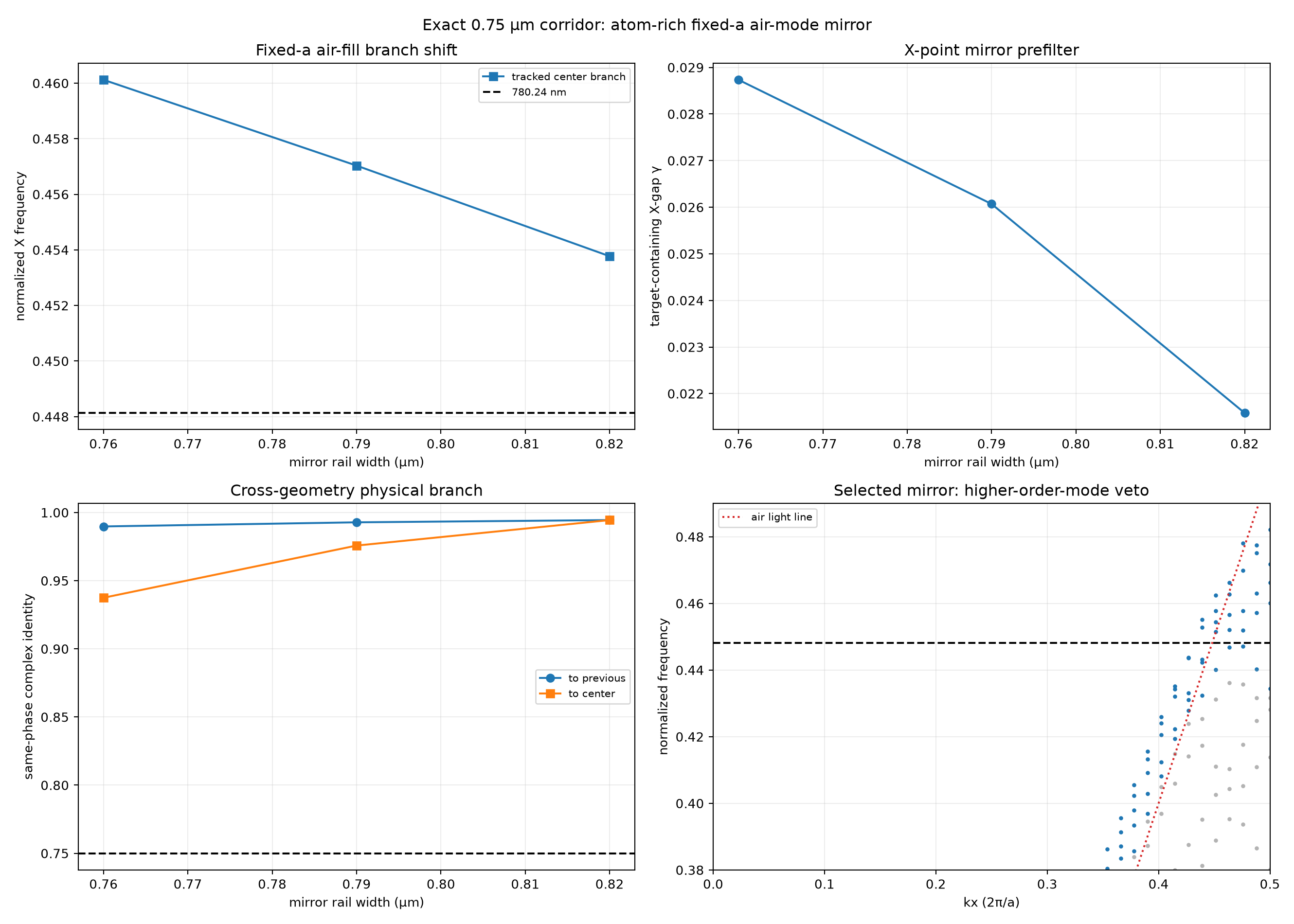
Machine-readable atom-rich fixed-a air-mirror plan
Machine-readable atom-rich fixed-a air-mirror result
Gamma-linear taper calibration
Two new X-only cells at rw=.84 and .83 µm fill the sparse region between
the center and the cached .82/.79/.76 µm mirror cells. All exact-gap,
same-phase identity, and phase-consistency gates pass. The measured local r8
calibration is:
| Rail width (µm) | γ | Identity to previous / center |
|---|---|---|
| .85 center | .014805656349205118 | 1 / 1 |
| .84 | .017490626661110144 | .9993569063865277 / .9993569063865277 |
| .83 | .019719148740384825 | .9991781859489228 / .9974026430196624 |
| .82 | .021583498857239734 | .9993577326094574 / .9944416738146739 |
| .79 | .026068974160620678 | .9928059867749169 / .9757437044023763 |
| .76 mirror | .028733239382041740 | .9897825322124899 / .9374668257302130 |
A monotone PCHIP fit of Δγ versus rail reduction is inverted at eight equal
Δγ intervals. Including both endpoints, the resulting nine-cell
half-profile is:
[.85, .8437262381170318, .8366286200098854, .8284576342211750,
.8188995956654914, .8083841781239516, .7966438969230470,
.7813287926001160, .76] µm
.
The predicted maximum fractional departure from a linear Δγ ramp is
8.72828130435333e-8. A simple quadratic rail-width profile, retained only
as a diagnostic comparison, misses linear mirror strength by
0.13731747818555531 (13.7317%). The calibrated profile is therefore the
authoritative taper input.
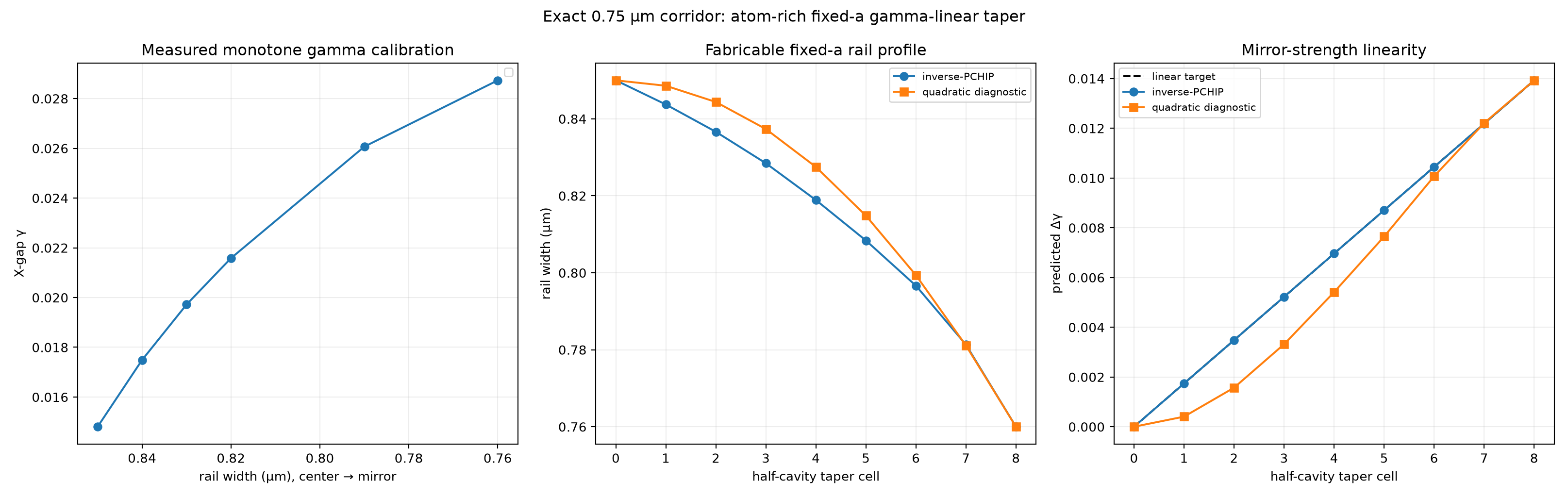
Machine-readable gamma-taper calibration plan
Machine-readable gamma-taper calibration and half-profile
The exact 0.75 µm corridor and cell-center a/2 finite-geometry phase action
remain unchanged. This calibration stage performs no new full-k audit,
supercell, FDTD, or cloud action. The next gate is r10/r14 convergence of the
center, mirror, and calibrated taper cells.
In-progress r10/r14 convergence: mirror blocked at r10
The r10 center remains healthy: its tracked root passes at
k=.4875740466. The r10 mirror X gap also remains strong, with
gamma=.02869444. However, the preregistered 31-k all-band mirror audit finds
two tiny guided band-6 target crossings at approximately
k=.4670488 and .4686695. The mirror is therefore blocked, even though
the X-point gap itself passes.
| In-progress gate | r10 status |
|---|---|
| Center root | pass at k=.4875740466 |
| Mirror X gap | γ=.02869444 |
| Complete all-band mirror | fail/blocked: two guided b6 target crossings |
| r14 | running; must distinguish a physical leakage channel from an r10 resolution artifact |
The inverse-PCHIP taper above remains a local r8 calibration only and is not promoted by this partial result. No supercell, FDTD, cloud action, or new FC is authorized while r14 is unresolved.
Machine-readable center/mirror r10/r14 convergence plan
This is the campaign's first strong center + complete-mirror pair at local r8. It is not yet a finite cavity: r10 reveals two candidate guided mirror leakage channels and r14 remains unresolved. There is no completed r10/r14 convergence, supercell atom-antinode/volume proxy, Q, mode volume, Purcell factor, or β. No supercell, FDTD, upload, estimate, submission, start, or cloud charge has occurred for this checkpoint.
This checkpoint is local-only: zero Tidy3D uploads, estimates, submissions, starts, or FC. No cloud action has occurred since 2026-07-29 06:42:06 UTC. The fishbone ledger remains unchanged at 15.511193 FC conservative started maximum, 9.438848 FC actual charge, and 9.488807 FC remaining. The separate 5 FC trustworthy-observables allocation remains fully unspent, with 2.980129 FC binding headroom. No FDTD is authorized until both a center root and an eligible mirror path pass.
What “tweezer accessible” does and does not establish
The access evidence has three distinct levels:
- Guaranteed geometry: the ideal CAD contains an unobstructed straight air corridor of the stated minimum width. This proves that the tweezer axis can approach without intersecting dielectric in the ideal geometry.
- Gaussian-tail geometry proxy: a finite beam can overlap the corridor walls even when its axis is clear. For example, the saved waist-plane proxy for an assumed 0.40 µm waist gives 21.13% outside a 0.50 µm slot versus 1.242% outside a 1.00 µm slot. These numbers are only ideal Gaussian integrals; they contain no material, polarization, wavelength, roughness, or scattered-field physics.
- Actual scattering and heating: not simulated. A credible next model needs the tweezer wavelength, waist, polarization, trajectory, fabricated geometry/materials, and an experimental heating threshold. It must compute the perturbed electromagnetic tweezer field and connect that result to trap potentials and relevant heating mechanisms. See Nanotrappy for trap-potential modelling near nanostructures and Heating in Nanophotonic Traps for Cold Atoms for an analysis of mechanically mediated heating near nanophotonic structures.
A clear corridor therefore does not prove “no scattering” or “no heating.” It is a necessary geometric condition, while the finite-beam and surface-coupling questions remain open.
There is no promoted paid-FDTD candidate from this design family. The later 0.60 and 0.50 µm paid diagnostics both fail to recover a 780 nm pole. The full-k audit then disqualifies the unsubmitted 1.00 µm branch because its terminal mirror supports a guided target crossing. The access-versus-overlap trade remains physical, but this specific three-branch family is stopped.
- Corrected r8 screen and semantics checks
- Separated r8/r10/r14 validation
- Independent r14 period-to-gamma curves
- Local Auto-14/16 ps finite-cavity preparation
- Guarded serial trade-study runner
- Corrected full-k guided-gap diagnosis
- Conventional wider/thicker 50-case tune screen
- Conventional wider/thicker 50/50 field audit
- Conventional wider/thicker four-case decision
- One-micron-slot multiband and branch-reordering controls
- Field-tracked r8 seed screen (seed only)
- Invalidated v2 field tracker
- V3 complex-field identity self-test
- Completed v3 A=0.35 retune checkpoint
- Outer-amplitude refinement
- Authoritative g=1 tracked-k audit
- Profile-shape seed screen
- Profile-shape retune
- Profile-shape tracked-k audit
- Exact 0.75 µm profile seed screen
- Exact 0.75 µm profile retune
- Exact 0.75 µm geometry-interpolation seed screen
- Exact 0.75 µm geometry-interpolation retune
- Exact 0.75 µm adaptive original-band tracked-k audit
- Curvature-aware one-based band-9 precheck
- Physical-band-9 retunes
- Targeted physical-band-9 thickness/profile screen
- Authoritative physical-band-9 center/mirror audit
- Preregistered fixed-a outer-geometry mirror screen
- Completed fixed-a outer-geometry mirror screen
- Preregistered bounded fixed-a rail refinement
- Completed bounded rail refinement and dense-k veto
- Preregistered atom-rich reverse-edge center pivot
- Completed atom-rich reverse-edge retunes
- Completed atom-rich reverse-edge tracked-k audit
- Preregistered atom-rich fixed-a air-mode mirror
- Completed atom-rich fixed-a air-mode mirror
- Preregistered atom-rich gamma-linear taper calibration
- Completed atom-rich gamma-linear taper calibration
- Preregistered atom-rich center/mirror r10/r14 convergence
- Gaussian waist-plane clearance proxy
- Finite-Rayleigh-range extension
Goal: design and numerically demonstrate a nanophotonic cavity whose optical mode can couple to a trapped atom while the optical tweezer approaches through a continuous air corridor, without crossing a dielectric surface.
Current stage: a SiO₂ unit-cell family and finite-cavity geometry have been
selected by local MPB screening. A controlled taper-length screen reached a
centered diagnostic Q≈2,280 with 40 taper cells per side. Its 781.269 nm pole
is about three linewidths red of the 780.24 nm design assumption. A late-window
N40 exact-pole run passes the implemented time-window and internal-closure
gates, but finds a large atom-referenced volume of 45.65 µm³
(95.73 λair³)—11.53 times its dielectric-centered peak volume. The present
geometry therefore confines a cavity mode, but couples that mode only weakly
to an Ey dipole at the intended atom site. Three overlap-redesigned N40+M8
cavities with 1.00, 0.75, and 0.60 µm slots then produced only Q≈208, Q≈210,
and Q≈199, respectively. Those negative broadband diagnostics show that
strong local MPB mirror strength did not carry over to high finite-cavity Q.
Three lower-modulation hybrids now pass the local r12→r14 and padding-change
screen at the 5% level. The first hybrid broadband run returns a promising
Q≈19,563 and the wider 0.75 µm-slot hybrid gives Q≈11,838. Their 16 ps records
span only 0.978 and 1.616 fitted field-amplitude lifetimes, so both are
promoted for follow-up rather than accepted as final. The near-light-line
a=.38 control gives a better-sampled but lower Q≈2,649, confirming the MPB
radiation-risk ranking. A coherent exact-pole run on the leading 0.60 µm-slot
a=.37 cavity then closes Qflux/Qring to 0.9952 and gives
Vatom,Ey=13.24 µm³ (27.73 λair³), 3.02× its peak-referenced volume.
All implemented single-mesh method and time-window gates pass. However, the
fixed-geometry Auto-16 broadband repeat shifts the pole by −1.731 nm and
lowers ringdown Q to 13,593, a 30.38% change from the Auto-14 exact
ringdown. Auto-18 then falls again to Q≈4,007, Auto-20 rebounds to Q≈6,925,
Auto-22 rises again to Q≈9,550, and Auto-24 falls to Q≈4,491. The
Auto-14→16→18→20→22→24 sequence is therefore
≈19,563→13,593→4,007→6,925→9,550→4,491. The 5% mesh-convergence gate fails
decisively, and no Q or mode volume can be promoted. In contrast, expanding
the
air padding by 1 µm on every side and increasing the PML from 12 to 16 layers
changes the Auto-14 broadband Q by only 0.1717%; that domain/PML check passes.
The N32 lower-side taper diagnostic then falls to Q≈3,952, confirming strong
residual taper-length dependence and making the N48 upper-side check
mandatory. N48 returns a preliminary Q≈44,019 but spans only 0.434 fitted
amplitude lifetimes, so it fails the duration gate and is not promoted; it
does confirm that N40 is not taper-saturated. The current Auto-14 Q/Vatom
once implied a single-pole Purcell proxy of 53.509 and conditional β=0.98165.
The complete mesh failure disqualifies those inputs, so that proxy is now
retired and non-predictive, not merely uncertain. A representation audit
finds only femtometre-scale touching-box gaps, but shows that grouping changes
AutoGrid and a clean union changes thousands of conformal-ε samples. The
campaign has therefore pivoted to a bounded three-family robustness screen
ranked by worst-case Q across separated meshes. The first two connected-
PolySlab diagnostics reveal clean Q≈2,200–2,450 modes near 926 nm rather than
the 780.24 nm atom target. Uniformly scaling the smoother geometry by
approximately 0.8425 then fails: Auto-14 finds no eligible target-band pole,
while Auto-20 finds only a one-probe 787.96 nm hint with Q≈165 and high fit
error. That family is rejected. Paid work was then paused until a local
canonical connected-profile MPB model was believed to match the finite
two-PolySlab geometry and track the intended pole family explicitly. The
erratum above now shows that transverse-match claim was false. A completed
local semantics audit finds up to 7.48% X-point band shifts between the legacy
touching-block and canonical connected representations. A subsequent coarse local
period-chirp screen ranks a 0.75 µm-slot raised-cosine candidate first. The
completed r10/r14, padding, and near-X repeat passes every declared local
gate, with the explicit caveat that band 4 is below the air line only very
near X. The matching Auto-14/20 finite-cavity pair then fails: Auto-14 has no
pole in the declared search window and an inconsistent 829 nm fallback;
Auto-20 has a clean 766.62 nm pole, but Q≈518 is off-target, below the
minimum useful-Q gate, and absent at Auto-14. The canonical family is
rejected. A local FDTD-aware calibration then identified two Auto-20 edge
families around 766.62 and 828.34 nm, retired Auto-14 as underresolved for
this geometry, and predicted that a 2.3373% period increase would move the
lower-edge finite pole to 780.23 nm. The original-period Auto-24 control
reproduces the Auto-20 pole within 0.0382% in wavelength and 0.93% in Q, so
that prerequisite passes. The retargeted Auto-20/24 pair now finds the same
clean ≈780.6 nm, Q≈542 pole with only 0.0375% wavelength spread and 0.271%
Q spread. Auto-22 then keeps the three-mesh family tight, and an expanded
domain/PML-16 Auto-22 repeat changes Q by only 1.06%; both final numerical
gates pass. The geometry is now a validated low-Q calibration/control cavity,
but its Qworst=541.504 is below the declared Q=1,000 usefulness floor.
A subsequent high-light-line-margin seed passed all 11 internal r10/r14,
padding, and near-X MPB checks. Those MPB values are now invalidated by the
centroid-semantics erratum and cannot be assigned to the FDTD geometry. Its
independent Auto-20 M12/M16 FDTD screen produces clean Q≈2,071/3,834 poles,
about 3.8×/7.1× the robust control, but both land near 767.4 nm and span fewer
than three fitted lifetimes. M16 wins only as a geometry-calibration seed. A
geometry-specific own-bias correction and stricter Auto-20/24 pair are now
complete: λ=780.145/779.648 nm, Q=3,542/3,585, ≥4.41 lifetimes, and only
1.196% Q spread. Independent Auto-22 returns λ=779.986 nm and Q=3,555.33;
the full Auto-20/22/24 family spans only 0.06364% in wavelength and 1.19675%
in Q, with Qworst=3,542.42. Expanding the domain and PML changes wavelength
by 0.000611% and Q by 0.000286%. All preregistered broadband numerical
promotion gates pass. A matching exact-pole v1 then passes its Q, frequency,
energy-balance, and flux-closure checks, but its apparent mode volume changes
by 20.278% between the early and main windows. That fails the declared 5%
stability gate, so neither 0.5154 nor 0.6465 µm³ is promoted. A later-window
v2 repeat with a common 2 ps start then passes every implemented method and
window gate: Vatom,Ey=23.505 µm³=49.534 λair³, stable to 0.00464%, while
Vpeak=3.506 µm³. The numerical observable is trustworthy at Auto-22 on the
externally broadband mesh/domain-converged geometry, but it is a negative
design result: the atom volume is 6.704× the peak volume and the field peaks
in silica, not at the atom. Exact V has not been repeated on a second mesh
because this failed-overlap geometry will not advance. Purcell enhancement
and emitter β remain unmeasured. Results below are labeled by evidence level;
this is a numerically converged cavity-Q and method/window-stable exact-pole
result, not a validated atom-cavity design.
After discovery of the MPB placement error, a corrected-coordinate r8 screen
and separated r8/r10/r14 rerun were completed locally. They prove that the
printed gaps now match the declared 0.50, 0.60, and 1.00 µm corridors. Only
the 0.50 µm optical-overlap branch passes every declared local optical and
convergence gate. The 0.60 µm inner-wall and 1.00 µm access-first branches
fail their atom-field gates. No branch is unconditionally promoted because
choosing 0.50 µm over 1.00 µm is an unresolved physical tweezer-access trade,
and neither geometric clearance nor the Gaussian-tail proxy establishes
actual scattering or heating. The project separately selected the 0.60 µm
branch for one exploratory Auto-14/16 ps diagnostic. It finds no positive-Q
target-band pole; off-target 867.47 and 932.50 nm fits are not promoted. The
failed local convergence label therefore remains, and this branch stops. The
0.50 µm branch—which did pass every local MPB gate—also finds no positive-Q
target-band pole. Its clean 933.84 nm, Q≈3,554 wider fit is diagnostic only.
Together the paid negatives falsify the current corrected-unit-cell-to-finite-
cavity promotion logic. A completed local full-k audit then disqualifies the
1.00 µm branch because its terminal mirror has a guided band-4 target crossing
away from X. The 0.60 µm center remains only an ambiguous X-edge touch. The
0.50 µm branch does have a guided center state and complete guided mirror gap,
so neither X-only screening nor a phase/taper-direction mistake explains its
paid negative. The 933.84/867.47 nm poles instead follow propagating
lower-family branches and are finite-length/Fabry–Perot-like diagnostics.
Further paid FDTD is paused. A conventional wider/thicker band-4 screen tuned
and field-audited 50/50 local cases, then full-k/mirror-audited four gap-wise
shortlists; zero pass and the proposal list is empty. The access-first g=1
row has 9.7694% X margin but weak 0.025685 atom proxy, reorders to center band
5, and leaks through guided mirror band 4. Because fixed sorted bands are only
diagnostic, the field-tracked g=1 path was then used. It shows that band 4
rail-localizes and that the useful slot-like field reorders from band 6 to
band 8 with thickness. The attractive t=0.50 µm X-point branch fails the
full-k center/mirror test. The exact-retuned t=0.80 µm branch has a real guided
crossing but only 0.003393 clearance, below the preregistered 0.005 gate. The
accompanying 15/15 r8 field-tracked screen is seed-only. No new FDTD or cloud
spend was used for these checkpoints. Its v2 intensity-only continuation was
then invalidated because it allowed a different mode to self-stabilize.
The replacement v3 same-cell-phase, full-3D complex-E tracker completes 15/15
A=0.35 attempts with 13 valid and two unresolved. Only rw=1.10/t=0.80 and
rw=1.10/t=0.90 clear 9% X margin, with weak atom proxies 0.024697 and
0.015578. The first control has zero guided full-k target crossings and is
disqualified before its mirror solve. The completed outer-amplitude
refinement shows a monotonic margin-versus-atom-field trade; its authoritative
tracked-k follow-up passes 0/4. The completed profile-shape screen has five
v3-valid rows out of eight and only one ≥9% margin row, whose atom proxy is
weak; its tracked-k shortlist passes 0/3. Every failed center skips its mirror,
so neither g=1 path produces a finite-cavity proposal. Research has moved to
a compact 0.75 µm open-corridor local MPB pivot, within the allowed
0.5–1.0 µm range. Its exact inner walls stay at ±0.375 µm for every x. The
six-cell profile screen completes ⅚ v3-valid with no ≥9% margin row; the
four-cell interpolation completes 4/4 valid and finds two ≥9% prefilter
points. Their adaptive original-band tracked-k audit passes 0/3: the
identity-tracked band-7 frequencies all remain below target while the coarse
sorted crossings belong to other modes. A curvature-aware full-vector
precheck instead selects one-based band 9 in all three geometries. All three
physical-band-9 retunes are exact and v3-stable, but their post-retune margins
are only 2.1576%, 5.2628%, and 7.1000%; none clears 9%. The targeted
thickness/profile screen then finds the first two genuine post-retune ≥9%
rows, t=1,p=1 and t=1,p=1.1, both with weak atom proxies. The
authoritative p=1 tracked-k audit passes its guided center root at
k=.49086690118539084, but all 16 period-reduction mirror cells fail to put
the target inside the tracked X gap even though all five identity anchors
pass. The completed p=1.1 row independently passes its center root at
k=.4908317904465669 and fails all 16 period-only mirror points in the same
way. Final passing count is zero and the r10/r14 proposal list is empty. The
completed nine-cell fixed-a geometry screen finds no amplitude or profile
path; rail widths .75 and .70 µm enter the target gap, but γ falls from
.011196 to .009540, violating the outward-monotonic gate. The bounded
.80→.75 µm refinement then finds a clean eligible onset at .78 µm and a
monotonic γ ramp through .75 µm, but its mandatory 41-k all-band audit exposes
guided target crossings at k=.485347843 and .464832716. Neither is the tracked
X branch, yet both are real same-sector leakage channels, so the complete
mirror gate fails and nothing advances. The reverse-edge pivot then retunes
two atom-rich, downward-curving band-7 seeds to a target .0025 below X. The
t=.85,p=1.2 row wins: atom proxy .087905, margin .09874, identity-valid root
at k=.487382978, and exactly one field-matched guided b7 crossing in the
dense audit. The t=.9,p=1 comparison has an extra guided b8 channel and is
rejected. A fixed-a air-mode mirror then preserves ≈.088 atom proxy while γ
rises to .028733 at rw=.76; its 41-k all-band audit finds zero guided target
crossings, so all local mirror gates pass. This is the first strong local
center+mirror pair. The completed inverse-PCHIP taper calibration converts
the measured γ curve into an eight-cell-per-half profile with
8.728e-8 maximum fractional linearity error, versus 13.7317% for the
quadratic diagnostic. The in-progress convergence run keeps the r10 center
root and mirror X gap, but two tiny guided band-6 target crossings in the
31-k mirror audit block promotion; r14 is running to test whether they survive
higher resolution. No supercell or finite cavity has run. No FDTD/cloud
action has occurred since
2026-07-29 06:42:06 UTC, and both ledgers are unchanged.
The active researcher is using free/local MPB work first. Paid Tidy3D work has a hard project cap of 25 FlexCredits (FC). The ledger on this page is the authoritative human-readable summary; its machine-readable source records every task ID, maximum estimate, state, and actual charge.
Visual status
| Question | Status | Evidence |
|---|---|---|
| Is there a continuous 1.0 µm air path from infinity to the atom site? | yes, geometrically | selected ideal CAD has 0.50 µm axis-to-surface clearance |
| Does the corrected SiO₂ cell have a useful guided stop band? | mixed by branch | full-k: gap050 center/mirror criterion passes, gap060 center is ambiguous, gap100 mirror has a guided target crossing |
| Can the center cells pull a guided mode into that stop band? | yes for finite candidates | multiple centered poles observed; latest exact hybrid Q≈19,525 |
| Is a finite resonance localized at the atom site? | diagnostic yes | N40: λ=781.269 nm, Q≈2,280; N32 exact-pole field is centered |
| Does the exact-pole energy and outgoing flux agree with ringdown Q? | single-mesh yes | latest hybrid Qflux/Qring=0.9952; nested/signed flux checks pass |
| Is the mode volume time-window stable? | yes for M16 v2 | Vatom changes 0.00464%; Vpeak changes 0.000193%; all exact method gates pass |
| Is the atom at the modal energy maximum? | no; M16 fails overlap | stable Vatom=23.505 µm³ is 6.704× Vpeak=3.506 µm³; field peaks in silica |
| Did the first atom-overlap MPB redesigns preserve high finite-cavity Q? | no | 1.00/0.75/0.60 µm-slot N40+M8 runs give Q≈208/210/199 |
| Is a smoother low-radiation hybrid available? | local MPB leads | three A=0.40, duty 0.50 cells pass r14/padding screen; first FDTD promoted |
| Do lower-radiation hybrids recover high finite-cavity Q? | two promising, not final | a=.37 slots .60/.75 give Q≈19,563/11,838; a=.38 control gives ≈2,649 |
| Are Q, mode volume, atom-field coupling, and port coupling converged? | Q yes; exact V method/window yes; β no | V2 is stable at Auto-22 on externally promoted geometry; no second exact mesh because overlap fails |
| Is a trustworthy emitter β available? | no | old 0.98165 proxy is retired with the disqualified N40 mesh sequence |
| Is a mesh-robust replacement cavity selected? | yes for broadband Q | high-margin M16 Auto-20/22/24 and expanded-domain gates pass with Qworst=3,542.42 |
| Is the empirically retargeted FDTD pole robust? | three-mesh + domain yes | tested FDTD poles converge near 780 nm; the old MPB prediction is withdrawn |
| Is there a geometry-matched connected MPB lead? | no; old claim withdrawn | declared MPB slot 0.75 µm, printed/effective slot ≈0.07492 µm because centroid conventions differed |
| Is the corrected MPB geometry placement verified? | yes, locally | canonical/new zero-inner controls have identical bands and ε; declared 0.75 µm prints as 0.7500014 µm |
| Does a corrected true-gap redesign pass local optical gates? | one branch only | 0.50 µm passes r8/r10/r14; 0.60 and 1.00 µm fail atom-field promotion |
| Does the exploratory corrected 0.60 µm cavity work at 780 nm? | no | Auto-14 finds no positive-Q target-band pole; diagnostic 867/933 nm fits are not promoted |
| Does the locally promoted corrected 0.50 µm cavity work at 780 nm? | no | Auto-14 finds no positive-Q target-band pole; clean 933.84 nm Q≈3,554 fit is off-target |
| Does the conventional wider/thicker band-4 family produce a new lead? | no | 50/50 field-audited and four full-k/mirror-audited; zero gate passes and zero r10/r14 proposals |
| Do wider one-micron-slot rails solve confinement and atom overlap together? | not yet | band 4 confines but rail-localizes; the field-selected t=.50 branch fails full-k, and exact-retuned t=.80 misses the 0.005 clearance gate |
| Is the field-tracked r8 seed screen a cavity result? | no; seed only | all 15/15 X-point cases completed locally, but no full-k mirror proof, finite cavity, Q, V, or β |
| Is v3 branch identity trustworthy at r8? | 13 valid; two unresolved | same-phase full-3D complex-E metric; 1.000 same-mode control and 0.001529 rejected jump |
| Does the first ≥9% v3 margin control have a guided center state? | no | rw=1.10/t=.80 has zero guided target crossings; mirror correctly skipped |
| Does g=1 outer-amplitude refinement produce a guided lead? | no; 0/4 tracked-k pass | A=.45/.55/.65 improves margin while reducing atom proxy; identity-valid adjacent brackets reject all four shortlisted centers |
| Does g=1 profile shaping produce a guided lead? | no; 0/3 tracked-k pass | five of eight retunes are identity-valid; only rounded p=.6 clears 9% margin, but all three shortlisted centers fail |
| Is the exact 0.75 µm prefilter complete? | yes; X-point evidence only | inner walls fixed ±.375 µm; profile screen ⅚ valid with zero ≥9%, interpolation 4/4 valid with two ≥9% |
| Does the original g=.75 selector survive tracked-k? | no; 0/3 pass | band 7 curves down from X; coarse sorted crossings belong to other field modes; every mirror skipped |
| Does curvature-aware band 9 produce a guidance-eligible center? | yes for two local hypotheses | targeted screen finds the first post-retune ≥9% rows at t=1,p=1 and t=1,p=1.1; both atom proxies remain weak |
| Do both ≥9% centers survive authoritative tracked-k? | yes locally | roots near k=.49087/.49083, identities .87325/.87029, and clearances .03657/.03579 |
| Does period-only tapering make either mirror? | no; each is 0/16 target-in-gap | each has 5/5 field-identity anchors pass, but every period ratio .995…860 has γ=0; final passing count 0 |
| Does fixed-a outer geometry make a monotonic mirror path? | no; rail near-path only | amplitude 0/3, profile 0/3; rw=.75/.70 enter gap with γ=.011196/.009540, so γ falls outward and recommended_path=null |
| Does bounded rail interpolation close the mirror? | no; X-gap seed only | rw=.78 onset and monotonic γ to .75 pass, but dense 41-k audit finds guided b8/b9 target crossings at k=.485348/.464833 |
| Does the atom-rich reverse-edge center pass? | yes; t=.85,p=1.2 | atom=.087905, margin=.09874, root identity=.923953, exactly one field-matched guided b7 crossing; t=.9 comparison has extra b8 leakage |
| Does its fixed-a air-mode mirror pass? | yes locally at r8 | rw=.76 has γ=.028733, center identity=.937467, atom=.088123, and zero guided crossings in the 41-k all-band audit |
| Is the taper linear in measured mirror strength? | yes at local r8 | inverse-PCHIP eight-cell half-profile has 8.728e-8 max fractional Δγ error; quadratic rail diagnostic misses by 13.7317% |
| Does the mirror pass at r10? | blocked | center root k=.4875740 and X-gap γ=.028694 pass, but 31-k audit finds two tiny guided b6 crossings near k=.46705/.46867 |
| What is the active local direction? | r14 resolution check | determine whether the r10 b6 crossings persist; r8 taper remains calibration-only and no supercell/FDTD is authorized |
| Does the M16 finite FDTD geometry improve Q? | yes, broadband Q converged | FDTD Auto-20/22/24 gives Q≈3,542/3,555/3,585; MPB explanation is invalid |
| Is dielectric scattering of the tweezer acceptably small? | not yet demonstrated | Gaussian-tail geometry proxy now shown; no electromagnetic scattering/heating model |
The older drawing below records the intended topology: two rails, a continuous central slot, and transverse fishbone teeth. Its blue material is the historical Si₃N₄ baseline, not the active SiO₂ material choice, and its illustrative dimensions are not a current candidate.
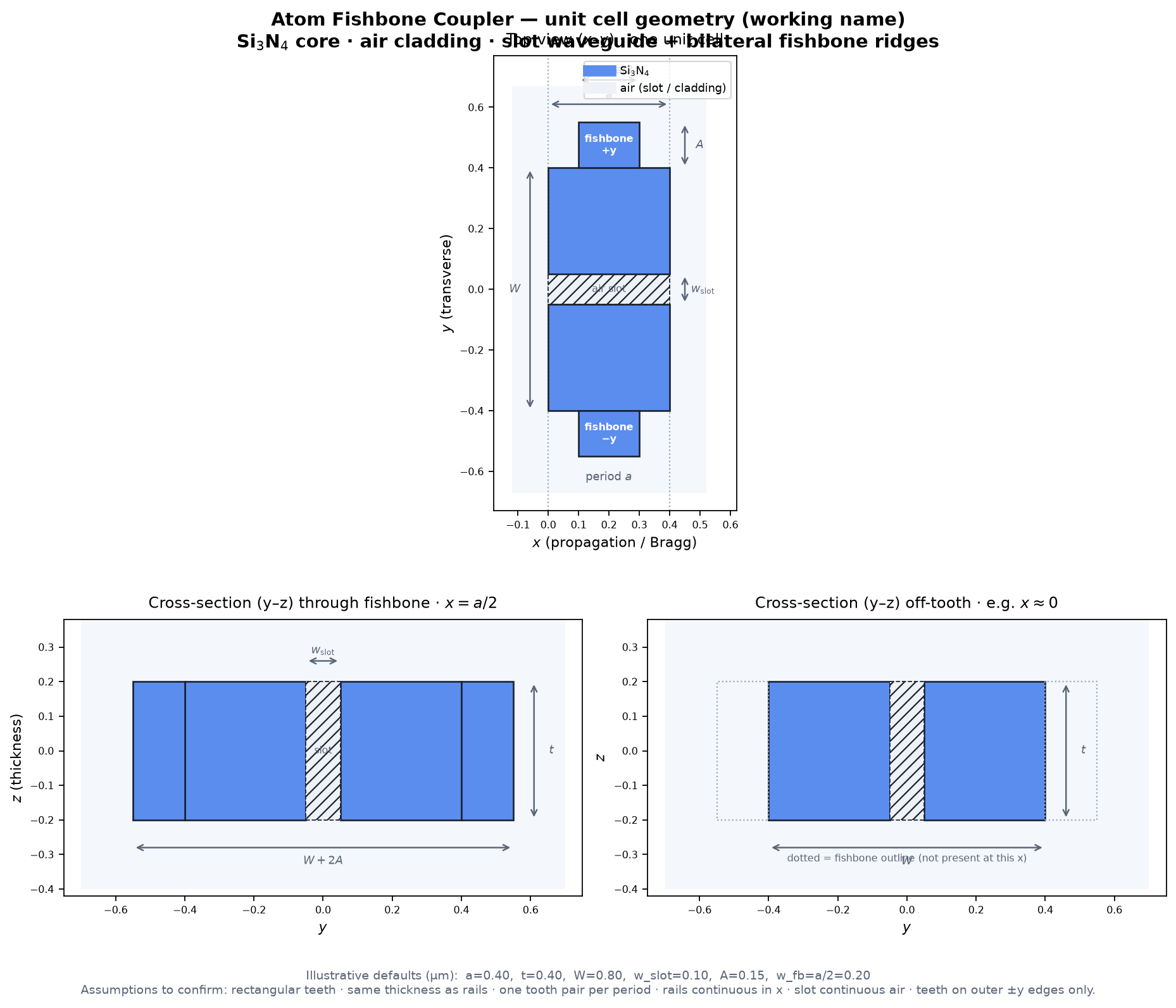
Physical design contract
Atom and tweezer access
- The atom site is in air, nominally on the centerline of a slot running along the cavity axis.
- The approach trajectory must connect the atom site to the exterior without intersecting any dielectric. The starting target is a 1.0 µm clear slot; 0.5–1.0 µm alternatives may be explored, but their reduced clearance must be reported explicitly.
- “The centerline does not touch dielectric” is necessary but not sufficient. A real focused tweezer has finite transverse extent and sidelobes. A later clearance gate must state the tweezer wavelength, waist, polarization, propagation direction, closest dielectric distance, and a quantitative dielectric-overlap or scattering proxy.
- The cavity field at the atom must be reported directly. A large field somewhere else in the air slot does not establish useful atom coupling.
Optical cavity
- Active material hypothesis: air-clad SiO₂ fishbone rails.
- Current spectral hypothesis: the Rb-87 D2 neighborhood, represented here by 780.24 nm. This is a design assumption until the intended isotope, transition, trapping fields, and required detuning are confirmed.
- Preferred mode: a guided, air-accessible cavity mode with a strong electric field at the proposed atom position.
- Desired evidence: a guided unit-cell stop band, a defect/taper that places a mode inside it, finite-cavity localization, Q, mode volume referenced to the atom position, and useful power coupling into identified ports.
Coordinates and units
| Axis | Meaning |
|---|---|
x |
propagation, Bragg periodicity, and cavity length |
y |
in-plane transverse direction across the central air slot |
z |
out-of-plane direction through the device thickness |
Physical geometry is recorded in micrometres. MPB frequencies are
dimensionless a/λ; MPB Bloch wavevectors use units of 2π/a unless a plot
explicitly relabels the horizontal axis as k_x/(π/a).
Why the plain slot is only a starting point
The existing local mode checks found that a 1.0 µm gap between ordinary SiO₂ rails supports guided modes in sufficiently large rails, but those modes are rail dominated. The largest sampled electric-intensity fraction in the gap was 8.2%. Very small rails produce near-light-line box/radiation states instead of a robust air-guided mode. These are useful negative controls:
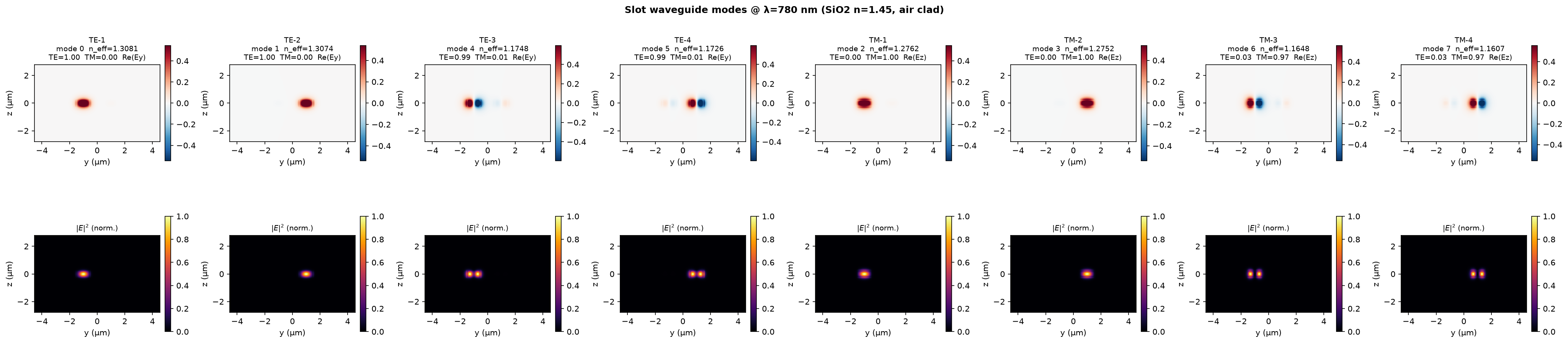
This does not rule out the fishbone concept. It says the periodic structure must supply the confinement and defect physics; ordinary transverse index-guiding alone does not make the wide slot air-core.
First selected SiO₂ geometry — preliminary local MPB
Evidence label: MPB-selected finite-cavity hypothesis. Unit-cell frequencies have a useful resolution/padding check; finite-cavity FDTD, Q, mode volume, port coupling, and tweezer scattering are still pending. This batch used 0 FC.
Geometry and access
| Parameter | Selected value |
|---|---|
| constant SiO₂ index | 1.45 |
| target wavelength | 0.78024 µm |
period a |
0.370 µm |
thickness t |
0.500 µm |
| continuous air slot | 1.000 µm |
| tooth amplitude beyond each rail | 0.400 µm |
| tooth duty cycle along x | 0.500 |
center base width W_center |
approximately 2.258 µm |
terminal-mirror base width W_mirror |
2.050 µm |
| taper | 16 cells per side, inverted from sampled γ(W) |
| uniform terminal mirror | 8 cells per side |
| center construction | L=0, two innermost cells meet at x=0 |
| total patterned structure | 48 cells, 17.76 µm |
The slot is continuous through every cell. The proposed atom is at
x=y=z=0; the proposed tweezer trajectory is the z-directed line x=y=0.
That entire idealized line is air, and its nearest dielectric faces are at
y=±0.50 µm. This establishes geometric access only. It is not yet a
finite-waist tweezer-scattering calculation.
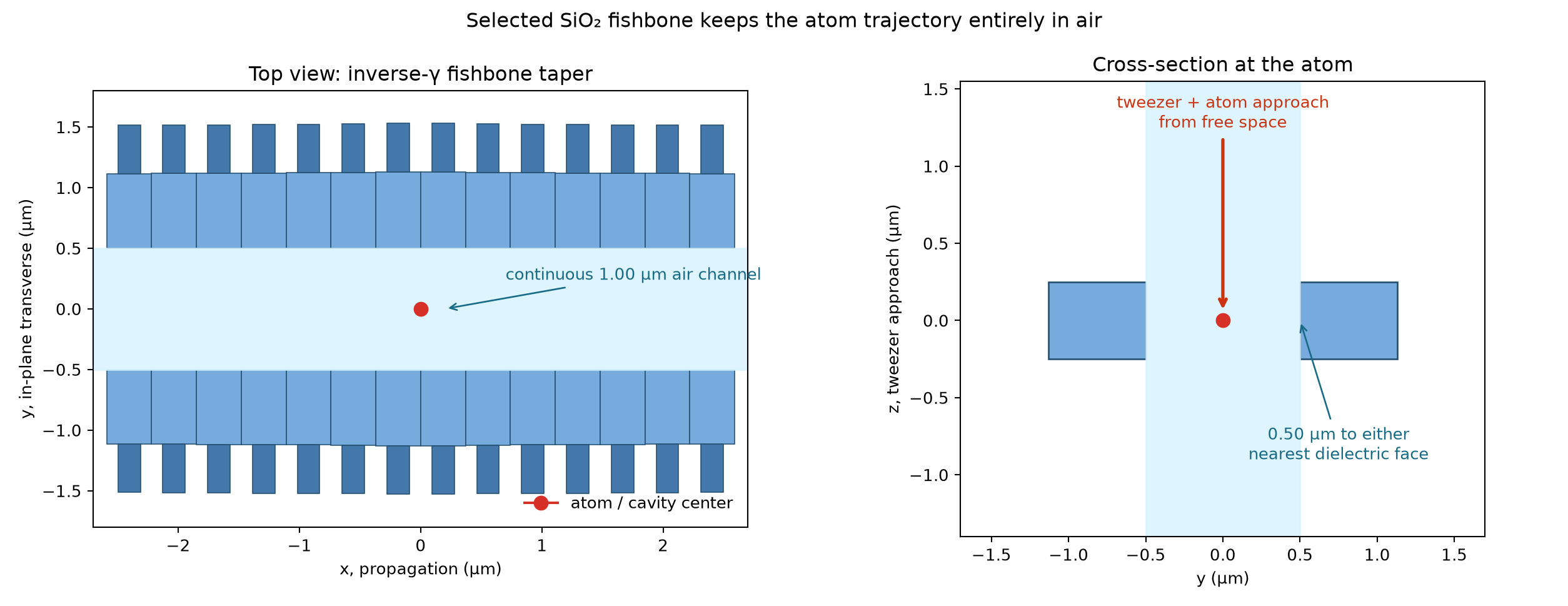
Tracked band pair and mirror strength
The selected branch is the y-odd/z-even sector, for which Ey is allowed and
dominant at the centered atom. At X, MPB bands 3 and 4 form the tracked
dielectric/air Bragg pair. Removing the teeth (A=0) recovers their
forward/backward degeneracy; adding the teeth splits the pair. This is the
current band-identity check.
At each sampled width, the shaded interval below is the X-point split. The right panel uses the Quan–Lončar near-X two-band estimate
γ = sqrt([Δ/(2 f_mid)]² - [(f_target-f_mid)/f_mid]²)
inside the gap and zero outside it, where Δ is the X-point band split and
2 f_mid is the sum of the two band-edge frequencies. It is an approximate
X-edge mirror-strength proxy for Im(k)/(π/a) from two real band edges,
not a directly solved complex band. The chosen center lies just outside
the stop band; narrowing toward 2.050 µm puts the target inside the gap and
raises the estimated mirror strength to about 0.0295.
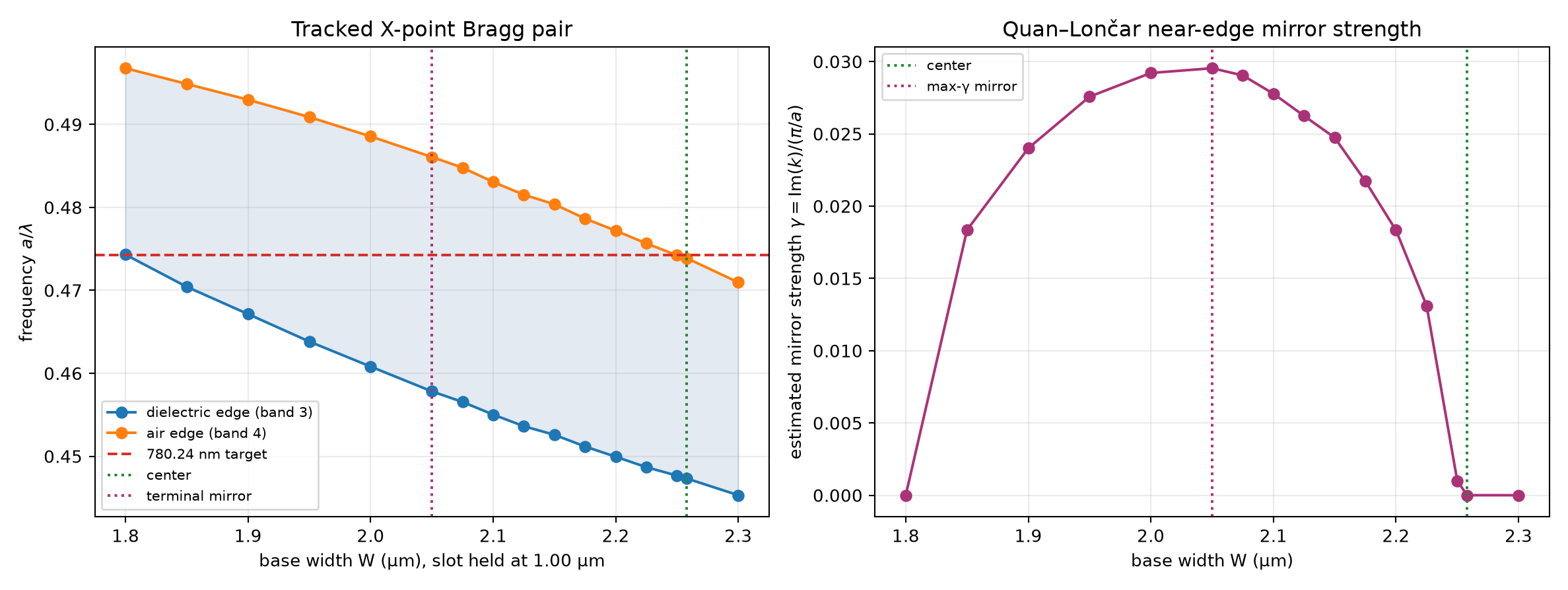
The finite geometry inverts the sampled γ(W) relation rather than assuming
that width itself should be quadratic. The result is a target mirror strength
that rises linearly across 16 cells and remains constant for eight terminal
cells on each side.
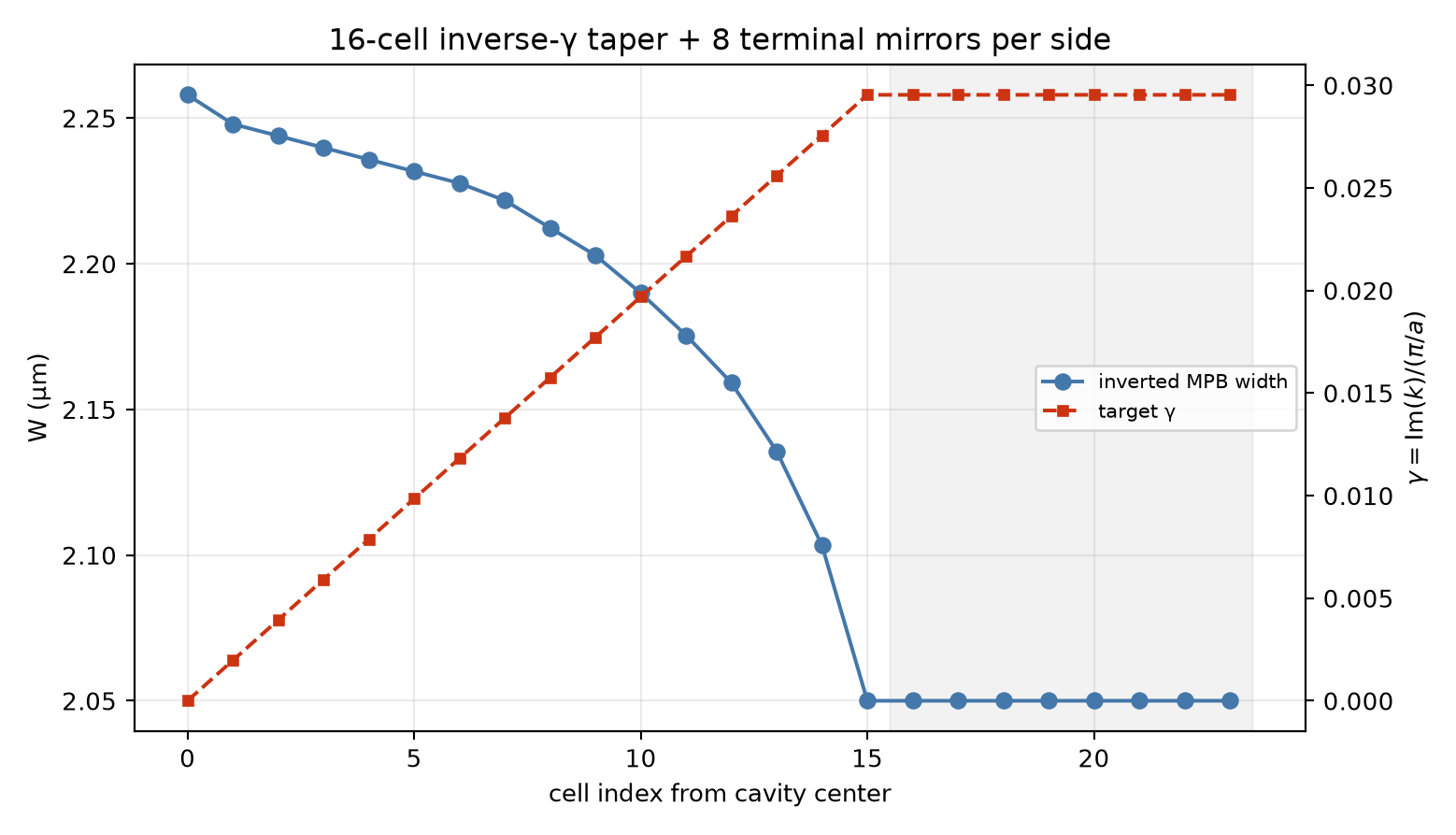
Dispersion and radiation context
The near-X diagrams show four bands in the selected symmetry sector. The tracked air-edge branch approaches the 780.24 nm line in the center cell, whereas the same target lies inside the mirror-cell stop band. The dashed gray line is the air light line. This helps reject an obvious above-light-line interpretation near the working point, but MPB's transversely periodic supercell cannot calculate radiation Q.
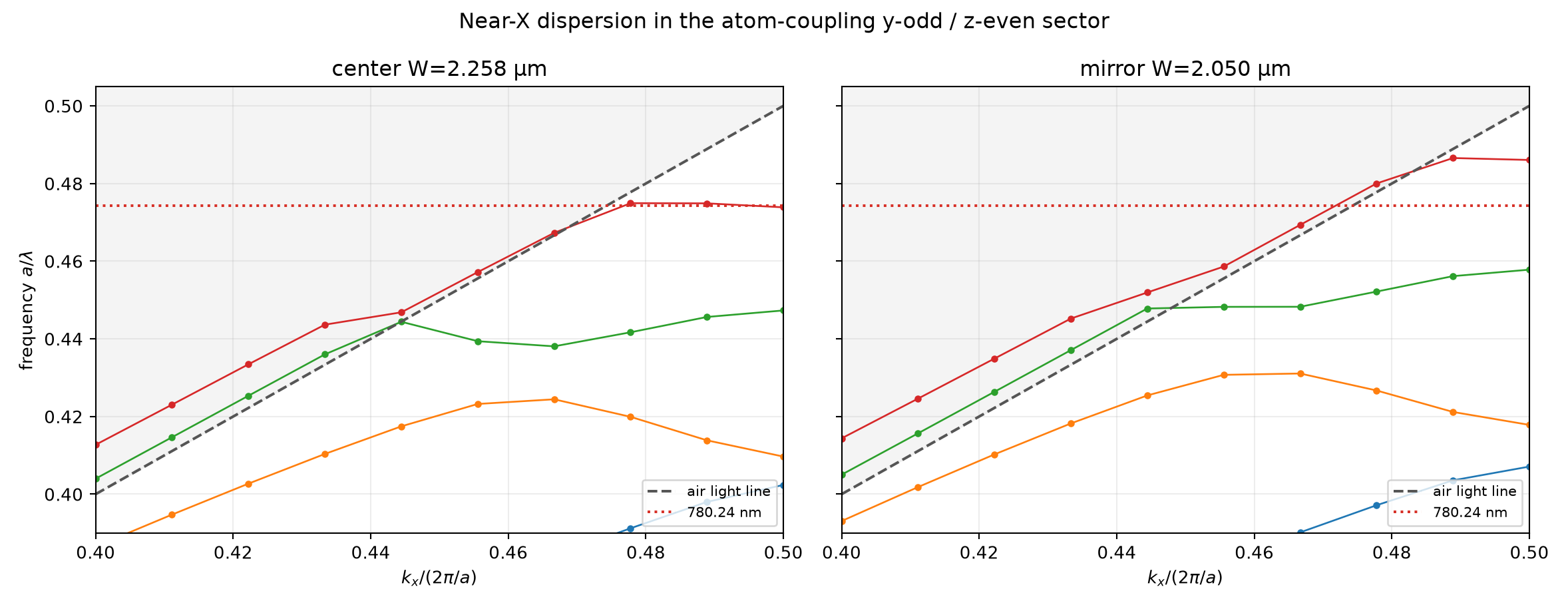
Field identity and field at the atom
The X-edge plots distinguish the rail-localized dielectric edge from the
selected air edge. Cyan contours mark SiO₂ boundaries and the white dot marks
the atom. The intended air edge has a nonzero, nearly pure Ey field at the
atom, but its global field maximum remains near dielectric surfaces.
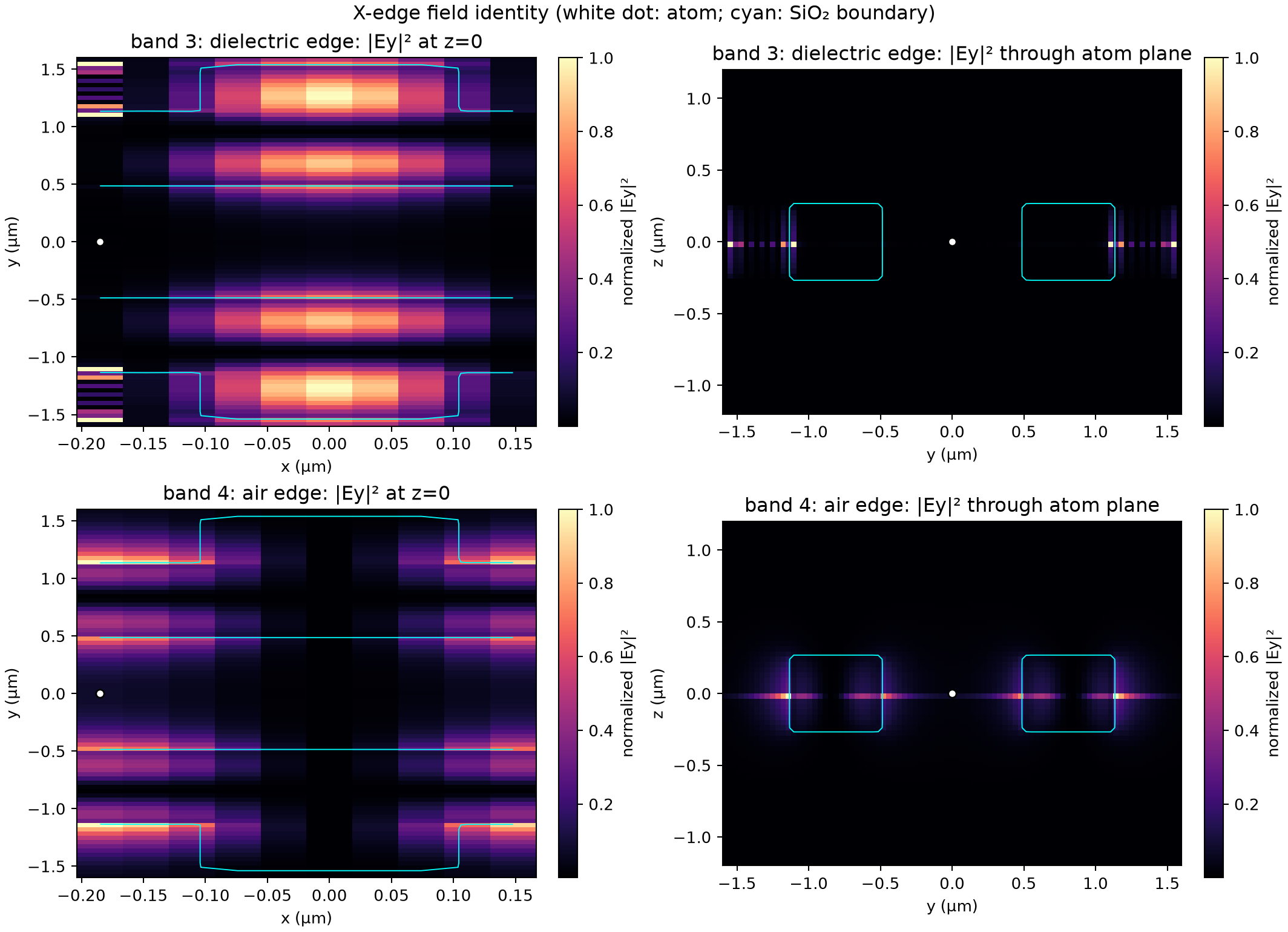
The atom metric comes directly from complex MPB E-field HDF5. For each x
sample, complex field is averaged over the central y/z lattice sample(s);
|E|² is then formed, and the largest atom-line value over one X-point unit
cell is compared with the global grid maximum.
| MPB grid | atom |E|² / max|E|² |
atom |E|² / max(ε|E|²) |
atom polarization |
|---|---|---|---|
| resolution 12, padding 1.2 µm | 0.07806 | 0.06759 | >99.99998% Ey |
| resolution 14, padding 1.2 µm | 0.07281 | 0.07281 | >99.99999999% Ey |
The atom-field ratio changes by about 6.7% from resolution 12 to 14, so it is reported as approximately 7–8%, not as a converged high-precision metric. Only the finite-cavity field can establish the actual atom coupling.
Numerical confidence and remaining MPB caveats
For the selected center width, resolution 12→14 changes the tracked lower and
upper edges by 0.12% and 0.06%, respectively. For the near-terminal
W=2.00 µm convergence proxy, the corresponding changes are 0.11% and 0.07%.
Changing simultaneously to resolution 10 with 1.6 µm transverse padding keeps
these edges within 0.08%. The narrow band-edge positioning is therefore
credible enough to justify a finite FDTD test.
This is not a full proof of an isolated guided band:
- The exact 2.050 µm terminal cell has a coarse resolution-8 width-sweep
result; the higher-resolution mirror check used nearby
W=2.00 µm. - The opposite-y-parity rail supermode is nearly degenerate. Ideal y symmetry prevents mixing, but fabrication asymmetry may not.
- Periodic transverse MPB boundaries discretize radiation states and cannot produce radiation Q.
- The constant
n=1.45screening model omits SiO₂ dispersion and process-specific index.
Provenance and reproduction
Small provenance files are published with this notebook:
- machine-readable MPB summary
- all 48 selected cell widths
- resolution-14 center raw MPB output
- resolution-14 near-mirror raw MPB output
- MPB control file
- analysis/plot script
The large raw ε/E HDF5 files remain on disk under
engines/atom_fishbone_coupler/runs/mpb_selected_*; they are intentionally not
copied into the public static site.
Representative converged edge command:
RUN=engines/atom_fishbone_coupler/runs/mpb_selected_a0p37_yodd_W2p262_A0p4_r14_pad1p2
(cd "$RUN" && mpb \
  a-um=0.37 t-um=0.50 W-um=2.262 gap-um=1.0 A-um=0.40 duty=0.50 \
  n-core=1.45 pad-y-um=1.2 pad-z-um=1.2 resolution=14 \
  num-bands=4 k-start=0.5 k-end=0.5 k-count=1 eig-tol=1e-6 \
  parity-code=1 output-fields?=true output-band=4 \
  ../../package/atom_fishbone/fishbone_unit_cell_sweep.ctl \
  > mpb_stdout.txt 2>&1)

.venv/bin/python \
  engines/atom_fishbone_coupler/package/atom_fishbone/analyze_selected_mpb.py
First finite FDTD diagnostic — complete, candidate only
Evidence label: completed broadband FDTD diagnostic. It demonstrates a low-Q, target-near, centered response worth investigating, but does not yet provide a promoted Q or mode volume.
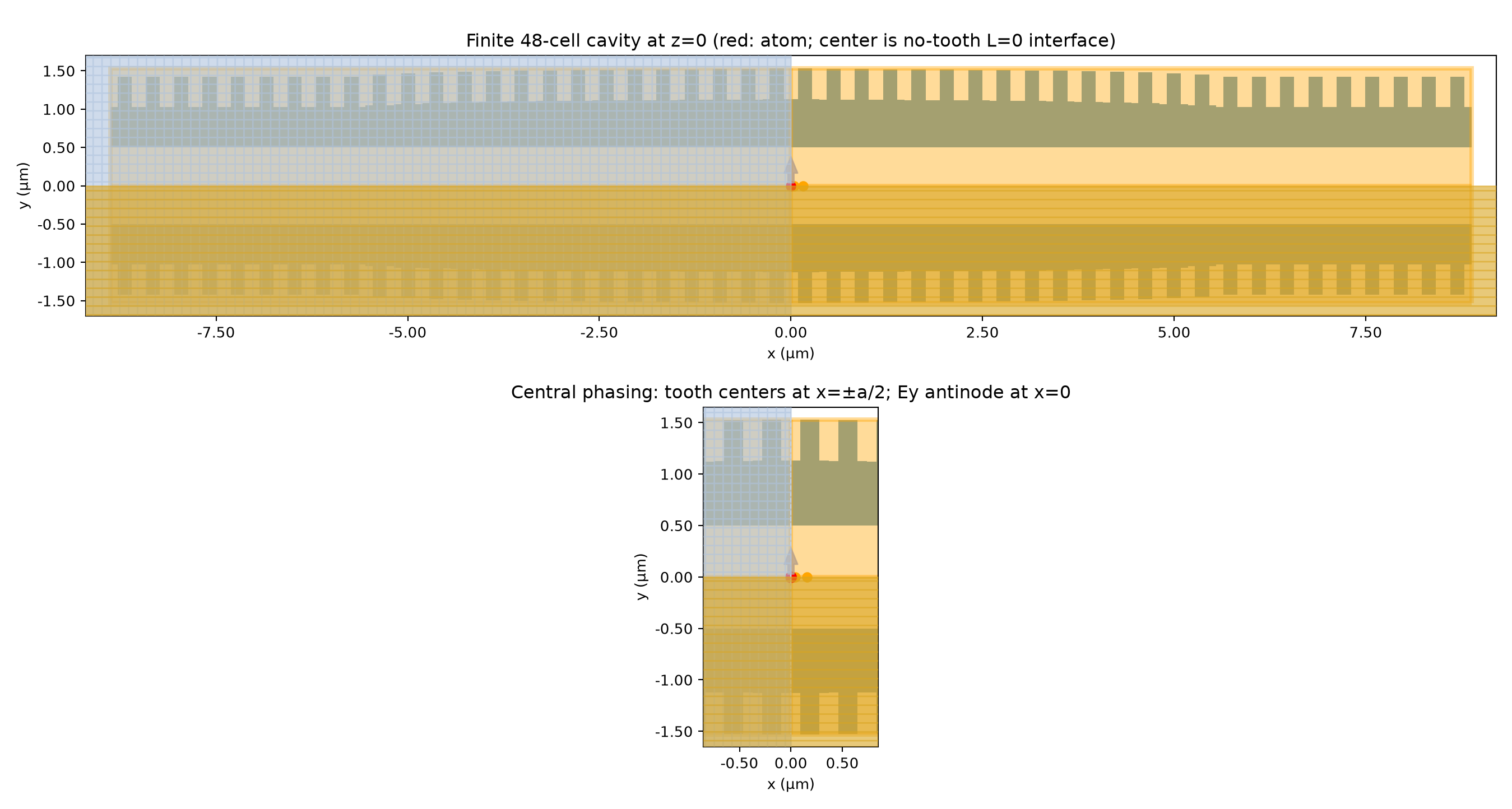
| Item | Prepared value |
|---|---|
| Tidy3D task ID | fdve-4635460c-fdaa-42ca-ae66-da6c43b03e28 |
| task name | atom-fishbone-rb780-open-slot-auto14-16ps-v1 |
| maximum cost estimate | 0.1030535238 FC |
| actual cost | 0.025 FC |
| grid | GridSpec.auto, minimum 14 steps/wavelength |
| manual mesh overrides | none |
| maximum runtime | 16 ps |
| automatic shutoff | 1e-5 |
| domain | 20.76 × 5.758 × 3.0 µm³ |
| symmetry | (x,y,z) = (+1,-1,+1) |
| source | broadband Ey point dipole at the atom |
| monitors | 3 ringdown probes, atom spectrum, XY/XZ/YZ fields, 6 flux faces |
What came back
Automatic shutoff ended the nominal 16 ps simulation after 0.6043 ps, so the inexpensive diagnostic cost 0.025 FC. The corrected harmonic-inversion analysis found the same pole at all three ringdown probes:
| Quantity | Result |
|---|---|
| fitted wavelength | 777.5748 nm |
| detuning from 780.24 nm assumption | −2.6652 nm (−0.342%) |
| Q across three probes | 360.39, 360.88, 360.90 |
| relative Q span | 0.143% |
| relative frequency span | 2.93×10⁻⁶ |
| fitted field-amplitude lifetime | 0.2980 ps |
| usable observed ringdown | 0.3043 ps |
| observed fitted lifetimes | 1.02 |
| target-frequency flux signs | outward on all six faces |
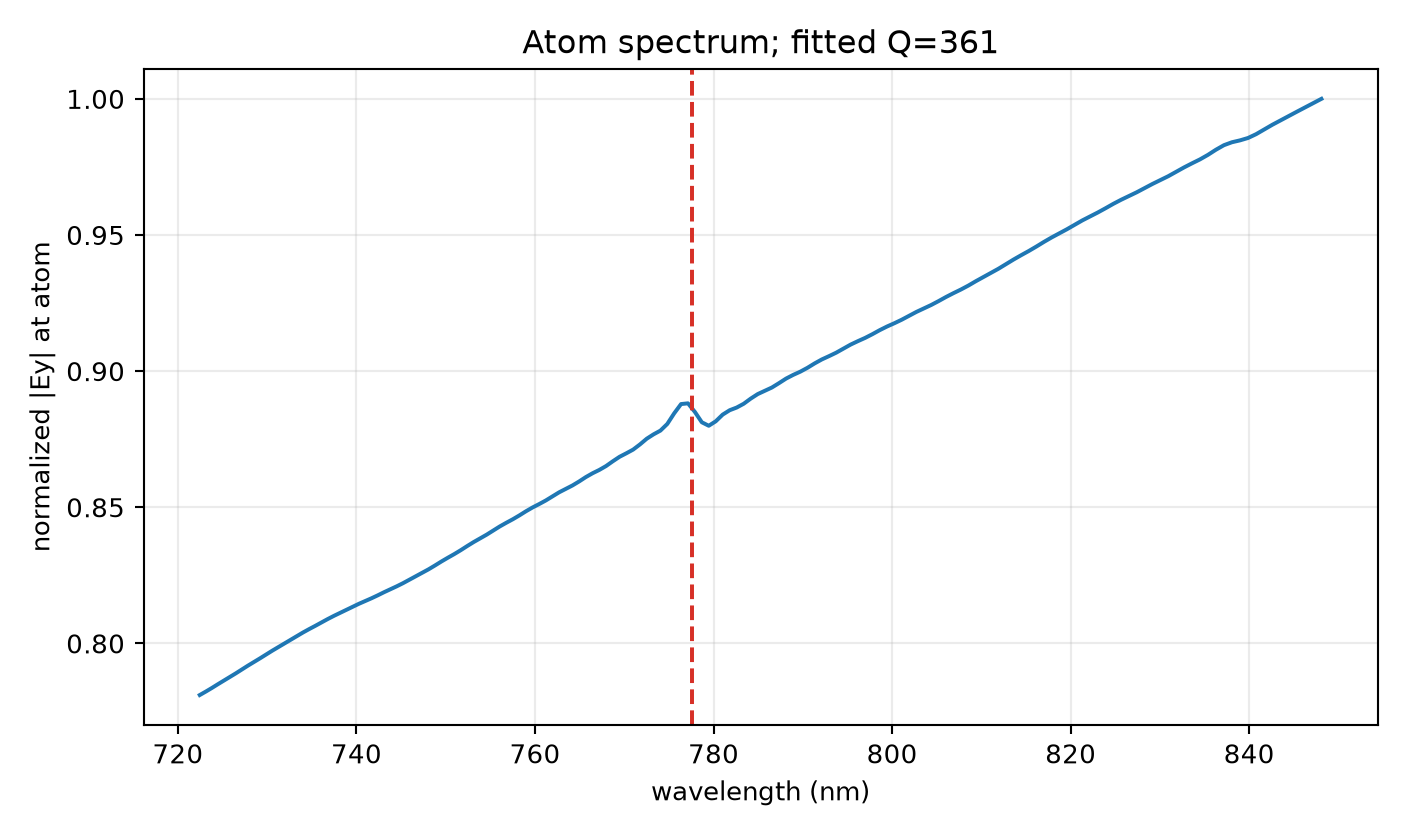
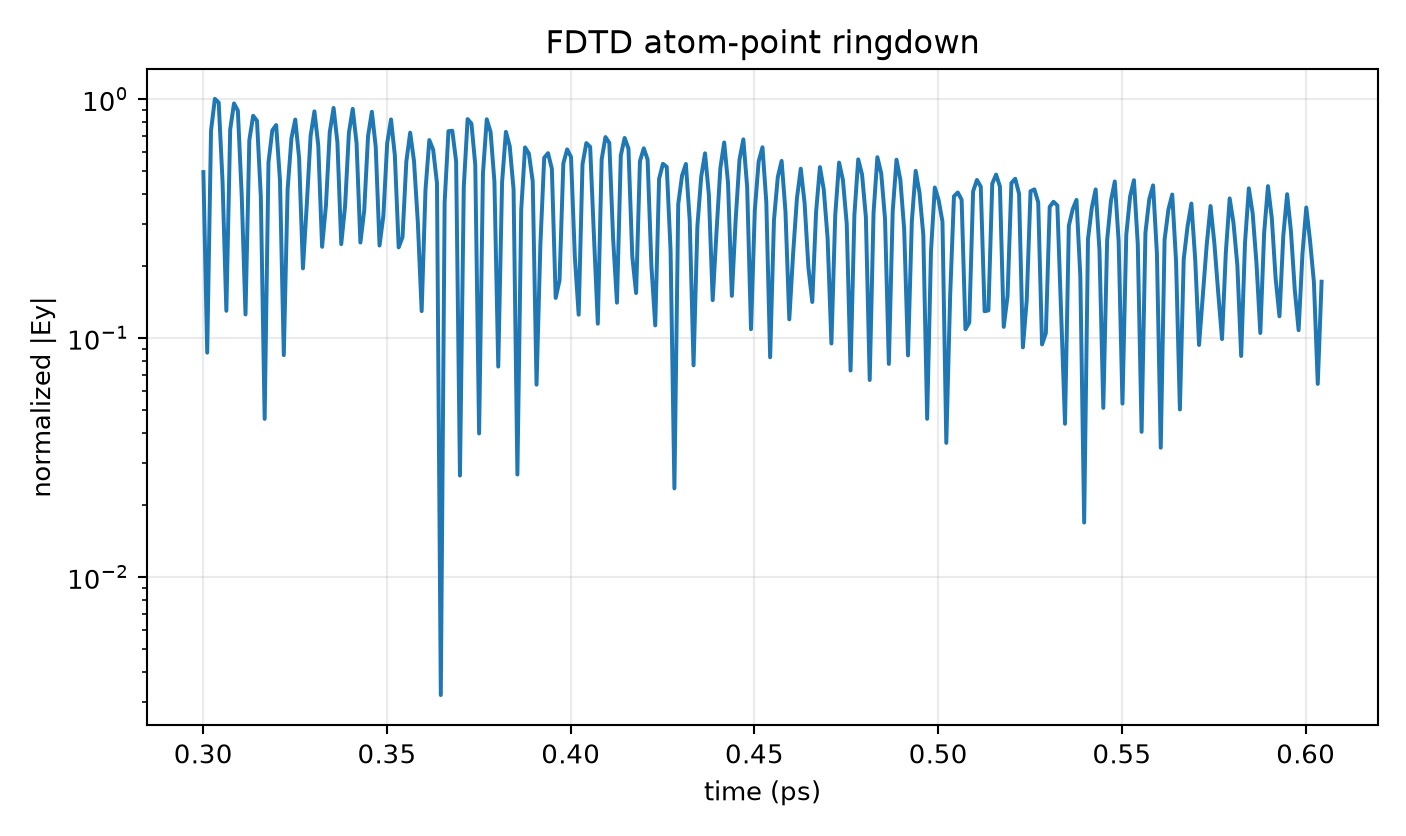
The target-frequency field is strongly centered on the atom in all three principal planes. This is encouraging geometric evidence that the MPB taper created a localized response rather than only a terminal-mirror or box mode.
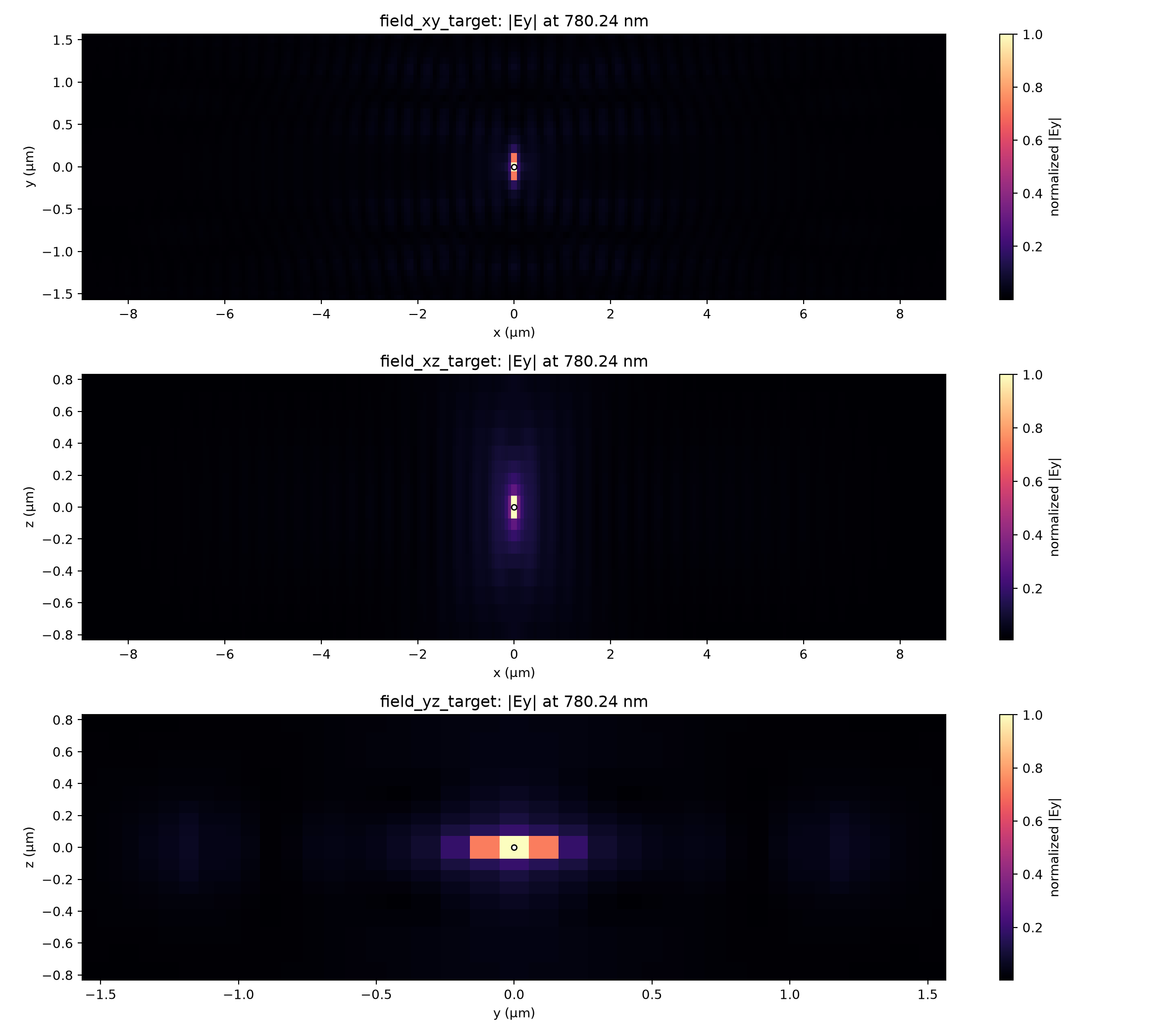
At 780.24 nm, summing the two outward faces on each axis gives approximately 5.39% x-directed, 17.45% y-directed, and 77.16% z-directed flux. This is a directional clue that vertical radiation may limit Q. It is not a promoted loss decomposition: the flux was sampled at 780.24 nm rather than the fitted 777.575 nm pole, and the source can contribute nonresonant background.
Why Q≈361 is not yet promoted
- Automatic shutoff provided only 1.02 fitted amplitude lifetimes after the selected start time. Cross-probe agreement is excellent, but the decay record is short.
- Field and flux monitors were fixed at 780.24 nm, not retuned to the fitted 777.57 nm pole. At Q≈361 this offset is about 1.2 linewidths.
- There is no auto-14→finer-mesh repeat, domain/PML sweep, or alternate shutoff/ringdown-window test.
- There is not yet an exact-pole energy/flux run, so no trustworthy mode volume, directional decay, or port β can be reported.
- Q≈361 is intrinsically low for the stated high-finesse ambition. The result validates a finite localized starting point, not the final cavity.
All five preliminary diagnostic gates passed: positive finite Q, pole within 5% of target, three-probe pole agreement, at least 0.75 fitted amplitude lifetimes observed, and outward target-frequency face flux. Those deliberately permissive gates justify a next experiment; they do not constitute the later promotion gates.
Public prepared artifacts:
- exact serialized simulation
- human-readable FDTD configuration
- machine-readable diagnostic result
- submission/analysis driver
- live machine-readable FC ledger
Controlled taper-length screen — N24, N32, and N40
Question: was the strong z-directed leakage clue caused partly by a taper that was too short to produce a smooth Gaussian-like envelope?
The next two geometries changed only the number of inverse-γ taper cells per side. Period, cross-section, center/mirror widths, 1.0 µm slot, and eight uniform terminal mirror cells per side stayed fixed.
| Variant | taper cells/side | total cells | patterned length | protocol |
|---|---|---|---|---|
| N16 baseline | 16 | 48 | 17.76 µm | v1, shutoff 1e-5, fit starts 0.30 ps |
| N24 | 24 | 64 | 23.68 µm | v2, shutoff 1e-7, fit starts 0.12 ps |
| N32 | 32 | 80 | 29.60 µm | v2, shutoff 1e-7, fit starts 0.12 ps |
| N40 | 40 | 96 | 35.52 µm | v2, shutoff 1e-7, fit starts 0.12 ps |
All four use AutoGrid with at least 14 steps/wavelength, no manual mesh overrides, and a 16 ps ceiling. The source ends at 0.0518 ps. N24, N32, and N40 form the clean controlled geometry comparison because they use the same v2 decay protocol. The apparent N16→N24 gain is partly confounded by N16's earlier shutoff and later fit start.
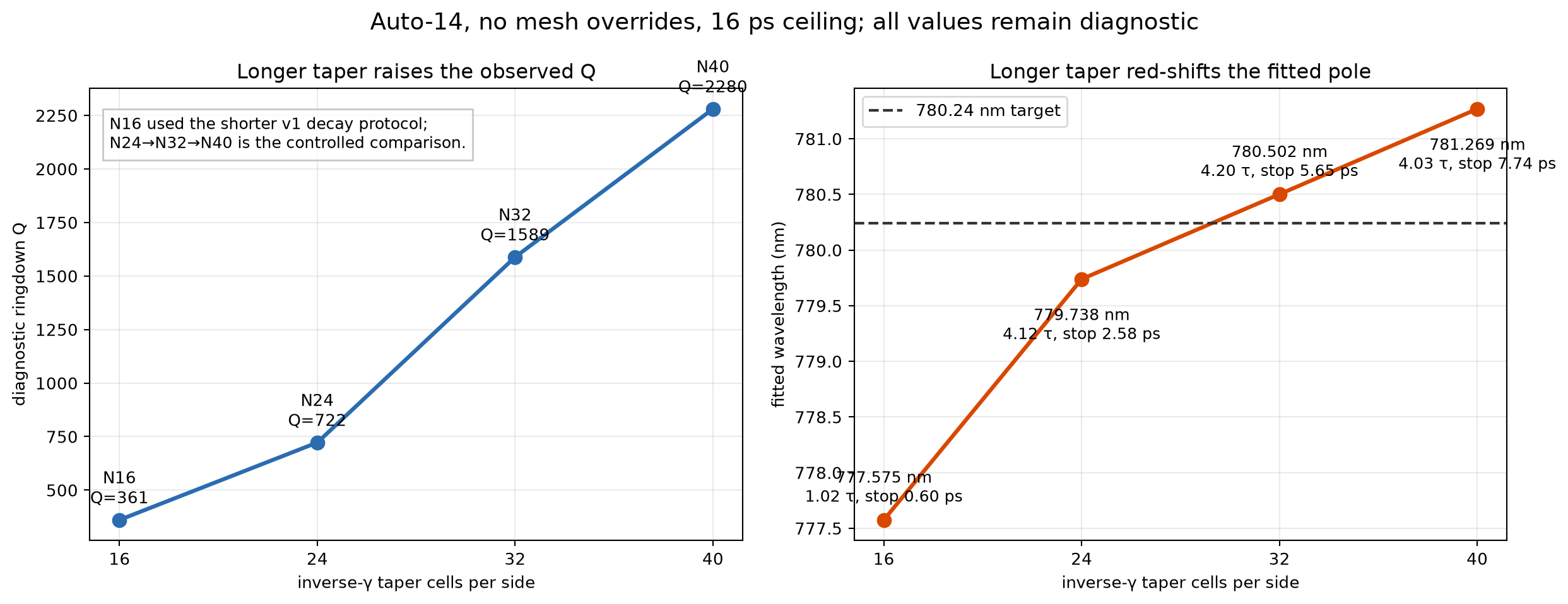
| Result | N16 | N24 | N32 | N40 |
|---|---|---|---|---|
| fitted λ | 777.5748 nm | 779.7385 nm | 780.5016 nm | 781.2685 nm |
| diagnostic Q | 360.90 | 722.31 | 1,588.58 | 2,280.37 |
| cross-probe Q span | 0.143% | 0.890% | 0.0272% | 0.00660% |
| cross-probe frequency span | 2.93×10⁻⁶ | 5.57×10⁻⁶ | 4.10×10⁻⁸ | 3.34×10⁻⁸ |
| fitted-amplitude lifetimes observed | 1.02 | 4.12 | 4.20 | 4.03 |
| automatic stop | 0.604 ps | 2.583 ps | 5.645 ps | 7.735 ps |
| maximum FC estimate | 0.103054 | 0.137905 | 0.166928 | 0.201347 |
| cloud actual | 0.025000 | 0.025000 | 0.058901 | 0.097351 |
The N24, N32, and N40 ringdowns are visibly longer and cleaner than the N16 diagnostic. N32 more than doubles Q relative to N24. N40 raises Q by another factor of 1.435, but it also red-shifts the resonance to 1.029 nm above the 780.24 nm design assumption. The multiplicative Q gain is diminishing as the taper gets longer.
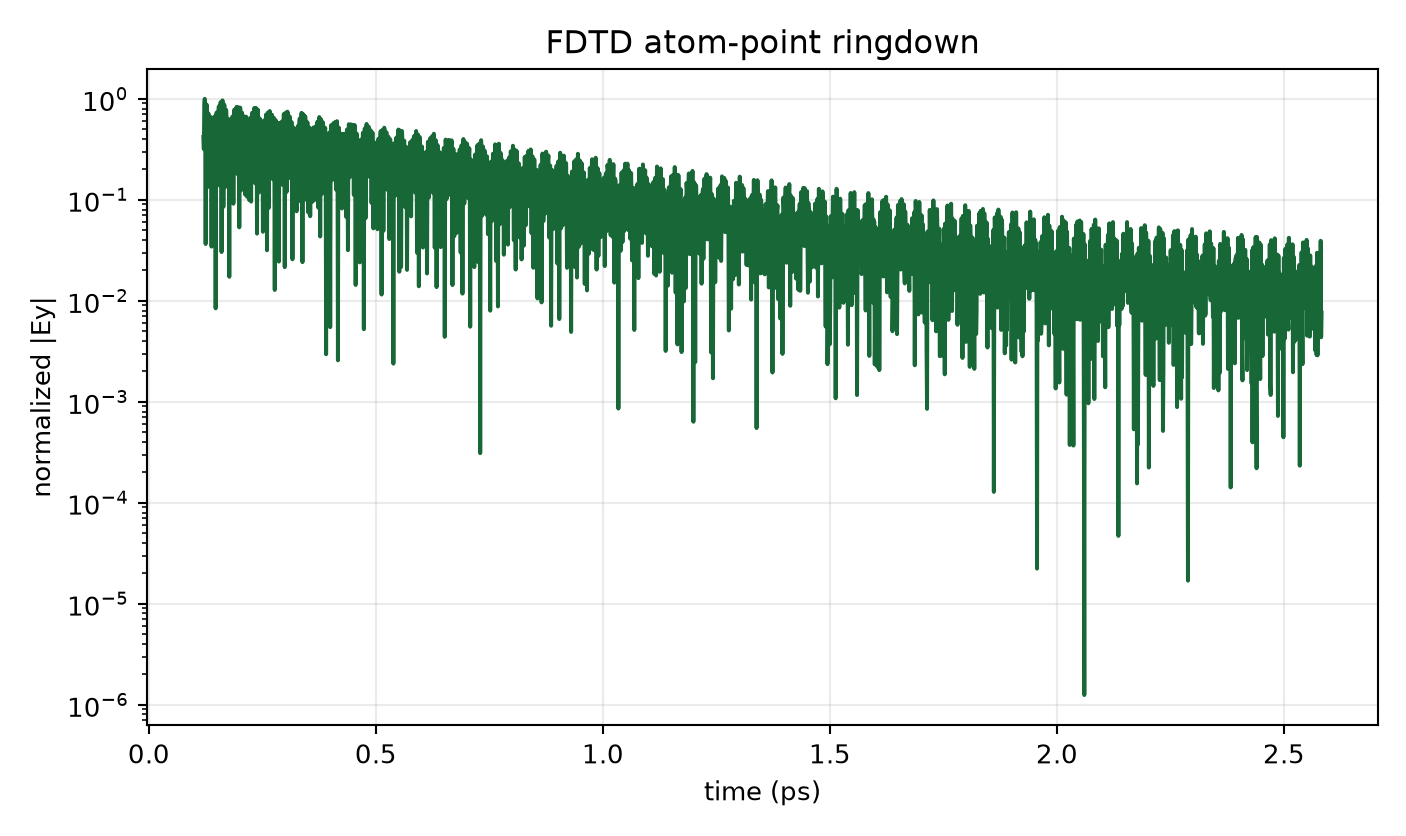
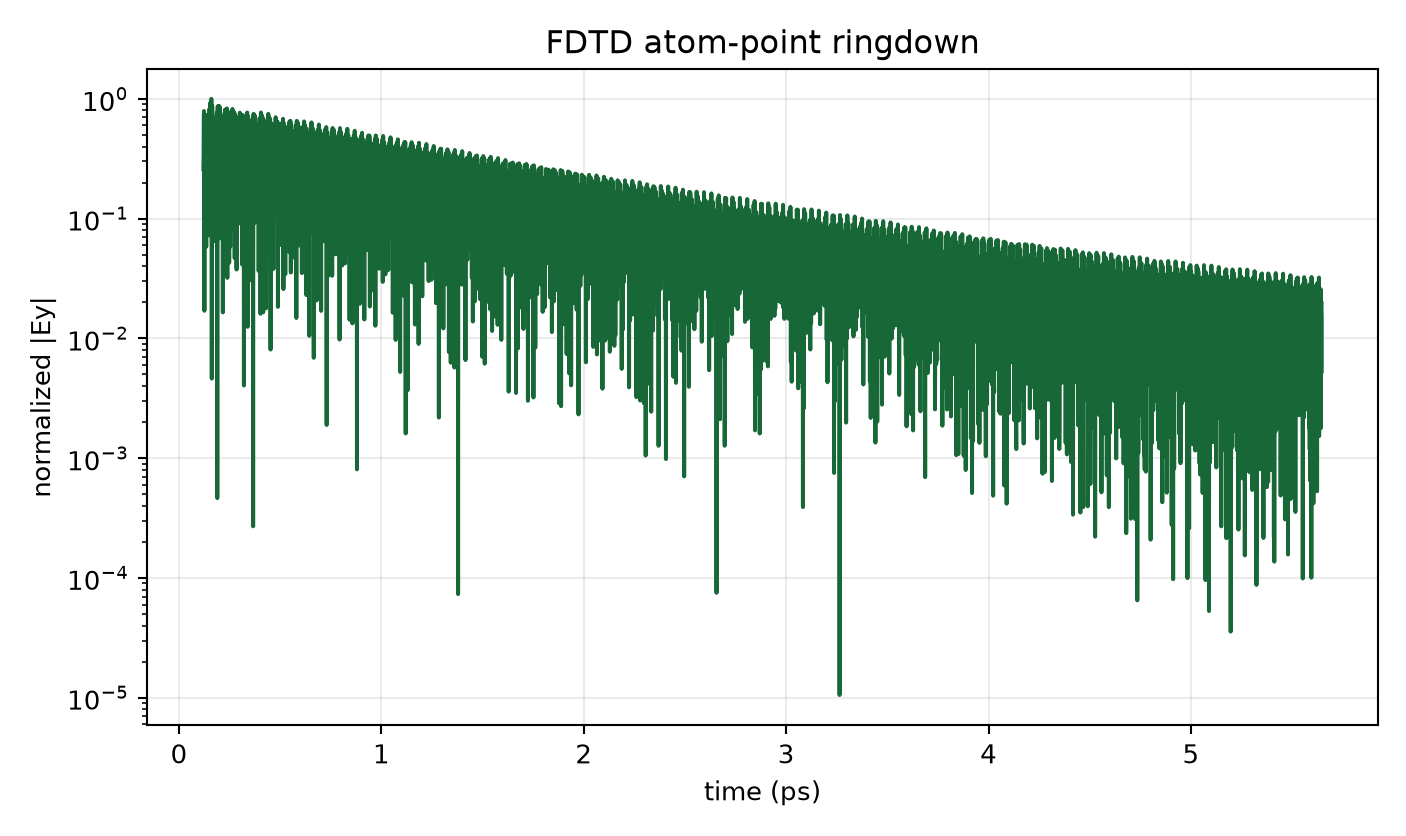
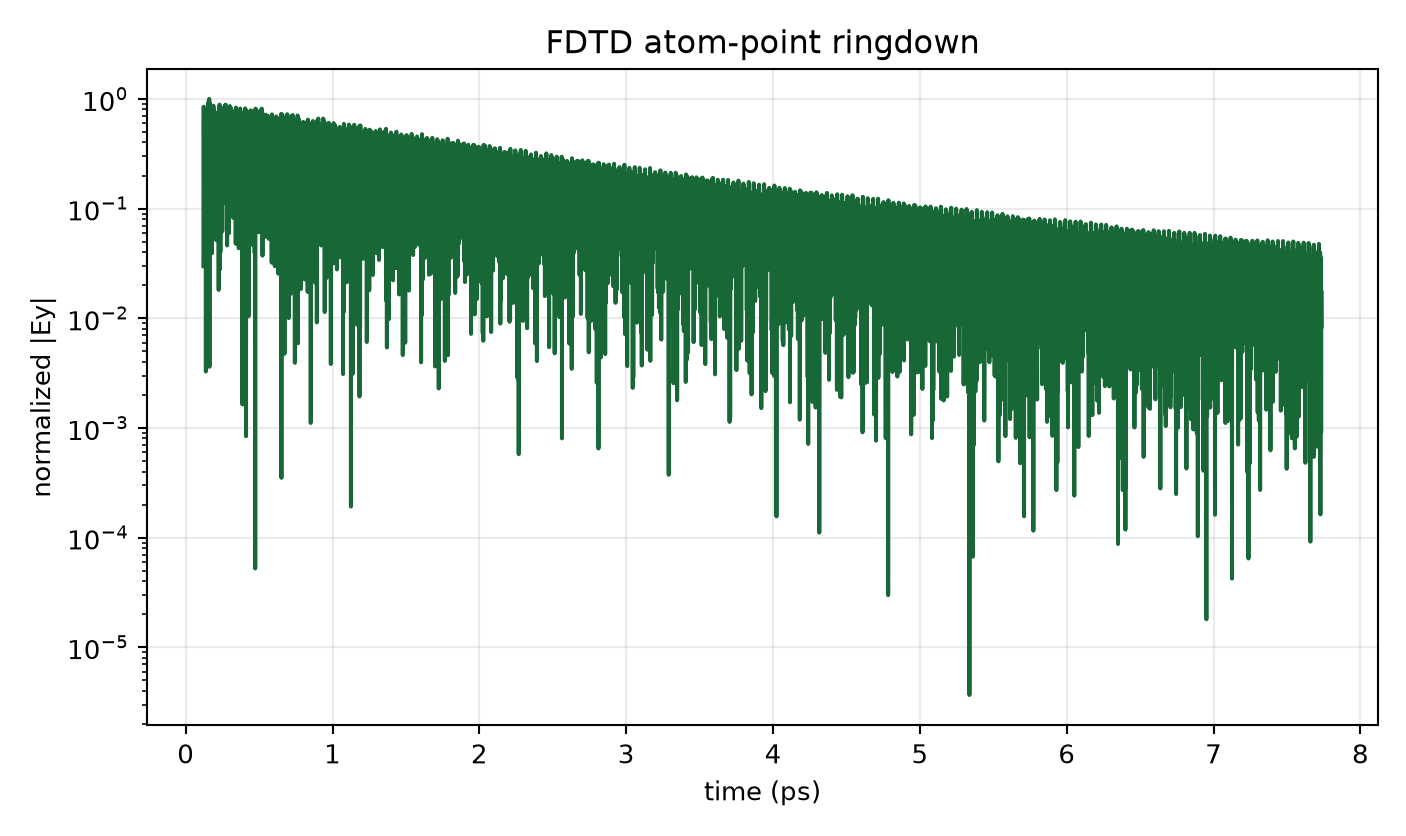
The 80-cell N32 geometry retains the full 1.0 µm access channel, and its target-frequency field remains centered on the atom.
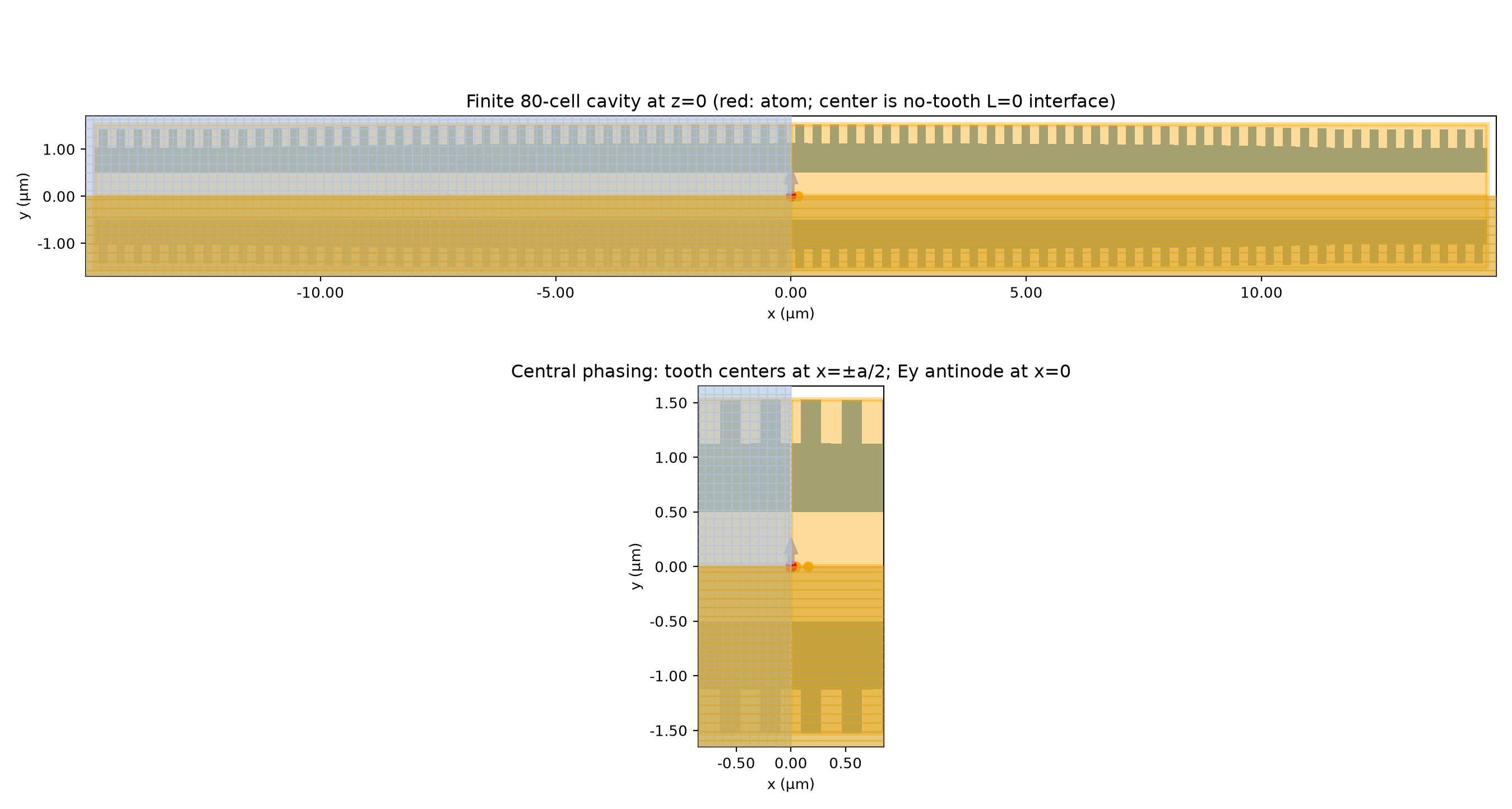
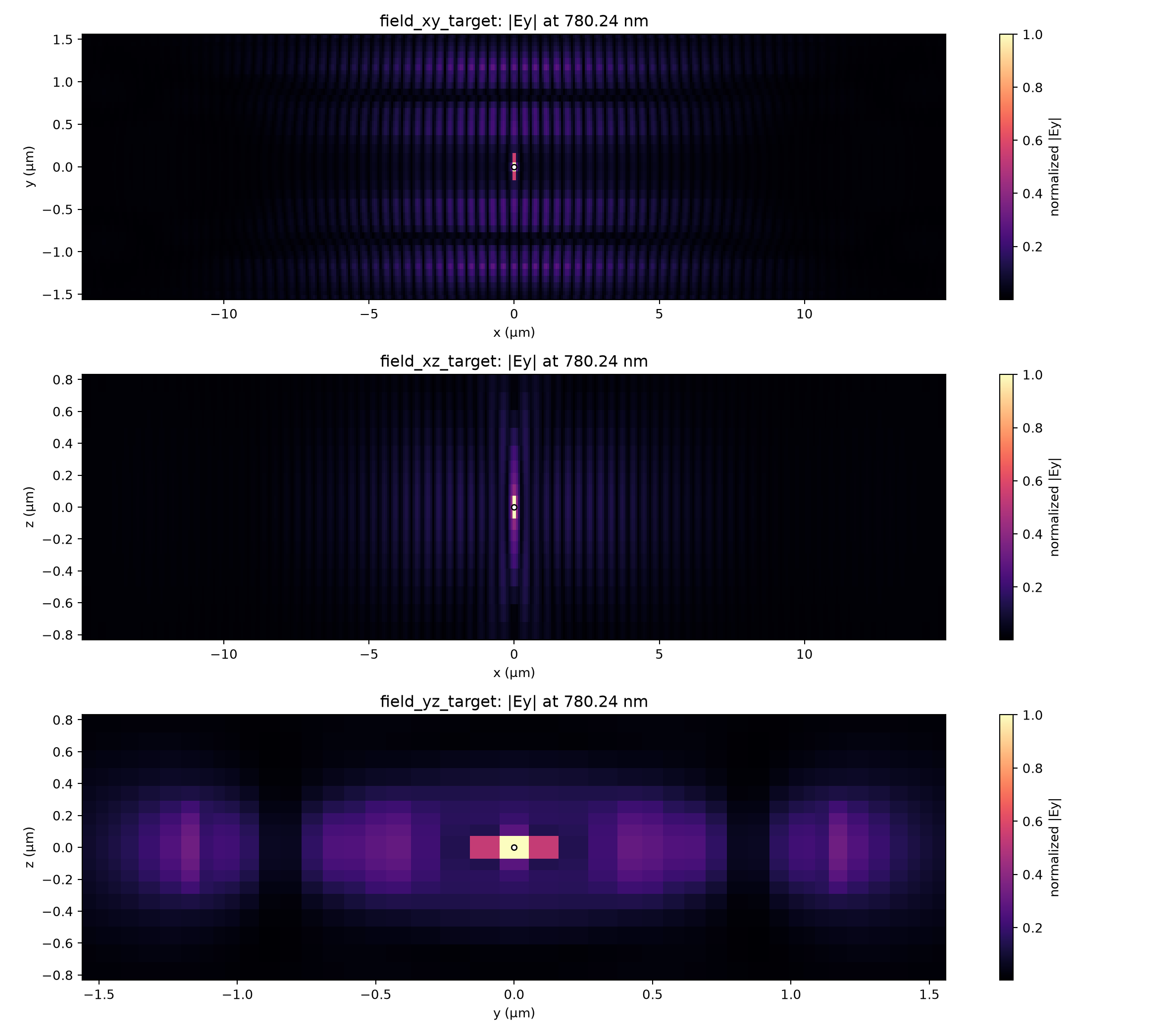
The 96-cell N40 geometry preserves the same slot and cross-section. Its serialized layout, rather than a cropped central field view, is the relevant access-path check.
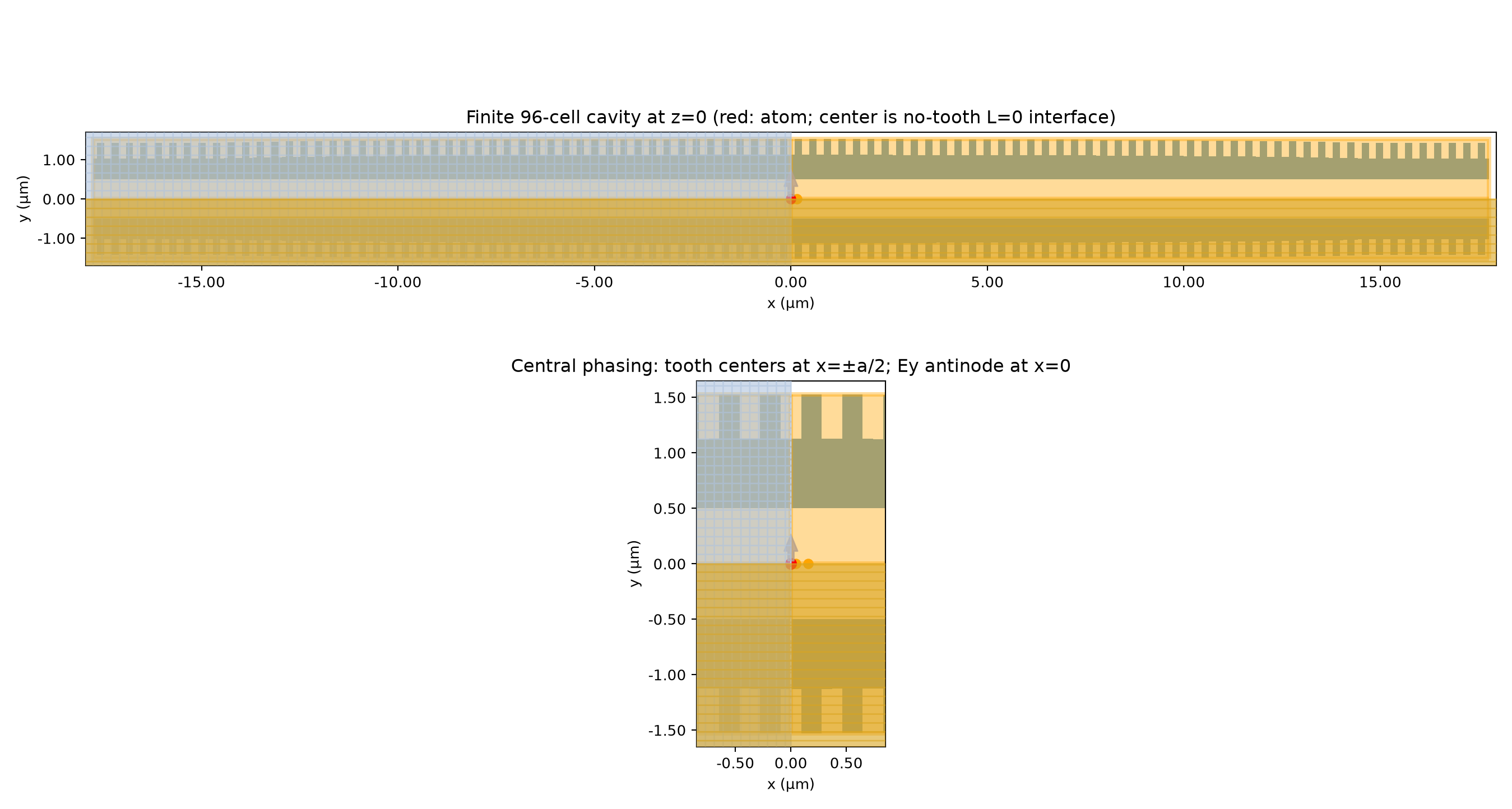
Interpretation
- N24→N32→N40 is evidence that taper radiation, not insufficient terminal-mirror count alone, limited the shorter candidate.
- Q≈2,280 is a meaningful improvement but still a diagnostic number. It has not been repeated at another mesh or domain.
- The N32 target-frequency face flux remains dominated by z-directed power (approximately 69% after pairing opposite faces), but this is not an exact-pole, coherently windowed loss decomposition.
- The N32 broadband ringdown is promoted only to the input candidate for a coherent exact-pole E/H, ε, nested-flux, and atom-referenced effective mode volume run.
- At N40, the standard 780.24 nm field and flux monitors are approximately three fitted linewidths from the 781.269 nm pole. Those fields may be used only as a qualitative localization check, and the corresponding face flux must not be interpreted as loss branching. A new exact-pole run is required.
Public evidence:
- N24: simulation · configuration · result
- N32: simulation · configuration · result
- N40: simulation · configuration · result
- variant runner · summary-figure generator
N32 coherent exact-pole observables — Q closure passes, volume gate fails
Evidence label: completed exact-pole, single-mesh diagnostic with an explicit failed mode-volume promotion gate. The run is useful evidence about the method and dominant loss directions, but neither of its two effective mode-volume numbers is promoted as trustworthy.
| Item | Value |
|---|---|
| Tidy3D task ID | fdve-9ffb9430-f24f-43f9-840d-5f0621f2b9f2 |
| task name | atom-fishbone-rb780-a0p37-n32-exact-observables-auto14-v1 |
| pole wavelength used by every frequency monitor | 780.5015998 nm |
| maximum cost estimate | 0.322831 FC |
| actual cost | 0.113911 FC |
| mesh | AutoGrid, minimum 14 steps/wavelength, no overrides |
| maximum runtime / stop | 16 ps / automatic stop at 5.645 ps |
| automatic shutoff | 1e-7 |
| source end | 0.0518 ps |
| early apodization window | 0.20–2.50 ps, 0.10 ps taper |
| main apodization window | 0.20–4.50 ps, 0.10 ps taper |
What was actually calculated
The broadband N32 run first identified the cavity pole. This second run then placed all six complex E/H components, permittivity, two nested closed flux boxes, and six signed face-flux monitors at that same fitted frequency. Both analysis windows begin after the source is off. Matching apodization is used for E, H, and every flux monitor so their amplitudes and phases refer to the same slice of the source-free ringdown.
Tidy3D stores electric and magnetic components on offset Yee-grid locations.
The analyzer explicitly interpolates every component onto the stored Ey
grid and rejects empty, mismatched, or nonfinite arrays before integrating.
It then uses
U = ¼ ∫ [ε₀ εᵣ |E|² + μ₀ |H|²] dV
and compares the independent flux estimate Qflux = ωU/Pout with the
harmonic-inversion ringdown Q. The two mode-volume diagnostics are
Vpeak = ∫ εᵣ|E|² dV / max(εᵣ|E|²)
and
Vatom,Ey = ∫ εᵣ|E|² dV / [εair |Ey(atom)|²].
The second definition is transition-oriented: it is the effective volume seen
by a y-oriented dipole at x=y=z=0, not merely the volume at whichever point
has the largest field. In this run the atom lies in air (εᵣ=1) and is also
the sampled global ε|E|² maximum, so Vatom,Ey and Vpeak happen to be
equal.
Internal closure checks
| Check | Early window | Main window | Gate |
|---|---|---|---|
| ringdown Q | 1,588.58 | 1,588.58 | common fitted pole |
| energy/flux Q | 1,597.44 | 1,603.65 | within 20% of ringdown |
| Qflux / Qring | 1.00558 | 1.00949 | pass |
| electric / magnetic stored energy | 1.01181 | 1.01175 | 0.8–1.2; pass |
| six signed faces versus outer closed box | <0.0001% | 8.65×10⁻⁶% | within 10%; pass |
| inner versus outer closed box | 1.71% | 1.73% | within 10%; pass |
| all six signed faces outward | yes | yes | pass |
Those checks make the energy/flux calculation internally consistent at this mesh. They do not replace AutoGrid or domain/PML convergence.
The failed mode-volume gate
| Quantity | Early 0.20–2.50 ps | Main 0.20–4.50 ps | Relative change |
|---|---|---|---|
Vatom,Ey = Vpeak |
1.73715 µm³ | 2.16805 µm³ | 19.88% — fail |
| in air-wavelength units | 3.65355 λair³ | 4.55983 λair³ | 19.88% — fail |
| Qflux | 1,597.44 | 1,603.65 | 0.39% — pass |
The acceptance threshold was 5% for all window-sensitivity quantities.
Qflux is stable, but the normalized energy integral is not. This can arise
from residual multimode/background interference or from a frequency-domain
field estimate that has not reached a single-pole regime. The correct action
is to preserve both numbers as failed diagnostic evidence and repeat with
later source-free windows—not to select the more attractive value.
The main-window field below is visibly centered and localized. Its title shows the unpromoted main-window value; the figure must be read together with the 19.88% failed-window result above.
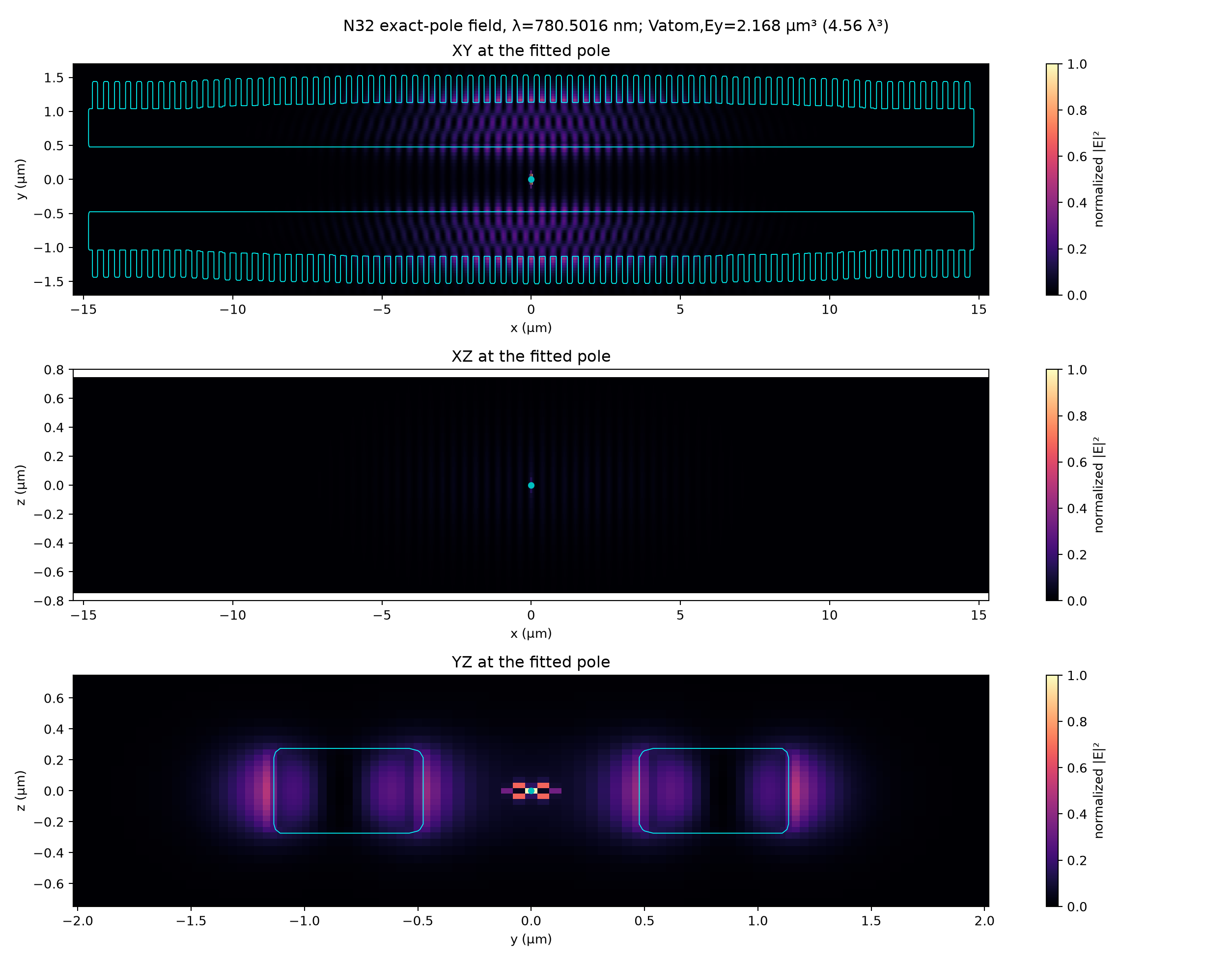
What the directional numbers mean
The main-window outward cavity-energy decay divides into approximately 38.19% along x, 10.20% along y, and 51.61% along z, after pairing the positive and negative faces on each axis. This is a more coherent loss diagnostic than the broadband target-frequency clue and still points to substantial vertical radiation.
These fractions are not emitter β and are not waveguide-port coupling. They say where the stored cavity energy leaves the enclosing box. A spontaneous-emission β requires a dipole-power/reference calculation or a separately justified single-pole Purcell model; a useful port β additionally requires mode decomposition into named, normalized outgoing waveguide modes.
Public evidence:
- prepared monitor/configuration record
- exact serialized simulation
- machine-readable exact-pole result
- submission and analysis driver
N40 late-window exact-pole observables — stable, but weak at the atom
Evidence label: completed coherent exact-pole diagnostic. It passes every implemented exact-pole and time-window gate at Auto-14. Its mode volumes are therefore trustworthy at this one mesh and domain, but remain unpromoted until numerical convergence is demonstrated.
| Item | Value |
|---|---|
| Tidy3D task ID | fdve-a17c408e-7999-4ea5-b5d5-b1681a79e5e7 |
| task name | atom-fishbone-rb780-a0p37-n40-exact-observables-auto14-v1 |
| requested monitor wavelength | 781.2685024 nm |
| refitted pole wavelength | 781.2685936 nm |
| monitor detuning | 0.000267 fitted linewidth |
| maximum cost estimate | 0.391152 FC |
| actual cost | 0.189122 FC |
| mesh | AutoGrid, minimum 14 steps/wavelength, no overrides |
| maximum runtime / stop | 16 ps / automatic stop at 7.735 ps |
| automatic shutoff | 1e-7 |
| source end | 0.0518 ps |
| early apodization window | 1.20–5.20 ps, 0.15 ps taper |
| main apodization window | 1.60–6.80 ps, 0.15 ps taper |
The later windows were chosen to suppress the background/multimode contamination exposed by the failed N32 test. E/H, ε, both closed flux boxes, and every signed face again use one exact frequency and matched apodization. The energy, Q, mode-volume definitions, and explicit Yee-grid colocation are identical to the N32 method documented above.
Internal consistency and window stability
| Check | Early window | Main window | Result |
|---|---|---|---|
| ringdown Q | 2,282.96 | 2,282.96 | common refitted pole |
| energy/flux Q | 2,238.98 | 2,238.84 | 0.00638% change; pass |
| Qflux / Qring | 0.980738 | 0.980675 | pass |
| electric / magnetic stored energy | 1.009730 | 1.009729 | pass |
| six faces versus outer box | 0.0000010% | 0.0000140% | pass |
| inner versus outer box | 1.94% | 1.94% | pass |
| all six signed faces outward | yes | yes | pass |
Vatom,Ey |
45.64872 µm³ | 45.64914 µm³ | 0.000919% change; pass |
Vpeak |
3.959897 µm³ | 3.959886 µm³ | 0.000284% change; pass |
Every window sensitivity is far below the predeclared 5% threshold.
The important design result: the mode misses the atom
| Volume definition | Main result | Normalized result | Denominator location |
|---|---|---|---|
global Vpeak |
3.95989 µm³ | 25.3154 (λ/nlocal)³ |
SiO₂, (0, −0.6144, 0) µm, n=1.45 |
atom-oriented Vatom,Ey |
45.6491 µm³ | 95.7264 λair³ |
air, atom at (0,0,0) |
The atom-oriented volume is 11.53× larger than the peak volume. In plain terms, the cavity has a well-defined mode, but most of its useful electric energy sits near/in the SiO₂ rails rather than at the atom in the middle of the 1 µm slot. Raising Q by lengthening this taper did not solve the central atom-coupling problem.
As an explicitly model-dependent inference, the ideal resonant,
perfectly-aligned single-pole Purcell expression
(3/4π²) Q/(Vatom/λair³) gives only about 1.81 at this Auto-14 result.
This is not a spontaneous-emission calculation and must not be relabeled
as emitter β.
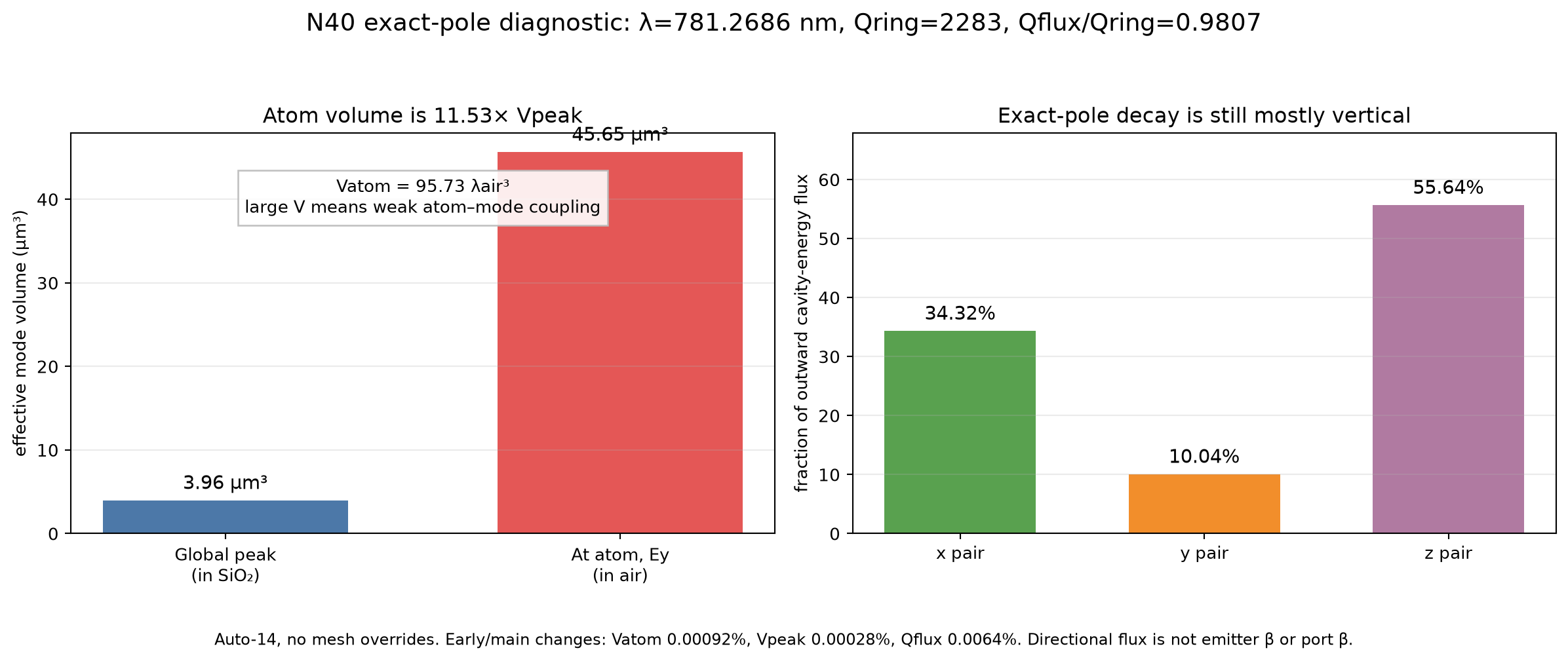
The field sections make the same problem visible: the cyan dot is the atom, while the brightest regions are adjacent to the dielectric.
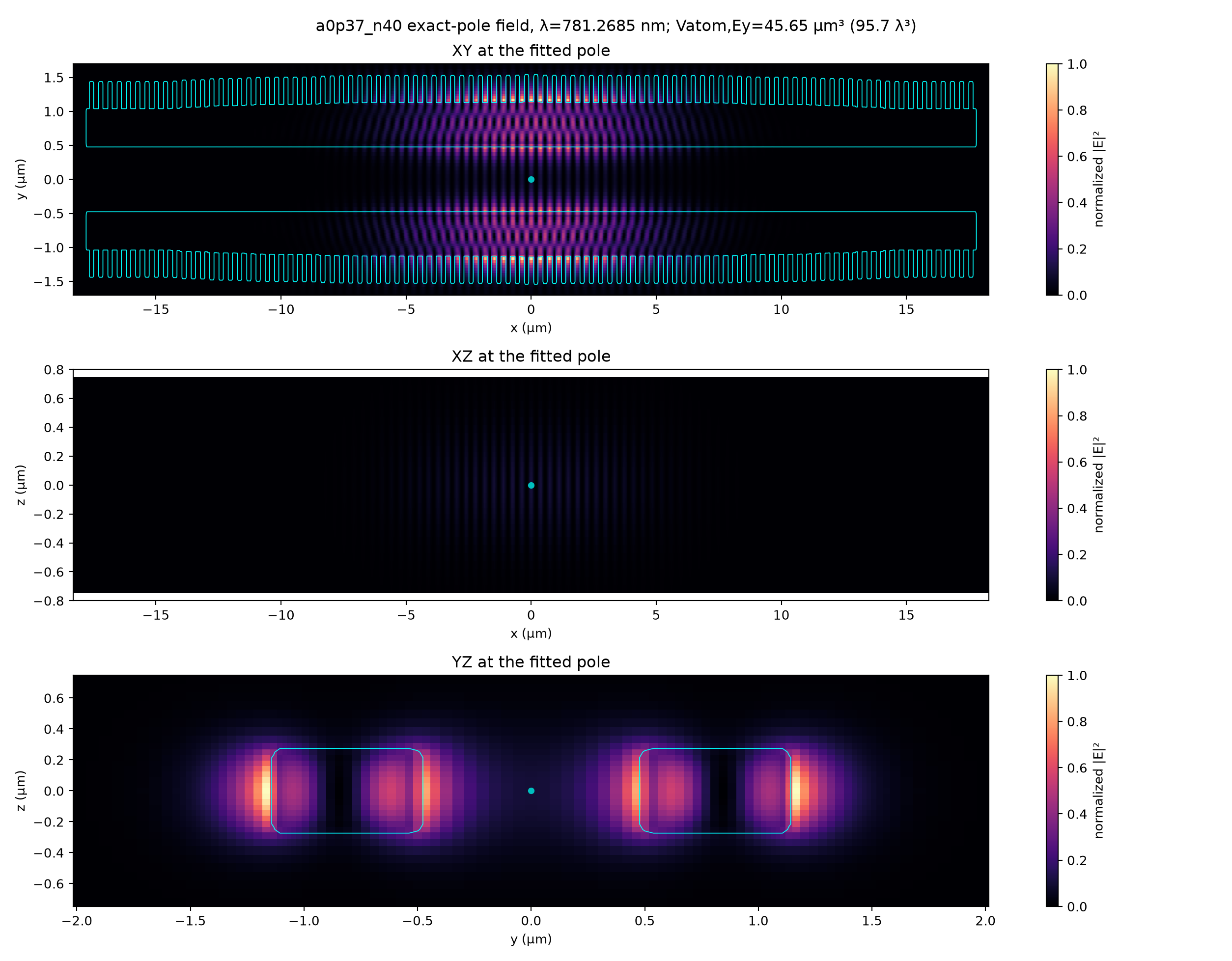
The exact-pole cavity-energy loss divides into 34.32% x, 10.04% y, and 55.64% z. As for N32, this is a closed-box radiation-direction diagnostic, not emitter β and not normalized waveguide-port coupling.
Public evidence:
- prepared monitor/configuration record
- exact serialized simulation
- machine-readable exact-pole result
- N40 late-window wrapper
Free MPB redesign screen — slot width is the dominant first lever
Evidence label: local, coarse MPB ranking screen; not finite-cavity Q, mode volume, or tweezer-scattering evidence. This batch used 0 FC.
The N40 result showed that continuing to lengthen the same 1 µm-slot taper would optimize the wrong quantity. The first redesign screen therefore held period at 0.360 µm and thickness at 0.500 µm while varying:
- clear slot: 0.50, 0.75, or 1.00 µm;
- tooth amplitude: 0.40 or 0.60 µm;
- tooth duty cycle: 0.40 or 0.60.
For each of the 12 cases, the center width was interpolated and then rerun at
MPB resolution 10 so band 4 lay near 780.24 nm. The centered y-odd/z-even
field supplied the ranking metric
|Ey(atom)|² / max[ε|E|²]. Seven lower-resolution mirror widths then supplied
the largest two-band mirror-strength proxy γ.
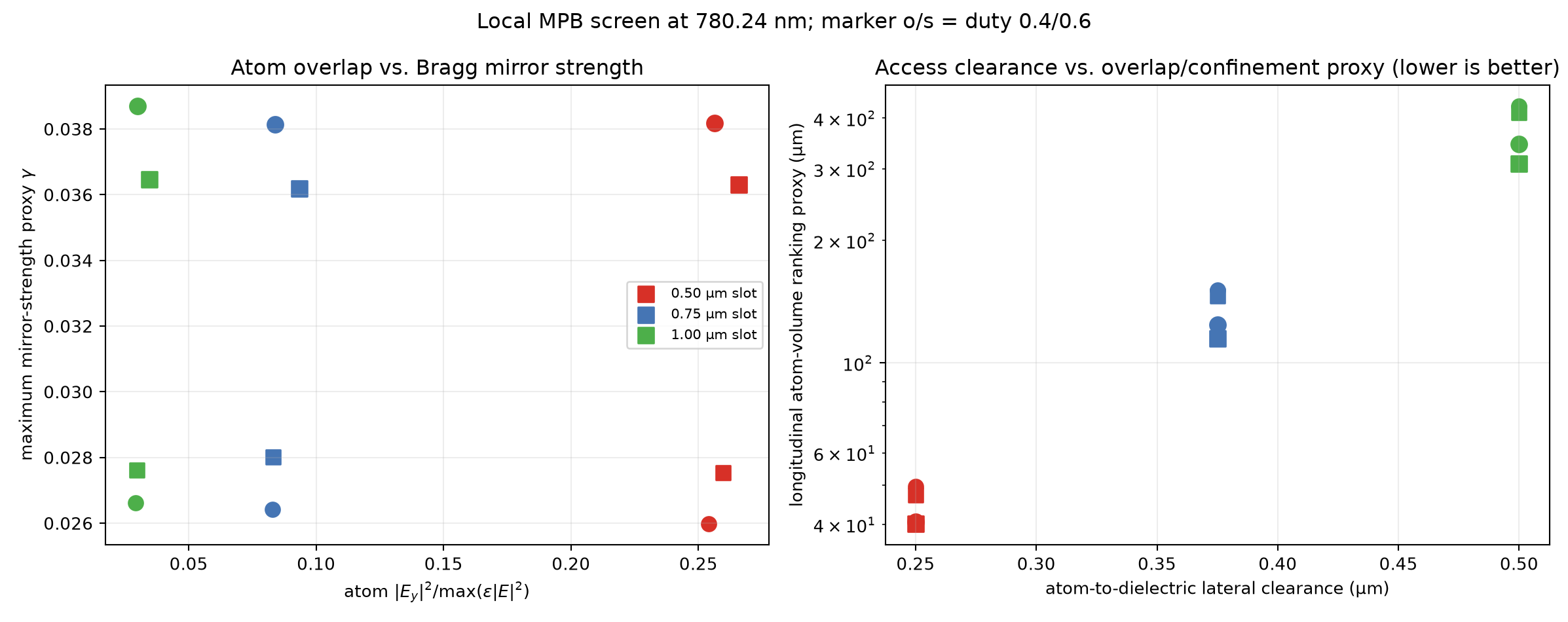
The best atom-overlap row within each slot used 0.60 µm teeth and 0.60 duty.
The nearby 0.50 µm-slot, 0.40-duty row is also retained because it trades a
small overlap decrease for the strongest γ in that slot:
| Clear slot | tooth amplitude | duty | centerline clearance | atom-field metric | maximum γ | longitudinal proxy |
|---|---|---|---|---|---|---|
| 0.50 µm | 0.60 µm | 0.60 | 0.250 µm | 0.26593 | 0.03629 | 40.20 µm |
| 0.50 µm | 0.60 µm | 0.40 | 0.250 µm | 0.25641 | 0.03819 | 40.64 µm |
| 0.75 µm | 0.60 µm | 0.60 | 0.375 µm | 0.09331 | 0.03618 | 114.74 µm |
| 1.00 µm | 0.60 µm | 0.60 | 0.500 µm | 0.03453 | 0.03646 | 308.88 µm |
Lower is better for the final ranking column. It divides a
linear-γ longitudinal-envelope length proxy by the atom-field metric; it is
useful for sorting candidates but is not a physical mode volume.
The central result is that narrowing the slot improves the local atom-field metric dramatically without sacrificing the estimated Bragg strength in this screen. The 0.50 µm row is about 2.85× better than the 0.75 µm row and 7.70× better than the 1.00 µm row on this metric. Relative to the earlier selected 1 µm-cell MPB metric of approximately 0.073, it is about 3.65× larger, though that cross-screen comparison also changes period, center width, resolution, and retuning procedure.
This does not establish that the 0.50 µm slot is atom-compatible. It leaves only 0.250 µm from the centerline to dielectric: one-third less clearance than the 0.75 µm candidate and half the clearance of the current 1.00 µm cavity. A finite-waist tweezer may reject that trade. The 0.75 µm candidate is retained as a practical clearance/overlap compromise.
Numerical cautions:
- the center retuning residuals are still 0.22–0.68%;
- center fields use MPB resolution 10 and mirror scans use resolution 6;
- the transverse-periodic MPB model cannot predict radiation Q;
- the one-cell atom metric and all longitudinal quantities are ranking proxies, not finite-cavity observables;
- mesh/padding/band-identity convergence remains required for a selected redesign.
Public evidence:
Refined MPB redesign screen — intermediate-slot Pareto
Evidence label: resolution-10 local MPB ranking screen; not a converged band calculation, finite-cavity Q, or mode volume. This batch used 0 FC.
The second screen tightened center-width retuning and explored 24 combinations of 0.50/0.60/0.65/0.75 µm slots, 0.36/0.37 µm periods, 0.40/0.60 duty, 0.50/0.60 µm thickness, and a limited 0.80 µm tooth-amplitude check. Twenty-two cases completed. Two secant retunes failed and remain explicitly recorded in the JSON rather than being dropped:
a=0.36, gap=0.50, t=0.50, A=0.60, duty=0.40;a=0.36, gap=0.60, t=0.50, A=0.60, duty=0.60.
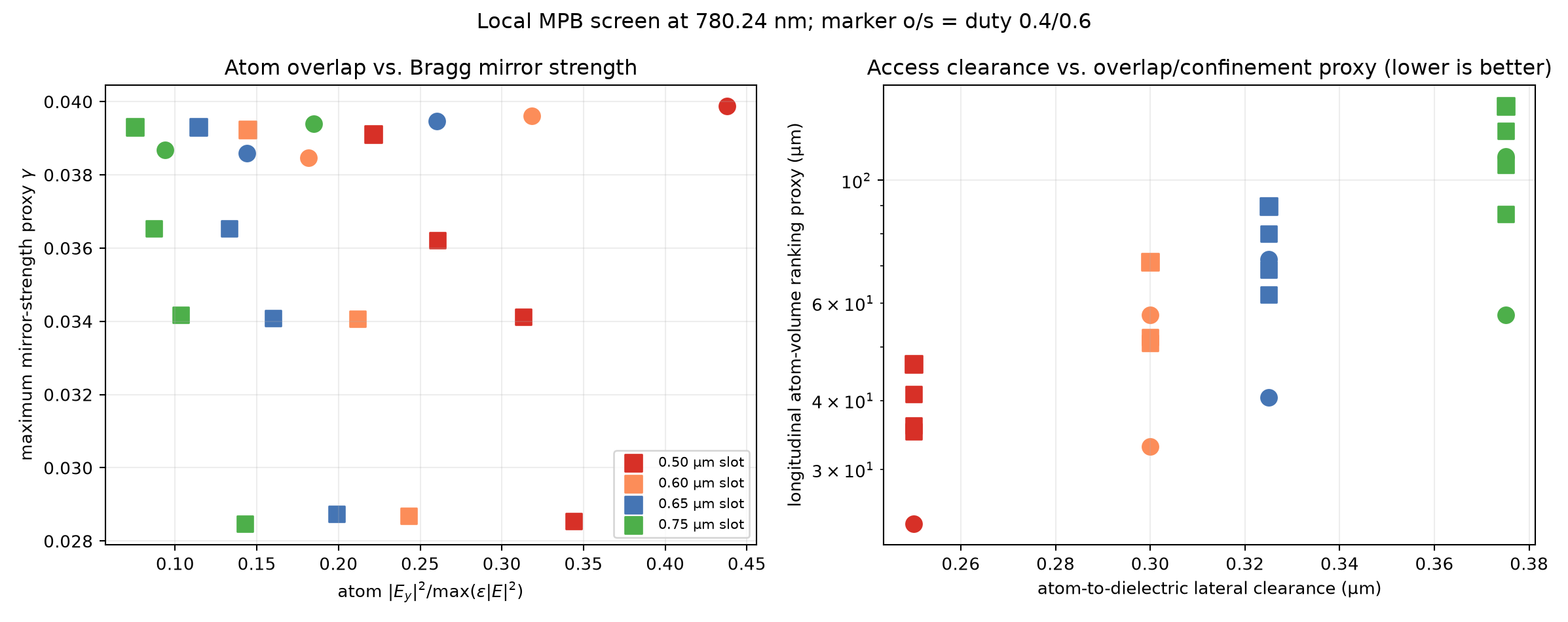
One common family dominates the successful overlap/confinement ranking:
a=0.37 µm, t=0.50 µm, A=0.60 µm, duty 0.40. Keeping the family common
lets the slot/access trade be read directly:
| Slot | clearance | center width | center residual | atom-field metric | maximum γ | longitudinal proxy | w₀=0.40 µm tail proxy |
|---|---|---|---|---|---|---|---|
| 0.50 µm | 0.250 µm | 1.763653 µm | 6.55×10⁻⁵ | 0.437754 | 0.039882 | 23.94 µm | 0.2113 |
| 0.60 µm | 0.300 µm | 1.876065 µm | 2.24×10⁻⁶ | 0.318240 | 0.039613 | 33.04 µm | 0.1336 |
| 0.65 µm | 0.325 µm | 1.933611 µm | 5.29×10⁻⁵ | 0.260340 | 0.039466 | 40.47 µm | 0.1042 |
| 0.75 µm | 0.375 µm | 2.038610 µm | 1.32×10⁻⁷ | 0.184759 | 0.039400 | 57.07 µm | 0.06079 |
All four rows have an approximately 5.157% X-point air-light-line margin in the screen. The 0.36 µm-period cases have a larger 7.721% margin but generally less atom overlap. This is another real trade: the 0.37 µm family ranks better for the atom metric, while the 0.36 µm family sits farther below the light line.
The refined 0.50 µm metric is 1.38× the 0.60 µm result, 1.68× the 0.65 µm result, and 2.37× the 0.75 µm result. Yet the geometric tweezer-tail proxy moves in the opposite direction. There is no single “winner” until tweezer waist/propagation and an acceptable scattering or heating threshold are specified. The 0.60 and 0.65 µm rows now provide concrete middle-ground candidates.
The successful center residuals are below 1e-4 relative, but all field
metrics still use MPB resolution 10 and the mirror scans remain coarse.
Resolution-14 and air-padding repeats are mandatory before constructing a
paid finite cavity from this Pareto.
Public evidence:
Access-first 1 µm-slot MPB control — modulation does not erase the trade
Evidence label: resolution-10 local MPB ranking control; not finite-cavity evidence. This batch used 0 FC.
The intermediate-slot Pareto could otherwise bias the search toward optical
overlap before giving the original access-first constraint its best chance.
This control therefore keeps the full 1.00 µm slot and screens periods
0.36/0.37 µm, tooth amplitudes 0.60/0.80 µm, and duties 0.40/0.60.
Six of eight cases completed. The two explicit retuning failures were both
a=0.36 µm, duty 0.40, at A=0.60 and A=0.80 µm.
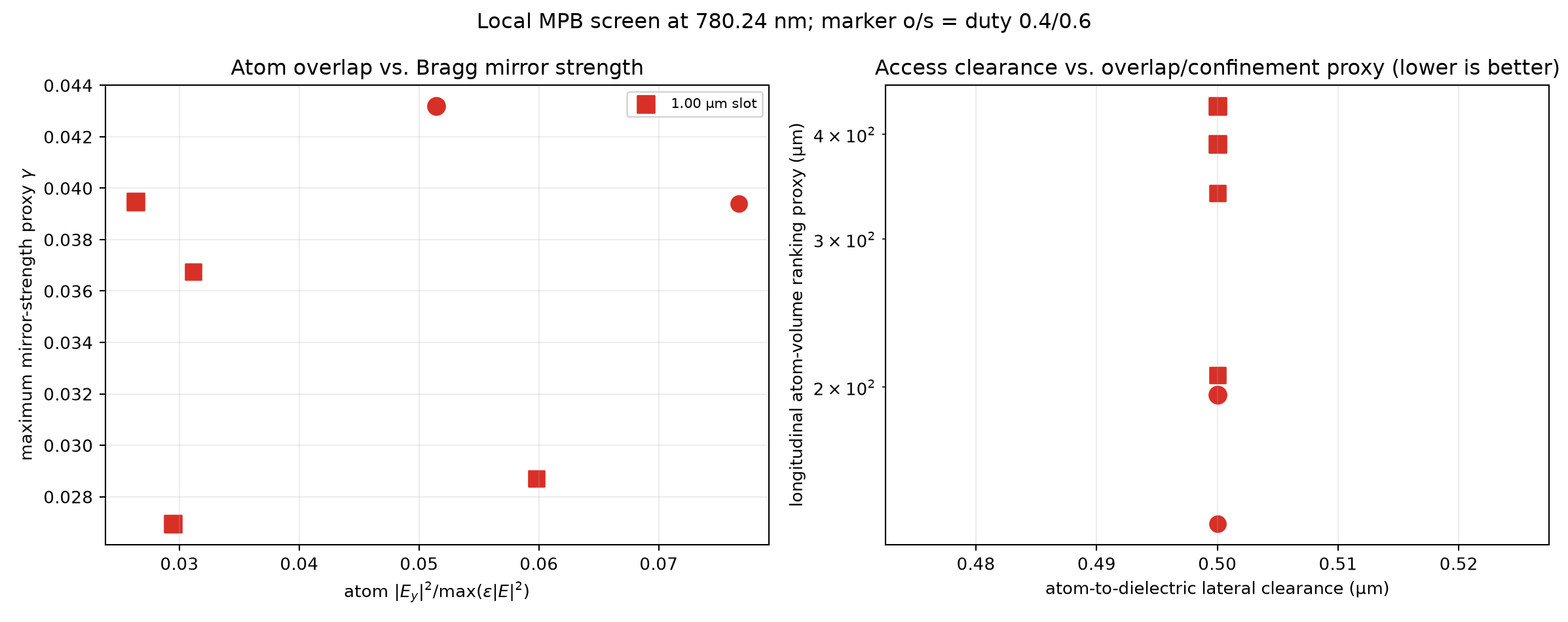
| 1 µm-slot row | center width | center residual | atom-field metric | maximum γ | longitudinal proxy |
|---|---|---|---|---|---|
| best combined rank: a=0.37, A=0.60, duty 0.40 | 2.299962 µm | 9.50×10⁻⁵ | 0.076694 | 0.039391 | 137.50 µm |
| strongest mirror: a=0.37, A=0.80, duty 0.40 | 2.279826 µm | 1.28×10⁻⁵ | 0.051404 | 0.043198 | 195.91 µm |
Stronger teeth can increase γ, but they do not restore the atom overlap
available in narrower slots. The best 1 µm row has nearly the same γ as the
refined 0.75 µm common-family row (0.03939 versus 0.03940), while its atom
metric is 2.41× smaller. Conversely, under the illustrative finite-range
λtw=0.85 µm, w₀=0.40 µm proxy, the 1.00 µm slot exposes 4.50× less beam
tail to the ideal rails than the 0.75 µm slot (0.01524 versus 0.06855).
That is the core Pareto, not a reason to select either geometry prematurely. The next trustworthy step is resolution/padding validation on representative access-first and overlap-first cells, followed by a user-specified tweezer model or acceptable overlap/heating threshold.
Public evidence:
Access-first period/thickness screen — promising, closer to the light line
Evidence label: resolution-10 local MPB ranking screen; not a converged guided-mode or finite-cavity result. This batch used 0 FC.
The full-slot search next varied period 0.35–0.38 µm and thickness
0.30–0.50 µm at gap=1.00 µm, A=0.60 µm, and duty 0.40. Eight of 12 cases
completed, three r10 secant retunes failed, and one thin a=0.35 µm case did
not bracket the target frequency. All outcomes remain in the raw JSON.
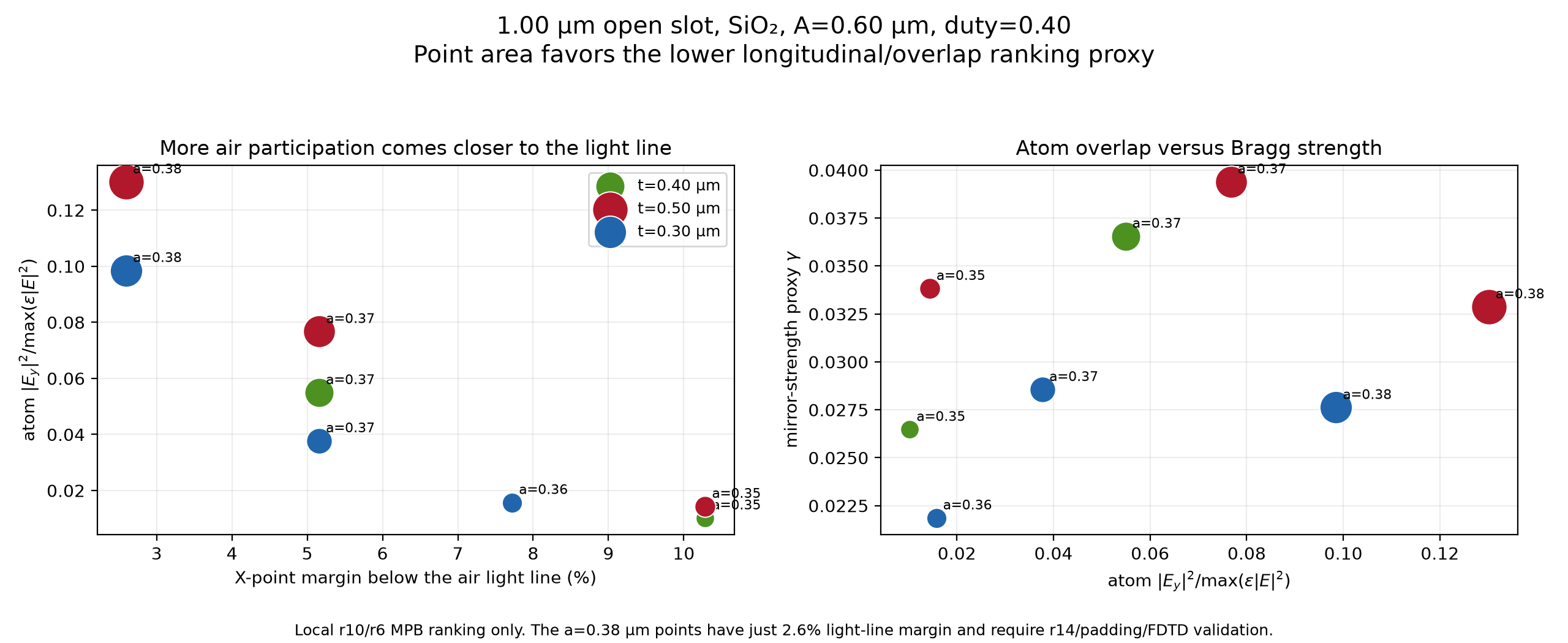
Representative successful rows:
| period | thickness | atom-field metric | maximum γ | longitudinal proxy | air-light-line margin |
|---|---|---|---|---|---|
| 0.35 µm | 0.40 µm | 0.01022 | 0.02648 | 1,190.4 µm | 10.284% |
| 0.35 µm | 0.50 µm | 0.01435 | 0.03383 | 750.0 µm | 10.284% |
| 0.37 µm | 0.30 µm | 0.03772 | 0.02856 | 328.3 µm | 5.157% |
| 0.37 µm | 0.40 µm | 0.05491 | 0.03655 | 199.4 µm | 5.157% |
| 0.37 µm | 0.50 µm | 0.07671 | 0.03939 | 137.5 µm | 5.157% |
| 0.38 µm | 0.30 µm | 0.09848 | 0.02762 | 131.3 µm | 2.594% |
| 0.38 µm | 0.50 µm | 0.13011 | 0.03287 | 91.13 µm | 2.594% |
Thinning the rails is a negative direction in the clean a=0.37 µm series:
both the atom metric and γ decrease from 0.50 to 0.30 µm thickness. Increasing
period to 0.38 µm instead raises the coarse atom metric while retaining the
full slot, but it cuts the simple light-line margin in half. The
a=0.38, t=0.50 µm row is therefore a near-light-line candidate, not a
winner.
Before finite-cavity spending, that candidate requires resolution-14 and padding checks, denser near-X dispersion, field-identity review, and eventually FDTD radiation-Q evidence. A scalar light-line margin alone cannot prove that the branch remains a robust guided mode.
Public evidence:
- all 12 successful/failed/unbracketed rows
- shared MPB screen driver and plotter
- labeled access/thickness summary plotter
First overlap-redesign FDTD screen — strong local γ, low finite Q
Evidence label: completed Auto-14 broadband FDTD diagnostics; not exact-pole mode-volume, emitter-β, port-β, or converged-Q evidence.
The first three finite cavities rebuilt the taper from the resolution-14 local
MPB γ(W) curves. Each has 40 inverse-γ taper cells plus eight uniform mirror
cells on each side (N40+M8, 96 cells total). Both use constant-index
SiO₂ (n=1.45) in air, an Ey point-dipole pulse at the atom, automatic mesh
accuracy 14 with no overrides, a 16 ps maximum runtime, and automatic shutoff
1e-7.
| Candidate | slot / clearance | local r14 atom metric | local max γ | fitted pole | fitted Q | maximum estimate | actual |
|---|---|---|---|---|---|---|---|
| access-first | 1.00 / 0.500 µm | 0.07560 | 0.04116 | 781.956 nm | 208.19 | 0.206017 FC | 0.029150 FC |
| clearance | 0.75 / 0.375 µm | 0.18139 | 0.04120 | 782.380 nm | 209.94 | 0.187262 FC | 0.060805 FC |
| practical | 0.60 / 0.300 µm | 0.31100 | 0.04141 | 782.390 nm | 199.28 | 0.183852 FC | 0.107601 FC |
The fitted poles are recovered at three atom-adjacent ringdown probes. Their frequency spans are 0.0068%, 0.0071%, and 0.0030%; their Q spans are 3.27%, 4.48%, and 0.604%. The runs stopped automatically at 2.264 ps, 5.195 ps, and 9.363 ps, respectively. The practical candidate records 55.8 fitted field amplitude lifetimes before stopping. These checks make the low-Q conclusion adequate for screening, but do not promote the quoted Q values: mesh, domain, PML, and taper convergence have not been performed.
The practical conclusion is negative and useful. The local periodic-cell
proxy predicted γ≈0.041 for both mirror families, yet neither inverse-γ
finite cavity retained the older baseline's Q≈2,280. In this geometry, local
X-edge attenuation is therefore insufficient to predict the finite-cavity
radiation loss. The cavity transition, light-cone content, and three-dimensional
radiation must be redesigned before spending on exact-pole volumes.
Access-first 1.00 µm slot
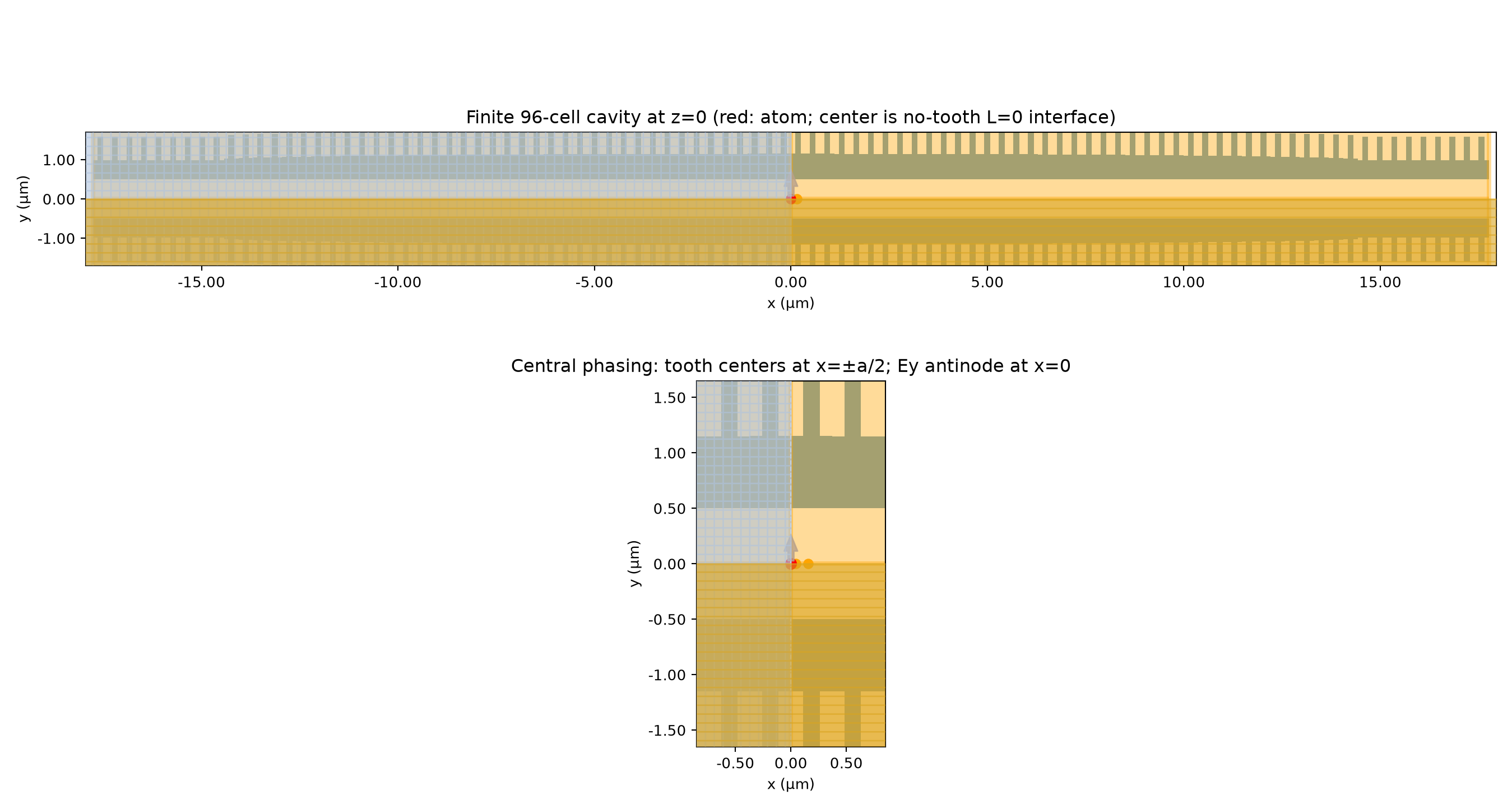
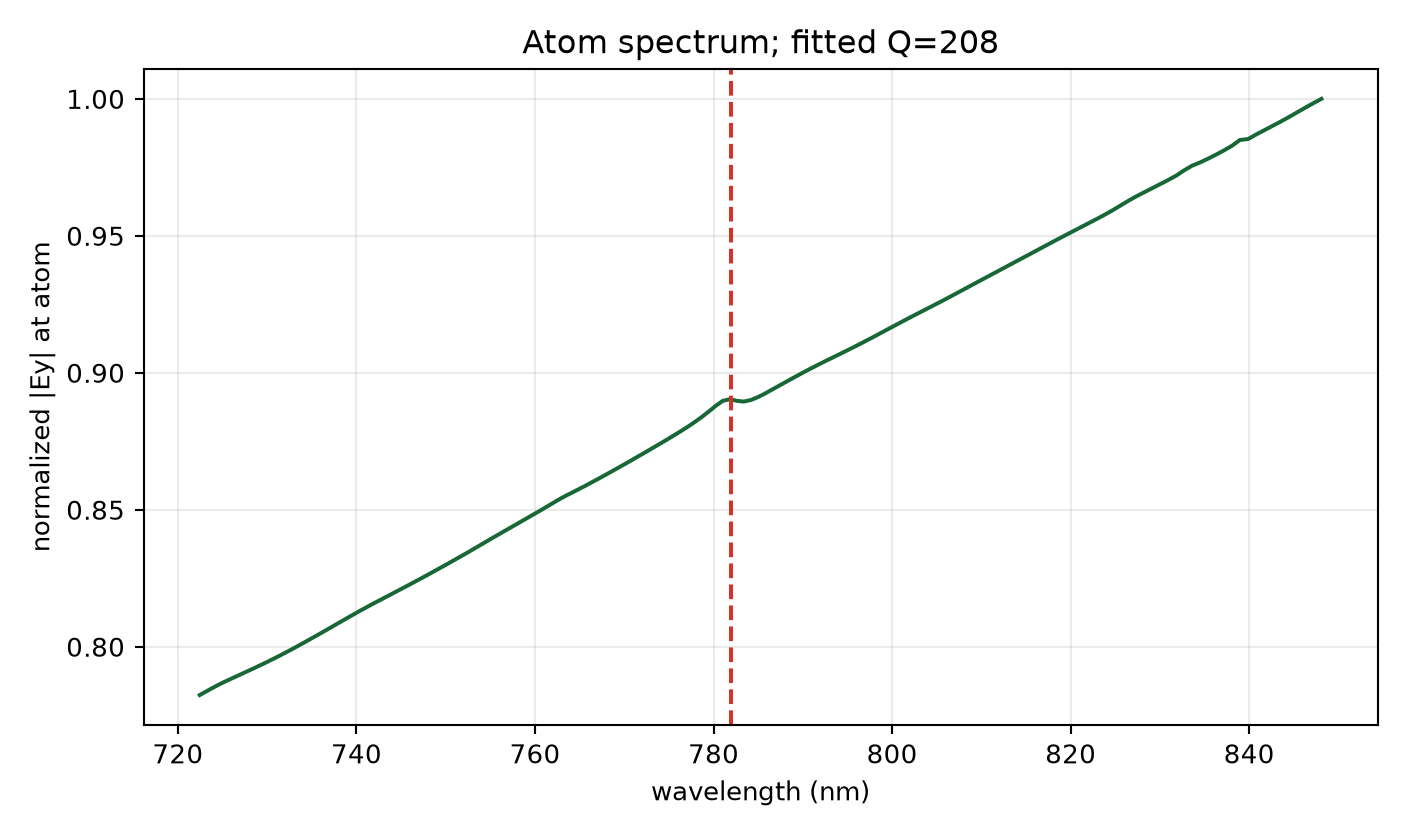
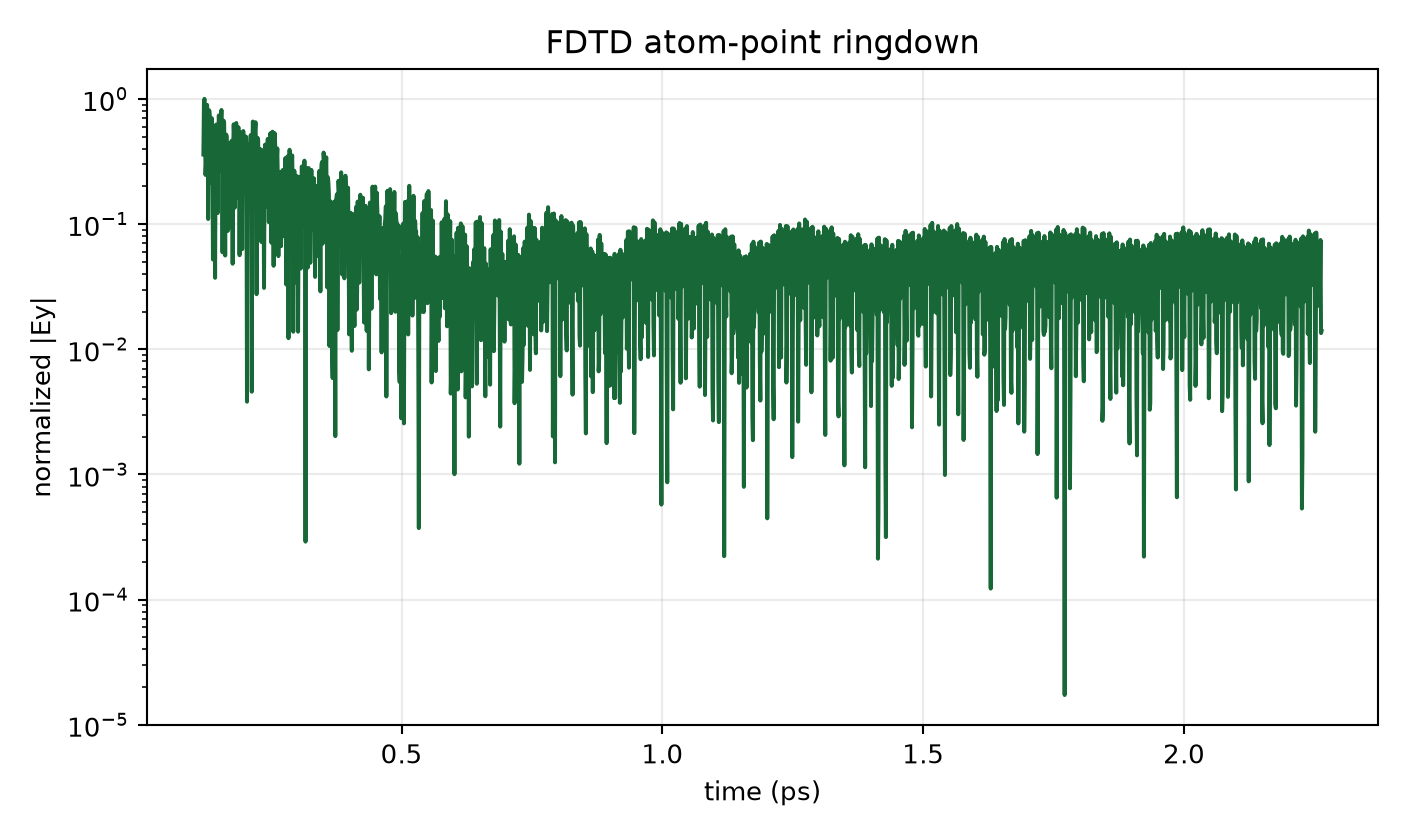
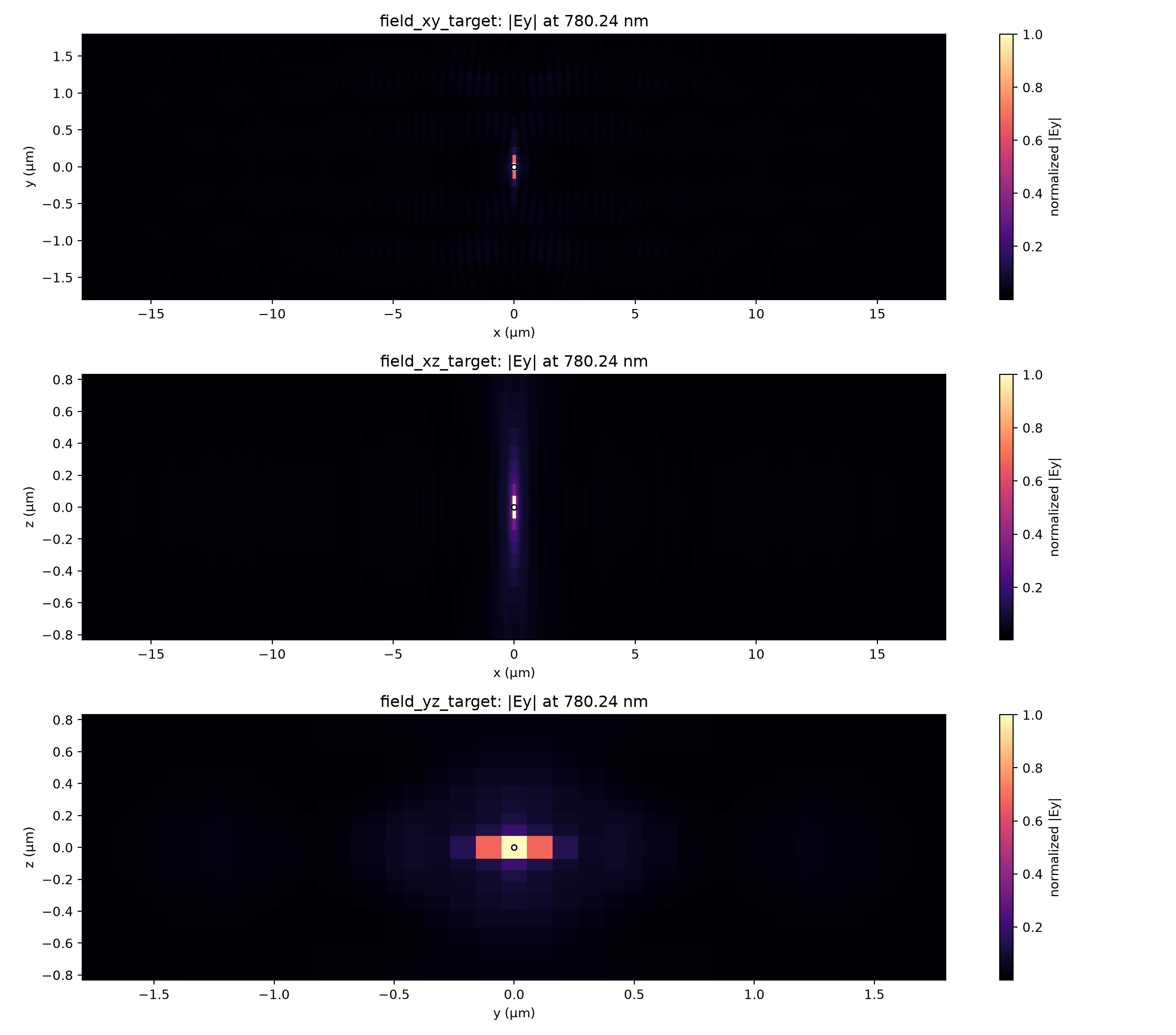
Clearance-first 0.75 µm slot
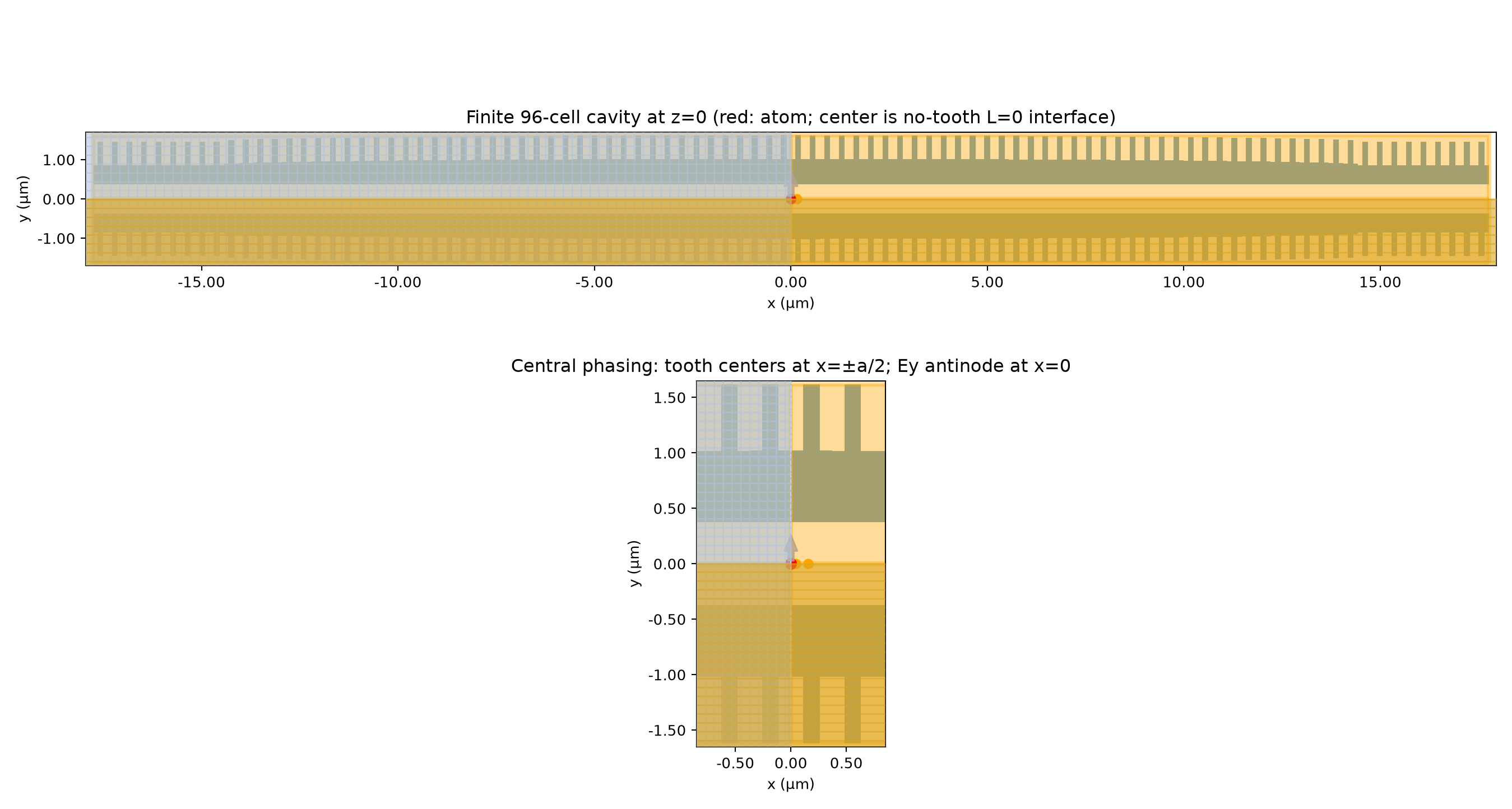
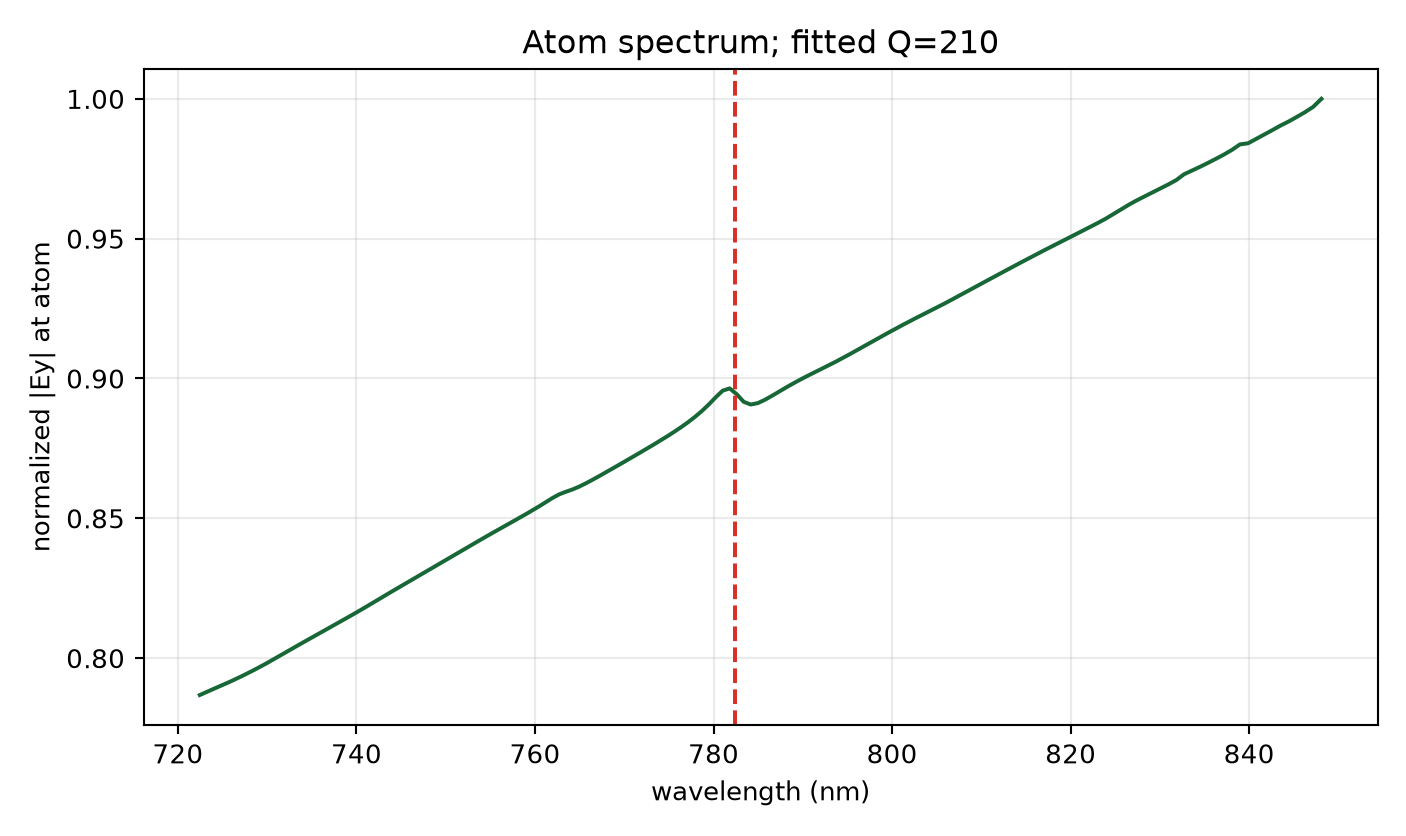
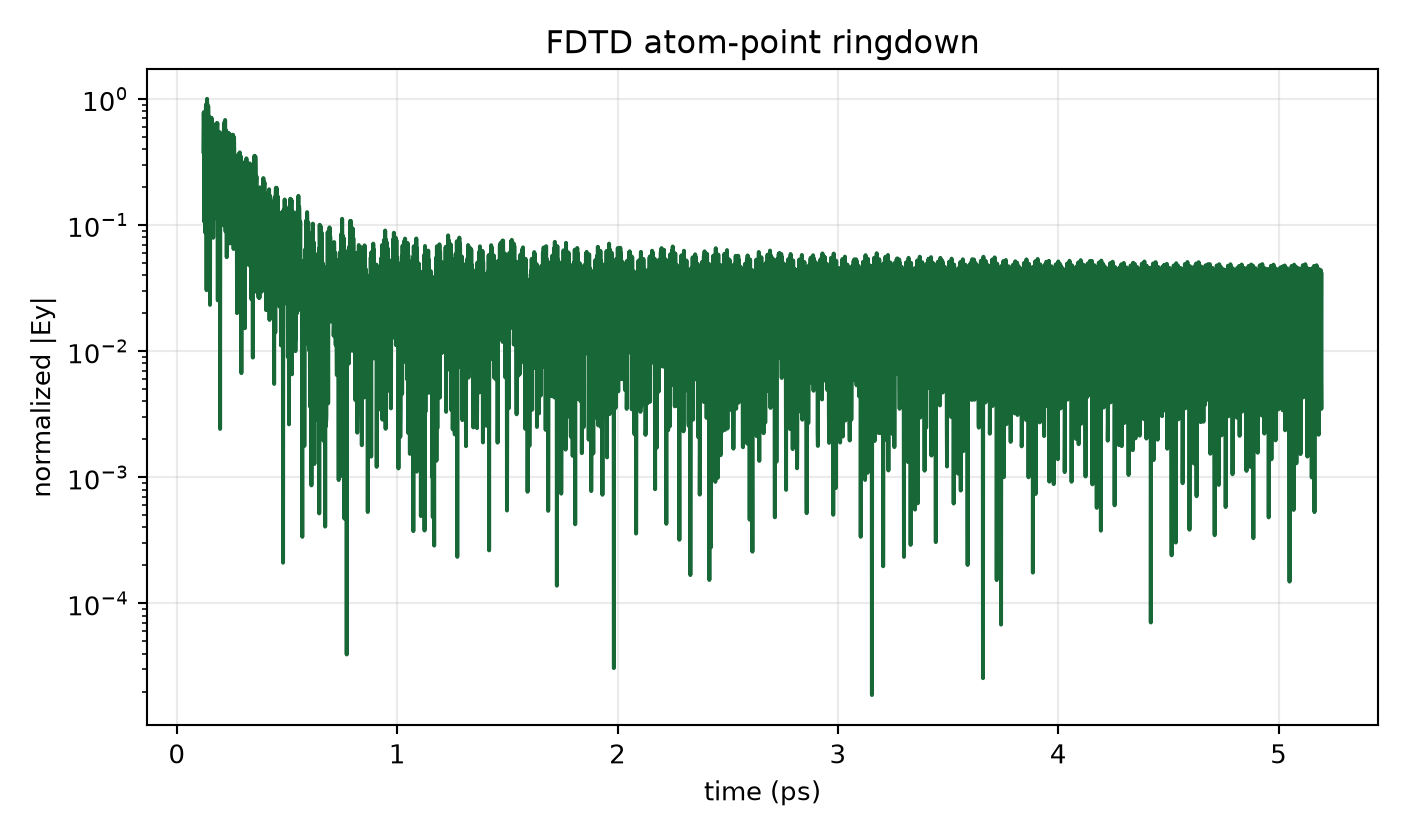
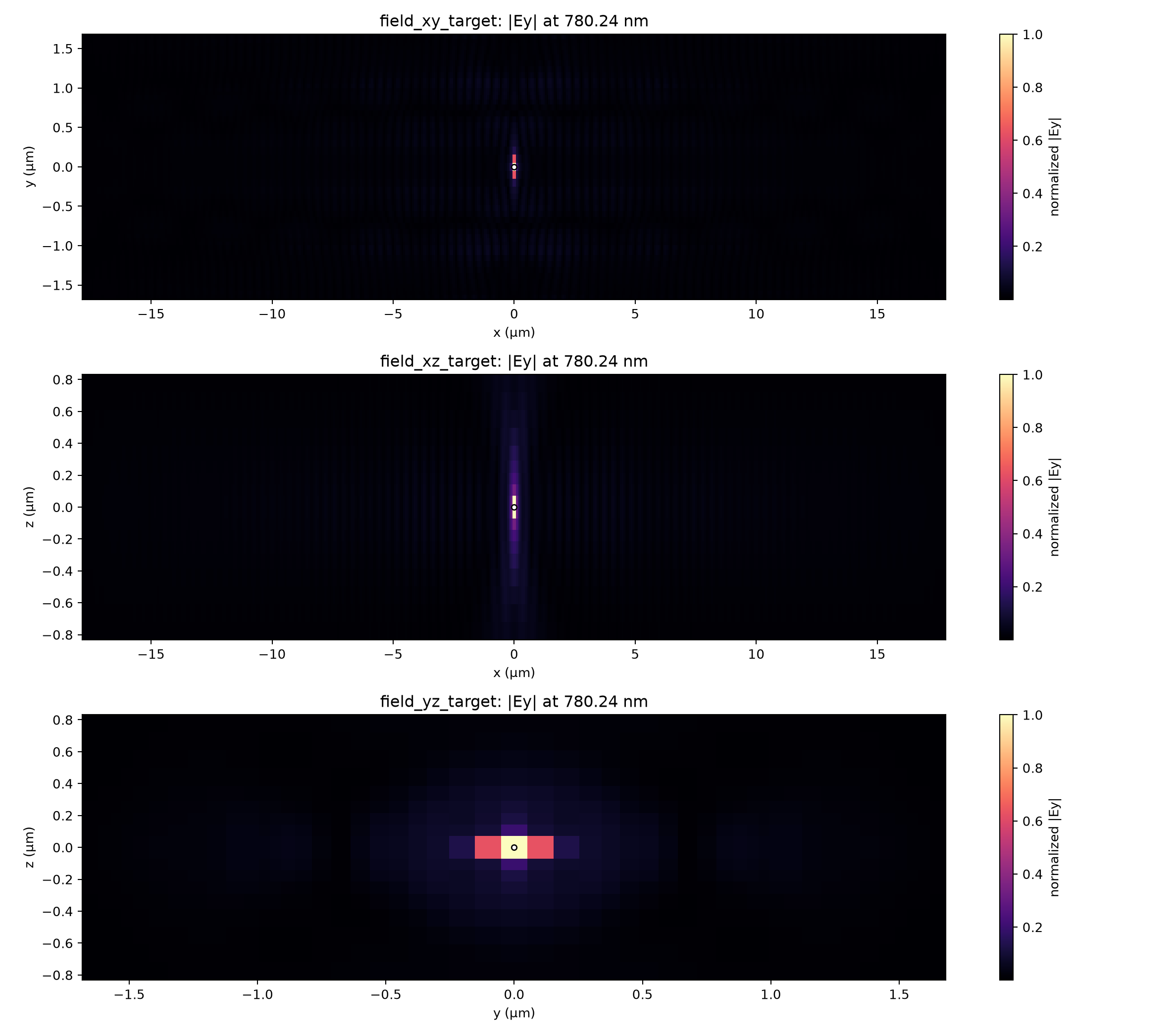
Practical-overlap 0.60 µm slot
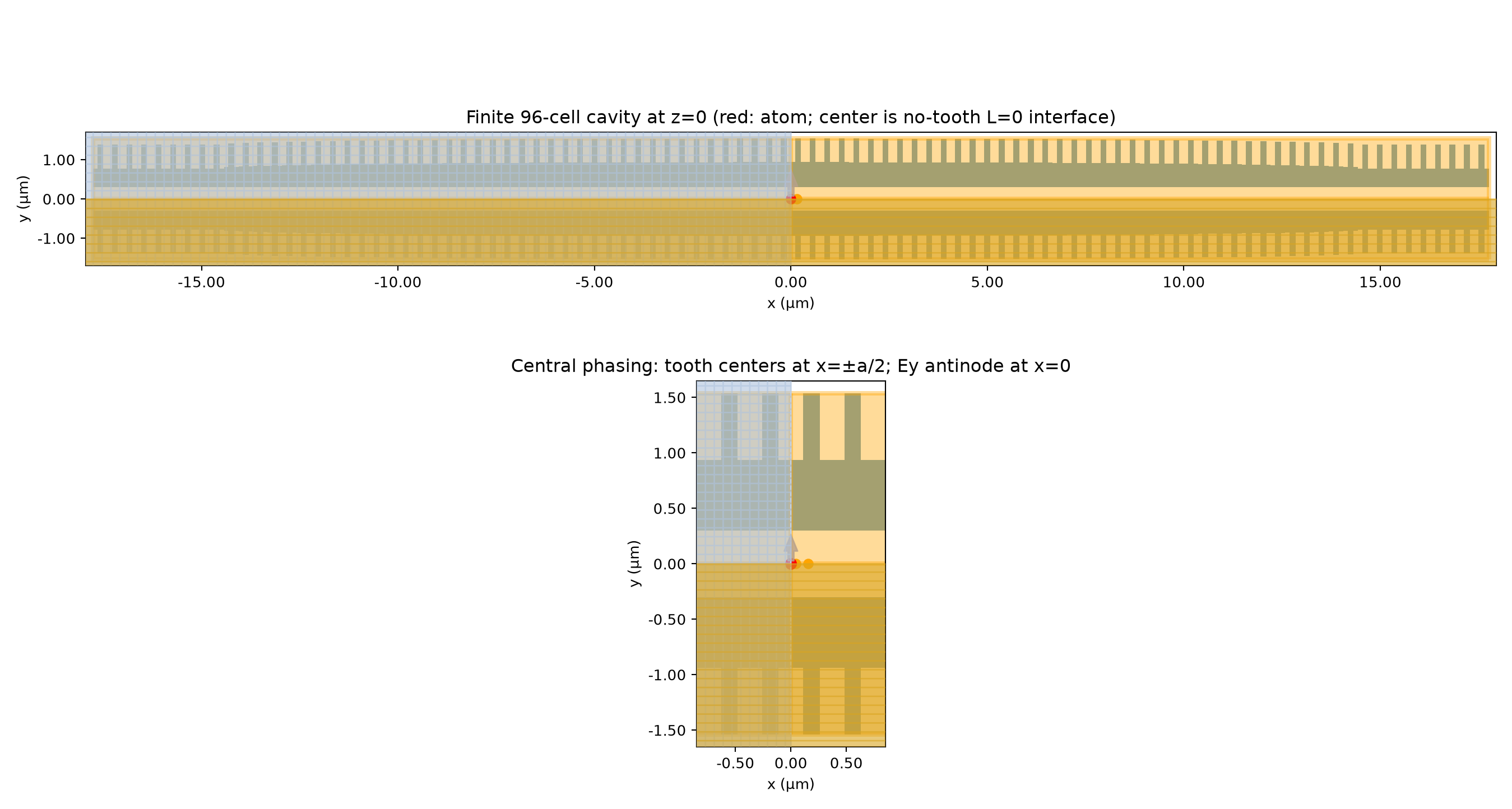
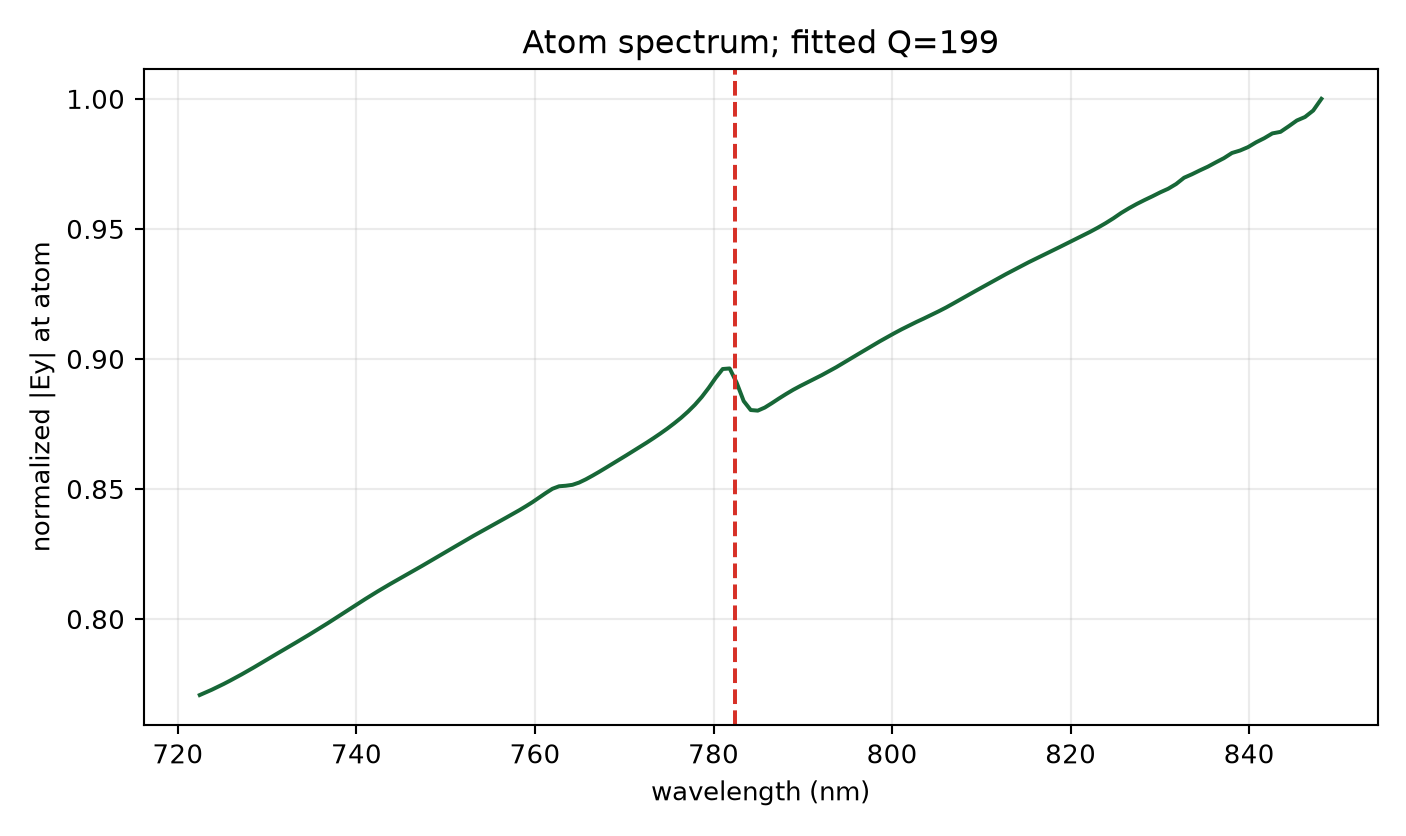
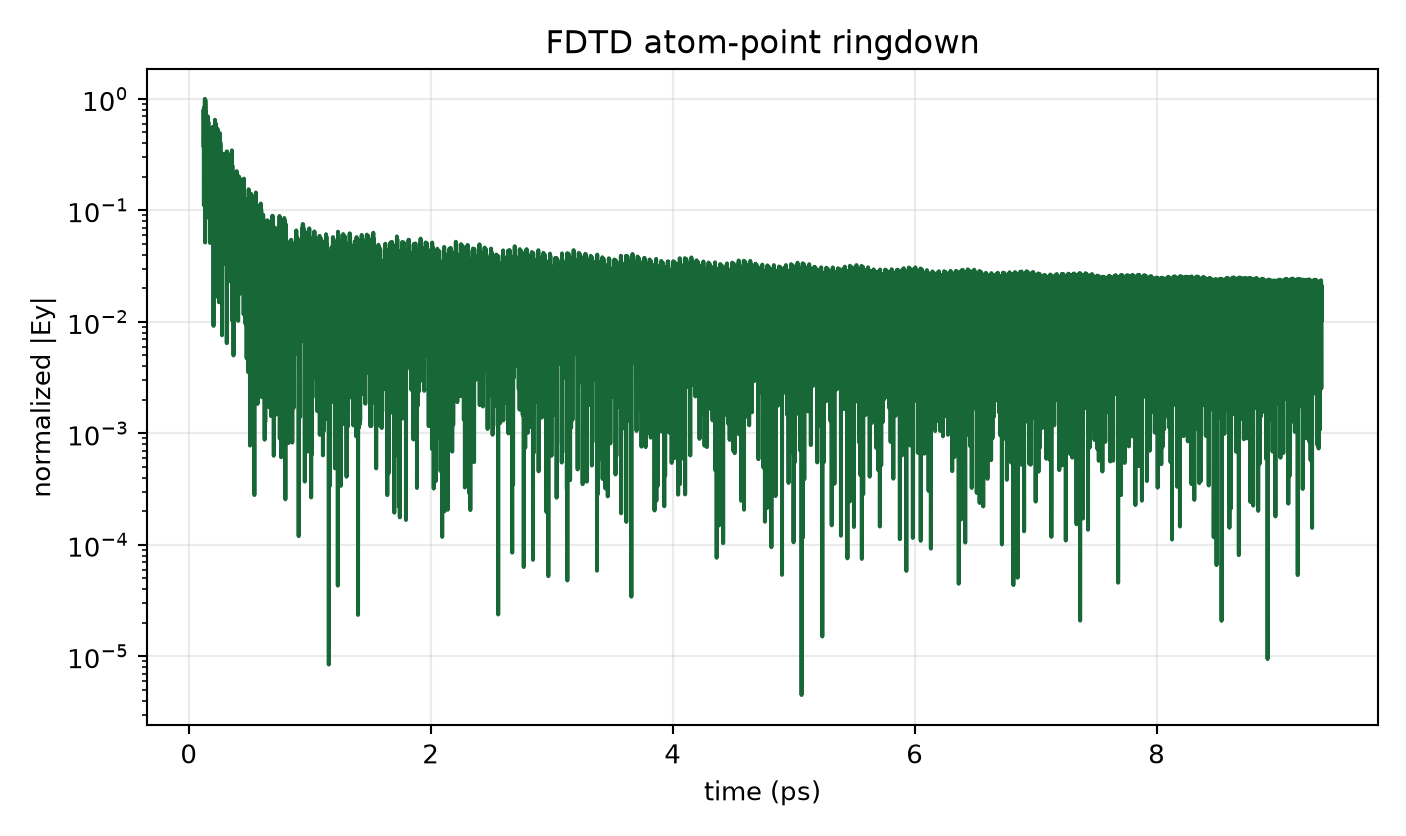
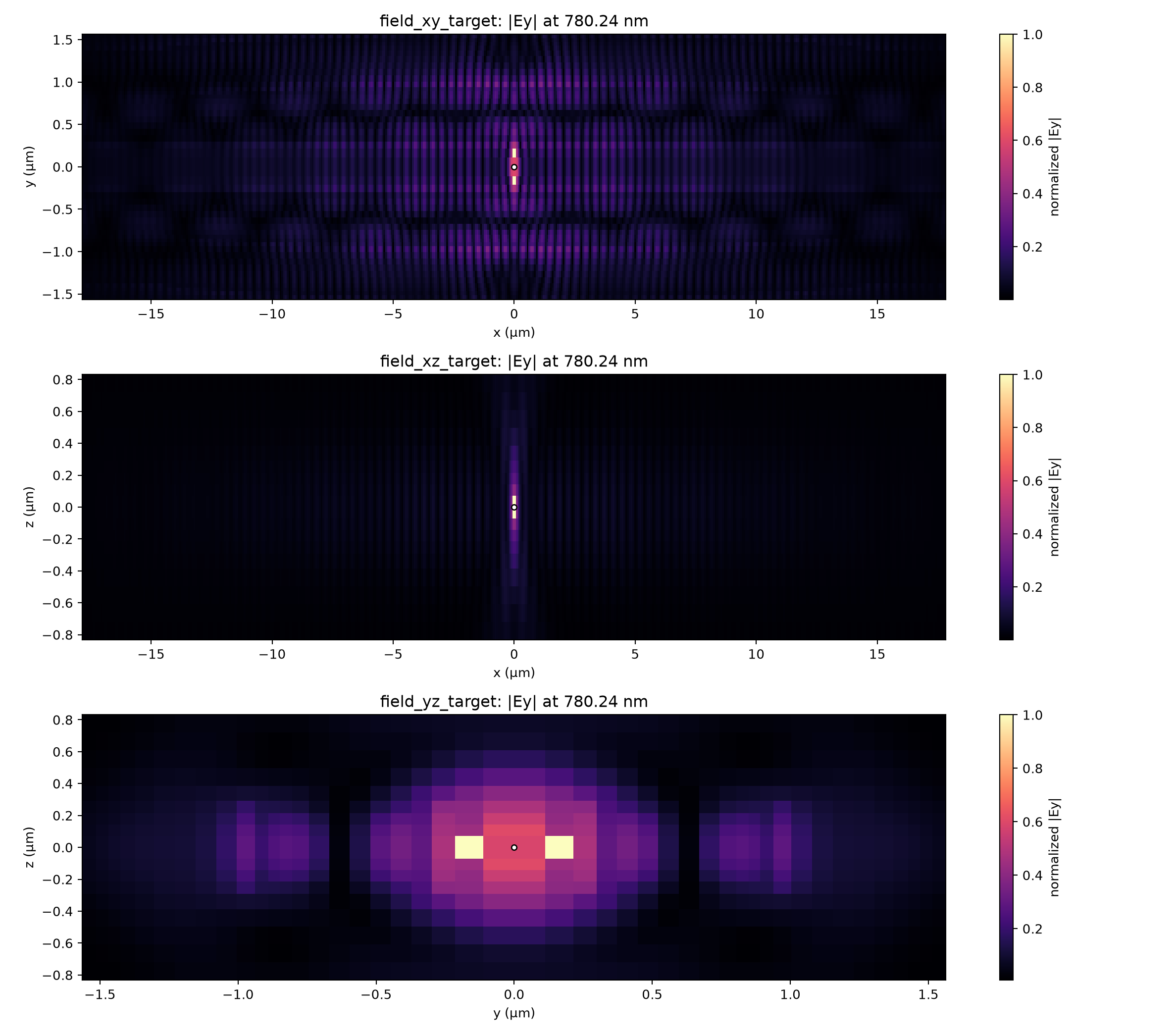
The field sections and six-face flux values above are sampled at the 780.24 nm design frequency, not at the fitted poles. They are qualitative broadband-response pictures only. They are not coherent exact-pole fields, stored cavity energy, loss branching, mode volume, or β. Because Q≈210 is already a design failure, an exact-pole follow-up was intentionally not run.
Public evidence:
- access-first variant, configuration, serialized simulation, and result
- clearance-first variant, configuration, serialized simulation, and result
- practical-overlap variant, configuration, serialized simulation, and result
Lower-radiation hybrid MPB screen — recover the baseline modulation
Evidence label: resolution-10 local MPB ranking screen; not finite-Q, mode-volume, or converged-band evidence. This screen used 0 FC.
The failed A=0.60 µm, duty 0.40 finite cavities had stronger local γ but
roughly 11× lower Q than the older A=0.40 µm, duty 0.50, 1 µm-slot N40
baseline. The next local screen therefore keeps the weaker baseline
modulation—which is at least associated with one Q≈2,283 finite cavity—while
retuning its center width for 0.60, 0.75, and 1.00 µm slots at periods 0.37
and 0.38 µm.
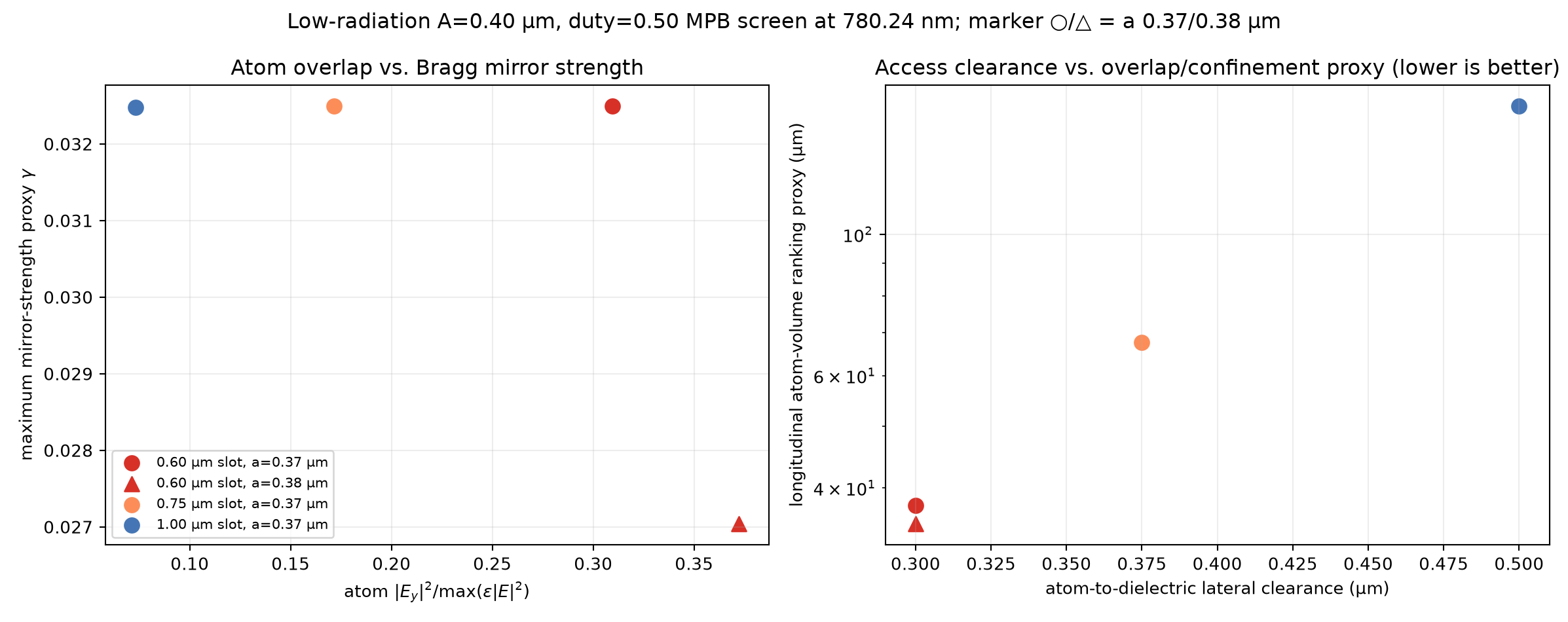
| Period | slot / clearance | center width | atom-field metric | maximum γ | longitudinal proxy | light-line margin |
|---|---|---|---|---|---|---|
| 0.37 µm | 0.60 / 0.300 µm | 1.833916 µm | 0.309624 | 0.032495 | 37.50 µm | 5.157% |
| 0.38 µm | 0.60 / 0.300 µm | 1.671719 µm | 0.372259 | 0.027040 | 35.12 µm | 2.594% |
| 0.37 µm | 0.75 / 0.375 µm | 1.997373 µm | 0.171584 | 0.032495 | 67.67 µm | 5.157% |
| 0.37 µm | 1.00 / 0.500 µm | 2.258313 µm | 0.073091 | 0.032478 | 158.90 µm | 5.157% |
The a=0.38 µm retunes for 0.75 and 1.00 µm slots failed at resolution 10,
likely because the secant step encountered coarse-pixelization structure.
They remain explicit failed rows; the table does not interpolate or infer
metrics for them.
The 0.60 µm-slot rows recover atom metrics comparable to the failed high-modulation practical candidate while reducing the mirror-strength proxy from about 0.0414 to 0.0325/0.0270. This is a deliberate attempt to trade some one-dimensional attenuation for a smoother, less radiative dielectric perturbation. That rationale is a hypothesis, not a radiation-Q calculation. In particular, retaining the modulation used by the baseline does not guarantee its Q survives the new center width, slot, period, or taper.
Resolution-14 validation was run separately for a=0.37, gap=0.60,
a=0.38, gap=0.60, and a=0.37, gap=0.75 µm; its results are below. No
hybrid was promoted to paid FDTD from this coarse table alone.
Public evidence:
Low-radiation hybrid r14/padding validation — three local leads
Evidence label: resolution-14 and air-padding-checked local MPB Pareto; not a complete dispersion/radiation test, finite-cavity Q, or mode volume. This validation used 0 FC.
Each selected center cell was retuned at resolution 14, its atom metric was
compared against resolution 12 and larger transverse air padding, and its
mirror-cell γ was checked the same way. An 11-point r14 γ(W) curve was
then regenerated for constructing an inverse-γ taper.
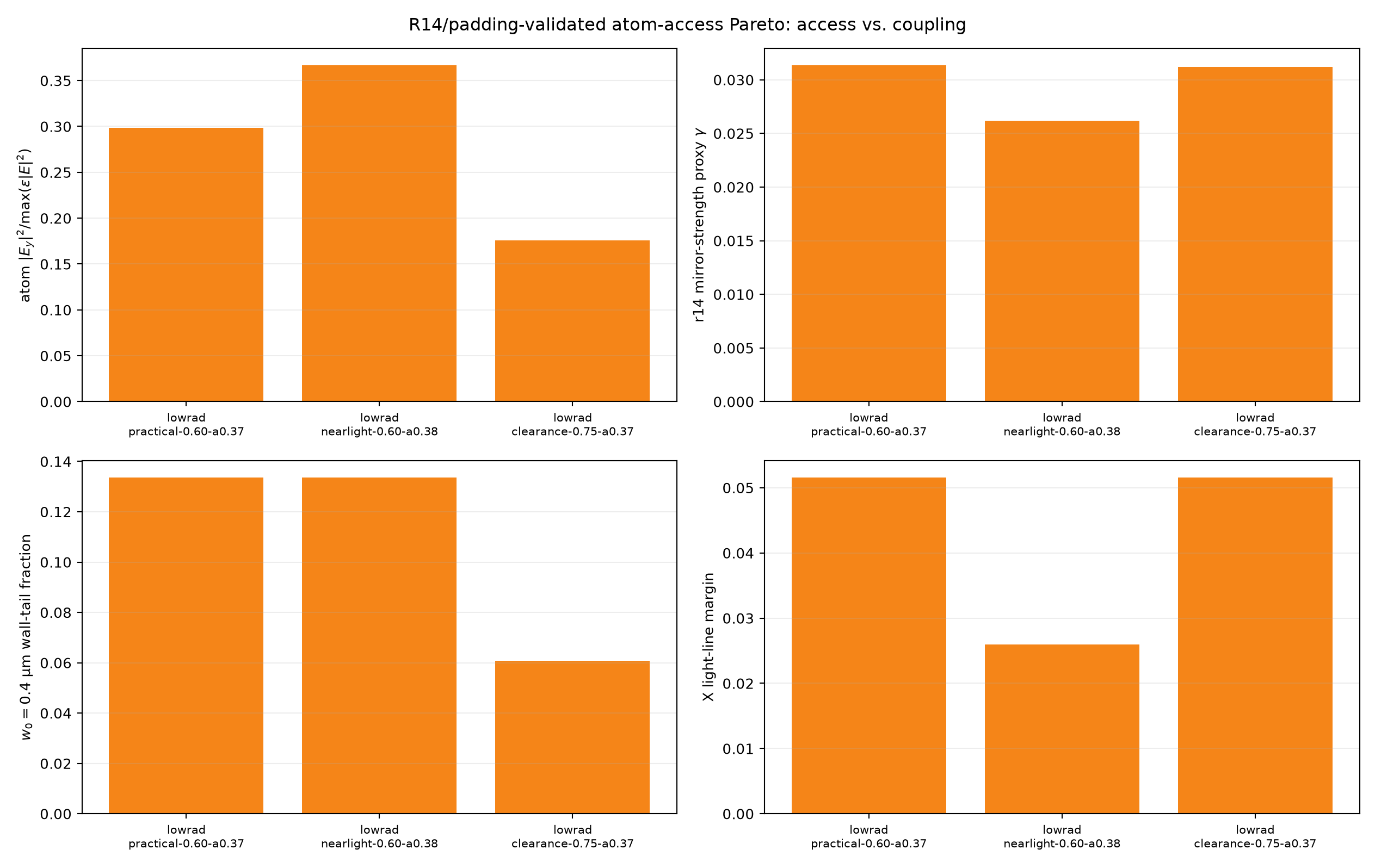
| Candidate | atom metric r14 | atom Δ r12→r14 | atom Δ pad 1.2→1.6 | γ r14 | γ Δ r12→r14 | γ Δ pad 1.2→1.6 | light-line margin | w₀=.40 wall tail |
|---|---|---|---|---|---|---|---|---|
| a=.37, slot=.60 | 0.298804 | 4.545% | 3.050% | 0.031342 | 2.767% | 0.198% | 5.157% | 13.361% |
| a=.38, slot=.60 | 0.366568 | 0.157% | 0.101% | 0.026158 | 3.073% | 0.695% | 2.594% | 13.361% |
| a=.37, slot=.75 | 0.175714 | 0.496% | 0.0856% | 0.031188 | 2.515% | 0.191% | 5.157% | 6.079% |
All listed atom and γ changes remain below the campaign's 5% local
resolution/padding screen. The first row is the practical lead: it retains the
larger 5.157% X-point light-line margin and γ≈0.0313, while its r14 atom
metric is about four times the 1 µm-slot baseline's coarse value. The 0.75 µm
row gives 25% more lateral clearance and less than half the illustrative
wall-tail fraction of the 0.60 µm row, but its atom metric is 41% lower.
The a=.38, slot=.60 µm row has the largest atom metric and the cleanest
center-field convergence, but its simple X-point light-line margin is only
2.594%. It remains a near-light-line control, not the first FDTD choice.
The 0.75 µm center retune landed on the best available r14 pixelized point:
relative target residual 5.47e-5. That is just outside the strict 5e-5
retune preference but inside the predefined 2e-4 acceptance bound. This
exception is recorded in the JSON rather than rounded into a nominal pass.
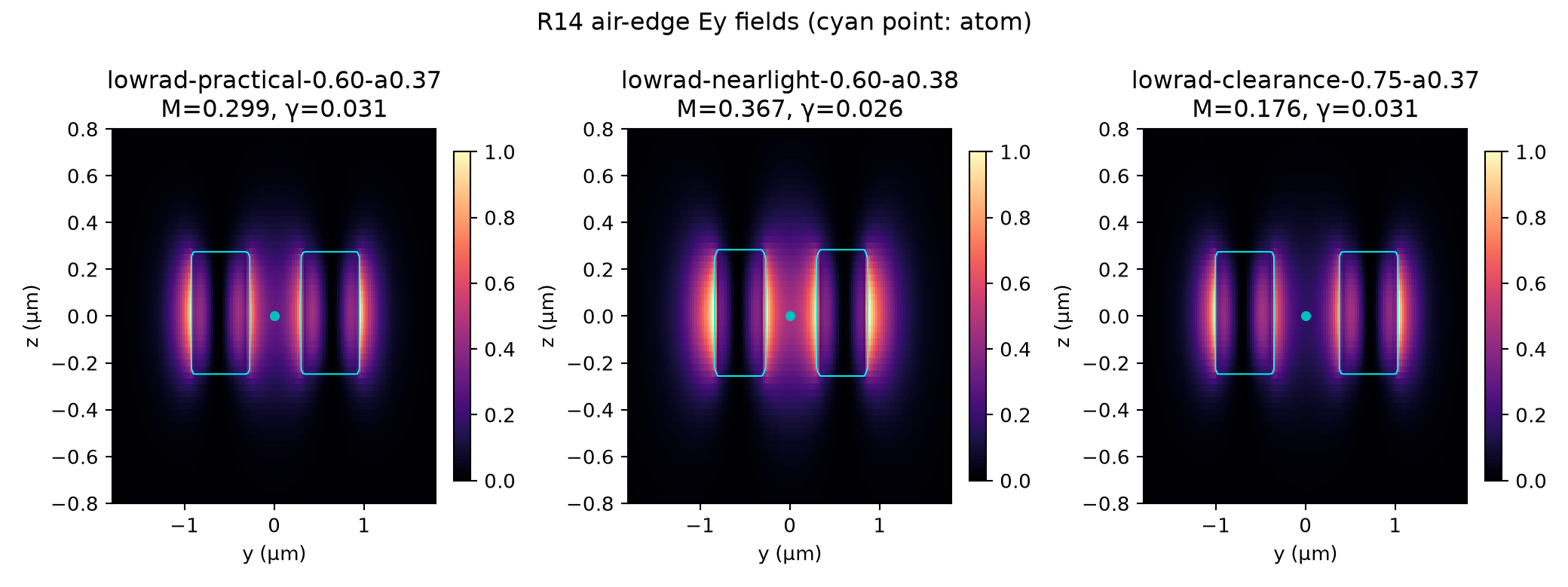
The cyan rectangles are the SiO₂ rails and the cyan dot is the intended atom.
All three air-edge fields are Ey polarized at the centered atom within the
sampled symmetry sector. The plotted metrics use
|Ey(atom)|² / max[ε|E|²]; they are local field-overlap rankings, not
normalized finite-cavity coupling rates or mode volumes.
The broadband FDTD screening order was a=.37/slot=.60, then
a=.37/slot=.75, then a=.38/slot=.60. Dense near-X dispersion was evaluated
separately below. Even a locally stable γ(W) curve cannot establish
transverse radiation Q; the earlier high-modulation failure is the direct
warning.
Public evidence:
Near-X dispersion check — a=.37 is the safer branch
Evidence label: local resolution-10, 1.6 µm-padding MPB branch-identity diagnostic over 18 near-X samples; not a finite-cavity radiation-Q calculation.
The X-point light-line margin is only one sample. This check follows bands 3
and 4 from kx=0.46 to 0.50 for the two 0.60 µm-slot leads, at both center and
mirror widths. Marker area in the plot follows the integrated slot-energy
fraction, adding a field-character diagnostic to the eigenfrequency curves.
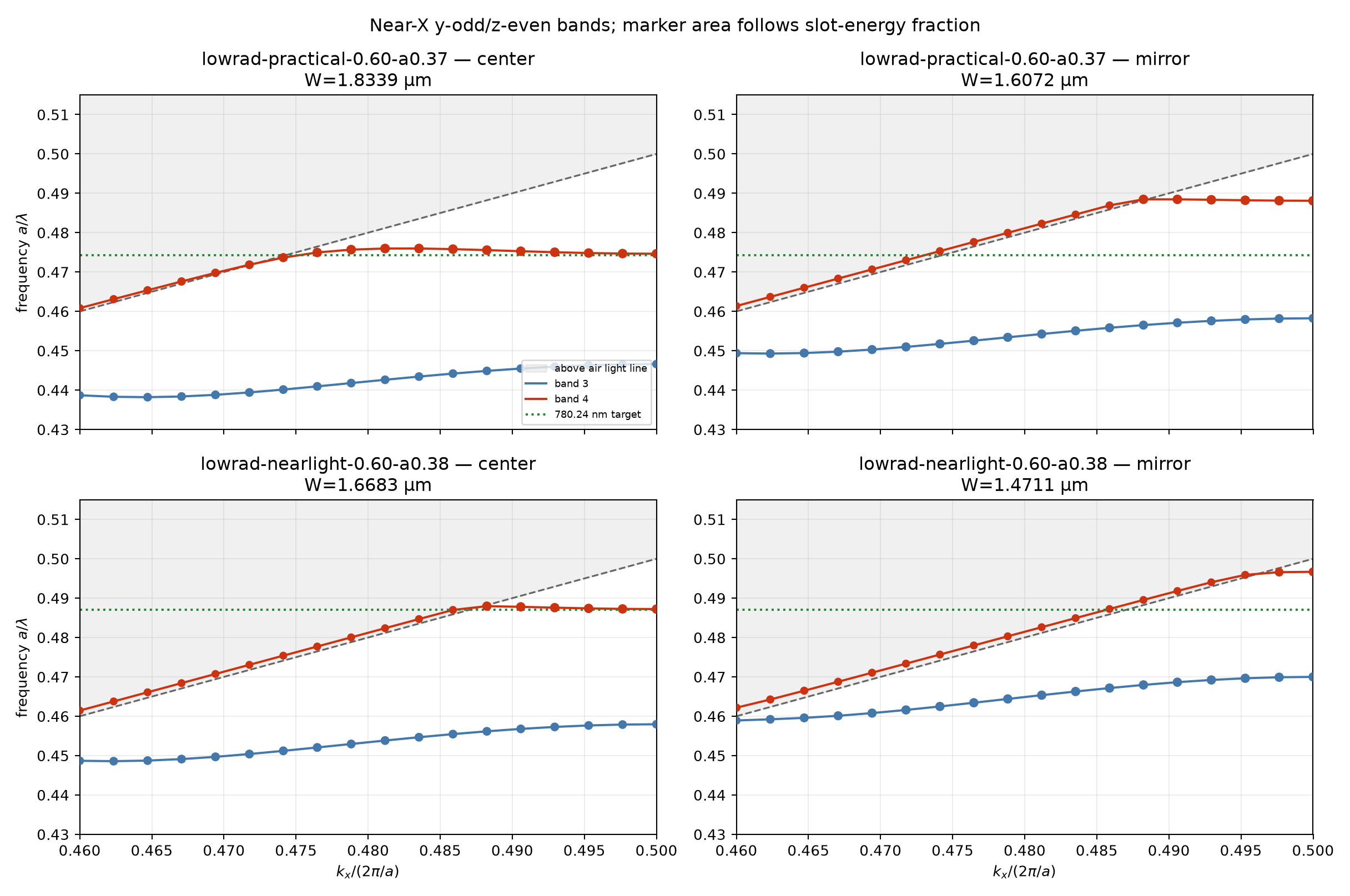
| Candidate / section | band 4 below air line | first below-line sample | minimum b4−b3 | maximum adjacent b4 slot-fraction jump | interpretation |
|---|---|---|---|---|---|
| a=.37 center | 12/18 | 0.474118 | 0.022135 | 0.0378 | no jump warning |
| a=.37 mirror | 5/18 | 0.490588 | 0.011978 | 0.1364 | hybridization warning |
| a=.38 center | 6/18 | 0.488235 | 0.012759 | 0.1273 | hybridization warning |
| a=.38 mirror | 2/18 | 0.497647 | 0.003241 | 0.0645 | hybridization warning |
The a=.37 center becomes below the air light line earlier and stays there
for twice as many samples as the a=.38 center. Its 5.157% X-point margin and
smooth center slot fraction make it the safer first finite-cavity test. The
near-light a=.38 center is below-line only close to X, consistent with its
2.594% X margin and greater sensitivity to finite-cavity k-space leakage.
Fixed y-odd/z-even parity and nonzero b3/b4 separation let us track the
eigenvalue branches numerically. They do not establish smooth physical-mode
identity when the slot-energy fraction jumps. Both mirror upper branches show
such hybridization; the a=.38 center does too. The target remains inside each
X-point gap, but that fact and local γ still do not predict transverse
radiation Q.
Public evidence:
Lower-radiation hybrid FDTD — a=.37 promoted, Q not final
Evidence label: completed Auto-14 broadband FDTD diagnostics, promoted for exact-pole and longer-record follow-up but not final Q values.
Practical 0.60 µm slot — Q≈19,563
The first finite hybrid uses a=.37 µm, a 0.60 µm slot, A=.40 µm, duty
0.50, 40 inverse-γ taper cells, and eight uniform mirror cells per side. It
preserves the same modulation family as the earlier Q≈2,283 baseline while
moving the local air-edge field toward the atom.
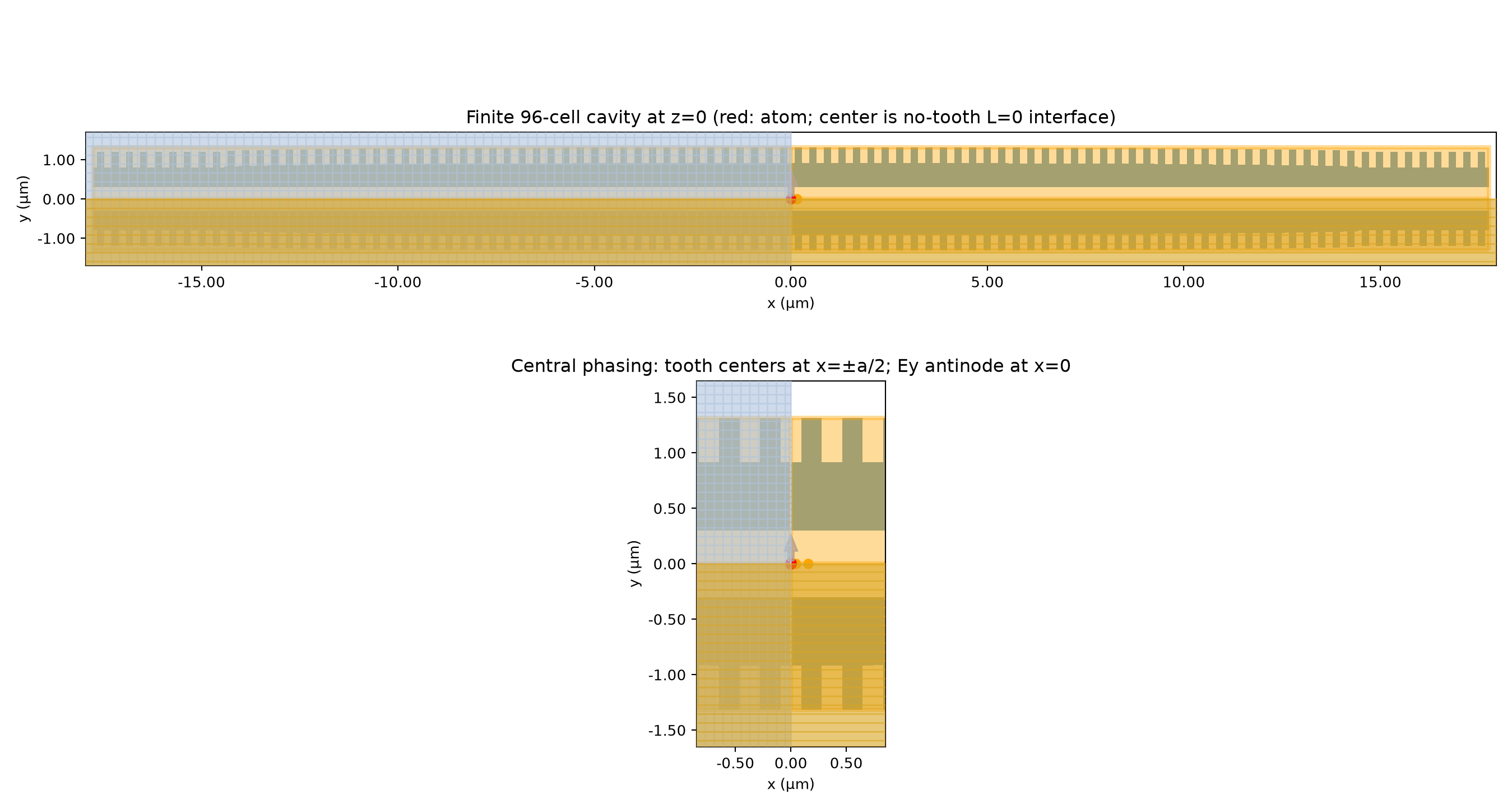
The run used the requested cost-controlled protocol: automatic mesh accuracy
14, no mesh overrides, 16 ps maximum time, and automatic shutoff 1e-7.
Unlike the Q≈200 redesigns, it used the entire 16 ps record.
| Quantity | Broadband diagnostic |
|---|---|
| Tidy3D task | fdve-019193d0-6ccc-4a2e-af9f-dd31ac6a2f6b |
| fitted pole | 781.652047 nm |
| fitted Q | 19,562.52 |
| three-probe Q span | 0.02016% |
| three-probe frequency span | 8.14×10⁻⁹ |
| per-probe fit error | 0.0037–0.0076 |
| Tidy3D end-of-run field-decay metric | 5.08×10⁻⁴ |
| fitted amplitude lifetimes observed | 0.978 |
| maximum estimate / actual | 0.191557 / 0.191557 FC |
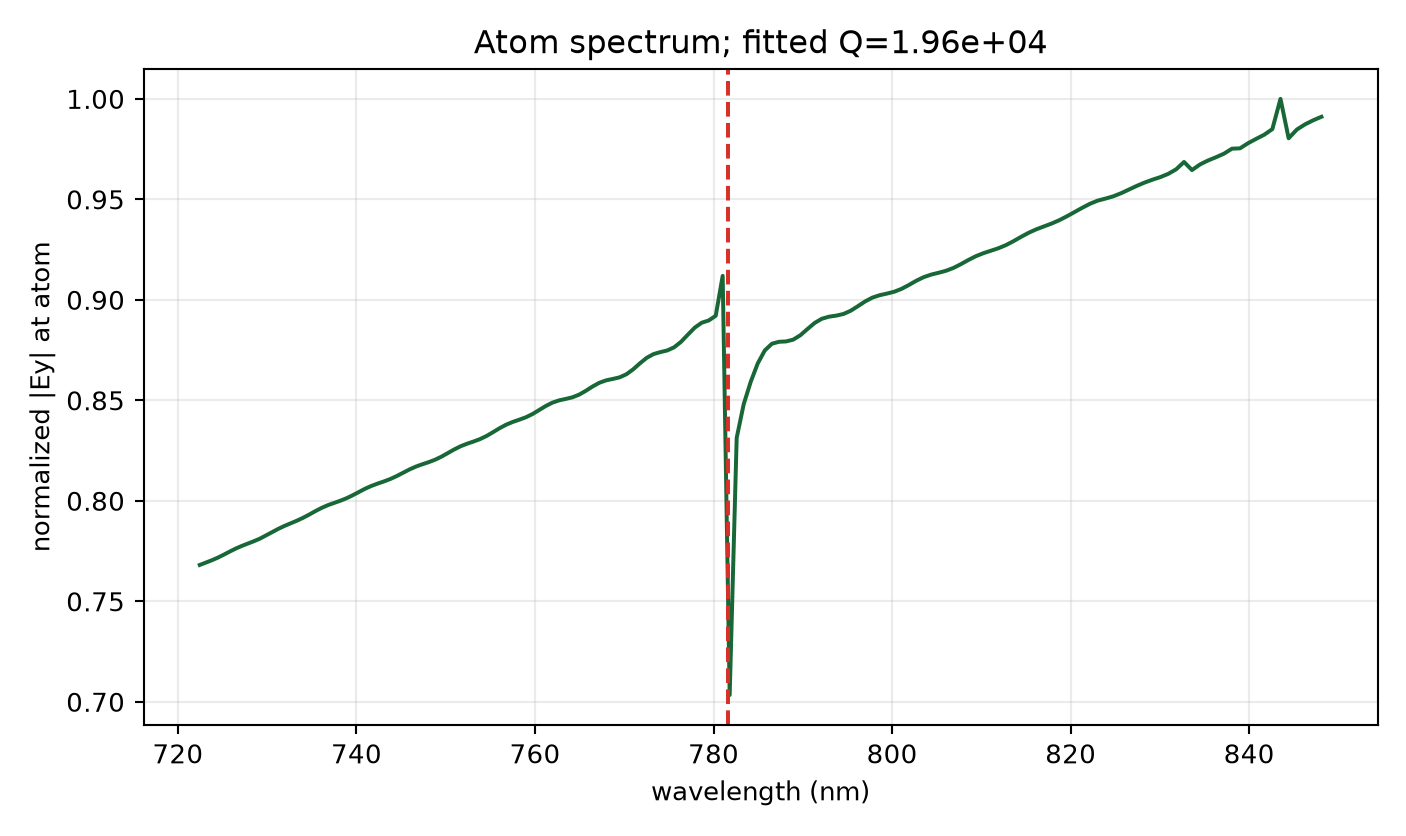
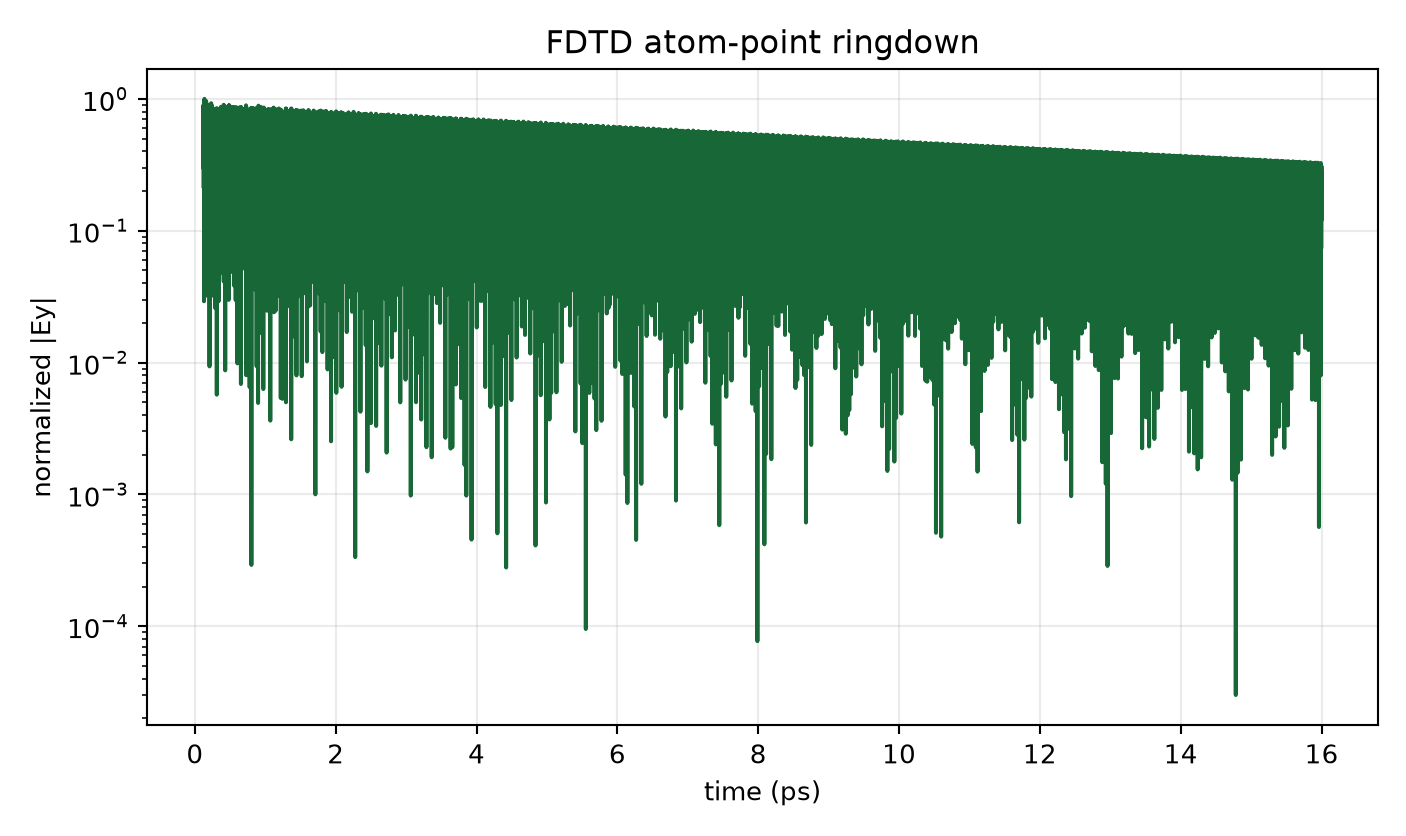
The pole is extremely consistent across the three probes and the trace shows a clean long-lived envelope. That is enough to promote the geometry. It is not enough to trust Q to high precision: the record contains less than one fitted field-amplitude lifetime and ends at the imposed 16 ps maximum rather than automatic shutoff. A longer or coherent exact-pole record, plus mesh/domain/PML convergence, is required.
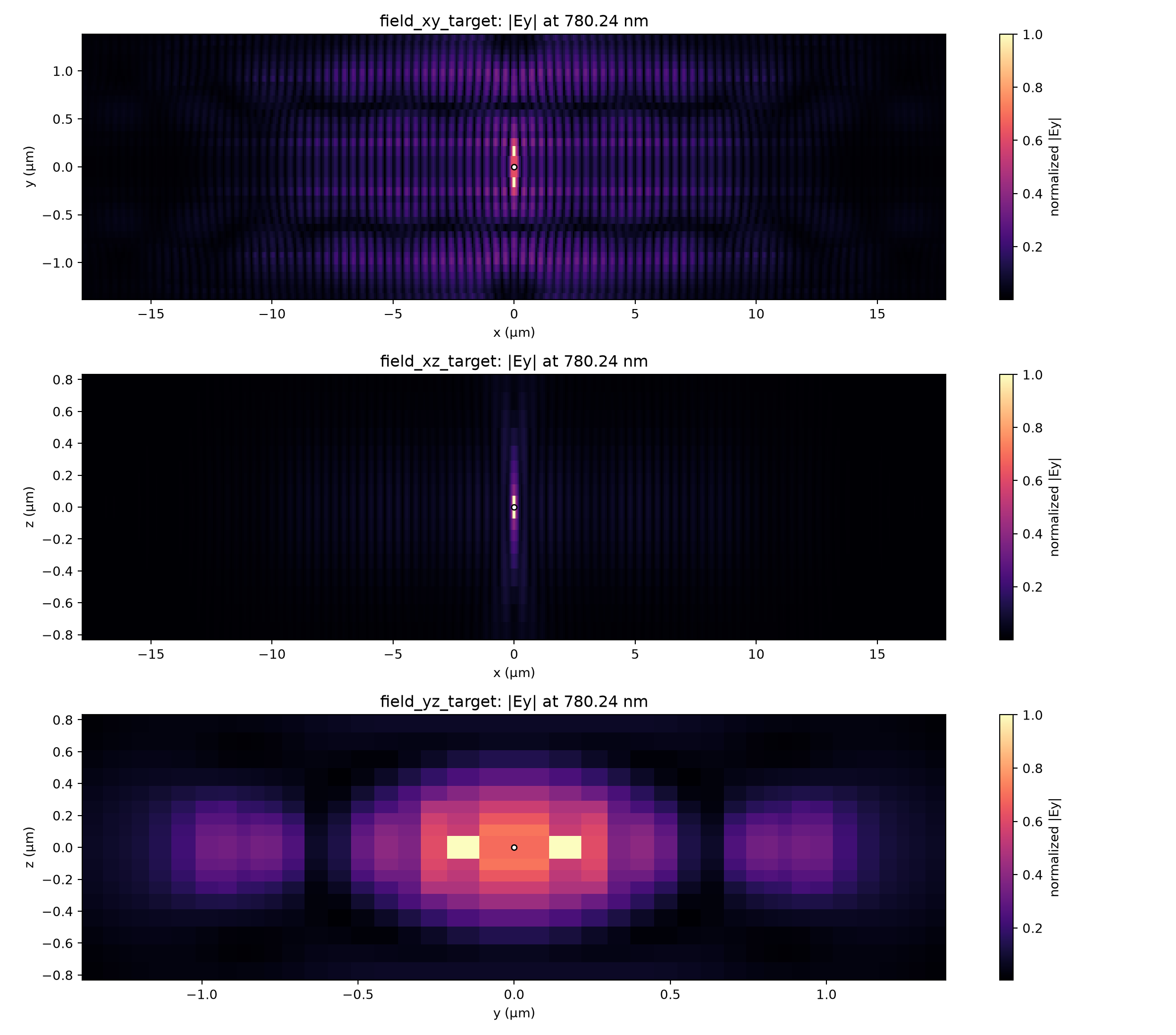
The spectrum and field/flux monitors were placed at the 780.24 nm design frequency, while the fitted pole is 781.652 nm. The field sections and six-face fluxes are therefore qualitative broadband-response evidence only. They are not exact-pole energy, mode volume, decay branching, or β.
Public evidence:
Clearance 0.75 µm slot — Q≈11,838
The second hybrid retains the a=.37 µm, A=.40 µm, duty 0.50 family but
widens the slot to 0.75 µm. That raises lateral atom-to-dielectric clearance
from 0.300 to 0.375 µm and cuts the illustrative w₀=.40 µm wall-tail proxy
from 13.36% to 6.079%.
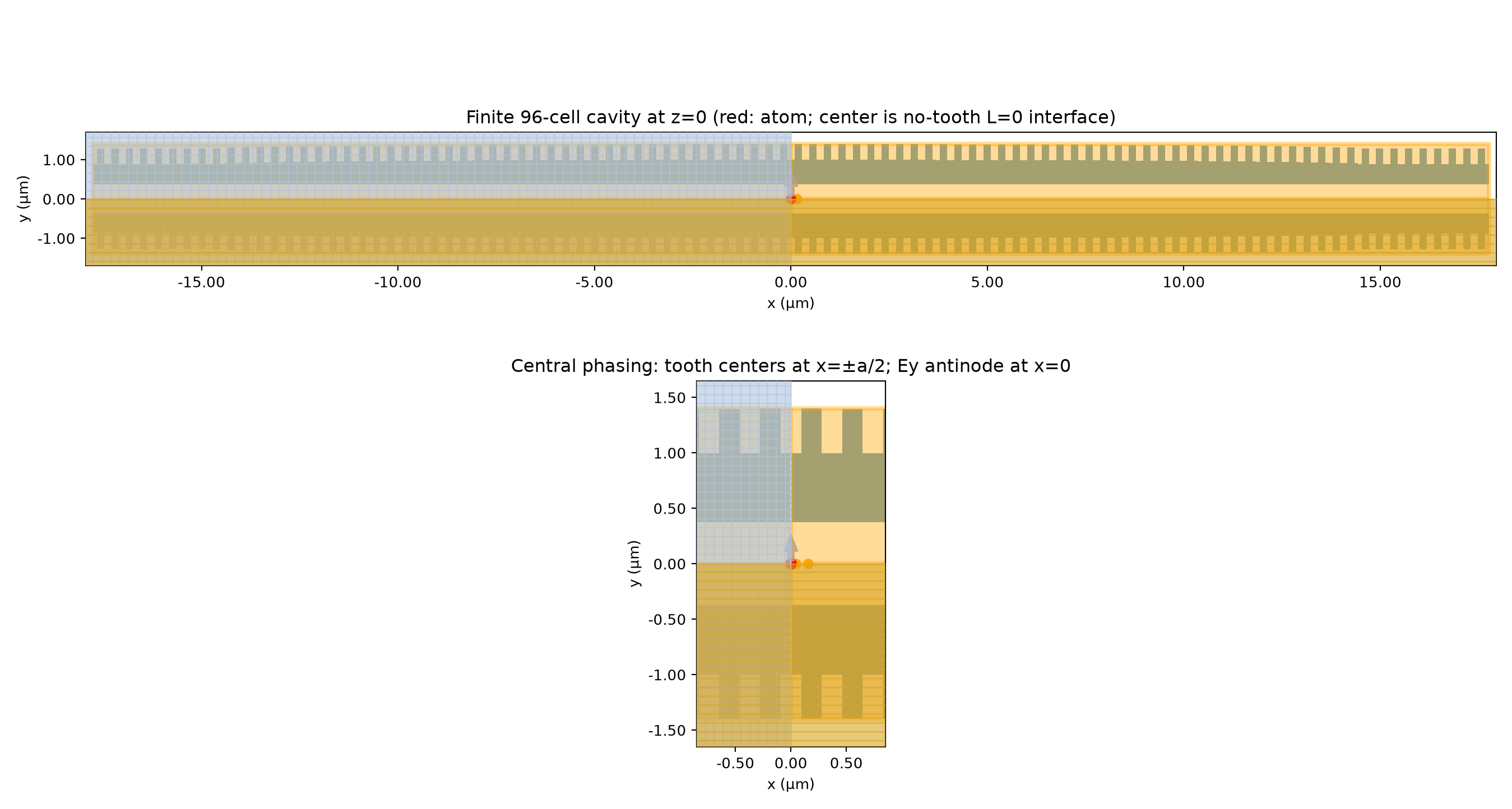
| Quantity | Broadband diagnostic |
|---|---|
| Tidy3D task | fdve-06eac865-d198-40f5-8787-4c8a1cd19dc6 |
| fitted pole | 781.662970 nm |
| fitted Q | 11,838.43 |
| three-probe Q span | 0.02474% |
| three-probe frequency span | 1.557×10⁻⁷ |
| per-probe fit error | 0.00256–0.00539 |
| Tidy3D end-of-run field-decay metric | 2.63×10⁻⁵ |
| fitted amplitude lifetimes observed | 1.616 |
| maximum estimate / actual | 0.197484 / 0.197484 FC |
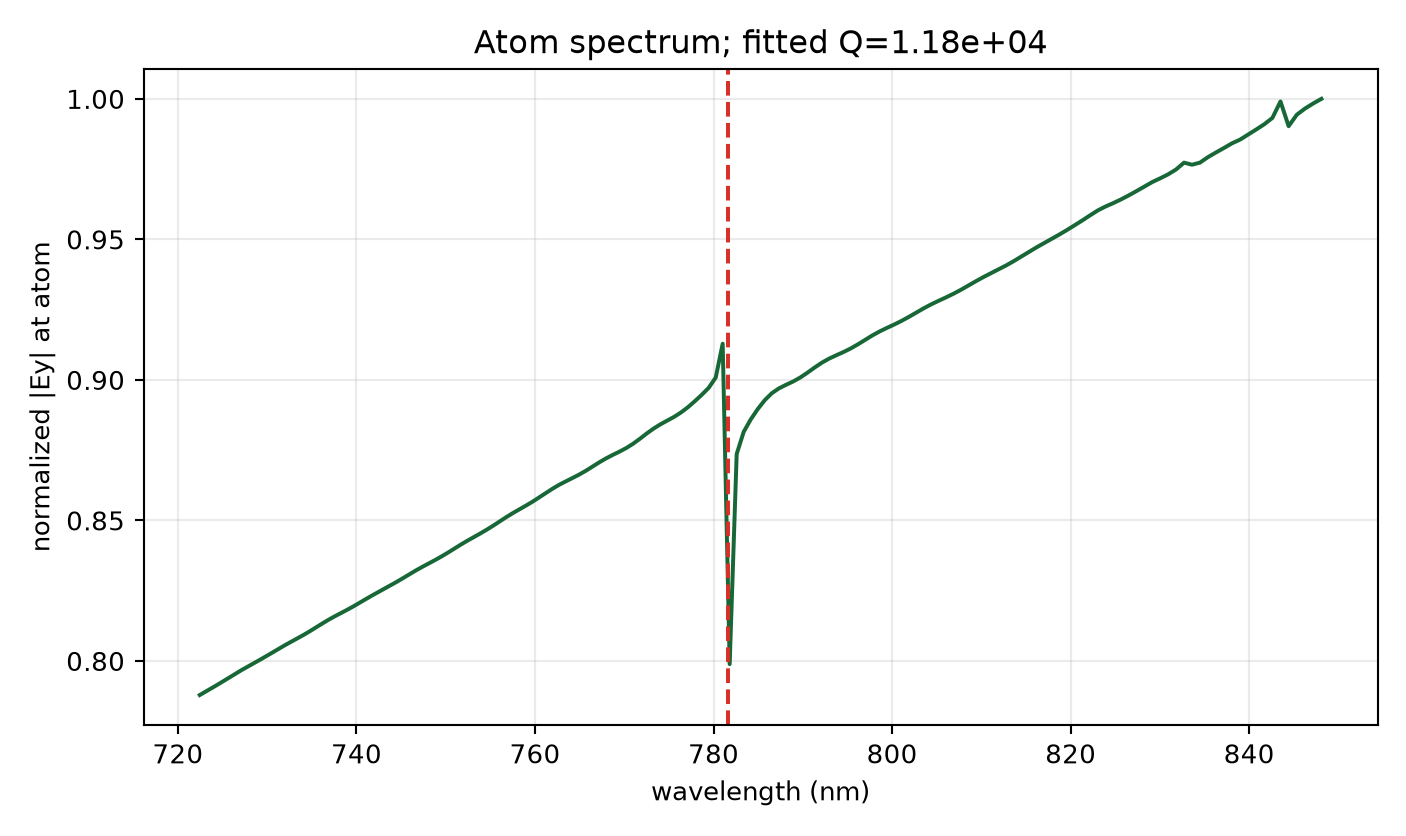
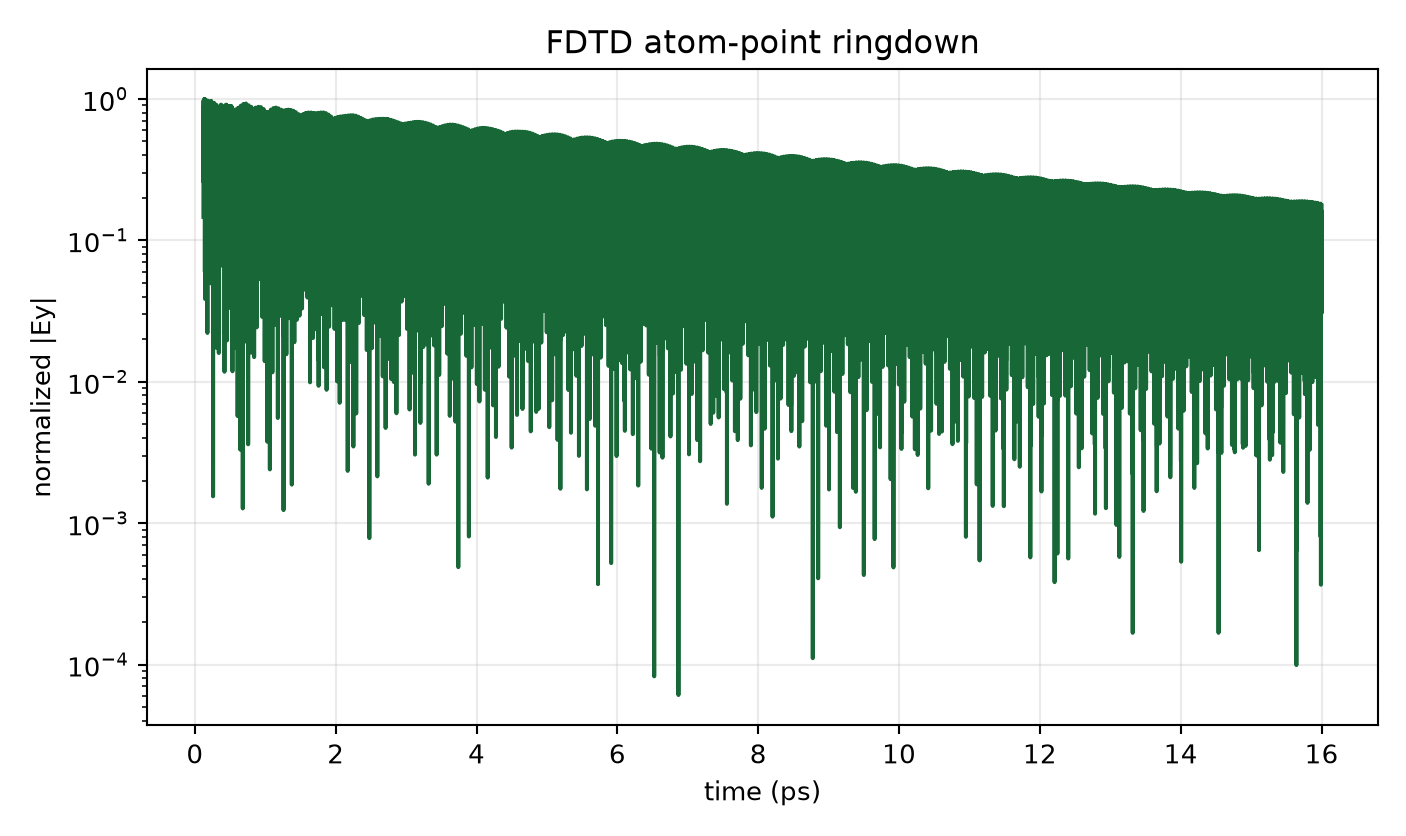
The three probes again agree closely and this record spans more than one fitted field-amplitude lifetime, strengthening the evidence that the mode is genuinely long-lived. Q is about 40% below the 0.60 µm candidate, so the two rows expose a real access/Q trade. The 16 ps endpoint, single mesh, and single domain still prevent either Q from being final.
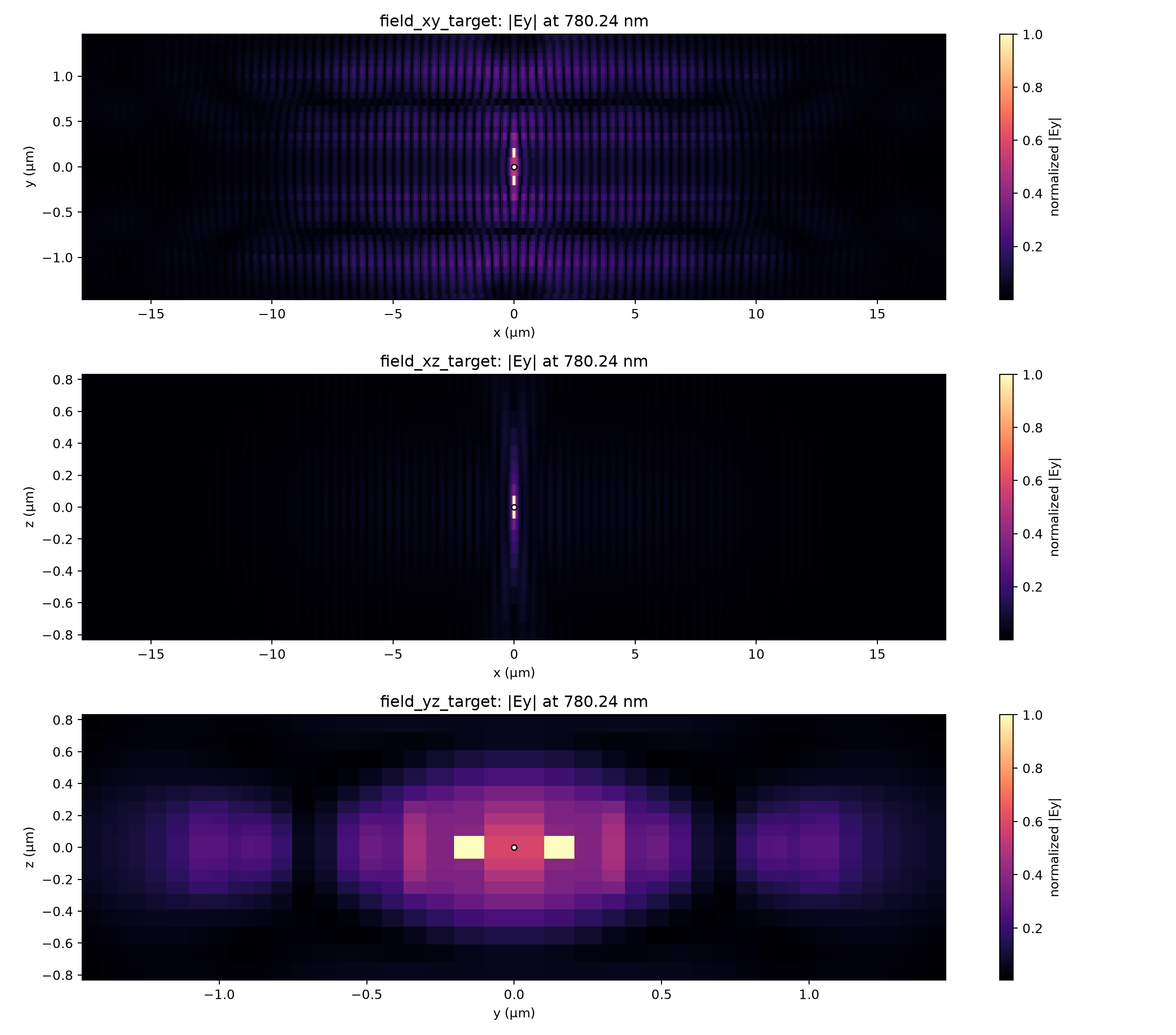
These fields and fluxes are also sampled at 780.24 nm, not the 781.663 nm
pole, and carry the same qualitative-only limitation. The near-light-line
a=.38, 0.60 µm-slot control was run next so exact-pole spending would follow
the full comparison rather than simply selecting the largest preliminary Q.
Public evidence:
Near-light-line a=.38, 0.60 µm control — Q≈2,649
The final broadband control keeps the 0.60 µm slot but increases the period from 0.37 to 0.38 µm. Local MPB predicted the largest atom metric, but the near-X check also showed the smallest light-line margin and strong field-character hybridization.
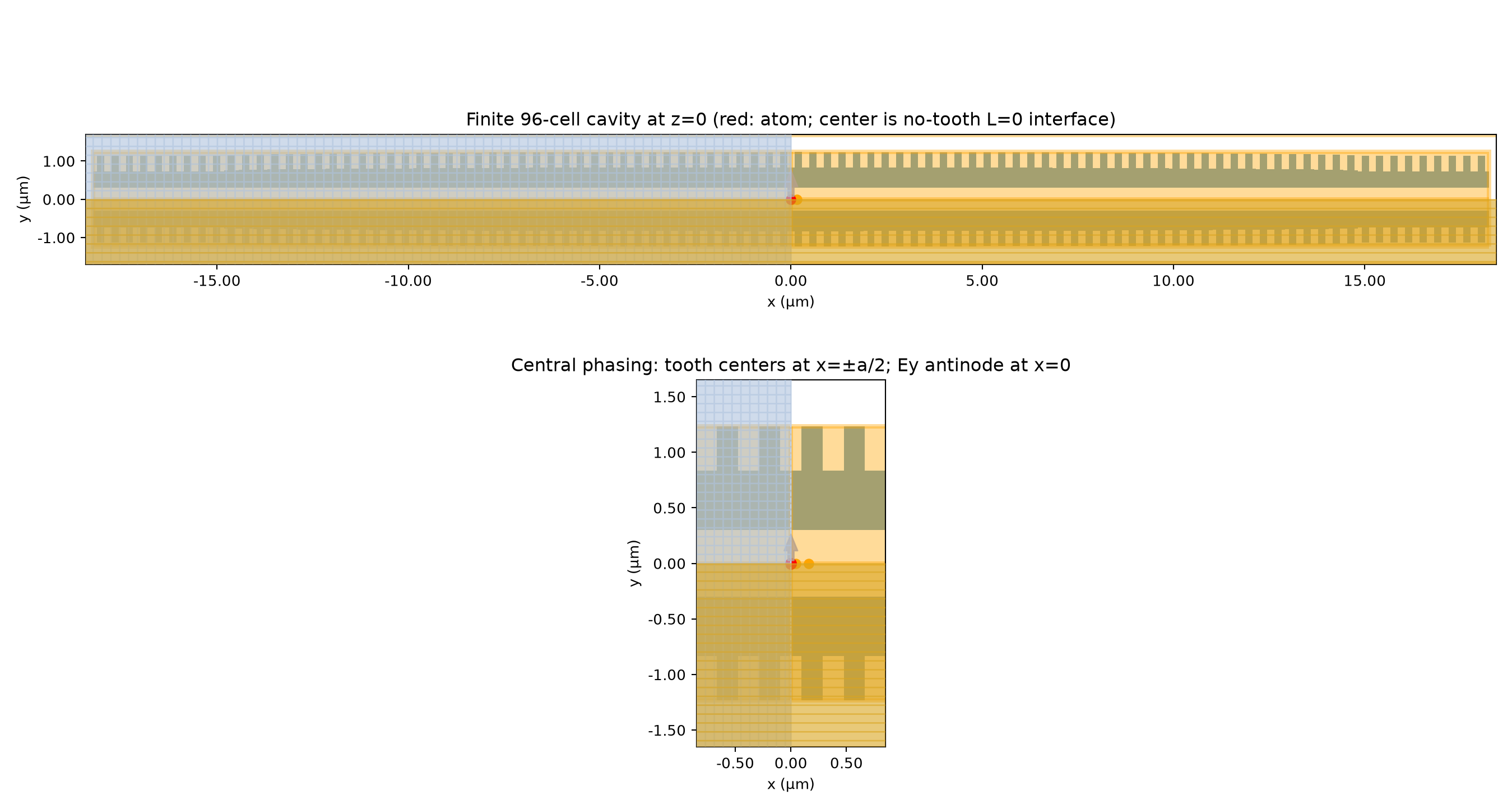
| Quantity | Broadband diagnostic |
|---|---|
| Tidy3D task | fdve-011bd235-a336-4812-a8c8-3d55509f4400 |
| fitted pole | 782.795273 nm |
| fitted Q | 2,649.41 |
| three-probe Q span | 0.1141% |
| three-probe frequency span | 1.851×10⁻⁷ |
| per-probe fit error | 0.00866–0.02621 |
| actual stop time | 11.033 ps, automatic shutoff |
| Tidy3D end-of-run field-decay metric | 9.69×10⁻⁸ |
| fitted amplitude lifetimes observed | 4.956 |
| maximum estimate / actual | 0.186972 / 0.128931 FC |
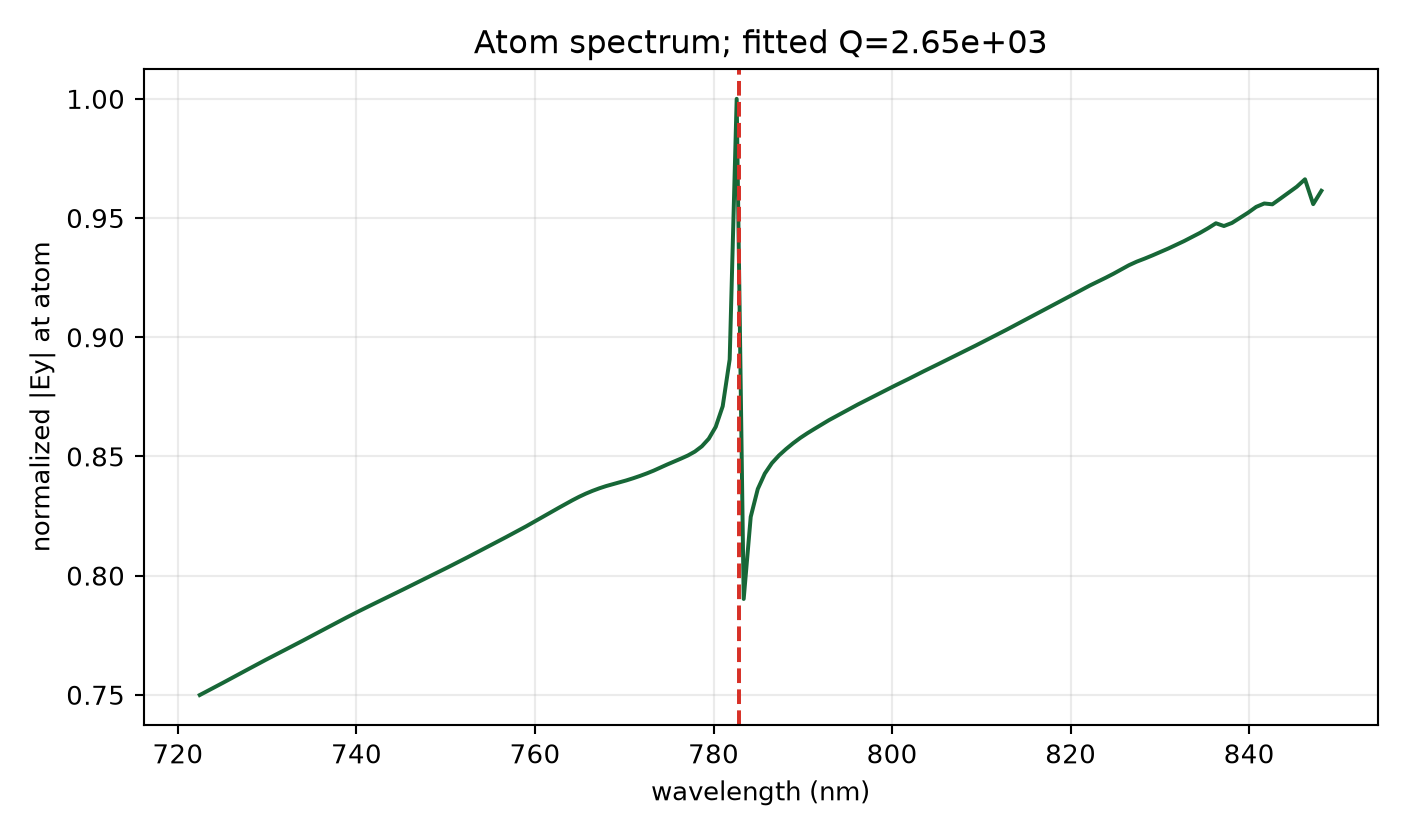
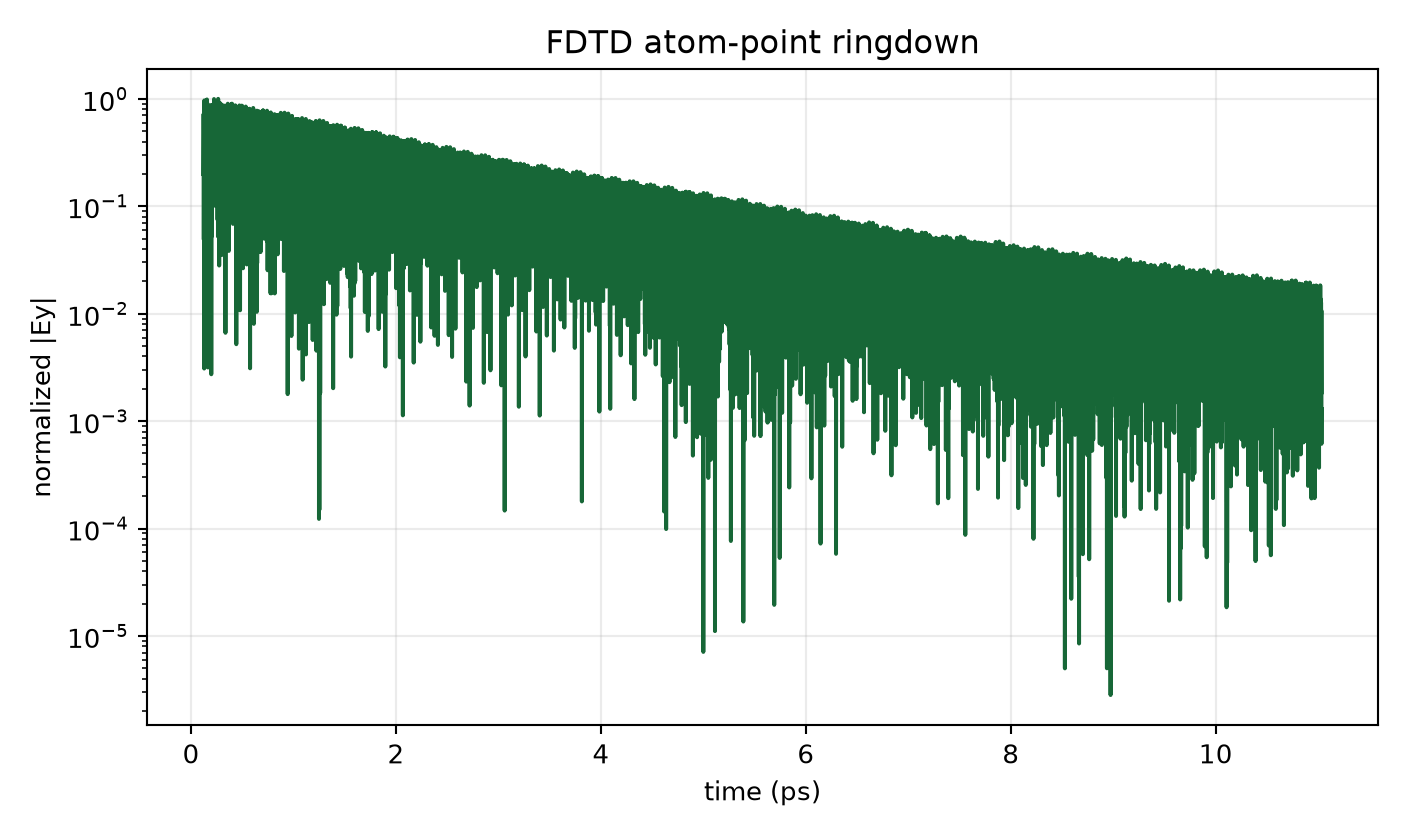
This trace has the healthiest temporal record of the three: almost five fitted amplitude lifetimes and a clean automatic shutoff. Its Q is still 4.47× below the 0.75 µm a=.37 candidate and 7.38× below the 0.60 µm a=.37 candidate. That ordering strongly agrees with the near-X radiation-risk diagnostic: the coarse atom metric alone would have selected the wrong period.
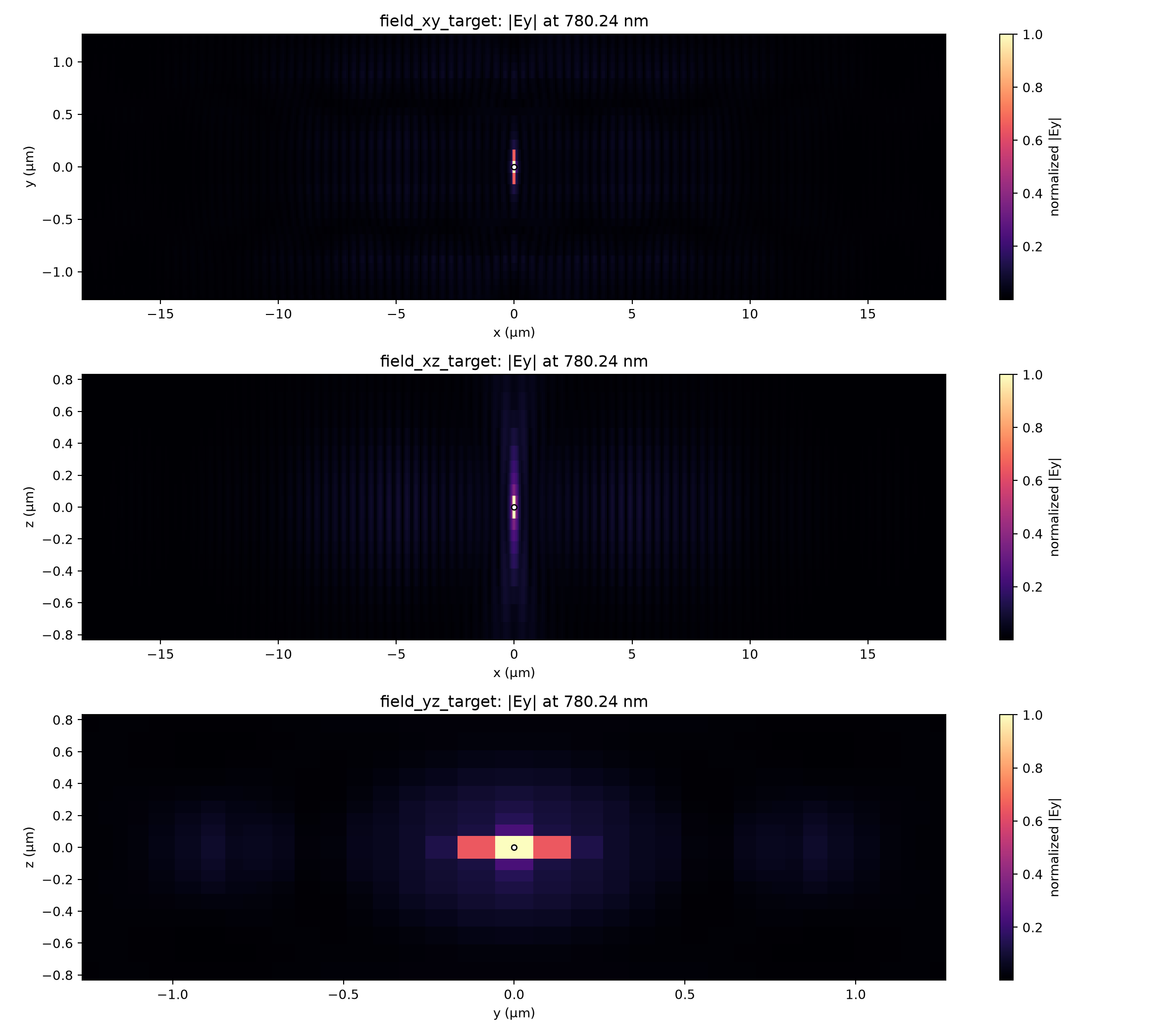
The target-frequency field/flux caveat still applies. Although its Q estimate has a better duration basis than the two high-Q rows, the broadband run does not provide an exact-pole mode volume, atom β, port β, or mesh/domain convergence.
Public evidence:
Exact-pole 0.60 µm hybrid — improved atom volume, method gates pass
Evidence label: completed coherent exact-pole, single-mesh diagnostic. Q/volume/flux closure and time-window gates pass; mesh and domain/PML convergence are still missing.
The promoted a=.37, 0.60 µm-slot cavity was rerun with its field, energy,
and all flux monitors coherently aligned to the 781.652 nm broadband pole.
Electric and magnetic fields were explicitly colocated on a common Yee-grid
integration mesh. The same frequency and apodization were used for stored
energy, volume, and every signed flux surface.
| Quantity | Main exact-pole result |
|---|---|
| Tidy3D task | fdve-951ce35f-3509-45c4-9e8f-d3489b4f2c7c |
| fitted pole | 781.651962 nm |
| ringdown Q | 19,524.72 |
| flux/energy Q | 19,431.32 |
| Qflux / Qring | 0.995216 |
| electric / magnetic stored energy | 1.010162 |
Vpeak |
4.379110 µm³ = 9.16950 λair³ |
Vatom,Ey |
13.242101 µm³ = 27.72788 λair³ |
Vatom,Ey / Vpeak |
3.023925 |
| x / y / z cavity-decay fraction | 0.324034 / 0.228972 / 0.446994 |
| maximum estimate / actual | 0.367332 / 0.367332 FC |
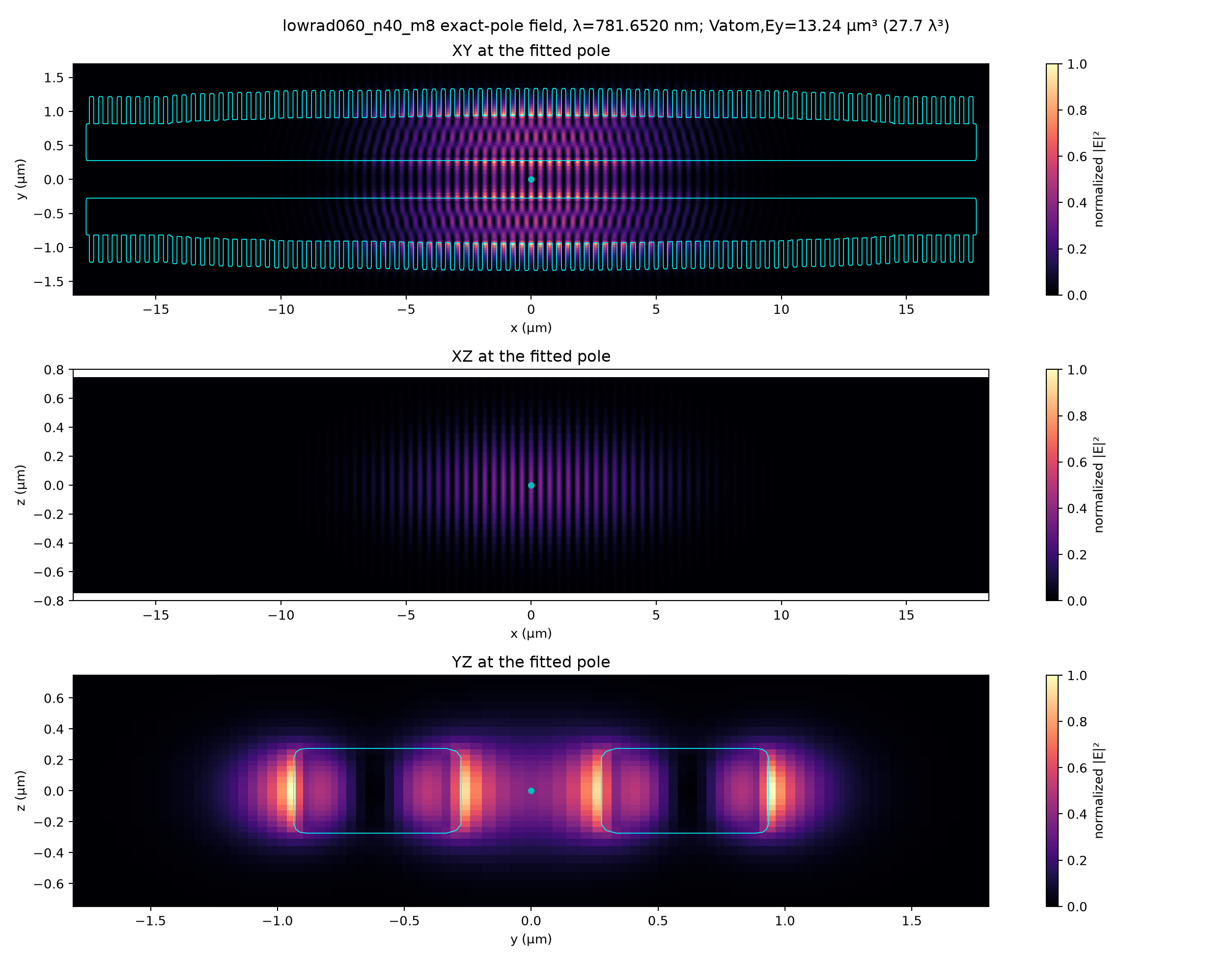
The atom remains away from the global energy-density maximum, but the mismatch
is much smaller than in the original 1 µm-slot N40 baseline:
Vatom/Vpeak=3.02 instead of 11.53. The absolute atom-referenced volume also
falls from 45.65 to 13.24 µm³, while Q rises from about 2,283 to 19,525. This
is the first geometry in this campaign to improve both the cavity lifetime and
the field normalization at the atom.
Closure and time-window checks
| Check | Result |
|---|---|
| six signed faces all outward | pass |
| six-face sum / outer-box flux closure | difference 2.58×10⁻⁷ |
| inner / outer flux-box closure | difference 1.42% |
| Qflux / Qring closure | difference 0.478% |
| monitor detuning from fitted pole | 0.00214 linewidth |
early→main Vatom change |
0.000470% |
early→main Vpeak change |
0.000670% |
| early→main Qflux change | 1.520% |
| all implemented main-method checks | pass |
The two windows use the same exact-pole convention and independently return stable volumes. The energy/flux Q also agrees with the ringdown Q much more closely than the 20% promotion threshold. These are strong internal consistency checks on this numerical model.
They are not mesh convergence. The simulation still uses AutoGrid 14, no mesh
overrides, a single domain/PML spacing, 16 ps maximum time, and automatic
shutoff 1e-7. At least one finer automatic mesh and domain/PML-clearance
repeat are required before the Q or volumes become final production numbers.
The x/y/z fractions report where cavity energy leaves the enclosing box. They are not emitter spontaneous-emission β, not a port-mode decomposition, and not driven transmission. A trustworthy atom β still requires a dipole-power/reference calculation or a separately justified single-pole Purcell model.
Operational note: the local wrapper process died while the cloud task continued. The runner was made resume-safe, recovered the same task ID, and downloaded/analyzed it without launching a duplicate. The ledger therefore contains one task and one charge for this result.
Public evidence:
- prepared exact-pole settings
- serialized exact-pole simulation
- exact-pole result, definitions, checks, and limitations
- resume-safe FDTD runner
Trustworthy emitter β — the old 0.98165 proxy is retired
Evidence label: schema-v3 validation plan and fail-closed local protocol, plus a historical single-mesh sanity-check calculation. No emitter-β simulation has been submitted, no final emitter β is claimed, and the N40 proxy must not be quoted as a cavity prediction.
Three different ratios must stay separate:
| Name | Definition | Present status |
|---|---|---|
| emitter-to-cavity β | Γcavity pole / Γtotal for the atom |
requested quantity; not measured |
| collection β | power in a separately defined useful output mode / total emitted power | no output mode has been defined |
| cavity-axis branching | x/y/z fraction of already-stored cavity energy leaving the flux box | measured diagnostic; neither β above |
V_atom and emitter β are different observables. V_atom asks how much
cavity energy exists relative to the oriented electric field at the atom:
V_atom = 2U / [ε₀ n_atom² |d̂·E(r_atom)|²].
It can validate that the cavity field is useful at the atom, but it does not
measure how an actual emitter divides its decay among the cavity pole and
every other channel. Emitter β requires physical-dipole decay rates:
β_emitter=Γ_cavity_pole/Γ_total. Neither Q/V_atom, cavity-axis flux
fractions, nor a two-port ratio may be relabeled as that β.
Schema-v3 trustworthy-observables foundation
The fail-closed Trustworthy FDTD observables protocol now defines the required candidate/run manifests, atom-oriented mode volume, physical-dipole references, convergence gates, and cost order. The machine-readable schema-v3 validation plan is its campaign snapshot.
Every promoted result must bind:
- a canonical candidate SHA-256 covering the complete geometry and phase, material model, atom position, normalized dipole orientation, target wavelength, and provenance;
- a run record that binds that candidate hash plus the realized grid hash, physical source-waveform hash, domain/PML, symmetry, monitors, mesh resolution, runtime, shutoff, and override count; and
- downloaded evidence whose hashes match those manifests. A cached result from another geometry is only a regression fixture.
The schema-v3 emitter-β evidence set requires one full-cavity physical Ey
point-dipole run, one vacuum reference, and at least two pole-removed
structured references that preserve the local dielectric environment. All
must use the same candidate hash, realized full-cavity grid hash, physical
source waveform, atom coordinate/orientation, domain/PML, symmetry, duration,
and shutoff. The reference structures reuse the realized full grid rather
than independently regenerating automatic grids, because the point-dipole
self field is grid-sensitive. Missing or mismatched evidence forces
promoted_beta=null.
The default first finalist diagnostic remains automatic mesh Auto-14, 16 ps maximum duration, automatic shutoff, and zero mesh-override regions. Auto-14 is a cost-controlled starting point, not a convergence claim; promotion still requires separated meshes and the full domain/PML, window, flux, energy, and reference gates. Runtime may exceed 16 ps only after the recorded ringdown proves that pole/background separation needs it and the extension is explicitly budgeted.
Future trustworthy-observables tasks are charged against two authorization ledgers:
| Ledger | Conservative remaining headroom |
|---|---|
| fishbone 25-FC campaign | 9.488807369 FC |
| earlier 5-FC trustworthy-observables allocation | 2.980129019 FC |
| binding future headroom | 2.980129019 FC |
The smaller trust allocation binds even though the fishbone ledger has more room. Every future physical task must fit both ledgers under one common cross-ledger ID, task ID, candidate/run hashes, and maximum estimate. Headroom is recomputed before reservation. No FDTD/cloud job has been started and no FC has been spent for the present v3 MPB/protocol update since 2026-07-29 06:42 UTC.
For an exactly resonant, perfectly Ey-aligned, transform-limited dipole, the
usual single-mode estimate gives
Fpole = [3/(4π²)] Q / (Vatom/λair³) = 53.509.
If—and only if—the smooth non-cavity decay rate at the atom were exactly its vacuum decay rate, that would imply
βnaive = Fpole/(Fpole+1) = 0.98165.
| Proxy input or output | Value |
|---|---|
| Auto-14 ringdown Q | 19,524.72 |
Vatom,Ey / λair³ |
27.72788 |
conditional Fpole |
53.50934 |
conditional βnaive |
0.9816545 |
| classification | retired diagnostic from a mesh-disqualified geometry |
The complete AutoGrid-14/16/18/20/22/24 sequence proves that the Auto-14 Q was an accidental high mesh point, not a converged cavity prediction. Pairing its mode volume with that Q cannot support a Purcell or β claim. The nearby SiO₂ also changes the smooth local density of optical states, so the atom's non-cavity decay need not equal the vacuum decay assumed by the shortcut. The domain/PML check passed, but that does not repair the mesh failure.
Why the old 16 ps direct-power shortcut was also insufficient
At Q≈19,525 and λ≈781.652 nm, the fitted cavity field-amplitude lifetime is about 16.2 ps. The whole simulation maximum is 16 ps, and the source plus transient occupy part of that record. A resonant dipole-power ratio taken directly from this finite trace would therefore depend strongly on the chosen window: the cavity has neither reached a clean steady state nor emptied. Automatic shutoff remains appropriate, but it does not reconstruct the unobserved high-Q tail.
For a future mesh-robust winner, the cost-controlled solution is to fit the known complex pole and extrapolate its tail. A longer run becomes scientifically justified only if that pole/background separation fails the stated window tests.
Required validation sequence
- Select and converge a robust cavity pole. The touching-box,
unscaled-union, and scale-retarget families are rejected. The canonical
connected period-chirp design's old MPB gates are invalidated by the
centroid-semantics erratum. Its Auto-14/20 finite-cavity handoff also
fails: there is no same pole, and the clean
Auto-20 Q=518 pole is off-window and below the useful-Q floor. The
original-period Auto-24 control now establishes that Auto-20/24 recover
that pole within 0.0382% in wavelength and 0.93% in Q. The retargeted
Auto-20/24 pair lands at 780.779/780.486 nm and Q=542.974/541.504,
passing the same-pole, target, and initial-spread gates strongly. This
bounded retarget deliberately targets a robust Q≈500 diagnostic rather
than extrapolating to high Q. Auto-22 and expanded-domain/PML-16 checks
also pass, establishing a reliable numerical control. It remains below the
Qworst≥1000promotion floor. The high-margin M16 redesign has now repeated and passed that sequence: Auto-20/22/24 have 1.19675% Q spread, the expanded-domain Q change is 0.000286%, andQworst=3,542.42. Its exact-pole v1 was correctly retuned, but the apparent volume changes by 20.278% across windows and fails the 5% stability gate. The completed later-window v2 passes every implemented method and window gate, but findsVatom=23.505 µm³=6.704×Vpeak. Treat that as a reliable design rejection and redesign the atom overlap before β work. - Measure the smooth structured background. With the same
Eypoint dipole, position, grid, domain, source waveform, and monitors, run vacuum plus at least two pole-removed structures: a long uniform center-cell fishbone and a detuned/no-defect fishbone. Use their spread as uncertainty, not whichever reference gives the larger β. - Separate the narrow cavity pole. Fit late-time fields at the atom and
independent probes to one complex pole, extrapolate the missing tail, and
subtract the prompt structured background. Compare the pole enhancement
against converged
Q/Vatom. - Close the power accounting. After matched vacuum self-field
subtraction, require the closed outward-flux estimate and source-work
estimate to agree within 10%. Require pole frequency/decay agreement among
probes,
Q/Vatomagreement within 10%, and no more than five percentage points of β change across two fit windows. - Report uncertainty. Include mesh/domain/taper spread, the two structured-background references, time-window/pole-fit spread, dipole position, orientation, detuning, and linewidth assumptions.
A collection β would be a later, separate measurement: first define a useful guided output mode, then use a mode monitor to project its outgoing power and close that result against total emitted power. The present x/y/z flux fractions must not be relabeled as collection β.
Simulation policy remains automatic mesh with no overrides, 16 ps maximum duration, and automatic shutoff. Auto-14 is the default new-candidate diagnostic; for the previously tested connected geometry it was underresolved, and the validated numerical sequence uses separated Auto-20/22/24 meshes plus an expanded-domain/PML repeat.
Public evidence:
Convergence matrix underway — Auto-14 remains the baseline
Evidence label: the matrix was locally serialized with zero paid tasks started by the preparation step. The root campaign subsequently completed the Auto-16, Auto-18, Auto-20, Auto-22, Auto-24, expanded-domain, N32, and N48 broadband repeats under the shared FlexCredit ledger.
Every row uses a 16 ps maximum, automatic shutoff 1e-7, and zero mesh
override regions.
| Variant | What changes from the N40 Auto-14 baseline | Purpose | State at publication |
|---|---|---|---|
auto16_n40 |
automatic minimum steps/wavelength 14→16 only | fixed-geometry mesh convergence | complete; fails 5% Q gate |
auto18_n40 |
automatic minimum steps/wavelength 14→18 only | determine whether the mesh trend settles beyond Auto-16 | complete; mesh still not settled |
auto20_n40 |
automatic minimum steps/wavelength 14→20 only | one more fixed-geometry mesh point after Auto-18 | complete; mesh still not settled |
auto22_n40 |
automatic minimum steps/wavelength 14→22 only | global-mesh diagnostic after the Auto-20 rebound | complete; mesh still not settled |
auto24_n40 |
automatic minimum steps/wavelength 14→24 only | conditional last high-resolution diagnostic after Auto-22 fails | complete; definitive mesh failure |
expanded_n40 |
padding (1.5,1.35,1.25)→(2.5,2.35,2.25) µm; PML 12→16 |
combined domain-clearance/PML check | complete; passes broadband gate |
n32_auto14 |
taper cells/side 40→32 | lower-side taper-limitation diagnostic | complete; strong taper dependence |
n48_auto14 |
taper cells/side 40→48 | required upper-side geometry-convergence check | complete; fails duration gate |
The target for a convergence claim is ≤5% change in Q and Vatom;
differences above 10% require investigation. Exact repeats must also keep
Qflux/Qring within 10% of unity and early/main-window quantities within 5%.
N32/N40 agreement is useful but cannot replace the N40/N48 upper-side test.
Broadband poles are screening inputs; each exact observable run must be
retuned before volumes are compared.
Auto-16 fixed-geometry repeat — mesh gate fails
Evidence label: completed broadband ringdown convergence diagnostic. It establishes that the Auto-14 Q is not mesh-converged; it does not provide an Auto-16 exact-pole mode volume.
| Quantity | Auto-14 exact ringdown | Auto-16 broadband repeat | Difference |
|---|---|---|---|
| fitted wavelength | 781.651962 nm | 779.920656 nm | −1.731306 nm |
| ringdown Q | 19,524.72 | 13,593.06 | −30.38% |
| fitted amplitude lifetime | 16.204 ps | 11.256 ps | −30.54% |
| observed fitted lifetimes | 0.980 | 1.4107 | longer sampling basis |
| three-probe Q span | 0.02617% | 0.02462% | both internally consistent |
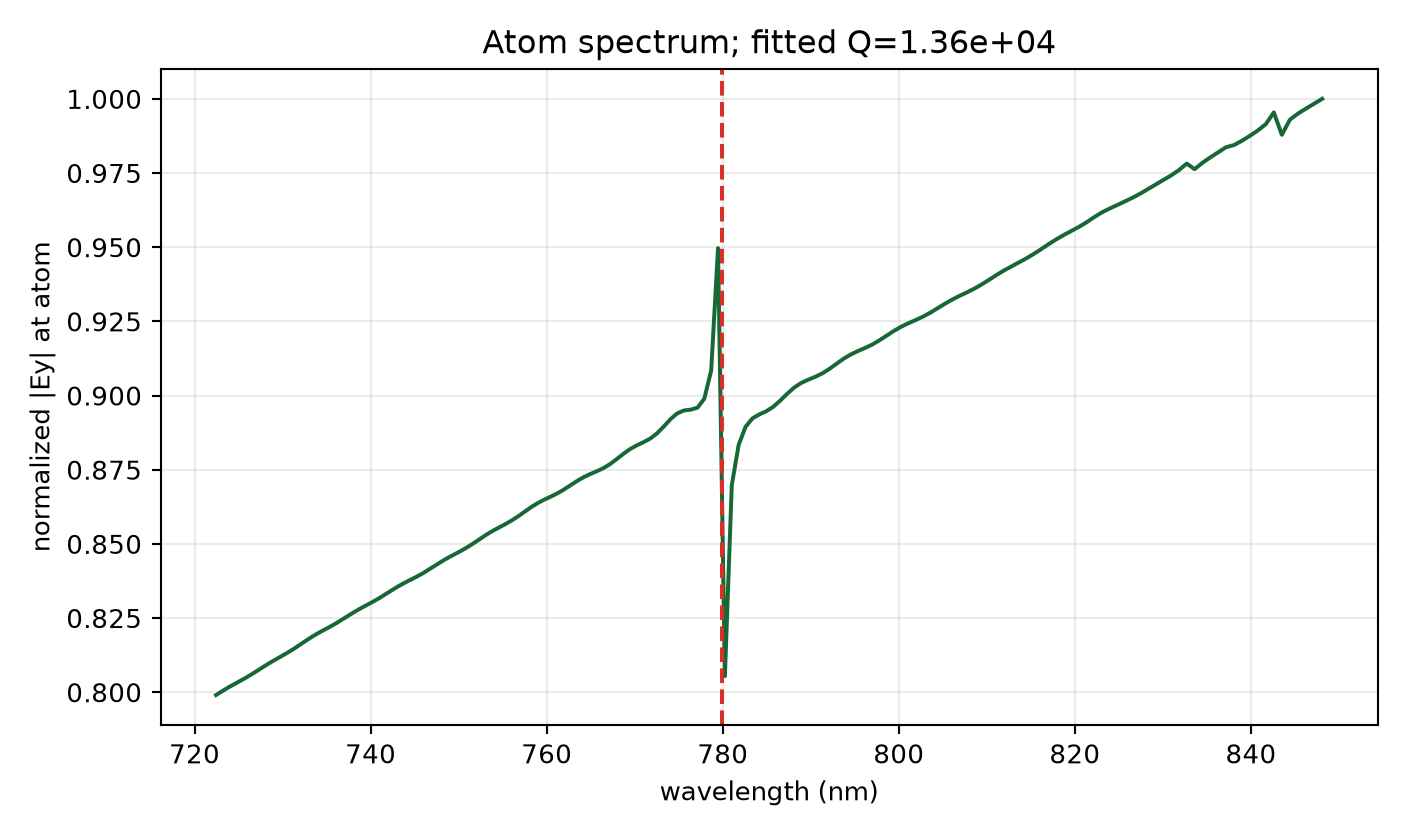
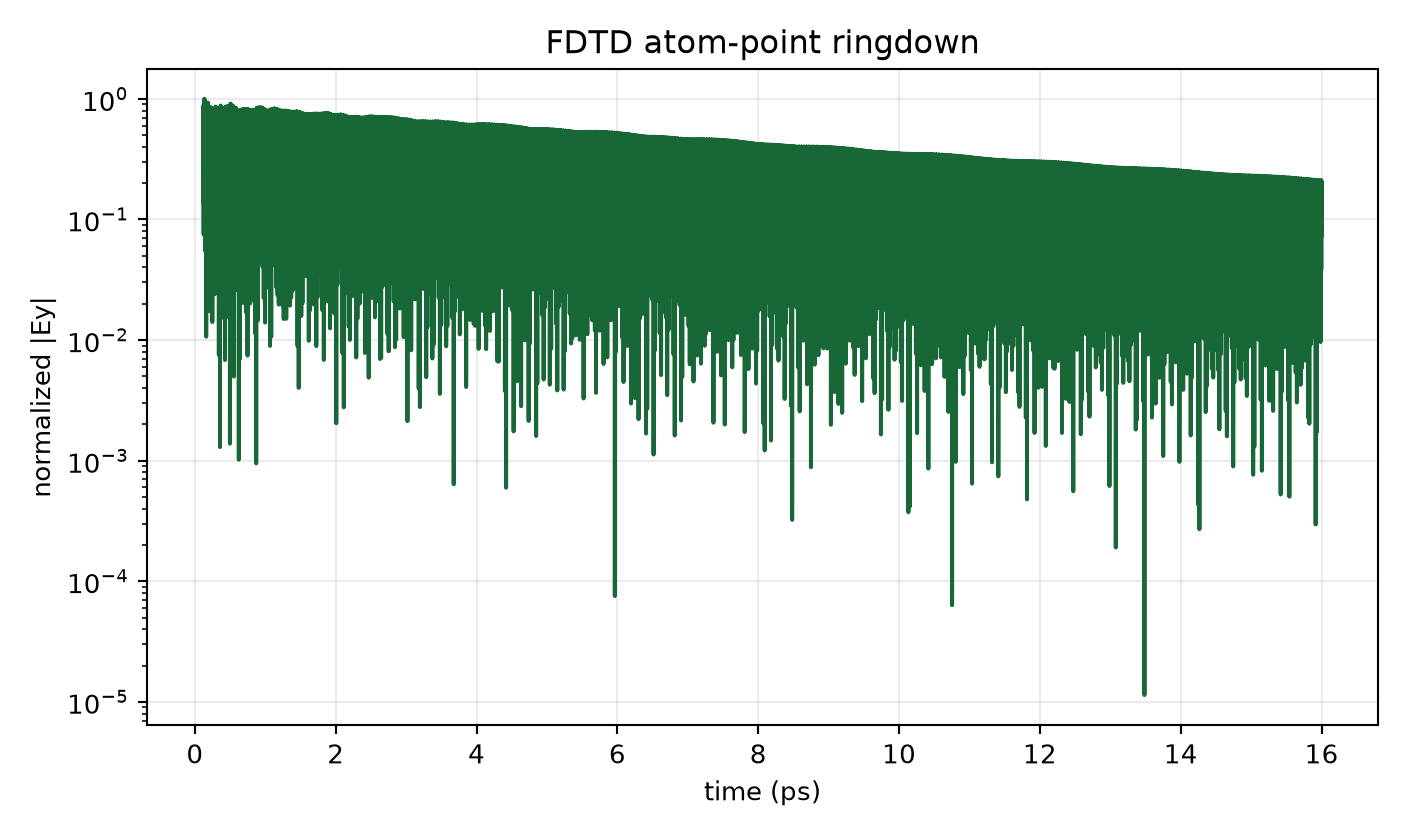
The repeat ran essentially the full 16 ps; its cloud field-decay metric reached 3.55×10⁻⁶ and the three independent probes recover the same pole. The 30.38% Q change is therefore not dismissed as a short-record or probe-selection artifact. It is far outside both the ≤5% target and the >10% investigation threshold.
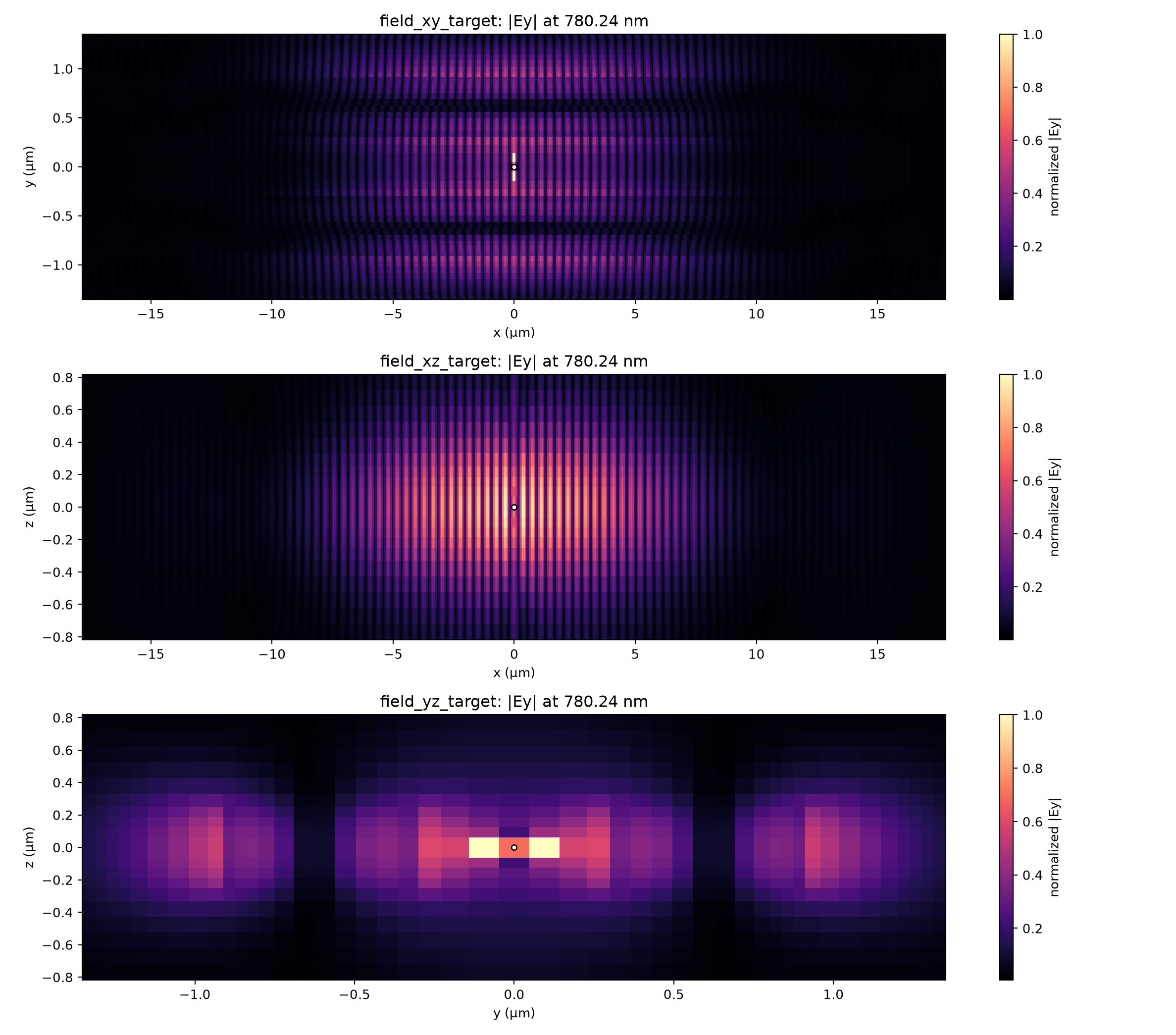
This is a negative convergence result, not evidence that Auto-16 itself is
converged. The Auto-18 and Auto-20 repeats below confirm that Q and wavelength
do not settle. Exact-frequency energy, flux, and Vatom monitors must not be
rerun until that mesh sensitivity is understood. The Auto-14 Q≈19,525,
volumes, Fpole=53.509, and conditional β=0.98165 are retired diagnostics.
Auto-18 and Auto-20 fixed-geometry repeats — mesh does not settle
Evidence label: completed broadband ringdown mesh diagnostics with strong time bases. They confirm that neither Auto-16 nor Auto-18 was converged and do not provide an exact-pole mode volume.
| Quantity | Auto-14 | Auto-16 | Auto-18 | Auto-20 |
|---|---|---|---|---|
| fitted wavelength | 781.652047 nm | 779.920656 nm | 780.064618 nm | 780.270335 nm |
| ringdown Q | 19,562.52 | 13,593.06 | 4,007.41 | 6,924.90 |
| change from previous mesh | — | −30.51% | −70.52% | +72.81% |
| fitted lifetimes observed | 0.9781 | 1.4107 | 3.6189 | 2.7679 |
| three-probe Q span | 0.02016% | 0.02462% | 0.07159% | 0.12360% |
| actual stop time | 16.000 ps | 15.999 ps | 12.132 ps | 15.999 ps |
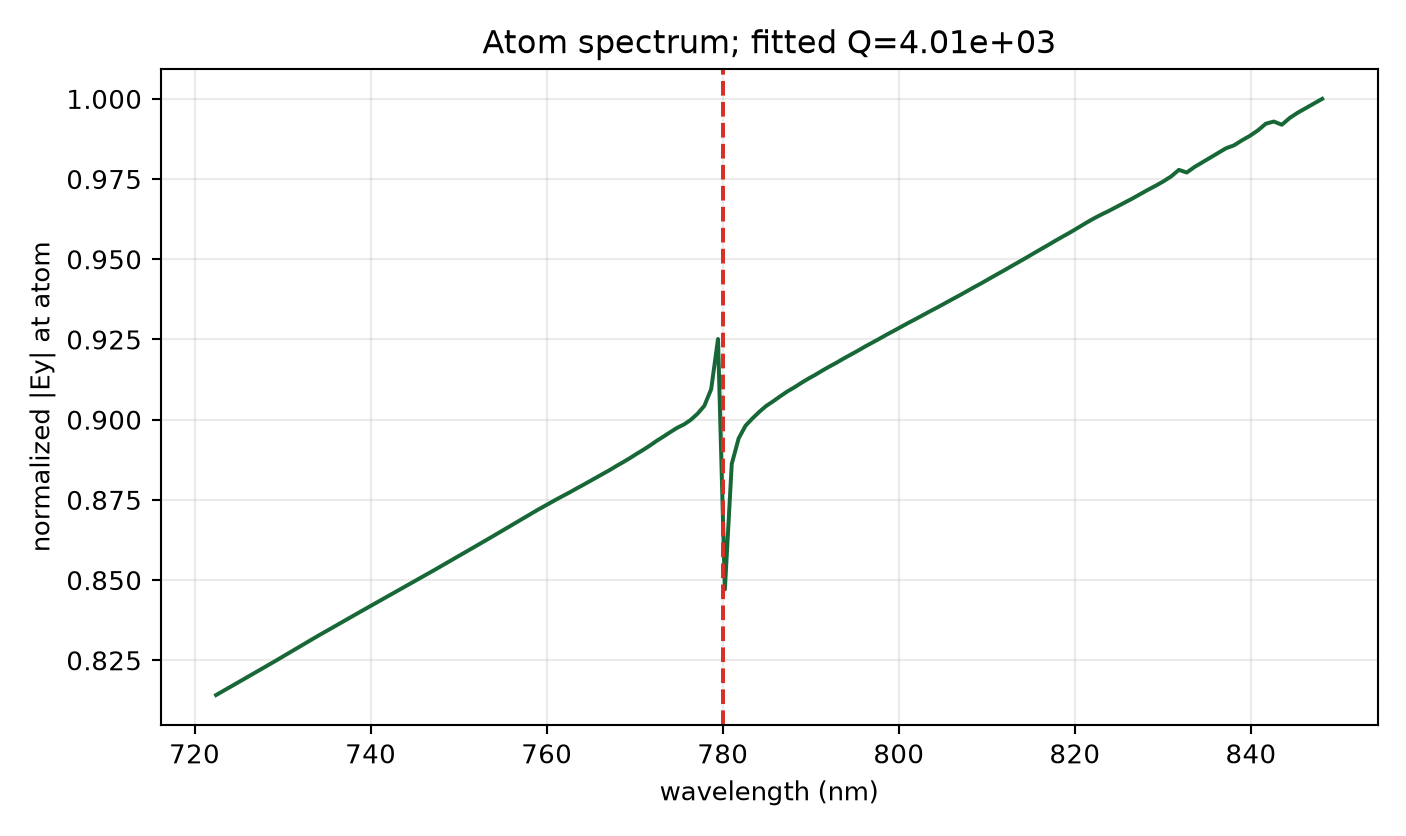
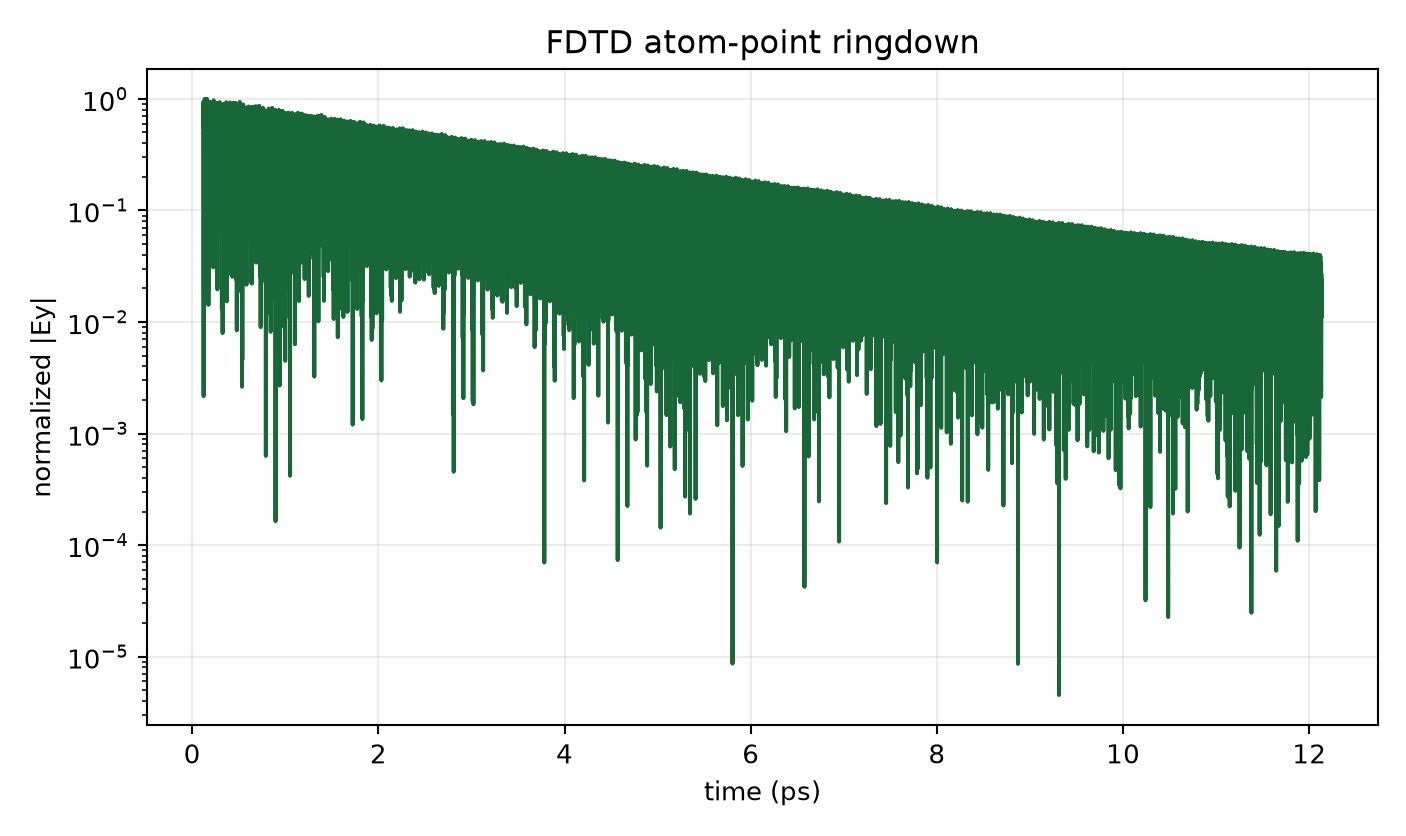
The Auto-18 pole is sampled over 3.62 fitted amplitude lifetimes, the three probes agree, and automatic shutoff ends the run. Its Q is 79.51% below the Auto-14 broadband value and 70.52% below Auto-16. This is a robust negative mesh-convergence result, not a duration failure.
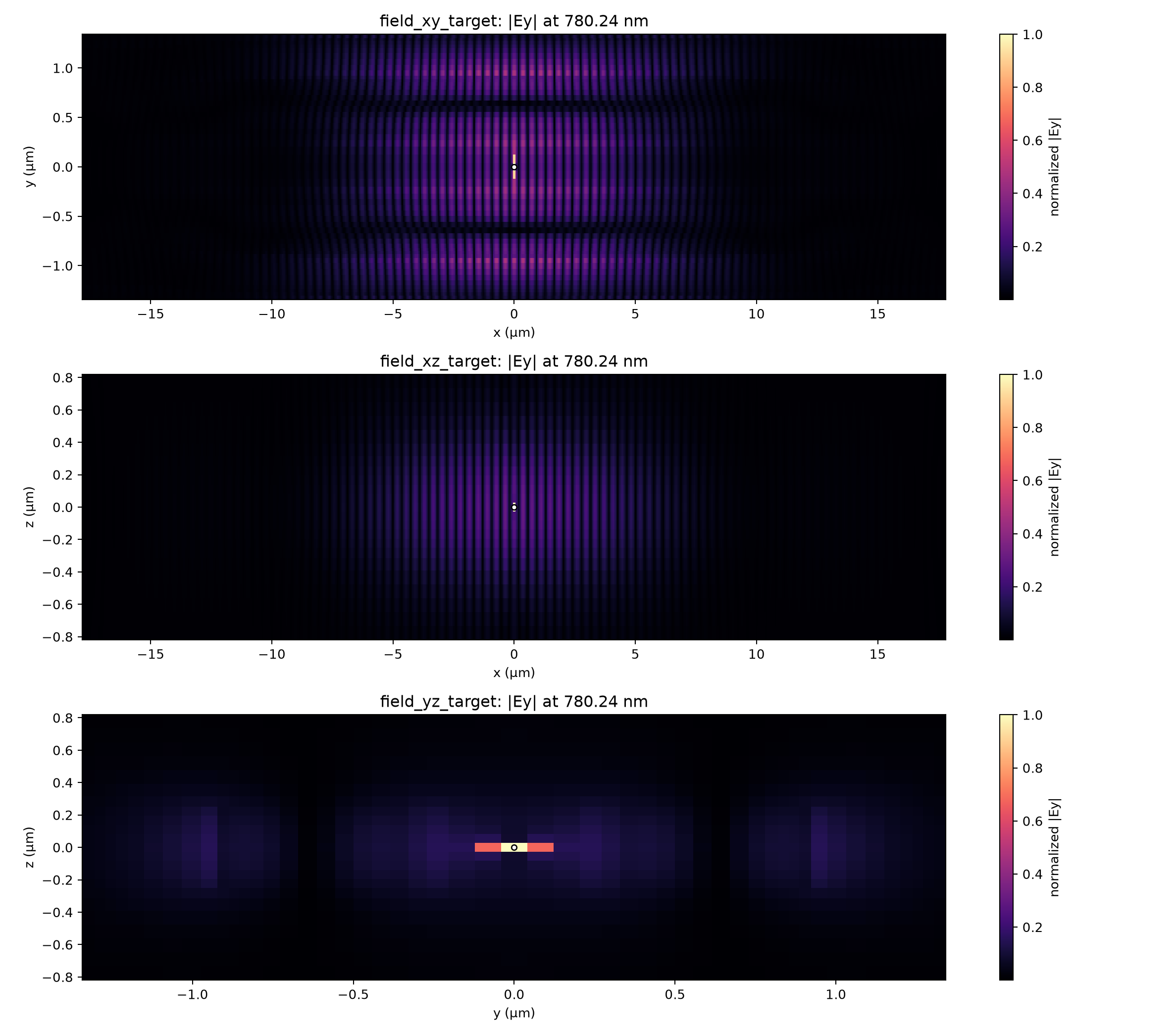
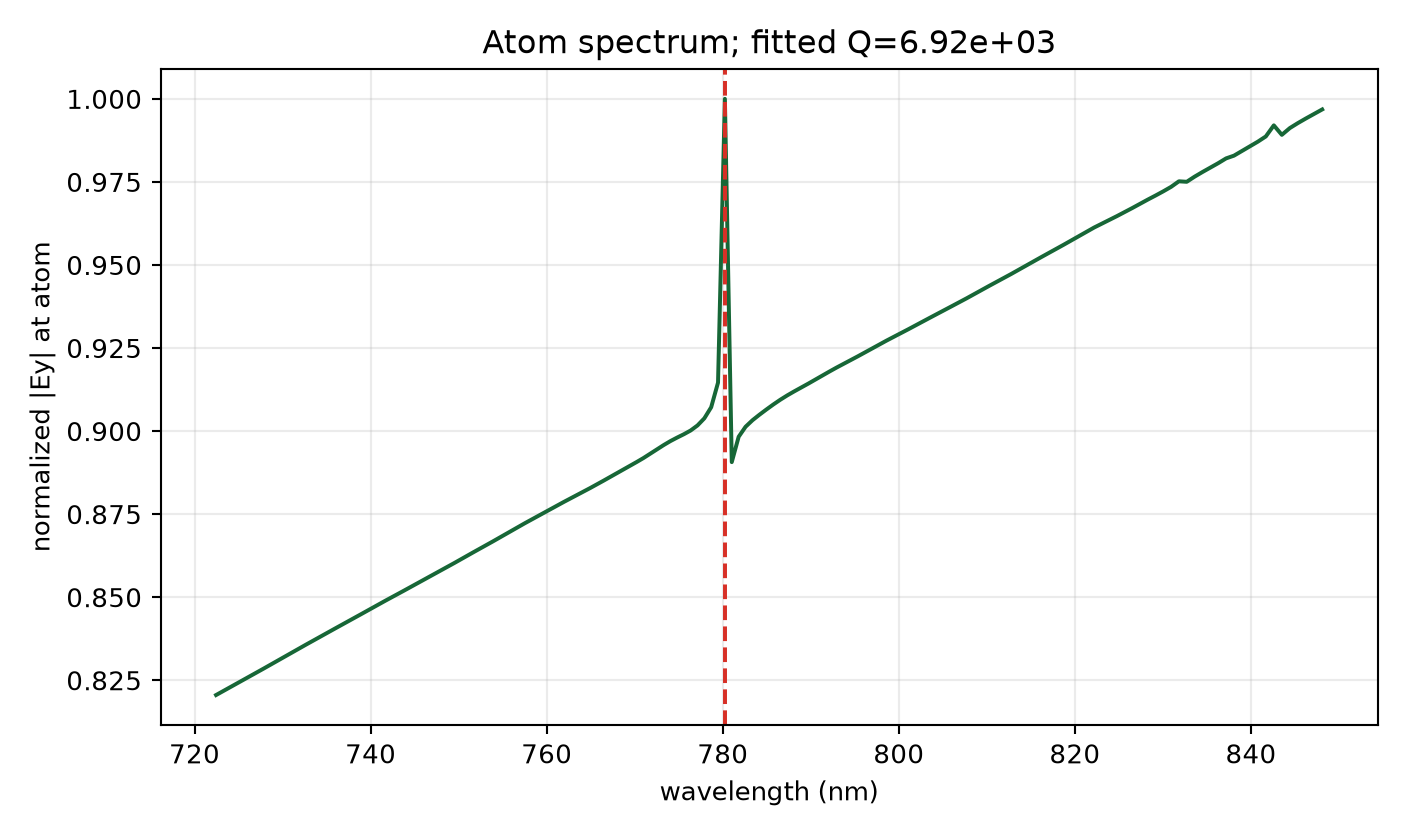
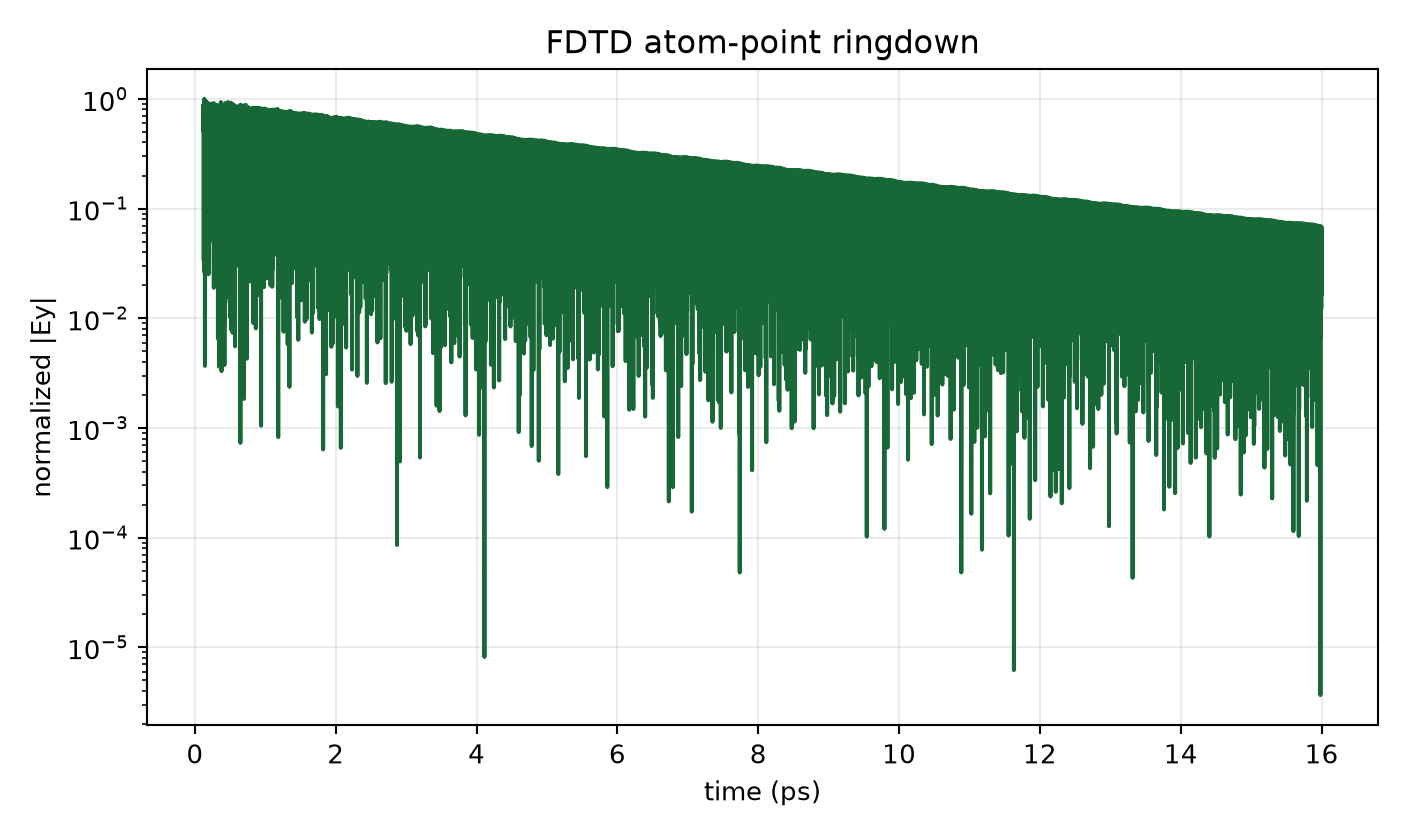
Auto-20 rebounds by 72.81% relative to Auto-18 even though it spans 2.77 fitted amplitude lifetimes and its three probes agree. This non-monotonic, order-unity Q variation is a hard stop on the present candidate's quantitative Q/V and emitter-β path. The campaign must inspect the grid representation of the thin periodic geometry and reconsider or redesign the candidate before spending on retuned exact-pole volume or emitter-β simulations.
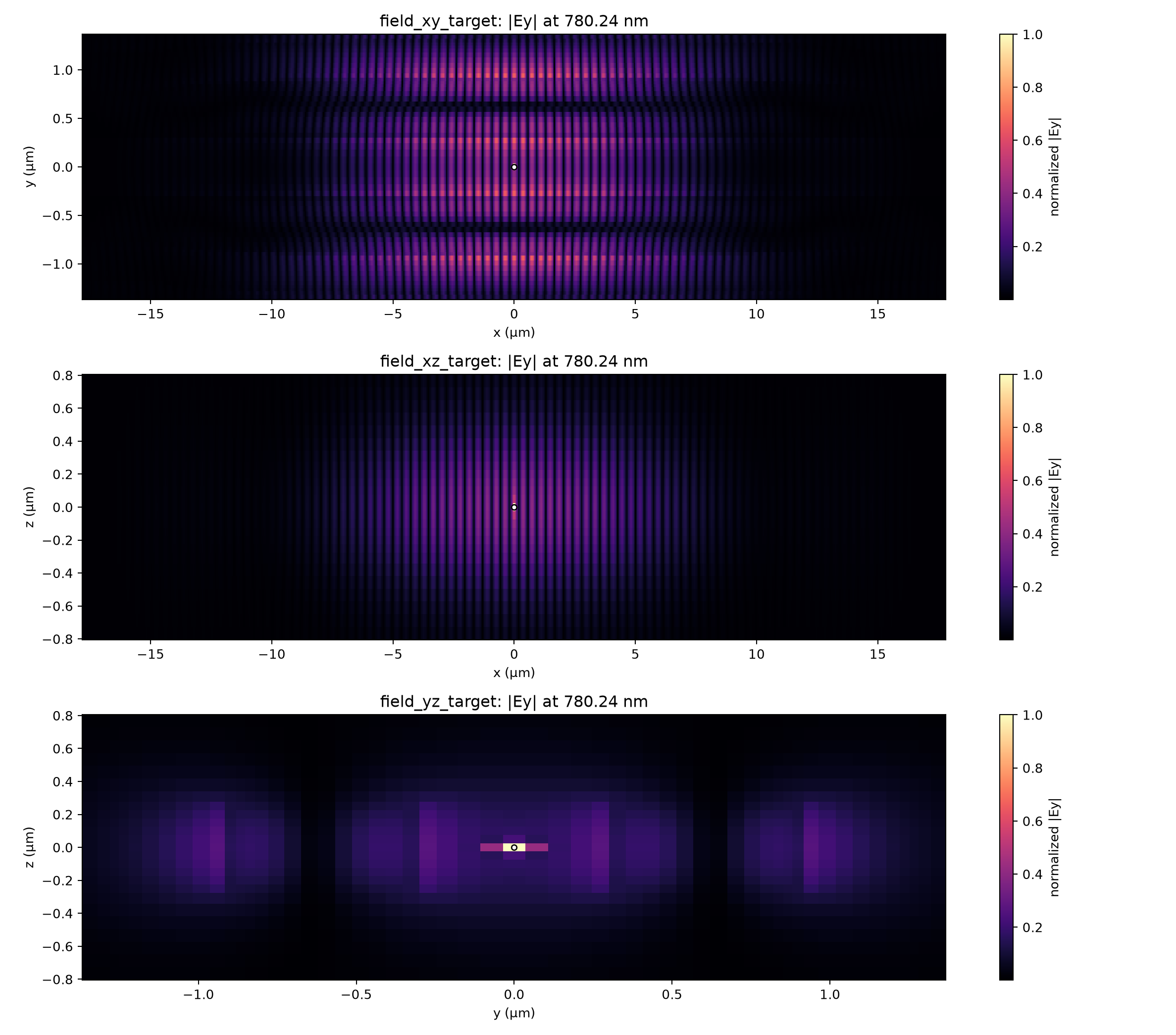
Auto-22 — still outside mesh tolerance
Evidence label: completed global automatic-mesh broadband diagnostic with a sufficient time record. No exact-pole or β run was launched.
| Quantity | Auto-20 | Auto-22 | Difference |
|---|---|---|---|
| total grid cells | 33.924M | 41.565M | +22.5% |
| fitted wavelength | 780.270335 nm | 779.387331 nm | −0.883004 nm |
| ringdown Q | 6,924.90 | 9,550.11 | +37.91% |
| fitted lifetimes observed | 2.7679 | 2.0093 | both pass duration gate |
| three-probe Q span | 0.12360% | 0.00961% | excellent agreement |
| actual stop time | 15.999 ps | 16.000 ps | full record |
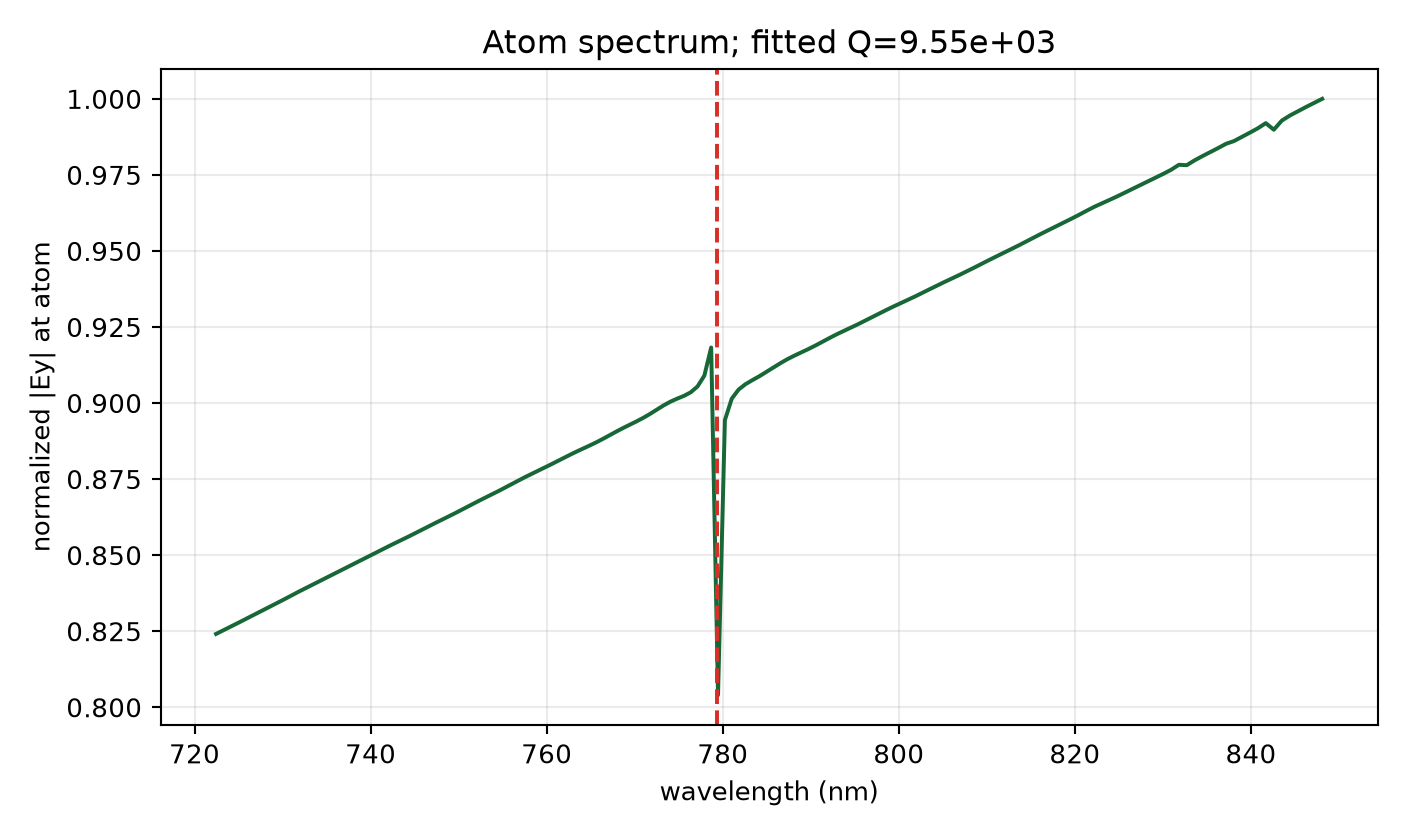
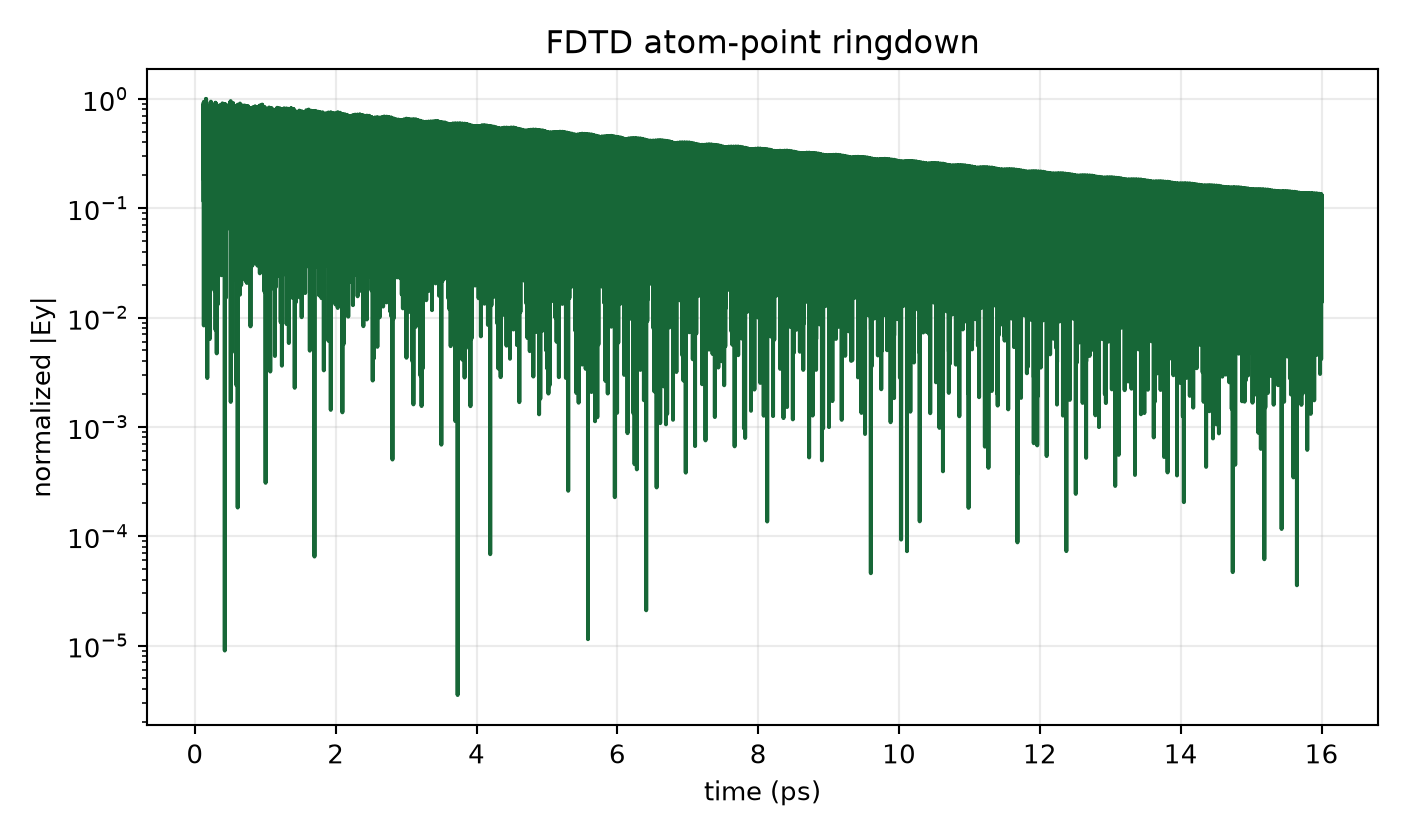
The +37.91% Q change remains far outside the ≤5% target. Auto-24 was therefore started as the last defined global-mesh diagnostic: 58.237M cells, no overrides, 16 ps, automatic shutoff, and a maximum estimate of 1.267137 FC. This does not relax the hard stop on exact-pole or emitter-β spending.
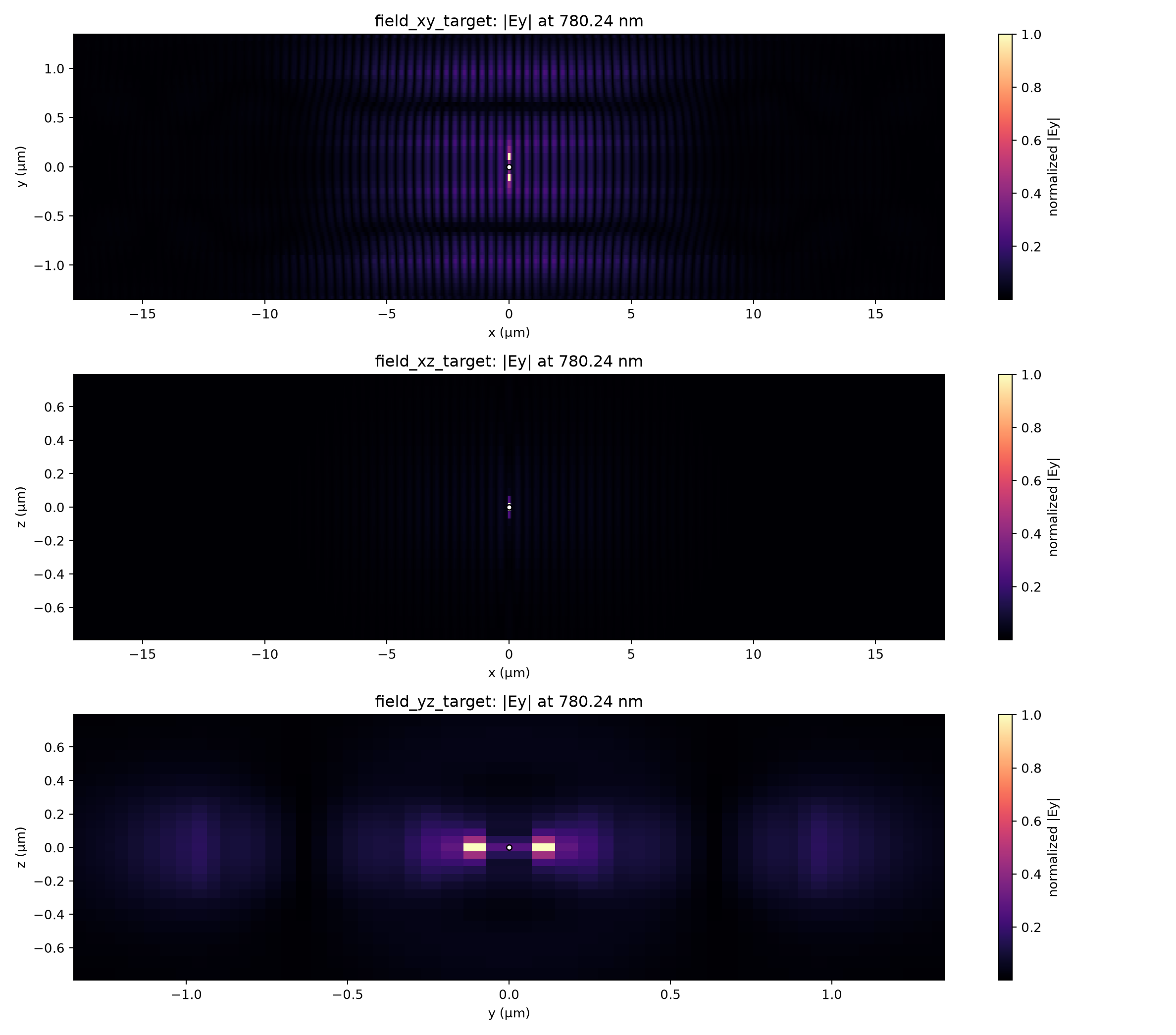
Auto-24 — definitive global-mesh failure
Evidence label: completed last defined high-resolution broadband mesh diagnostic. The record has sufficient duration and all internal broadband checks pass, but the inter-mesh tolerance fails badly.
| Quantity | Auto-22 | Auto-24 | Difference |
|---|---|---|---|
| total grid cells | 41.565M | 58.237M | +40.1% |
| fitted wavelength | 779.387331 nm | 779.584821 nm | +0.197490 nm |
| ringdown Q | 9,550.11 | 4,491.27 | −52.97% |
| fitted lifetimes observed | 2.0093 | 2.7764 | both pass duration gate |
| three-probe Q span | 0.00961% | 0.19054% | pass |
| actual stop time | 16.000 ps | 10.442 ps | automatic shutoff |
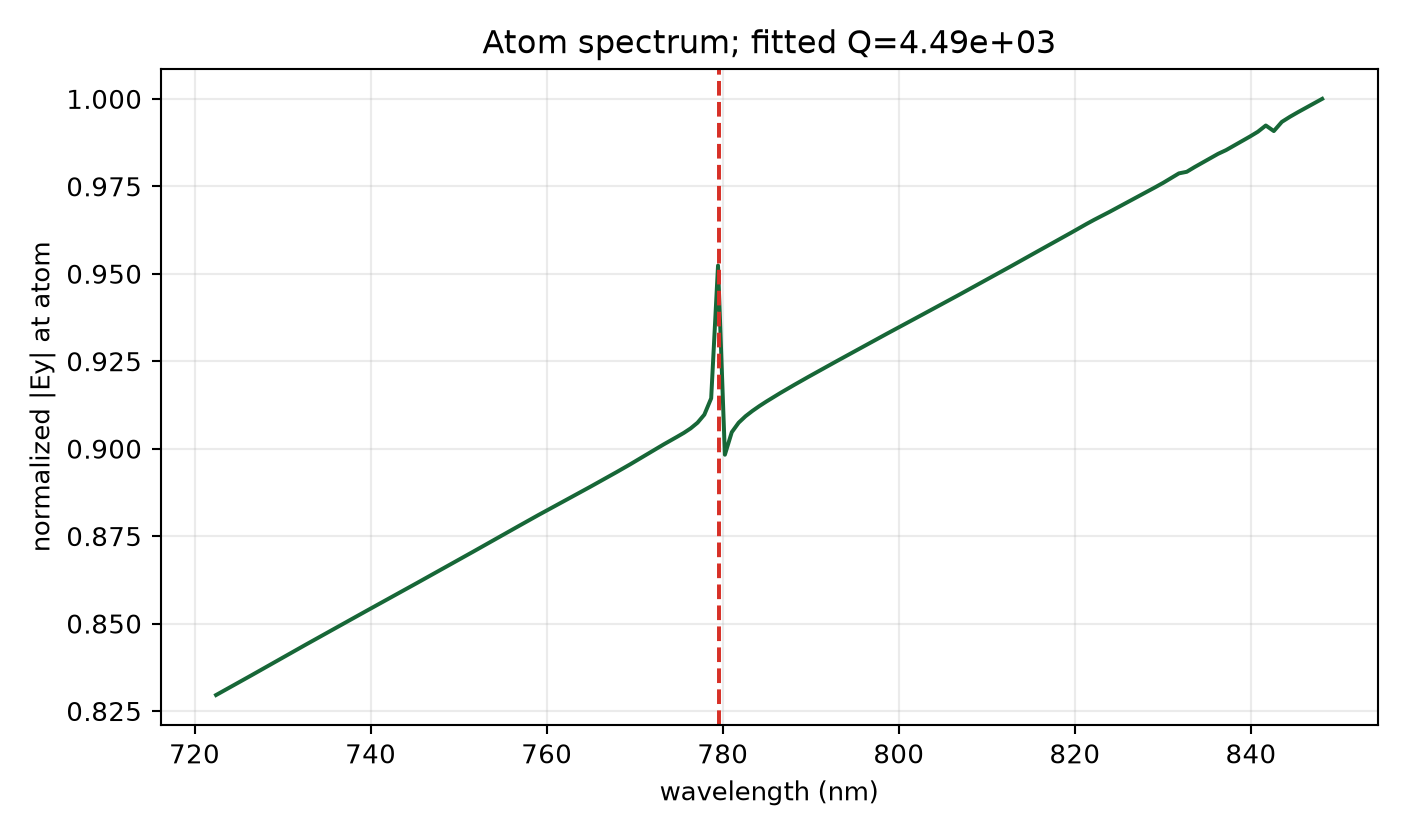
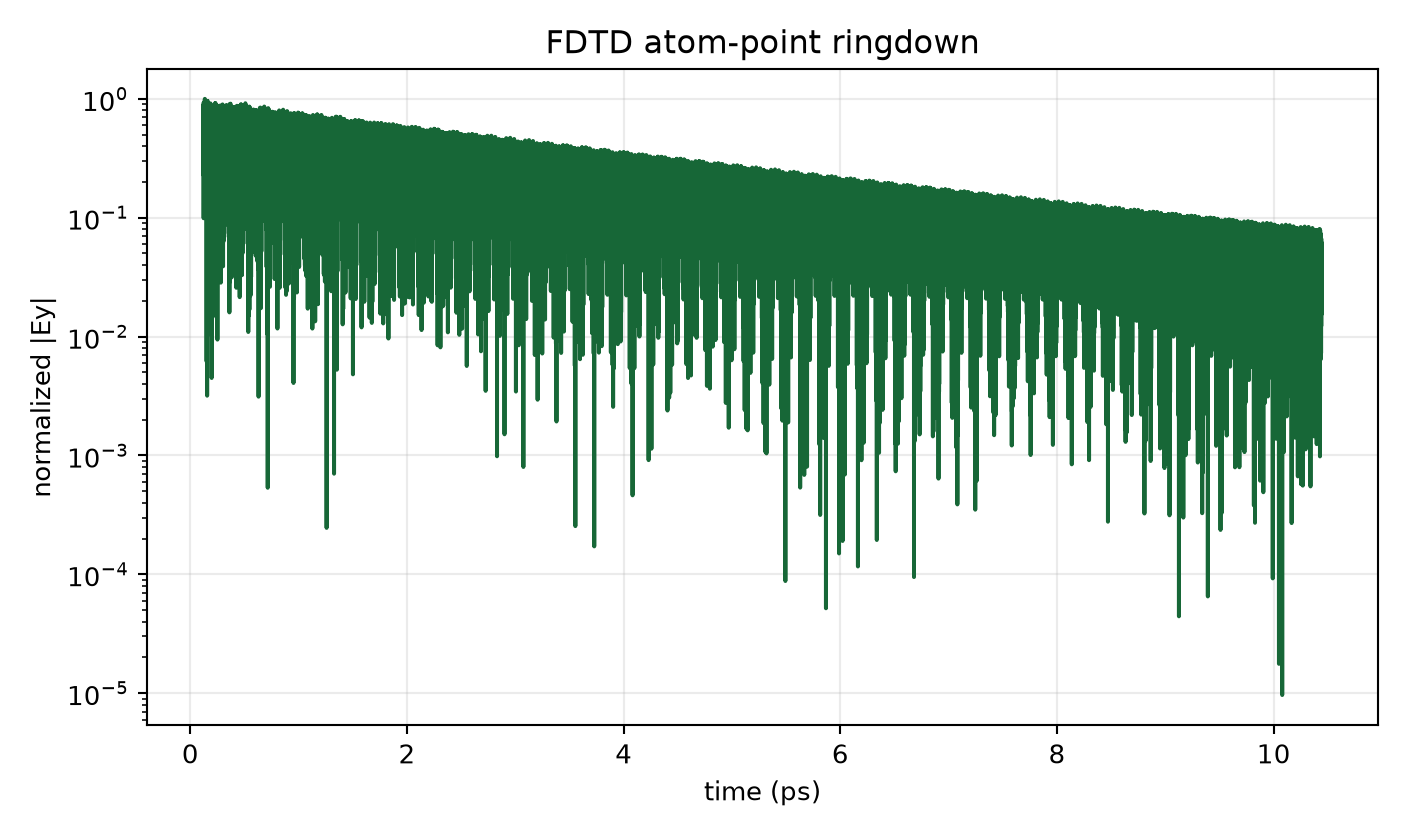
The Q shift remains an order of magnitude above the 5% convergence target, even though the run observes 2.78 fitted lifetimes and shuts off automatically. Auto-24 therefore closes this convergence sequence as a failure. No completed automatic mesh from 14 through 24 supports a production-Q claim for this geometry.
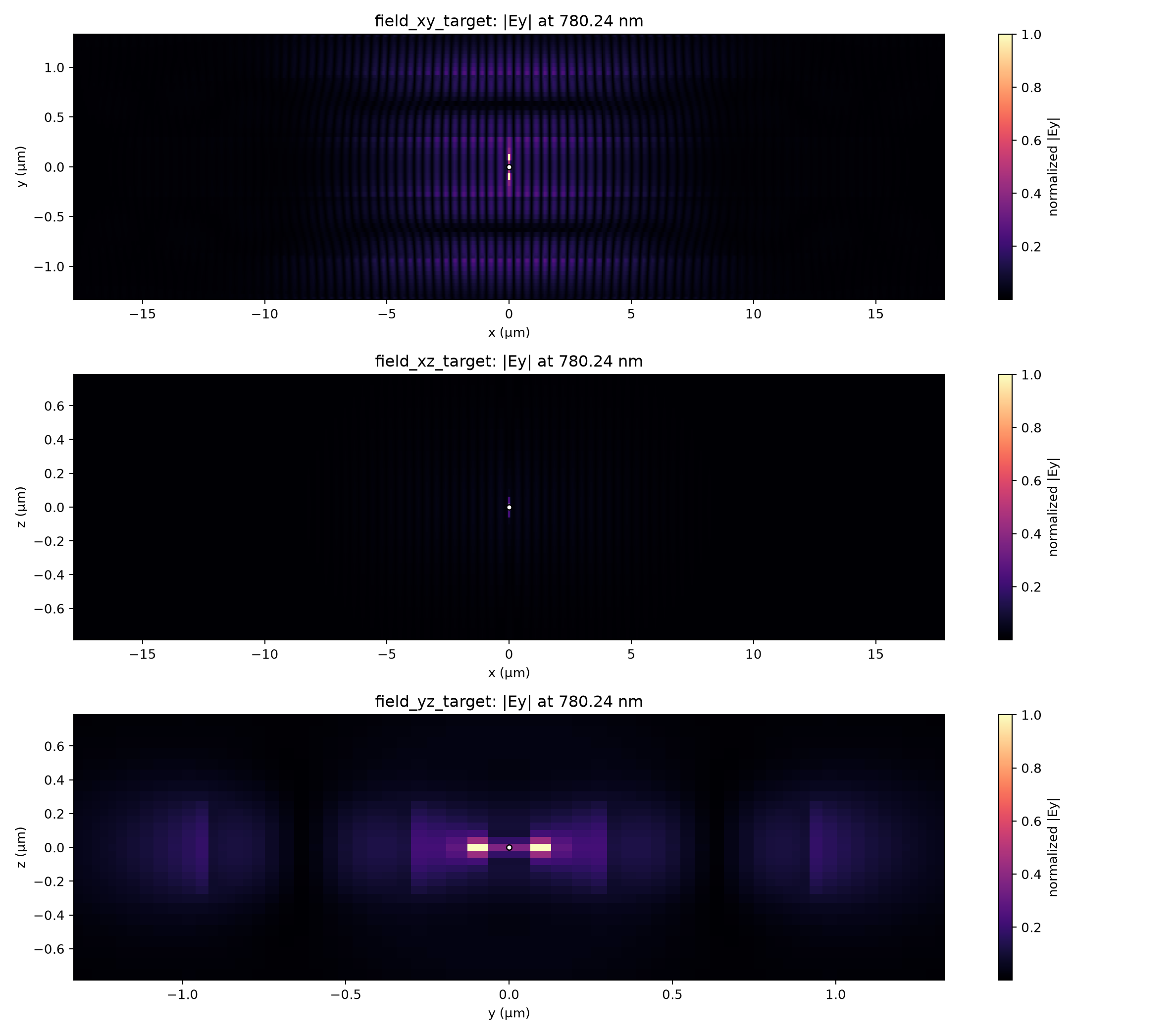
The stop rule is now unambiguous: do not run a retuned exact-pole volume, emitter-β, collection-β, or longer N48 task on this geometry. Diagnose or redesign the mesh-sensitive tapered edges first, then require a new broadband mesh sequence to pass before resuming those observables.
Local grid-boundary inspection — clue, not causal proof
Evidence label: local serialized-grid geometry diagnostic; 0 FC.
The atom-access boundaries are not the obvious source of the mesh sequence:
the slot walls at y=±0.300 µm and slab faces at z=±0.250 µm align exactly
with grid boundaries in every inspected automatic mesh. The representative
tooth edges along x and mirror-cell rail/tooth edges along y also align.
By contrast, the tapered center-cell rail and tooth outer edges shift relative
to the y grid as the automatic resolution changes.
| AutoGrid steps/λ | total cells | center rail y boundary error |
center tooth y boundary error |
Q |
|---|---|---|---|---|
| 14 | 14.314M | 4.853 nm | 4.853 nm | 19,562.5 |
| 16 | 19.622M | 8.949 nm | 8.949 nm | 13,593.1 |
| 18 | 29.416M | 6.082 nm | 6.325 nm | 4,007.4 |
| 20 | 33.924M | 1.970 nm | 1.970 nm | 6,924.9 |
| 22 | 41.565M | 5.842 nm | 5.845 nm | 9,550.1 |
| 24 | 58.237M | 0.294 nm | 1.076 nm | 4,491.3 |
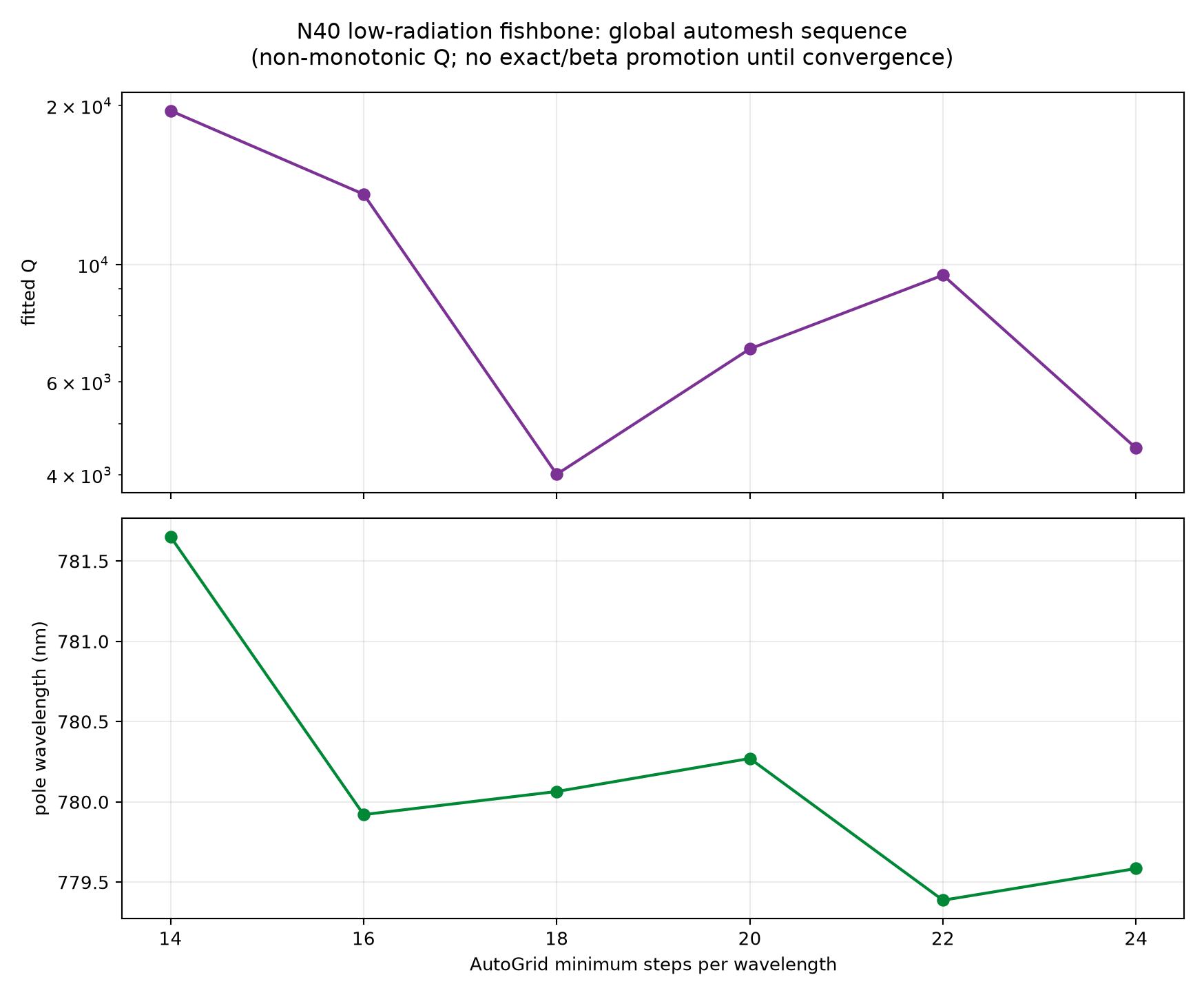
That pattern is consistent with, but does not prove, sensitivity of radiative cancellation to discretized tapered edges. A high-Q, radiation-limited cavity can change sharply when small edge shifts alter the phase and amplitude of leakage. There is no simple monotonic Q-versus-offset trend in the completed rows, so pole identity and other discretization effects must still be checked before assigning cause. Auto-24 also fails, so exact-pole/β spending on this geometry is stopped.
Public evidence:
Robustness pivot — representation-aware worst-case-Q screen
Evidence label: completed local representation audit, completed paid grouping and touching-box negatives, two clean but red-detuned PolySlab poles, a failed scale-retargeted Auto-14/20 pair, and a local-only bounded screen preparation. At this historical pivot checkpoint no mesh-robust 780 nm replacement had been selected; the later high-margin M16 sequence reported below now supplies the broadband-Q replacement.
The N40 result remains disqualified. Its domain/PML check passed, but its automatic-mesh Q sequence failed decisively. The representation audit narrows the likely numerical risk without claiming a cause:
| Audit check | Finding | Interpretation |
|---|---|---|
| largest touching-box endpoint mismatch | 3.55×10⁻¹⁵ µm | floating-point noise, not a physical access gap |
| raw planar union | 83 components before 1e-12 µm snap |
exact touching is numerically fragile to construct |
| snapped union | one polygon/rail, 656 outline vertices | connected, but still very sharp and complex |
| grouped boxes on common Auto-14 grid | zero ε-sample differences | grouping preserves occupancy on a fixed grid |
| grouping during AutoGrid generation | 14.314M→12.169M cells | grouping changes the generated grid |
| clean union conformal-ε differences | Ex 1,452; Ey 2,496; Ez 3,948 samples | representation is not invariant under subpixel averaging |
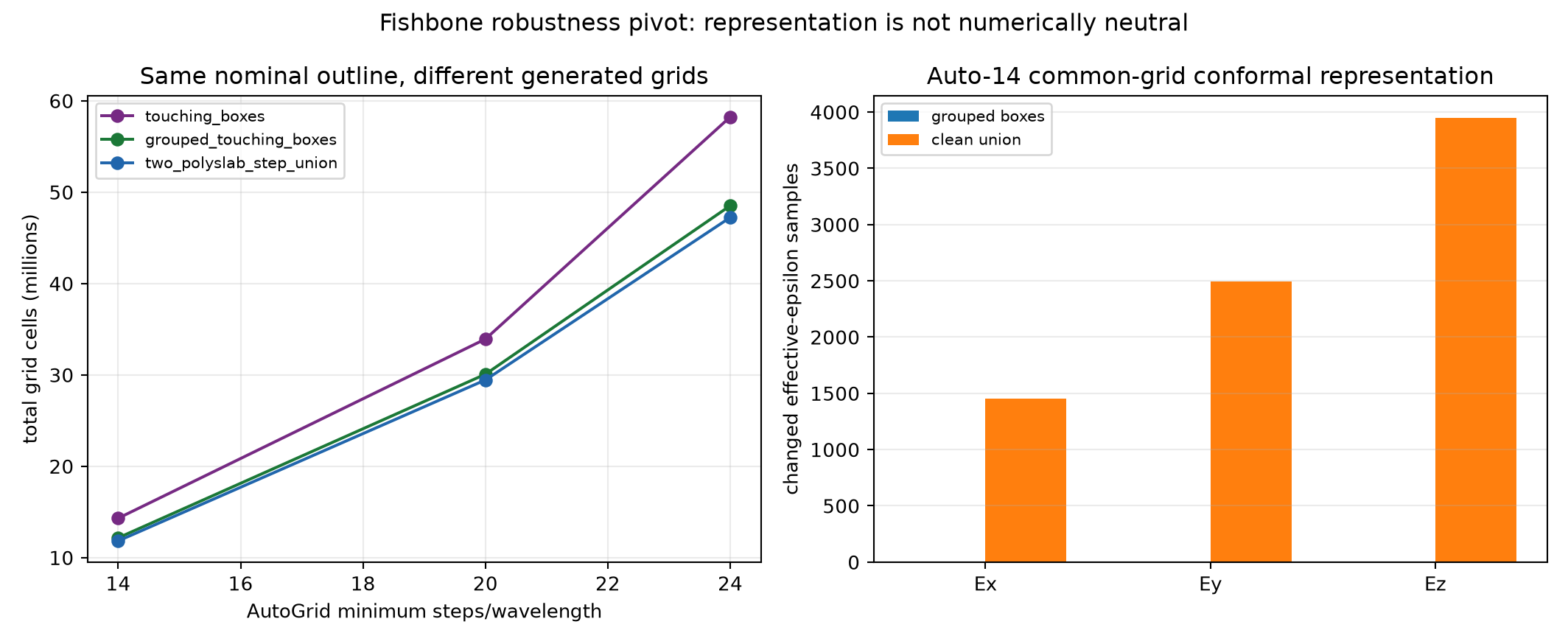
The touching-box gaps are harmless. The plausible risk is instead fragile radiation cancellation at sharp, representation-dependent conformal interfaces. That is an inference, not demonstrated causality: the audit does not prove which edge or subpixel sample caused the Q sequence.
Grouping-only control is a negative
The N40 Auto-14 grouping control replaced 384 same-medium structures with one
grouped structure. It generated a 1006×144×84 grid and completed as task
fdve-56fc463e-e4a8-46b2-aa2f-689606b35afa for 0.115811 FC, but the
target-band resonance analysis found no positive-Q eligible pole.
Grouping is therefore not a robustness cure, and the prepared grouped
Auto-20 partner will not run.
Three prepared candidate families
Every family preserves the 0.60 µm gap, 0.30 µm lateral clearance, open
z-approach path, low-radiation center cell, and r14 MPB atom metric
0.298804. Every prepared run uses 16 ps, automatic shutoff 1e-7, AutoGrid,
and zero overrides.
| Family | Geometry/representation | Initial mesh pair | Role |
|---|---|---|---|
| N32 box baseline | 32 taper + 8 mirror cells; touching boxes | existing Auto-14 Q=3,951.97 + prepared Auto-20 | adversarial repeat of a lower-Q baseline |
| N32 exact step union | same stepped outline as two connected PolySlabs | Auto-14 completed; Auto-20 cancelled after detuning | remove false internal same-material interfaces |
| N24 smooth weak mirror | two smooth PolySlabs; 24 taper + 6 mirrors; 70% terminal γ | unscaled Auto-14 red-detuned; scaled Auto-14/20 rejected | reduce sharp-edge cancellation and deliberately trade peak Q for stability |
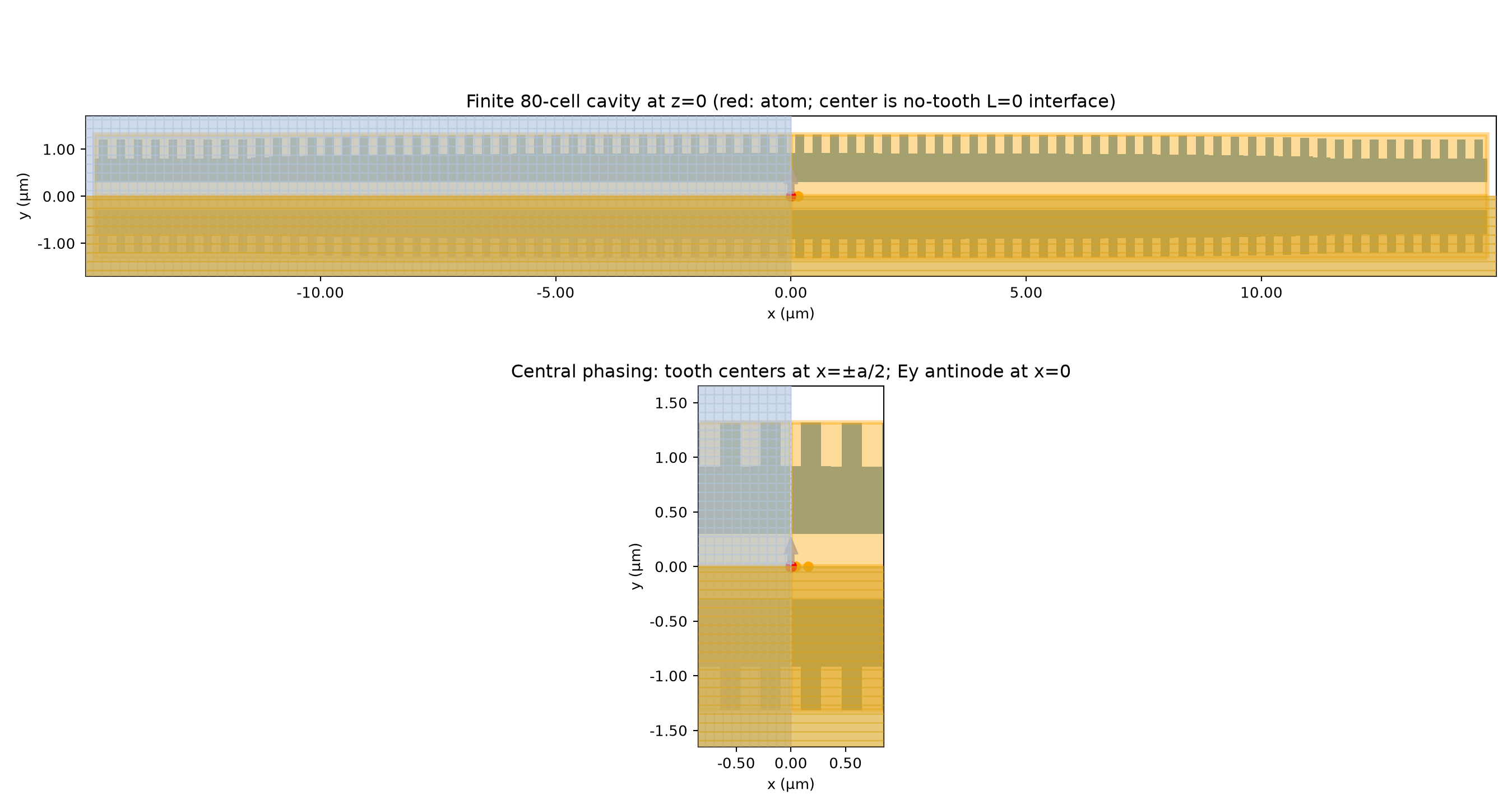
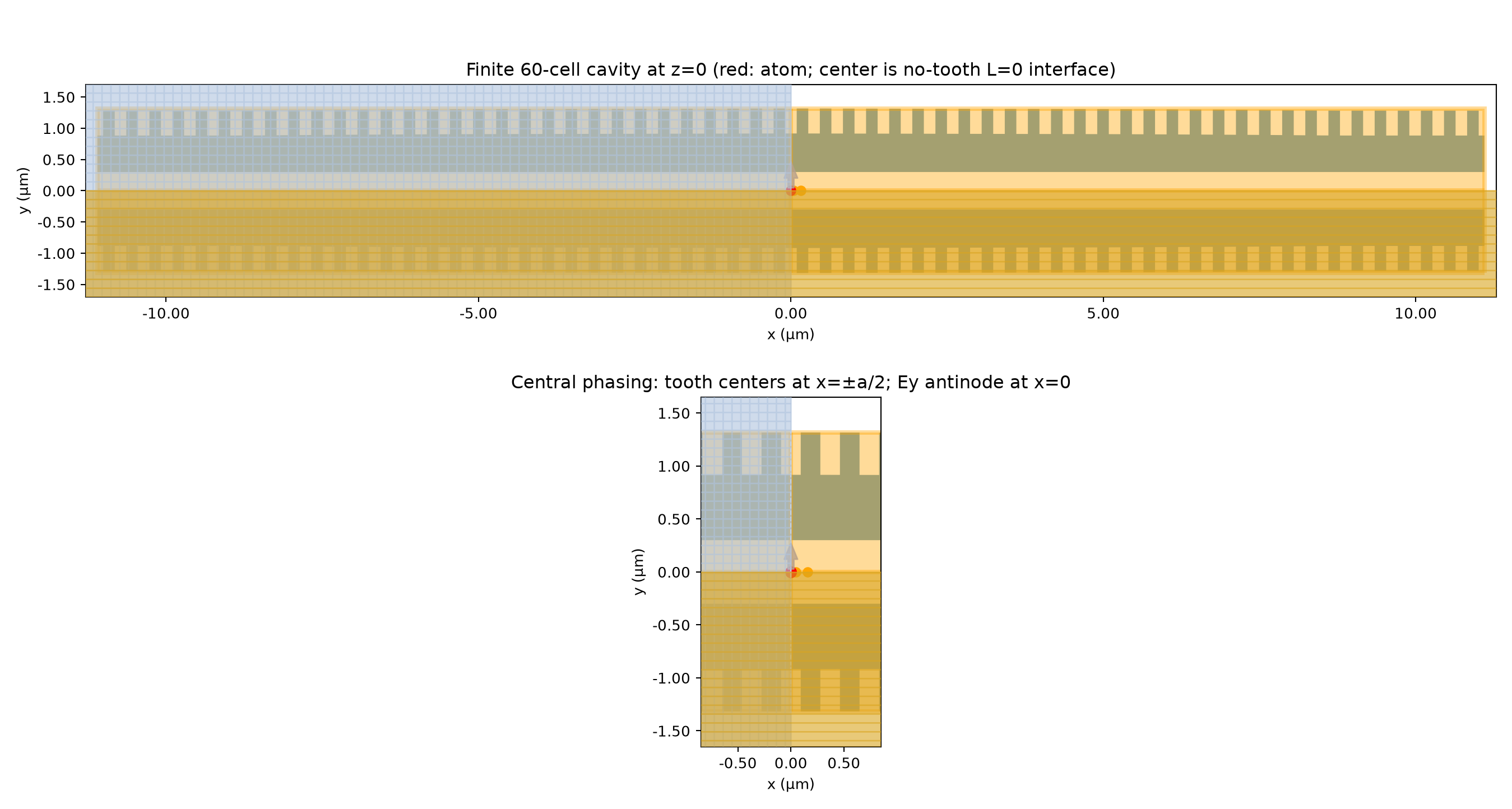
Selection is intentionally pessimistic:
- rank by
Qworst=min(Q14,Q20), never the best or average Q; - reject initial relative spread above 20% or
Qworst<1000; - test the winner at a third mesh and require ≤5% total Q spread;
- repeat domain/PML on that winner;
- only then spend on exact
Vatom, Purcell, or emitter/collection β.
Result 1 — N32 touching boxes rejected
| Metric | Auto-14 | Auto-20 | Gate |
|---|---|---|---|
| Q | 3,951.97 | 2,114.52 | Qworst=2,114.52 passes 1,000 floor |
| wavelength | 781.195825 nm | 779.759045 nm | descriptive |
| observed amplitude lifetimes | 3.5468 | 3.5535 | both well sampled |
| two-mesh relative spread | 86.90% | fails ≤20% |
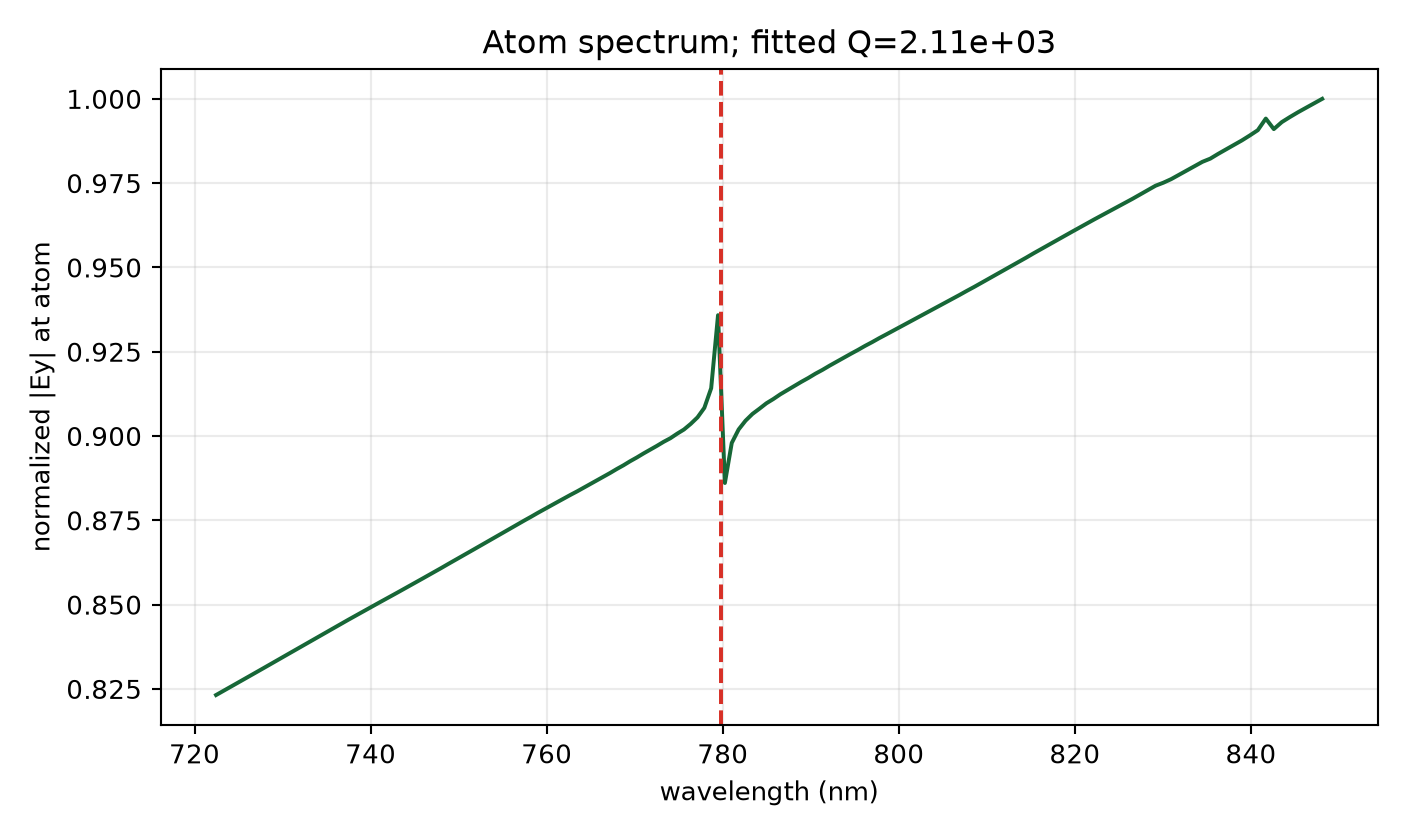
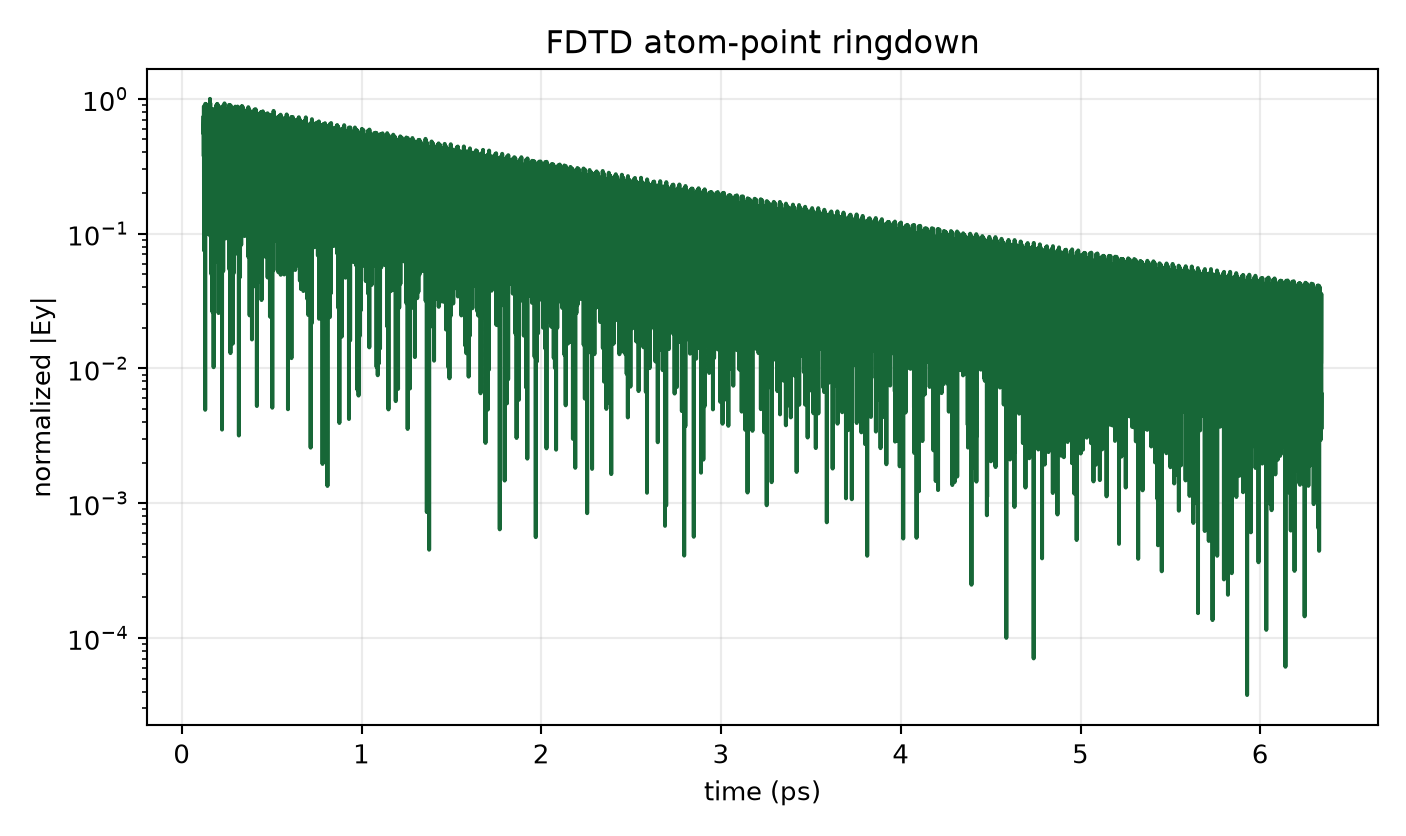
The Auto-20 task fdve-0f3d8a0e-1660-495e-916d-f626cb153988
automatically stopped at 6.341 ps after 3.55 fitted lifetimes. All three
probes agree within 0.0133% in Q, so the 86.90% pair spread is not blamed on
an undersampled record. The touching-box family is rejected even though its
worst-case Q remains above 1,000.
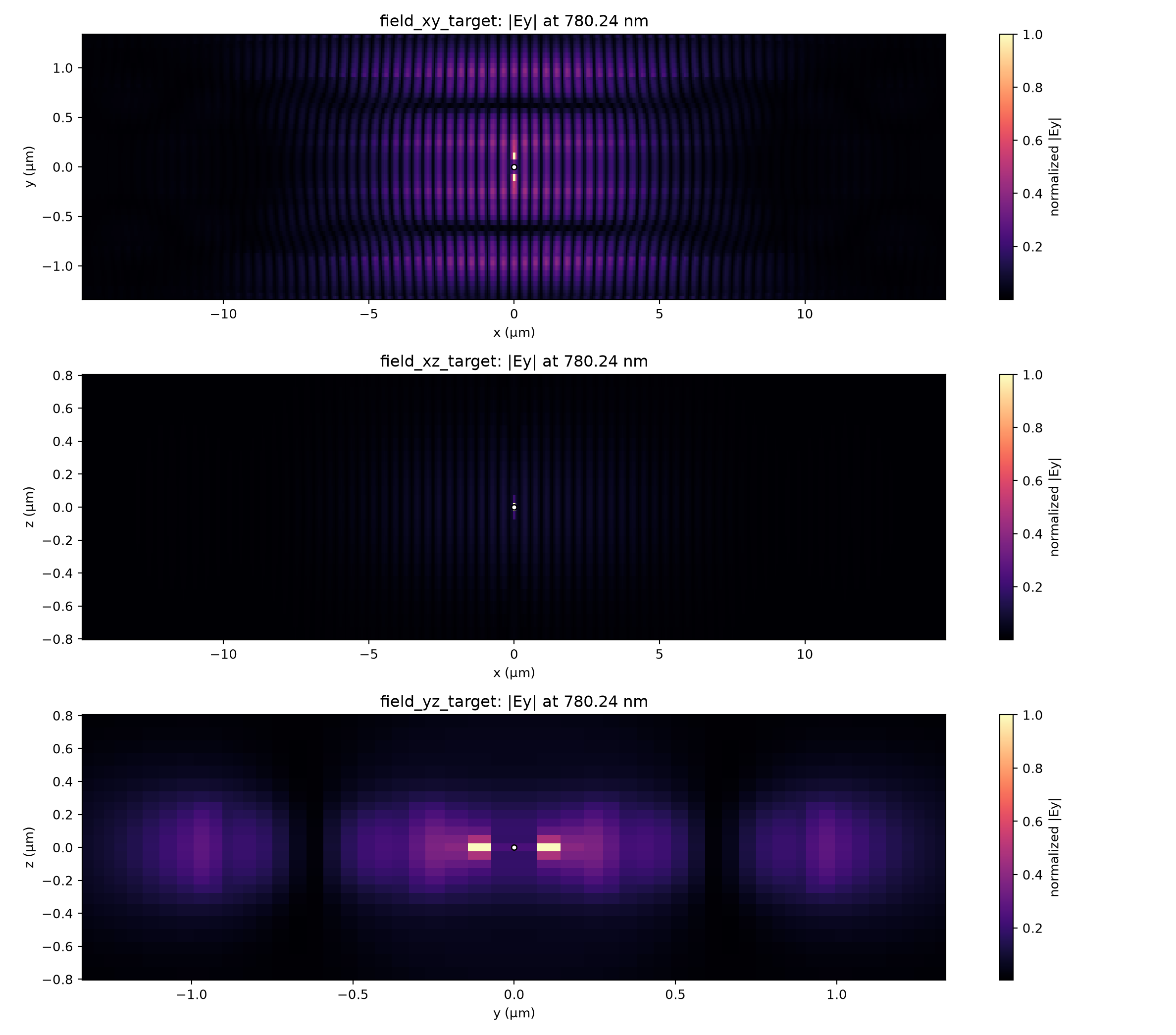
Result 2 — connected PolySlabs reveal a wavelength-retargeting error
The strict analyzer correctly found no positive-Q pole in its narrow
780 nm target band for either the N32 connected-step union or the N24 smooth
weak-mirror cavity. A deliberately broader 0.8–1.2 f0 diagnostic then found
clean cavity modes near 926 nm:
| Geometry | Mesh | broader-band pole | Three-probe Q | Classification |
|---|---|---|---|---|
| N32 exact step union | Auto-14 | 926.320119 nm | 2,179.85–2,180.31 | clean pole, but wrong wavelength |
| N24 smooth weak mirror | Auto-14 | 926.109434 nm | 2,442.57–2,446.59 | clean pole, but wrong wavelength |
The smooth-cavity fit used an 8.04 ps ringdown window and has low per-probe fit error, approximately 0.00051–0.00279. Its Q relative span is 0.164%; the N32-union three-probe Q relative span is still tighter at 0.0208%. Thus “no target-band pole” does not mean “no cavity mode.” It means the unscaled finite geometry was about 19% too red. The N32-union Auto-20 partner is intentionally cancelled: mesh-converging a known off-target design would not answer the atom-coupling question.
The follow-up geometry uses a scale retarget of the smoother family by
780.24/926.109434 ≈ 0.842492. This should move the same normalized mode toward
the Rb target while preserving its topology. It also scales the 0.60 µm slot
to 0.505495 µm, leaving 0.252747 µm atom-to-dielectric clearance. This
remains within the original 0.5–1.0 µm slot range but leaves less tweezer
clearance. The serialized vertices and slab bounds were checked to be the
intended uniform transform. The scale relation was still a design prediction,
not evidence that the same pole would be recovered; the completed check below
shows that prediction failed numerically.
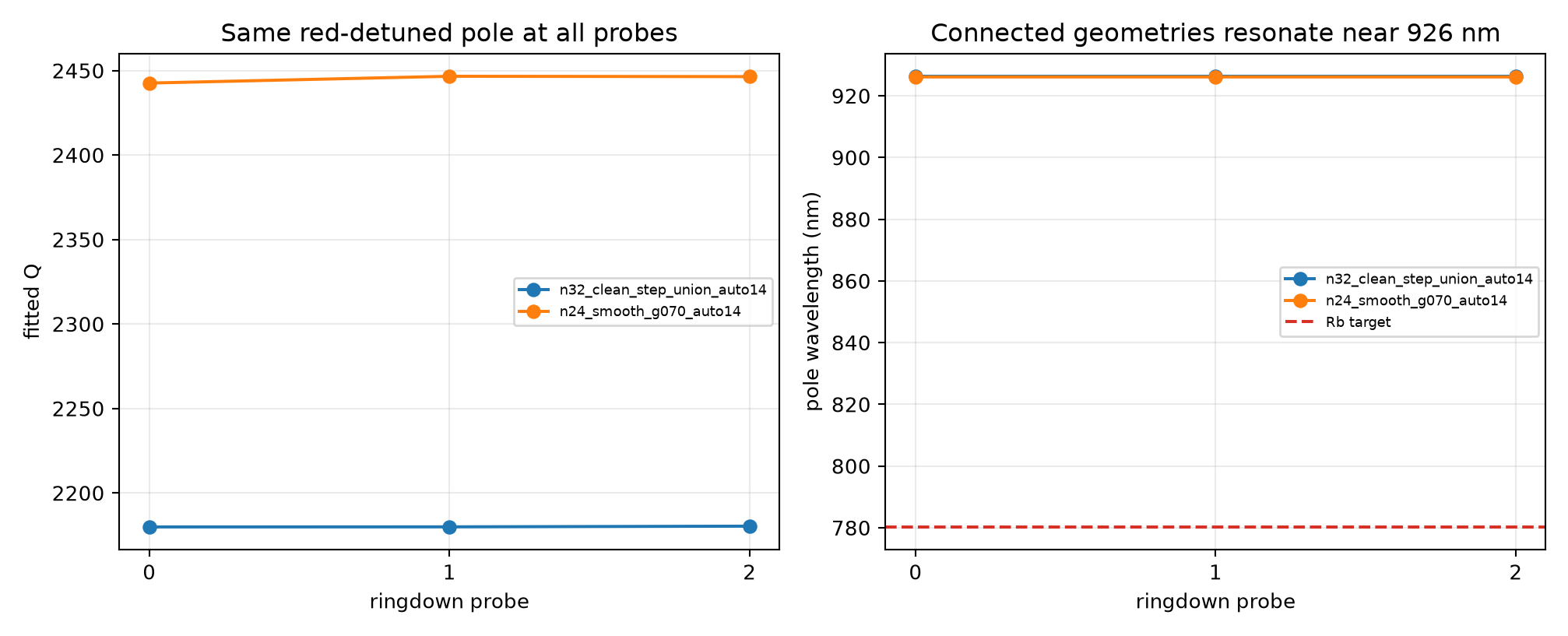
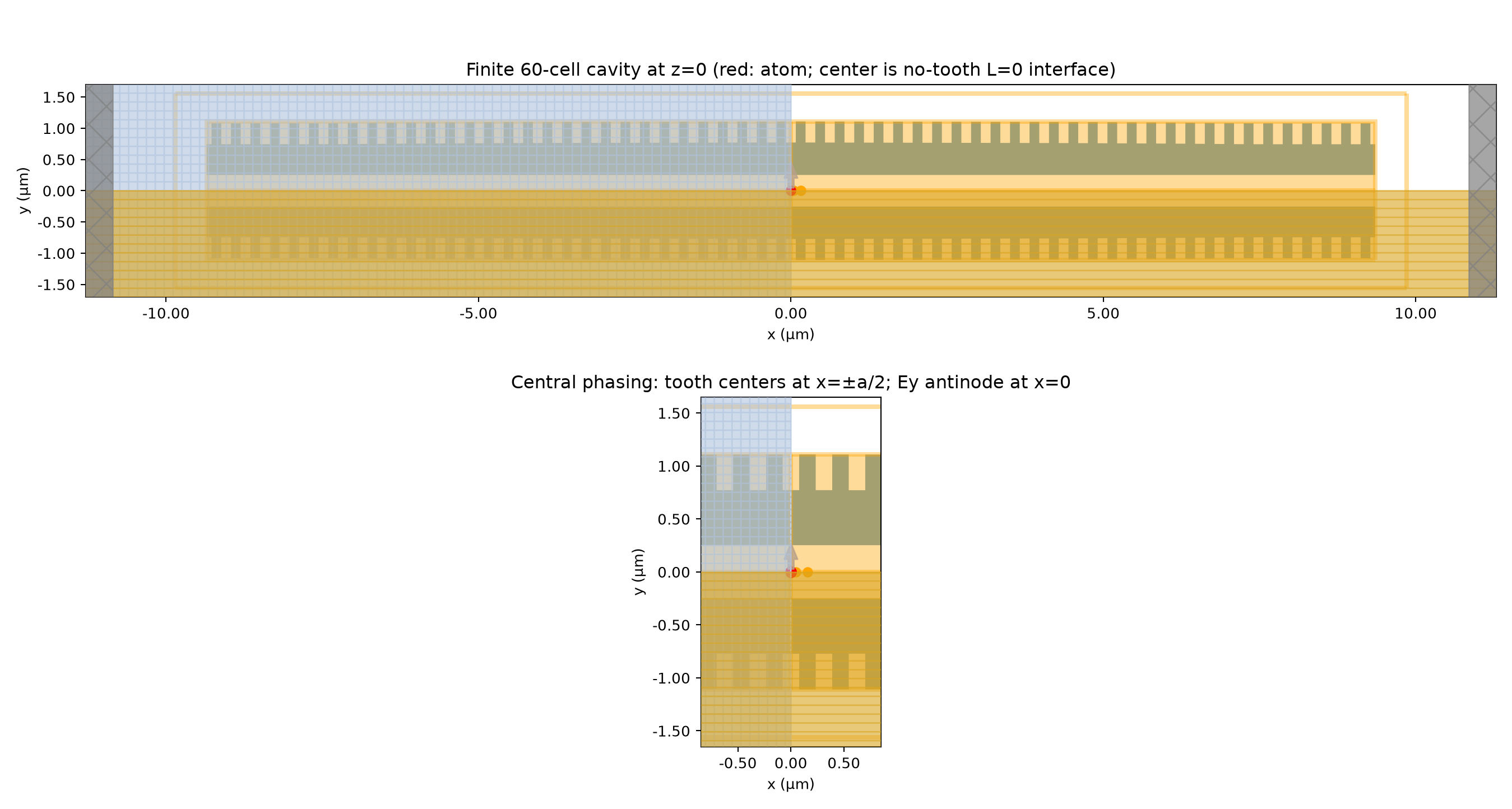
The robustness-preparation script itself started zero cloud tasks and spent
0 FC. The connected-step-union task
fdve-b854a58c-d3e4-4463-bfdc-29f8ed7ee76b completed for 0.051717 FC
after automatically shutting off at 54% of the planned record. The unscaled
smooth task fdve-07f6b9c0-8de4-4173-917c-bda4656a5d65 also completed.
Paid results are logged separately in the shared ledger.
Result 3 — scaled smooth family rejected
Both retargeted runs preserve the 0.505495 µm open slot, use 16 ps maximum
time, automatic shutoff 1e-7, AutoGrid, and no overrides. They do not
recover a trustworthy 780 nm cavity pole:
| Mesh | Strict target-band result | Cross-probe evidence | Verdict |
|---|---|---|---|
| Auto-14 | no eligible positive-Q pole | no valid target-band result | fail |
| Auto-20 | 787.957661 nm, Q=165.438 | only probe 0; fit error 0.7673 | fail |
The Auto-20 record spans 4.371 ps, or 31.58 nominal fitted lifetimes for that
low-Q candidate, so record duration is not the problem. The candidate fails
the more basic pole-identity gate: the other two probes do not recover it and
the single fit has very high error. Therefore the pair cannot be assigned a
meaningful Qworst, and it is rejected before the 20% mesh-spread gate.
The broader three-probe clustering diagnostic reinforces that verdict. Auto-14's common clusters lie near 967, 1,020, and 1,151 nm; Auto-20's lie near 656, 710, 738, and 758 nm. None is a common 780 nm pole and no family matches across the two meshes. Some off-target clusters are internally clean and high-Q—for example Auto-14 Q≈1,673 at 1,150.99 nm and Auto-20 Q≈3,037 at 656.39 nm—but those are evidence of unstable pole identity, not successful retargeting.
The exact geometry transform having been verified, this negative points to numerical/pole-identity failure rather than an unscaled-vertex coding error. It also warns that the clean 926 nm pole cannot yet be assumed to be the same physical cavity branch after retargeting. No mode volume, Purcell factor, or β calculation is justified for this family.
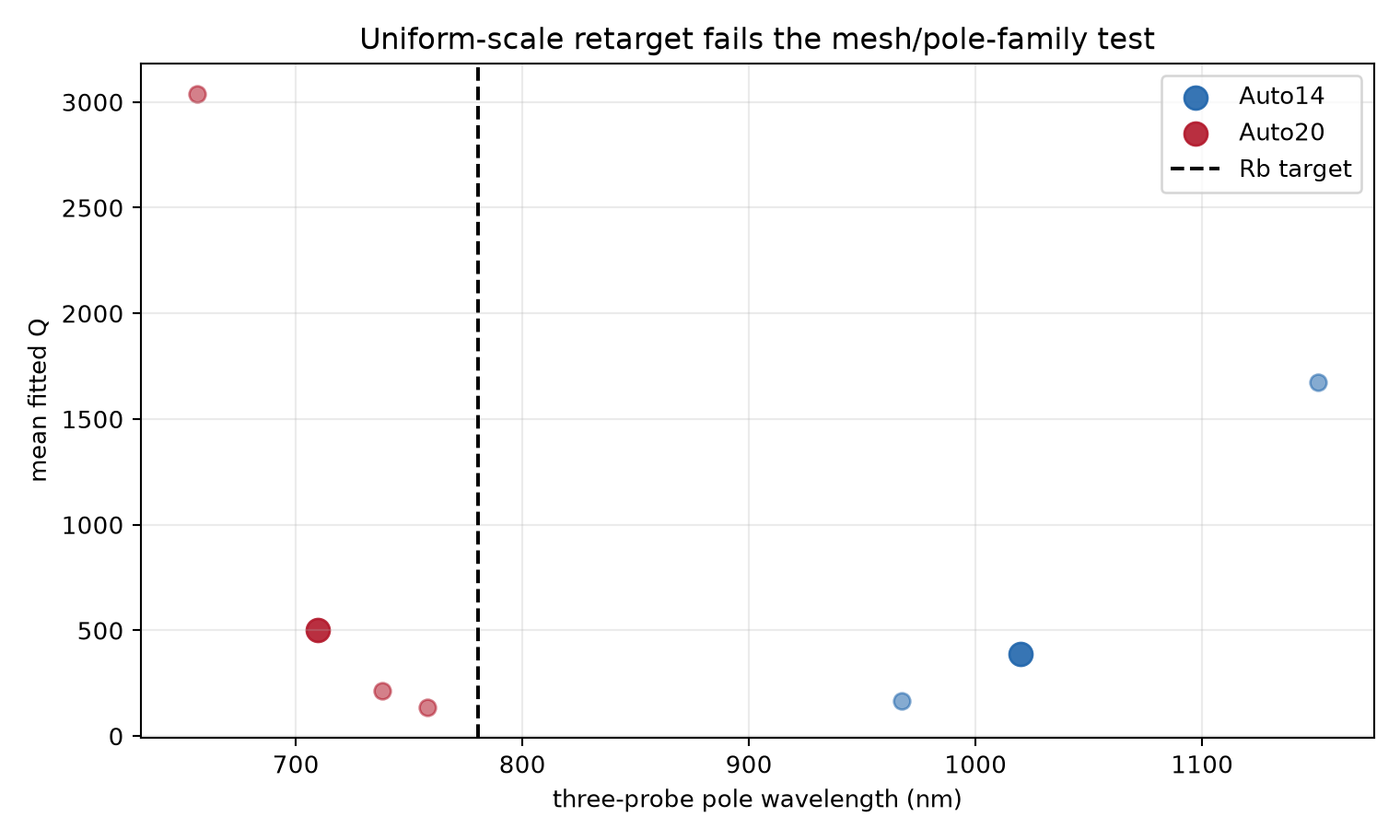
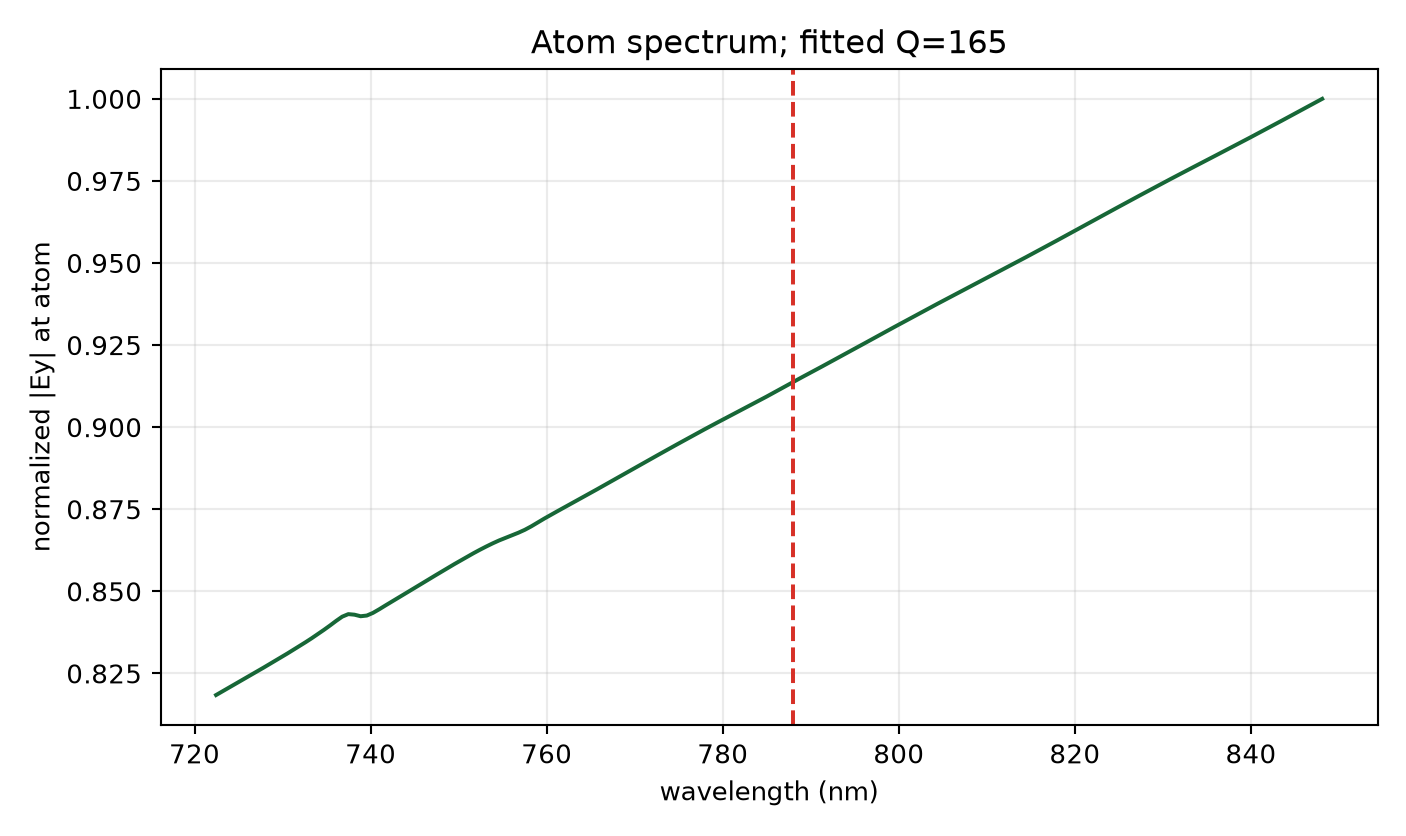
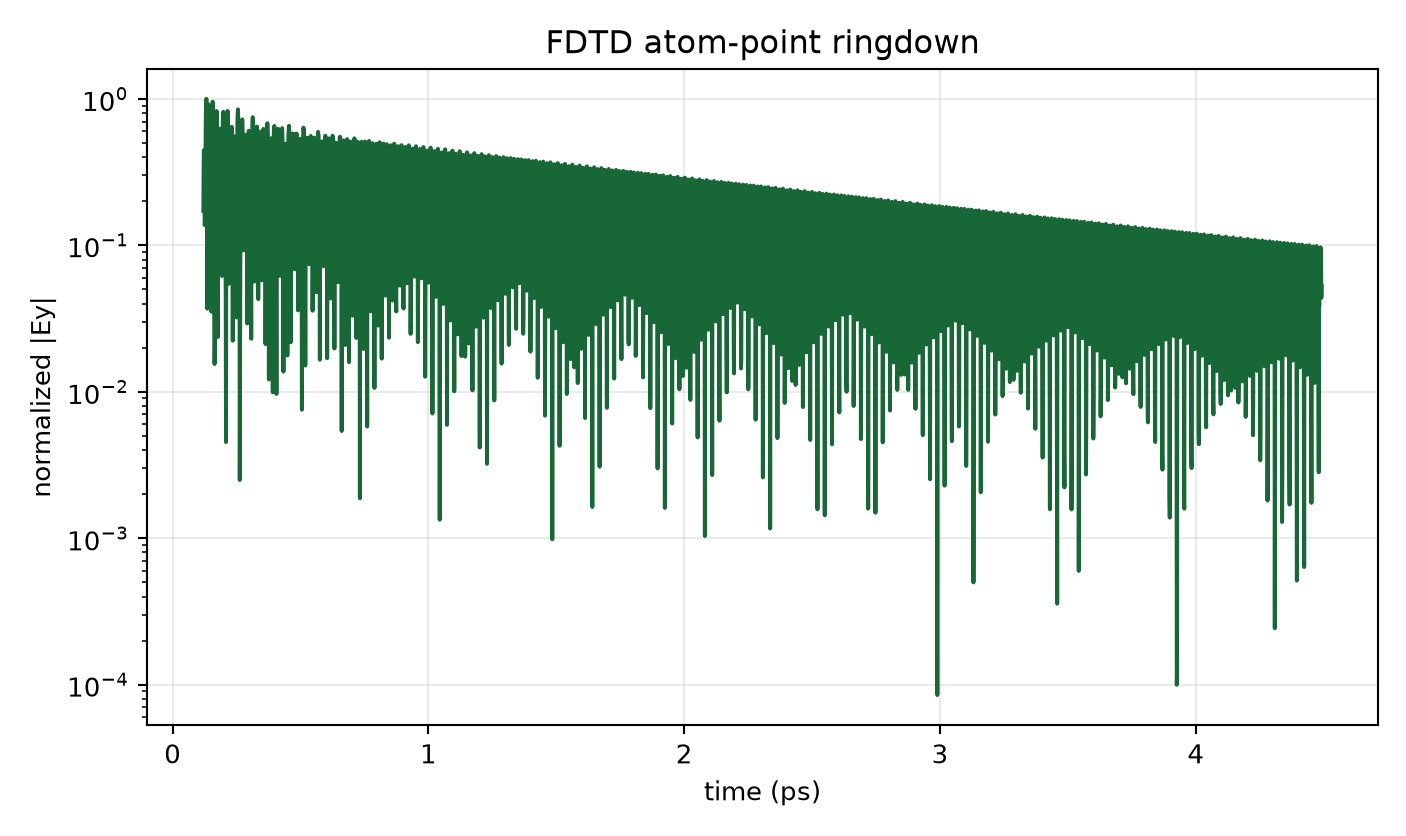
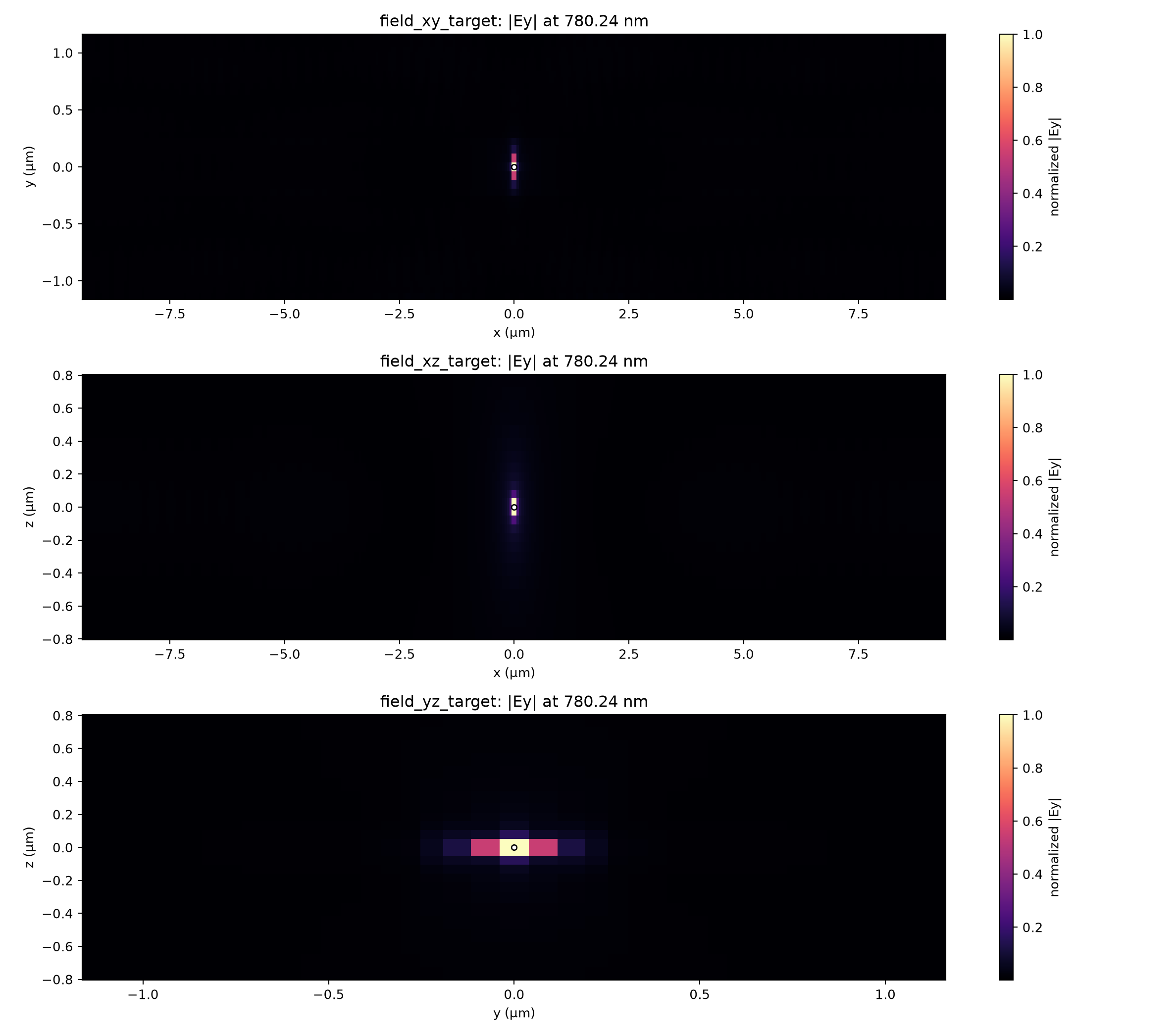
Local gate — canonical connected MPB/FDTD geometry
ERRATUM — geometry-equivalence claim withdrawn. The following MPB audit, screen, and validation are preserved as historical evidence, but the MPB prisms used the wrong transverse placement. Their effective slot was approximately 0.07492 µm, not 0.75 µm. No connected-MPB field, band, gap, light-line, atom-overlap, or mirror-strength value in this subsection may be assigned to the finite FDTD geometry until the corrected semantics are rerun.
The new canonical model defines W as the minimum full outer backbone width,
A as the one-sided outer-wall excursion, and gap as the full unobstructed
air slot. It was intended to make MPB and finite FDTD extrude the same
vertices, but the area-centroid versus arithmetic-vertex-mean mismatch broke
that equivalence.
The audit confirms that the legacy and canonical width variables have the same analytic meaning, but they are not numerically interchangeable under subpixel averaging:
| Old cell | largest X-point band shift | changed ε voxels | mean ε difference |
|---|---|---|---|
| center width 1.833915 µm | 6.52% | 6,886 | 1.84% |
| mirror width 1.607249 µm | 7.48% | 6,746 | 1.72% |
The maximum pointwise ε difference is 1.1025 in both comparisons. That is large enough to invalidate carrying legacy band placement directly into the connected-PolySlab cavity, even though the intended dimensions have the same names. The original conclusion that the connected-prism MPB model exactly corresponded to the connected-PolySlab FDTD geometry is invalid. The numerical differences in the table remain historical outputs from the saved models.
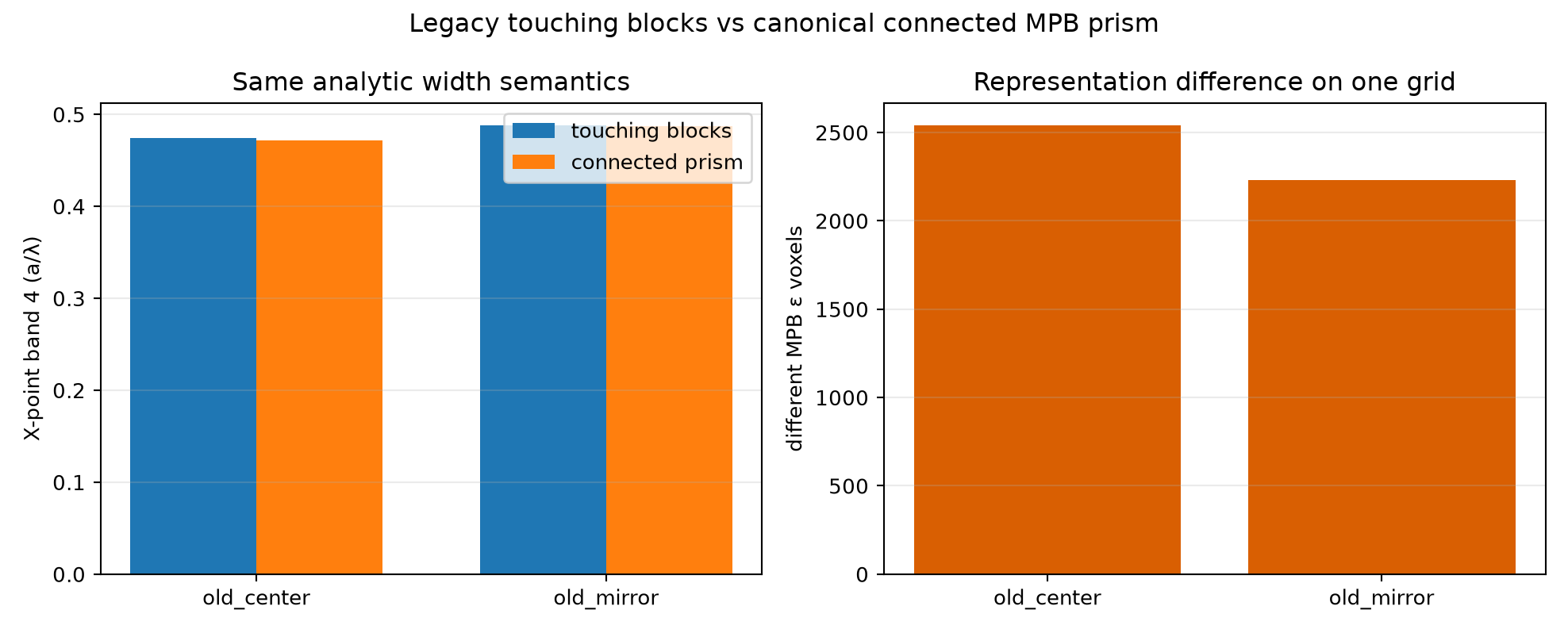
Coarse connected-profile period-chirp screen
Evidence label: historical local MPB resolution-6 screen; zero cloud action. Invalid for ranking the intended 0.75 µm-slot geometry because the saved prism's effective slot was approximately 0.07492 µm.
All eight geometry combinations found a center-period crossing and a shorter- period mirror gap. The best coarse score favors the wider access slot:
| Rank | gap | rail width | outer excursion A | center→mirror period | γ | atom Ey²/max(εE²) |
|---|---|---|---|---|---|---|
| 1 | 0.75 µm | 0.45 µm | 0.45 µm | 377.831→365.000 nm | 0.02613 | 0.97159 |
| 2 | 0.60 µm | 0.45 µm | 0.45 µm | 370.992→360.000 nm | 0.02975 | 0.76045 |
| 3 | 0.75 µm | 0.45 µm | 0.35 µm | 382.663→370.000 nm | 0.02084 | 0.92634 |
| 4 | 0.60 µm | 0.45 µm | 0.35 µm | 378.763→370.000 nm | 0.02404 | 0.67910 |
The rank-1 candidate uses a 3.396% period chirp, predicts its center crossing at 781.050 nm, and places the 780.24 nm target inside the coarse mirror gap. The screening script assigns a deliberately broad expected finite-FDTD search window of 773.05–789.05 nm. That window is a pole-tracking aid, not an error bar or a promise that FDTD will contain a cavity pole.
The rank-1 light-line margin is only 3.15%, and the unusually large coarse atom metric must be checked against resolution and near-X branch identity. The completed validation immediately below performs those checks.
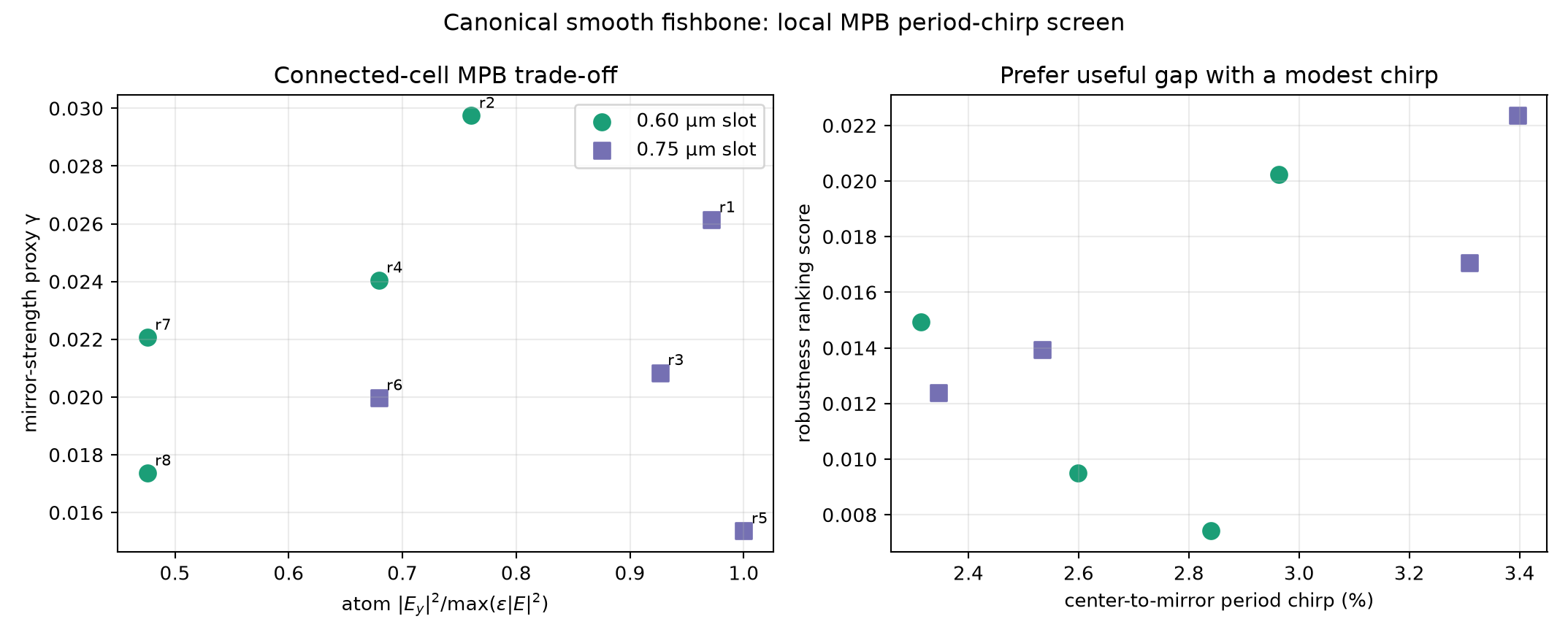
Rank-1 high-resolution and near-X validation passes its local gates
Evidence label: historical local r10/r14, padding, and near-X MPB validation; zero cloud action. The numerical solver checks passed internally for the wrong transverse geometry. They do not validate the intended 0.75 µm-slot cell and no longer promote this MPB family.
| Quantity | r10, pad 1.2 µm | r14, pad 1.2 µm | r14, pad 1.6 µm |
|---|---|---|---|
| retuned center period | 377.545692 nm | 377.563132 nm | fixed |
| predicted center wavelength | 780.240082 nm | 780.239037 nm | 780.243874 nm |
atom Ey²/max(εE²) |
0.929410 | 0.939632 | 0.938587 |
| mirror γ at 365 nm | 0.027243 | 0.027448 | 0.027420 |
The center-period change from r10 to r14 is 0.00462%; the atom metric changes 1.088% with resolution and 0.111% with extra padding. Mirror γ changes 0.748% with resolution and 0.102% with extra padding. At r14 the target lies in the 760.569–803.574 nm mirror gap. The finite-FDTD pole search window is therefore 772.239–788.239 nm, centered on the retuned connected-cell prediction.
The near-X result needs a precise caveat. Bands 3 and 4 remain separated in
the sampled fixed-parity ordering, and band 4 is below the air line at X.
However, band 4 is below the air line at only the last two of seven samples
from k=0.45 to 0.50; band 3 is below it at all seven. Thus the declared
X-point gate passes, but this is not proof that band 4 is guided throughout
the near-X interval. Fixed-order hybridization and open-boundary radiation
remain risks that the bounded FDTD pair must expose.
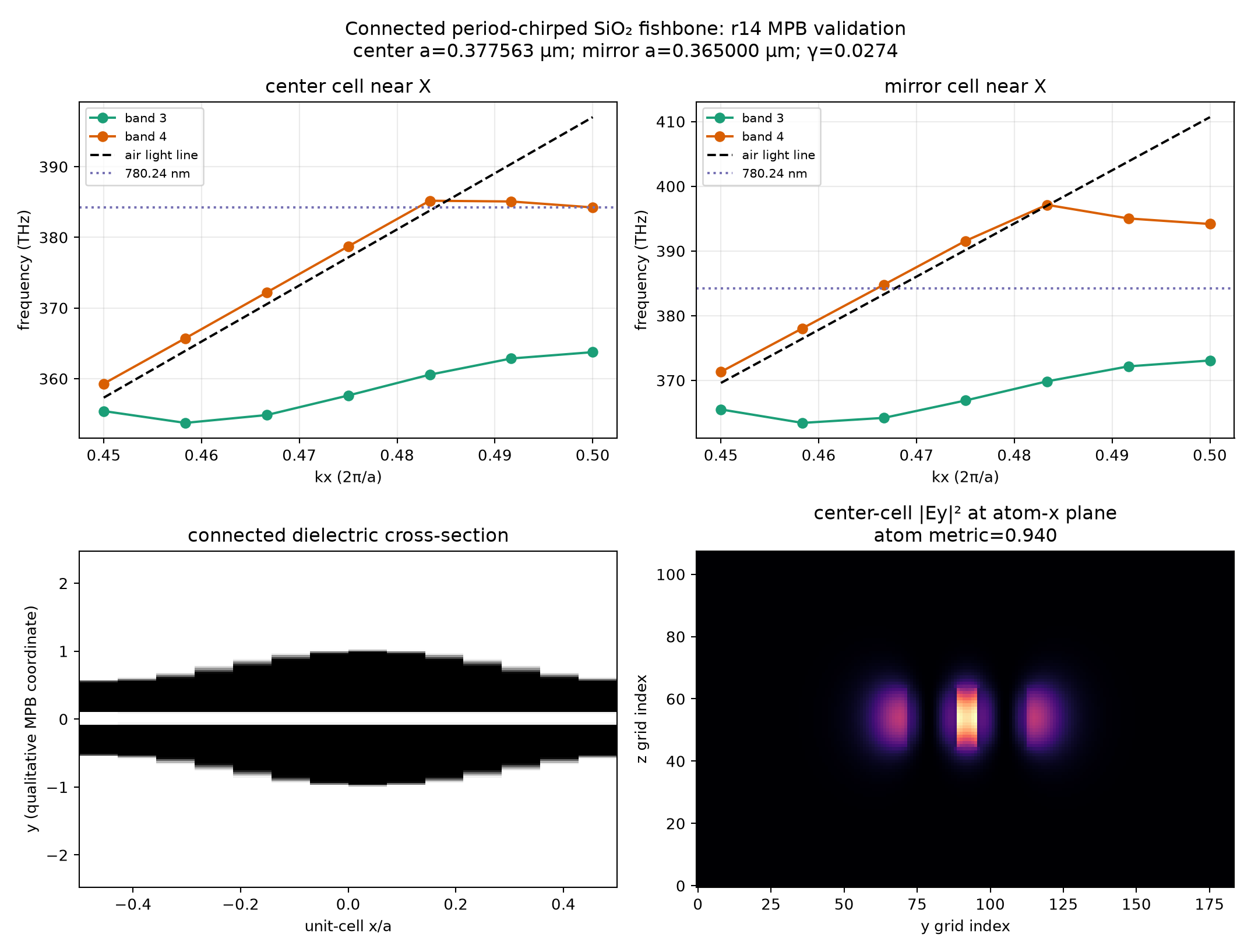
Exact connected finite cavity prepared — no FDTD result yet
Evidence label: local-only FDTD serialization and validation; zero cloud tasks and 0 FC. The serialized FDTD geometry retains its explicit 0.75 µm slot, but the former label MPB-qualified is withdrawn.
The prepared cavity uses exactly two connected SiO₂ PolySlabs, one per rail. Each cell is a raised cosine sampled at 40 points; both the profile height and slope vanish at cell boundaries, so changing the period does not introduce a geometric step. Twenty-four taper cells per side were chosen using a now- invalid MPB mirror-strength transfer, followed by eight 365 nm-period mirror cells per side. The air slot remains 0.75 µm wide throughout.
| Prepared variant | AutoGrid | grid cells | time/shutoff | overrides | structures |
|---|---|---|---|---|---|
| Auto-14 | 14 steps/λ | 698×138×84 = 8.091M | 16 ps / 1e-7 |
0 | 2 |
| Auto-20 | 20 steps/λ | 984×182×110 = 19.700M | 16 ps / 1e-7 |
0 | 2 |
Both variants use 12-layer PML and the same 26.7016×5.25×3.00 µm domain. The first paid gate is not “largest Q”: both meshes must recover the same positive-Q pole inside 772.239–788.239 nm. Their initial Q spread must be ≤20%; a promoted candidate then needs a third mesh with ≤5% total spread and a domain/PML repeat. Exact mode volume, Purcell, and β remain forbidden until those gates pass.
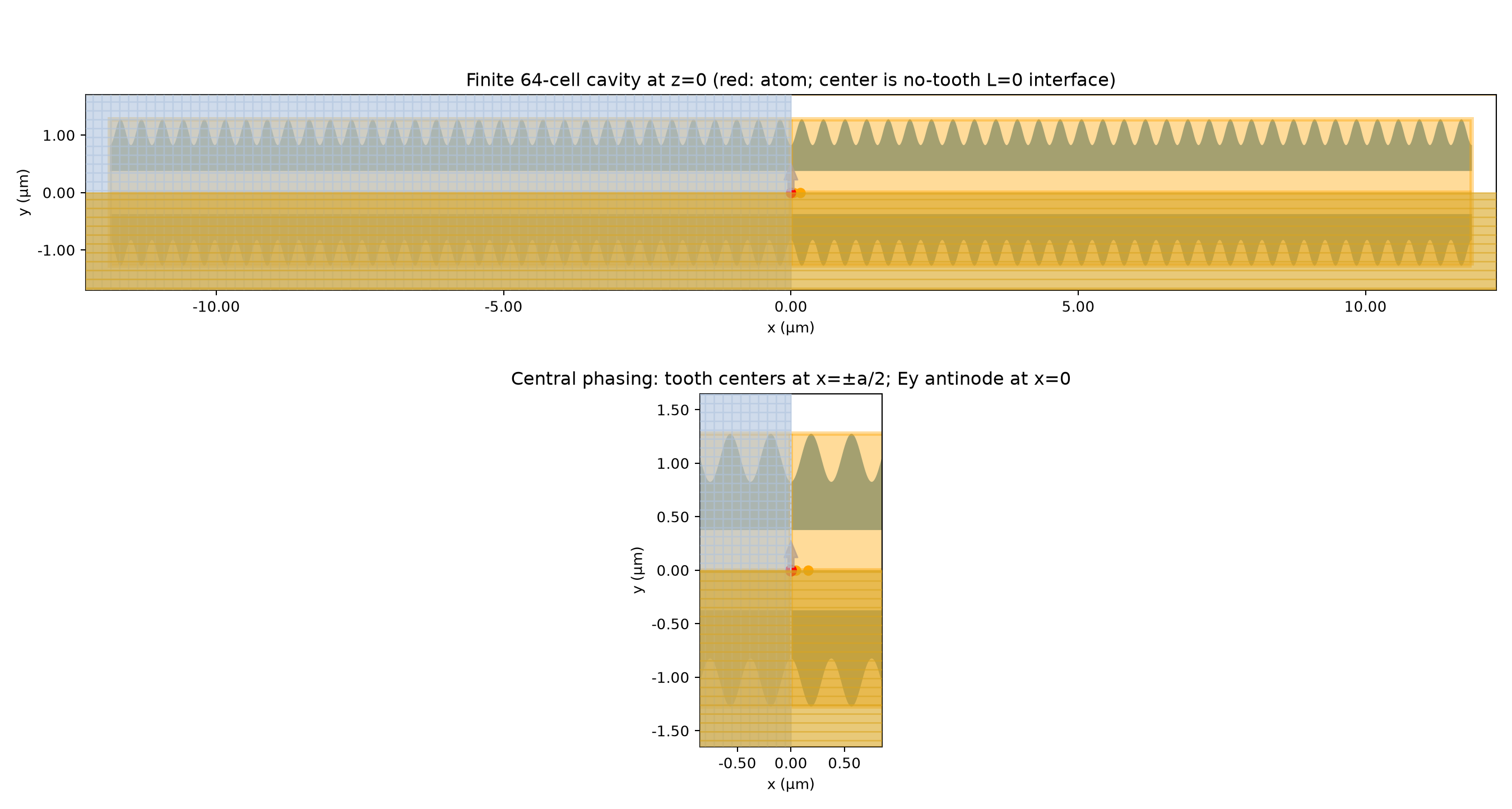
Canonical connected Auto-14 fails the finite-pole gate
Evidence label: completed paid Auto-14 broadband diagnostic; negative finite-cavity result. The saved FDTD outcome remains valid, while the former r14 MPB qualification is withdrawn by the centroid-semantics erratum.
Task fdve-03140b16-b0ef-4fbd-9928-84fdd6e75236 completed for 0.025 FC
after automatic shutoff at 2.319 ps. No eligible positive-Q pole appears in
the explicit 772.239–788.239 nm MPB-derived search window.
The generic analyzer's fallback selection at 829.051 nm must not be reported as “Q=1,852”:
| Check | Result | Gate |
|---|---|---|
| probe Qs | 1,852 / 1,509 / 1,377 | 30.08% span; fails |
| probe-frequency span | 0.0269% | descriptive |
| fit errors | 0.1715 / 0.1139 / 0.0315 | first two are poor |
| fitted lifetimes observed | 1.349 | duration passes |
| target window | no pole | fails |
The record is long enough for the fitted low-Q fallback, so the failure is not blamed on an early record cutoff. It is a pole-location and pole-identity failure. This is precisely the risk left open by MPB's periodic transverse boundaries and near-light-line branch ordering.
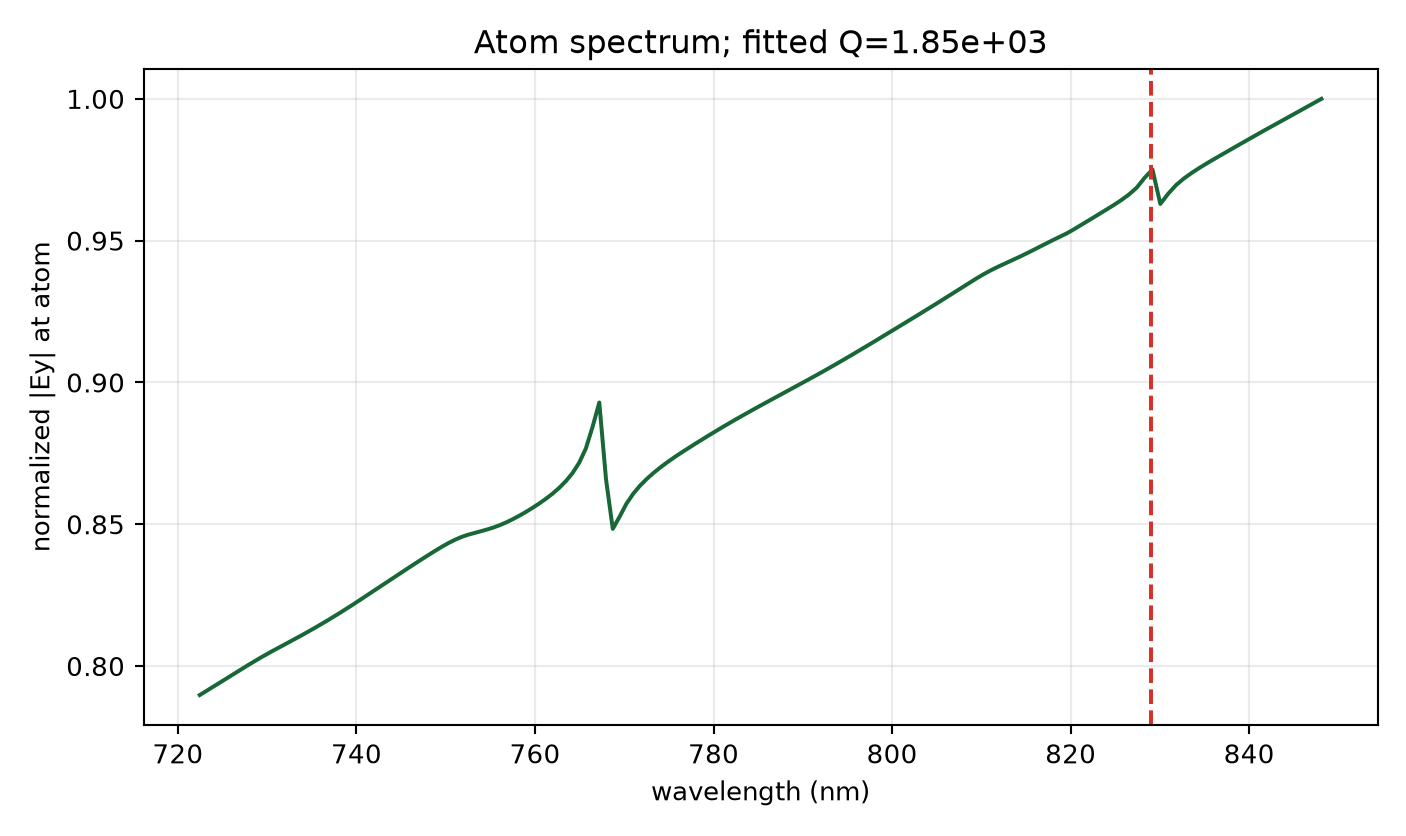
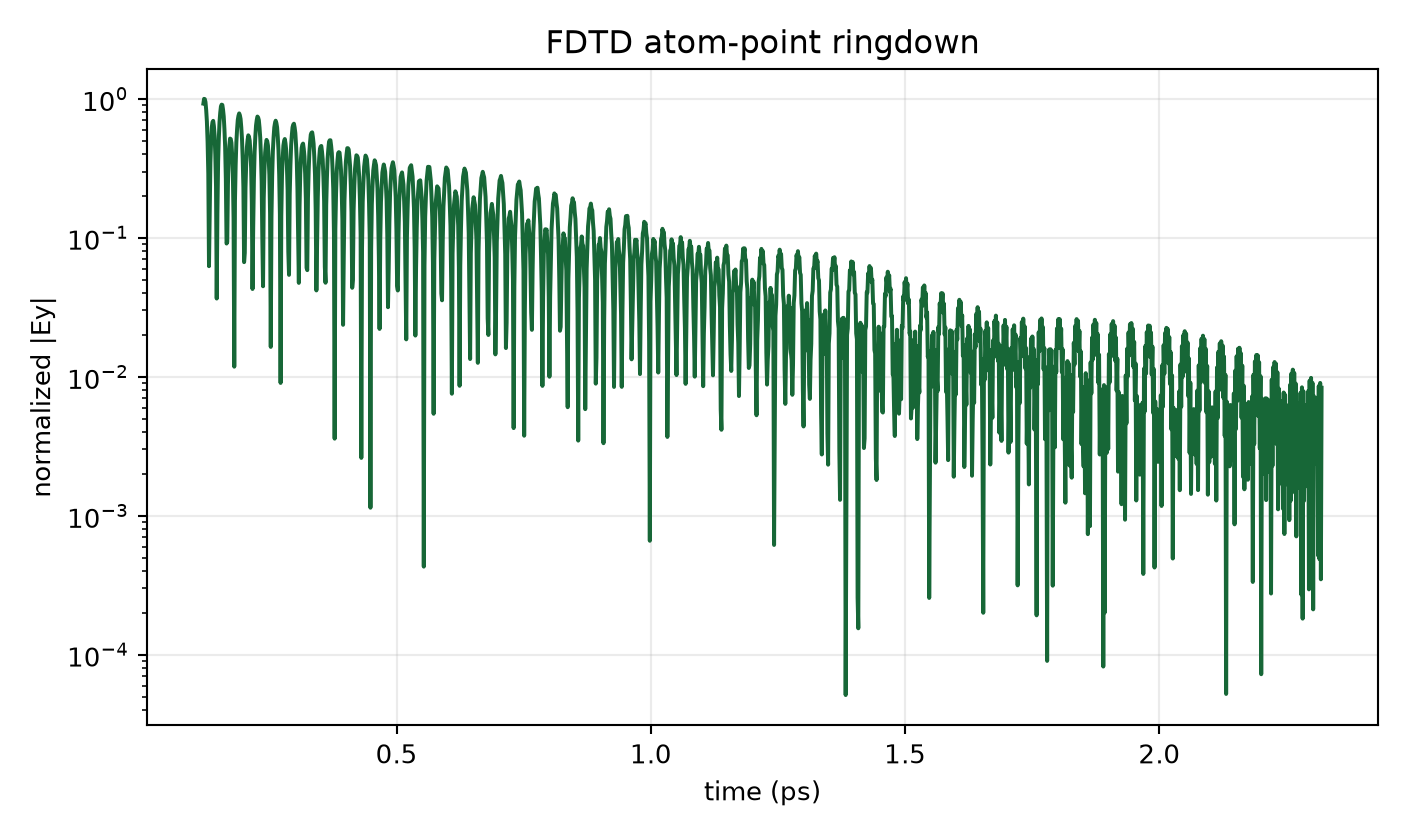
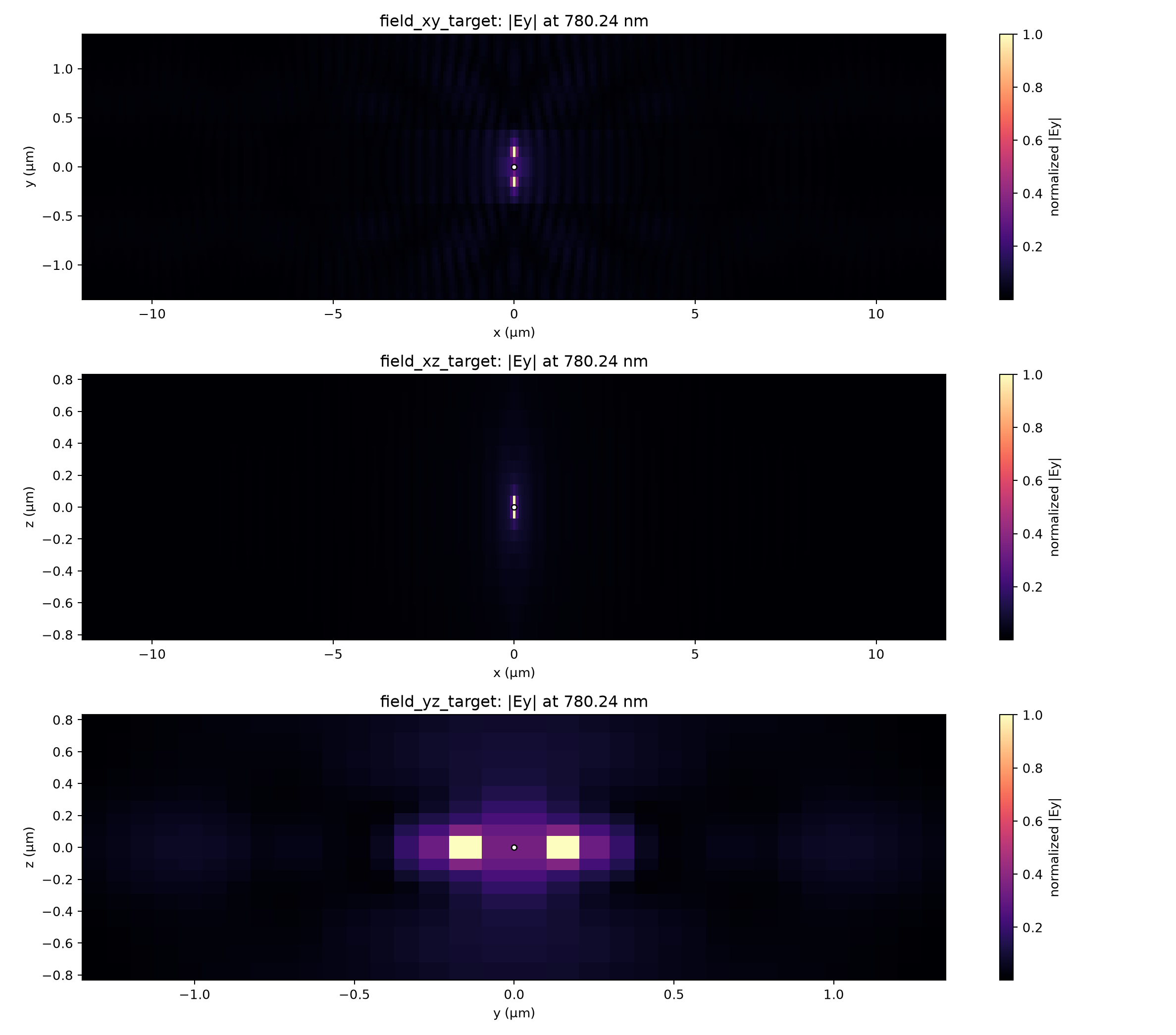
Auto-20 finds a clean off-target low-Q pole; the pair is rejected
Task fdve-2abff5f6-9d4f-4d2d-9850-c09cfbea34ca completed for
0.032622 FC. It finds a clean three-probe pole at 766.619894 nm with
Q=518.219:
| Auto-20 check | Result | Interpretation |
|---|---|---|
| probe Qs | 518.219 / 518.150 / 515.807 | 0.466% span; internally consistent |
| probe-frequency span | 0.000362% | same pole |
| fit errors | 0.0487 / 0.0293 / 0.0521 | acceptable diagnostic fits |
| fitted lifetimes observed | 4.524 | duration passes |
| explicit r14 search window | 772.239–788.239 nm | 766.620 nm is outside |
minimum useful Qworst |
1,000 | Q=518 fails |
The generic analyzer's looser “within 5% of target” check passes, but that is not the design-specific gate established before submission. The explicit historical MPB-derived window fails, but that window is now invalidated by the centroid erratum. Independently, Auto-14 does not recover this pole at all; its inconsistent fallback is near 829 nm. Therefore there is no same-pole Auto-14/20 pair to score, and even the clean Auto-20 Q is below the 1,000 floor. The canonical connected N24+M8 family is rejected. No third mesh, domain repeat, exact mode volume, Purcell factor, or β run is justified.
The two paid tasks cost 0.057622 FC actual in total. The finite-FDTD pair is a valid negative. The former explanation that a geometry-matched MPB band design failed to transfer is withdrawn.
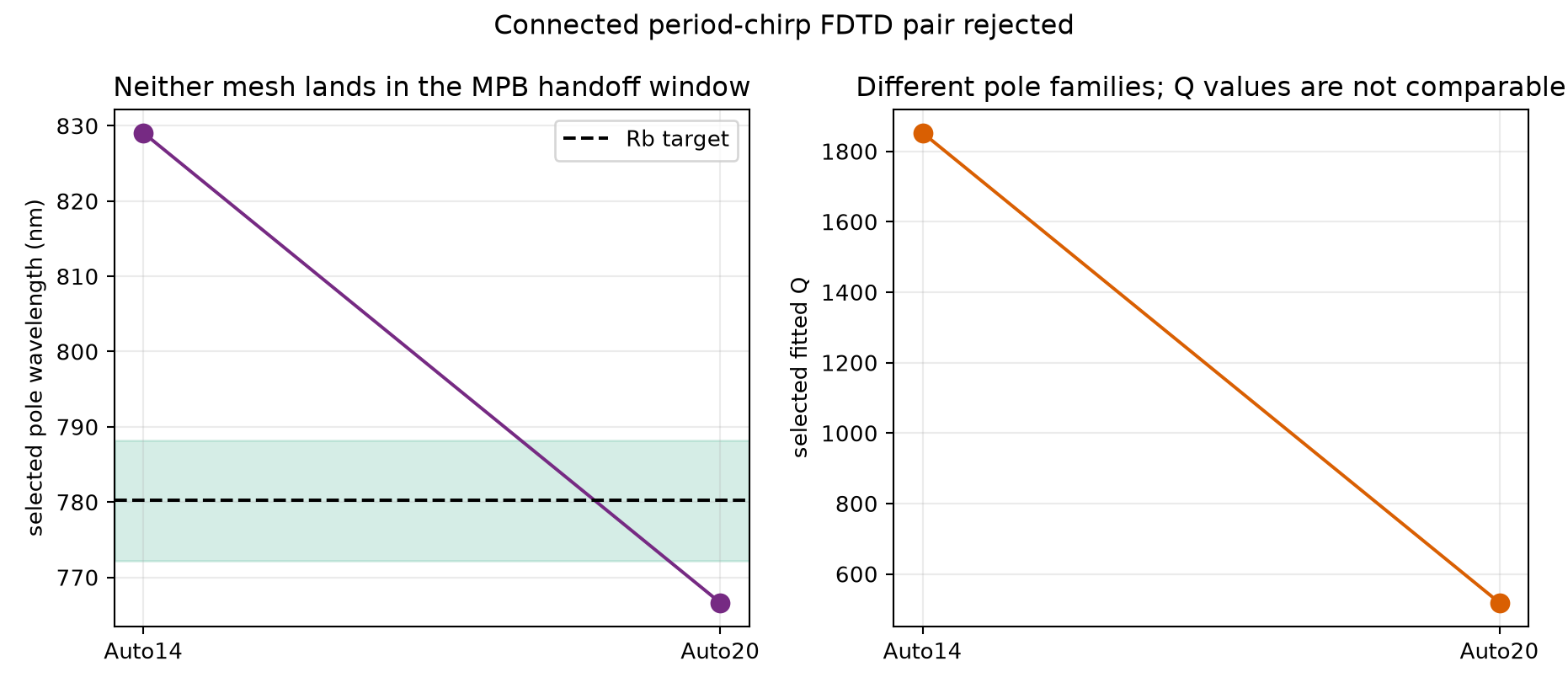
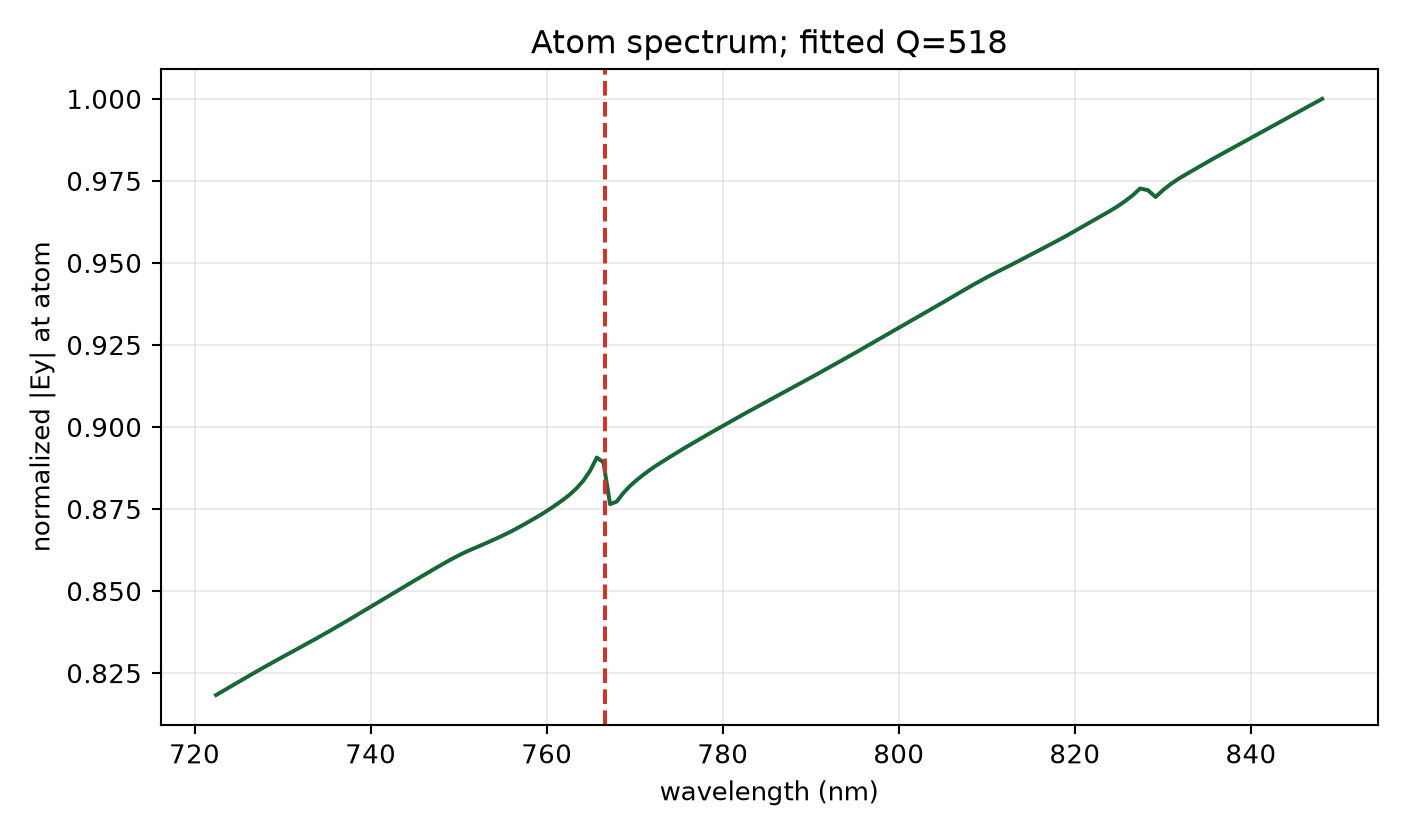
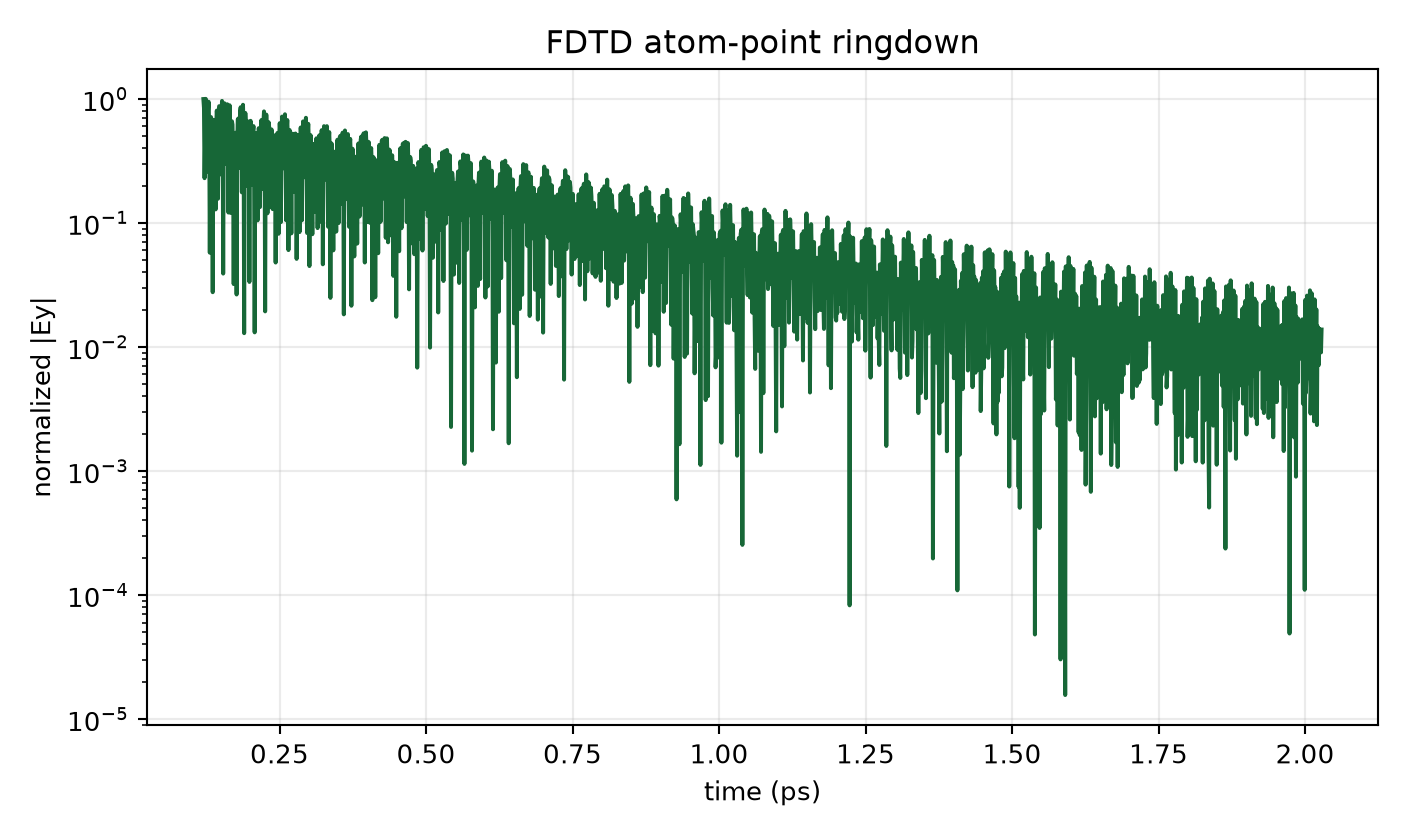
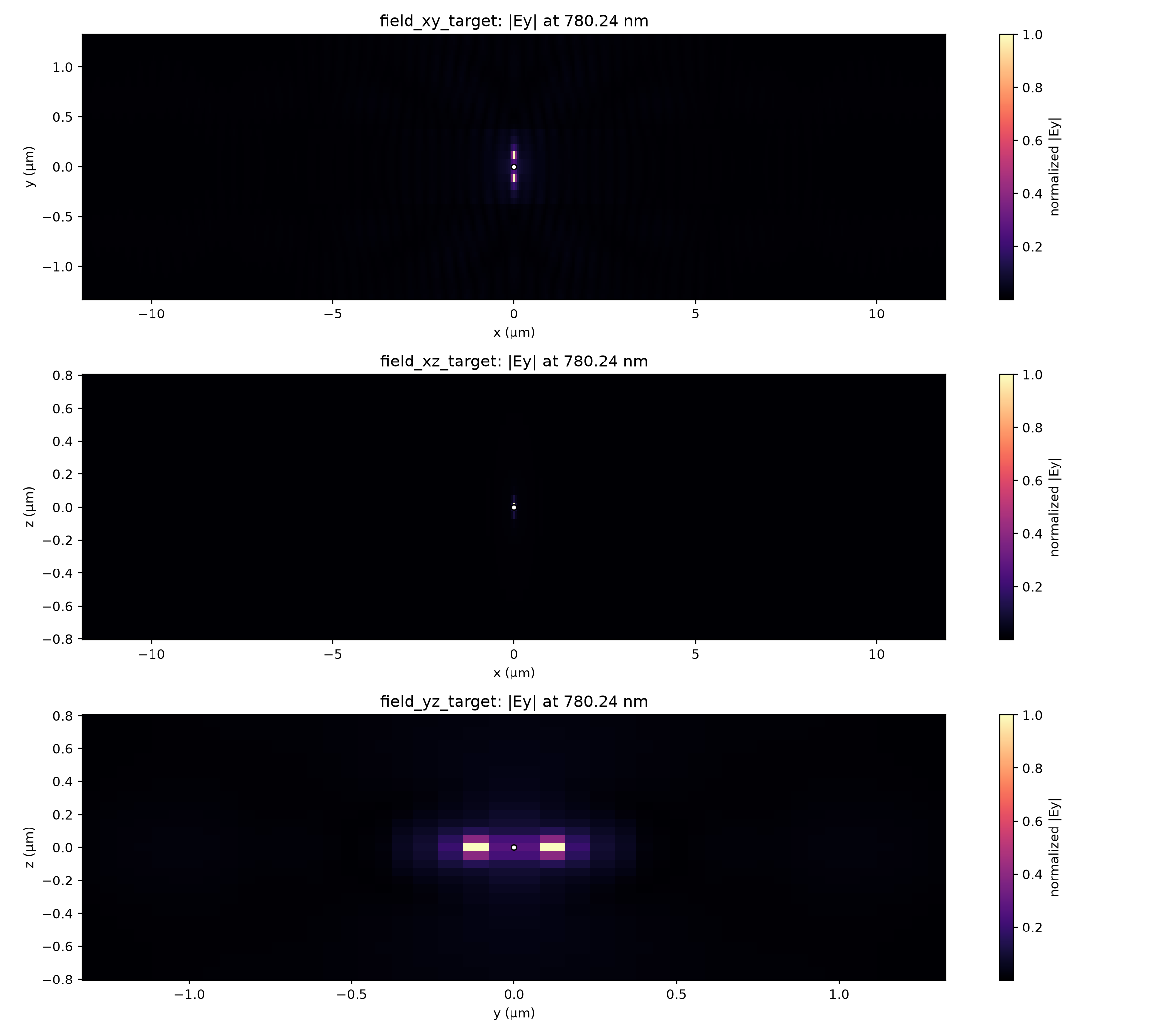
FDTD-aware period retarget — initial Auto-20/24 pair passes
Evidence label: completed local MPB and saved-FDTD calibration, one completed paid original-geometry control, and a completed paid retargeted Auto-20/24 pair. The FDTD pole identity and measured target result pass strongly; the MPB/FDTD wavelength correction is geometrically invalid and must not be generalized. The Q≈542 cavity is nevertheless below the campaign's Q≥1,000 usefulness floor and lacks the required third mesh and domain/PML repeat. No mode-volume, Purcell, or β claim follows from this step.
The earlier Auto-14/20 mismatch is now diagnosed more carefully. Auto-20 resolves two repeatable edge-associated pole families, with the intended 780.24 nm handoff between them. Auto-14 does not resolve the lower-wavelength family and gives an unstable higher-wavelength fallback, so it is retired for this connected geometry rather than averaged with the finer meshes.
| Saved-FDTD family | Wavelength | Q evidence | Interpretation |
|---|---|---|---|
| Auto-20 lower/air edge | 766.6199 nm | Q=518.219; 0.466% probe span | clean three-probe family used for calibration |
| Auto-20 upper/long edge | mean 828.3407 nm | mean Q=752.905; 1.606% probe span | second clean three-probe family |
| Auto-14 lower/air edge | not found | — | underresolved; retired |
| Auto-14 upper fallback | ≈829.051 nm | Q=1,852/1,509/1,377; 30.08% span | unstable and rejected |
The historical calculation used an FDTD/MPB wavelength ratio of 0.98254491
and a uniform period factor of 1.02337295. The table is retained for
provenance; its MPB predictions, gap, γ, and field metric are invalid for
the FDTD geometry:
| Calibration quantity | Value |
|---|---|
| corrected MPB target | 794.1011 nm |
| center period | 386.3879 nm |
| mirror period | 373.5311 nm |
| MPB center prediction | 794.0875 nm |
| bias-mapped FDTD prediction | 780.2266 nm |
| retargeted mirror gap | 773.954–817.553 nm |
retargeted mirror strength γ |
0.027363 |
| local slot-center field metric | 0.90531; not mode volume or β |
Only the periods change. The 0.75 µm slot, transverse dimensions, 24-cell raised-cosine taper, eight mirror cells, and exact two-connected-PolySlab topology remain fixed.
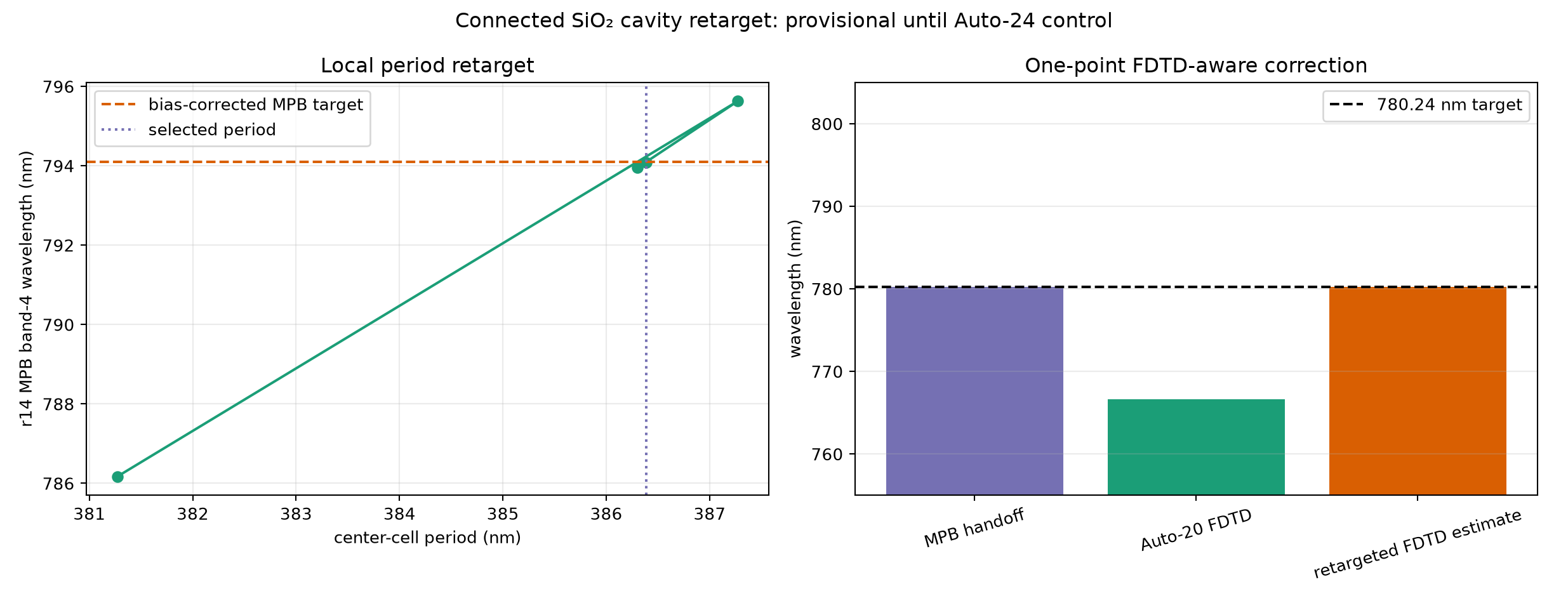
The validation was deliberately serialized as a strict sequence:
| Step | AutoGrid / grid | Cloud state | Result or gate |
|---|---|---|---|
| original-period control | Auto-24; 1176×214×126 | complete, task fdve-8e713772-d7f2-4727-b23e-54e7d2bca9be |
λ=766.3268 nm, Q=523.025; control passes |
| retargeted first half | Auto-20; 1004×182×110 | complete, task fdve-c67c2d71-fdf9-4c74-bf62-380d264b8e13 |
λ=780.7786 nm, Q=542.974; target-location half passes |
| retargeted confirmation | Auto-24; 1200×214×126 | complete, task fdve-f2b87974-d93f-44ad-a056-a106f012c566 |
λ=780.4859 nm, Q=541.504; same-pole pair passes |
The original Auto-20/24 control comparison is unusually tight: wavelengths 766.6199 and 766.3268 nm differ by 0.0382%, while Q values 518.219 and 523.025 differ by about 0.93%. The Auto-24 control's three Q values 517.637/523.025/519.505 span 1.036%; its frequency span is 0.00346%, and the record covers 4.494 fitted field-amplitude lifetimes. It cost 0.062310 FC actual, against a 0.490375 FC maximum estimate.
The retargeted Auto-20 result is 0.0690% from 780.24 nm. Its three Q values 536.782/542.974/535.478 span 1.392%; its frequency span is 0.00101%, and the record covers 4.240 fitted lifetimes. After cloud-cost reconciliation it cost 0.033281 FC actual against a 0.262463 FC maximum; the conservative ledger counts the full maximum.
Auto-24 returns 780.4859 nm and Q=541.504. Its three Q values 541.504/535.560/540.439 span 1.102%; its frequency span is 0.00260%, and the record covers 4.004 fitted lifetimes. It cost 0.059955 FC actual against a 0.500309 FC maximum. Across the retargeted Auto-20/24 pair, wavelength spread is only 0.0375% and Q spread only 0.271%. Thus the empirical period correction is predictive across these two meshes. The finite Q itself remains only a low-Q diagnostic and is not promoted.
The preregistered fixed-geometry Auto-22 and expanded-domain/PML Auto-22 gates
are now complete. Across Auto-20/22/24, wavelength span is 0.03749% and Q
span is 1.1159%; the expanded domain changes wavelength by 0.00215% and Q by
1.0492%. All numerical robustness gates pass. Q improvement remains a design
task because Qworst=541.504 is below 1,000.
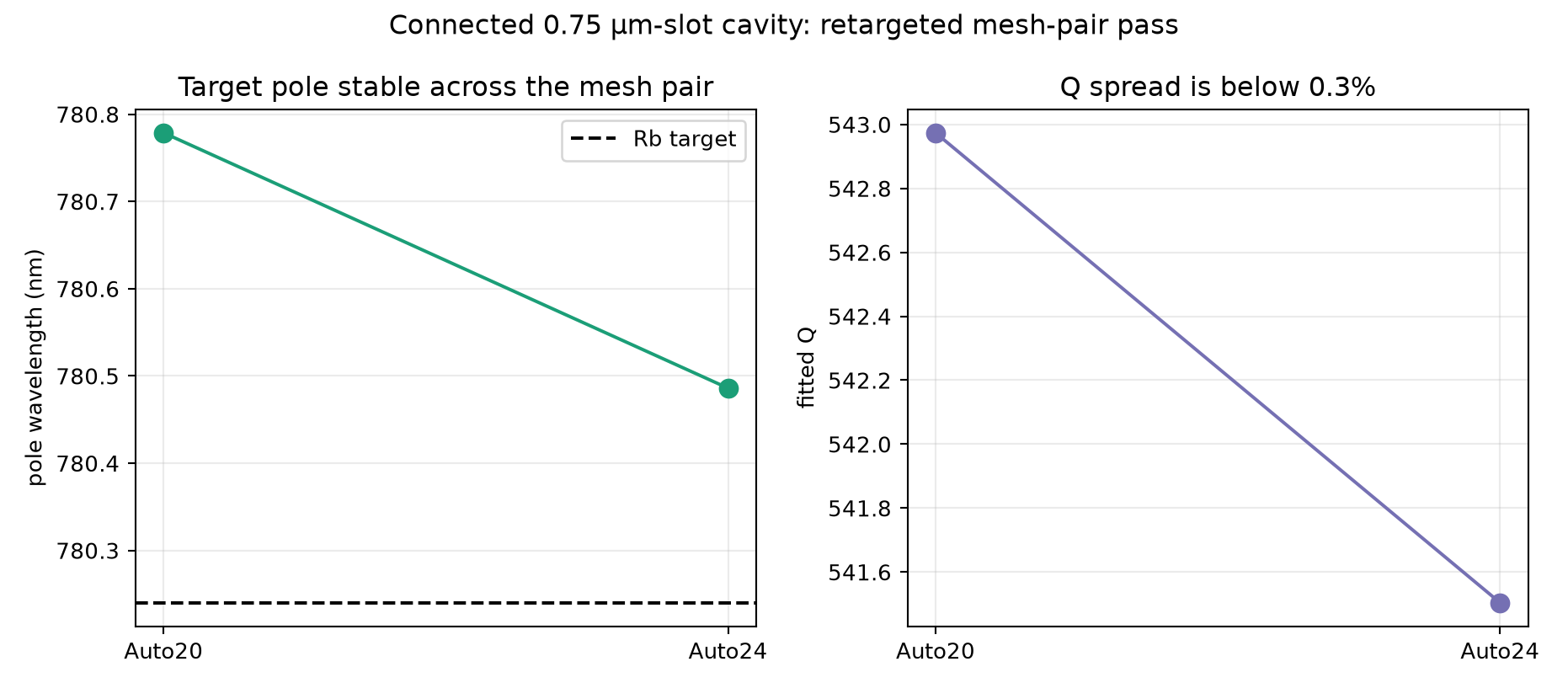
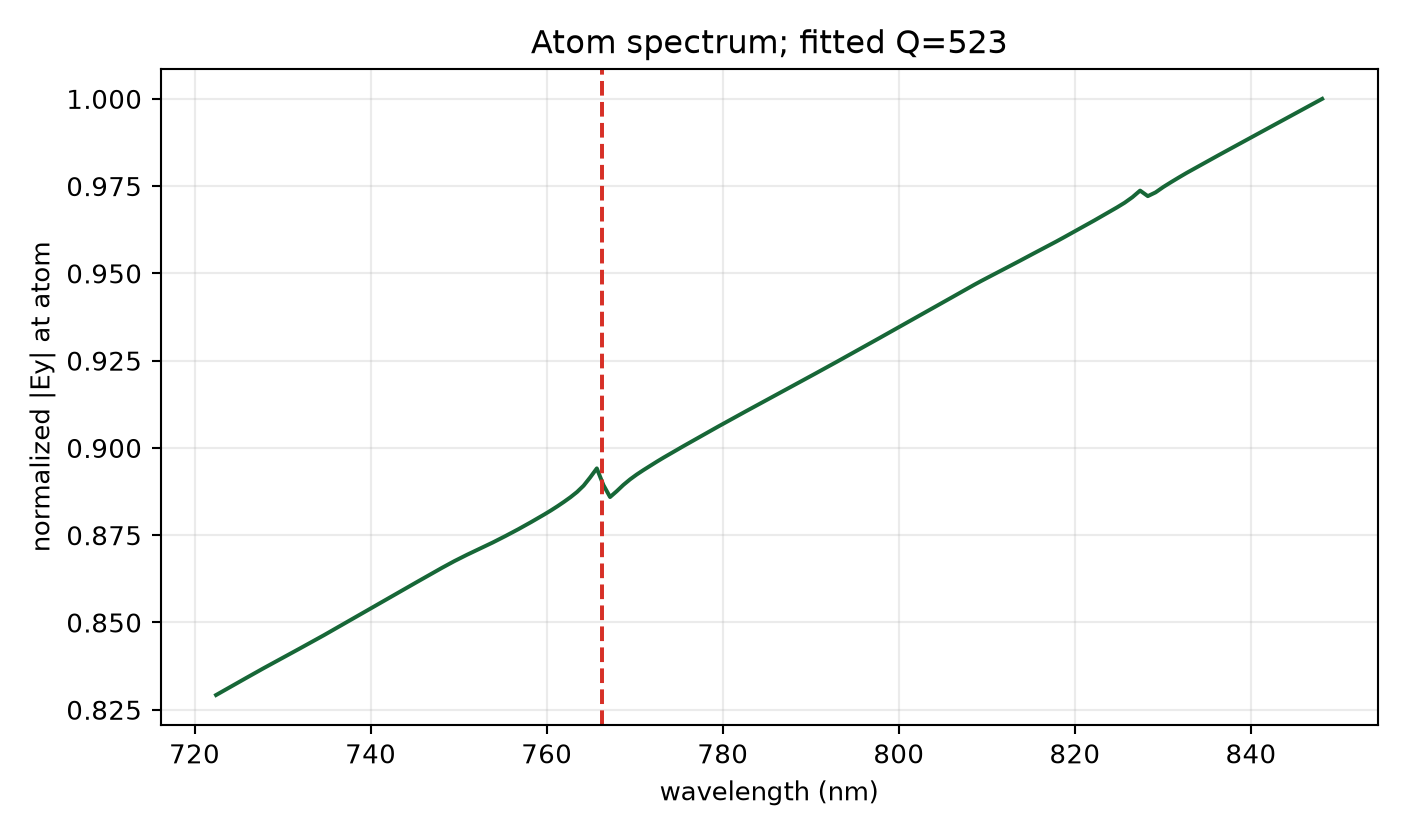
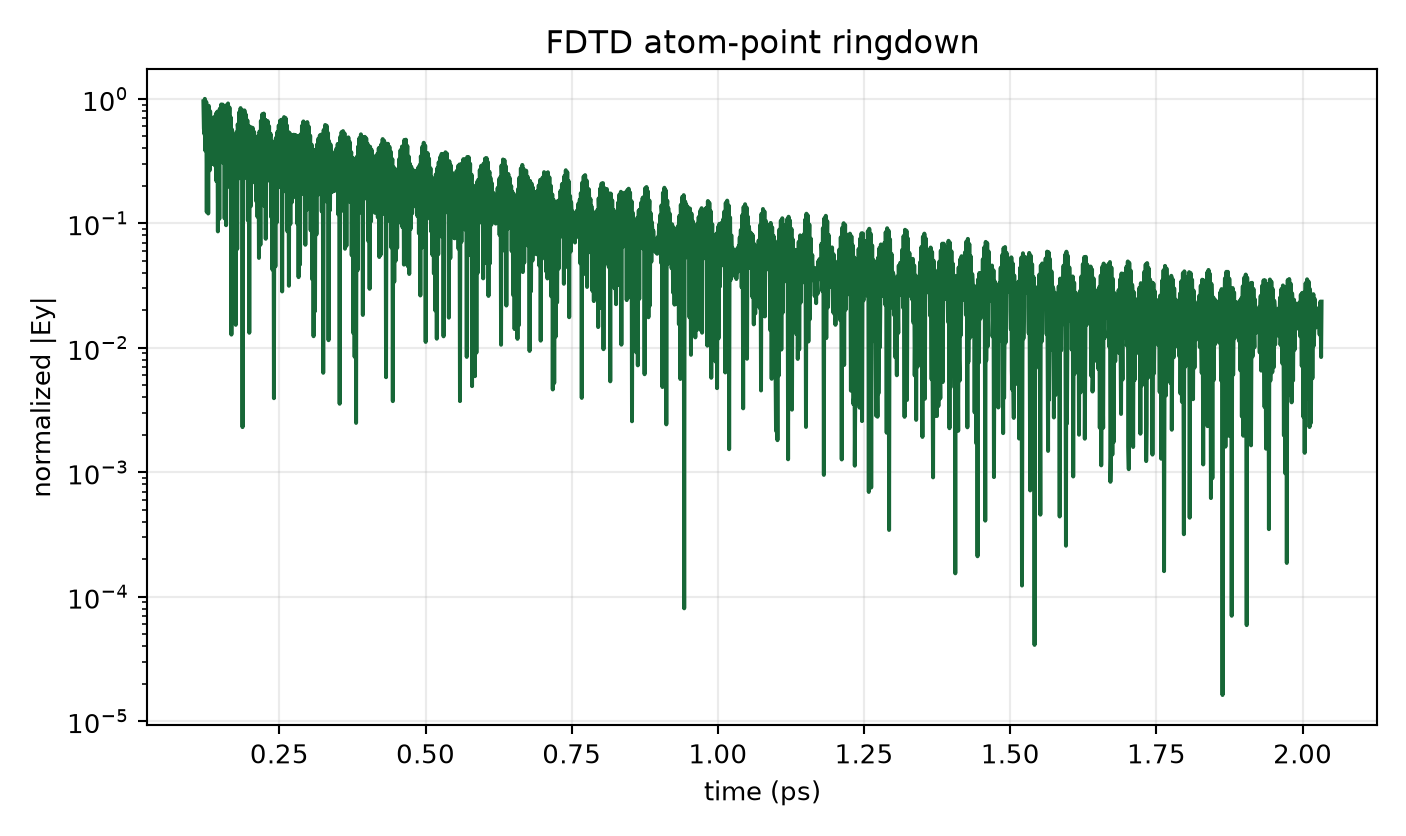
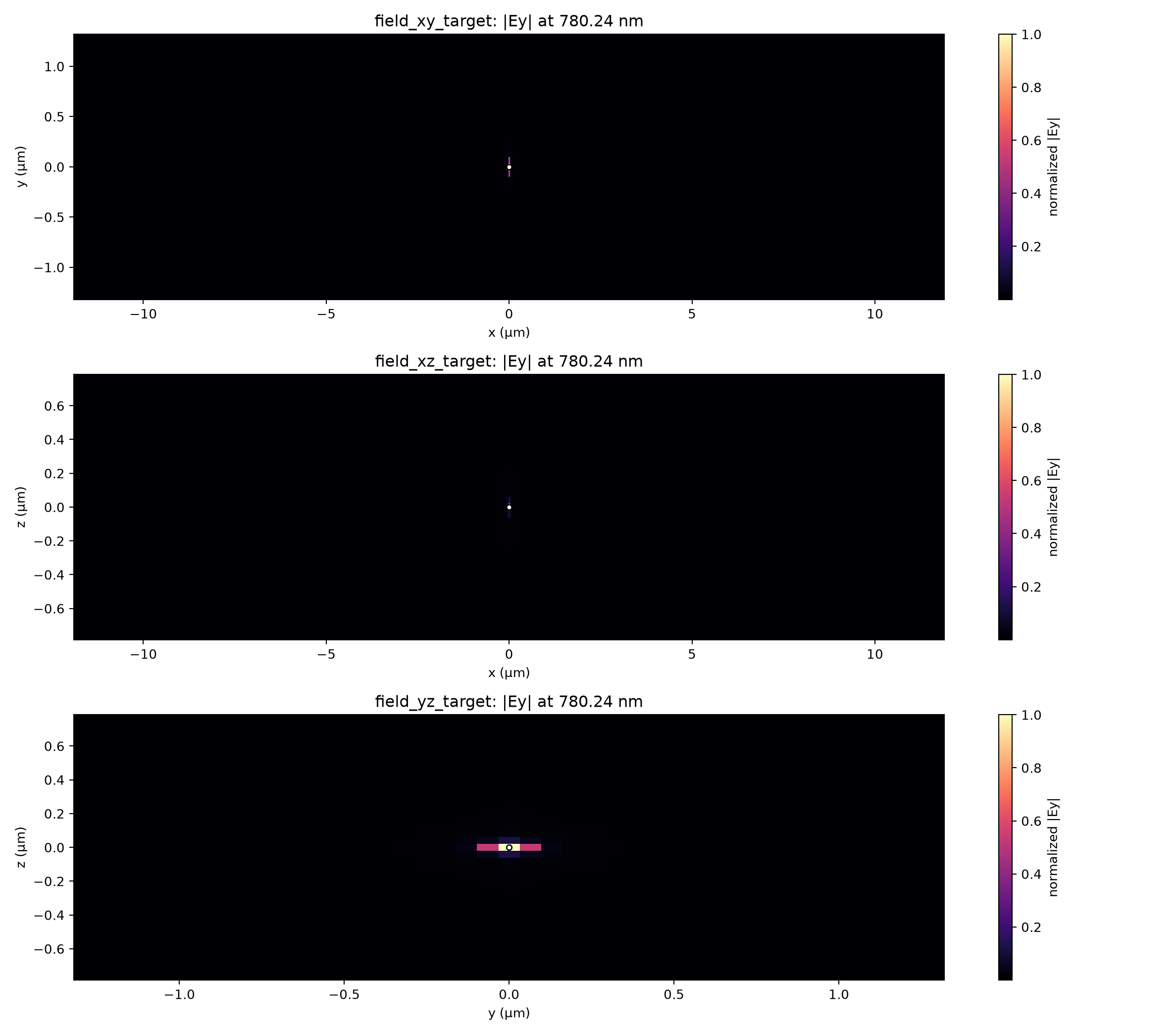
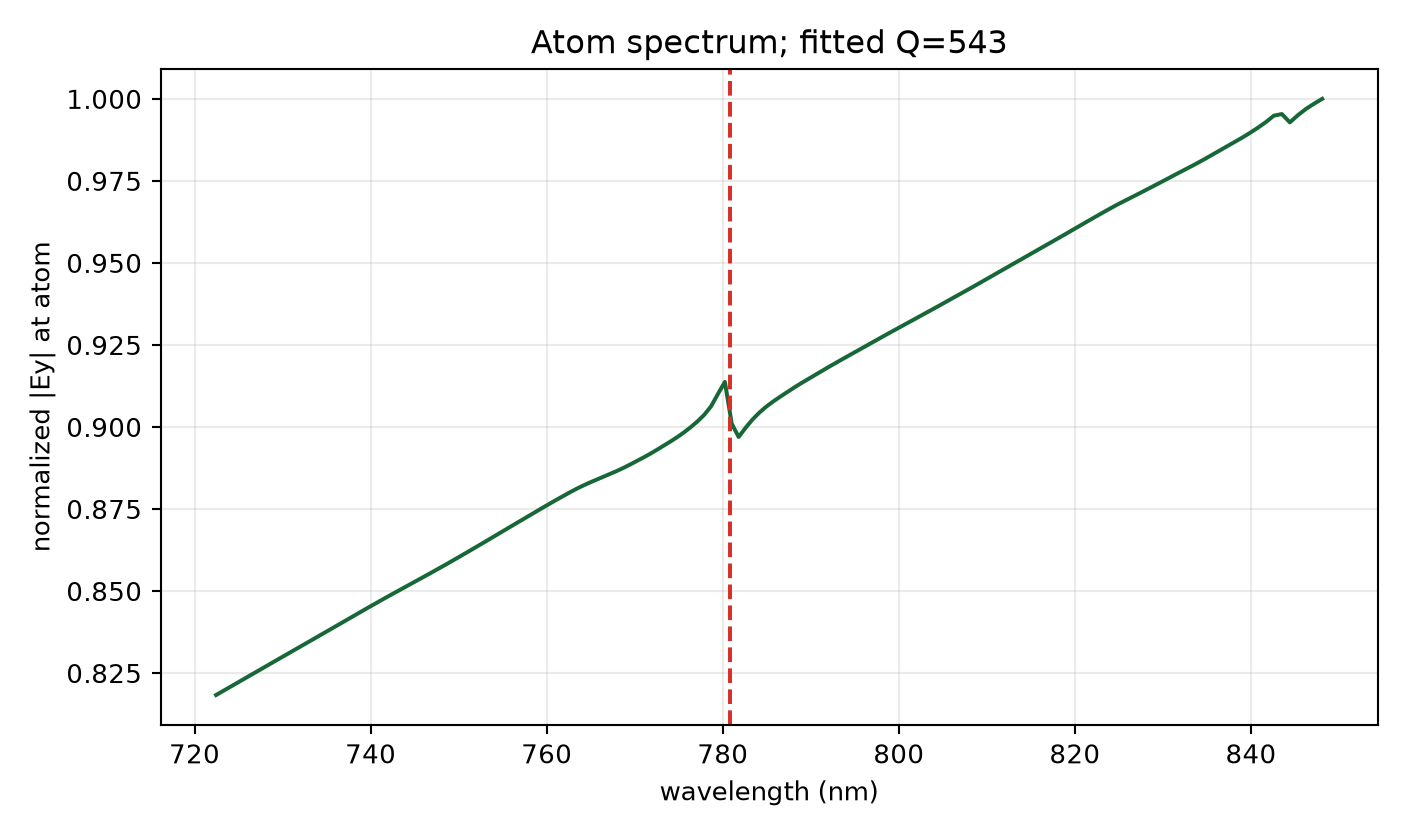
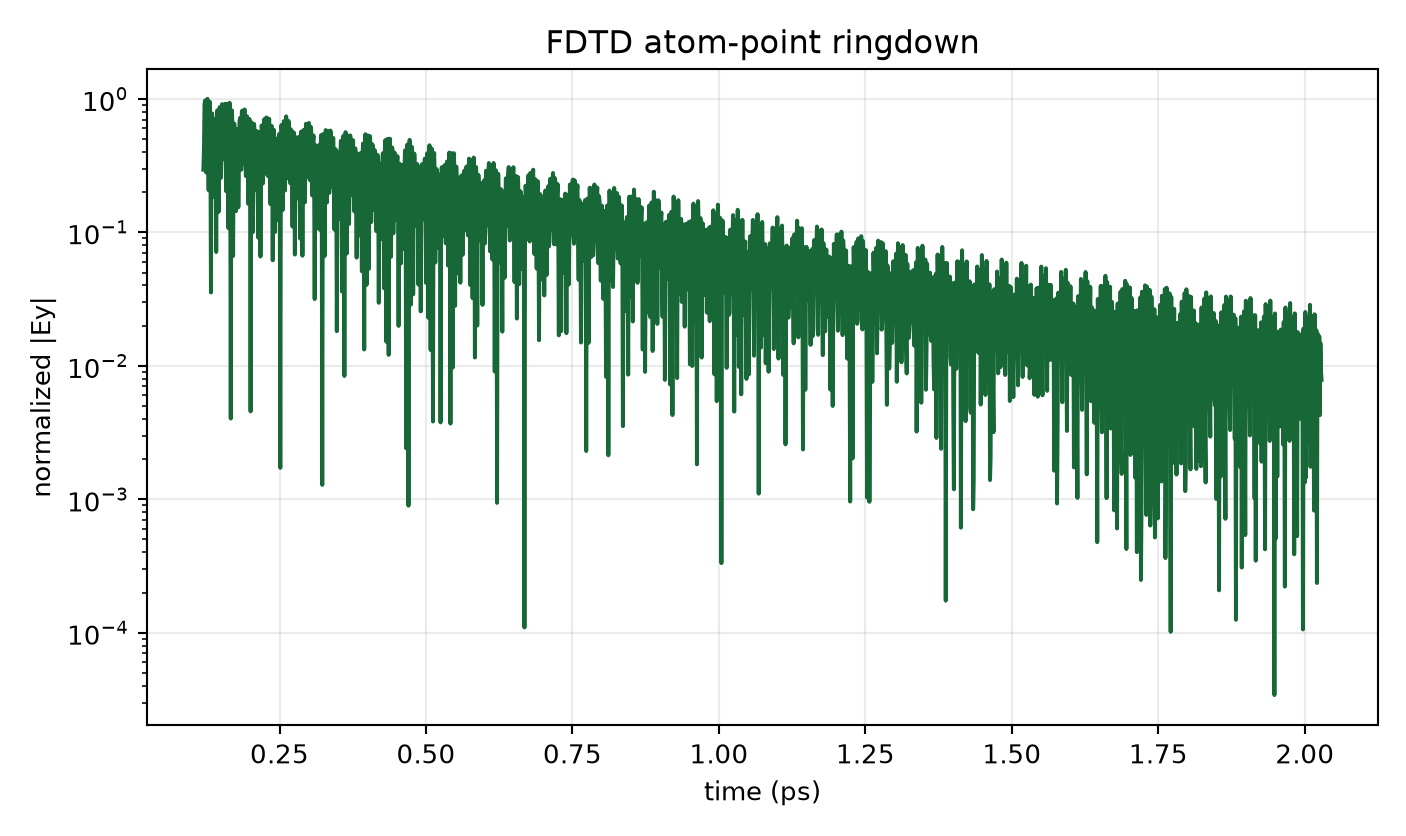
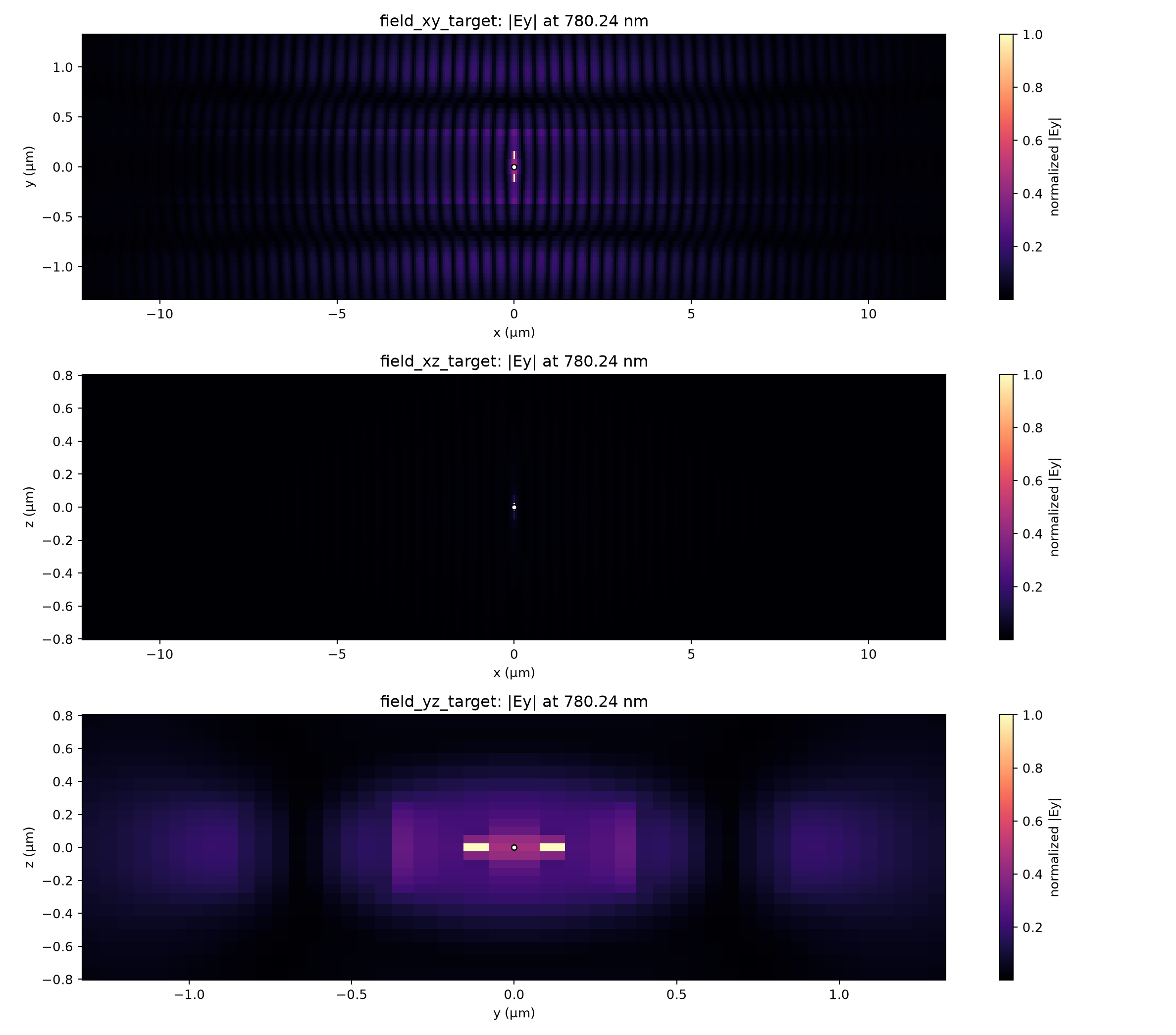
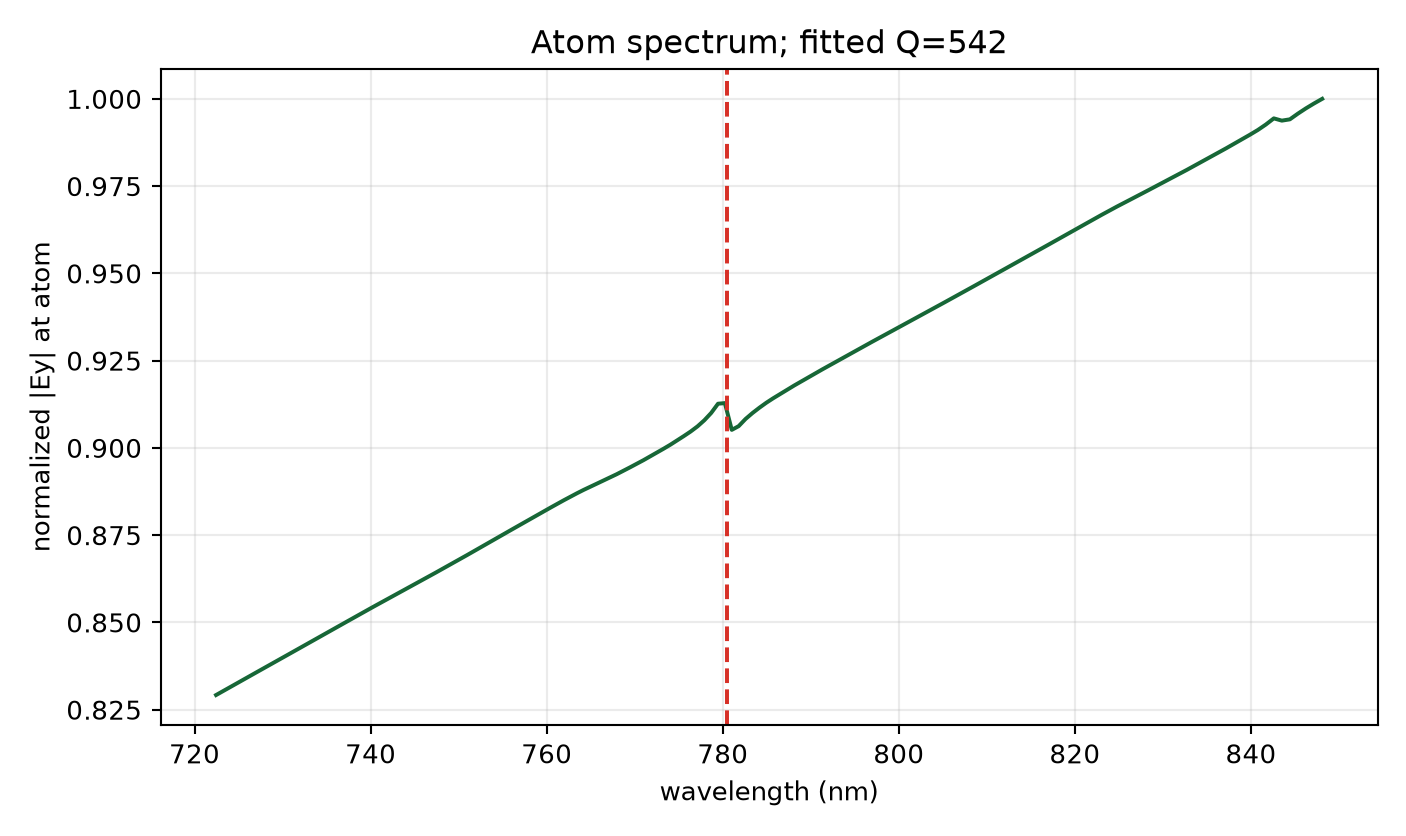
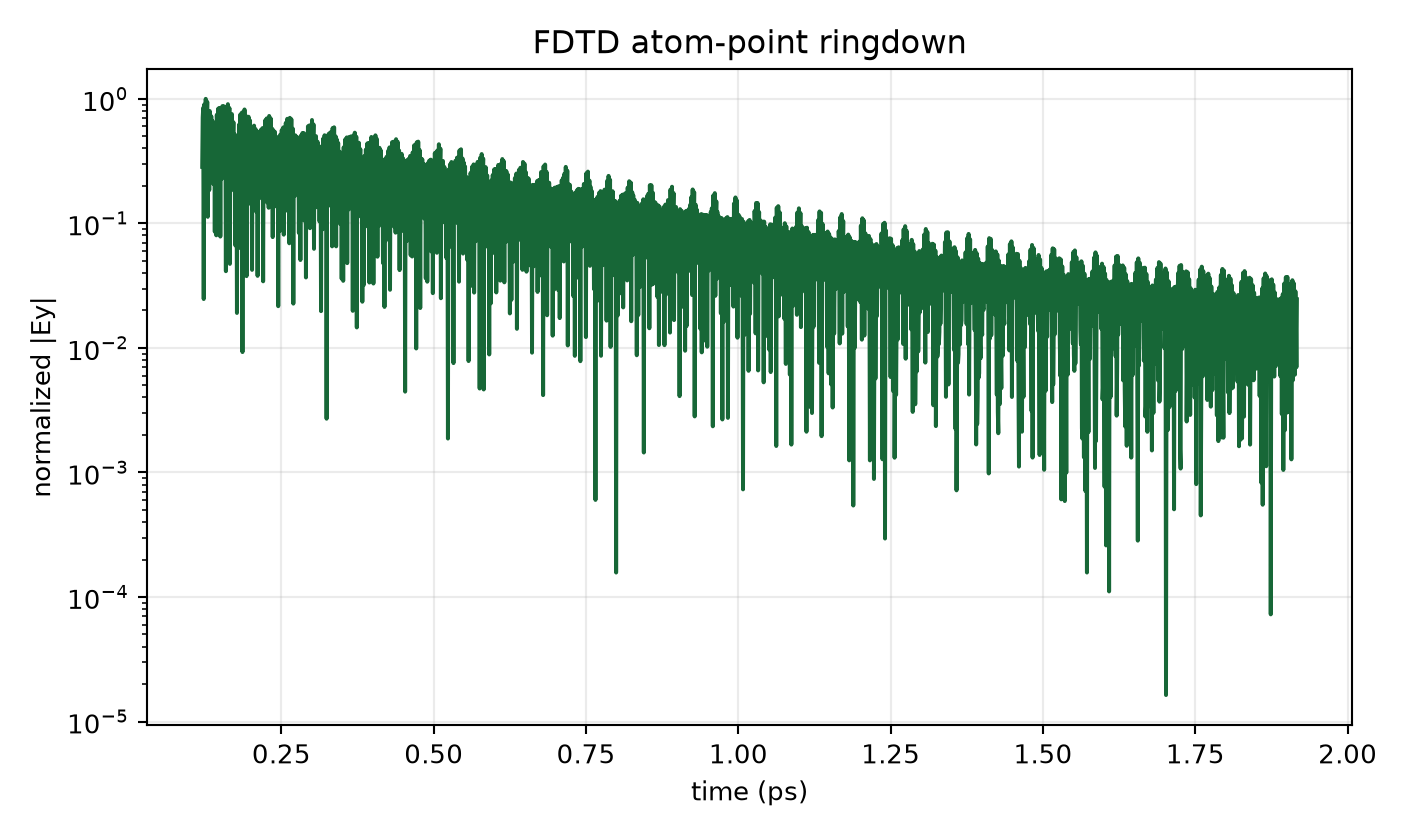
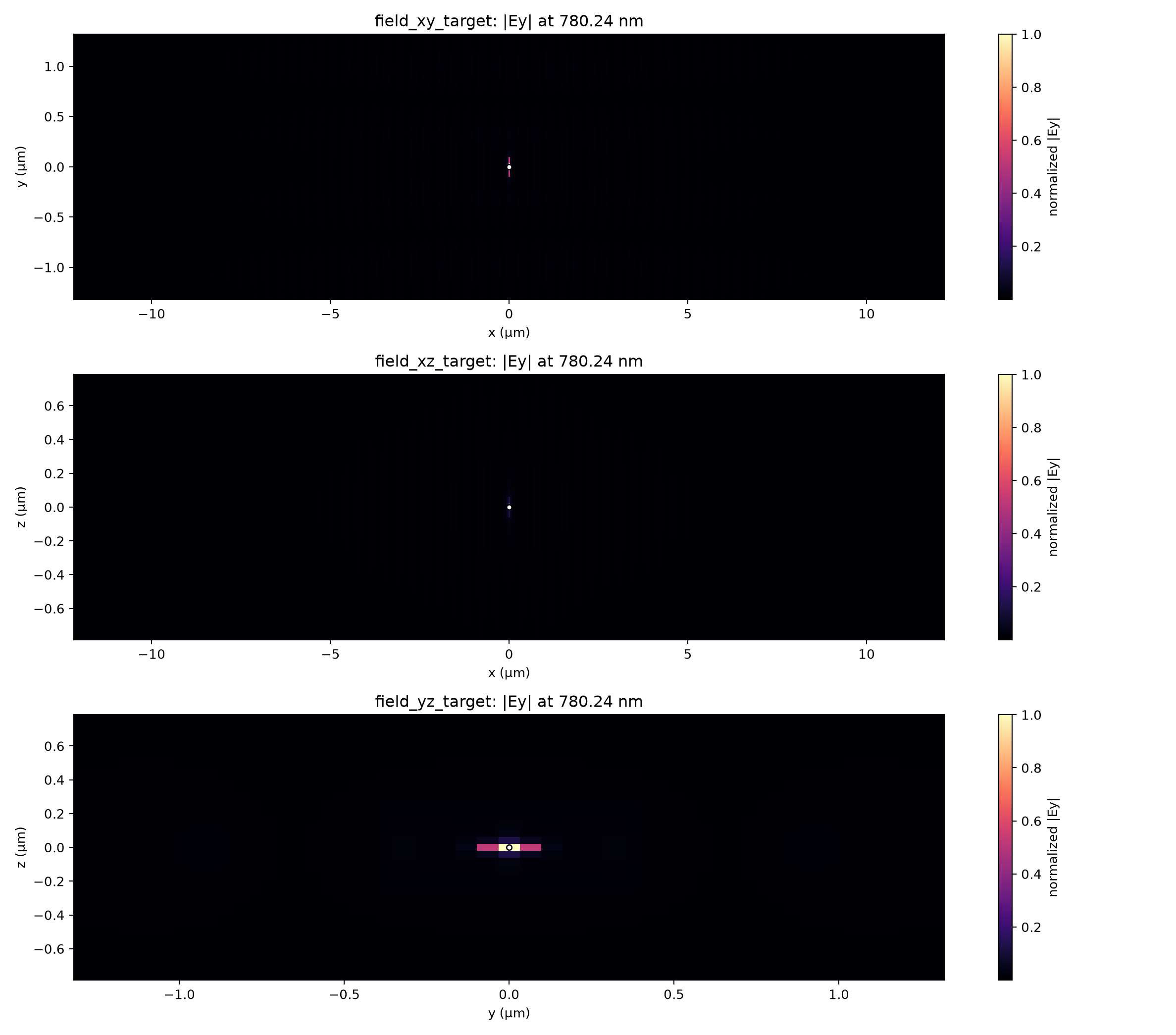
Third-mesh and domain/PML gates pass
Evidence label: completed paid broadband third-mesh and expanded-domain diagnostics. This establishes a robust Q≈545 numerical control at the Rb target. It does not promote a production cavity because the worst Q remains below 1,000.
| Completed gate | Grid and domain | Result |
|---|---|---|
| fixed-domain third mesh | Auto-22; 1102×198×118 = 25.747M cells; 27.256×5.25×3.00 µm; 12 PML | task fdve-c8600035-ee6f-420a-826a-fa2b82e497c2; λ=780.6478 nm, Q=547.574; passes |
| expanded domain/PML | Auto-22; 1166×262×182 = 55.600M cells; 29.256×7.25×5.00 µm; 16 PML | task fdve-4b6a46f8-c1d9-4d25-b9d2-f3d7ca07cb46; λ=780.6310 nm, Q=553.380; passes |
Both keep the 16 ps maximum, 1e-7 automatic shutoff, zero mesh overrides,
two connected PolySlabs, and 0.75 µm open slot. The baseline Auto-22 probes
span 1.330% in Q and 0.00154% in frequency across 3.929 fitted lifetimes. It
cost 0.043510 FC actual against a 0.365681 FC maximum. The expanded Auto-22
probes span 2.074% in Q and 0.00216% in frequency across 3.575 lifetimes. It
cost 0.084293 FC actual against a 0.766221 FC maximum.
The combined robustness result is:
| Metric | Value | Gate |
|---|---|---|
| Auto-20/22/24 wavelength span | 0.03749% | ≤0.5%; pass |
| Auto-20/22/24 Q span | 1.1159% | ≤5%; pass |
three-mesh Qworst |
541.504 | ≥1,000 usefulness; fails promotion |
| expanded-domain wavelength change | 0.00215% | ≤0.5%; pass |
| expanded-domain Q change | 1.0492% | ≤5%; pass |
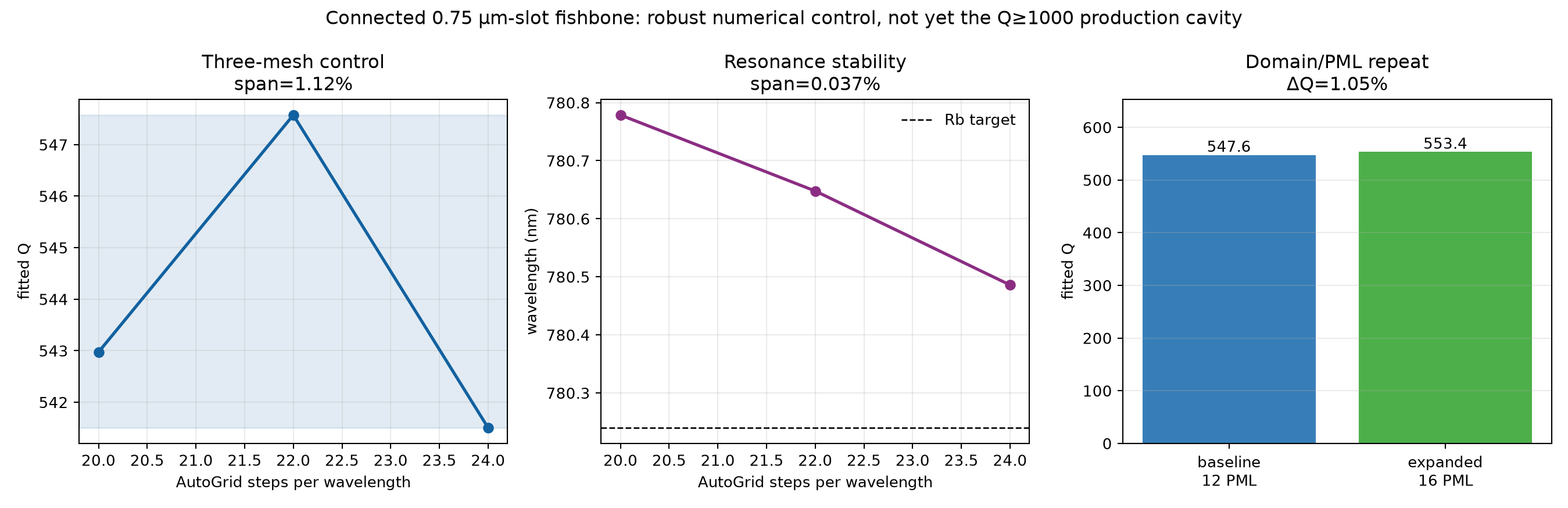
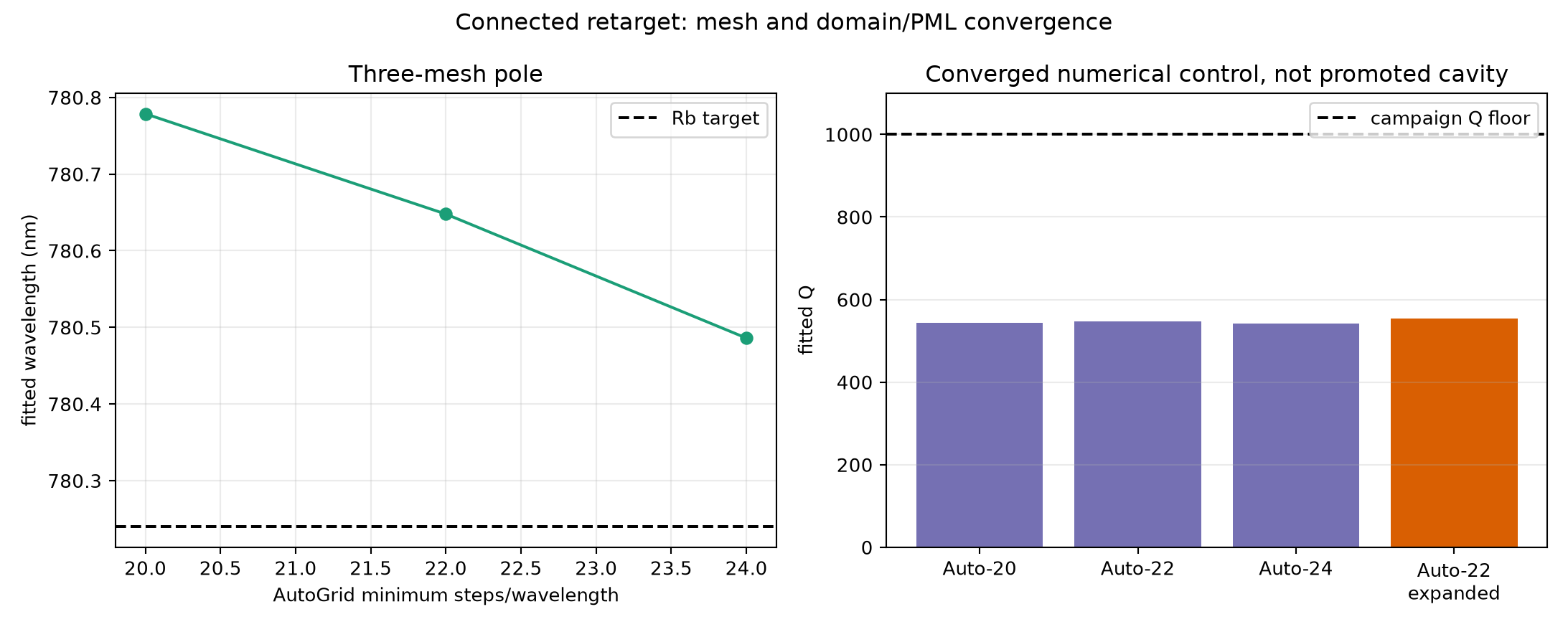
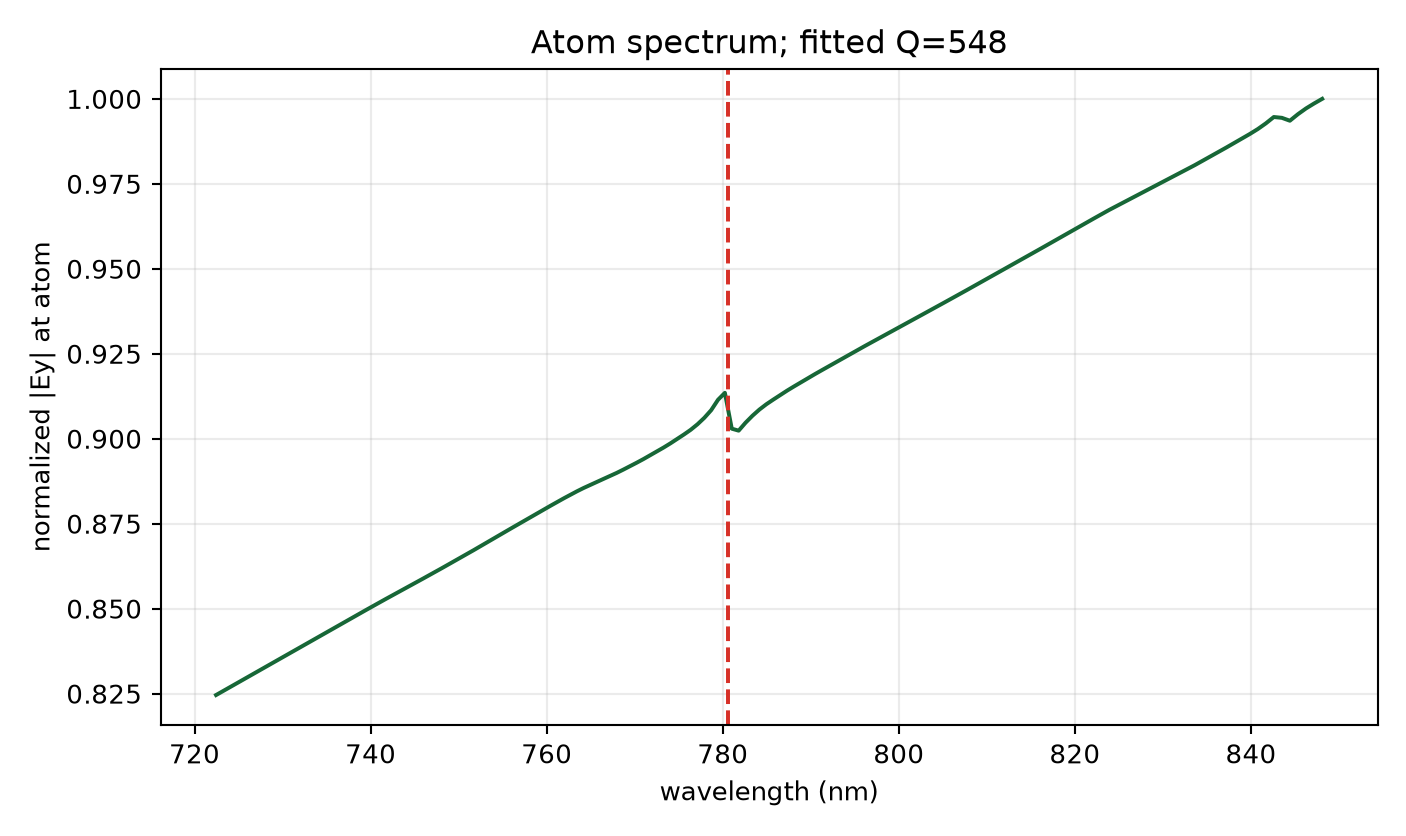
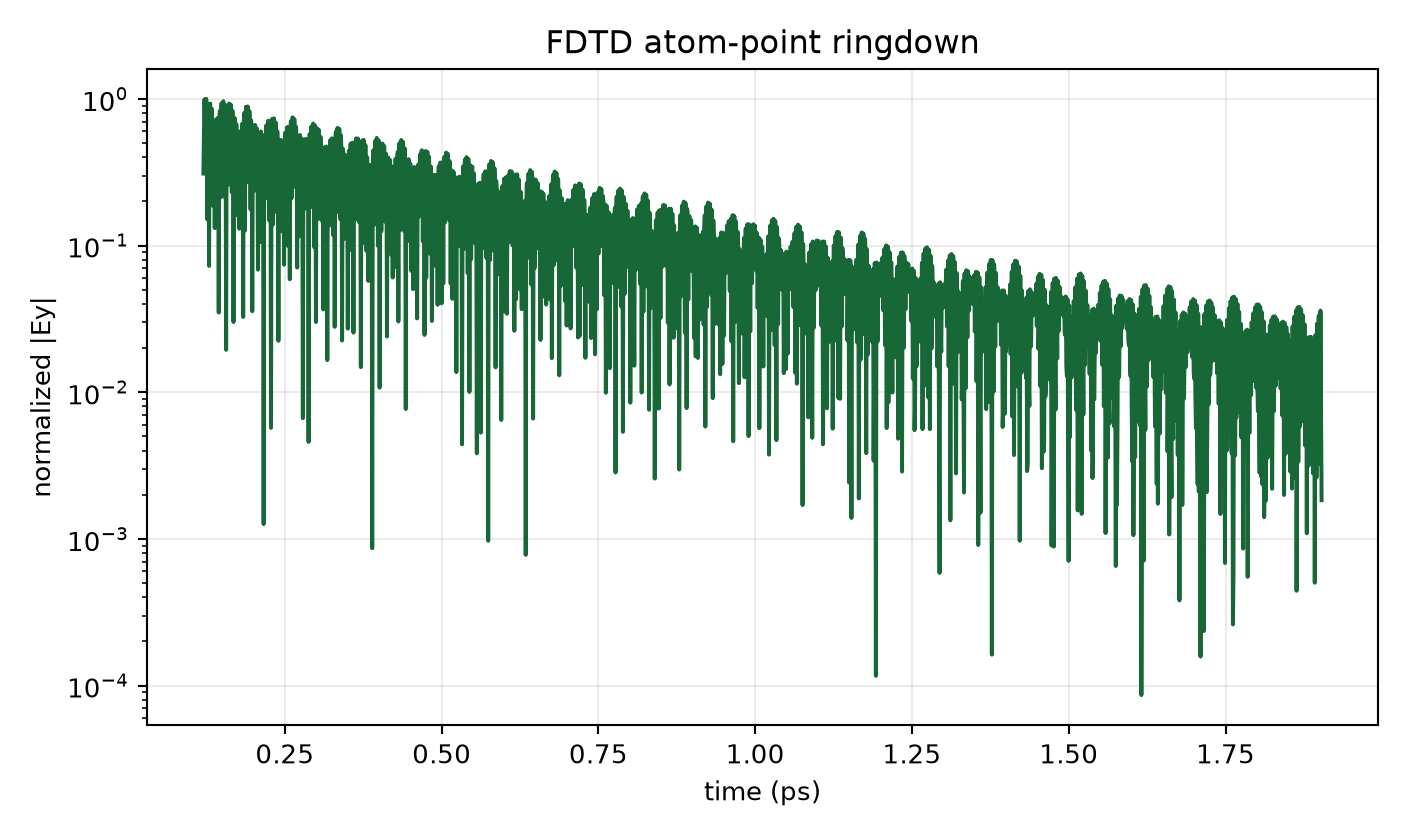
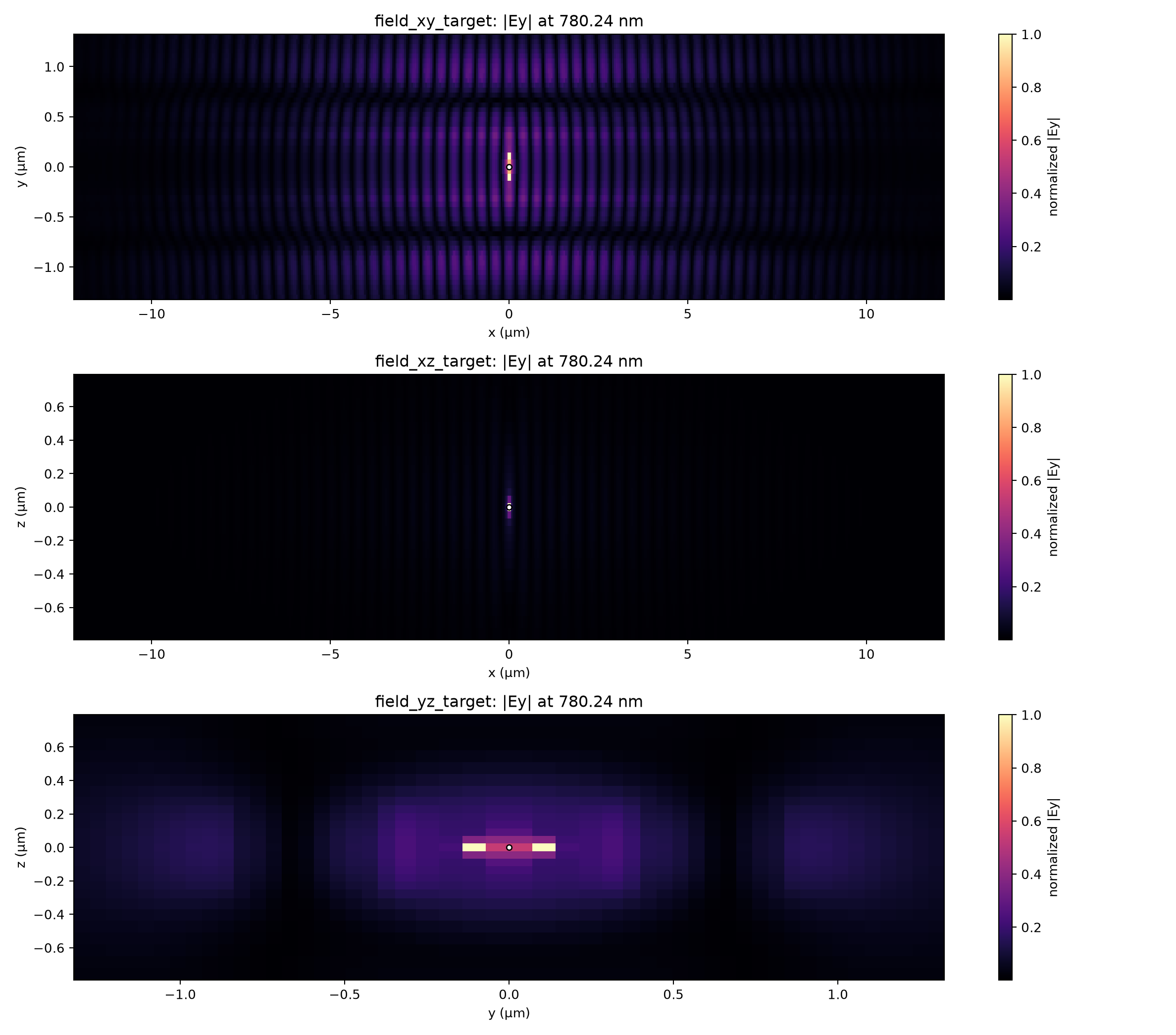
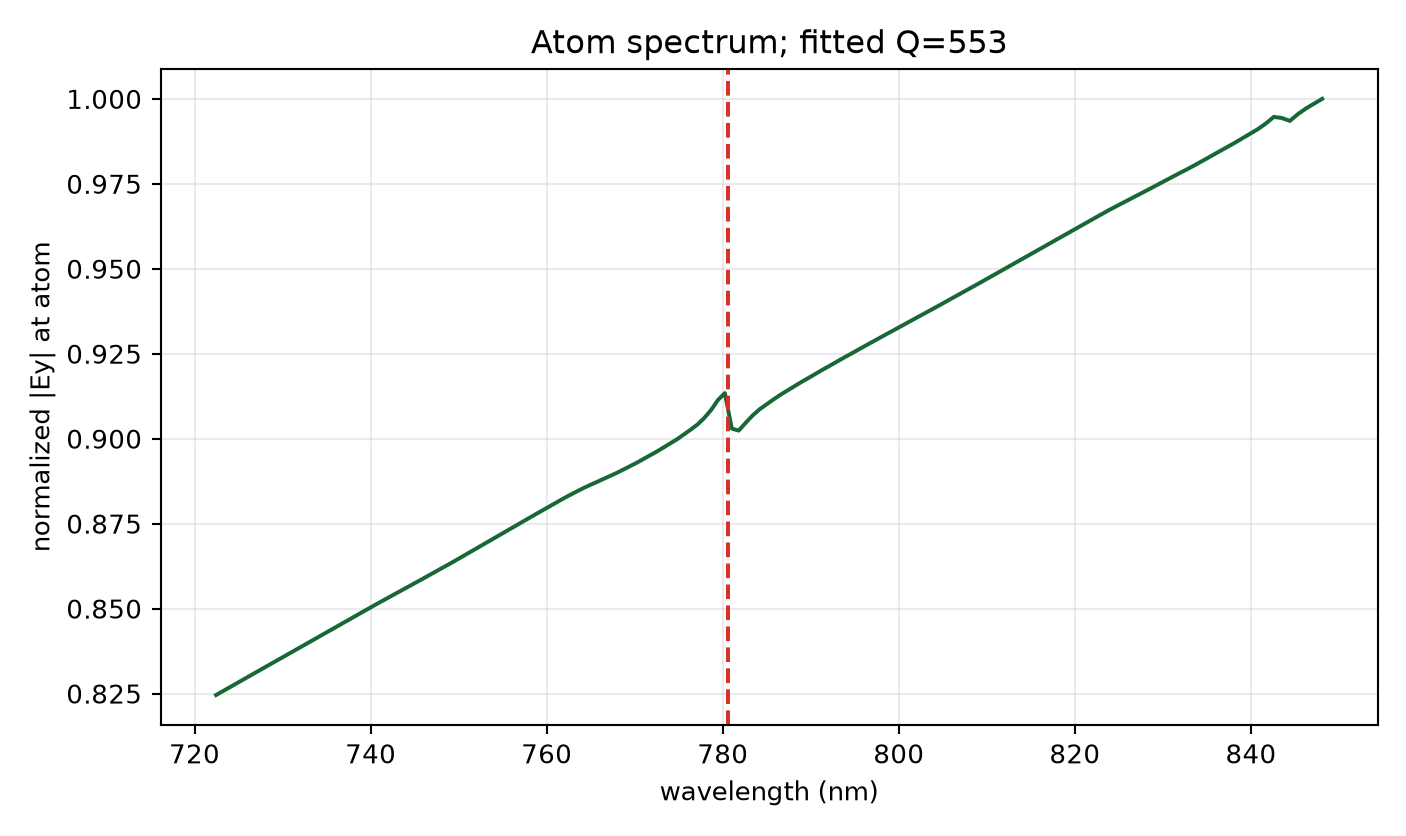
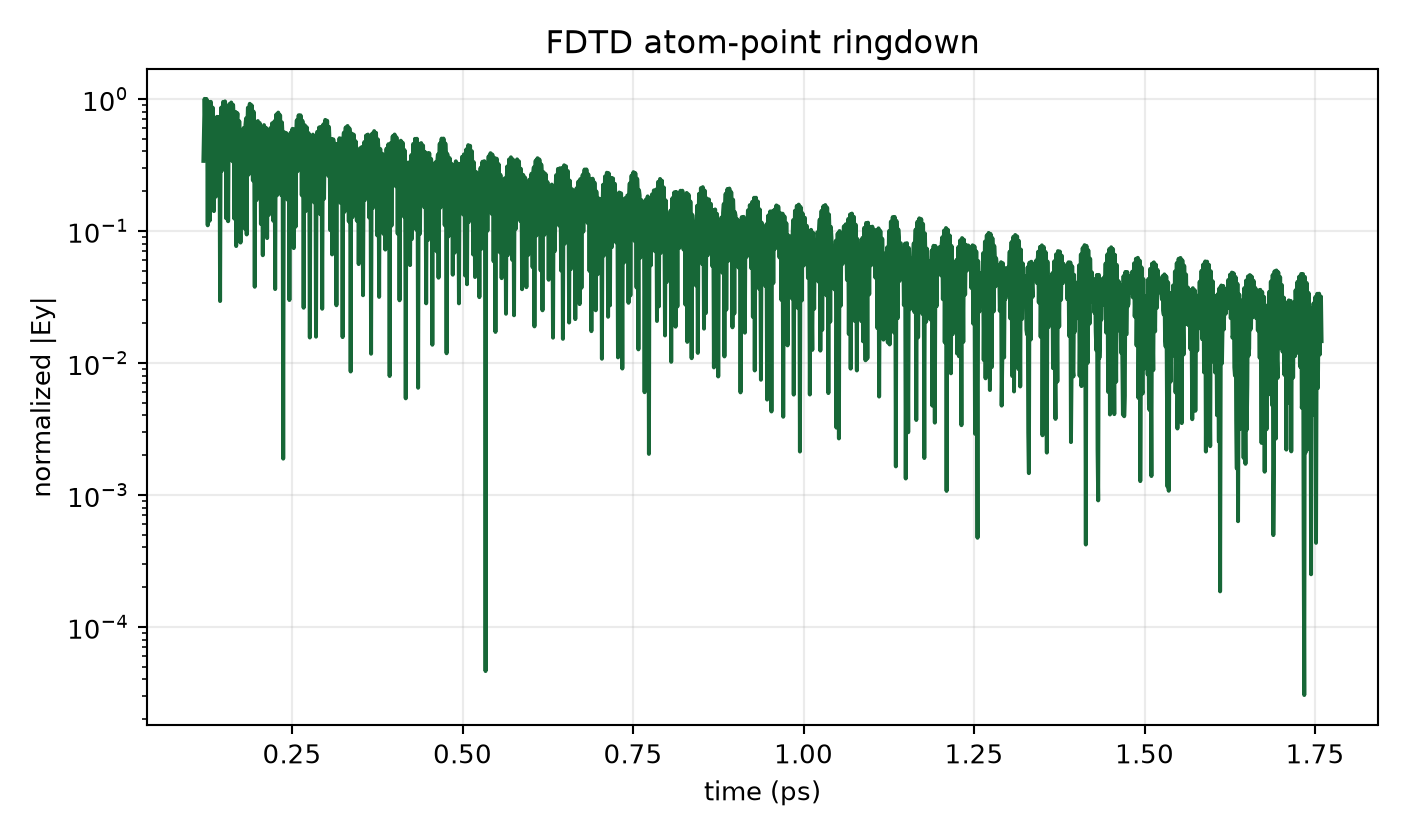
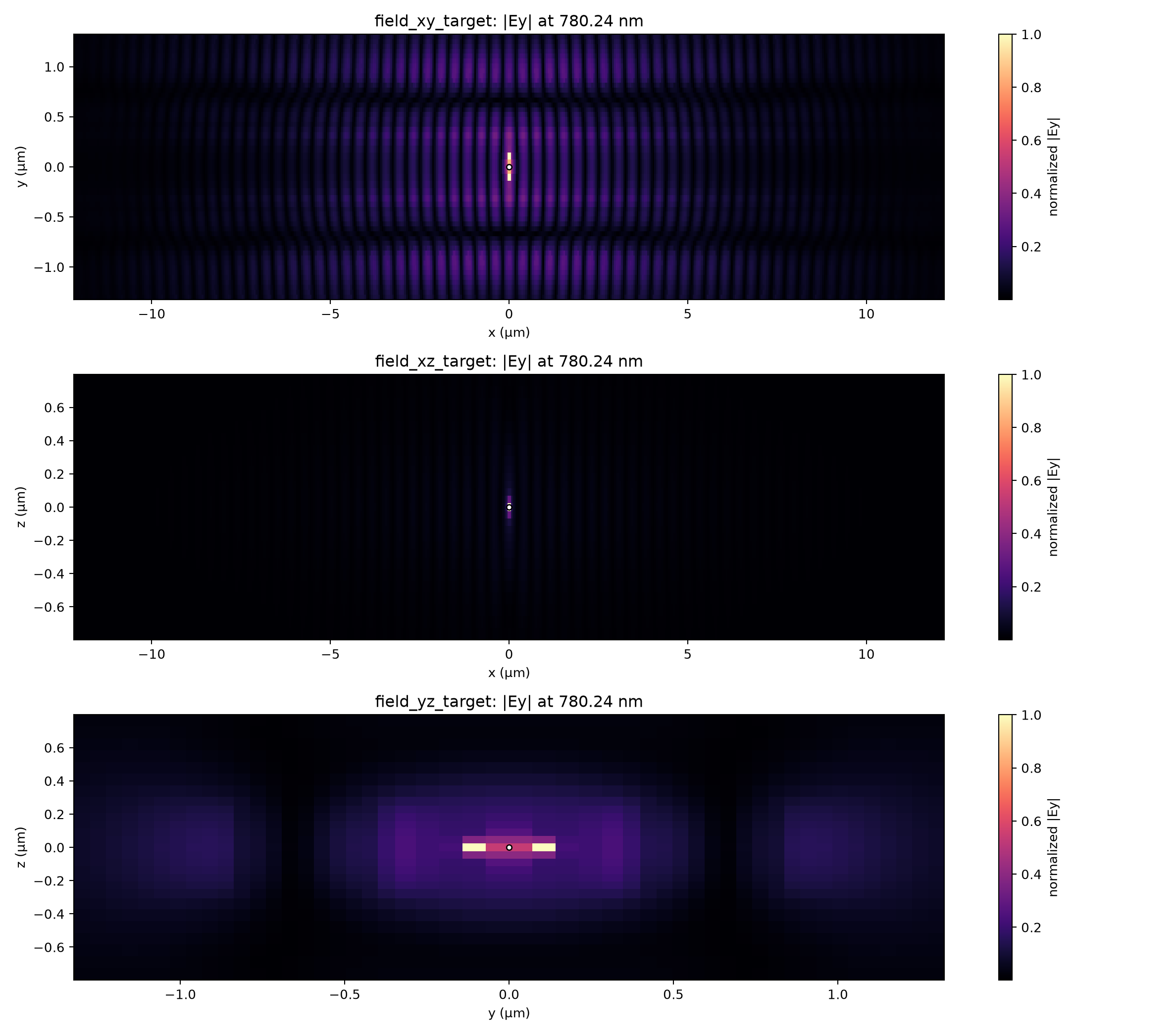
An exact-observables simulation was serialized only to make the future
handoff reproducible. Its handoff status is blocked by the Q floor: the
pair center Q=542.239 is below the required Qworst≥1000, so that simulation
must not be submitted for this calibration/control cavity. Exact mode volume,
Purcell, and emitter β belong on the best later Q-improvement candidate after
the broadband gates pass.
Historical high-margin MPB seed — invalidated by geometry erratum
Evidence label: historical local r10/r14, padding, and near-X MPB validation; zero cloud actions. All 11 checks passed internally for the misplaced approximately 0.07492 µm-slot prism. None of the following MPB values is valid for the intended 0.75 µm-slot FDTD cross-section.
The historical rank-5 table is retained so the invalidated design path can be audited:
| Quantity | High-margin seed |
|---|---|
| open slot | 0.75 µm |
| total transverse width / rail width | 1.95 / 0.60 µm |
| raised-cosine amplitude / thickness | 0.35 / 0.50 µm |
| r14 center period | 0.352268 µm |
| r14 center prediction | 780.2693 nm |
| X-point band-4 light-line margin | 9.706% |
| r14 mirror period | 0.345000 µm |
r14 mirror strength γ |
0.016696 |
| r14 mirror gap | 768.412–794.590 nm |
| finite-FDTD search window | 772.269–788.269 nm |
| local atom metric | 0.999996; not V, Purcell, or β |
These convergence percentages show repeatability of the wrong geometry, not
correctness. The center period changes only 0.0402% from r10 to r14. The atom metric
changes 0.00784% with resolution and less than 0.00001% with added padding.
Mirror γ changes 0.587% with resolution and 0.112% with padding. In the
seven-point near-X sample, band 4 is below the air line at five samples for
both center and mirror cells, compared with only two of seven for the earlier
rank-1 control. At X, both center and mirror band 4 are below the air line.
The former claim that the 9.706% value explained reduced FDTD radiation is withdrawn. Only the separated finite-FDTD results establish the M16 Q.
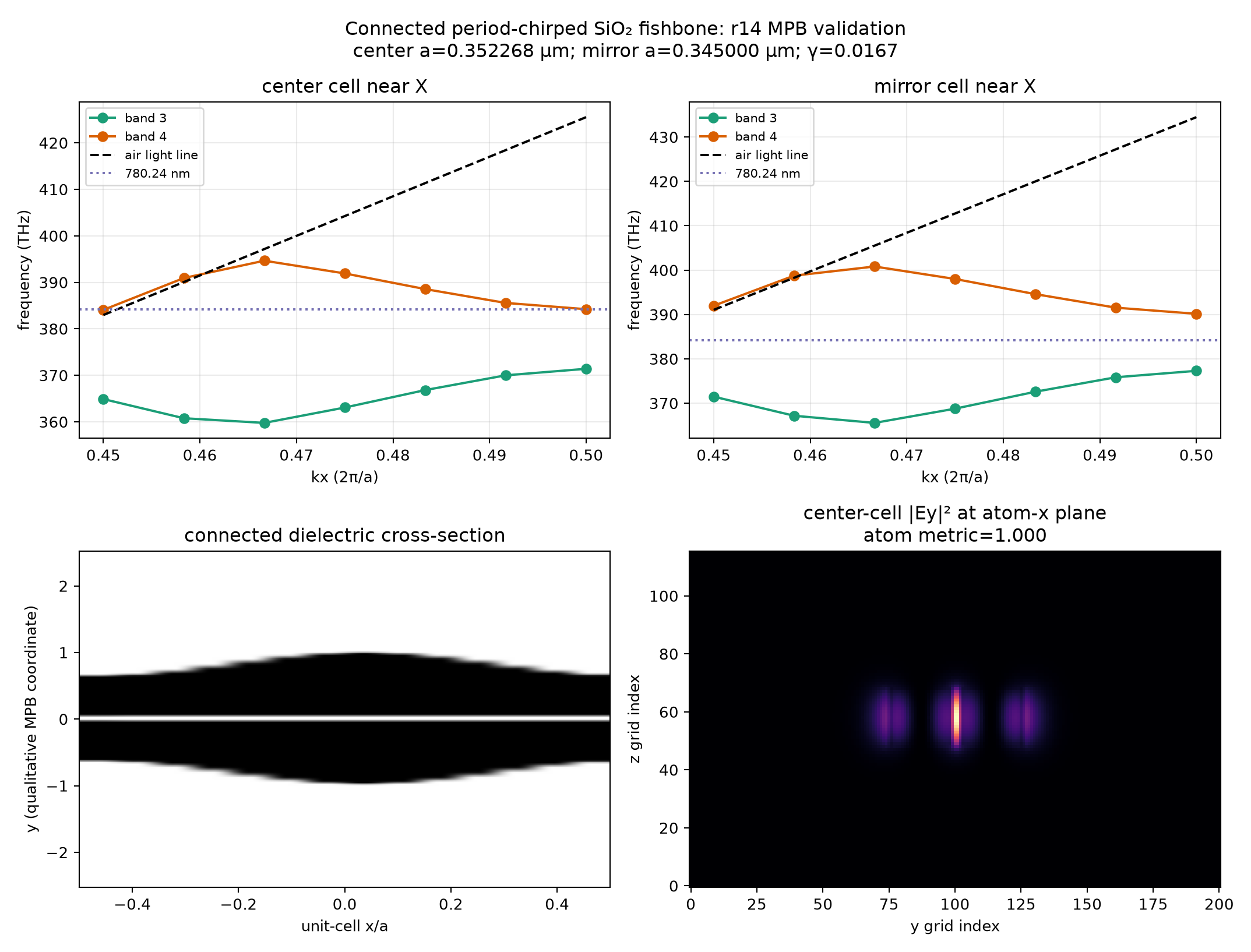
High-margin FDTD retarget and bounded M12/M16 screen prepared
Evidence label: completed local bias-transfer calibration and FDTD serialization; zero cloud tasks were started by these steps. The transferred bias was based on geometrically non-equivalent MPB and is invalid as a physical MPB-to-FDTD calibration. The serialized FDTD periods and subsequent measured FDTD results remain valid.
The historical procedure used the control's FDTD/MPB wavelength ratio of 0.98254491 and a 1.024703× period scale:
| Retargeted quantity | Value |
|---|---|
| center period | 360.9703 nm |
| mirror period | 353.5226 nm |
| r14 MPB center prediction | 794.0901 nm |
| bias-mapped FDTD prediction | 780.2292 nm |
| retargeted mirror gap | 782.298–809.580 nm in MPB wavelength |
retargeted mirror γ |
0.017019 |
| retargeted local atom metric | 0.999999; not V, Purcell, or β |
The MPB prediction, mirror gap, γ, atom metric, and transferred-bias
interpretation in that table are withdrawn. The center/mirror periods remain
the actual serialized FDTD inputs. The broadband analyzer searched both the
bias-transferred 772.229–788.229 nm window and the
uncorrected-MPB 772.269–788.269 nm window. A missing pole in one window cannot
be hidden by a loose generic fallback.
The historical γ×M mirror-count comparison is invalid. The M12/M16 counts
remain actual FDTD geometries, and their paid finite-FDTD comparison remains
valid. Both use 24 taper cells per side:
| Prepared screen | AutoGrid and grid | Domain | Policy |
|---|---|---|---|
| N24+M12 | Auto-20; 1058×186×110 = 21.647M cells | 28.670×5.35×3.00 µm | 16 ps, shutoff 1e-7, no overrides |
| N24+M16 | Auto-20; 1162×186×110 = 23.775M cells | 31.498×5.35×3.00 µm | 16 ps, shutoff 1e-7, no overrides |
Both preserve two connected PolySlabs and the 0.75 µm open slot. Each must
recover one three-probe pole with ≤5% probe-Q span, observe at least three
fitted lifetimes, and beat the converged control Qworst=541.504. Q>1,000 is
preferred before paying for a separated Auto-24 confirmation; only the
Auto-20 winner may advance.
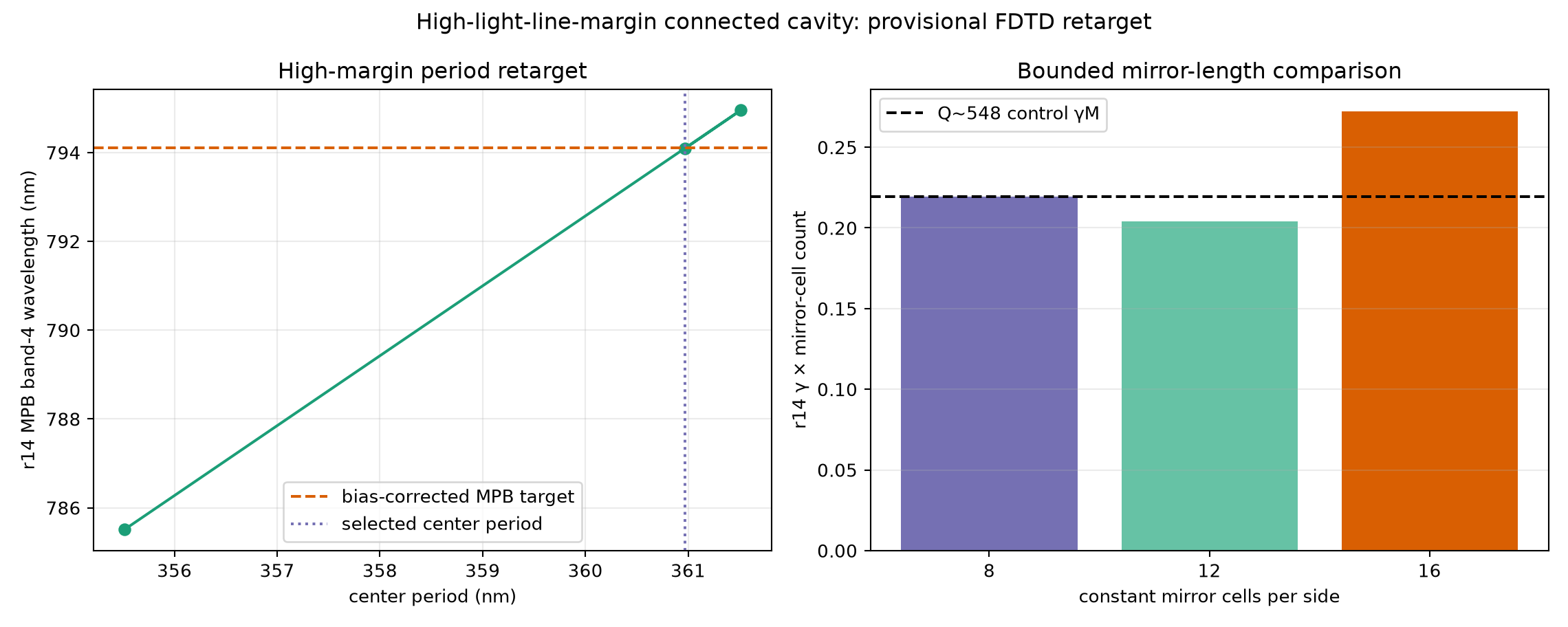
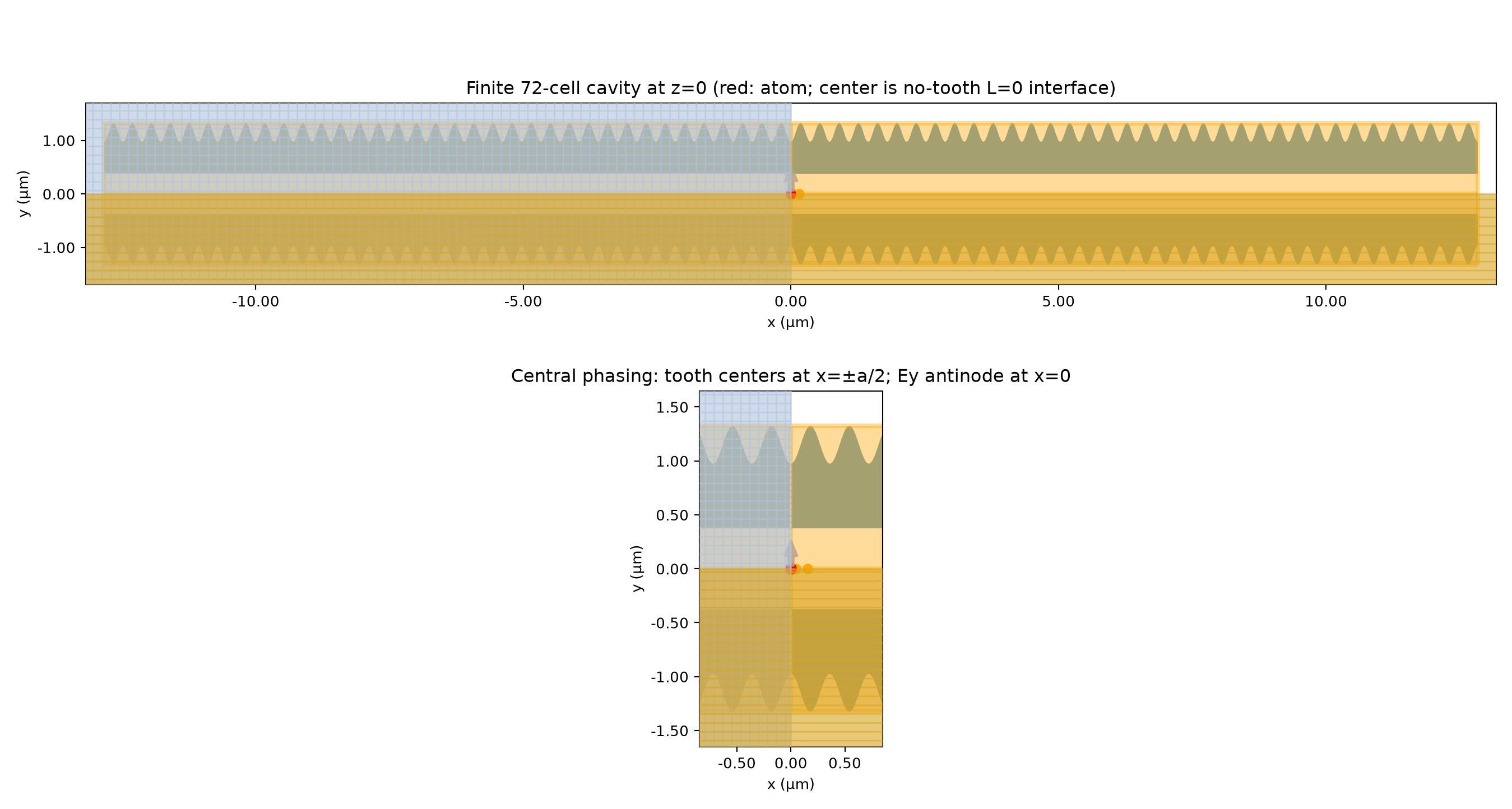
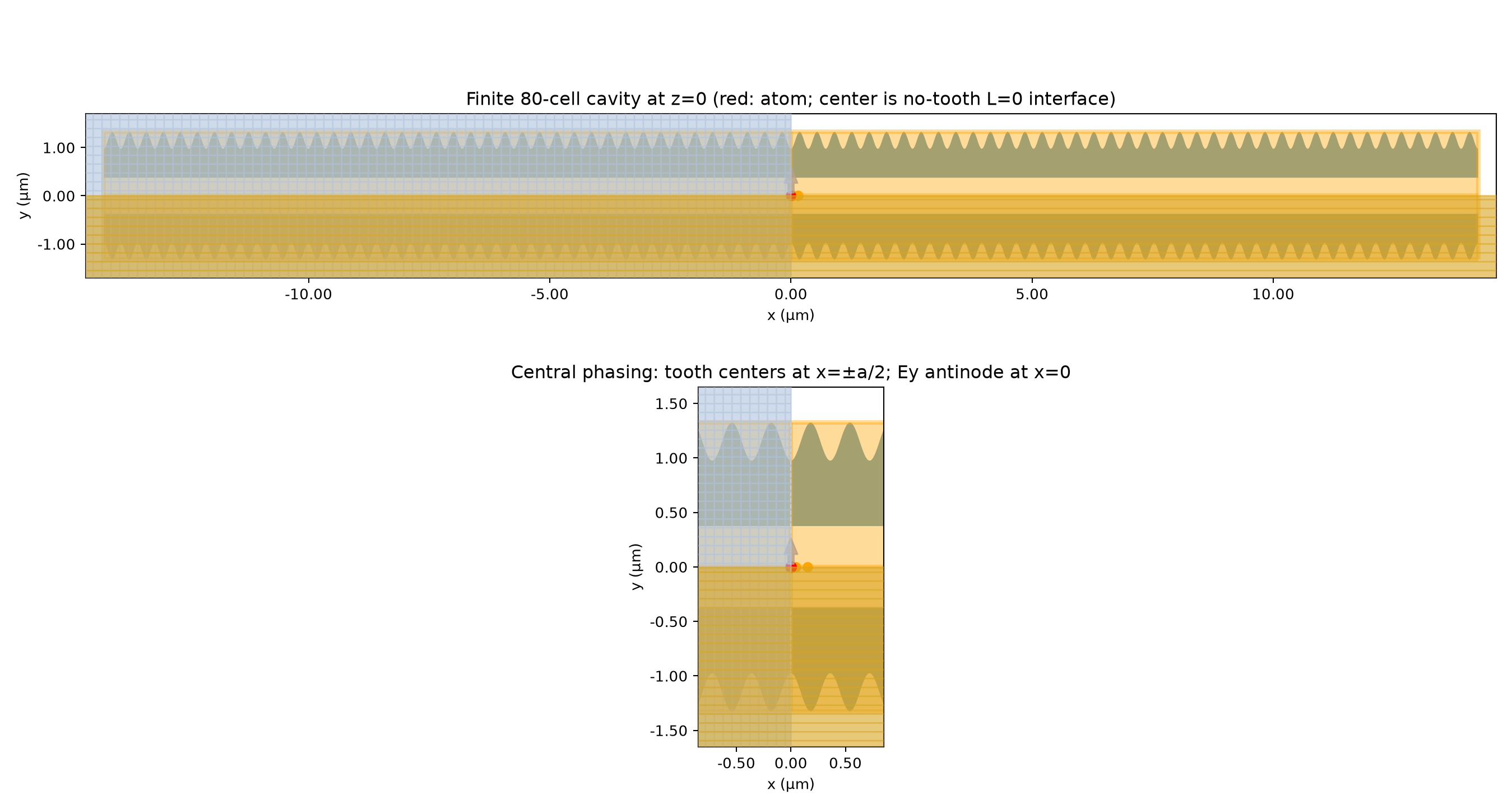
Paid M12/M16 calibration screen — M16 wins, neither promotes
Evidence label: completed paid Auto-20 broadband diagnostics. Both recover clean three-probe poles and beat the converged control Q, establishing a promising high-margin direction. Both poles are about 12.9 nm blue of the atom target and both traces fail the stricter ≥3-lifetime gate, so neither Q is promoted or trusted for exact observables.
| Screen | Task | Pole | Probe consistency | Time basis | Cost |
|---|---|---|---|---|---|
| N24+M12 | fdve-541b8d77-eebb-43e6-baf0-6f4a46f07a5b |
λ=767.3521 nm, Q=2,071.34 | Q span 0.520%; frequency span 0.0000369% | 2.518 lifetimes; fails | 0.077250 FC actual / 0.282868 max |
| N24+M16 | fdve-6a891311-16c6-4081-a3d1-a563aa357547 |
λ=767.3887 nm, Q=3,834.34 | Q span 0.325%; frequency span 0.0000721% | 2.086 lifetimes; fails | 0.128742 FC actual / 0.310392 max |
M16 is the geometry-calibration winner: its fitted Q is 1.851× M12 and
7.081× the robust control Qworst. This is not a convergence claim. M16 is
still one mesh, outside both preregistered 772.2–788.3 nm windows, and
undersampled in fitted lifetimes. It must be retargeted using its own measured
wavelength and repeated at separated meshes.
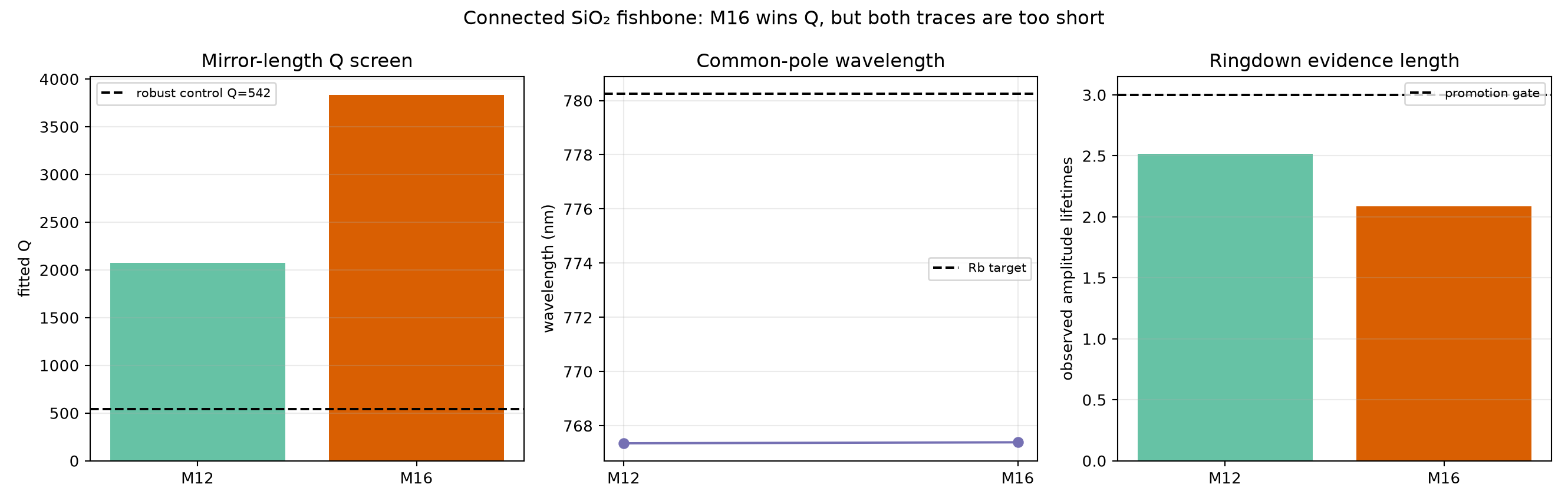
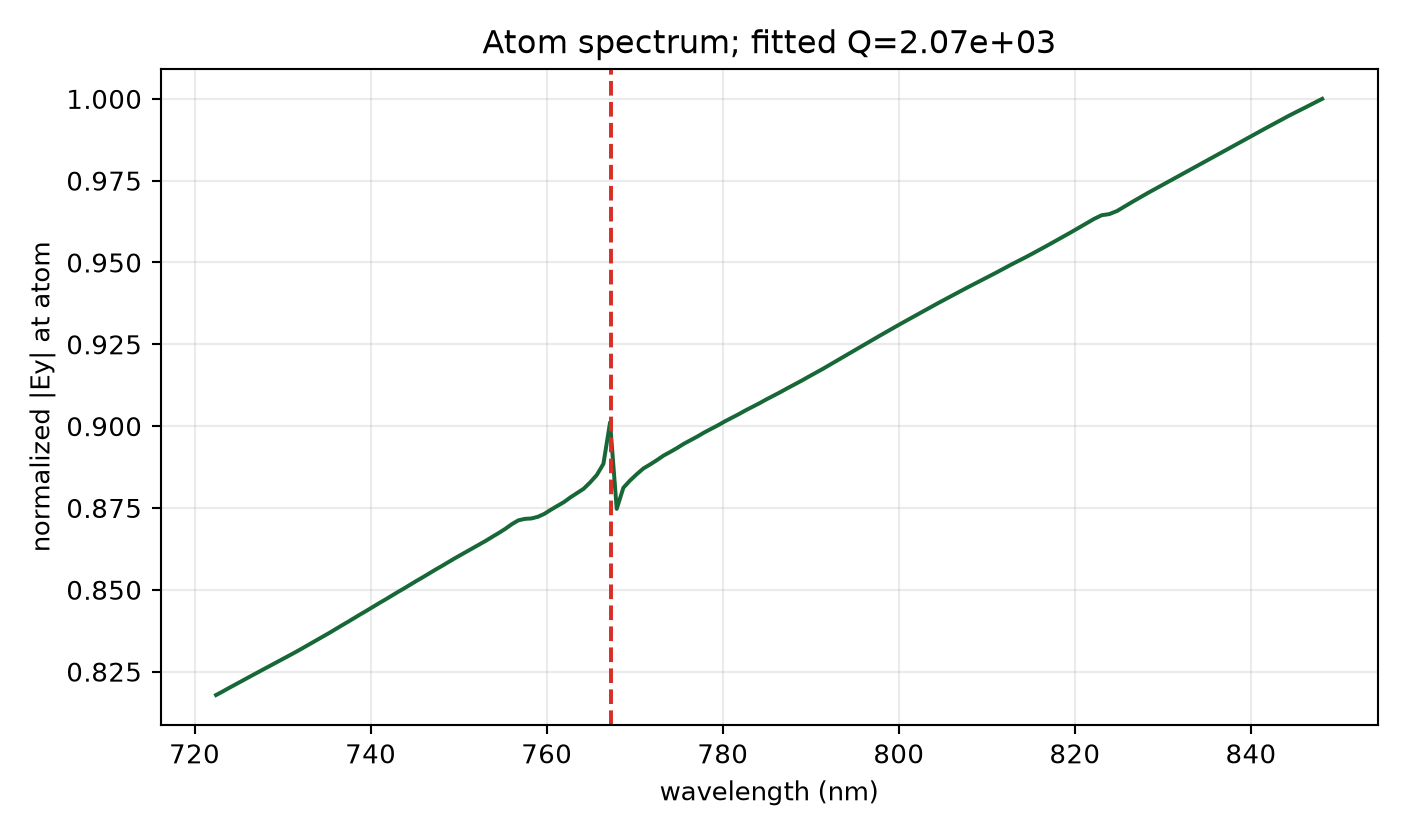
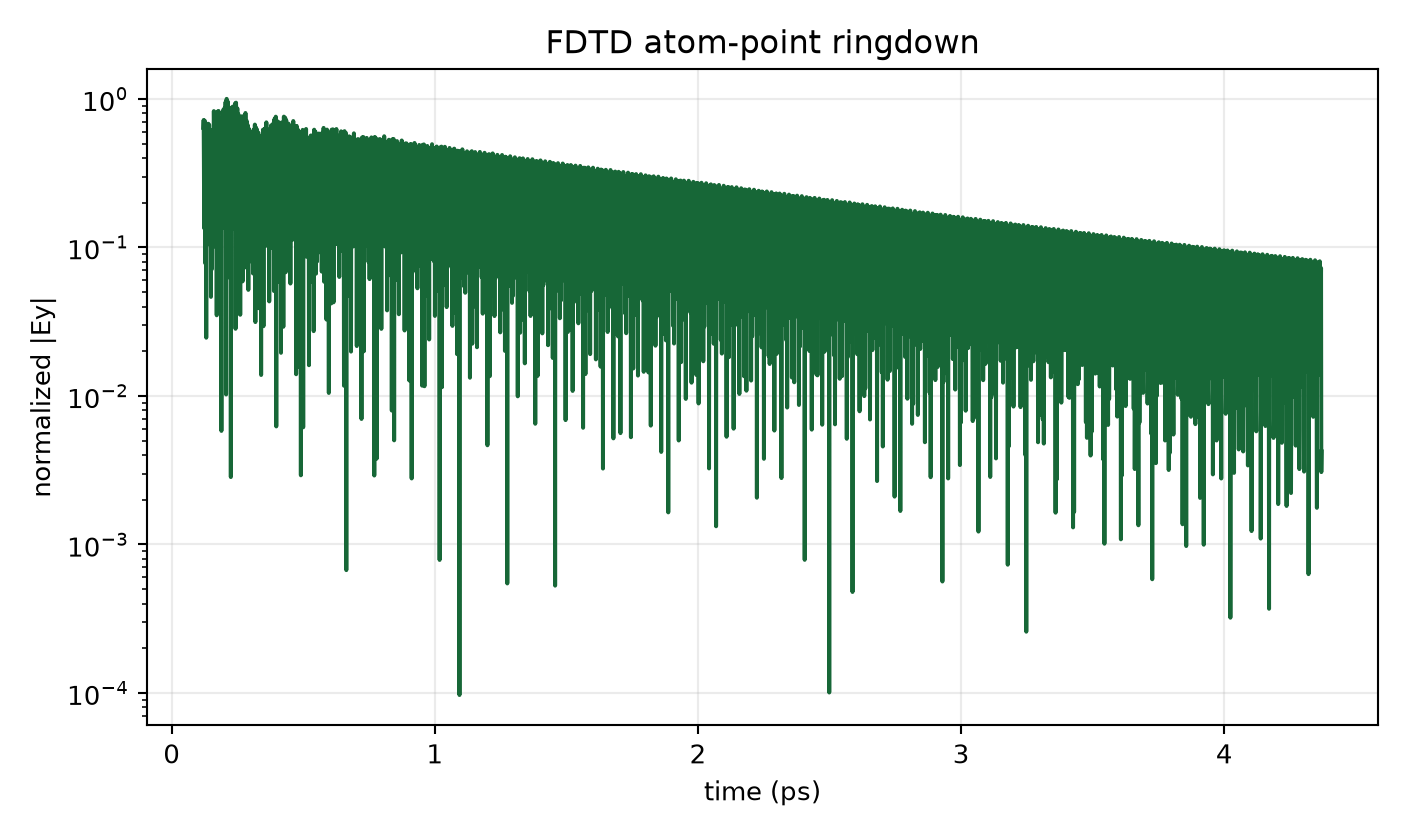
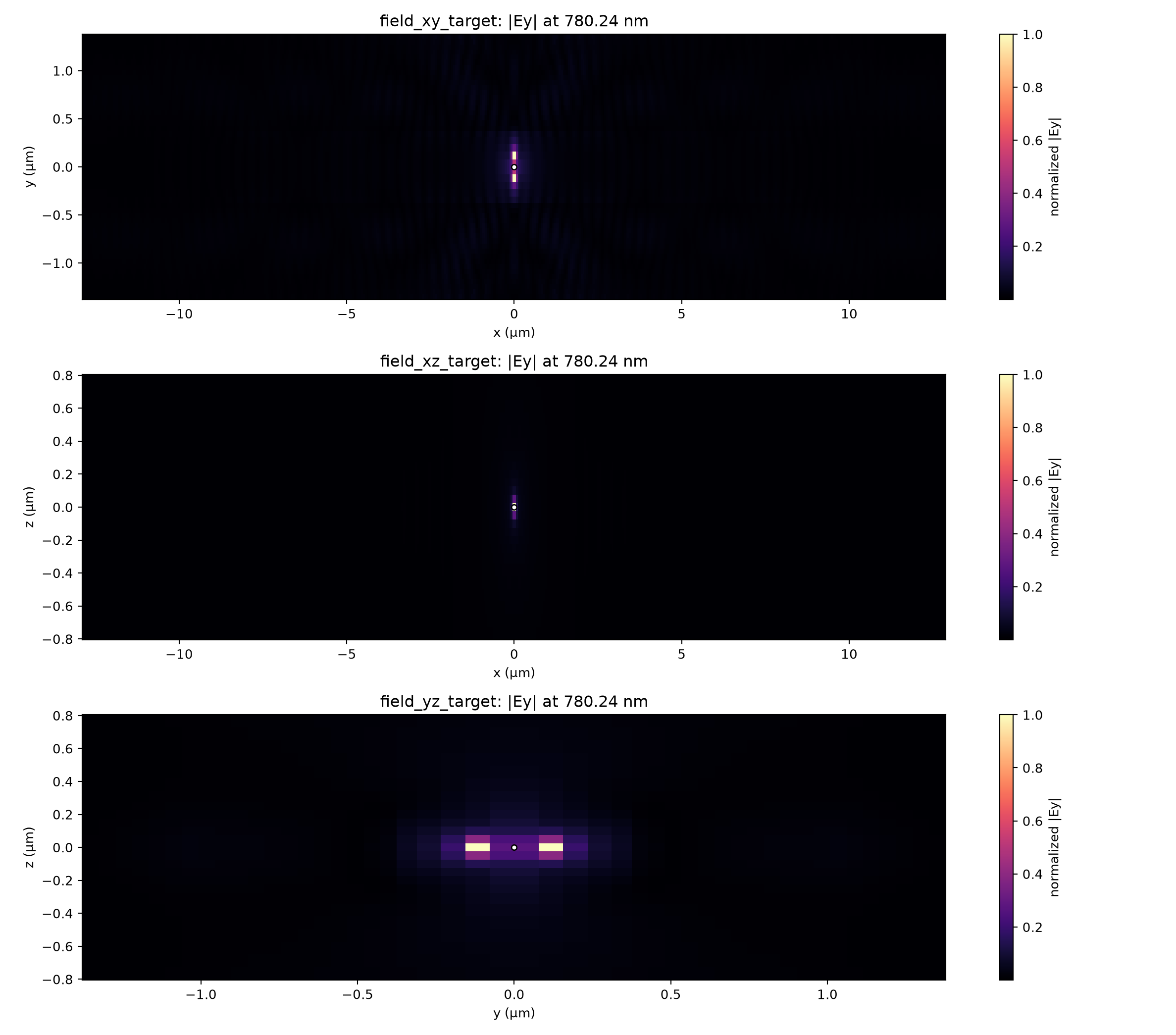
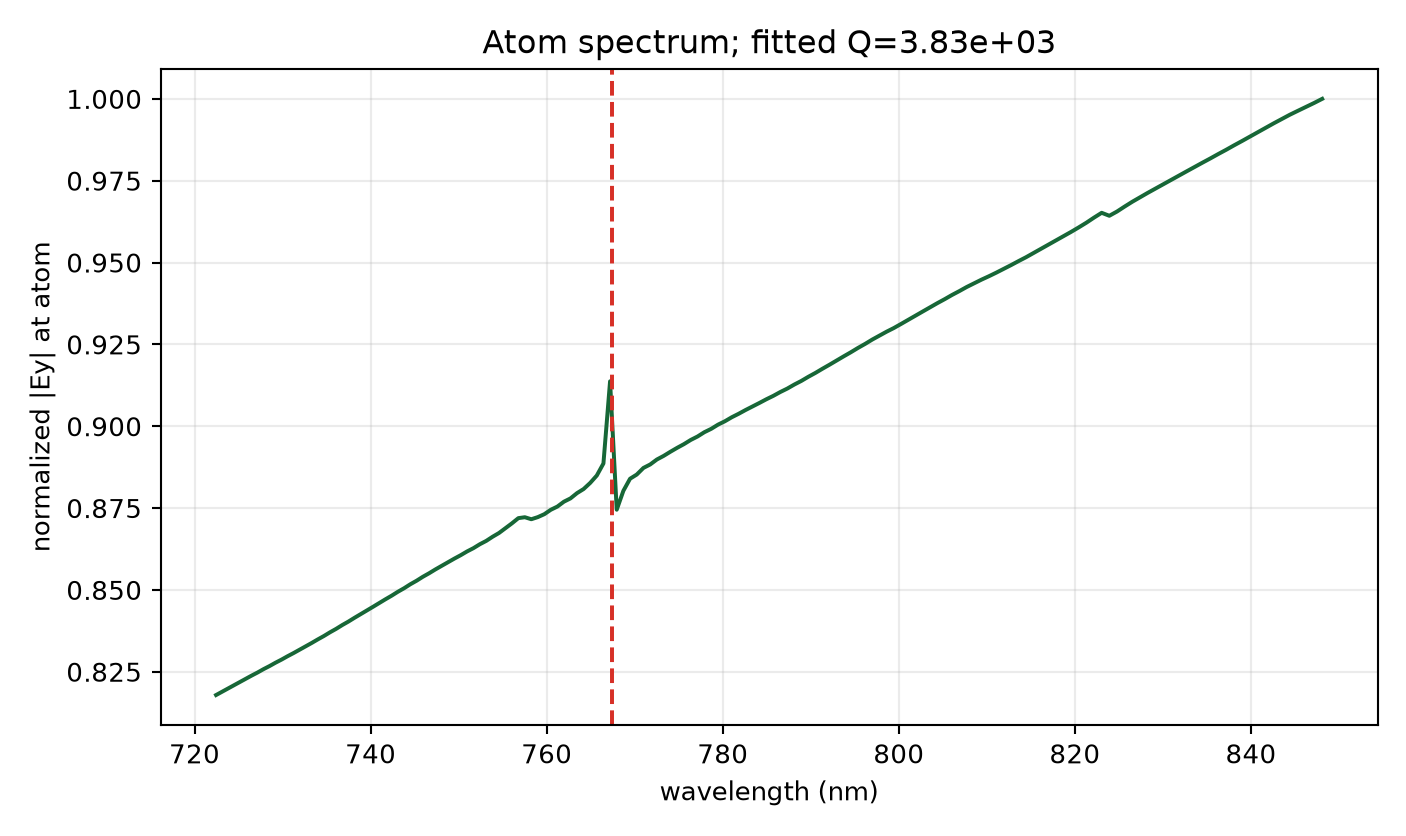
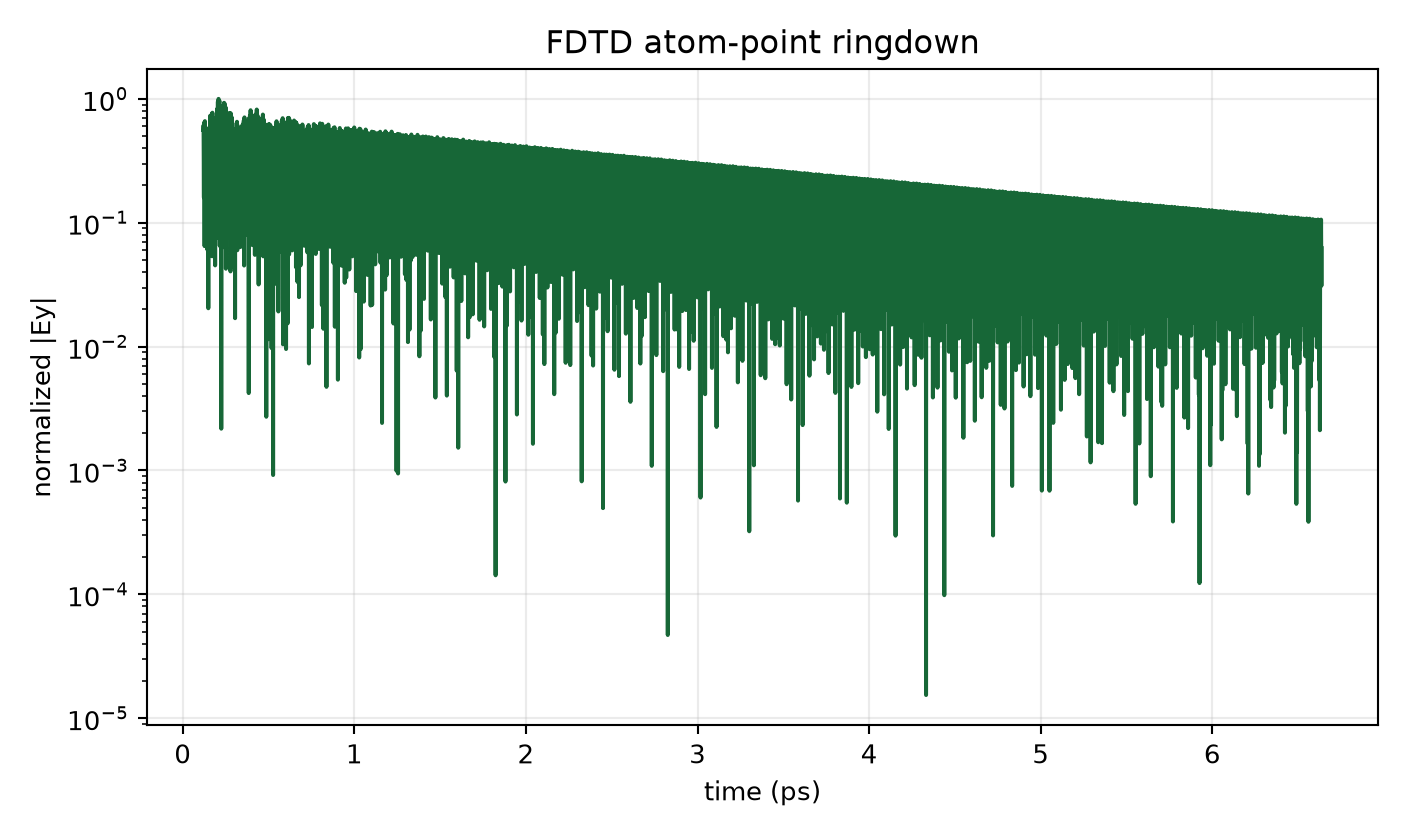
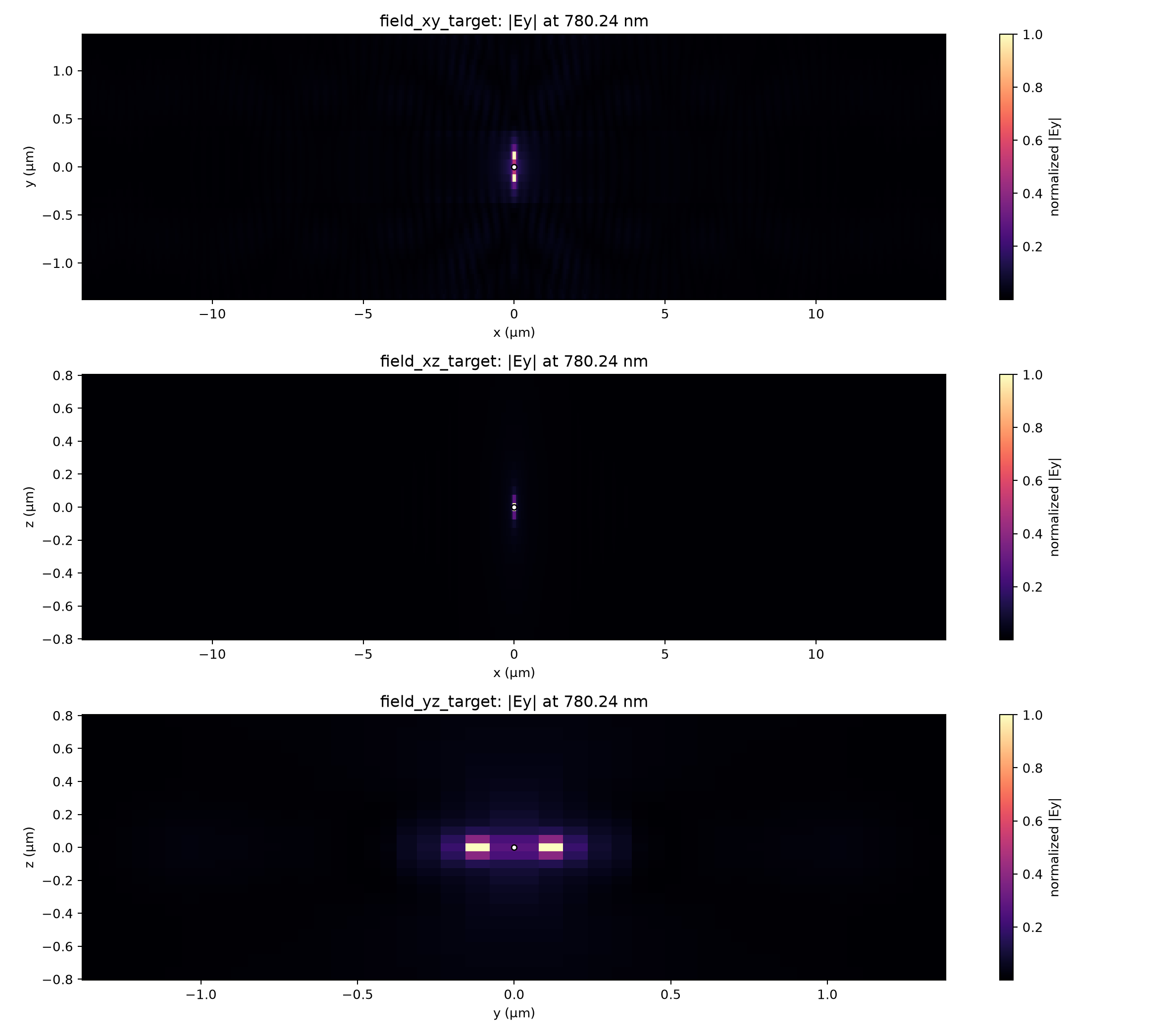
Historical M16 MPB/FDTD retarget — interpretation invalidated
Evidence label: local MPB plus saved-FDTD one-point wavelength calibration and local FDTD serialization; zero cloud tasks started by these steps. The final FDTD periods and measured FDTD convergence remain valid, but the MPB/FDTD ratio is not a comparison of equivalent transverse geometries.
The historical calculation used an FDTD/MPB wavelength ratio of 0.96637479
and an additional 1.022679× period scale. The table is retained for
provenance; its MPB prediction, gap, γ, light-line margin, and atom metric
are invalid for the FDTD cross-section:
| Own-bias retarget quantity | Value |
|---|---|
| center / mirror period | 369.157 / 361.540 nm |
| cumulative scale from rank-5 r14 | 1.047943× |
| MPB center prediction | 807.3875 nm |
| own-bias mapped FDTD prediction | 780.2390 nm |
| mirror MPB gap | 794.994–823.179 nm |
mirror γ / γ×M16 |
0.017325 / 0.277194 |
| X light-line margin | 8.555% |
| local atom metric | 0.97438; not V, Purcell, or β |
The old local checks passed only for the misplaced MPB prism and are
withdrawn as FDTD-geometry evidence. The prepared Auto-20/24 pair keeps 16
ps, two connected rails, the 0.75 µm
slot, 12 PML layers, and zero overrides, but tightens automatic shutoff to
1e-9 to target at least three fitted lifetimes:
| Prepared pair | Grid | Strict gate |
|---|---|---|
| own-bias Auto-20 | 1186×186×110 = 24.266M | target within 1%; Q>1,000; ≥3 lifetimes; probe-Q span ≤5% |
| own-bias Auto-24 | 1418×218×126 = 38.950M | same; pair wavelength ≤0.5% and Q spread ≤5% |
Only a passing pair may proceed to Auto-22 and expanded-domain/PML checks. Exact mode volume, Purcell, and emitter β remain blocked until that full sequence passes.
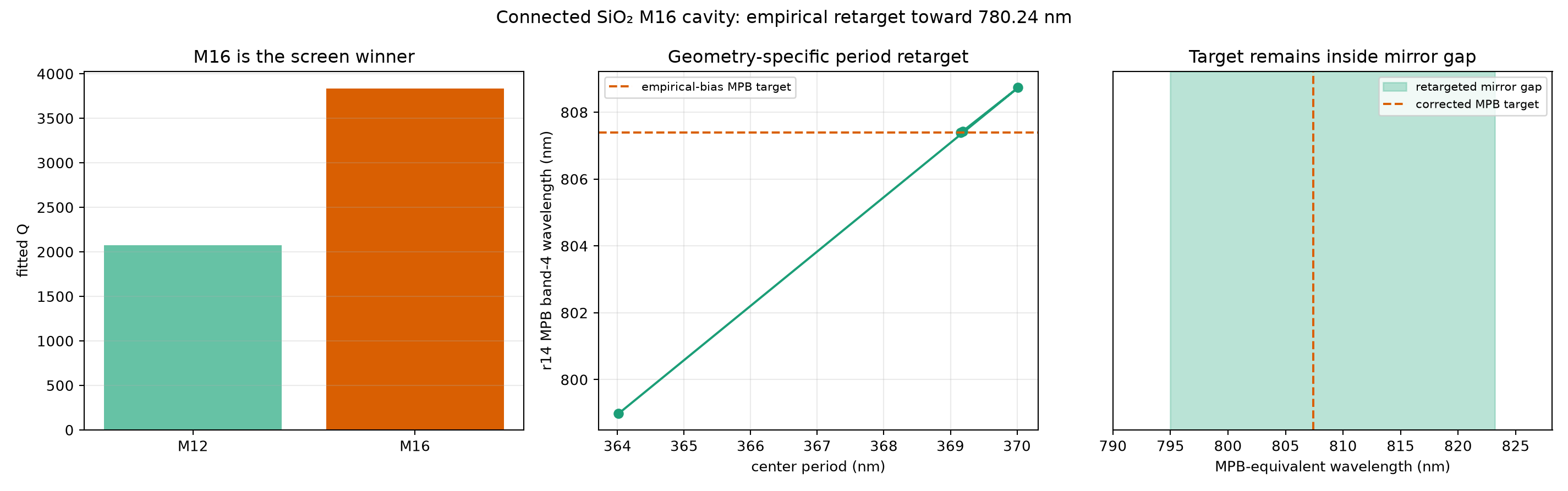
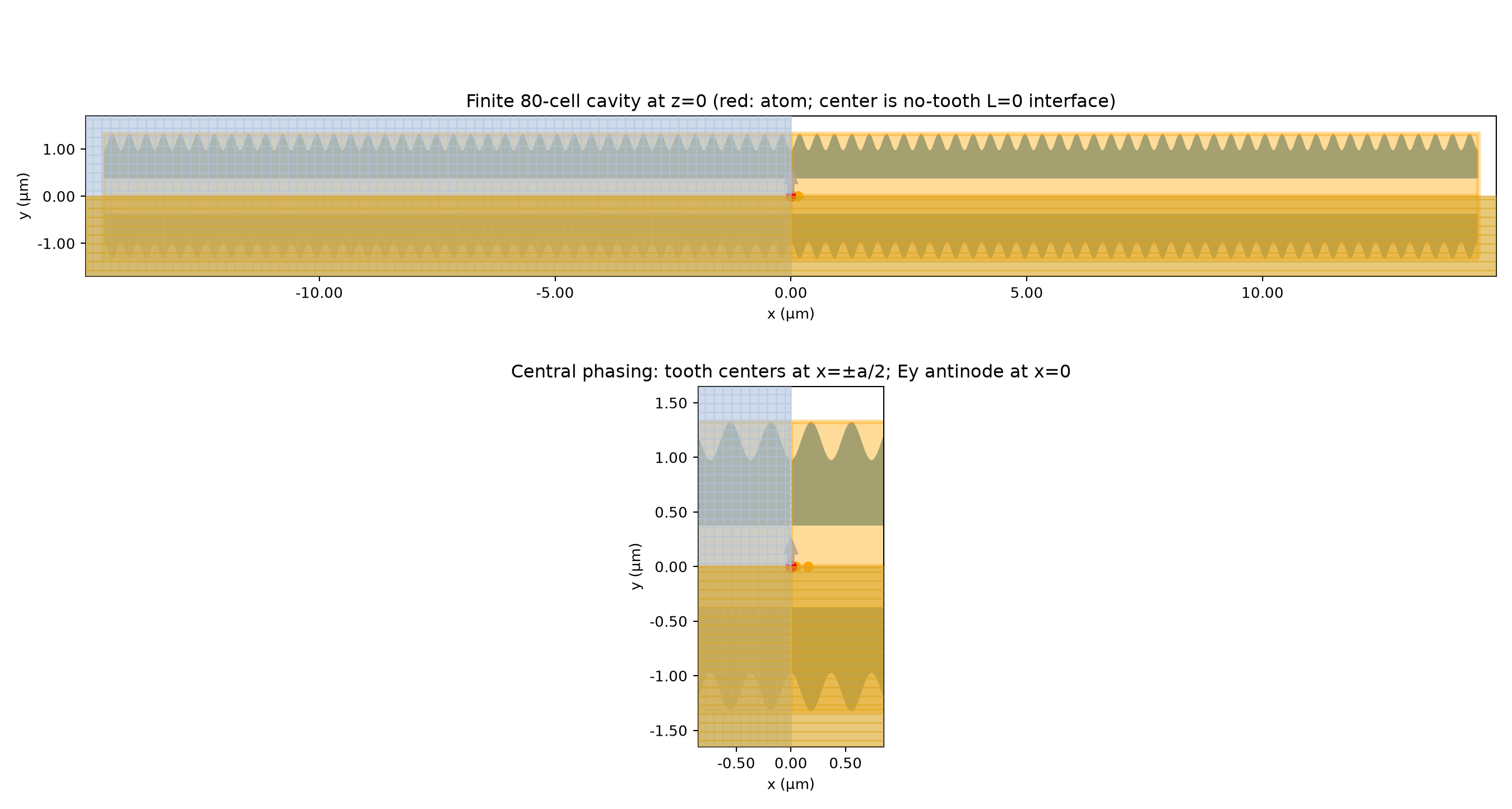
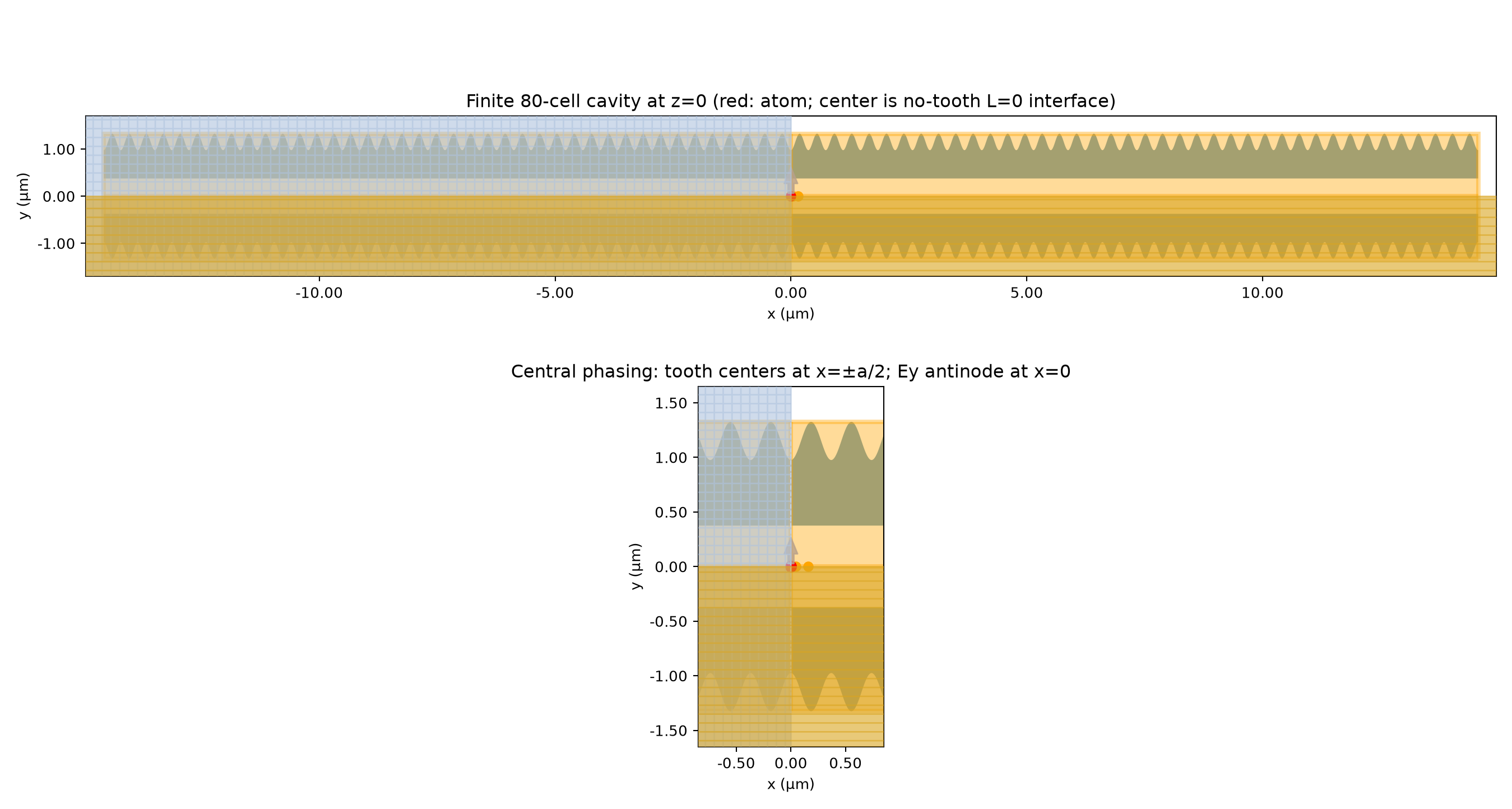
M16 own-bias Auto-20/24 pair passes
Evidence label: completed paid separated-mesh broadband pair. Every individual target, Q, probe-agreement, and ≥3-lifetime gate passes; the pair also passes the strict 0.5% wavelength and 5% Q-spread gates. This was the initial gate; the independent Auto-22 and expanded-domain/PML tests reported in the next subsection have since passed as well.
| Mesh | Task and cost | Pole | Probe / duration evidence |
|---|---|---|---|
| Auto-20 | fdve-7132d5bb-670c-4d78-af1d-32831ced8130; 0.277328 FC actual / 0.316764 max |
λ=780.1448 nm, Q=3,542.42 | Q span 0.02793%; 4.733 lifetimes |
| Auto-24 | fdve-fa4d33e0-3219-440f-84ee-7de9503f95f7; 0.495668 FC actual / 0.600007 max |
λ=779.6484 nm, Q=3,585.03 | Q span 0.02930%; 4.413 lifetimes |
The pair wavelength span is 0.06365%, Q span is 1.1958%, and
Qworst=3,542.42. This was the first high-margin pair to satisfy the
campaign's strict target, time-basis, and initial mesh requirements.
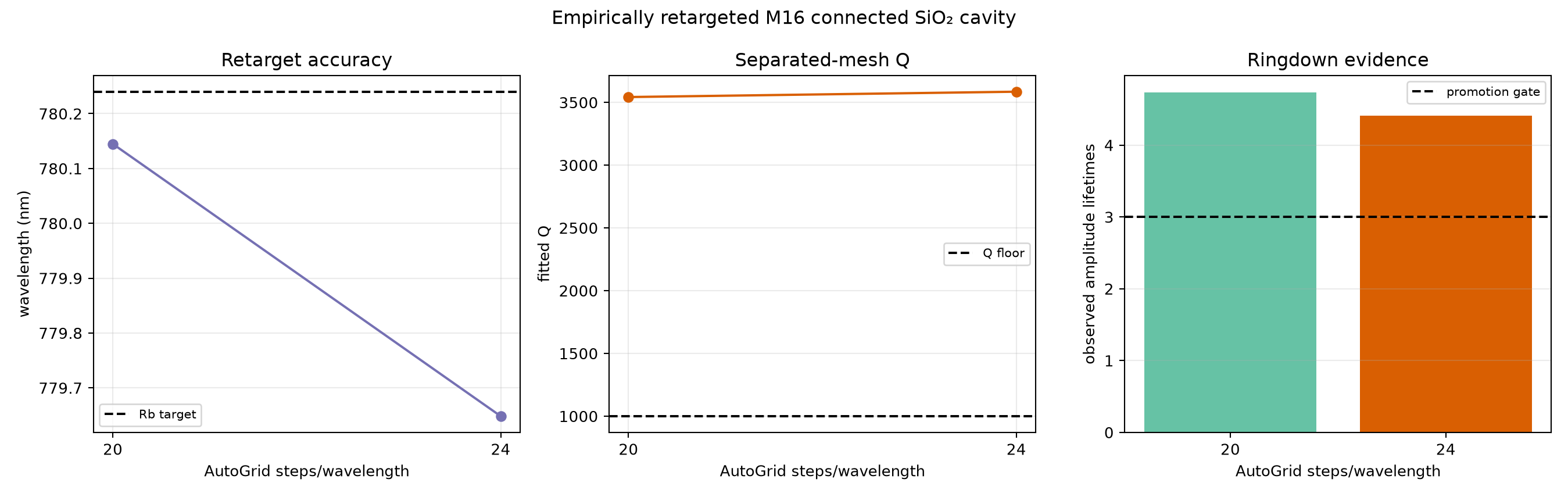
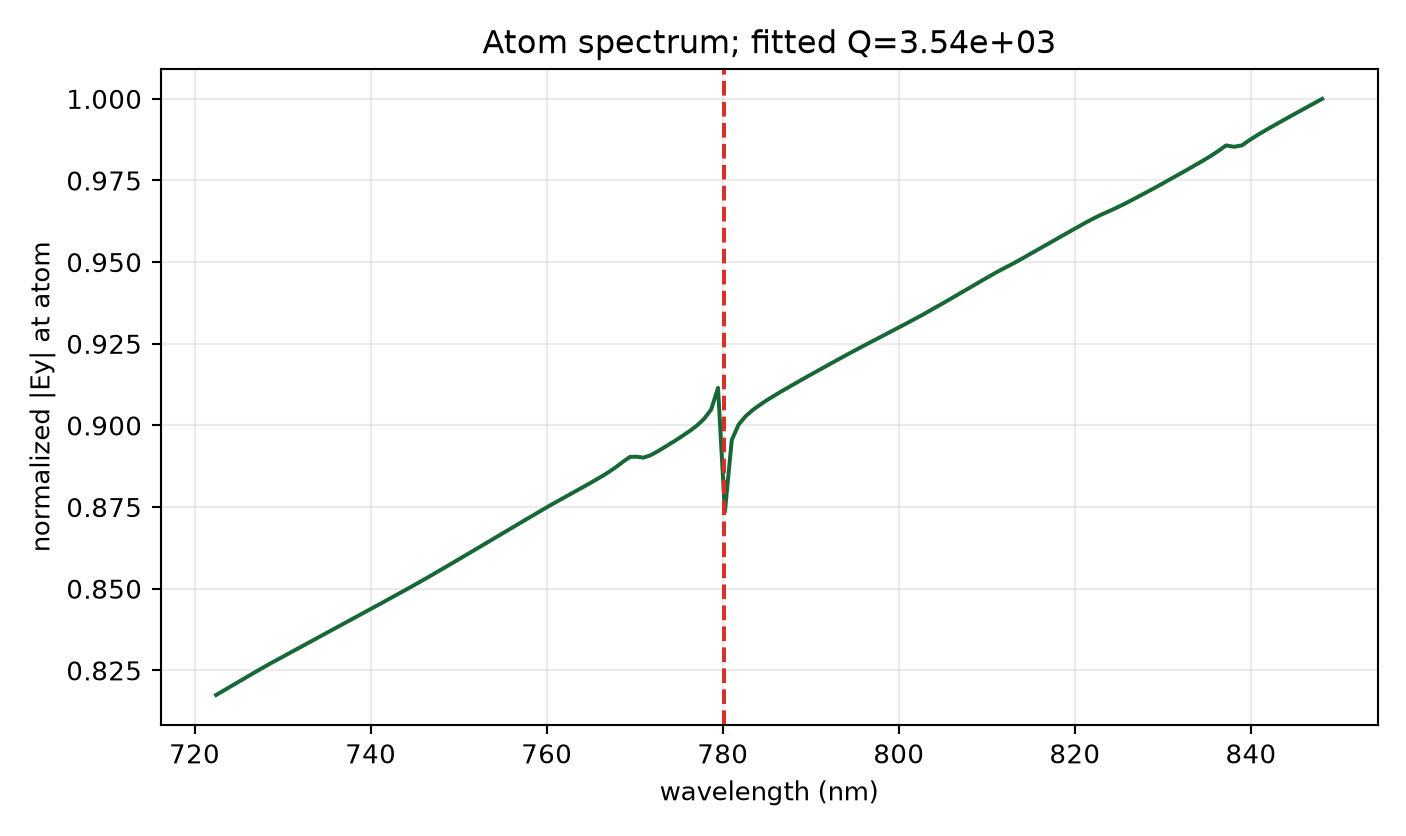
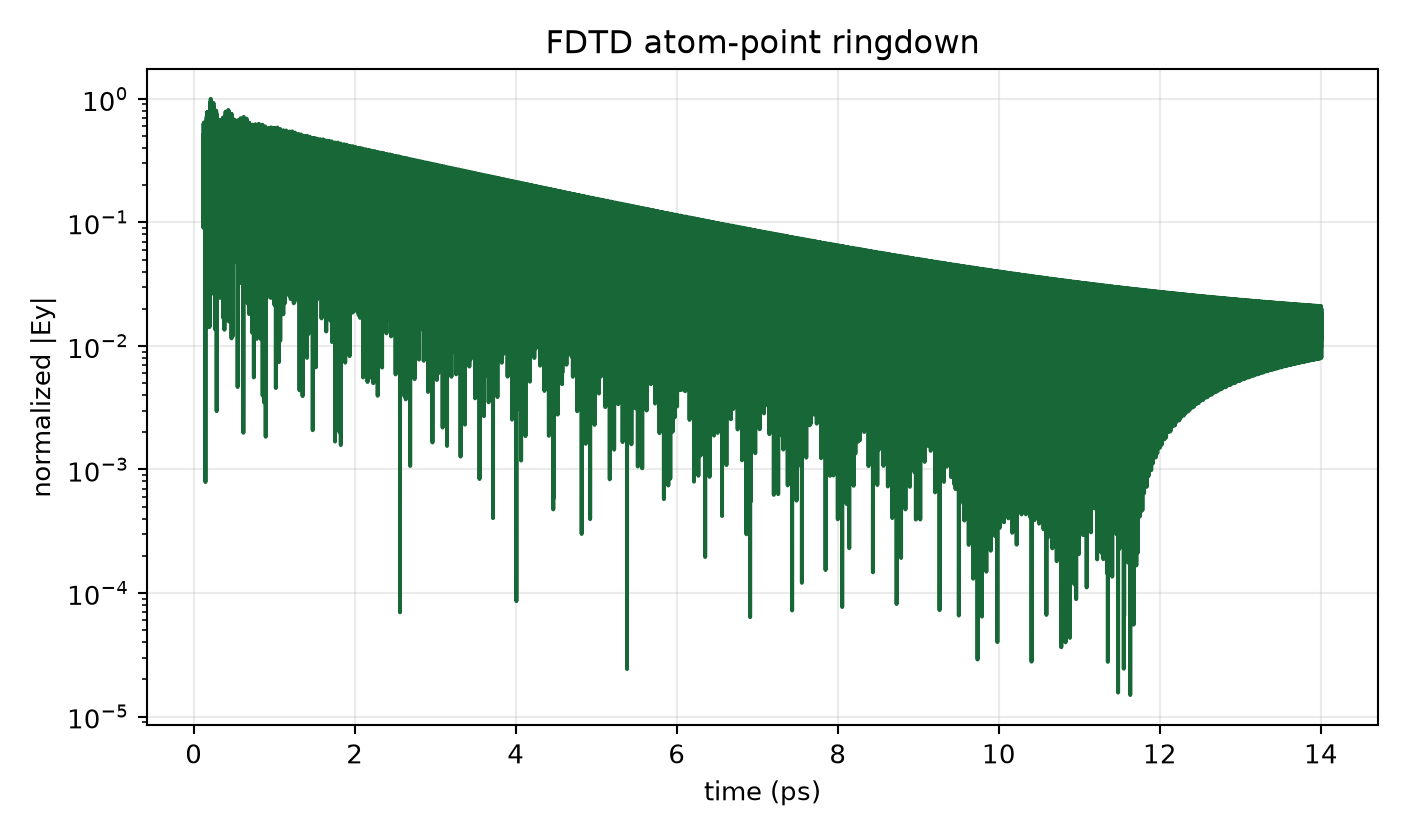
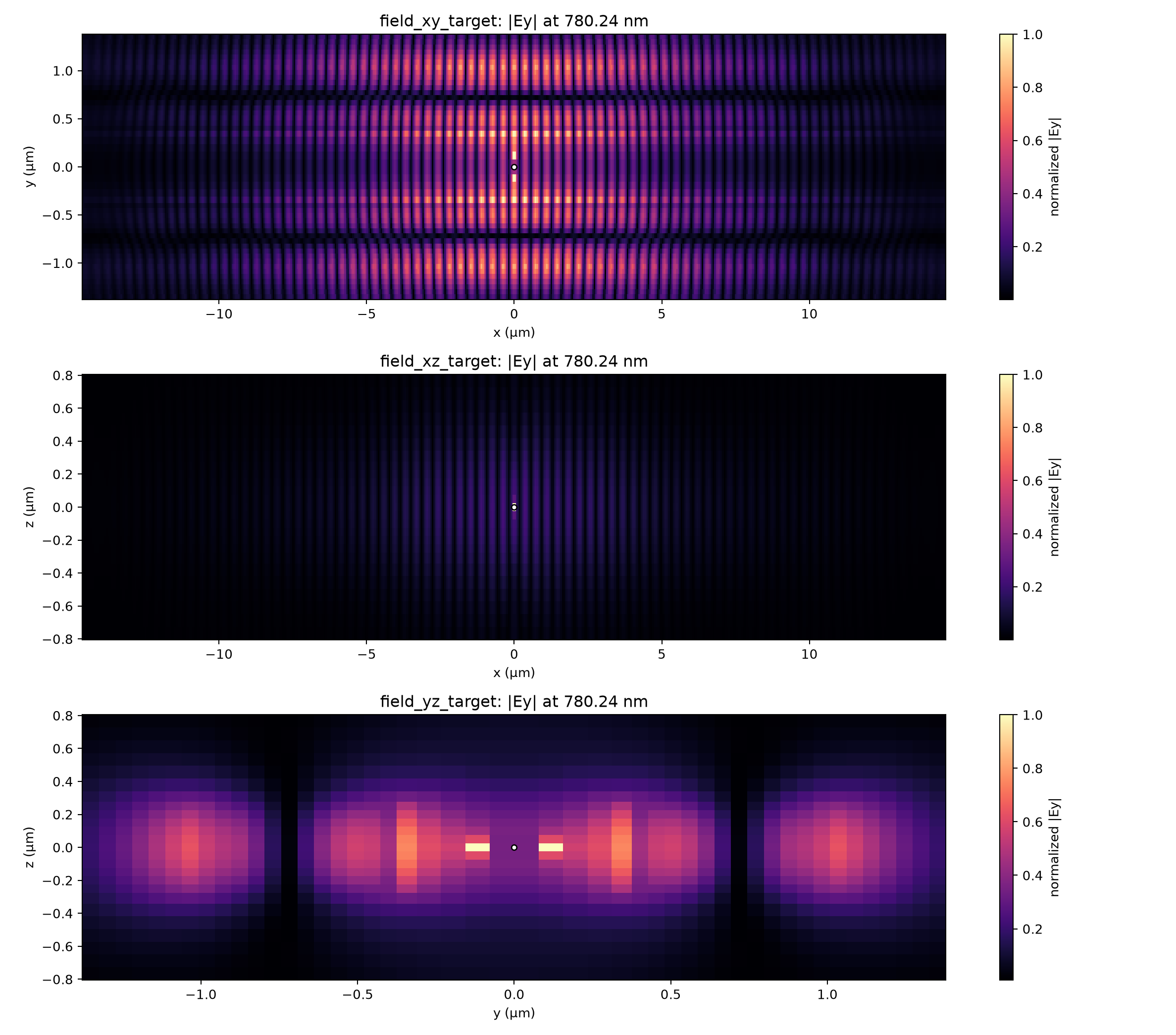
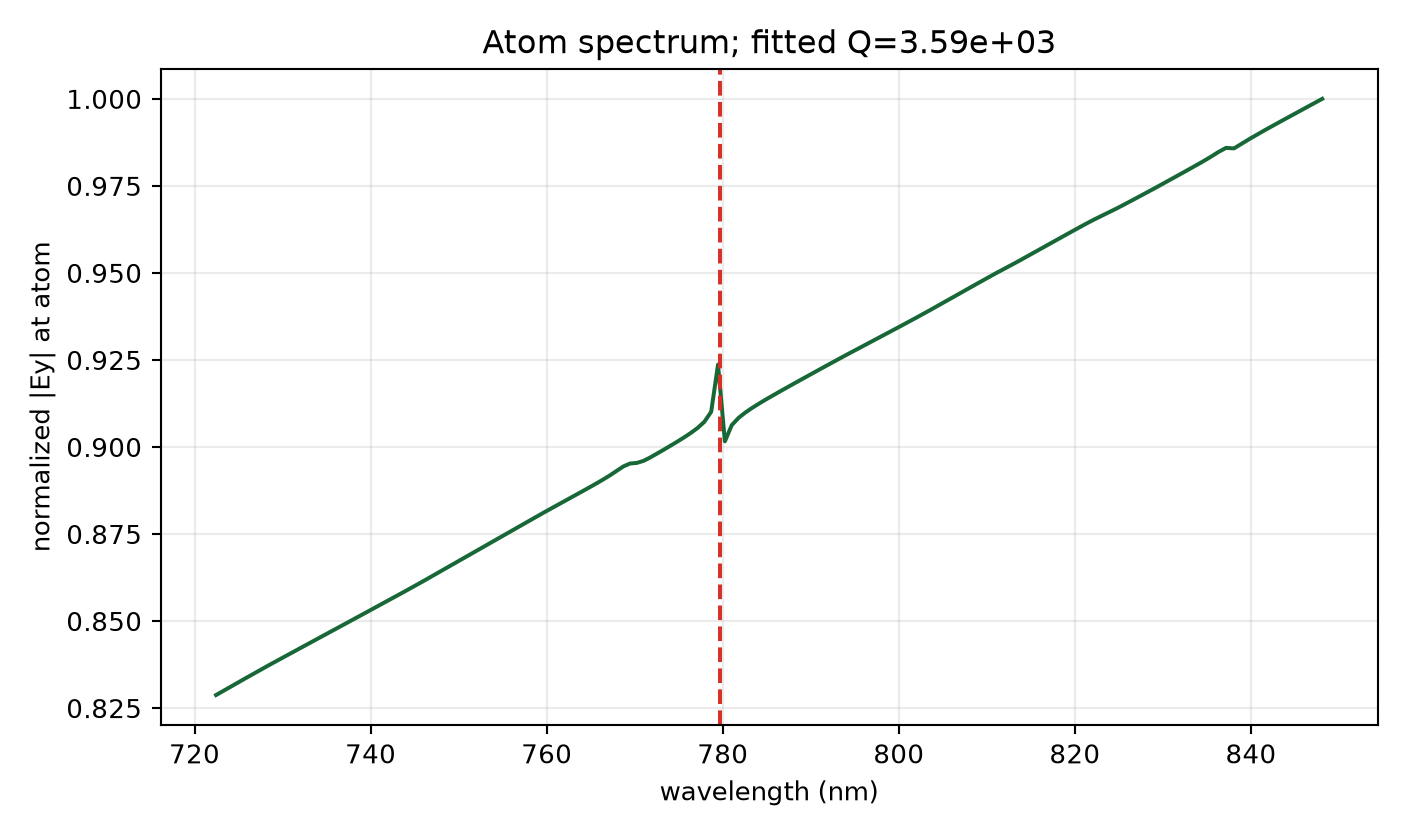
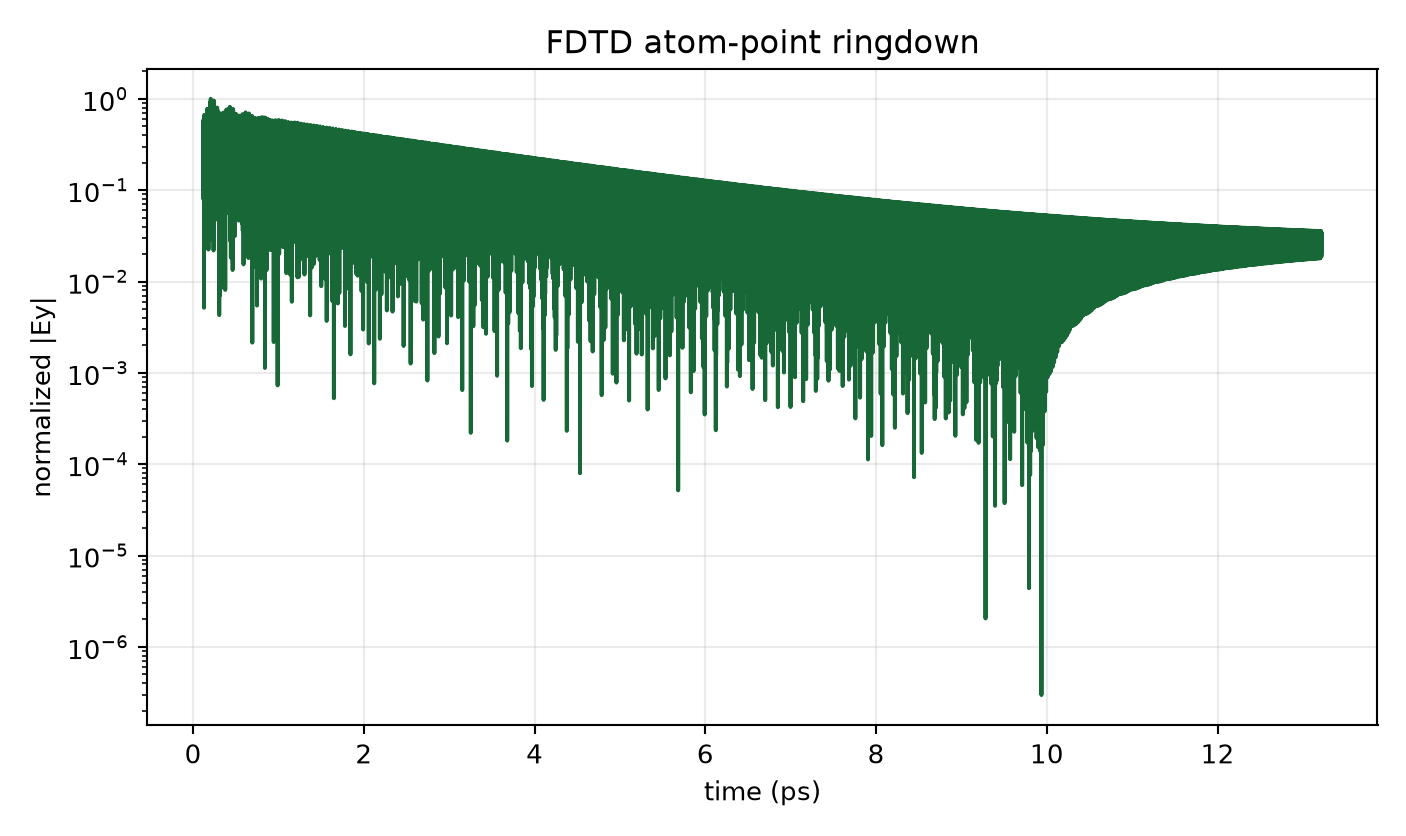
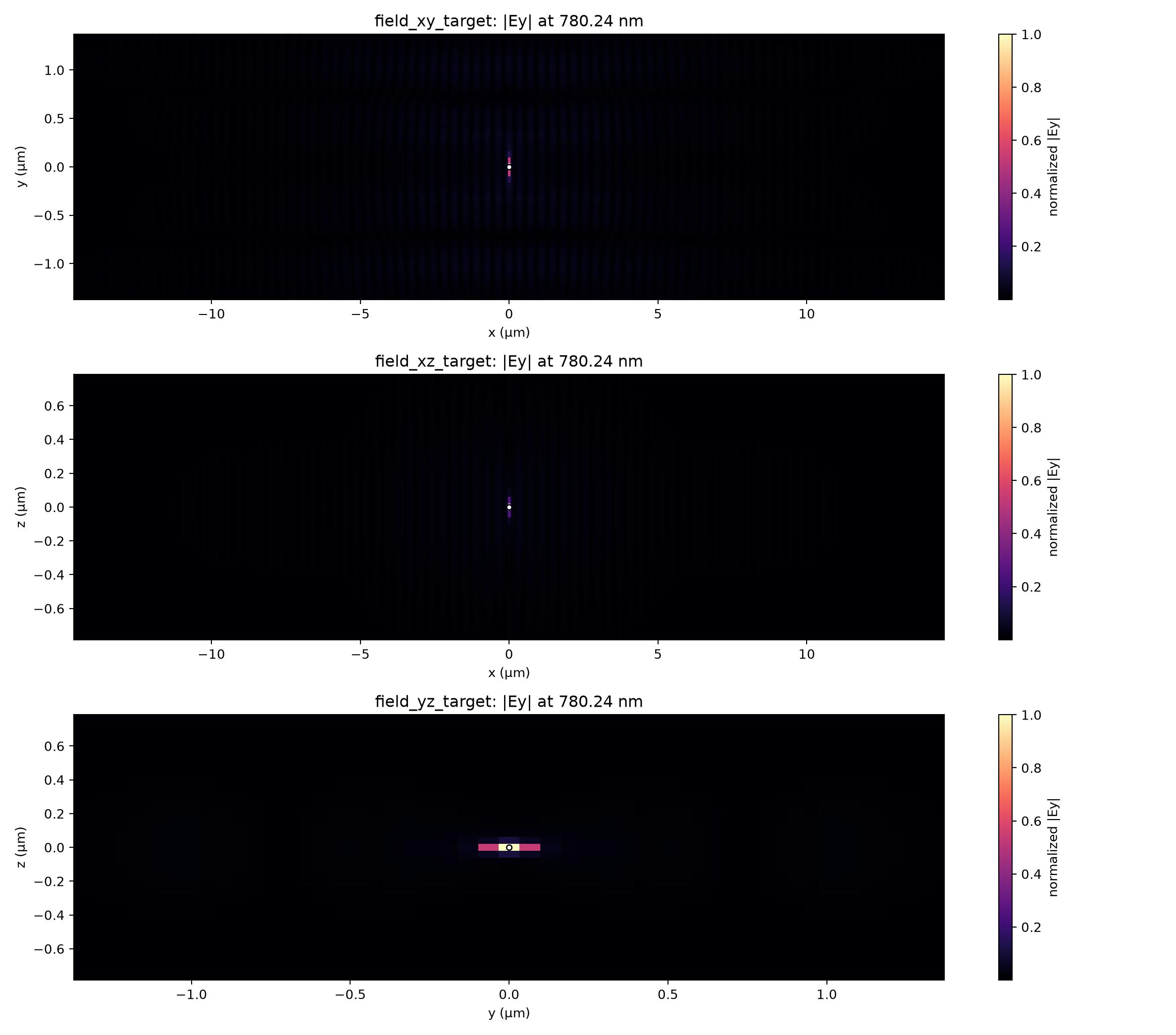
Final M16 mesh and domain/PML robustness gates pass
Evidence label: completed paid broadband numerical validation. This is strong evidence for the pole wavelength and Q of the simulated ideal geometry. It does not measure mode volume, atom coupling, Purcell enhancement, port branching, or emitter β.
The fixed-domain Auto-22 grid has 31.034M cells; the expanded
Auto-22/PML-16 grid has 66.131M. Both preserve 16 ps, shutoff 1e-9, zero
mesh overrides, two connected rails, and the 0.75 µm open slot.
| Validation row | Task and cost | Pole | Probe / duration evidence |
|---|---|---|---|
| Auto-20 | fdve-7132d5bb-670c-4d78-af1d-32831ced8130; 0.277328 FC actual / 0.316764 max |
λ=780.1448 nm, Q=3,542.42 | Q span 0.02793%; 4.733 lifetimes |
| Auto-22 | fdve-7e135e7f-c952-41c6-9145-51d20d44f773; 0.334657 FC actual / 0.440129 max |
λ=779.9857 nm, Q=3,555.33 | Q span 0.01646%; 4.091 lifetimes |
| Auto-24 | fdve-fa4d33e0-3219-440f-84ee-7de9503f95f7; 0.495668 FC actual / 0.600007 max |
λ=779.6484 nm, Q=3,585.03 | Q span 0.02930%; 4.413 lifetimes |
| expanded Auto-22/PML-16 | fdve-f8b31577-b4c0-4ccf-a91a-122d53c78e25; 0.716993 FC actual / 0.909235 max |
λ=779.9809 nm, Q=3,555.32 | Q span 0.02920%; 4.244 lifetimes |
| Promotion gate | Measured | Limit | Result |
|---|---|---|---|
| three-mesh wavelength span | 0.063644% | ≤0.5% | pass |
| three-mesh Q span | 1.19675% | ≤5% | pass |
| worst tested Q | 3,542.42 | ≥1,000 | pass |
| expanded-domain wavelength change | 0.000611% | ≤0.5% | pass |
| expanded-domain Q change | 0.000286% | ≤5% | pass |
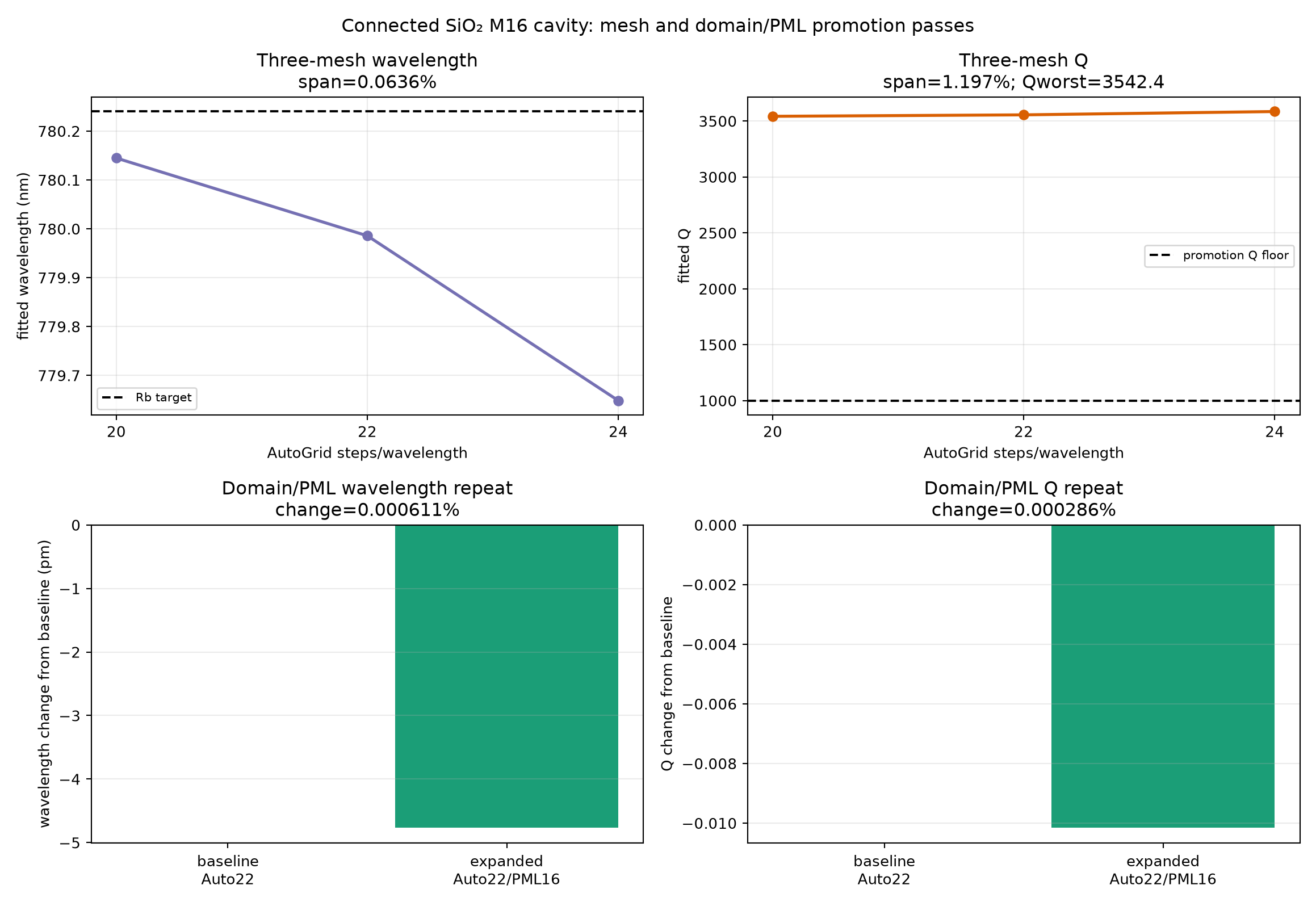
The expanded-domain result is nearly identical to the ordinary Auto-22 result, and every trace covers at least four fitted field-amplitude lifetimes. The appropriate conclusion is narrow but useful: the ideal M16 cavity's broadband pole and Q are numerically robust under the tested mesh, domain, and PML changes. It is not yet evidence that an atom sees a small mode volume or a large β.
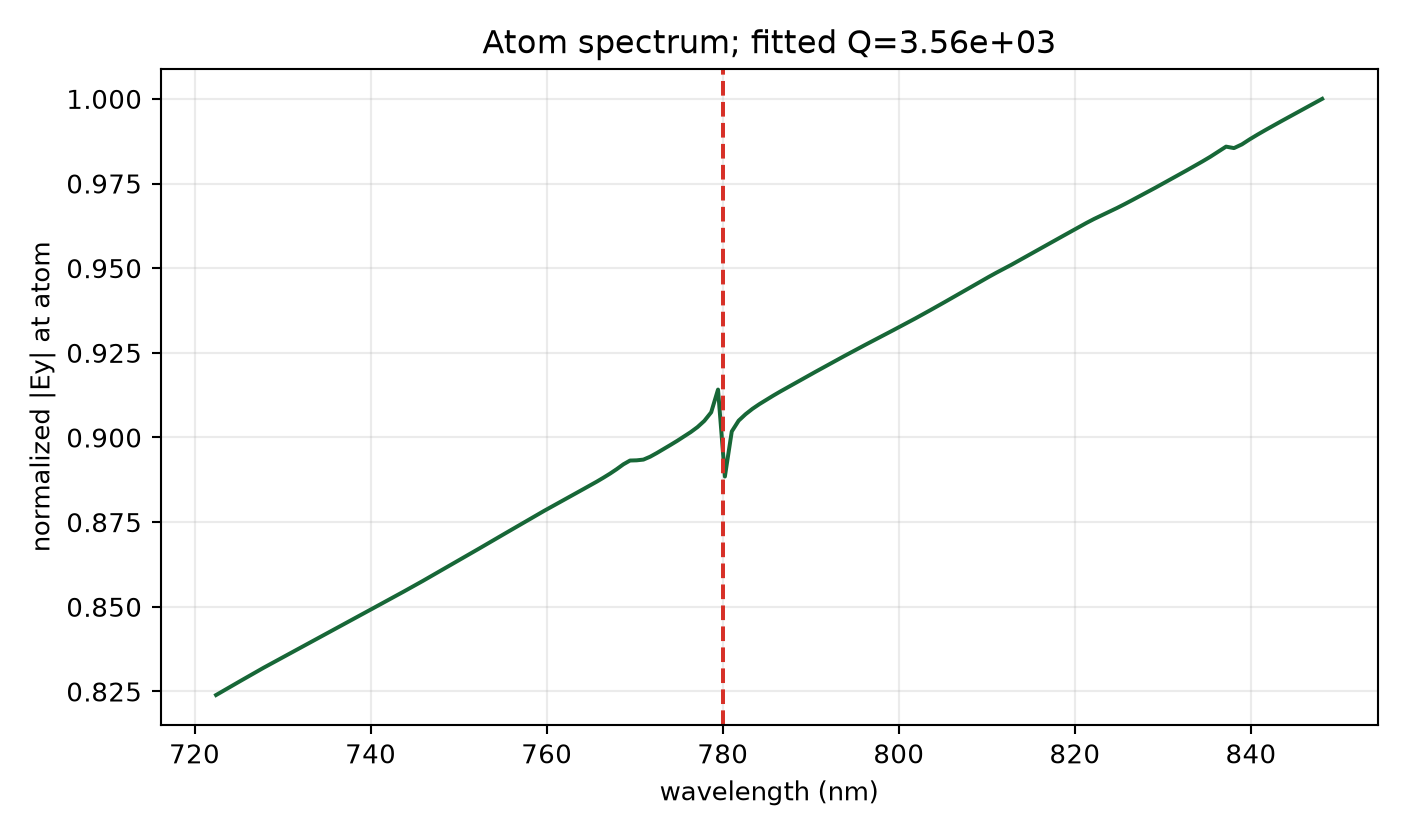
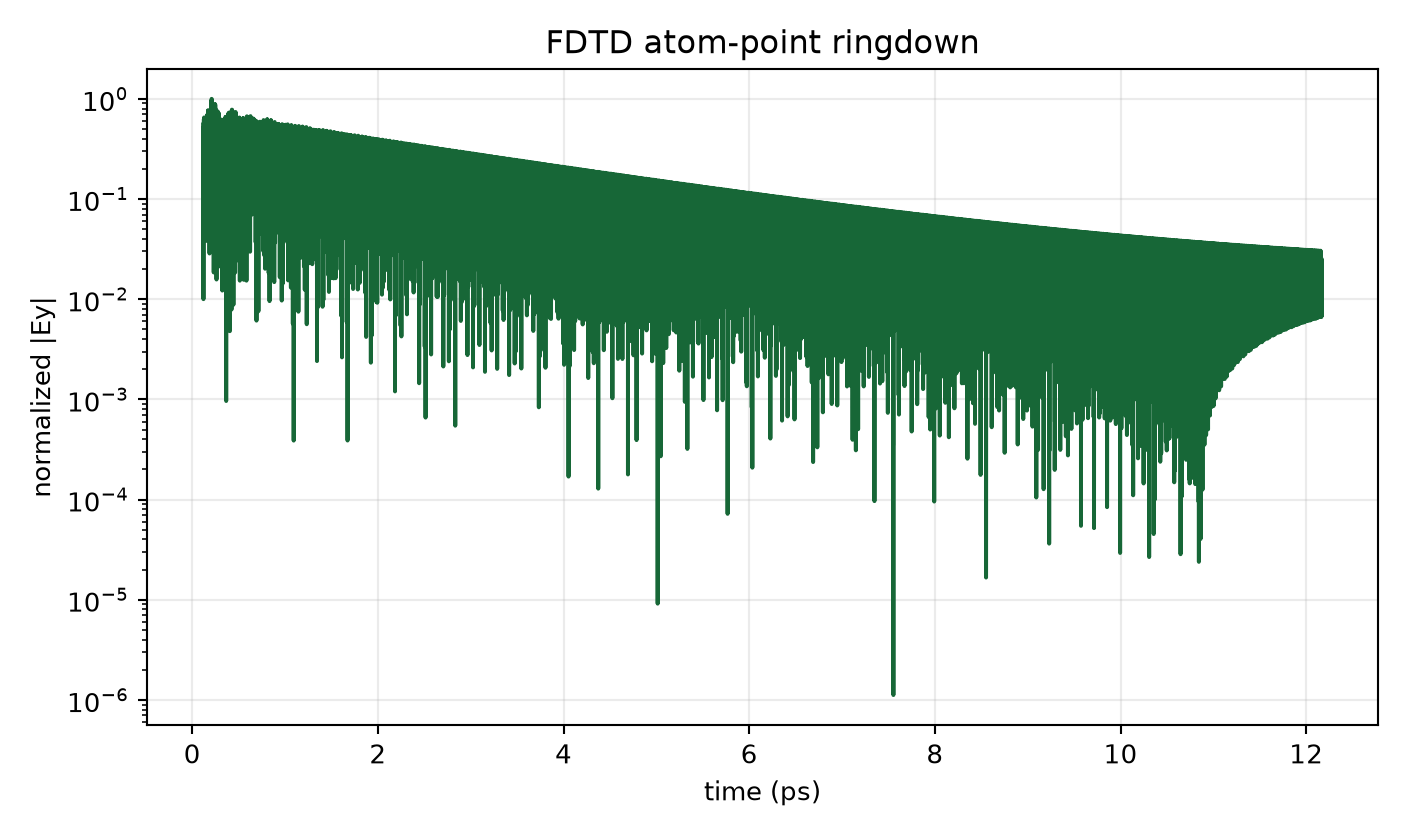
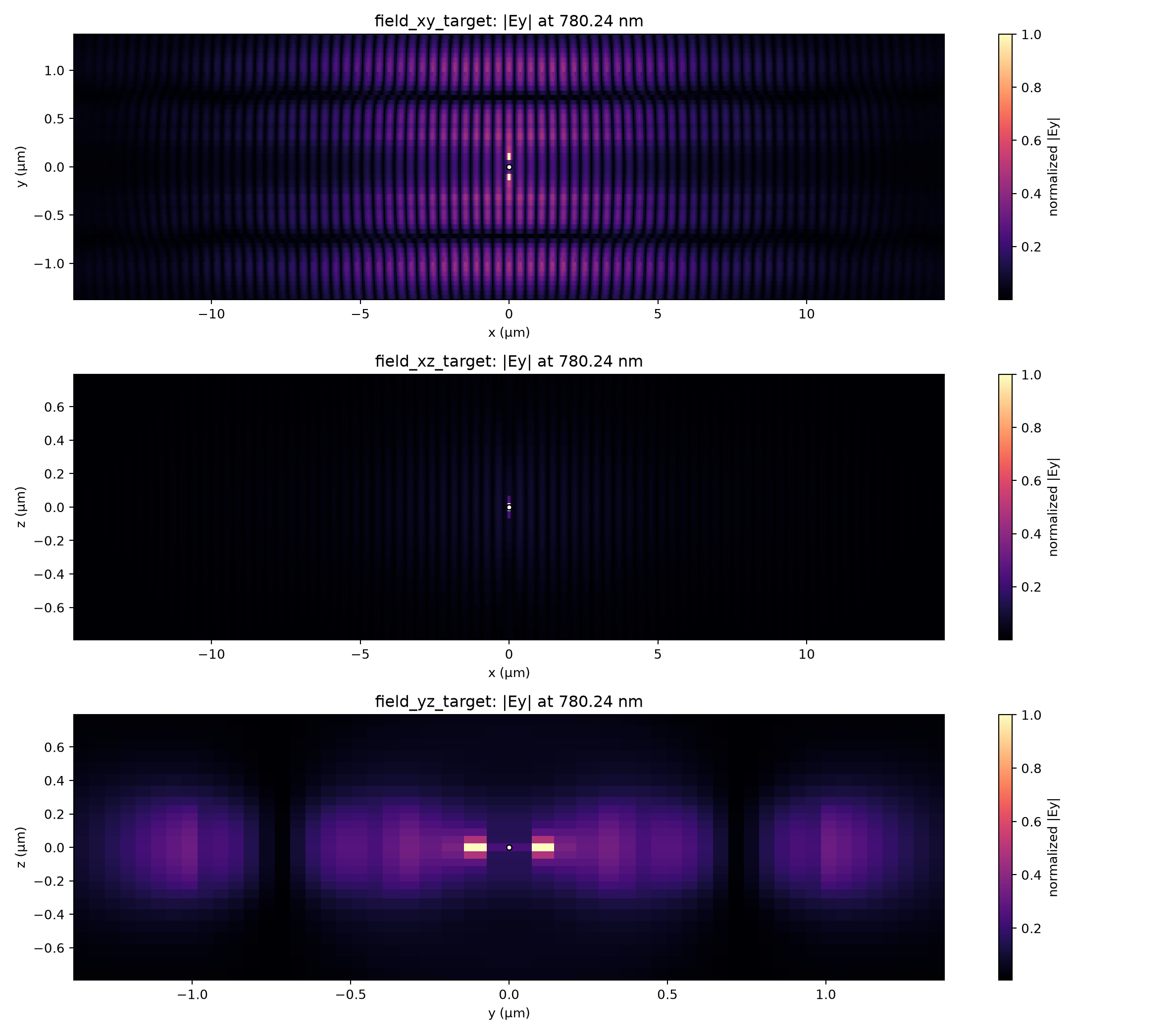
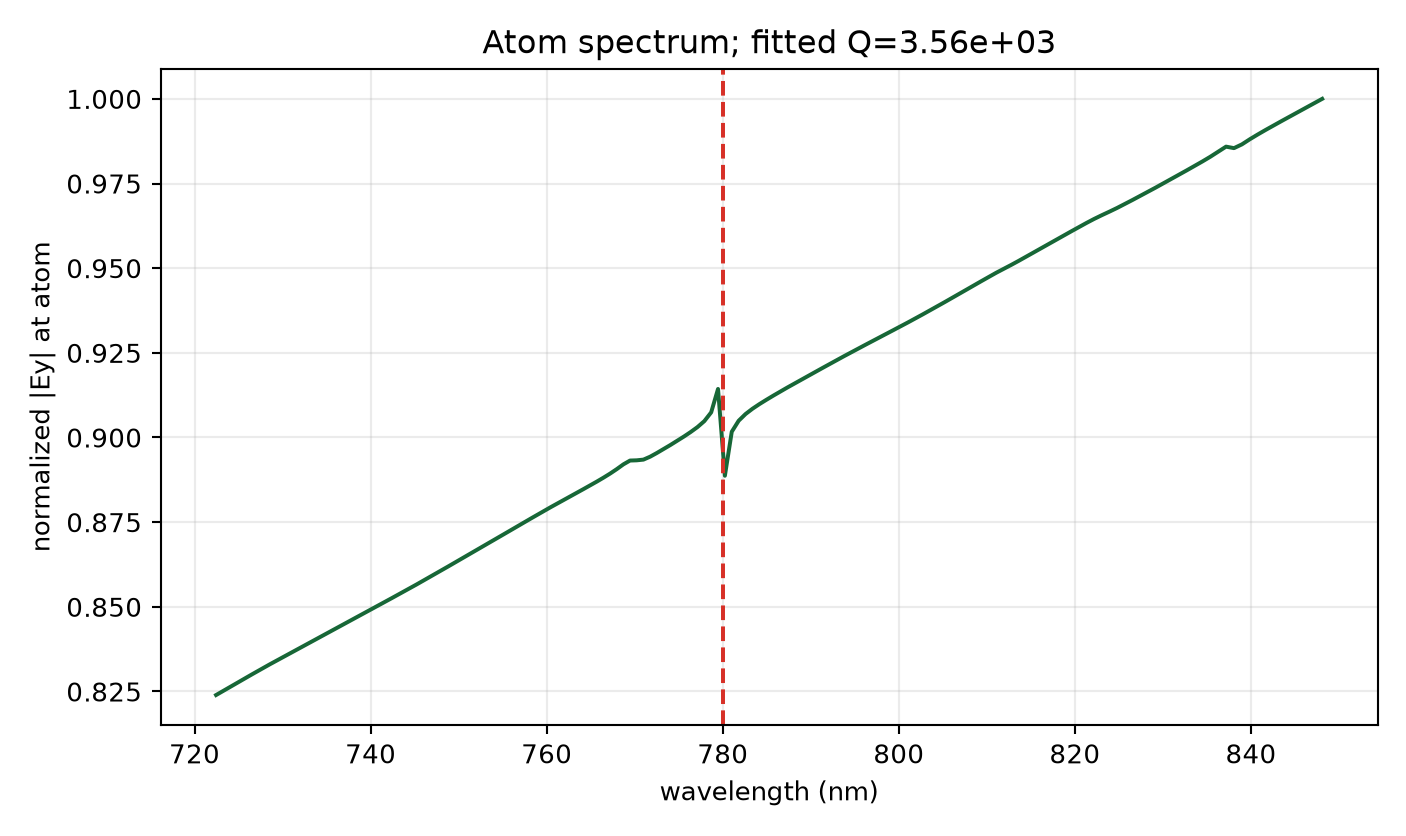
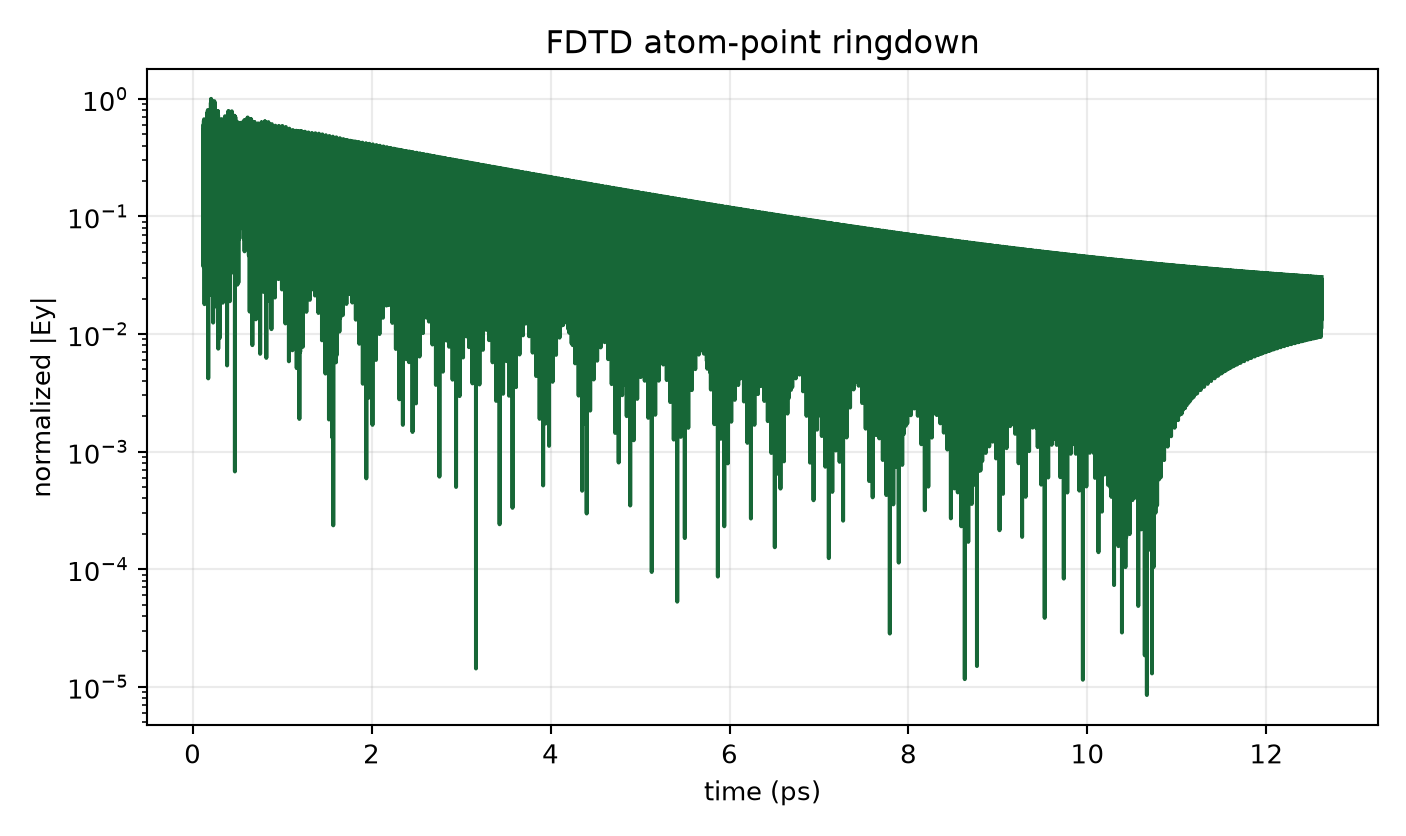
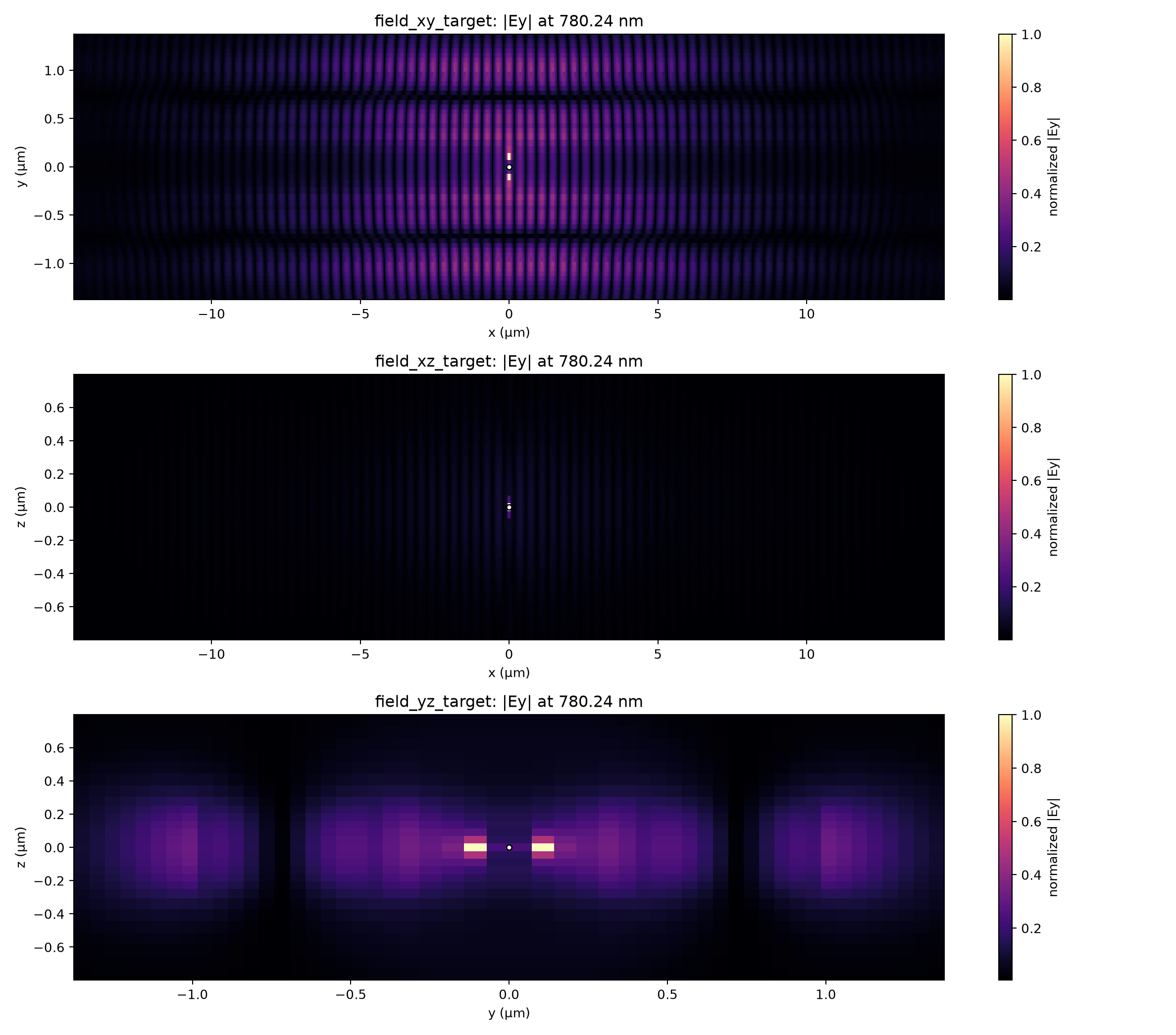
Exact-pole v1 passes closure but fails mode-volume stability
Evidence label: completed paid exact-pole diagnostic; informative negative
for mode volume. Task fdve-4cbf80ae-02eb-4991-aaea-acebb6dee34a cost
0.629487 FC actual / 0.827878 FC maximum. It used Auto-22, 16 ps, automatic
shutoff 1e-9, 12 PML layers, no mesh override, and a full-volume field
monitor.
The resonance itself is exceptionally consistent with broadband FDTD:
λ=779.98574 nm and Qring=3,555.323, with only 0.04261% cross-probe Q
spread. Both windows independently pass the frequency, energy-balance, signed
flux, nested-box, and Q-closure checks.
| Exact quantity | Early window | Main window | Gate |
|---|---|---|---|
| atom/peak mode volume | 0.515405 µm³ = 1.08615 λair³ | 0.646505 µm³ = 1.36242 λair³ | fail: 20.278% drift >5% |
| flux-derived Q | 3,468.196 | 3,485.163 | pass |
Qflux/Qring |
0.97549 | 0.98027 | pass: within 20% |
| electric/magnetic energy | 1.01250 | 1.01243 | pass: within 20% |
| x-axis leakage fraction | 0.72178 | 0.72534 | descriptive only; not β |
The v1 transient-contaminated windows make the atom appear to be the global
ε|E|² maximum. The integrated field energy continues to change while the
local field denominator is nearly settled; v2 later proves that this apparent
atom maximum was not the cavity pole. That is exactly the failure the
early/main-window test is designed to catch. Neither v1 volume value is
trustworthy enough to promote, and no Purcell factor should be formed from
them.
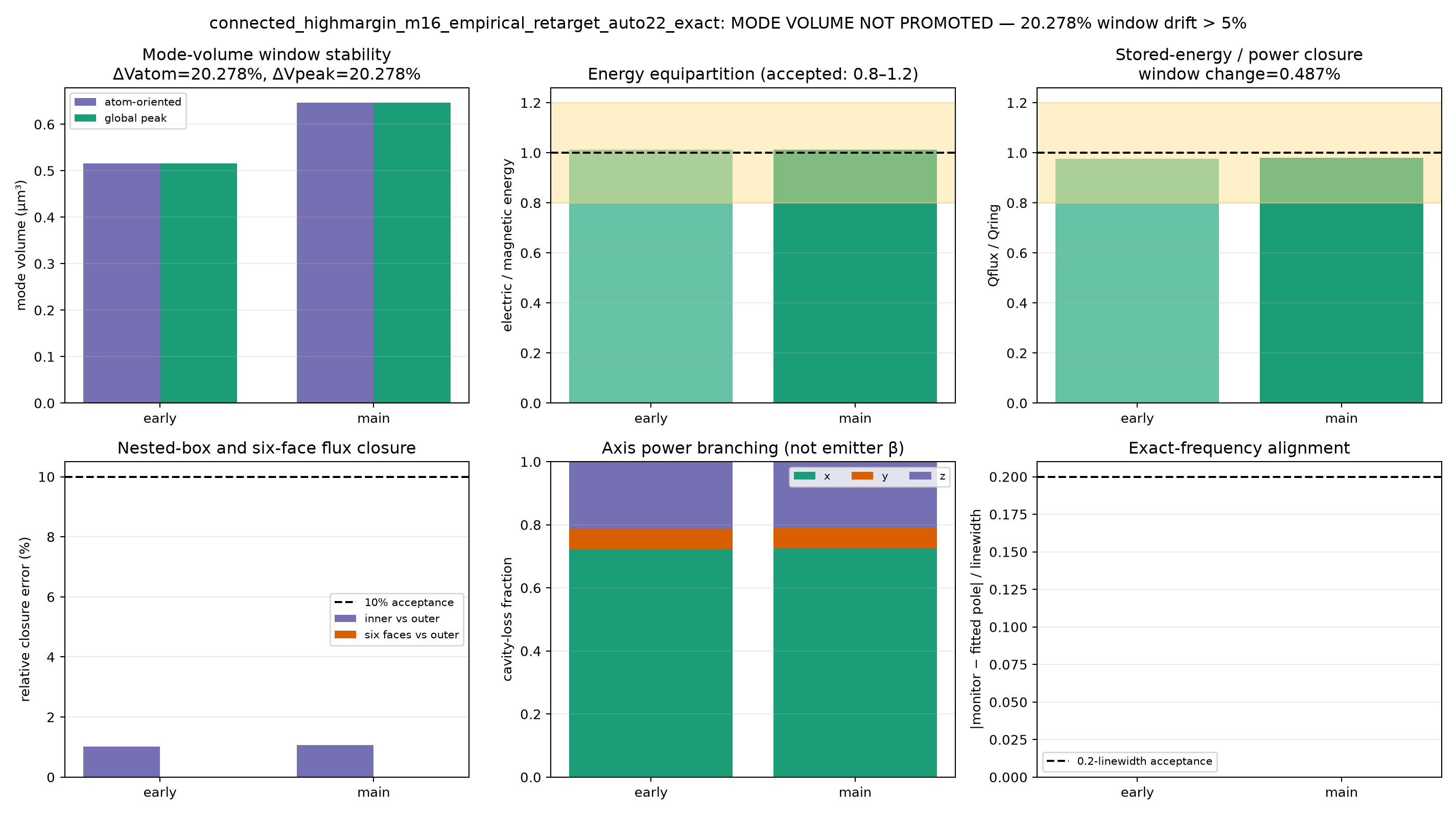
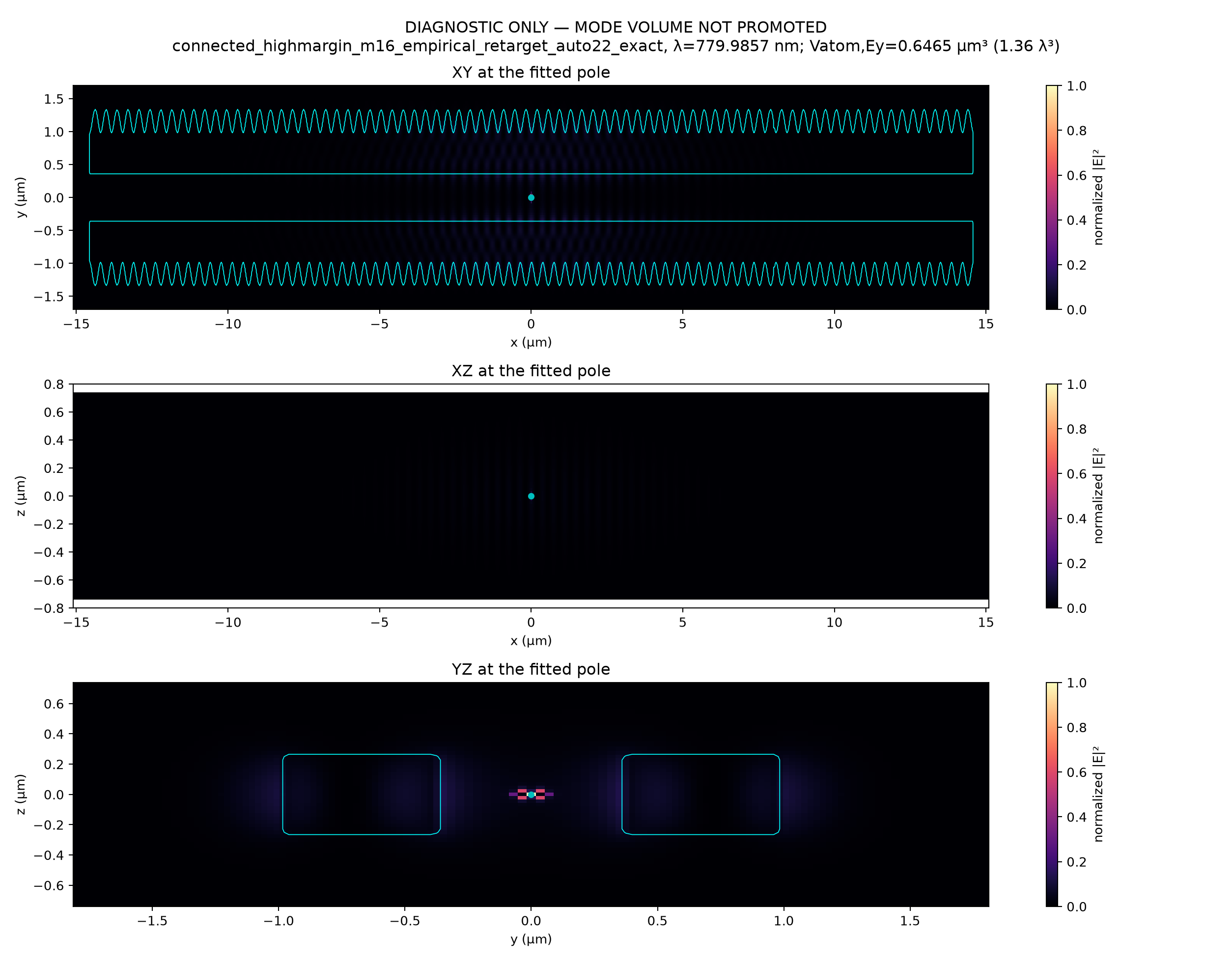
Exact-pole v2 passes numerically; geometry fails atom overlap
Evidence label: completed paid exact-pole observable on the passing Auto-22 geometry, after external broadband mesh/domain/PML promotion. The method and time-window evidence is strong; exact V was not repeated on a second mesh because the resulting overlap is too poor to justify more spending.
V2 tests the hypothesis that v1's common 0.25 ps start admitted broadband
transients. It moves both windows to a common source-free 2 ps start: early
2–8 ps and main 2–12 ps, each with 0.2 ps apodization. Everything else is
held fixed: λ=779.9857 nm monitor, Auto-22, 16 ps, shutoff 1e-9, 12 PML
layers, 31.034M grid cells, no overrides, and the same full-volume monitor.
| V2 exact quantity | Early window | Main window | Result |
|---|---|---|---|
| atom-oriented mode volume | 23.50387 µm³ = 49.5313 λair³ | 23.50496 µm³ = 49.5336 λair³ | pass: 0.00464% drift |
| global-peak mode volume | 3.506247 µm³ | 3.506240 µm³ | pass: 0.000193% drift |
Vatom/Vpeak |
6.70343 | 6.70375 | atom is far from modal maximum |
| flux-derived Q | 3,540.699 | 3,540.476 | pass |
Qflux/Qring |
0.995887 | 0.995824 | pass |
| x-axis cavity-loss fraction | 0.73755 | 0.73751 | stable; not emitter β |
All implemented frequency-alignment, electric/magnetic energy-balance, nested-box, signed-six-face, and Q-closure gates pass. The exact monitor is only 0.000292 fitted linewidth from the broadband pole; main-window electric/magnetic energy is 1.01223, and the inner/outer flux mismatch is 1.534%.
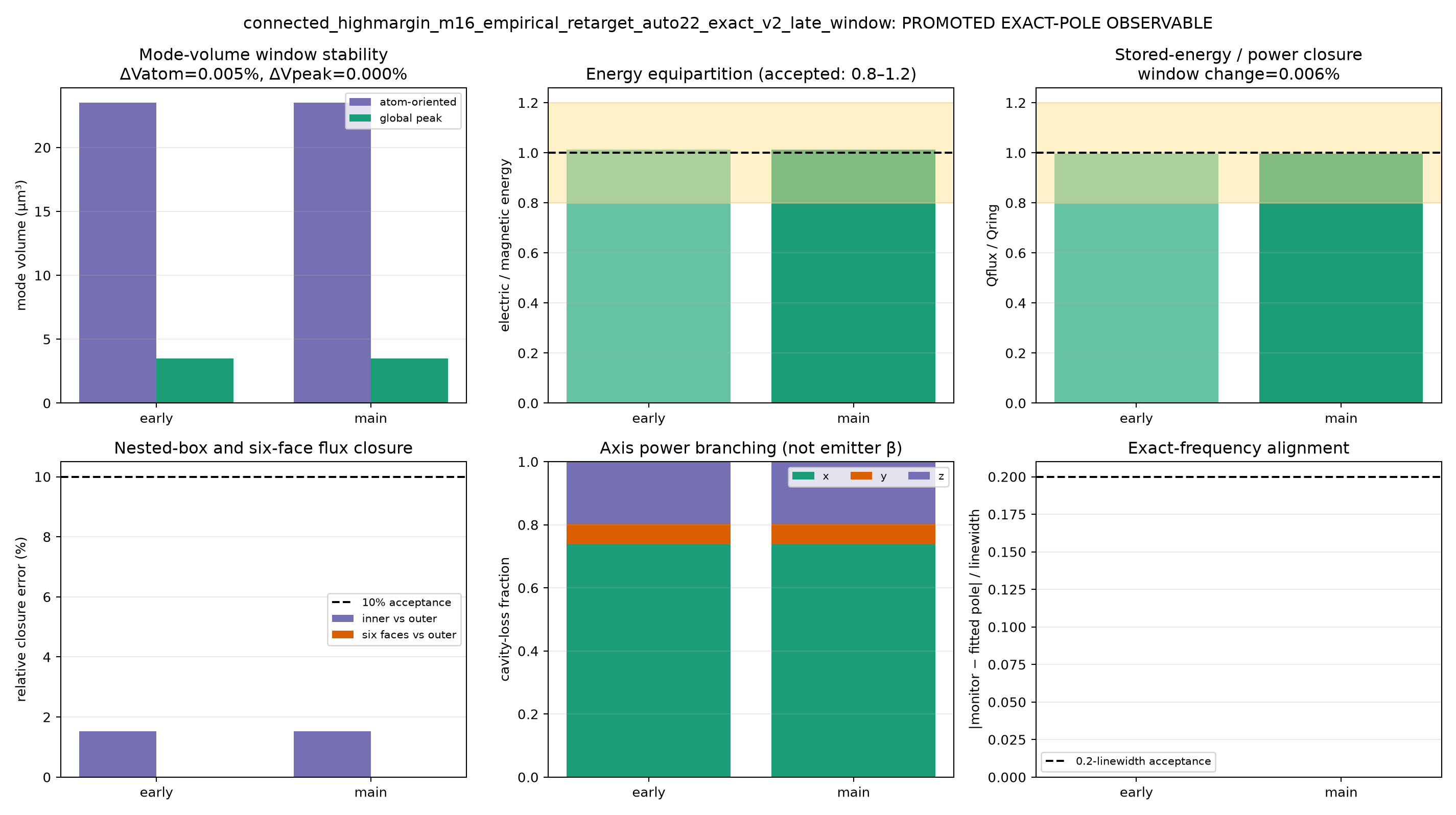
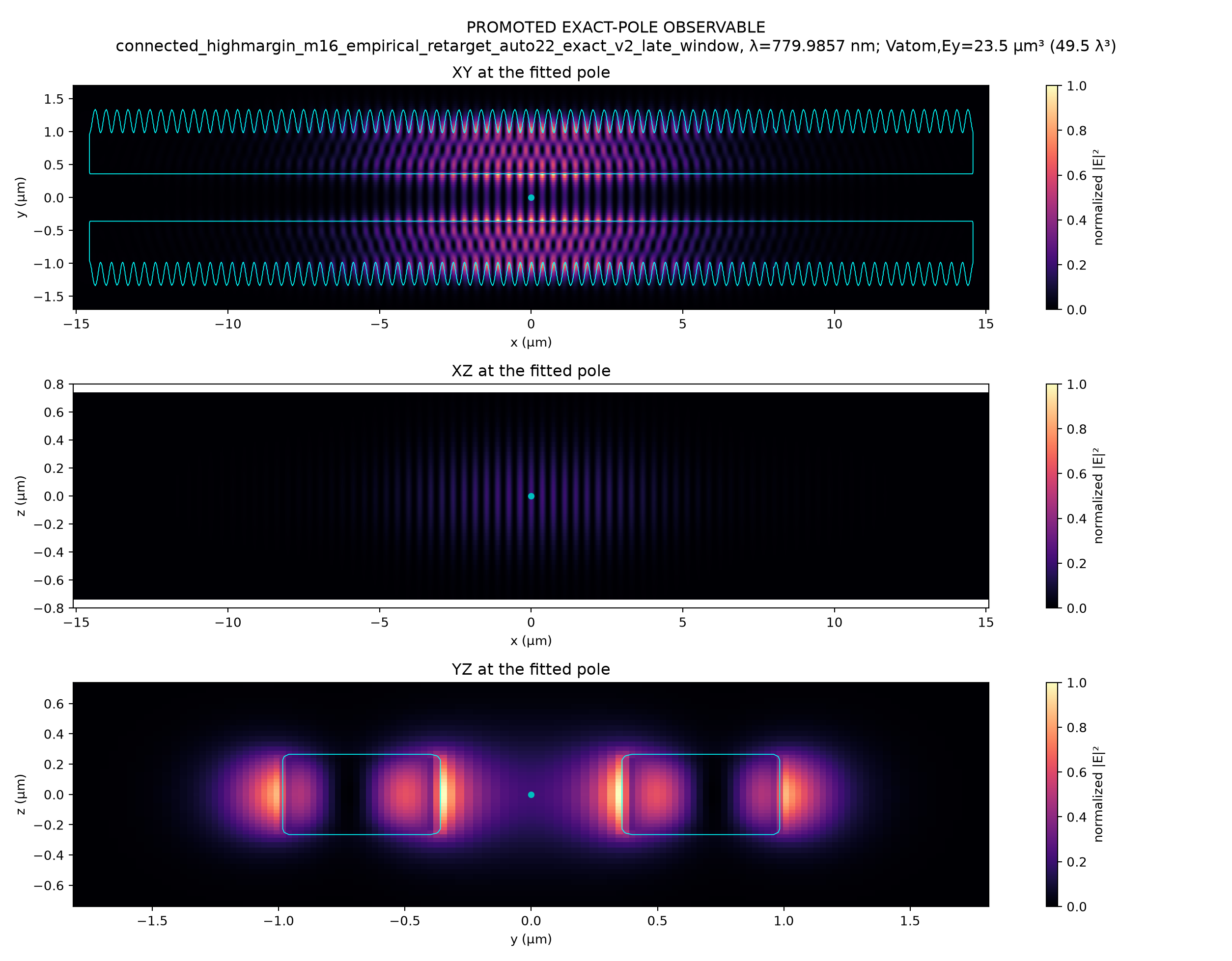
This is a trustworthy negative FDTD design finding. The old connected-MPB
metric of 0.974 is not a valid comparator: the centroid-semantics error gave
that MPB model an effective approximately 0.07492 µm slot. The finite
0.75 µm-slot cavity's exact ε|E|² at the atom is about
1/6.704=0.149 of its global maximum. Correct the MPB placement and rerun the
periodic bands, fields, mirror γ, and taper logic locally before diagnosing
any residual finite-cavity phase effect or spending on β.
Even a future passing exact result will provide cavity mode volume and cavity-axis power branching, not emitter β. Axis branching asks where energy already in the cavity leaks. Emitter β asks what fraction of all power emitted by an atom enters the chosen cavity/guided channel, which still requires a dipole-source calculation, a matched structured-background reference, and a guided-mode decomposition.
Public evidence:
- urgent connected-profile MPB centroid-semantics erratum
- geometry/grid representation audit
- broader-band connected-geometry redshift diagnostic
- scaled retarget failure and cross-probe pole clusters
- reproducible broader-band diagnostic
- MPB/FDTD connected-geometry semantics audit
- coarse canonical connected-profile MPB screen
- rank-1 r10/r14, padding, and near-X validation
- prepared connected N24+M8 FDTD pair and gates
- connected Auto-14/20 mesh-pair rejection
- prepared connected-cavity cell sequence
- Auto-14 connected-cavity variant
- Auto-14 connected-cavity configuration
- serialized Auto-14 connected-cavity simulation
- Auto-14 connected-cavity negative result
- Auto-20 connected-cavity variant
- Auto-20 connected-cavity configuration
- serialized Auto-20 connected-cavity simulation
- Auto-20 connected-cavity negative result
- FDTD-aware connected-period calibration
- prepared control-first retarget robustness sequence
- original Auto-24 control geometry cells
- original Auto-24 control variant
- original Auto-24 control configuration
- serialized original Auto-24 control
- original Auto-24 control result
- retargeted Auto-20 geometry cells
- retargeted Auto-20 variant
- retargeted Auto-20 configuration
- serialized retargeted Auto-20 simulation
- retargeted Auto-20 result
- retargeted Auto-24 geometry cells
- retargeted Auto-24 variant
- retargeted Auto-24 configuration
- serialized retargeted Auto-24 simulation
- retargeted Auto-24 result
- retargeted Auto-20/24 pair summary
- reproducible FDTD/MPB calibrator
- reproducible robustness preparer
- budgeted control-first robustness runner
- prepared third-mesh/domain promotion sequence
- Auto-22 third-mesh geometry cells
- Auto-22 third-mesh variant
- Auto-22 third-mesh configuration
- serialized Auto-22 third-mesh simulation
- Auto-22 third-mesh result
- expanded Auto-22 geometry cells
- expanded Auto-22 variant
- expanded Auto-22 configuration
- serialized expanded Auto-22 simulation
- expanded Auto-22 result
- combined third-mesh/domain robustness result
- blocked exact-observables handoff
- reproducible promotion preparer
- budgeted serial promotion runner
- high-margin rank-5 r14 MPB validation
- reproducible high-margin MPB validator
- high-margin FDTD-aware retarget calibration
- prepared bounded high-margin screen
- high-margin M12 geometry cells
- high-margin M12 variant
- high-margin M12 configuration
- serialized high-margin M12 simulation
- high-margin M12 result
- high-margin M16 geometry cells
- high-margin M16 variant
- high-margin M16 configuration
- serialized high-margin M16 simulation
- high-margin M16 result
- combined M12/M16 screen summary
- reproducible high-margin calibrator
- reproducible high-margin FDTD preparer
- budgeted high-margin FDTD runner
- reproducible M12/M16 summarizer
- M16 geometry-specific empirical retarget
- prepared M16 own-bias Auto-20/24 pair
- M16 own-bias Auto-20/24 pair result
- M16 own-bias Auto-20 geometry cells
- M16 own-bias Auto-20 variant
- M16 own-bias Auto-20 configuration
- serialized M16 own-bias Auto-20 simulation
- M16 own-bias Auto-20 result
- M16 own-bias Auto-24 geometry cells
- M16 own-bias Auto-24 variant
- M16 own-bias Auto-24 configuration
- serialized M16 own-bias Auto-24 simulation
- M16 own-bias Auto-24 result
- reproducible M16 empirical calibrator
- reproducible own-bias pair preparer
- budgeted own-bias pair runner
- reproducible own-bias pair summarizer
- prepared M16 third-mesh/domain promotion workflow
- M16 Auto-22 third-mesh result
- M16 expanded-domain/PML-16 result
- combined M16 broadband promotion audit
- M16 exact-pole v1 preparation
- serialized M16 exact-pole v1 simulation
- M16 exact-pole v1 handoff
- M16 exact-pole v1 result; mode-volume window gate fails
- prepared M16 exact-pole v2 late-window workflow
- M16 exact-pole v2 monitor preparation
- serialized M16 exact-pole v2 simulation
- M16 exact-pole v2 handoff
- M16 exact-pole v2 stable negative-overlap result
- reproducible M16 promotion preparer
- budgeted serial M16 promotion runner
- prepared robustness screen and gates
- reproducible robustness preparer
- grouped Auto-14 provenance
- grouped Auto-14 configuration
- serialized grouped Auto-14 simulation
- prepared but intentionally unrun grouped Auto-20 control
- N32-box Auto-20 variant
- N32-box Auto-20 configuration
- serialized N32-box Auto-20 simulation
- N32-box Auto-20 result
- N32-union Auto-14 variant
- N32-union Auto-14 configuration
- serialized N32-union Auto-14 simulation
- prepared but intentionally unrun N32-union Auto-20 variant
- N24 smooth Auto-14 variant
- N24 smooth Auto-14 configuration
- serialized N24 smooth Auto-14 simulation
- prepared unscaled N24 smooth Auto-20 variant
- scaled N24 smooth Auto-14 variant
- scaled N24 smooth Auto-14 configuration
- serialized scaled N24 smooth Auto-14 simulation
- scaled N24 smooth Auto-20 variant
- scaled N24 smooth Auto-20 configuration
- serialized scaled N24 smooth Auto-20 simulation
- scaled N24 smooth Auto-20 result
- budgeted robustness runner
Expanded-domain/PML repeat — broadband gate passes
Evidence label: completed Auto-14 broadband domain/PML diagnostic. It supports the existing domain clearance for the broadband pole; it does not repair the failed mesh gate or establish exact-pole volume convergence.
| Quantity | N40 Auto-14 baseline | Expanded domain/PML | Difference |
|---|---|---|---|
air padding (x,y,z) |
(1.5,1.35,1.25) µm |
(2.5,2.35,2.25) µm |
+1 µm each side |
| PML layers | 12 | 16 | +4 |
| fitted wavelength | 781.652047 nm | 781.654995 nm | +0.002948 nm |
| ringdown Q | 19,562.52 | 19,596.17 | +0.1717% |
| fitted lifetimes observed | 0.9781 | 0.9764 | comparable |
| three-probe Q span | 0.02016% | 0.01955% | comparable |
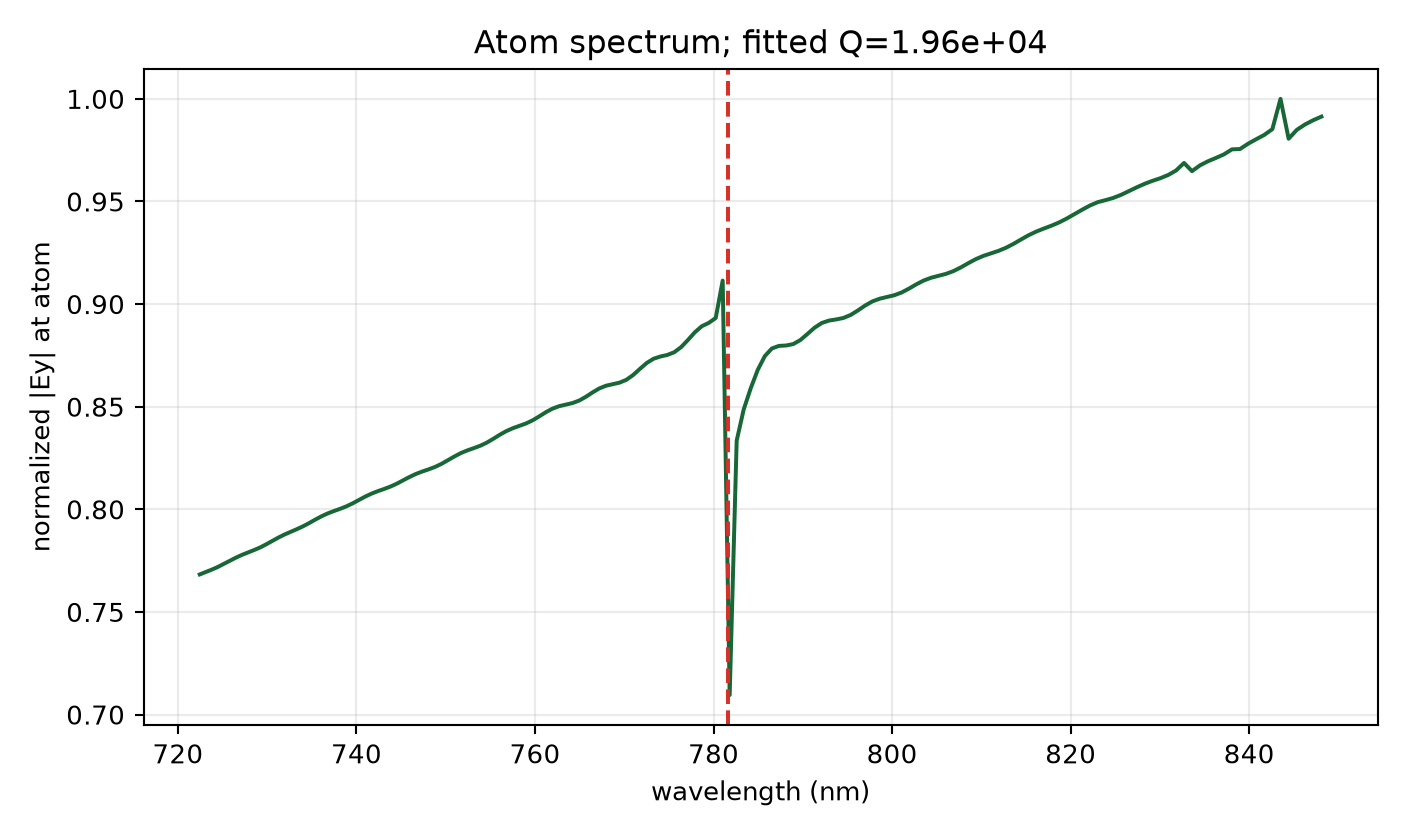
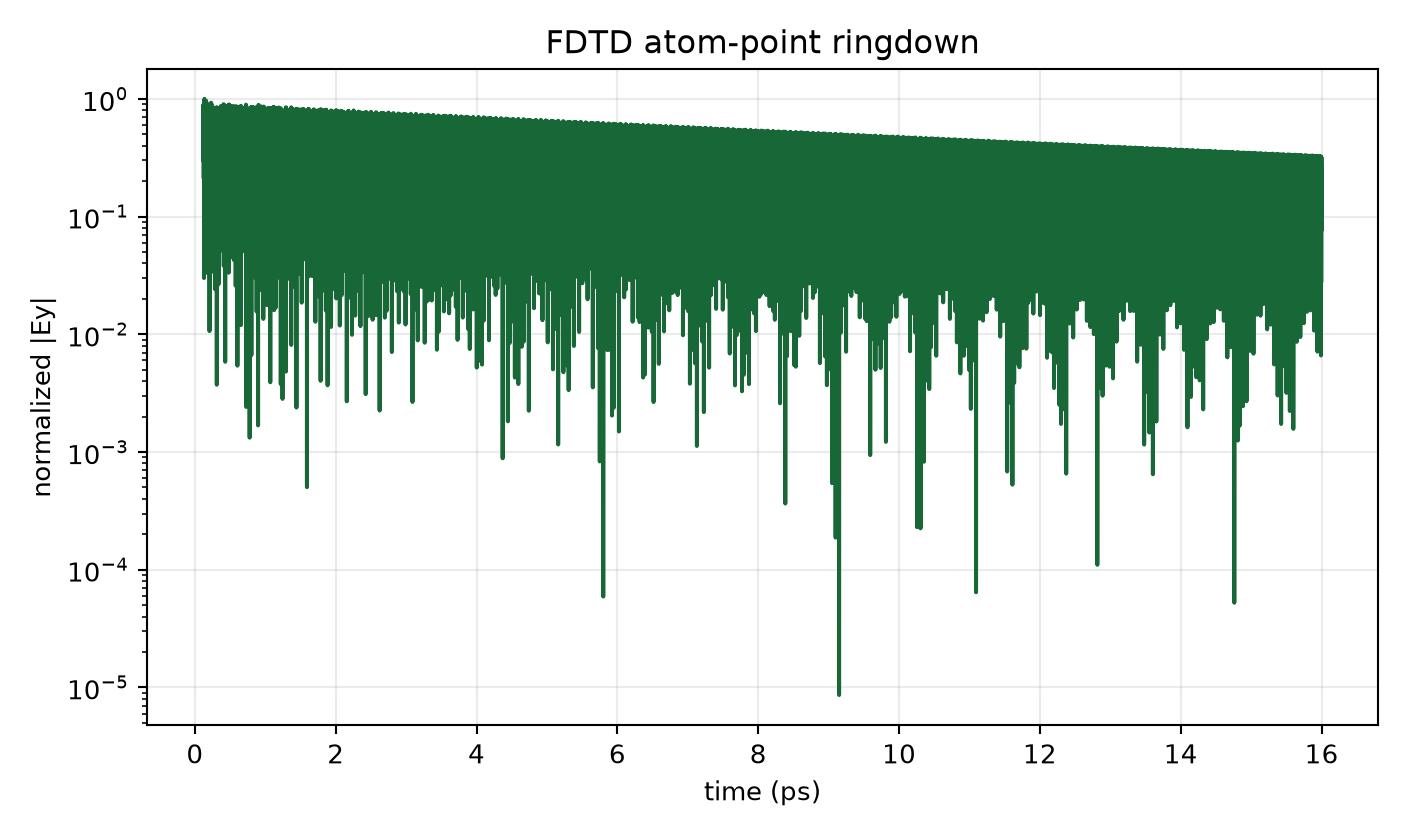
Both Q and wavelength are essentially unchanged after a substantial clearance and PML increase, and all broadband internal checks pass. The original domain/PML is therefore adequate for this broadband comparison at Auto-14. That conclusion is deliberately narrow: the Auto-14→Auto-16 mesh result is still a 30.38% failure, and an exact-pole field/volume check on the ultimately selected mesh remains required.
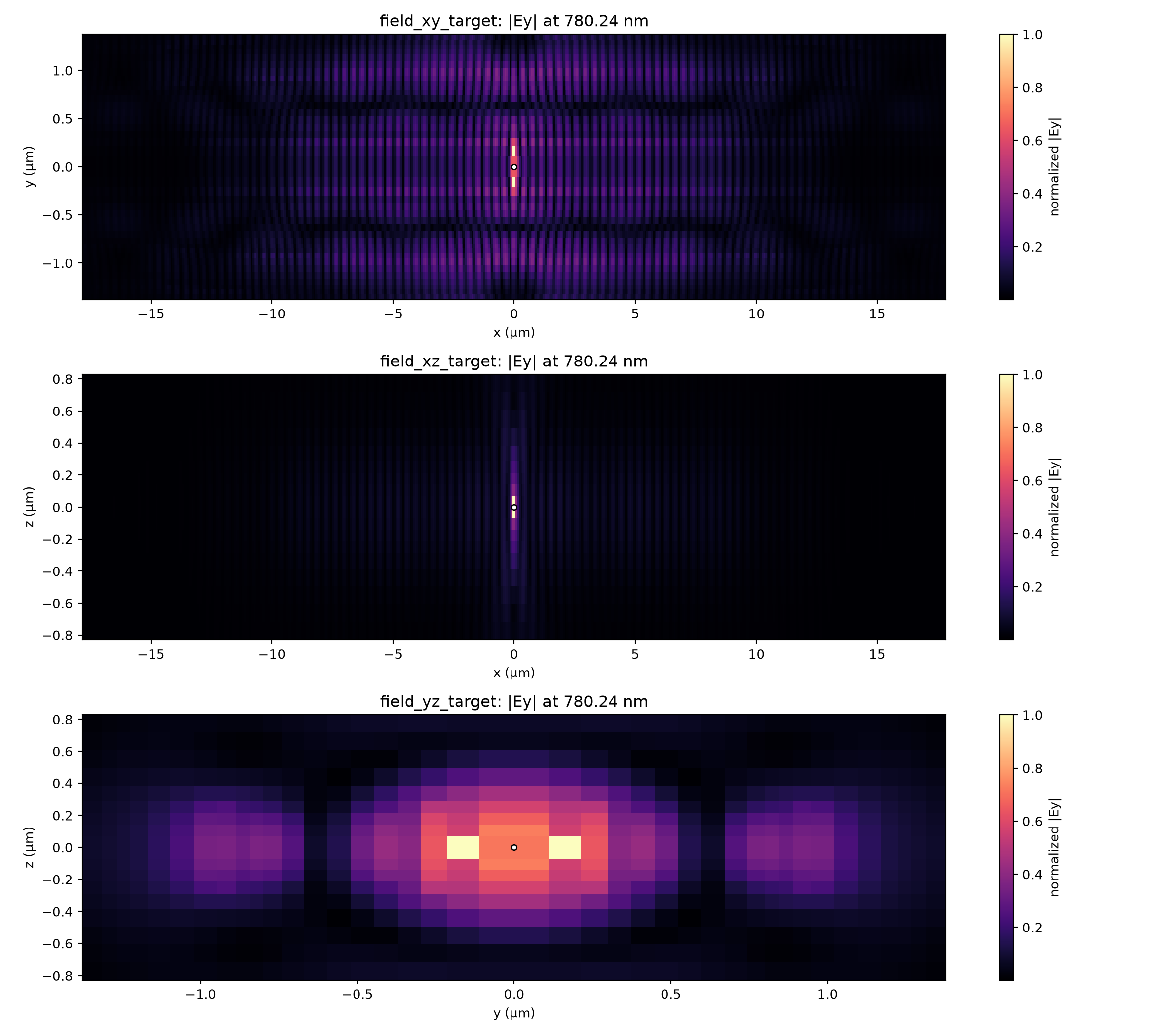
N32 lower-side taper diagnostic — Q collapses
Evidence label: completed Auto-14 broadband taper-length diagnostic. It proves N32 is not long enough for this low-radiation cavity; it cannot establish the upper-side convergence of N40.
| Quantity | N40 Auto-14 baseline | N32 Auto-14 | Difference |
|---|---|---|---|
| taper cells per side | 40 | 32 | −8 |
| fitted wavelength | 781.652047 nm | 781.195825 nm | −0.456222 nm |
| ringdown Q | 19,562.52 | 3,951.97 | −79.80% |
| fitted lifetimes observed | 0.9781 | 3.5468 | much stronger time basis |
| three-probe Q span | 0.02016% | 0.22068% | internally consistent |
| actual stop time | 16.000 ps | 11.746 ps | automatic shutoff |
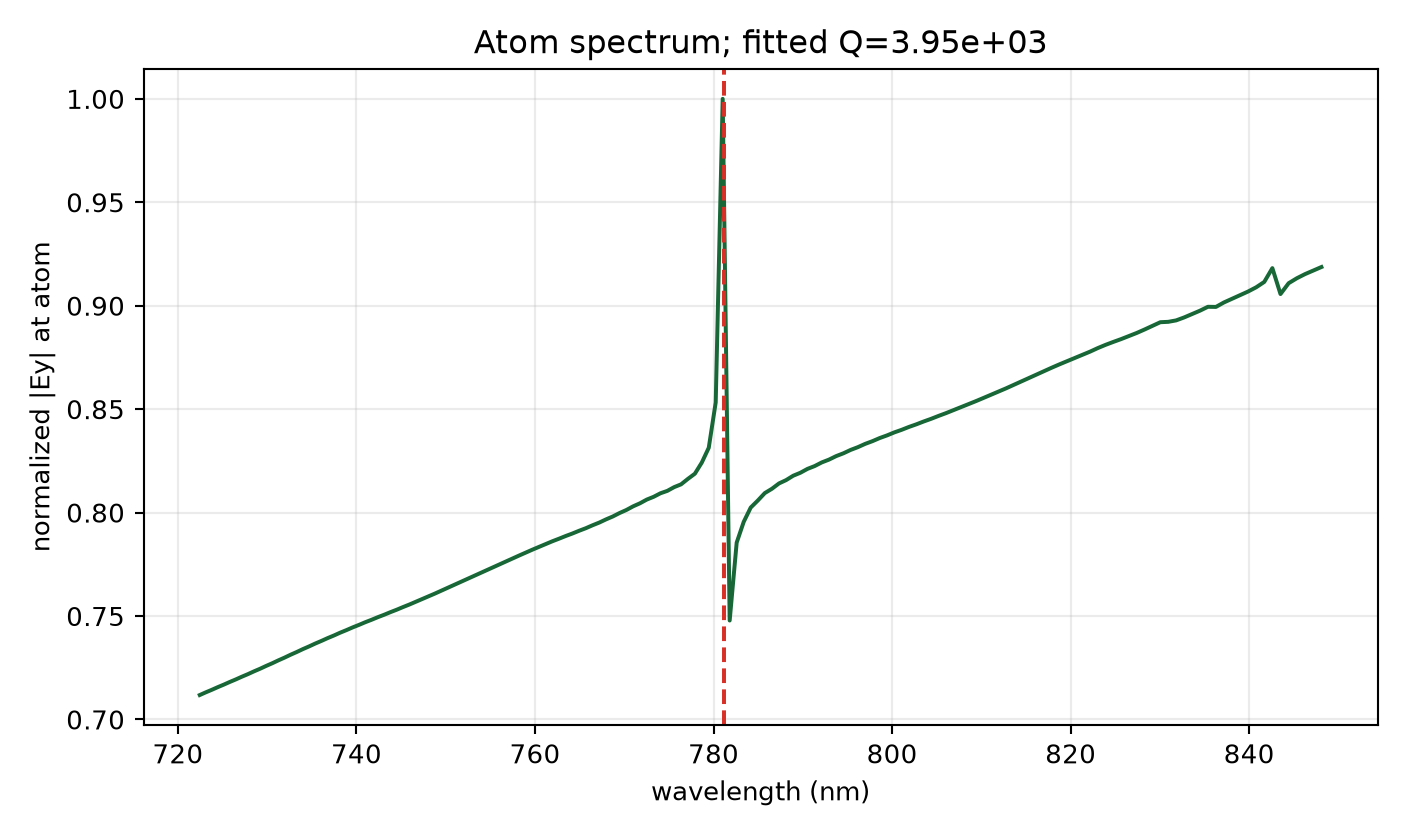
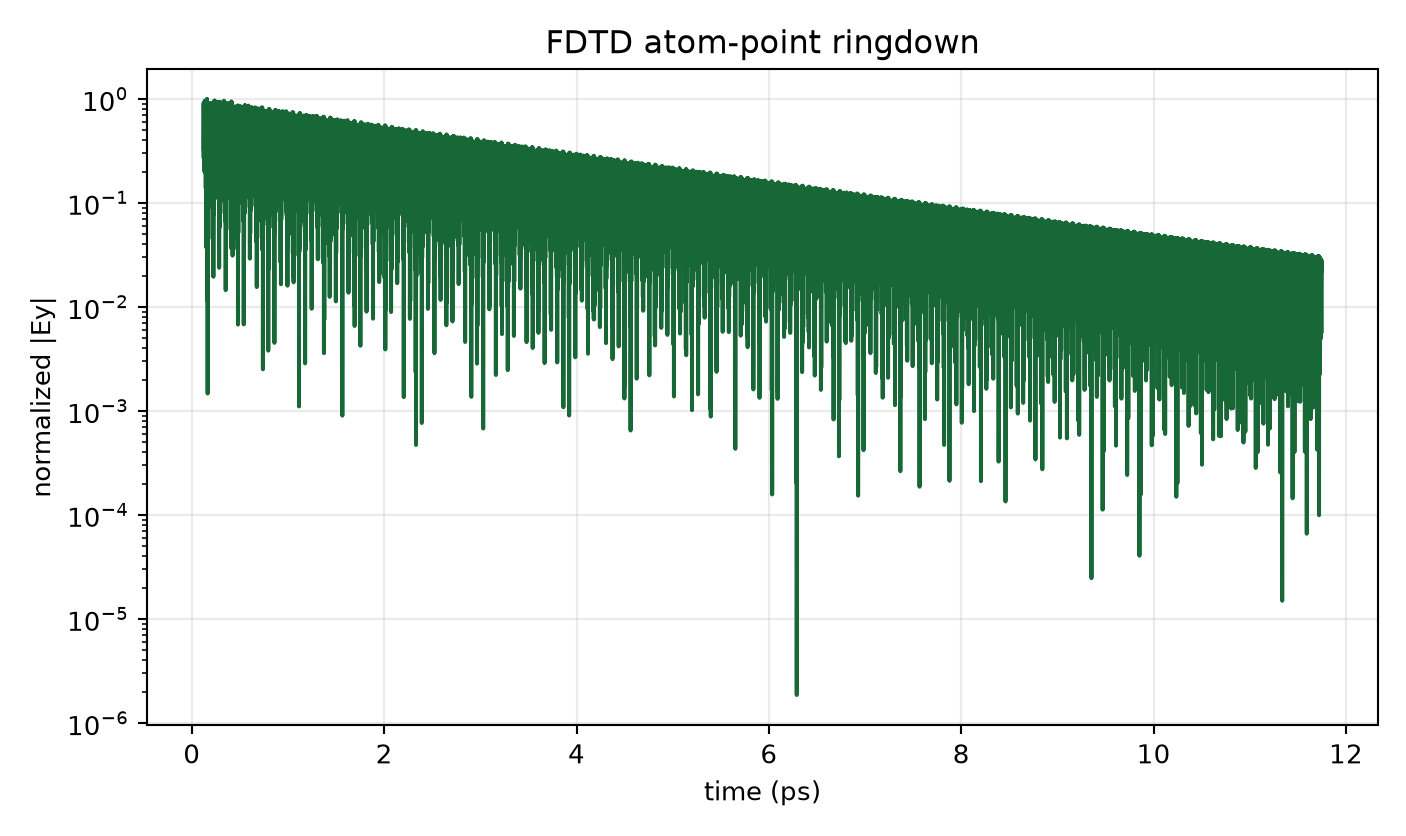
The lower Q is sampled across 3.55 fitted amplitude lifetimes and the three probes recover the same pole, so the collapse is not a short-record artifact. It shows that radiation loss remains very sensitive to taper length below N40. Only N48 can test whether N40 is on the upper-side plateau.
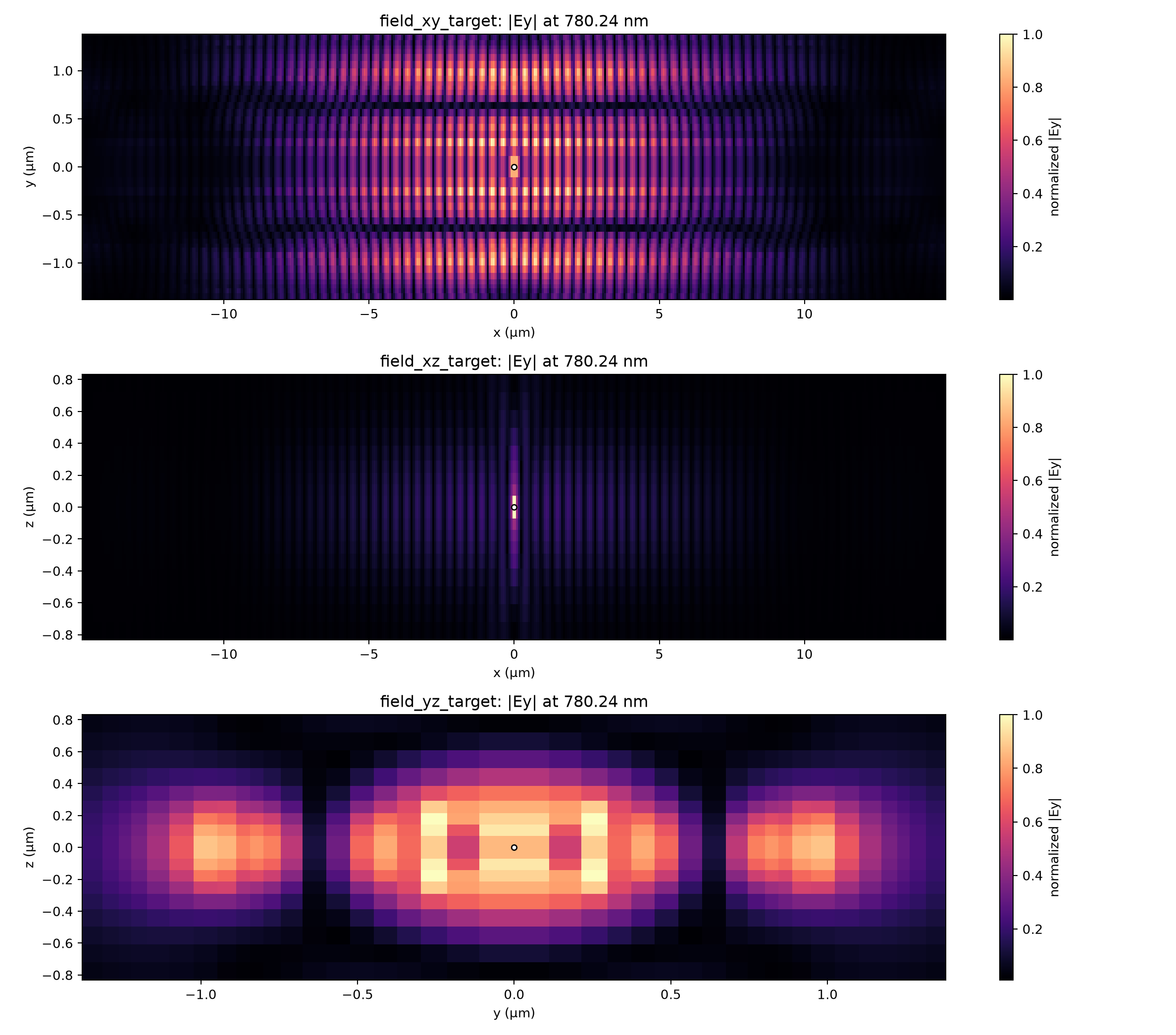
N48 upper-side taper diagnostic — high-Q indication, duration gate fails
Evidence label: completed Auto-14 broadband upper-side diagnostic with an internally consistent pole but an inadequate time record. The Q≈44,019 value is not trustworthy or promoted because only 0.434 fitted amplitude lifetimes were observed.
| Quantity | N40 Auto-14 baseline | N48 Auto-14 | Difference |
|---|---|---|---|
| taper cells per side | 40 | 48 | +8 |
| fitted wavelength | 781.652047 nm | 782.376106 nm | +0.724058 nm |
| preliminary ringdown Q | 19,562.52 | 44,018.98 | +125.0% |
| fitted amplitude lifetime | 16.23 ps | 36.57 ps | +125.3% |
| fitted lifetimes observed | 0.9781 | 0.43427 | duration gate fails |
| three-probe Q span | 0.02016% | 0.03160% | internally consistent |
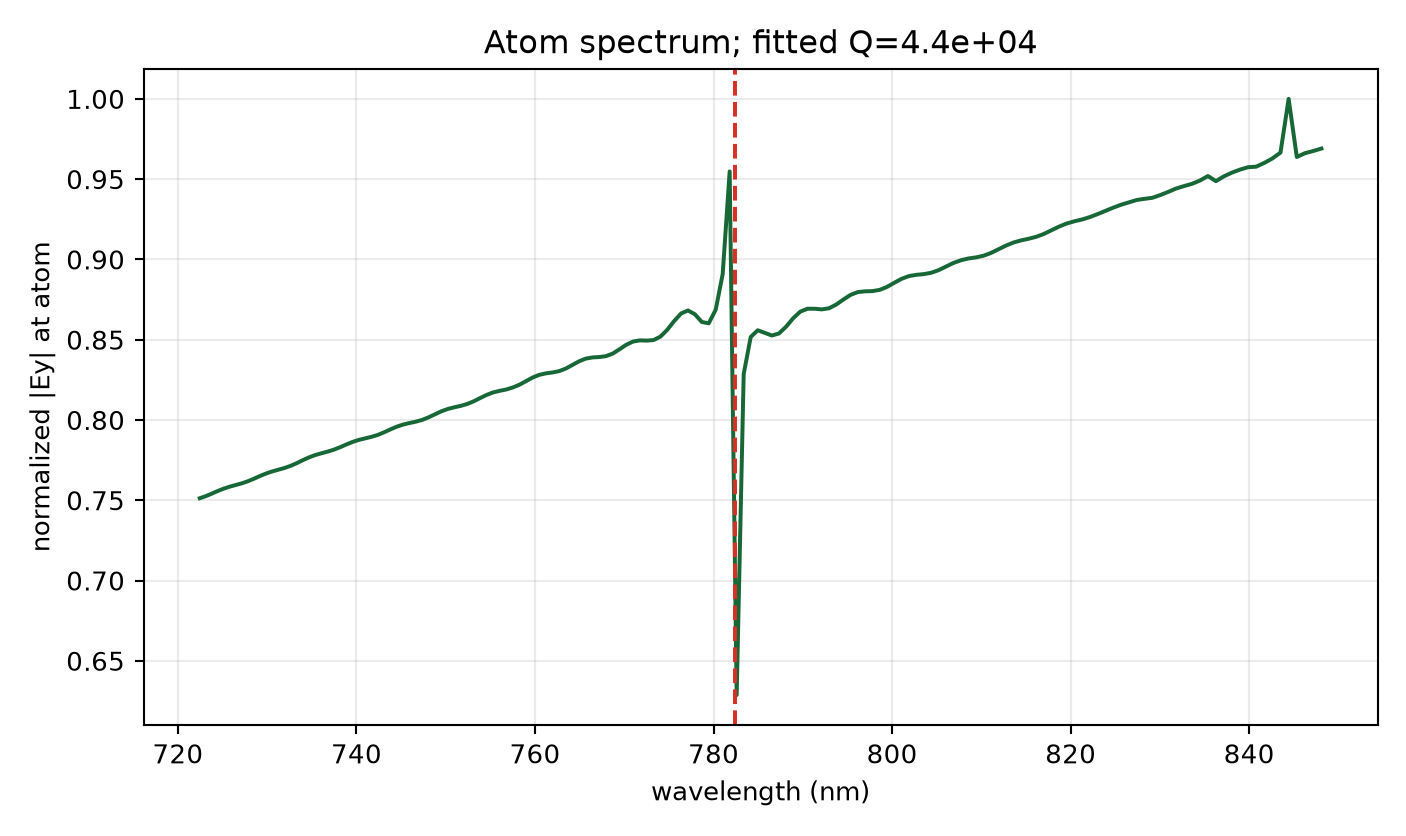
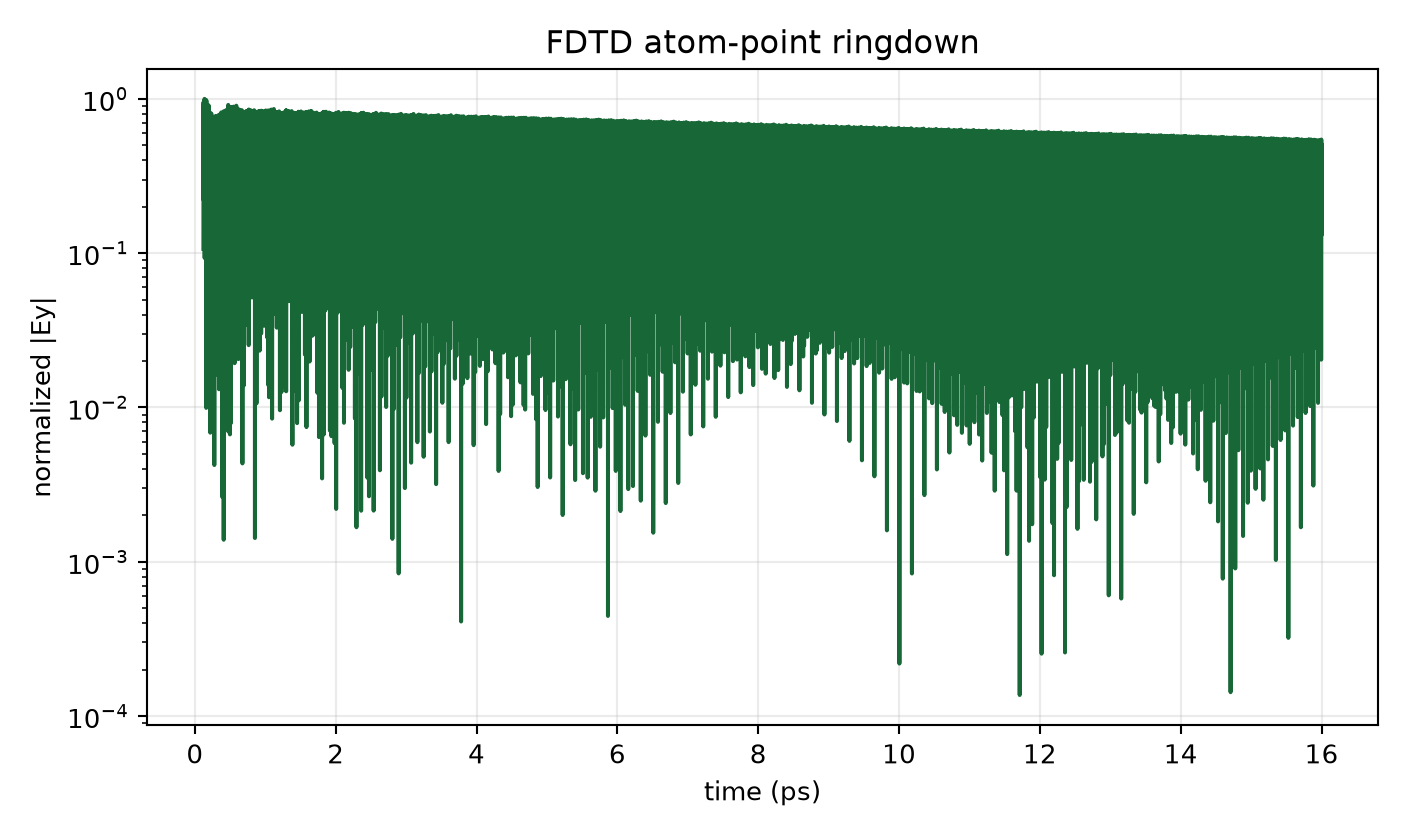
The three probes agree closely, but the run reached the 16 ps maximum with a cloud field-decay metric of 1.34×10⁻³ and less than half a fitted amplitude lifetime. The numerical value 44,019 is therefore a high-Q indication, not a converged measurement. Together with the much lower N32 result, it establishes the qualitative conclusion that N40 is not taper-saturated.
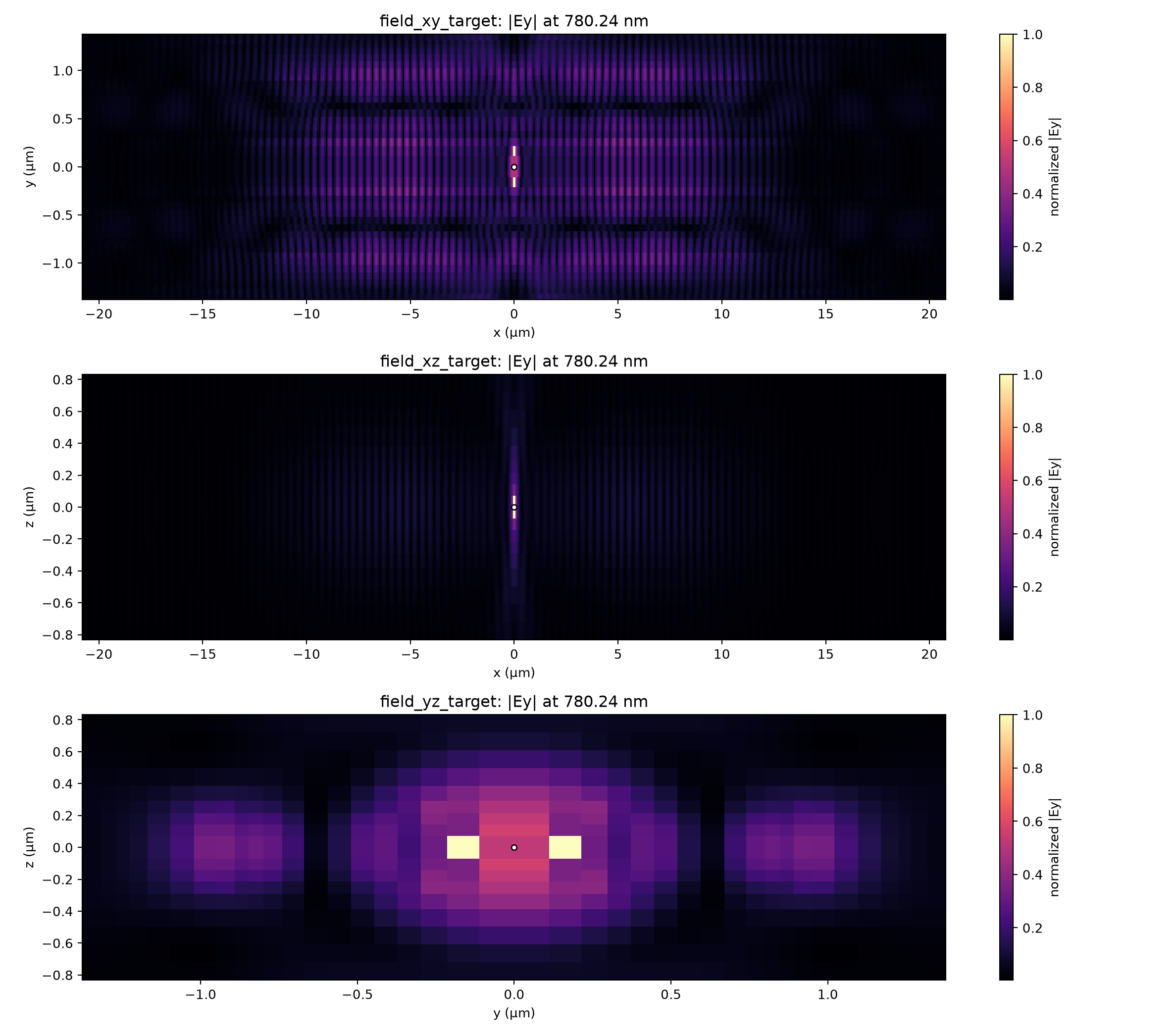
This is precisely the case where a longer record is scientifically justified: the nominal Q is high enough that 16 ps cannot satisfy even the minimum 0.75 lifetime gate. Any longer N48 repeat must retain automatic shutoff and the same mesh/domain policy and must be budgeted before submission.
Public evidence and reproduction:
- machine-readable prepared matrix
- Auto-16 convergence variant
- Auto-16 configuration
- Auto-16 serialized simulation
- Auto-16 ringdown result
- expanded-domain convergence variant
- expanded-domain configuration
- expanded-domain serialized simulation
- expanded-domain ringdown result
- N32 convergence variant
- N32 configuration
- N32 serialized simulation
- N32 ringdown result
- N48 convergence variant
- N48 configuration
- N48 serialized simulation
- N48 ringdown result
- prepared Auto-18 convergence variant
- prepared Auto-18 configuration
- serialized Auto-18 simulation
- Auto-18 ringdown result
- Auto-20 convergence variant
- Auto-20 configuration
- serialized Auto-20 simulation
- Auto-20 ringdown result
- Auto-22 convergence variant
- Auto-22 configuration
- serialized Auto-22 simulation
- Auto-22 ringdown result
- Auto-24 convergence variant
- Auto-24 configuration
- serialized Auto-24 simulation
- Auto-24 ringdown result
- local convergence preparer
- budgeted, resume-safe convergence runner
Tweezer-clearance trade — geometric Gaussian-tail proxy
Evidence label: parameterized geometry proxy, not a dielectric scattering or heating calculation.
A clear centerline is not enough for a real focused beam. To make the slot tradeoff concrete without inventing an atomic/tweezer specification, the plot below models a centered circular Gaussian intensity at its waist and integrates the fraction of beam power lying laterally beyond the two ideal slot walls:
tail fraction = erfc[slot / (sqrt(2) w₀)].
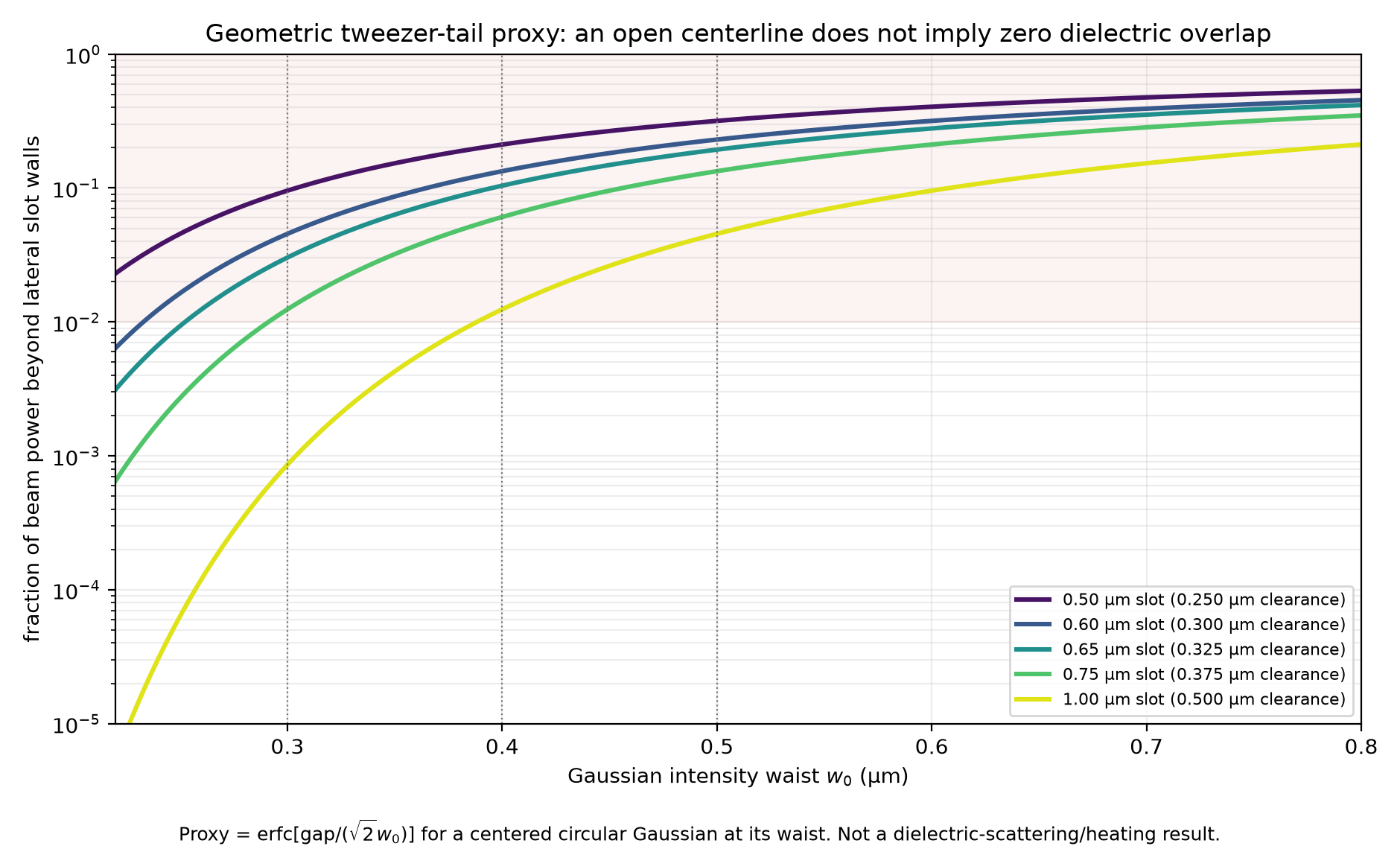
For a reference w₀=0.40 µm—not a selected experimental design—the
geometric tail fractions are:
| Slot | centerline clearance | power beyond ideal lateral walls |
|---|---|---|
| 0.50 µm | 0.250 µm | 0.2113 |
| 0.60 µm | 0.300 µm | 0.1336 |
| 0.65 µm | 0.325 µm | 0.1042 |
| 0.75 µm | 0.375 µm | 0.06079 |
| 1.00 µm | 0.500 µm | 0.01242 |
The pale red area above 1% is a visual reference band, not an acceptance threshold. No acceptable overlap or heating threshold has been specified. The calculation omits tweezer wavelength, Rayleigh-range/focus evolution, propagation direction, polarization, dielectric response, finite teeth and rails, surface roughness, and the atom's trap/heating dynamics. It therefore cannot turn a tail fraction into scattered power or atom temperature. Its purpose is to show why the 0.50 µm MPB overlap winner may be unacceptable and why intermediate 0.60/0.65 µm slots belong in the next Pareto screen.
Finite-Rayleigh-range extension
A second geometric proxy adds one of those missing effects without pretending
to solve the full problem. It assumes the tweezer propagates along z, places
its waist at the atom, and averages the same ideal-wall tail fraction through
the current 0.50 µm SiO₂ thickness:
zR = πw₀²/λtw, w(z) = w₀ sqrt[1 + (z/zR)²].
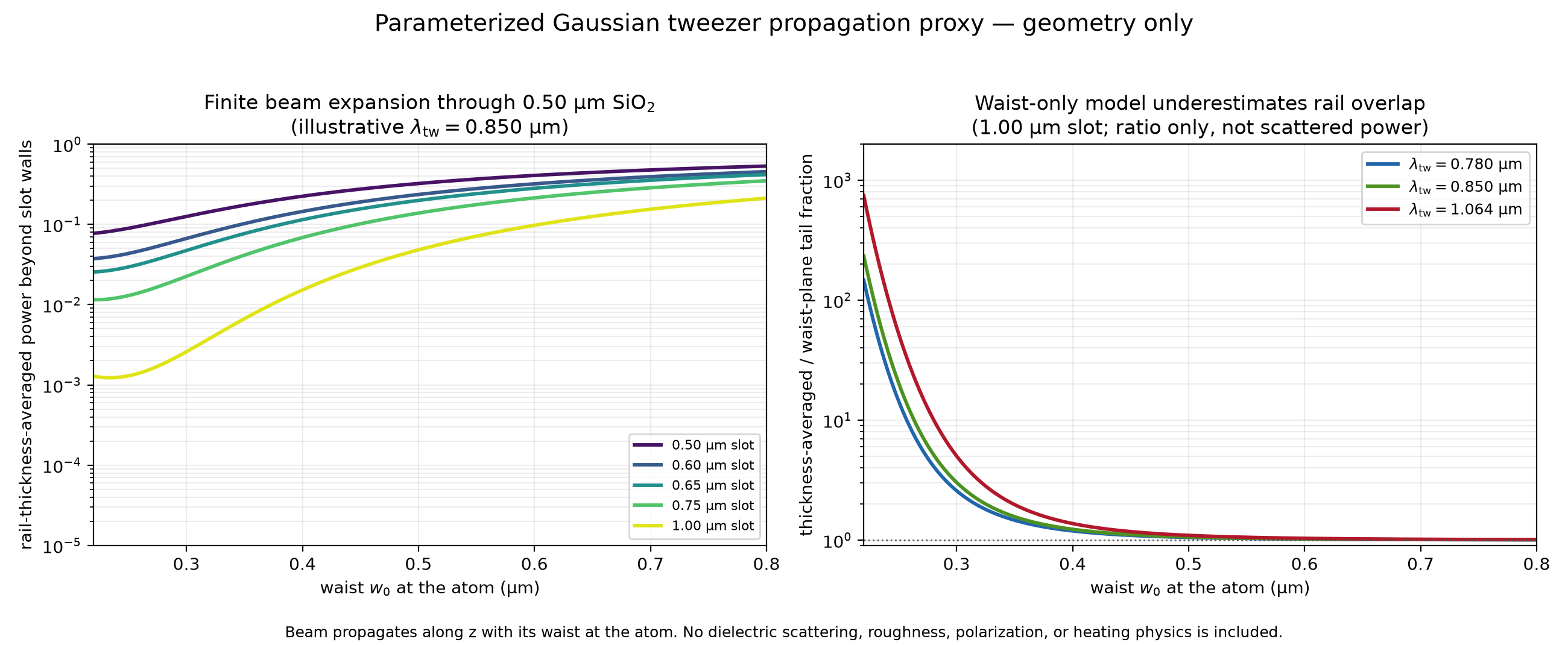
For the illustrative—not experimentally selected—combination
λtw=0.850 µm, w₀=0.40 µm, and t=0.50 µm:
| Slot | waist-plane tail | thickness-averaged tail | averaging / waist |
|---|---|---|---|
| 0.50 µm | 0.21130 | 0.22439 | 1.062 |
| 0.60 µm | 0.13361 | 0.14494 | 1.085 |
| 0.65 µm | 0.10416 | 0.11435 | 1.098 |
| 0.75 µm | 0.06079 | 0.06855 | 1.128 |
| 1.00 µm | 0.01242 | 0.01524 | 1.227 |
Beam expansion through the rail thickness makes every waist-only number optimistic. The right panel intentionally plots only the ratio of two geometric tail integrals; very large ratios at tiny waists can occur because the waist-plane denominator is extremely small. Neither panel is scattered or absorbed power.
The propagation proxy still omits material response, finite rail extent, polarization, roughness, reflection/interference, and atom/trap dynamics. Its wavelength and waist grid is parameterized, not an experimental specification.
Public evidence:
- machine-readable proxy values and limitations
- proxy plot script
- finite-Rayleigh-range proxy data
- finite-Rayleigh-range plot script
Deterministic cavity recipe being tested
The design follows the logic of Quan and Lončar, “Deterministic design of wavelength scale, ultra-high Q photonic crystal nanobeam cavities”, adapted to a low-index, wide-open fishbone geometry:
- Use MPB to calculate multiple guided bands of a periodic mirror cell, not merely one eigenvalue near a requested frequency.
- Identify a target frequency inside a guided stop band and track the same physical band across geometry changes using symmetry and field localization.
- For a frequency inside the gap, estimate the imaginary Bloch wavevector as
a mirror-strength proxy
γ. Near the band edge the paper writesk = (1 + iγ)π/a; this campaign uses the two-real-band-edge approximationγ = sqrt([Δgap/(f_upper+f_lower)]² - [(f_target-f_mid)/f_mid]²), not an exact complex-band calculation. - Choose a center cell whose band edge permits the desired defect mode and a mirror cell with stronger attenuation at the same frequency.
- Taper a geometry parameter so
γrises approximately linearly away from the center. This produces an approximately Gaussian envelope and suppresses light-cone Fourier components. - Put two symmetric tapered mirrors back to back and add uniform terminal mirror cells if needed.
- Test the finite structure with FDTD. The 2011 recipe is design guidance, not evidence that the present SiO₂ fishbone inherits its reported Q.
The taper parameter is deliberately not fixed yet. Period, tooth width/amplitude, rail width, and thickness are candidates; the winning choice must preserve the open atom/tweezer corridor.
Evidence ladder and promotion gates
| Level | What may be claimed | Required checks |
|---|---|---|
| Hypothesis | geometry worth testing | dimensions, material, atom point, and approach path stated |
| Local MPB result | unit-cell bands for one numerical model | multi-band plot, symmetry/field identity, light-line context, raw command |
| Converged MPB result | credible guided stop band | resolution, air-padding, k-grid, and band-tracking convergence |
| Estimated FDTD | anticipated cloud charge only | task not started; estimate and settings recorded |
| Submitted FDTD | cloud computation started | task ID and maximum estimated FC entered in ledger first |
| FDTD candidate | observed finite resonance | spectrum, field localization, source/monitor layout, actual charge |
| Validated cavity | trustworthy numerical cavity | mesh/domain/PML/runtime convergence; Q extraction agreement; mode-volume definition |
| Atom-compatible candidate | optical + access evidence | validated cavity plus tweezer clearance/overlap and field at atom |
MPB checks
- Plot all relevant bands over a sufficiently dense Γ–X path.
- Distinguish guided dielectric bands from air-supercell box states using field localization, symmetry, and padding convergence.
- Mark the air light line or explain why a supercell calculation requires a different radiation classification.
- Show band-edge fields for the branches used to calculate the gap.
- Sweep the proposed taper variable and plot both band edges and
γat one fixed target frequency. - Track candidate branches by field character and atom-site polarization, not by a fixed sorted band number. The one-micron-slot controls explicitly reorder the useful slot-like family from band 6 to band 8 as thickness changes.
- For retuning, require the normalized, symmetrically ε-weighted full-3D
complex-vector-E identity at the same geometry phase to be at least 0.75
relative to both the previous step and original seed. Intensity overlap and
cyclic
a/2registration are diagnostic only. - Evaluate the atom field at both cell boundary and cell center. If the chosen plane is a boundary, serialize an explicit finite-cavity geometry-phase shift that places that antinode at the fixed atom coordinate.
- Reject X-point optima unless the full Γ–X path shows the intended guided center continuation and a complete guided mirror gap. Apply the preregistered 0.005 guided-clearance floor before finite-cavity promotion.
- Repeat at higher MPB resolution and larger air padding before treating a narrow gap as real.
FDTD checks
- Prefer Tidy3D automatic meshing; do not add mesh overrides without a documented convergence need.
- Start at automatic mesh accuracy 14, use automatic shutoff, and use a 16 ps maximum for Q values in the thousands. Extend runtime only when the measured ringdown demonstrates the need.
- Save the exact uploaded simulation, task ID, maximum estimate, actual FC, spectrum, fitted pole, energy decay, and field cross-sections.
- Verify Q with a clean post-source ringdown window. Check that the fitted result is insensitive to reasonable window changes and that the field has not fallen into the numerical floor.
- Converge mesh, domain/PML spacing, and runtime. A single mesh/run is a candidate, not a validated result.
- Report mode volume at both the global field maximum and the proposed atom position, with the energy-density convention and normalization stated.
- If port coupling or β is reported, decompose the outgoing waveguide modes and close their power against an independent flux measurement.
FlexCredit ledger — hard cap 25 FC
Thirty-seven broadband FDTD tasks and five coherent exact-pole tasks have
completed.
The Auto-16 broadband convergence repeat failed the 5% Q gate, the
expanded-domain repeat passed, the N32 taper diagnostic confirms strong
lower-side taper-length dependence, and the preliminary N48 Q≈44,019 fails
the duration gate. Auto-18, Auto-20, Auto-22, and Auto-24 fail to settle the
mesh trend. A grouping-only Auto-14 control then finds no eligible
positive-Q target-band pole, so its Auto-20 partner is intentionally skipped.
The N32 touching-box pair fails its 20% spread gate. The connected retarget's
original Auto-24 control and retargeted Auto-20/24 pair are now complete; the
pair, independent Auto-22 mesh, and expanded-domain/PML-16 repeat pass every
numerical robustness gate. The resulting control remains below the Q=1,000
promotion floor. The higher-margin M16 redesign then passes Auto-20/22/24 and
expanded-domain/PML gates with Qworst=3,542.42. Its exact-pole v1 closes
Q, energy, and flux but fails the 5% mode-volume window gate with 20.278%
drift. Exact-pole v2 then passes every implemented method/window gate and
finds stable Vatom=23.505 µm³, but rejects the geometry because
Vatom/Vpeak=6.704. Auto-14 remains a cost-controlled screening mesh, never
a production result by itself.
Two uploaded v1 variant estimates were superseded before start and therefore
consumed no conservative or actual budget. The three overlap-redesign
broadband tasks are intentionally terminal negative screens; their low Q did
not justify exact-pole follow-up.
| State | Task | Tidy3D task ID | Maximum estimate (FC) | Actual (FC) | Evidence |
|---|---|---|---|---|---|
| complete; diagnostic | N16 broadband | fdve-4635460c-fdaa-42ca-ae66-da6c43b03e28 |
0.103054 | 0.025000 | Q≈361 |
| superseded before start | N24 v1 estimate | fdve-55a1fc1b-45f9-4e28-9138-b86b0b8ee581 |
not counted | 0 | replaced by longer-decay v2 |
| superseded before start | N32 v1 estimate | fdve-5d927ea6-b528-4f1f-950e-df72945407af |
not counted | 0 | replaced by longer-decay v2 |
| complete; diagnostic | N24 v2 broadband | fdve-5b463a06-cce8-444e-aada-bb8fc04d5937 |
0.137905 | 0.025000 | Q≈722 |
| complete; selected diagnostic | N32 v2 broadband | fdve-7b7d1bcd-10df-450a-a6db-c178b77f4dbd |
0.166928 | 0.058901 | Q≈1,589; selected exact-pole input |
| complete; failed V gate | N32 exact-pole observables | fdve-9ffb9430-f24f-43f9-840d-5f0621f2b9f2 |
0.322831 | 0.113911 | Q closure passes; V changes 19.88% by window |
| complete; selected diagnostic | N40 v2 broadband | fdve-17cd1ef7-5787-435e-b4e1-5bbcb1714167 |
0.201347 | 0.097351 | Q≈2,280; selected baseline exact-pole input |
| complete; gates pass at Auto-14 | N40 exact-pole observables | fdve-a17c408e-7999-4ea5-b5d5-b1681a79e5e7 |
0.391152 | 0.189122 | stable V exposes weak atom overlap |
| complete; negative screen | 1.00 µm access N40+M8 broadband | fdve-39b576b4-61eb-4c1d-bfb6-211d9b238144 |
0.206017 | 0.029150 | Q≈208; no exact follow-up |
| complete; negative screen | 0.75 µm clearance N40+M8 broadband | fdve-6925a6cb-5449-4285-8b33-d33cfa84fad2 |
0.187262 | 0.060805 | Q≈210; no exact follow-up |
| complete; negative screen | 0.60 µm practical N40+M8 broadband | fdve-52900088-dcb1-4591-8dad-309d9ed556fb |
0.183852 | 0.107601 | Q≈199; no exact follow-up |
| complete; promoted, Q not final | low-rad a=.37, 0.60 µm N40+M8 broadband | fdve-019193d0-6ccc-4a2e-af9f-dd31ac6a2f6b |
0.191557 | 0.191557 | Q≈19,563; only 0.978 amplitude lifetimes |
| complete; promoted, Q not final | low-rad a=.37, 0.75 µm N40+M8 broadband | fdve-06eac865-d198-40f5-8787-4c8a1cd19dc6 |
0.197484 | 0.197484 | Q≈11,838; 1.616 amplitude lifetimes |
| complete; comparative control | low-rad a=.38, 0.60 µm N40+M8 broadband | fdve-011bd235-a336-4812-a8c8-3d55509f4400 |
0.186972 | 0.128931 | Q≈2,649; 4.956 amplitude lifetimes |
| complete; method gates pass at Auto-14 | low-rad a=.37, 0.60 µm exact-pole observables | fdve-951ce35f-3509-45c4-9e8f-d3489b4f2c7c |
0.367332 | 0.367332 | Q≈19,525; Vatom=13.24 µm³; mesh/taper pending, broadband domain passes |
| complete; fails mesh gate | low-rad a=.37, 0.60 µm Auto-16 N40 broadband | fdve-22e6cbae-c974-43c3-9fb2-2803b0d9d1ee |
0.289051 | 0.289051 | Q≈13,593; −30.38% vs Auto-14 exact ringdown |
| complete; domain/PML gate passes | low-rad a=.37, 0.60 µm expanded-domain N40 broadband | fdve-70c45e17-892b-443c-8e17-b56d57873dfe |
0.378229 | 0.378229 | Q change +0.1717%; wavelength +0.00295 nm |
| complete; lower-side diagnostic | low-rad a=.37, 0.60 µm N32 Auto-14 broadband | fdve-6c6b9ba5-0d6f-48b0-b557-2ad40d4a2a6a |
0.163430 | 0.119987 | Q≈3,952; proves N32 is taper limited |
| complete; duration gate fails | low-rad a=.37, 0.60 µm N48 Auto-14 broadband | fdve-1935baeb-2fa2-4ccb-8b78-fc50775db56c |
0.217281 | 0.217281 | preliminary Q≈44,019 from only 0.434 lifetimes |
| complete; mesh still not settled | low-rad a=.37, 0.60 µm Auto-18 N40 broadband | fdve-4d867d35-f727-4909-97be-4ff81e1e7824 |
0.489661 | 0.371284 | Q≈4,007; −70.52% from Auto-16 |
| complete; mesh still not settled | low-rad a=.37, 0.60 µm Auto-20 N40 broadband | fdve-e5994283-280b-471b-b5d0-171a4282ecff |
0.616981 | 0.616981 | Q≈6,925; +72.81% from Auto-18 |
| complete; mesh still not settled | low-rad a=.37, 0.60 µm Auto-22 N40 broadband | fdve-bcf17341-13ac-4d33-8238-ffc5cabcada7 |
0.782823 | 0.782823 | Q≈9,550; +37.91% from Auto-20 |
| complete; definitive mesh failure | low-rad a=.37, 0.60 µm Auto-24 N40 broadband | fdve-41bab909-74e2-4399-84d6-aacb714b02ee |
1.267137 | 0.826965 | Q≈4,491; −52.97% from Auto-22 |
| complete; grouping negative | low-rad N40 grouped-box Auto-14 broadband | fdve-56fc463e-e4a8-46b2-aa2f-689606b35afa |
0.115811 | 0.115811 | no positive-Q eligible target-band pole |
| estimated, intentionally not started | low-rad N40 grouped-box Auto-20 broadband | fdve-4eb359a5-5ab9-4252-af91-365025c1038c |
not counted | 0 | Auto-14 negative; no value in paired repeat |
| complete; robustness spread fails | N32 touching-box Auto-20 broadband | fdve-0f3d8a0e-1660-495e-916d-f626cb153988 |
0.510649 | 0.202384 | Q≈2,115; 86.90% pair spread rejects family |
| complete; clean but target-band negative | N32 clean-union Auto-14 broadband | fdve-b854a58c-d3e4-4463-bfdc-29f8ed7ee76b |
0.095439 | 0.051717 | no 780 nm pole; broader diagnostic finds λ≈926.320 nm, Q≈2,180 |
| complete; clean but target-band negative | N24 smooth g70 Auto-14 broadband | fdve-07f6b9c0-8de4-4173-917c-bda4656a5d65 |
0.073789 | 0.037639 | no 780 nm pole; broader diagnostic finds λ≈926.109 nm, Q≈2,445–2,448 |
| complete; target-band negative | scaled N24 smooth Auto-14 broadband | fdve-31c180ce-b0a7-488c-84b8-3a4ebebd0cc0 |
0.059860 | 0.025000 | no eligible target-band pole |
| complete; pole identity fails | scaled N24 smooth Auto-20 broadband | fdve-a2d5edaa-3885-497c-b472-c5bc878aa875 |
0.190013 | 0.053350 | λ≈787.958 nm, Q≈165 from only one probe; fit error 0.7673 |
| complete; target/pole identity fails | connected period-chirp N24+M8 Auto-14 broadband | fdve-03140b16-b0ef-4fbd-9928-84fdd6e75236 |
0.078927 | 0.025000 | no pole in 772.239–788.239 nm; inconsistent 829 nm fallback |
| complete; clean but rejected | connected period-chirp N24+M8 Auto-20 broadband | fdve-2abff5f6-9d4f-4d2d-9850-c09cfbea34ca |
0.257318 | 0.032622 | λ=766.620 nm, Q=518; off-target, below floor, absent at Auto-14 |
| complete; control passes | original connected period-chirp Auto-24 control | fdve-8e713772-d7f2-4727-b23e-54e7d2bca9be |
0.490375 | 0.062310 | λ=766.327 nm, Q=523; agrees with Auto-20 within 0.0382% λ and 0.93% Q |
| complete; retarget pair passes | retargeted connected period-chirp Auto-20 | fdve-c67c2d71-fdf9-4c74-bf62-380d264b8e13 |
0.262463 | 0.033281 | λ=780.779 nm, Q=542.974; clean first half |
| complete; retarget pair passes | retargeted connected period-chirp Auto-24 | fdve-f2b87974-d93f-44ad-a056-a106f012c566 |
0.500309 | 0.059955 | λ=780.486 nm, Q=541.504; pair spans 0.0375% λ and 0.271% Q |
| complete; third-mesh gate passes | retargeted connected period-chirp Auto-22 | fdve-c8600035-ee6f-420a-826a-fa2b82e497c2 |
0.365681 | 0.043510 | λ=780.648 nm, Q=547.574; three-mesh Q span 1.1159% |
| complete; domain/PML gate passes | expanded-domain/PML-16 retargeted Auto-22 | fdve-4b6a46f8-c1d9-4d25-b9d2-f3d7ca07cb46 |
0.766221 | 0.084293 | λ=780.631 nm, Q=553.380; baseline Q change 1.0492% |
| complete; high-margin calibration only | high-margin N24+M12 Auto-20 | fdve-541b8d77-eebb-43e6-baf0-6f4a46f07a5b |
0.282868 | 0.077250 | λ=767.352 nm, Q=2,071; only 2.518 lifetimes |
| complete; high-margin calibration winner, not promoted | high-margin N24+M16 Auto-20 | fdve-6a891311-16c6-4081-a3d1-a563aa357547 |
0.310392 | 0.128742 | λ=767.389 nm, Q=3,834; only 2.086 lifetimes |
| complete; M16 promotion gate passes | high-margin M16 own-bias Auto-20 | fdve-7132d5bb-670c-4d78-af1d-32831ced8130 |
0.316764 | 0.277328 | λ=780.145 nm, Q=3,542; 4.733 lifetimes |
| complete; M16 promotion gate passes | high-margin M16 own-bias Auto-24 | fdve-fa4d33e0-3219-440f-84ee-7de9503f95f7 |
0.600007 | 0.495668 | λ=779.648 nm, Q=3,585; 4.413 lifetimes |
| complete; third-mesh gate passes | high-margin M16 own-bias Auto-22 | fdve-7e135e7f-c952-41c6-9145-51d20d44f773 |
0.440129 | 0.334657 | λ=779.986 nm, Q=3,555; three-mesh Q span 1.19675% |
| complete; domain/PML gate passes | high-margin M16 expanded-domain/PML-16 Auto-22 | fdve-f8b31577-b4c0-4ccf-a91a-122d53c78e25 |
0.909235 | 0.716993 | λ=779.981 nm, Q=3,555; Q change 0.000286% |
| complete; exact V window gate fails | high-margin M16 Auto-22 exact-pole v1 | fdve-4cbf80ae-02eb-4991-aaea-acebb6dee34a |
0.827878 | 0.629487 | Q/flux/energy close; apparent V changes 20.278%, so no V claim |
| complete; exact method passes, design overlap fails | high-margin M16 Auto-22 exact-pole v2 | fdve-8c545b6a-fdc7-48e0-bdb4-7f51ee90bde0 |
0.827878 | 0.629487 | Vatom=23.505 µm³ stable to 0.00464%; 6.704× Vpeak |
| complete; corrected exploratory target FAIL | corrected gap060_inner012 N24+M16 Auto-14 |
fdve-edb532d7-45f0-43d4-a4bd-de64a75d90d3 |
0.092072 | 0.038788 | no positive-Q 780 nm pole; 867/933 nm wider fits not promoted |
| complete; corrected promoted-lead target FAIL | corrected gap050 N24+M16 Auto-14 |
fdve-d5ec4382-ea29-4c92-a54d-8f6863152a6b |
0.088827 | 0.088827 | no positive-Q 780 nm pole; clean 933.84 nm Q≈3,554 fit not promoted |
Conservative started-job total: 15.511193 / 25.000 FC
Cloud-reported actual total: 9.438848 FC
Remaining conservative allowance: 9.488807 FC
A task enters the conservative total when it is started, using its maximum estimate. Failed or automatically shut-off jobs remain in the ledger and are never silently removed. Actual charges are filled from cloud metadata after completion.
Reproduction environment
Recorded on 2026-07-28 UTC:
| Component | Version |
|---|---|
| Python | 3.12.3 |
| MPB | 1.11.1 |
| libctl | 4.5.1 |
| Guile | 3.0.9 |
| Tidy3D | 2.11.2 |
Existing historical baseline commands are in the 2026-07-27 unit-cell log. Exact commands for the new SiO₂ sweep and every finite-cavity run will be added beside their results; a command is not documented until it has actually been run or is clearly labeled “planned.”
Historical evidence versus active campaign
| Artifact | Classification | What it establishes | What it does not establish |
|---|---|---|---|
| Si₃N₄ one-branch MPB plot | historical, coarse MPB | old geometry ran in MPB | a full gap, SiO₂ behavior, or a cavity |
| SiO₂ plain-slot fields | local negative control | 1 µm ordinary slot is rail dominated | periodic fishbone performance |
| selected SiO₂ MPB sweep | preliminary/converged edges | tracked gap, taper, atom-allowed band | radiation Q or finite-cavity V |
| N16/N24/N32/N40 FDTD screen | completed diagnostics | centered pole; longer taper reaches Q≈2,280 | converged Q, exact-pole V, port coupling |
| N32 coherent exact-pole run | completed, failed V gate | energy/flux Q closure and exact-pole decay directions | stable/promoted V, mesh/domain convergence, emitter or port β |
| N40 coherent exact-pole run | completed; Auto-14 gates pass | stable V and Q closure; mode is weak at atom | mesh/domain convergence, emitter or port β |
| slot/modulation MPB redesign | completed local ranking | narrower slots strongly improve local atom-field proxy | finite-cavity V/Q or tweezer compatibility |
| intermediate-slot MPB redesign | 22/24 local cases completed | a=0.37 common-family Pareto for 0.50–0.75 µm slots | r14/padding convergence or finite-cavity performance |
| access-first 1 µm MPB control | 6/8 local cases completed | stronger modulation preserves clearance but does not match narrower-slot atom overlap | r14/padding convergence or finite-cavity performance |
| access-first period/thickness screen | 8/12 local cases completed | a=0.38 improves coarse overlap; thinner rails are worse | near-light-line guidance, r14/padding, dense dispersion, finite-cavity Q |
| first overlap-redesign FDTD screen | three Auto-14 N40+M8 broadband diagnostics completed | 1.00/0.75/0.60 µm variants are all low-Q (≈208/210/199) | exact-pole V/β intentionally skipped; no mesh/domain convergence |
| lower-radiation hybrid MPB screen | 4/6 r10 cases; three selected r14/padding checks; two dense near-X candidates | A=0.40, duty 0.50 retains overlap; a=.37 has safer near-X guidance | MPB still cannot establish finite-cavity radiation Q |
| lower-radiation hybrid FDTD screen | three Auto-14 N40+M8 broadband diagnostics complete | a=.37 slots .60/.75 reach Q≈19,563/11,838; a=.38 control Q≈2,649 | first two need longer/exact-pole records and mesh/domain convergence |
| low-rad 0.60 µm exact-pole run | coherent Auto-14 energy/flux/field diagnostic complete | Q closure and window gates pass; Vatom=13.24 µm³ | mesh and domain/PML convergence; emitter/port β not measured |
emitter-β plan and retired Q/Vatom proxy |
schema-2 validation plan; no β-specific task submitted | exact definitions and robustness-first validation gates | old F=53.509, β=0.98165 values are non-predictive |
| low-rad convergence matrix | Auto-16/18/20/22/24, expanded-domain, N32, and N48 complete | mesh sequence 19,563→13,593→4,007→6,925→9,550→4,491 never settles; domain/PML passes; N40 is not taper-saturated | diagnose/redesign mesh-sensitive geometry before longer N48 or exact-pole work |
| geometry-representation audit | completed local-only grid/ε comparison | float gaps are harmless; grouping changes AutoGrid; clean union changes conformal ε | radiation-cancellation sensitivity is plausible, not proven |
| grouped N40 control | completed paid Auto-14 negative; Auto-20 intentionally skipped | grouping alone removes the eligible target-band pole | behavior of clean connected-PolySlab candidates |
| robustness-pivot preparation | three families serialized locally; zero tasks started by preparer | fixed access contract and worst-case-Q promotion gates | a selected winner |
| N32 touching-box robustness pair | Auto-14/20 complete | Qworst≈2,115, but 86.90% spread rejects the representation |
behavior of clean union or smooth families |
| connected-PolySlab target check | N32 step union and N24 smooth Auto-14 complete | both have clean ≈926 nm poles, not a 780 nm target-band pole | scaled geometry wavelength or mesh robustness |
| scaled smooth target check | Auto-14/20 complete | Auto-14 has no eligible target pole; Auto-20 one-probe hint fails identity | a trustworthy retargeted pole |
| connected MPB/FDTD semantics audit | superseded/invalid geometry-equivalence conclusion | saved comparison shifted X-point bands, but connected MPB slot was ≈0.07492 µm | any claim about the intended 0.75 µm-slot FDTD cross-section |
| connected-profile coarse MPB screen | historical invalid geometry; zero cloud action | internally repeatable outputs from an ≈0.07492 µm-slot prism | ranking the intended 0.75 µm-slot cells |
| connected-profile r14 validation | historical invalid geometry; zero cloud action | solver gates passed for the misplaced prism | intended-geometry γ, gap, light line, atom field, or taper |
| connected N24+M8 FDTD preparation | exact two-PolySlab Auto-14/20 variants serialized; zero tasks and 0 FC | 16 ps, shutoff 1e-7, no overrides, explicit 772.239–788.239 nm search |
any FDTD pole or Q |
| connected N24+M8 FDTD pair | Auto-14/20 complete for 0.057622 FC actual | Auto-14 misses target; Auto-20 clean λ=766.620 nm, Q=518; no same-pole pair | a robust finite-cavity pole |
| connected FDTD-aware retarget | historical invalid MPB transfer plus valid original Auto-24 FDTD control | Auto-14 is underresolved; original Auto-20/24 FDTD pole agrees | a geometry-equivalent MPB correction |
| retargeted connected FDTD pair | Auto-20/24 complete | λ=780.779/780.486 nm and Q=542.974/541.504; 0.0375% λ and 0.271% Q spread | useful Q≥1,000, third-mesh/domain convergence, V, Purcell, or β |
| retargeted third-mesh/domain gate | Auto-22 and expanded Auto-22 complete | three-mesh Q span 1.1159%; expanded-domain Q change 1.0492%; all robustness checks pass | useful Q≥1,000, V, Purcell, or β |
| high-margin connected MPB seed | historical invalid geometry; zero cloud action | all 11 gates passed internally for an ≈0.07492 µm-slot prism | 0.75 µm-slot light-line margin, γ, atom metric, or FDTD explanation |
| high-margin M12/M16 FDTD screen | two Auto-20 diagnostics complete | clean Q≈2,071/3,834 poles show Q-improvement direction; M16 wins calibration | target wavelength, ≥3 lifetimes, separated-mesh or domain convergence |
| M16 own-bias broadband promotion | Auto-20/22/24 plus expanded-domain/PML-16 complete | λ span 0.06364%, Q span 1.19675%, Qworst=3,542.42, domain Q change 0.000286% |
mode volume, Purcell factor, or emitter β |
| M16 exact-pole v1 | coherent Auto-22 energy/flux/field diagnostic complete | Q≈3,555 and all closure gates pass | stable V: 20.278% window drift exposes transient contamination; no Purcell or β |
| M16 exact-pole v2 | late-window coherent Auto-22 observable complete | all gates pass; Vatom=23.505 µm³ stable to 0.00464% | useful atom overlap: Vatom/Vpeak=6.704; no β |
| corrected-coordinate MPB control | formal zero-inner parity and printed-geometry checks complete | identical bands/ε across implementations; declared 0.75 µm gap prints as 0.7500014 µm | finite-cavity performance |
| corrected transverse-design validation | local r8/r10/r14 complete; zero cloud action | 0.50 µm branch passes; 0.60 and 1.00 µm branches fail atom-field promotion | physical clearance choice and finite-FDTD Q/V |
| independent corrected r14 γ maps | eight mirror solves per branch complete; zero cloud action | all three γ curves rise monotonically and stay in the tracked gap | finite-cavity Q or mode volume |
| corrected finite-cavity handoff | three local Auto-14/16 ps simulations serialized; zero cloud action | exact MPB/FDTD vertices, open-slot widths, linear-γ tapers, and costs preregistered | two branches tested and fail; gap100 is disqualified locally |
| corrected 0.60 µm exploratory FDTD | paid Auto-14 broadband diagnostic complete | no positive-Q 780 nm pole; off-target 867/933 nm fits only | no convergence or exact-pole promotion |
| corrected 0.50 µm promoted-lead FDTD | paid Auto-14 broadband diagnostic complete | no positive-Q 780 nm pole; off-target 933.84 nm Q≈3,554 fit only | current MPB→finite transfer logic is falsified |
| corrected full-k guided-gap audit | local six-band Γ→X r8 plus critical r14 checks complete; zero cloud action | gap100 mirror crossing disqualifies it; gap060 center ambiguous; gap050 unit-cell logic survives | wider-rail/thicker local redesign before more FDTD |
| conventional wider/thicker band-4 screen | 50/50 r8 cells tuned and field-audited; four full-k/mirror audits; zero cloud action | all four shortlists fail; exact g=.5 loses overlap/monotonic γ, exact g=1 reorders to center b5 and leaks via mirror b4 | any r10/r14 proposal or finite-cavity result |
| one-micron-slot multiband controls | completed cached local X-field and full-k audit; zero cloud action | wider rails confine, but band 4 rail-localizes; t=.50 higher branch fails center/mirror physics; exact-retuned t=.80 has 0.003393 clearance | any finite-cavity Q, V, or β |
| field-tracked r8 seed screen | completed 15/15 local all-band X-point cases; zero cloud action | maps atom-proxy/light-line trade and branch reordering | full-k gap, taper, cavity, Q, V, or β |
| field-tracked v3 A=.35 retune | 15/15 attempted locally; 13 valid, two unresolved; zero cloud action | complex-E controls pass/fail at 1.000/0.001529; only two rows clear 9% margin with poor atom proxy; first full-k center has zero guided crossings | no cavity promotion |
| g=1 outer-amplitude + tracked-k closure | 6/6 retunes valid; four authoritative center audits complete; zero cloud action | A=.45/.55/.65 exposes monotonic margin/atom trade; adjacent identity-valid bracket gate passes 0/4 | every mirror skipped; proposal list empty |
| g=1 profile-shape + tracked-k closure | 8/8 attempted, five v3-valid; three authoritative center audits complete; zero cloud action | only rounded rw=1/t=.8/A=.55/p=.6 clears 9% margin but atom proxy is 0.021512; tracked-k passes 0/3 | every mirror skipped; g=1 path closed and local 0.75 µm corridor pivot begins |
| exact g=.75 local prefilter | profile screen 6/6 attempted, five v3-valid; interpolation 4/4 valid; zero cloud action | exact ±.375 µm inner walls; profile has zero ≥9% rows; interpolation has two ≥9% Pareto points | pre-tracked-k only; ≤3 combined rows advance, mirrors conditional on center roots |
| g=.75 original-band adaptive tracked-k | three center audits complete; zero cloud action | adaptive k=.46…50 windows show the band-7 continuation remains entirely below target; sorted crossings are other modes | 0/3 pass; every mirror skipped |
| g=.75 curvature-aware band-9 restart | three full-vector prechecks and 3/3 exact v3 retunes complete; zero cloud action | one-based band 9 has correct X→.49 curvature, but retuned margins are .021576/.052628/.071000 | zero ≥9% rows; root/mirror audit deferred |
| g=.75 targeted band-9 thickness/profile | 5/5 exact v3 retunes complete; zero cloud action | t=1,p=1 and t=1,p=1.1 are the first post-retune ≥9% rows; boundary-plane atom proxies are .002566/.002484 |
local center-cell hypotheses only; not Q, V, Purcell, or β |
| g=.75 two-candidate tracked centers + period mirrors | both center roots and both 16-point period-only mirror audits complete; zero cloud action | roots near k=.49087/.49083 pass identity and guidance; each mirror has 5/5 identity anchors pass | each mirror is 0/16 target-in-gap; gates T,T,T,T,F,F,F, passing count 0, r10/r14 list empty |
| g=.75 fixed-a outer-geometry mirror screen | all nine preregistered amplitude/profile/rail cells complete; zero cloud action | amplitude 0 eligible; p=1.6 upper=.454197 misses target=.454301; rw=.75/.70 have γ=.011196/.009540 with valid identity | rail γ decreases outward, no coarse monotonic path; motivates the bounded refinement below |
| g=.75 bounded fixed-a rail refinement | four new cells plus two cached endpoints and dense 41-k audit complete; zero cloud action | eligible onset rw=.78; γ rises .009743→.010585→.010912→.011196 and identity path passes | guided b8/b9 target crossings at k=.485348/.464833 veto mirror; no r10/r14, supercell, or FDTD |
| g=.75 atom-rich reverse-edge center | two band-7 retunes and tracked/dense audits complete; zero cloud action | t=.85,p=1.2 passes all six gates with atom=.087905 and one intended guided b7 crossing; t=.9,p=1 has extra guided b8 crossing | one local center winner; cell-center phase requires explicit a/2 finite shift |
| g=.75 atom-rich fixed-a air mirror | three rail cells and selected rw=.76 dense 41-k audit complete; zero cloud action | γ=.021583/.026069/.028733, center identity=.994442/.975744/.937467, atom proxy remains ≈.088 | zero guided target crossings; all local mirror gates pass; taper calibration follows below |
| g=.75 atom-rich gamma-linear taper | two new X cells plus four cached center/mirror points complete; zero cloud action | measured γ=.014806→.028733; all identity/phase gates pass; inverse-PCHIP gives the serialized nine-point half-profile | Δγ linearity error 8.728e-8 versus 13.7317% quadratic diagnostic; r10/r14 next |
| g=.75 atom-rich r10/r14 convergence | r10 partial checkpoint; r14 running; zero cloud action and 0 new FC | r10 center root k=.4875740 and mirror X-gap γ=.02869444 pass | two tiny guided b6 crossings in 31-k mirror audit block promotion pending r14 |
| schema-v3 trustworthy-observables foundation | protocol and machine-readable plan complete locally; zero cloud action | candidate/run hashes, Vatom gates, one vacuum plus ≥2 structured β references, dual-ledger cost gate | no finalist, no emitter β, and no paid observable task |
| Gaussian tweezer-tail proxy | completed parametric geometry model | narrower slots expose more finite-waist beam power to ideal walls | dielectric scattering, heating, or an acceptance threshold |
| finite-Rayleigh-range tail proxy | completed parametric geometry model | waist-only tail underestimates thickness-averaged ideal-wall overlap | electromagnetic scattering, heating, or experimental beam specification |
The historical MPB image below is intentionally retained as a warning: one target-selected branch is not a band diagram and cannot support a bandgap claim.
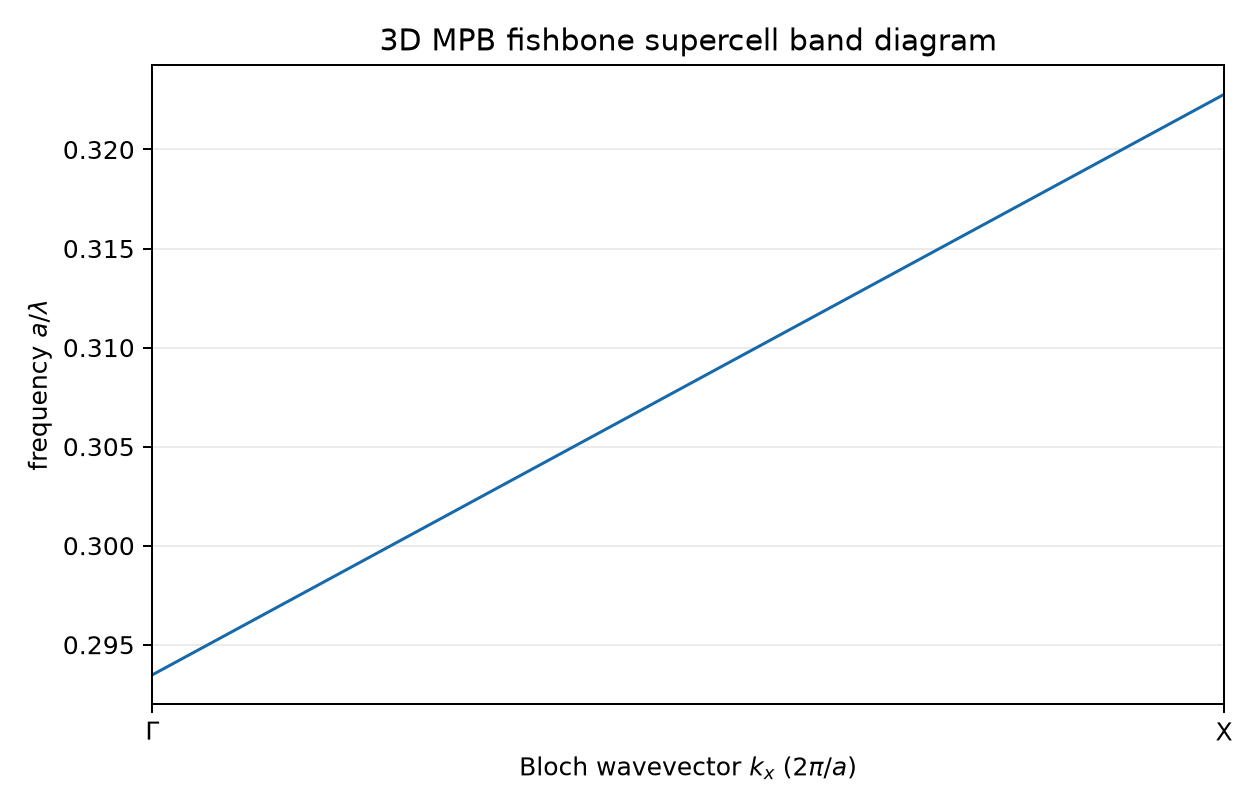
Open risks and decisions
- Material/index: the active SiO₂ index model and target atomic wavelength must be fixed and eventually made dispersive/process-specific.
- Weak confinement: low SiO₂/air contrast and a wide slot may make the desired guided bandgap very small or nonexistent.
- Air-box false bands: a large MPB supercell has dense radiation states; band identity cannot be assigned from frequency alone.
- Tweezer scattering: geometric clearance is not yet a scattering calculation. A beam model and acceptable threshold are still required.
- Fabrication/support: mechanical supports and connections outside the idealized unit cell may perturb the optical mode and access path.
- Atom metric: “good mode” must eventually become a transition-specific coupling target, including dipole orientation, field at the atom, linewidth, Q, mode volume, and relevant decay channels.
- Geometry semantics: MPB prism placement must be verified from printed geometry/ε, not inferred from upstream polygon coordinates or a different library's centroid convention.
Next documented milestone
The comparative screen now supports a specific next sequence:
- keep N40 disqualified and the old
F=53.509,β=0.98165proxy retired; - do not run the grouped N40 Auto-20 partner after its Auto-14 negative;
- keep the N32 touching-box family rejected after its 86.90% pair spread;
- do not run the unscaled connected-step-union or smooth Auto-20 partners: their clean ≈926 nm poles establish that wavelength retargeting comes first;
- keep the 0.842492-scaled smoother family rejected: its ≈0.5055 µm slot remains open, but its Auto-14/20 pair does not recover a trustworthy common target-band pole;
- keep the failed scaling branch and emitter-β work paused; exact-pole work may proceed only under the stated window-stability and closure gates;
- require the next promoted MPB unit-cell geometry to match the finite two-PolySlab connected profile exactly; verify the printed/effective full slot numerically before interpreting any band or field;
- keep the canonical connected N24+M8 Auto-14/20 pair rejected: Auto-14 has no target pole, while Auto-20's clean 766.620 nm, Q=518 pole is outside the handoff window, below the useful-Q floor, and not the Auto-14 pole;
- treat Auto-14 as underresolved for this connected geometry: the original-period Auto-20/24 control passes within 0.0382% wavelength and 0.93% Q;
- retain the measured retargeted FDTD Auto-20/24 outcomes near 780.6 nm, but withdraw the 1.023373× value as a transferable MPB correction;
- do not promote that Q≈542 pair as a useful cavity merely because it is
numerically stable;
Qworst=541.504remains below the declared 1,000 floor; - record the completed Auto-22 and expanded-domain/PML-16 passes: the three-mesh Q spread is 1.1159% and the domain Q change is 1.0492%;
- use the validated Auto-20/22/24 numerical basis for a bounded local redesign that raises mirror/taper performance while preserving the 0.75 µm slot, connected two-PolySlab topology, and atom access;
- do not call the old high-margin rank-5 MPB seed validated: its effective slot was approximately 0.07492 µm; retain only the independent M12/M16 FDTD outcomes as evidence about their serialized 0.75 µm-slot geometries;
- record the completed high-margin M16 Auto-20/22/24 and expanded-domain/PML passes: Q is ≈3,555, three-mesh Q spread is 1.19675%, and the domain Q change is 0.000286%;
- keep all four conventional wider/thicker band-4 shortlists rejected and the r10/r14 proposal list empty: 50/50 cells were field-audited, but none passes overlap, full-k/mirror, and monotonic-γ gates together;
- treat fixed band labels as diagnostic only; use the field-tracked g=1 path to identify the slot-like mode by spatial field character before full-k validation;
- keep the t=0.50 µm one-micron-slot band-6 X-point optimum rejected: its atom proxy is strong, but the full-k center has no guided target crossing and the mirror has a guided band-5 leakage path;
- track the one-micron-slot branch by field character rather than a fixed band index; the slot-like family reorders from band 6 to band 8 as silica thickness changes;
- keep the exact-retuned t=0.80 µm branch as a rejected near-miss: its real guided crossing has 0.003393 clearance, below the 0.005 gate;
- treat the completed 15/15 r8 field-tracked screen only as a seed map; require full-k center/mirror validation before any finite-cavity or paid FDTD step;
- retain 13/15 A=.35 v3 retunes as identity-valid and keep the remaining two unresolved; never restore the invalidated v2 intensity-only rows;
- require same-cell-phase full-3D complex-E overlap ≥0.75 and an explicit finite-cavity geometry-phase record for boundary-plane atom antinodes;
- keep rw=1.10/t=.80 rejected after its center full-k solve finds zero guided target crossings; the skipped mirror is an intentional fail-fast action;
- close the g=1 outer-amplitude path after the completed A=.45/.55/.65 screen and authoritative tracked-k audit pass 0/4; do not bridge across an identity-failed k anchor or accept a discontinuous avoided-crossing root;
- close the g=1 profile-shape path after five of eight retunes are v3-valid but the rounded, sharp, and highest-atom shortlists pass 0/3 tracked-k audits;
- retain the completed compact 0.75 µm prefilter as X-point evidence only: exact inner walls are ±.375 µm for all x, the profile screen is ⅚ v3-valid with no ≥9% row, and the interpolation is 4/4 valid with two ≥9% rows;
- close the original-band g=.75 shortlist after its adaptive tracked-k audit passes 0/3: band 7 has the wrong curvature and the sorted coarse crossings are other modes;
- retain one-based physical band 9 as the curvature-correct branch, but do not inherit precheck margins across a period retune; all three exact v3 retunes remain below 9%;
- retain
t=1,p=1andt=1,p=1.1as the first post-retune physical-band-9 rows above 9% X margin, while keeping their weak atom proxies explicit; - accept both center roots locally but reject both period-only mirrors: each has five passing identity anchors and 0/16 period reductions target-in-gap; keep passing count zero and the r10/r14 proposal list empty;
- retain the completed fixed-a screen as a near-path, not a promotion: amplitude and profile have no eligible cells, while rail .75/.70 µm enter the gap but γ falls outward from .011196 to .009540;
- retain the completed bounded rail interpolation as an X-gap seed only: rw=.78→.75 has monotonic γ and valid identity, but guided b8/b9 target crossings at k=.485348/.464833 fail dense full-k leakage closure;
- promote only the atom-rich
t=.85,p=1.2reverse-edge center locally: it passes all six center gates with one intended guided b7 crossing; rejectt=.9,p=1because its dense audit also finds guided b8 leakage; - retain the rw=.82/.79/.76 fixed-a air-mode path as the first complete local mirror for that center: γ increases to .028733, atom proxy stays ≈.088, and the selected rw=.76 cell has zero guided target crossings;
- retain the inverse-PCHIP equal-Δγ taper as authoritative: its serialized eight-cell-per-half profile has 8.728e-8 fractional linearity error, while the quadratic rail-profile diagnostic misses by 13.7317%;
- keep the mirror blocked at r10 despite the passing center root and X gap: the 31-k audit has two tiny guided b6 crossings near k=.46705/.46867;
- finish r14 and require those crossings to disappear as resolution artifacts before validating taper cells or starting finite assembly;
- assemble the cavity locally with the explicit
a/2geometry shift and require the intended atom-plane antinode plus an atom-referenced volume/field-overlap proxy gate before any paid FDTD; - run a few short, budgeted connected-cavity candidates using 16 ps, auto-shutoff, and no overrides only after their local geometry and pole hypotheses are serialized;
- rank by worst-case Q, reject >20% initial spread or
Qworst<1000, and require a third mesh with ≤5% final spread plus domain/PML repeat; - document each paid robustness task as it completes, without promoting the best isolated mesh point;
- treat exact-pole v1 as an informative failed-window result: Q and closure pass, but do not quote either 0.5154 or 0.6465 µm³ after 20.278% drift;
- record exact-pole v2 as the trustworthy late-window result at Auto-22 on
the externally promoted geometry:
Vatom=23.505 µm³=49.534 λair³,Vpeak=3.506 µm³, and 0.00464% window drift; - reject this M16 geometry for atom coupling because
Vatom/Vpeak=6.704; do not spend on exact mesh repeats or emitter β for a failed-overlap design; - retain the corrected-coordinate parity result: the two zero-inner implementations have identical bands and ε, and the declared 0.75 µm control slot prints as 0.7500014 µm;
- record the separated corrected r8/r10/r14 decision: only the 0.50 µm branch passes all local optical/convergence gates; the 0.60 and 1.00 µm branches fail atom-field promotion;
- start no paid FDTD task merely because the 0.50 µm branch passes locally: choosing it over the 1.00 µm access-first branch is an unresolved physical tweezer trade, and the local quantities are not Q or mode volume;
- treat the separately chosen 0.60 µm Auto-14/16 ps run as an exploratory access/Q diagnostic: retain its failed r8/r10/r14 atom-metric convergence label; its completed target-band FAIL stops this branch;
- do not promote the diagnostic Q≈1,085 pole at 867.47 nm or Q≈974 pole at 932.50 nm: neither is the target pole and both lie outside the saved 722.44–848.09 nm atom-spectrum range;
- do not interpret the driven 780.24 nm field ratio 0.77865 as mode volume or atom-mode overlap after the analyzer finds no target-band pole;
- record the locally promoted 0.50 µm branch as a second target-band FAIL: its clean Q≈3,554 pole is at 933.84 nm, while its 777.906 nm spectrum bump is not a recovered positive-Q pole;
- pause further paid corrected-transverse FDTD: both tested branches falsify the current unit-cell-to-finite-cavity promotion logic, so offline phasing and pole-identity diagnosis comes before any new mesh or exact-pole run;
- keep
gap100_outer065permanently unsubmitted: the completed full-k audit confirms a guided terminal-mirror band-4 crossing at r14 k=0.443641; - do not blame the
gap050paid negative on X-only screening or reversed phase/taper direction: its center guided branch, complete guided mirror gap, x=0 phase, and decreasing-period taper all survive the local audit; - treat the
gap060_inner012center as weak/ambiguous because it only touches the target at the X edge without a robust sampled guided continuation; - classify the 933.84/867.47 nm paid poles as lower-family finite-length/ Fabry–Perot-like diagnostics because both center and mirror cells have propagating same-parity branches at those frequencies;
- continue the wider-rail/thicker, larger-light-line-margin redesign locally and require its full-k guided-gap audit before any new paid handoff;
- retain the 0.75 µm-slot a=.37 row as the access-favoring comparison and possible redesign seed; its preliminary Auto-14 Q remains above 10,000 but has no independent mesh-convergence claim;
- do not promote the larger coarse atom metric of the a=.38 row: near-X hybridization and finite FDTD both show higher radiation risk;
- preserve exact-pole energy/flux closure, peak and atom-referenced mode volume, window sensitivity, and directional-loss reporting in every future exact-pole repeat after a broadband mesh gate passes;
- specify a real tweezer wavelength, waist, polarization, approach direction, and acceptable heating threshold before replacing geometric wall-tail proxies with electromagnetic scattering evidence;
- make a transition-specific atom-coupling or cooperativity estimate only after exact-pole field normalization is mesh/domain converged.
Historical connected-profile sources requiring the centroid fix before reuse: