From-scratch inverse-design prototypes
The target pipeline is:
dipole-to-waveguide topology optimization
                ↓
filter, project, and binarize
                ↓
extract fabrication-valid material contours
                ↓
QNM full-boundary Q refinement
                ↓
sparse Tidy3D verification
Two documented Tidy3D campaigns exercised this path. The all-dielectric Si₃N₄ prototype produced a resonant structure, spectrum, field, and boundary handoff. The follow-up restored the useful material stack: SiO₂ below, 300 nm Si₃N₄ with air gaps, 100 nm anthracene containing the dipole, and PVA above. Neither campaign has yet produced a validated Q≥25,000 endpoint.
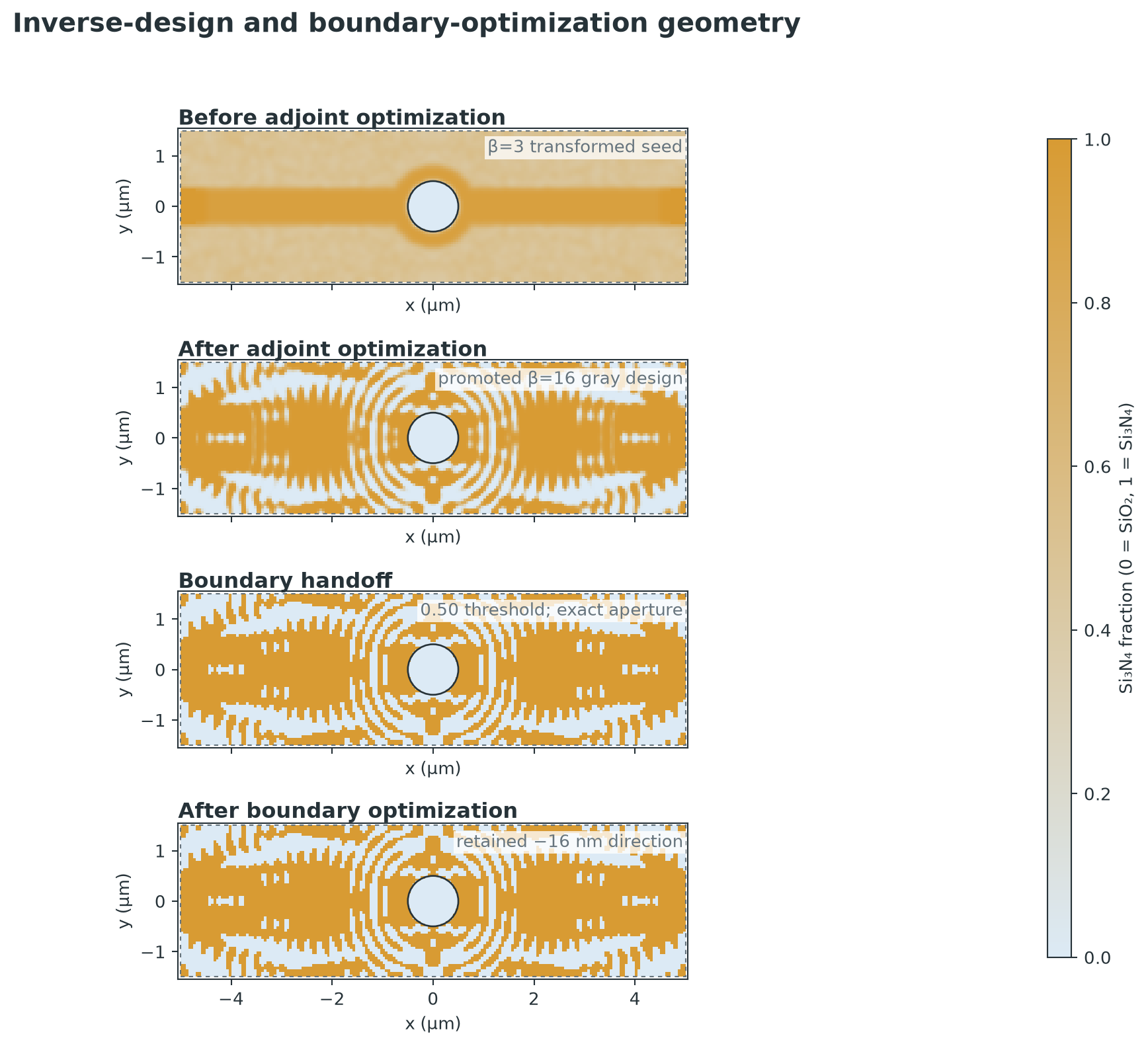
Initial, optimized, and binarized topology at matched axes. Source: retained Tidy3D adjoint density checkpoints from the Si₃N₄ pipeline; generator and projection settings are documented on the linked experiment page.
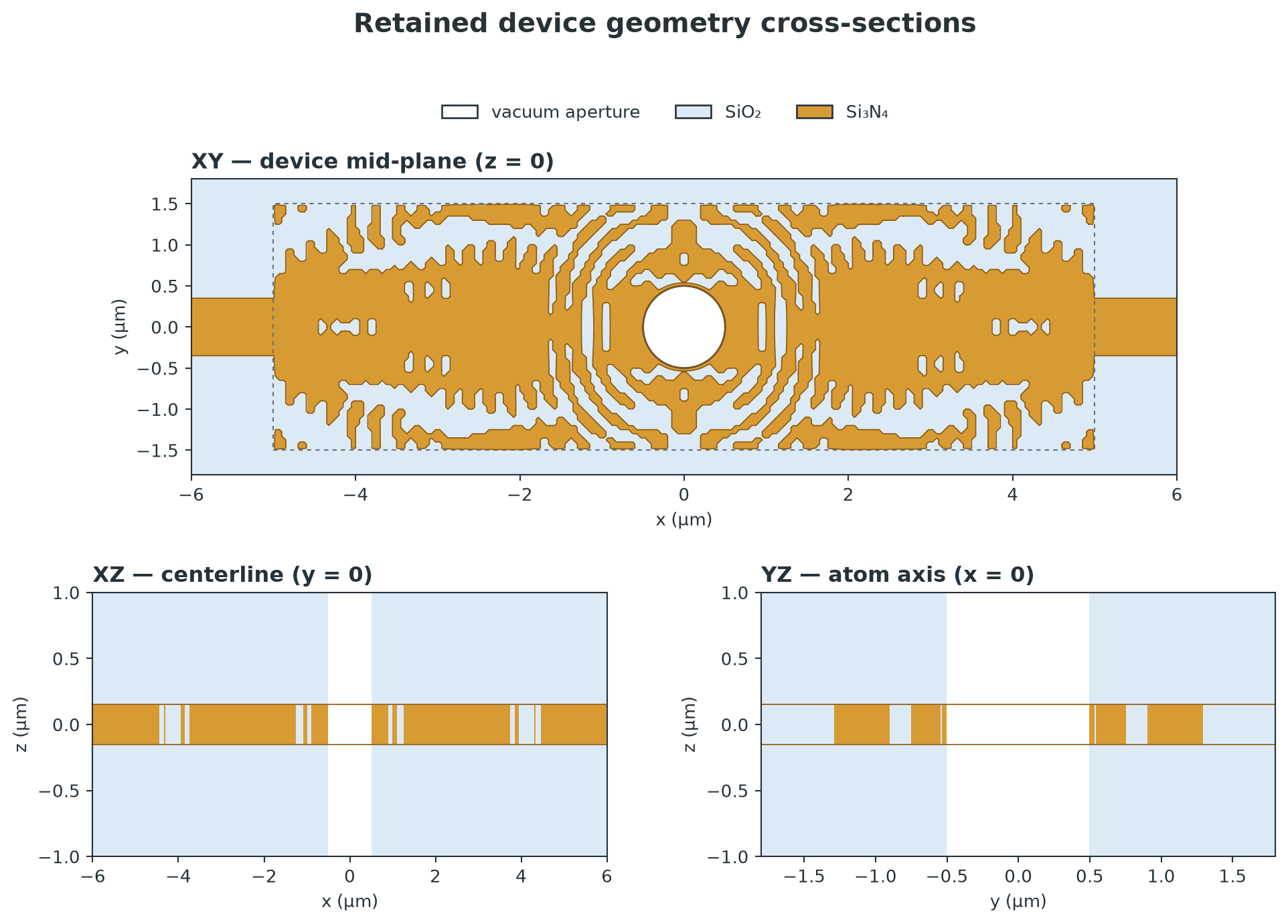
Material cross-sections for the promoted topology handoff, including the Si₃N₄ design layer and SiO₂ cladding. Source geometry and plotting choices are listed in the Si₃N₄ experiment record.
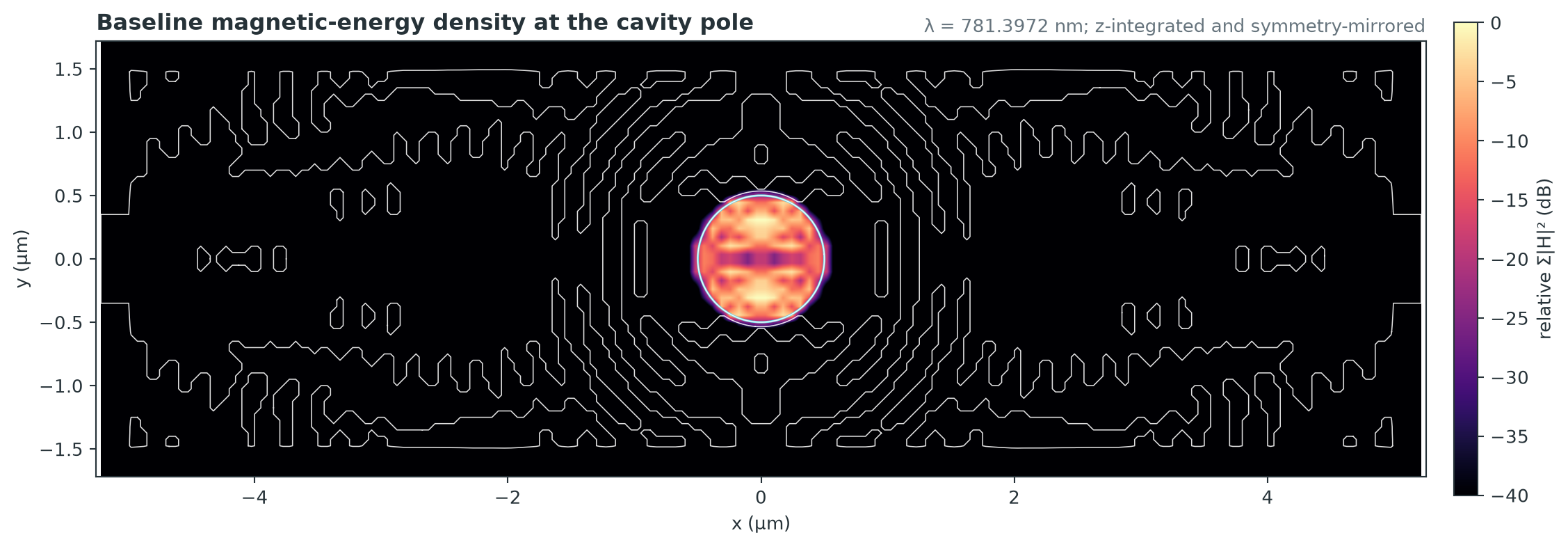
Representative retained cavity-mode field from the promoted Si₃N₄ structure. The experiment page states the field component, slice, frequency, normalization, and source monitor used for this raster.
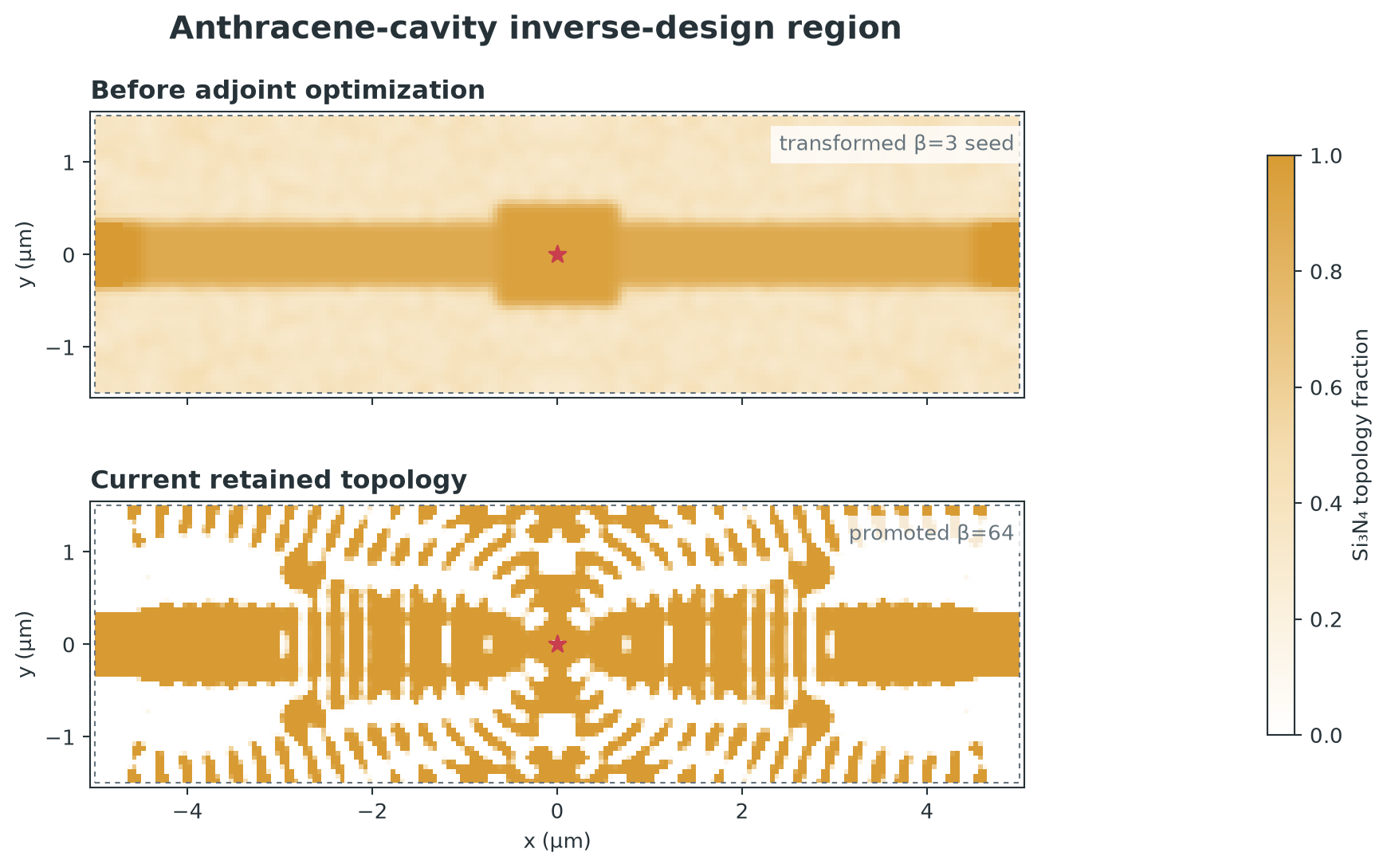
Anthracene-stack topology checkpoints through the adjoint stage. The 100 nm anthracene layer contains the dipole; source artifacts and binarization choices are recorded in the linked campaign page.
These prototypes remain separate from Device23 because they answer a different question: creation of a useful resonant geometry from scratch. Device23 is the current test bed for whether the downstream Q boundary optimizer can be trusted.