Device23 full-boundary Q optimization
Outcome so far
The physical pattern search raised qualified Tidy3D Q from 923.53 to 1183.52. Starting from that exact geometry, the corrected free-form surrogate moved holes and cavity sidewalls and raised its common-connectivity FEM Q from 1932.85 to 2286.52 over five accepted steps. The latter is an 18.30% surrogate gain, not a post-seed FDTD result.
The continuation is currently stopped at
prestrained_mesh_line_search_blocked: 14 attempts contracted the step to
0.05 nm without passing the boundary-motion transfer gate. This is a geometry
representation/mesh-motion blockade, not evidence that the physical device is
at a Q optimum.
Current corrected dashboard Physical seed dashboard
Geometry and physical seed
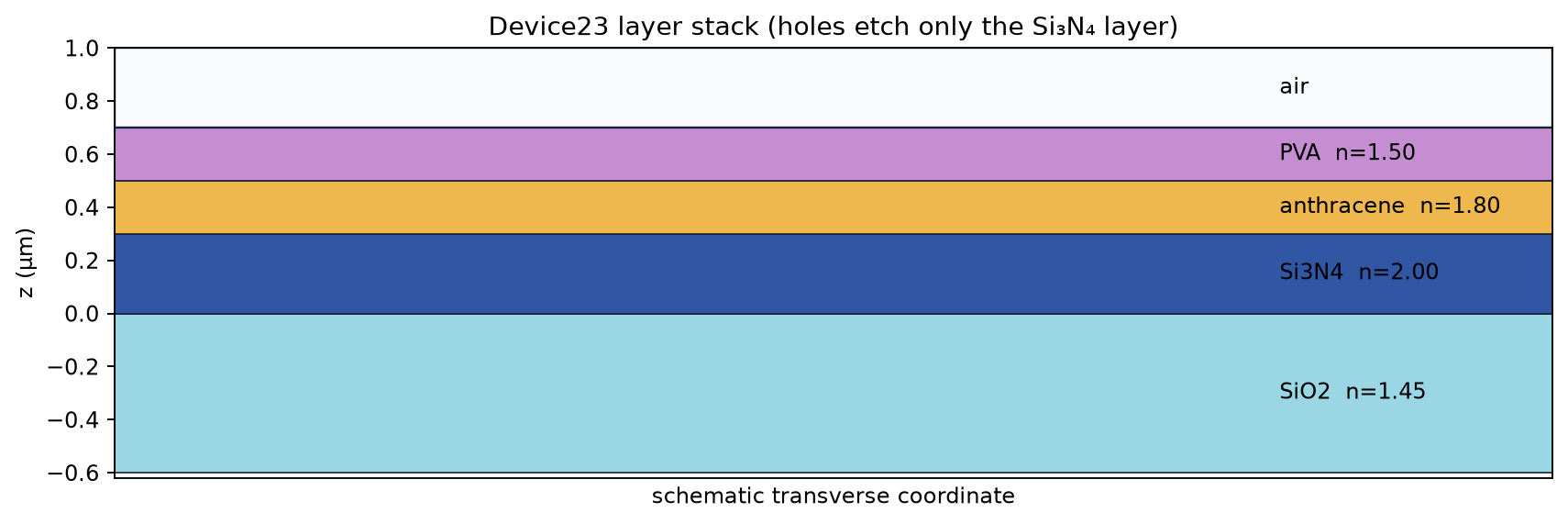
Simulation cross-section: 600 nm SiO₂ substrate, 300 nm etched Si₃N₄,
200 nm unetched anthracene, 200 nm unetched PVA, then air. The current Q-only
campaign uses the retained Device23 stack. Source:
device23_40hole_fdtd_seed.json; generator: plot_geometry.py; material
indices and dimensions are printed in the figure.
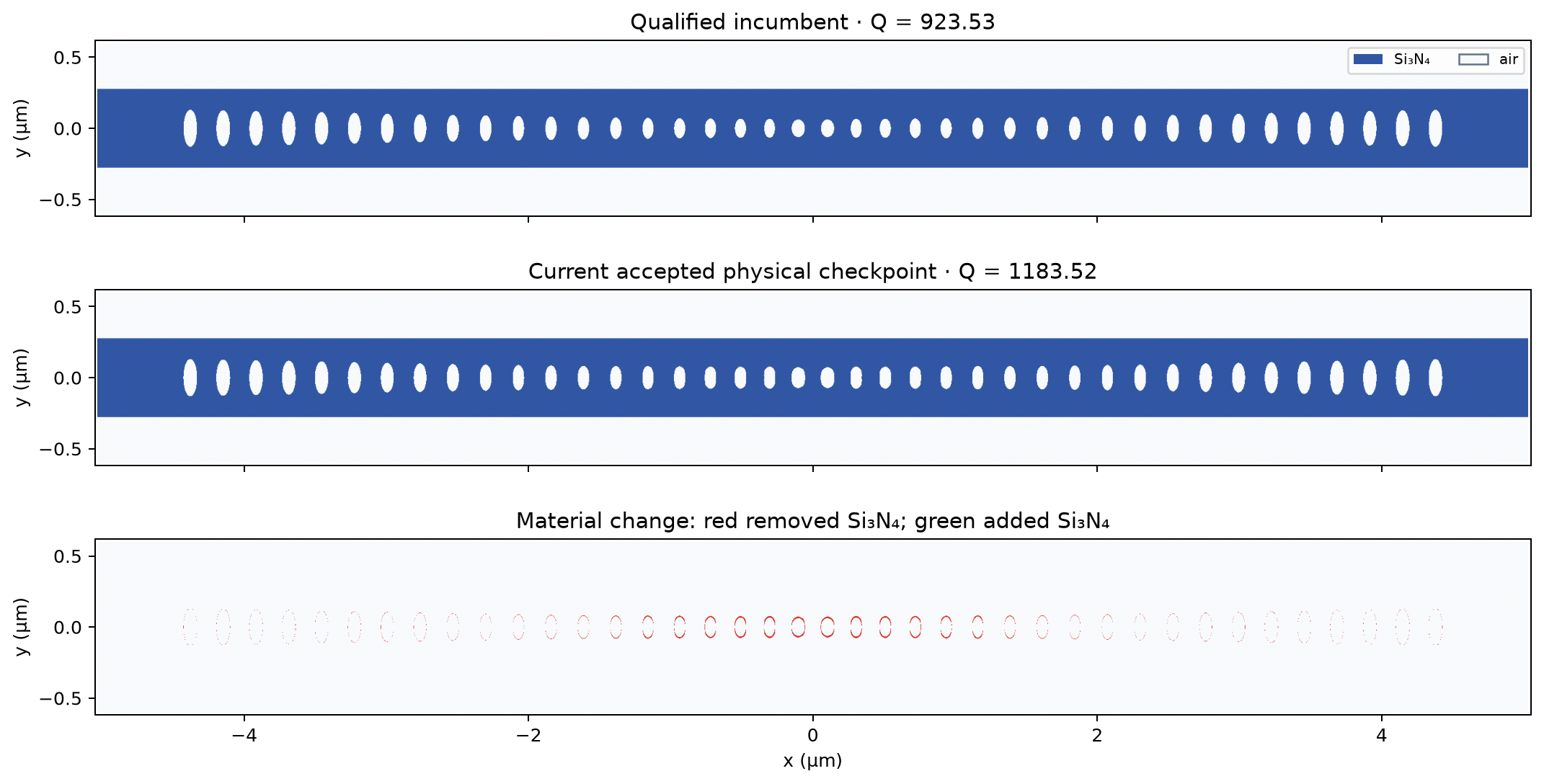
Matched-axis rollback and best qualified physical geometry. Blue is Si₃N₄,
white is air, red removes dielectric, and green adds dielectric. Sources:
rollback field_step_000002.npz and the
hole_defect_ellipticity__1.5625nm__minus candidate; 4 nm level-set grid;
hashes and axes are in physical_bootstrap_manifest.json.
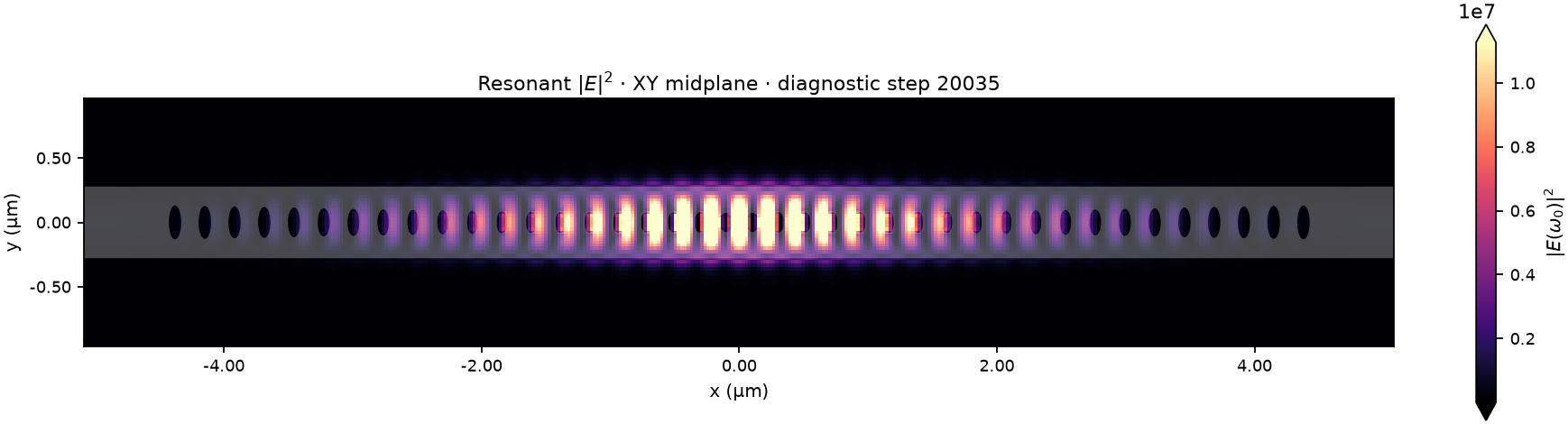
Qualified Tidy3D candidate at 768.555 nm and Q=1183.52. Quantity:
Hann-projected vector \(|E(\omega_0)|^2\) on the XY midplane, with robust
per-panel color normalization. Source: retained diagnostic-step-20035 HDF5;
monitor and time-window provenance are in physical_bootstrap_manifest.json.
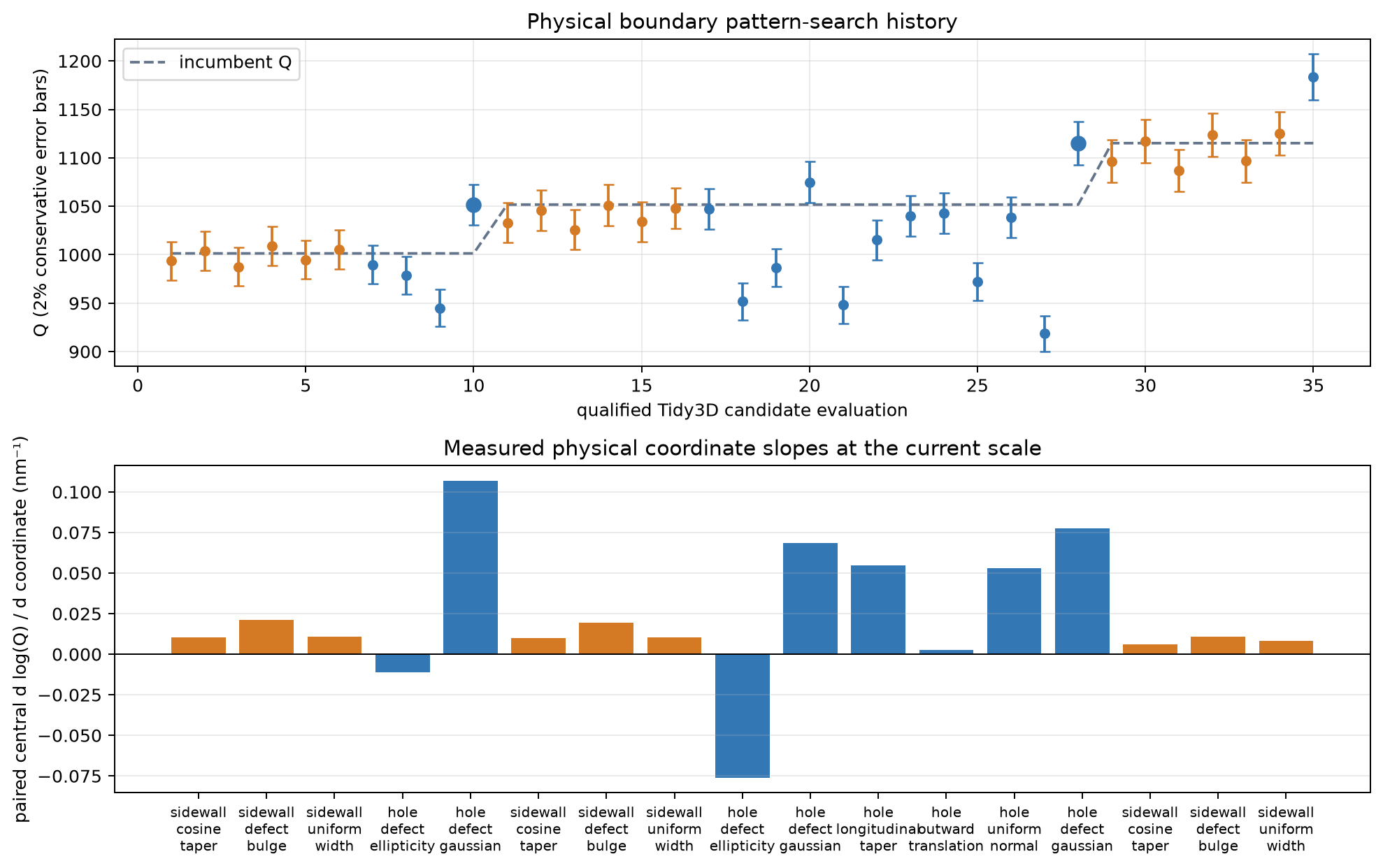
All qualified Tidy3D candidates with the conservative 2% analysis floor.
Orange marks sidewall controls and blue marks hole controls; the final unpaired
point is the Q=1183.52 offline seed. Source: physical-search state.json;
generator: plot_physical_pattern_history.py; exact values are recorded in
physical_pattern_history_manifest.json.
Why there are three dashboards
| Dashboard | Meaning | Read it as |
|---|---|---|
| Corrected full-boundary ascent | Current implementation, FDTD disabled after the physical seed | Local surrogate-Q evidence only |
| FDTD trust rebuild | Physical pattern search and seed qualification | Tidy3D evidence through Q=1183.52 |
| Rejected pre-fix trajectory | Historical failure that exposed contour/ALE/remesh bias | A counterexample, never current progress |
The plot in which physical Q falls belongs only to the rejected pre-fix trajectory. It is important diagnostic evidence, but it is intentionally absent from the current dashboard.
What has been fixed
- The hidden material-dependent mirror-plane boundary condition was removed and pinned by a solver test.
- Sidewalls are explicit free boundaries in the cavity region; the uniform leads remain fixed.
- The shape derivative is pure
log(Q)and acts on both hole and sidewall blocks through an arclength Sobolev metric. - Candidate(0) is identity; projection and reinitialization no longer introduce finite motion as the line-search step tends to zero.
- Mode continuation begins from the accepted field overlap, not a narrow fixed frequency window.
- The exact canonical boundary motion—not the requested motion—is used in the first-order prediction.
- The post-seed offline branch is hard-disabled from launching Tidy3D jobs.
Remaining blocker and next experiment
The 0.05 nm transfer floor is below the scale at which a one-million-DOF boundary-conforming mesh can reliably distinguish the imaginary pole change from geometry-transfer error. The next implementation should change the local discretization, not merely shrink the line-search step:
- represent the moving interfaces with a fixed-background or higher-order unfitted geometry map so candidate(0) and \(d\Gamma/d\alpha\) are exact;
- replay the five accepted checkpoints and require the same mode overlap and monotonic surrogate Q before continuing;
- run a small, predeclared Tidy3D checkpoint set only after a meaningful total boundary displacement has accumulated;
- then compare long-horizon surrogate and FDTD trends, without requiring pointwise gradient agreement.
The full technical chronology remains in the detailed trust-rebuild record. The mathematical contract is in QNM and arbitrary-boundary shape derivatives.