Quan–Lončar analytical optimizer
The original Quan–Lončar engine constructs an outgoing complex-frequency cavity pole from a waveguide Green tensor, complete through-hole modes, symmetry reduction, and a multiple-scattering determinant. Its optimizers explored nanobeam cavities with BFGS-like analytical updates and occasional physical checks.
Read the derivation guide Open the main archived run
Historical result
The curated primary archive reports analytical Q near \(1.03\times10^5\) and a retained FDTD Q near \(5.11\times10^5\). Other autonomous runs reached still higher analytical Q but lack comparable physical endpoints. Those values are useful lineage evidence, not a converged cross-solver benchmark.
The durable contribution is the operator construction and its derivations. The current project reuses that QNM viewpoint while replacing scalar hole parameters with arbitrary normal motion on complete material boundaries.
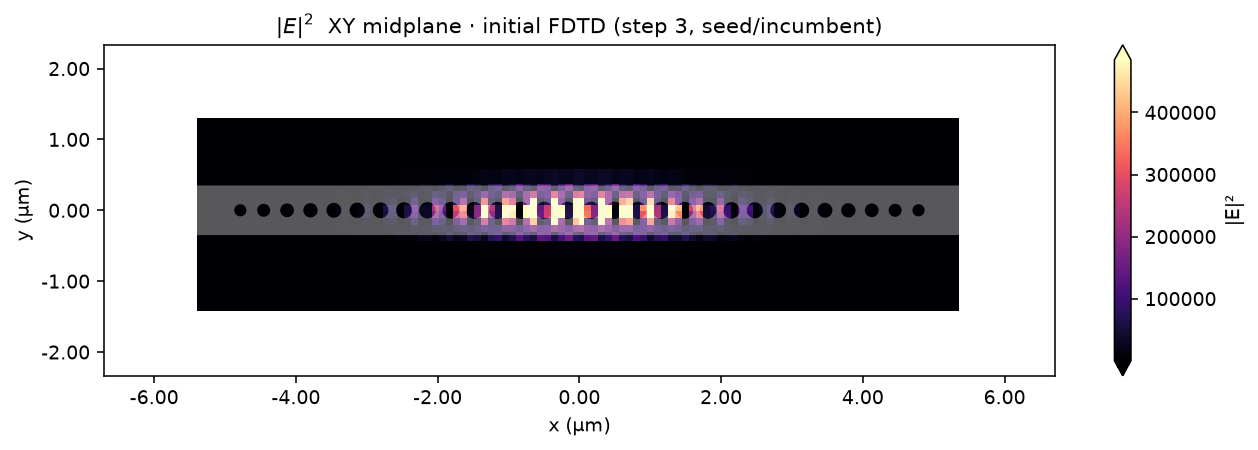
Initial XY-plane tracked-mode intensity from the archived v2 run. Source:
run 20260724T002948Z_quan_v2_indefinite_maxQ,
dashboard/mode/intensity_xy_initial.png; numerical plotting metadata are in
dashboard/mode/mode_meta.json.
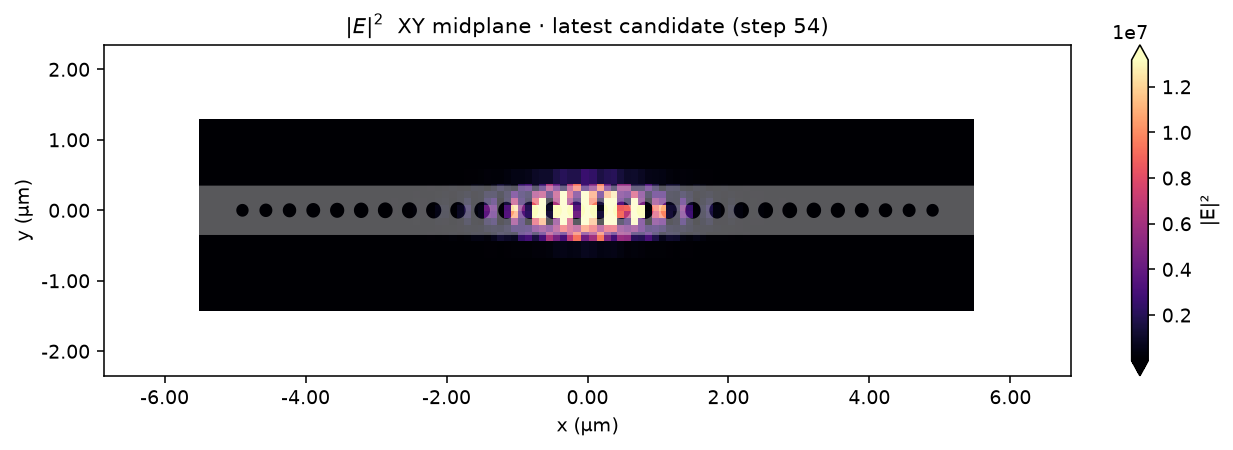
Latest retained XY-plane intensity from the same run and plotting convention. The legacy field export does not provide a material legend in the raster; geometry must be read from the run dashboard and manifest.