Atom-accessible fishbone cavity
This is the direct target-device effort: collect 780 nm atomic emission while preserving a continuous 0.5–1.0 µm air corridor for tweezer delivery. It is an air-clad SiO₂ fishbone concept developed independently of Device23.
The latest retained N40 diagnostic reports Q≈2283 and passes its Auto-14 exact-pole energy/flux and time-window checks. It is not yet a useful atom cavity: the atom-oriented mode volume is 45.65 µm³ (95.73 \(\lambda_\mathrm{air}^3\)), 11.53 times the volume referenced to the dielectric-centered field maximum. Mesh/domain convergence and finite-waist tweezer scattering remain open.
Open the active research record Open the engine overview
Geometry
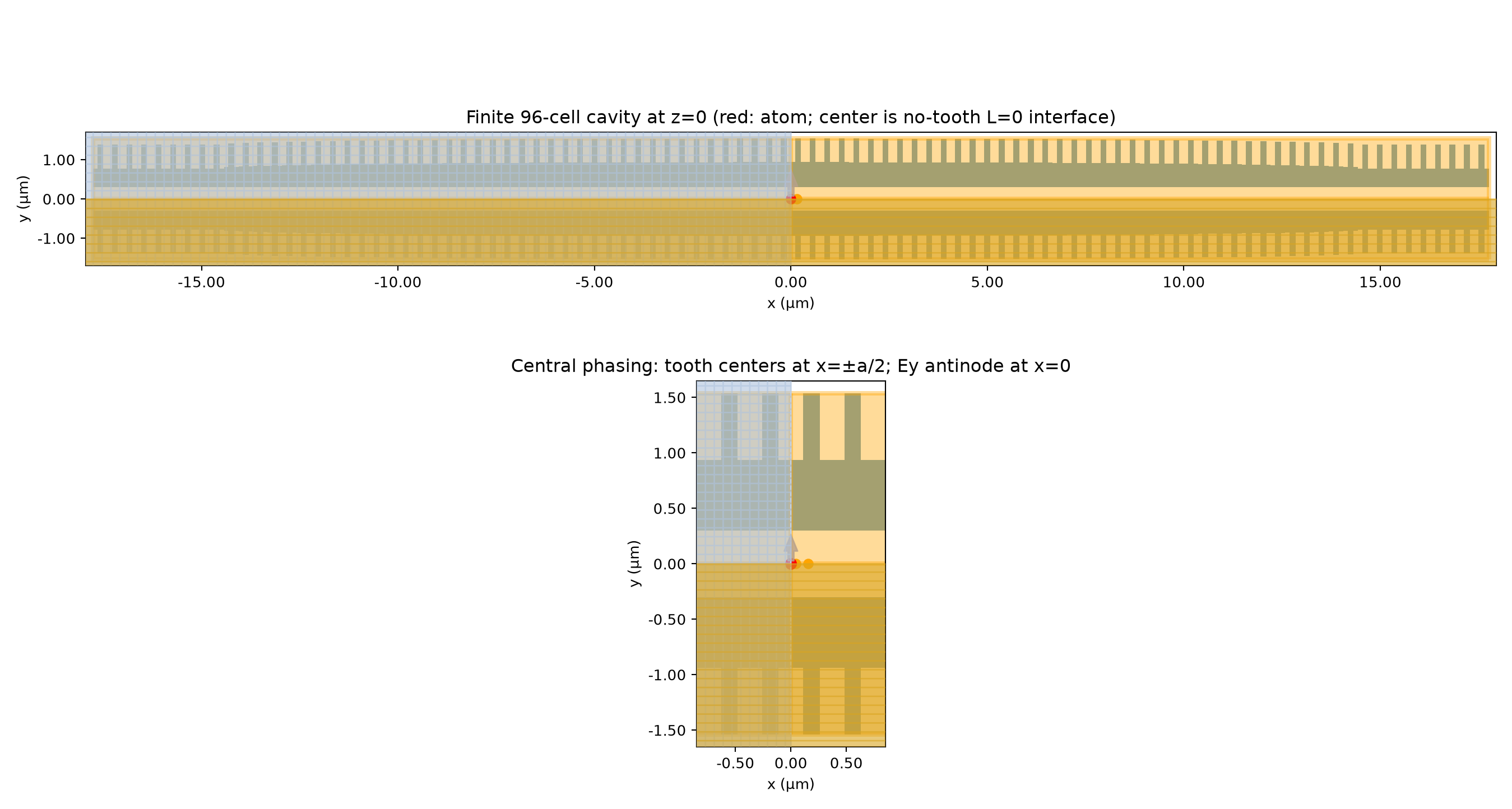
Finite 96-cell SiO₂ fishbone at the z=0 midplane, with the atom location in
red and the open centerline visible in the expanded panel. Source:
runs/rb780_sio2_open_slot_cavity_v1/cavity_cells_practical060_n40_m8.json;
the generator and exact material-color mapping are recorded in the active
campaign note.
Field and ringdown
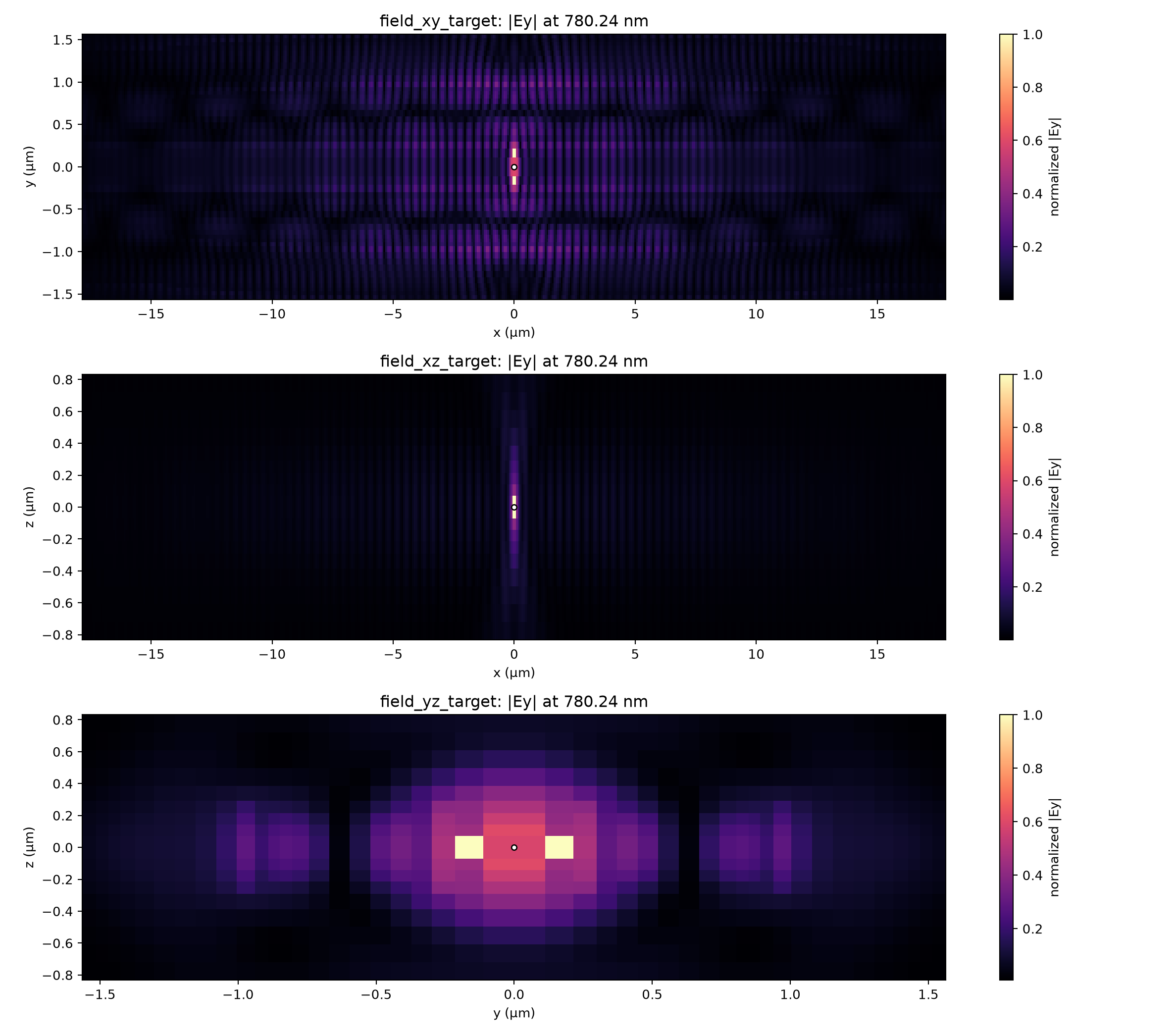
Normalized \(|E_y|\) at 780.24 nm in XY, XZ, and YZ sections through the atom point. Each panel uses a 0–1 color scale; black/white circles mark the atom. Source: retained FDTD monitors for the practical-060 N40 M8 diagnostic; plotting choices are stated in the active campaign note.
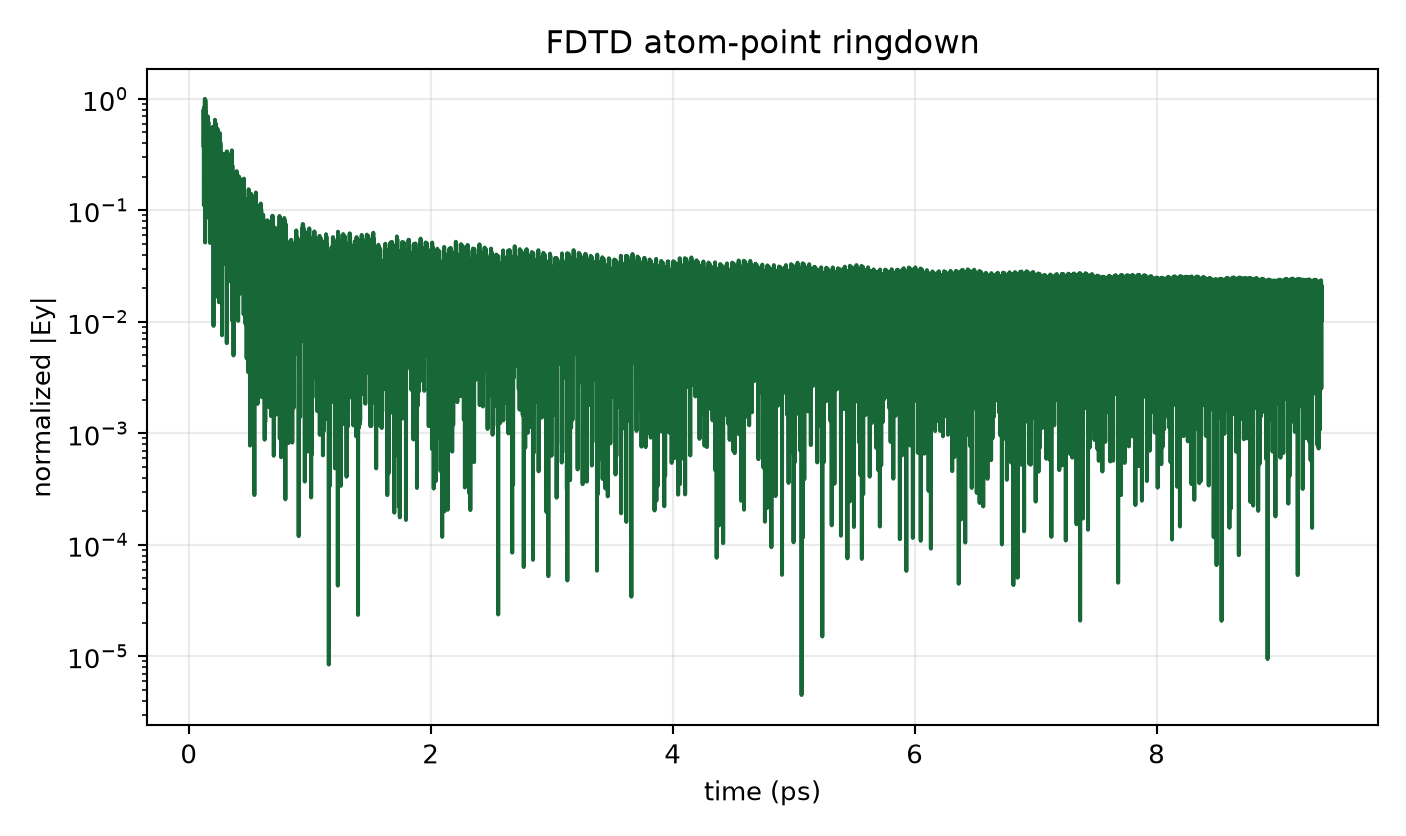
Normalized atom-point \(|E_y|\) versus time on a logarithmic axis. Source: the same practical-060 N40 M8 FDTD run; the pole fit uses the documented time-window and energy/flux gates.
Tweezer-access warning
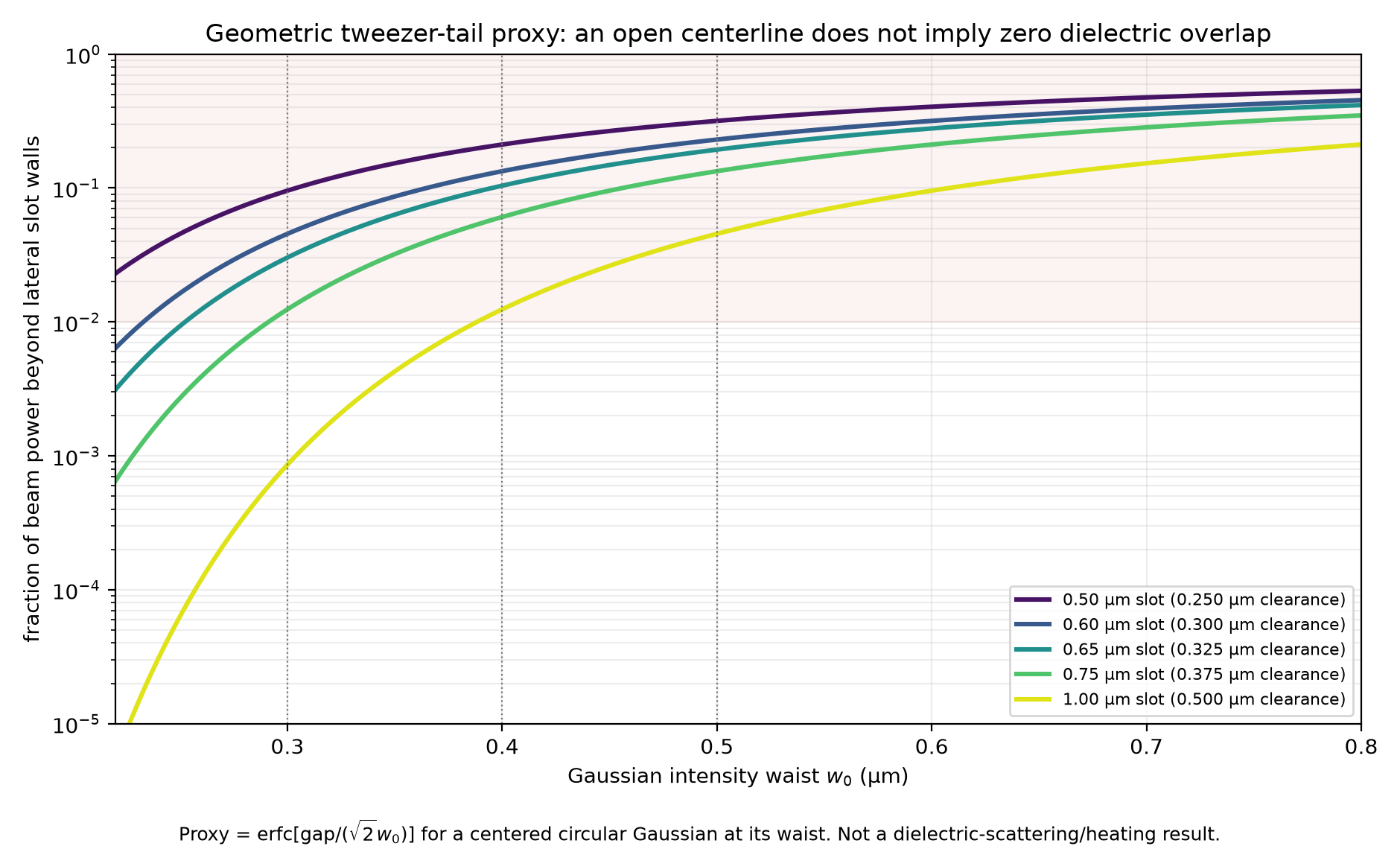
Gaussian-tail power beyond the lateral slot walls versus waist and slot width.
This is the analytic erfc geometric proxy stated in the figure, not an
electromagnetic heating or scattering calculation. Source data and generator:
tweezer_clearance_proxy.json and plot_tweezer_clearance_proxy.py in the
engine run/schematics records.
Why this is not a global hub run
The engine's runs/ directory contains thousands of MPB/FDTD solver work
directories, not sixteen campaign-level optimizer records. Publishing each as a
dashboard would recreate the clutter this audit removes. The curated campaign
note and engine figures are therefore the public entry point until the next
optimization is launched with a campaign manifest, state, and dashboard.
The boundary optimizer is being developed on Device23 because it already has a well-characterized resonant branch. Once that optimizer transfers reliably to FDTD, the atom-accessible geometry can use the same QNM full-boundary refinement while adding independently validated mode-volume and beta objectives.