Trying to get to the single molecule limit
I stepwise diluted DBT:Ac = 1e4 -> 1e6 -> 1e8 -> 2e10 -> 4e11 (approximately)
I melted in a clean test tube at 700 mBar and 265 C on a hot plate in the aluminum holder for 10 minutes. Then I put the test tube in a copper block to cool (still under 700 mBar of N2).
Before putting it in the tube furnace, I use a test tube as a rolling pin and turn it into a fine powder. This greatly increases the quality of the crystals.
This method is working very well for me. The doping efficiency is very high and uniform.
DBT:Ac = 2e10
This seems to be a sweet spot
It is still a little on the high density side. Maybe a factor of 5x more dilution would help. But I would say there is maybe 1 molecule per micron squared on average.
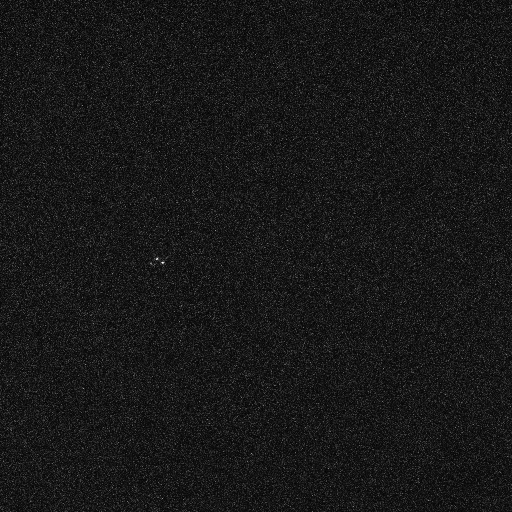
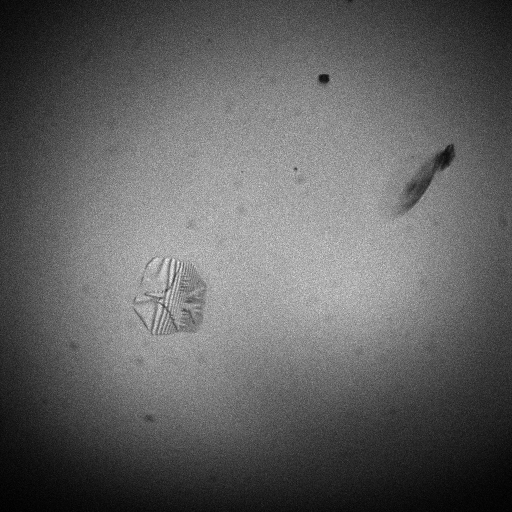
DBT:Ac = 4e11
This is pretty good too. Single isolated molecules
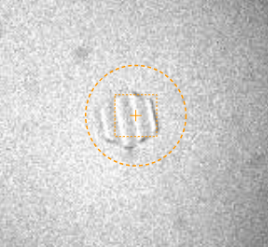
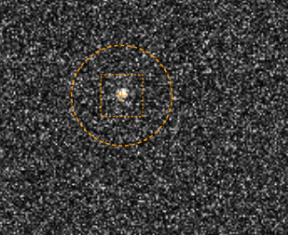
Single molecule
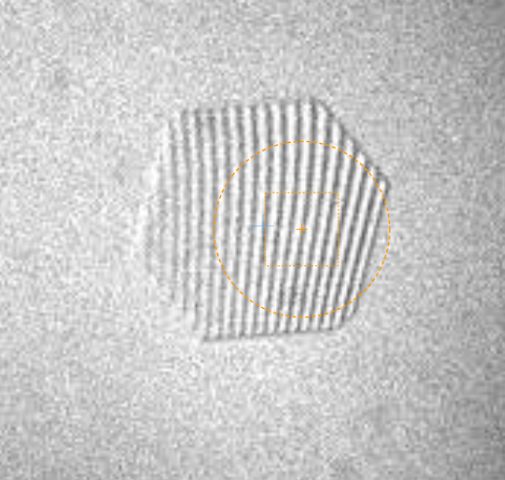
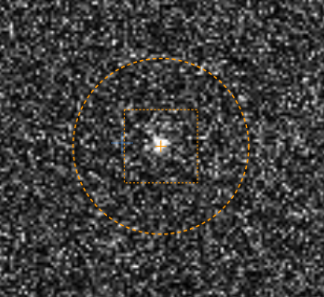
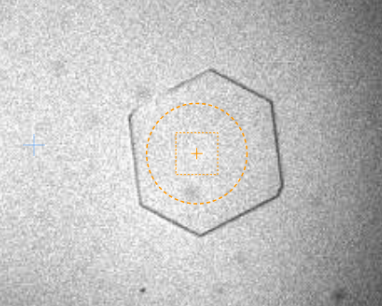
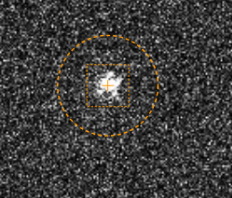 Several molecules in a beam spot in this one
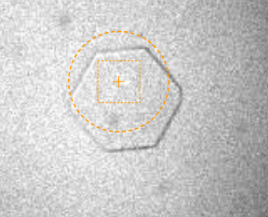
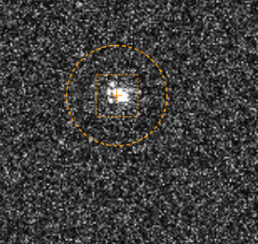 Also this one
The REG protocol Christian is working on
Let me review the actual code to make sure this explanation is precise rather than reconstructed from memory.
Here's the complete model, laid out precisely.
1. The underlying protocol (unchanged from the earlier dark-port analysis)
Two Rb atoms, each in a one-sided cavity, each atom prepared in $(|0\rangle+|1\rangle)/\sqrt2$. A single DBT photon (ZPL branch, Lorentzian spectrum, 35 MHz FWHM) is split on a 50/50 beamsplitter into two arms, one per node. Each arm's amplitude gets multiplied by the atom-state-dependent cavity reflection coefficient ($r_0=-1$ if uncoupled, $r_1\to+1$ at high cooperativity — from the previously-verified caps_reflection.py input-output theory). The arms recombine on a second beamsplitter; a dark-port click heralds $|\Psi^-\rangle$ with fidelity $F=1$ exactly, for any photon bandwidth, cooperativity, or cavity linewidth — this "dark-port immunity" was the earlier session's headline result and is unchanged here. Everything in this session's extension sits on top of that base calculation.
2. What's new: splitting "collection efficiency" into two physically distinct stages
The earlier rate model used one number, $\eta_{\rm del}=0.5$, for "probability the photon makes it from the emitter to a herald." I split this into:
- $\eta_{\rm up}$ — survival probability from the sideband dichroic to the interferometer input (fiber coupling, propagation to the atom nodes). A photon lost here never reached the atoms.
- $\eta_{\rm down}$ — survival probability from the atom-cavity interaction to registration at a detector (return path, final beamsplitter, detector efficiency). A photon lost here did reach the atoms and imprint phase information on them before being lost.
This split is the entire point of the analysis: these two loss stages have different physical consequences (untouched atoms vs. entangled-with-a-lost-photon atoms), and the original single-parameter model couldn't distinguish them.
Simplifying assumption: each stage is modeled as a single scalar transmission efficiency, uniform across the photon's spectrum and identical for both nodes. Real systems could have frequency-dependent or node-asymmetric loss; not modeled.
3. The anti-heralding policy: two independent confidence parameters
On a given ZPL-triggered attempt, four outcomes are possible: dark click, bright click, "safe" silence (lost at the $\eta_{\rm up}$ stage), "unsafe" silence (lost at the $\eta_{\rm down}$ stage). The experimenter's policy — what to do with each outcome — is parametrized by:
- $q_{\rm safe}$ = probability a safe silence is correctly recognized as safe and re-preparation is skipped.
- $q_{\rm unsafe}$ = probability an unsafe silence is correctly recognized as unsafe and re-preparation happens.
Two special cases matter: $q_{\rm safe}=0$ reproduces the original model exactly (every silence, safe or not, triggers re-prep — there's nothing left to misclassify, so $q_{\rm unsafe}$ becomes irrelevant). $q_{\rm safe}=q_{\rm unsafe}=1$ is the "ideal" policy — skip exactly when safe, re-prep exactly when unsafe.
Simplifying assumption — this is the biggest one: $q_{\rm safe}$ and $q_{\rm unsafe}$ are treated as free-standing numbers, not derived from a concrete detection mechanism. I never specified how an experimenter would achieve a given $q$ — e.g., a lossy confirmation tap before the interferometer, or a calibrated argument that most loss is known (by system design) to occur upstream. The rate/fidelity consequences of a given $(q_{\rm safe}, q_{\rm unsafe})$ are computed exactly; what hardware achieves that pair is unaddressed.
4. How contamination is computed (the fidelity side)
If an unsafe silence is missed ($q_{\rm unsafe}$ fails), the atom pair isn't reset — it's left in whatever state the interaction-then-loss actually produced. I compute that state exactly: I generalized the dark/bright port calculation (originally built only for the clean pure input state) to accept an arbitrary density matrix, via per-frequency-bin Kraus operators sandwiching $\rho_{\rm in}$. Verified this reproduces the original pure-state calculation to $10^{-10}$.
The "contaminated" state is $\rho_C(\rho_{\rm in}) + \rho_D(\rho_{\rm in})$ (both ports summed incoherently, since a lost photon at the dark port and one at the bright port are physically distinguishable events even though neither is observed). Reusing this contaminated state for the next attempt gives a dark-port click with essentially the same probability as a clean herald, but fidelity collapses to ≈0.20. Repeated misses compound non-monotonically (0.20 → 0.68 → 0.39 → 0.56...), so I track the full convergent series over contamination depth rather than assuming a single "effective" bad fidelity.
Simplifying assumption: the branching probabilities themselves ($p_{\rm dark}$, $p_{\rm bright}$, etc.) are computed once from the clean state and reused at every contamination depth — I checked this is accurate to within a few percent (probability of a click stays ≈0.369 across five contamination generations) but did not use the exact, depth-dependent values throughout. This is a genuine approximation, not exact.
5. The timing/rate model
Per raw DBT trigger (10 MHz rate): probability $1-f_{\rm ZPL}=0.7$ diverts to the sideband detector (fast retry, atoms untouched, no re-prep). Probability $f_{\rm ZPL}=0.3$ is a ZPL-conditioned attempt, which resolves (costs $T_{\rm prep}=1\,\mu$s) with probability $p_{\rm resolve}$ or is a fast retry otherwise. Mean time per ZPL-conditioned attempt: $\bar T = T_{\rm trig}/f_{\rm ZPL} + p_{\rm resolve}\,T_{\rm prep}$, rate $=p_{\rm dark}/\bar T$.
This formula was wrong on the first attempt — an earlier version divided $T_{\rm trig}$ by $p_{\rm resolve}$ instead of adding the two terms this way, which double-counted $f_{\rm ZPL}$ and, worse, produced the opposite conclusion (conservative beating anti-heralded at low collection efficiency). I only trusted the fix after cross-checking against a from-scratch discrete-event Monte Carlo that steps through actual trigger-by-trigger elapsed time — it disagreed with the buggy formula by exactly the predicted factor and confirmed the corrected formula to within MC statistical noise.
Simplifying assumptions here: $T_{\rm prep}=1\,\mu$s and $T_{\rm trig}=100$ ns are fixed constants, not derived from any specific hardware (microwave/Raman state prep, AOD switching, etc.) — they're the same placeholder values used throughout this project. Re-preparation is treated as instantaneous dead time with no possibility of pipelining (e.g., preparing the next attempt's atom while waiting on the current one) — a real system might parallelize this, which would reduce the gap between the conservative and anti-heralded policies (since re-prep cost would be hidden rather than serial).
6. What the resulting numbers do and don't establish
Established, with a validated model: the rate formula for both policies (Monte Carlo–confirmed), the existence and severity of the silent-corruption failure mode, the fact that the anti-heralding rate benefit saturates at ≈4× rather than growing without bound, and the crossover collection efficiencies against Cabrillo/Barrett-Kok/coherent-probe.
Not established: any concrete implementation of $q_{\rm safe}/q_{\rm unsafe}$; the joint $(\eta_{\rm up},\eta_{\rm down})$ dependence (only $\eta_{\rm down}=0.95$ was swept against $\eta_{\rm up}$); pipelined re-preparation; frequency- or node-dependent loss; and, as with the rest of this project, the atom-emission baseline numbers (Cabrillo/Barrett-Kok) carry their own earlier-flagged caveats independent of this analysis.