Anthracene dual-angle waveguide
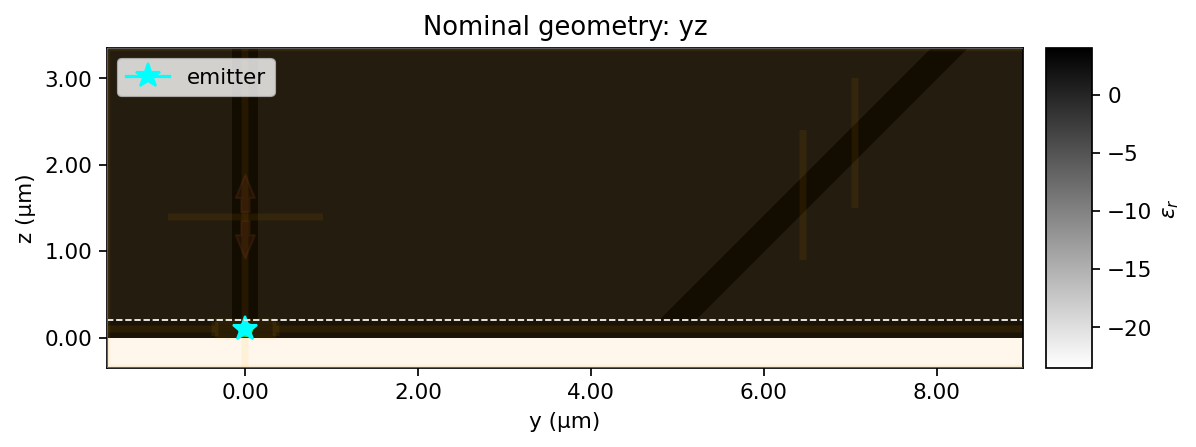
Straight collection guide + a 45-degree tilted pump guide meeting a cleaved SiO2 chip surface.
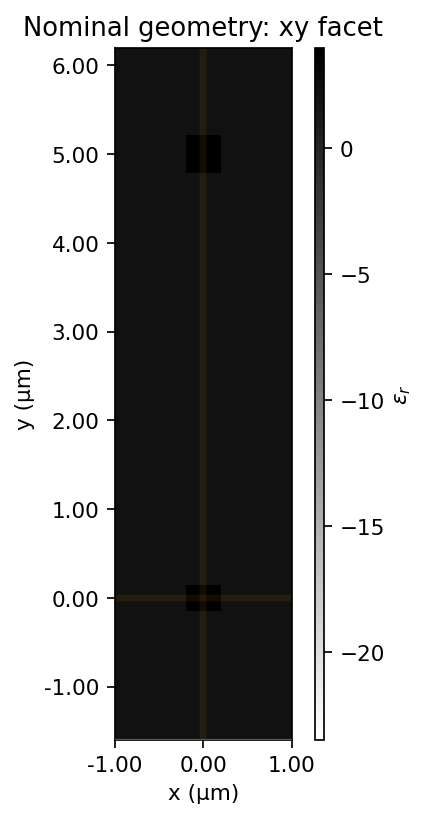
FDTD study of a DBT-like, x-polarized emitter in a 200 nm anthracene crystal on silver. Two Si3N4 waveguides in a cleaved SiO2 chip touch the top crystal surface:
- a straight collection guide normal to the crystal;
- a pump guide in the y-z plane, tilted 45 degrees from the z normal.
The tilted-guide facet is the intersection of the oblique core with the
horizontal cleave plane, so its y extent is larger by 1/cos(45 degrees).
The sweep varies the y coordinate of the tilted-guide facet center:
2.0, 5.0, 8.0 um. These near, nominal, and far points keep the complete
dipole/cross-talk study inside the authorized 5 FlexCredit cap.
Metrics
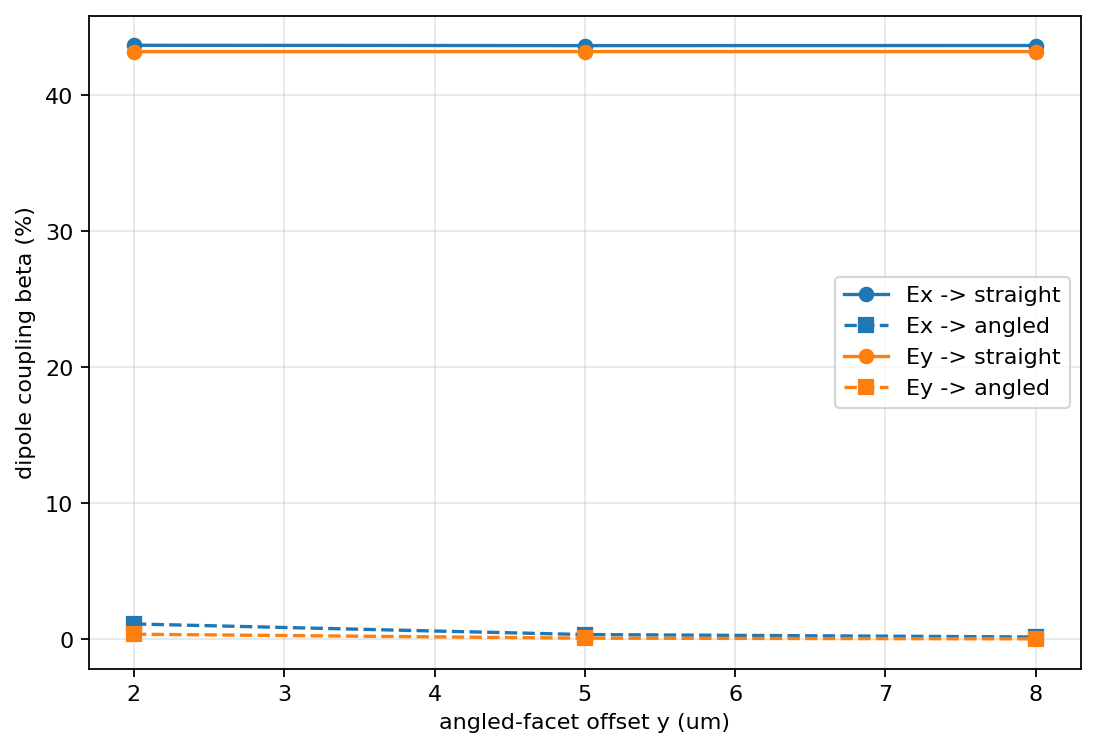
- Dipole beta factor into the straight fundamental mode.
- Dipole beta factor into the angled guided port (aperture flux, checked at two planes).
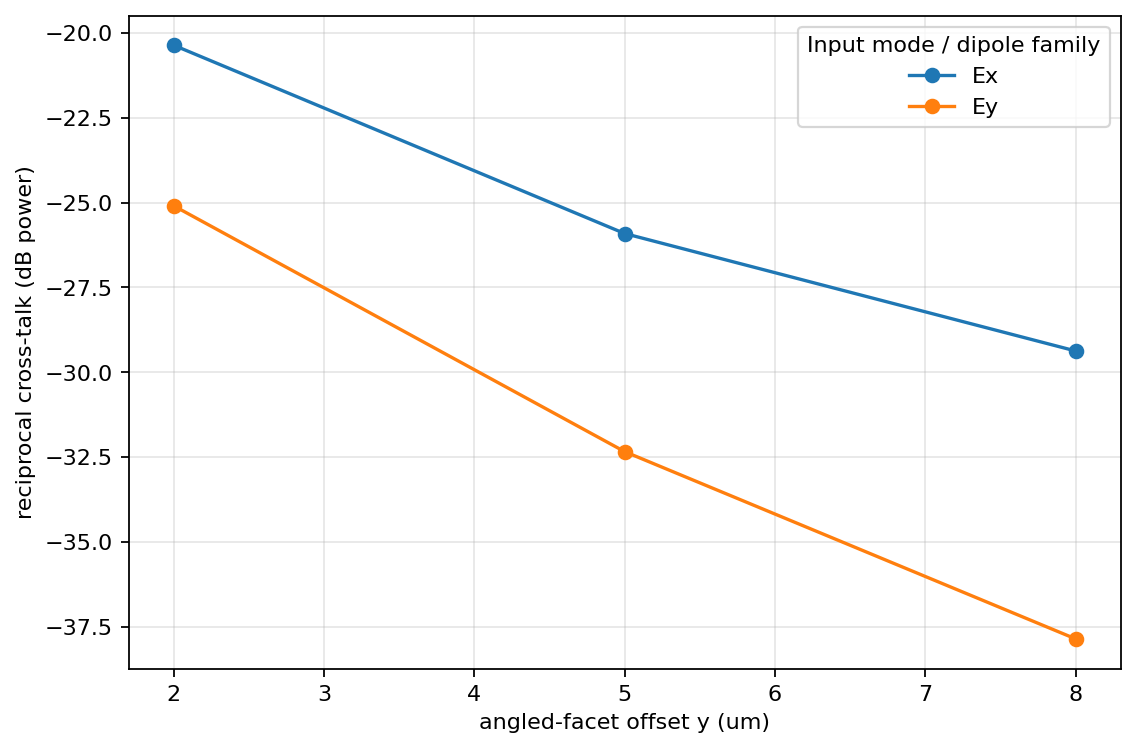
- Straight-to-angled power transfer. Reciprocity makes this equal to the requested angled-to-straight cross-talk.
- Relative angled-pump excitation strength from dipole-to-angled coupling, by Lorentz reciprocity.
- Estimated and actual billed FlexCredit cost.
Commands
cd nanophotonic_structures/anthracene_dual_angle_waveguide_v1
python study.py --dry-run
python study.py --estimate
python study.py --run --max-flexcredits 5
python study.py --report
--run estimates every missing job before starting any of them and refuses
to submit the batch if the estimated total exceeds the supplied cap.
Results
Silver / anthracene dual-angle waveguide: two-polarization study
Method
For every offset and dipole orientation, two production simulations are used:
- A point dipole (Ex or Ey) measures emitted power in the matching straight-guide mode and in the angled guided port.
- A unit-power matching straight-guide mode is injected toward the crystal with no dipole source. Power reaching the angled port is the straight-to-angled cross-talk. Lorentz reciprocity makes it equal to angled-to-straight cross-talk.
The local mode solve identifies straight mode 0 as Ex-like and mode 1 as Ey-like. The angled guide is evaluated by two y-normal flux apertures because Tidy3D does not provide oblique mode-monitor planes.
Geometry
Results
| Offset (um) | Dipole / mode | n_eff | beta straight | beta angled | cross-talk | cross-talk plane mismatch |
|---|---|---|---|---|---|---|
| 2.0 | Ex | 1.6806 | 43.67% | 1.119% | -20.37 dB | 30.32% |
| 2.0 | Ey | 1.6574 | 43.2% | 0.3631% | -25.10 dB | 25.49% |
| 5.0 | Ex | 1.6806 | 43.64% | 0.3391% | -25.91 dB | 10.80% |
| 5.0 | Ey | 1.6574 | 43.2% | 0.07221% | -32.34 dB | 9.54% |
| 8.0 | Ex | 1.6806 | 43.65% | 0.1593% | -29.37 dB | 3.25% |
| 8.0 | Ey | 1.6574 | 43.2% | 0.02081% | -37.86 dB | 25.94% |
At the requested 5 um offset:
- Ex is the stronger straight-collection orientation.
- Ex is the stronger angled-guide emitter-coupling orientation.
- Ex cross-talk is -25.91 dB; Ey-family cross-talk is -32.34 dB.
Ex field intuition at 5 um
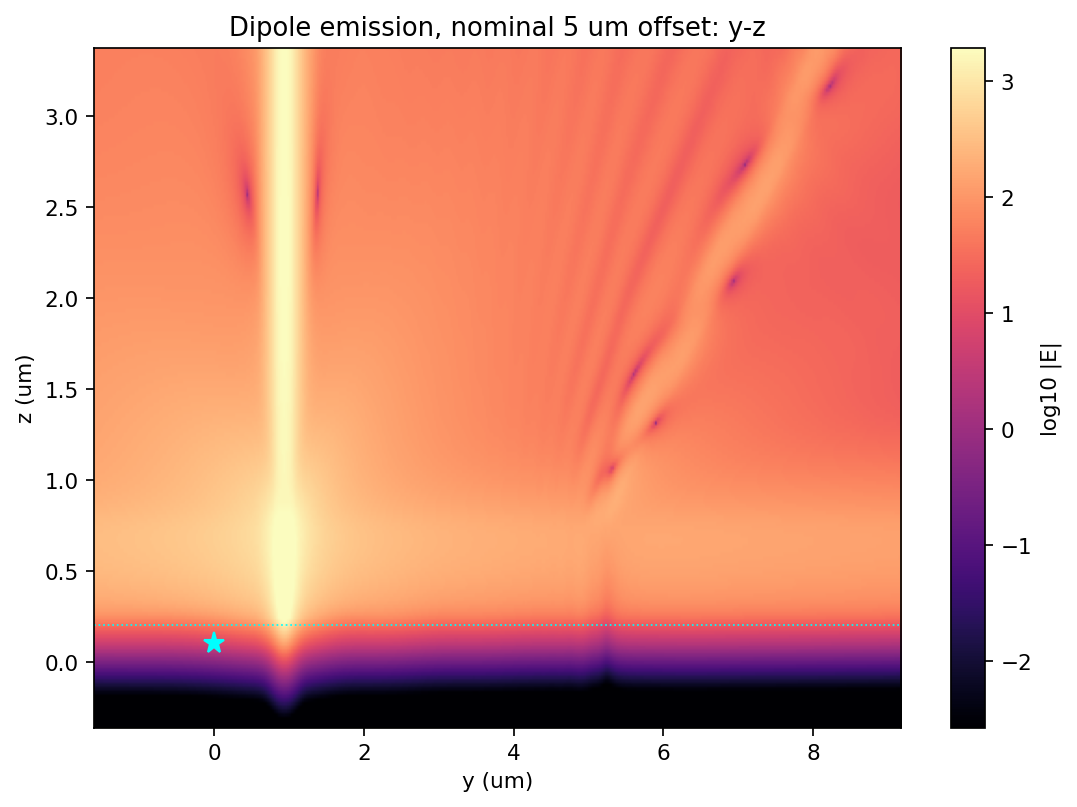
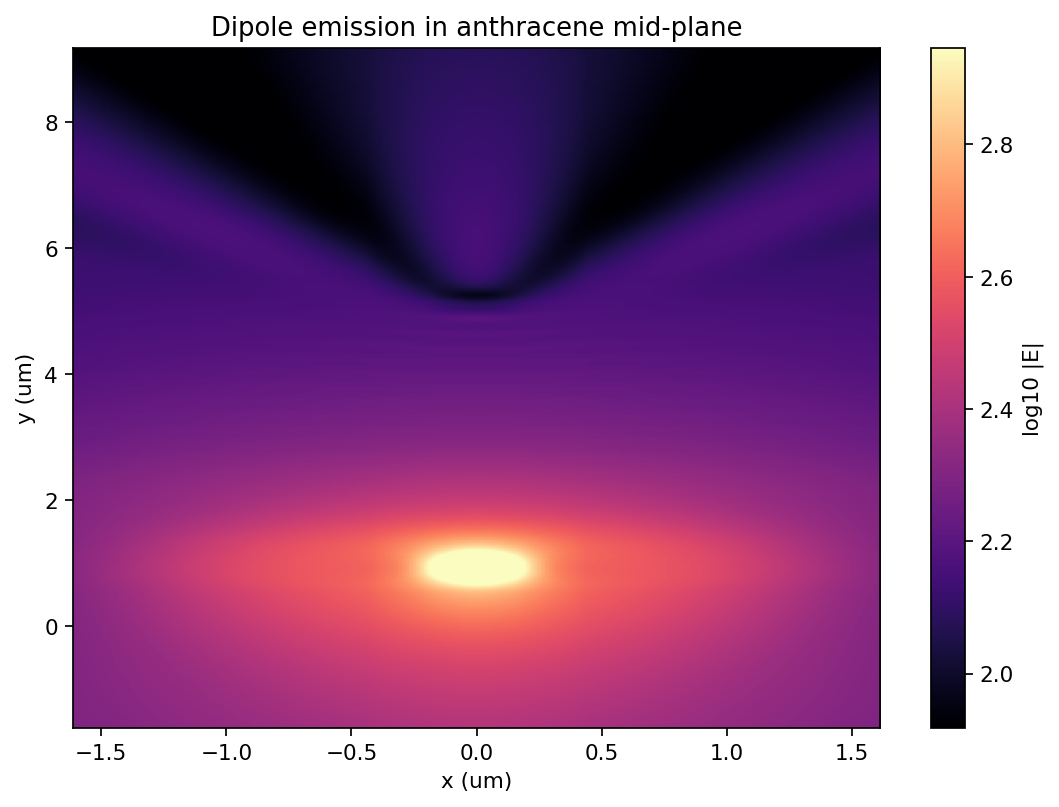
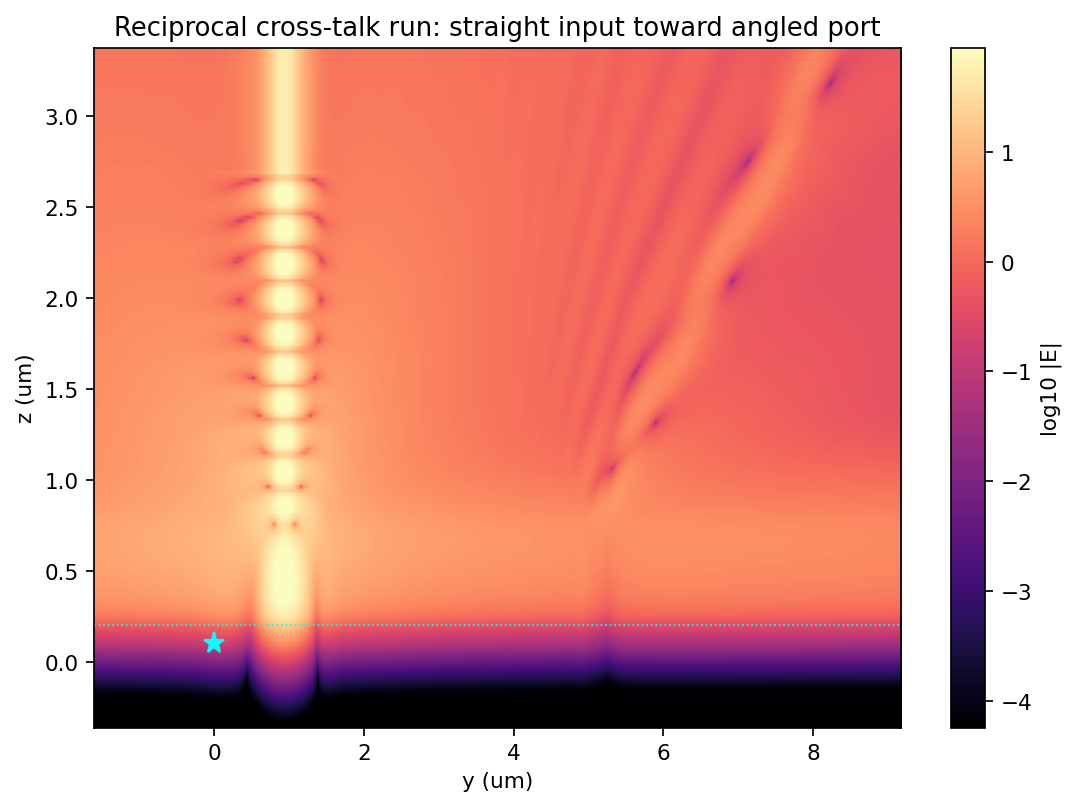
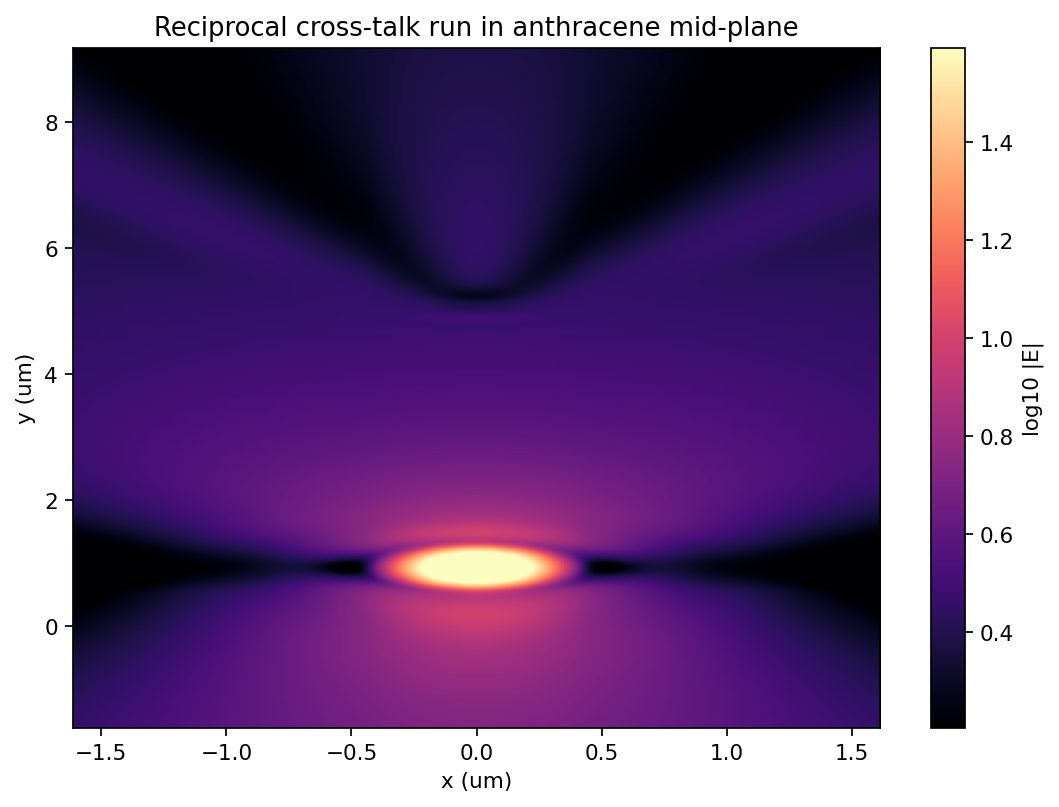
Ey field intuition at 5 um
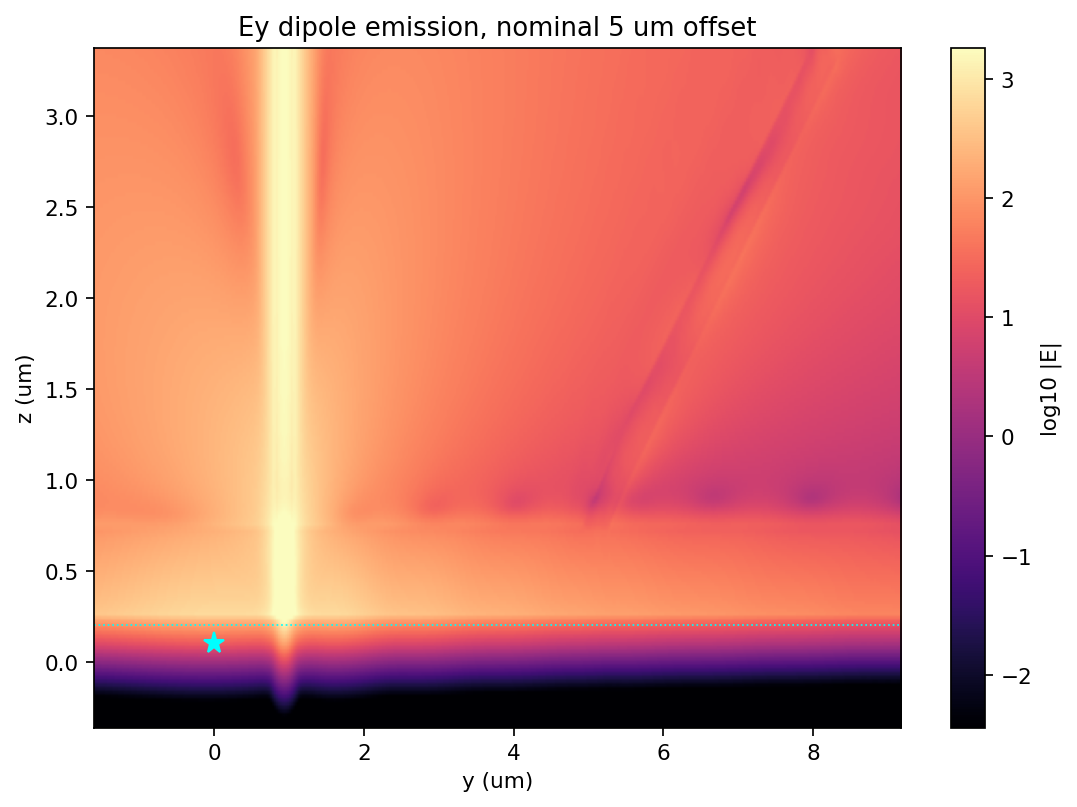
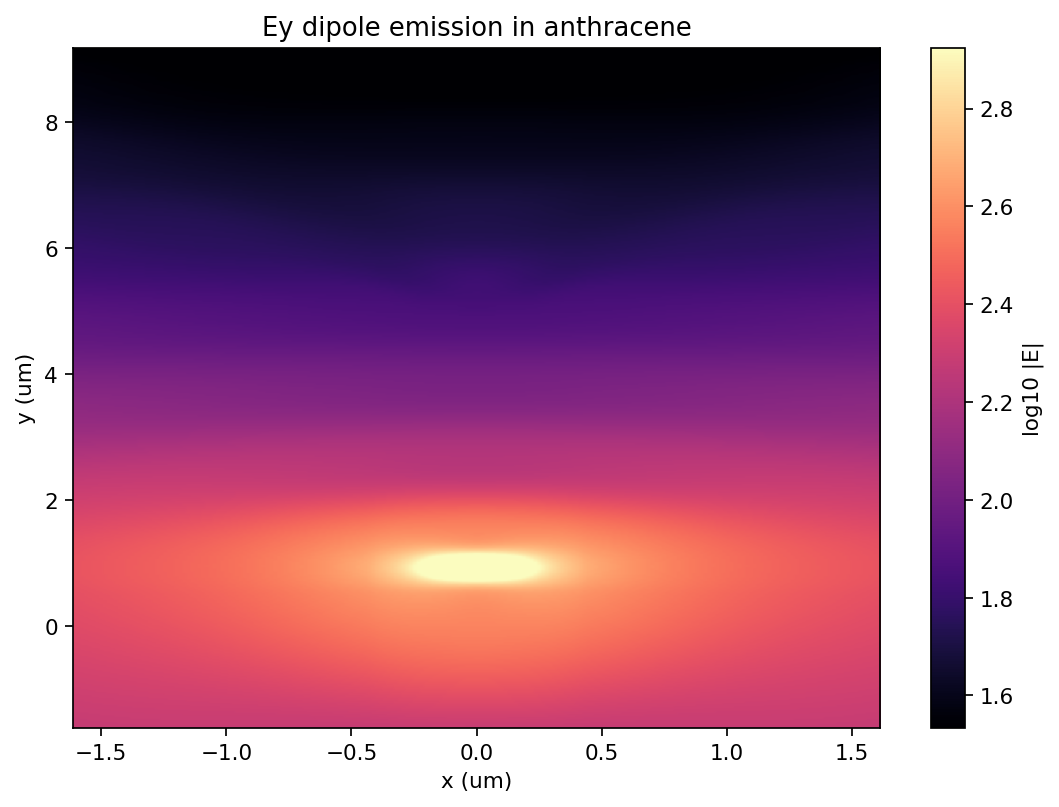
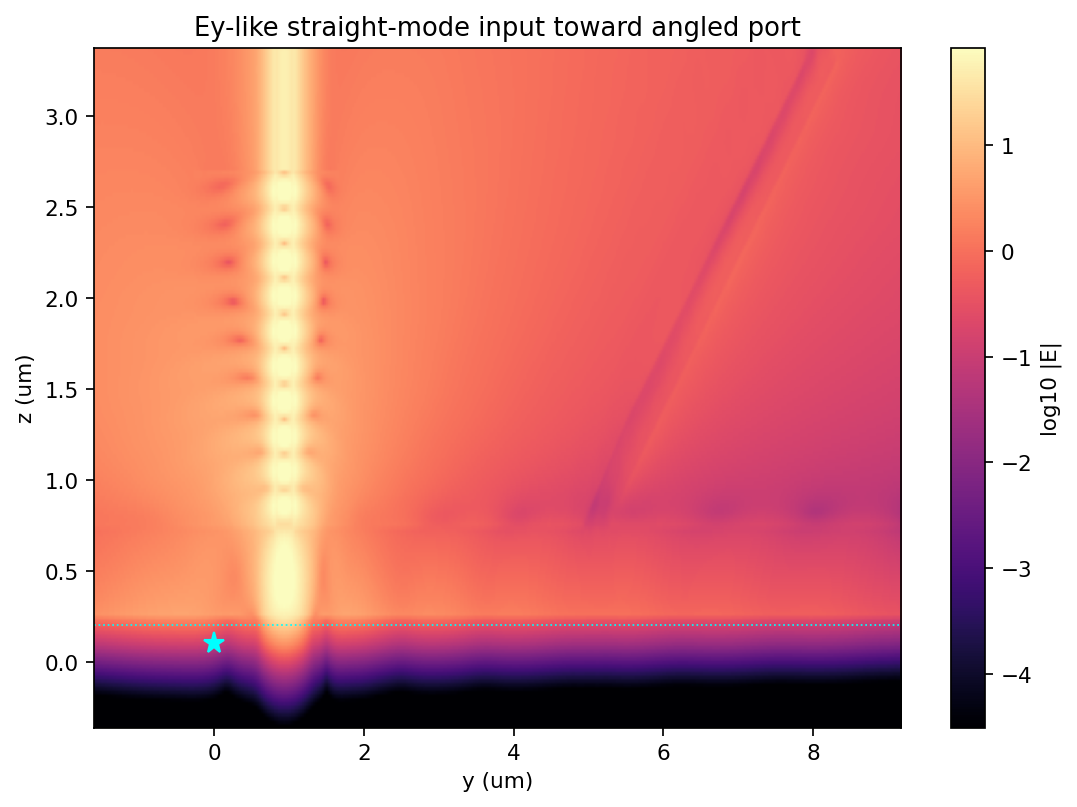
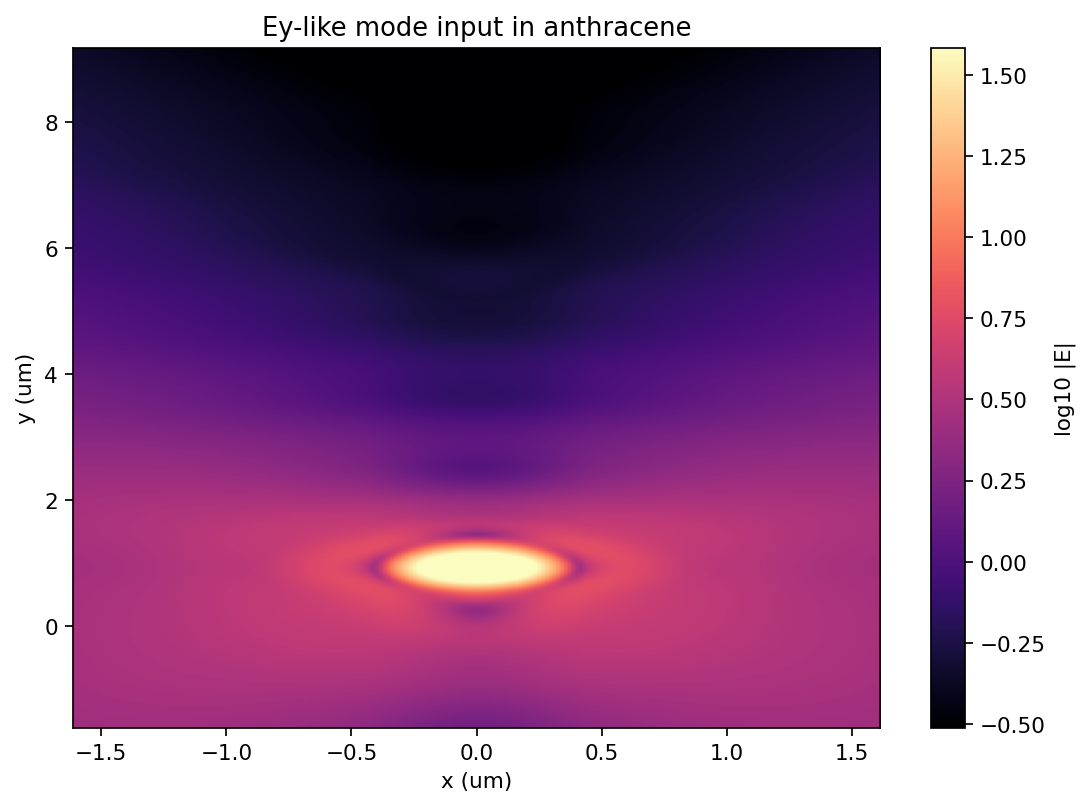
field_reverse_xy.png.
Cost
- Initial mode-index screening: 0.4681 FC.
- Corrected Ex production runs: 0.4149 FC.
- Ey extension runs: 0.4987 FC.
- Total billed study cost: 1.3817 FC of the authorized 5 FC.
Limitations
- Straight-guide powers use exact modal decomposition.
- Angled-guide powers use aperture flux rather than an oblique modal decomposition; the two-plane mismatch is reported for every cross-talk result.
- The in-plane Ey/Ez polarization family remains separate from Ex by x-mirror symmetry, but the angled-port aperture sums any guided power within that family.
- Results are monochromatic at 780 nm and assume an ideal planar cleave, isotropic anthracene, and the stated dipole axes.
Downloads
FDTD simulation study only -- no GDS/STL deliverable files exist in this tree.
Source: nanophotonic_devices/emitter_coupling/anthracene_dual_angle_waveguide_v1/