
Sources and detectors#
A source specifies both a spatial field pattern and a temporal signal. A detector reduces the evolving state to data useful after—or during—the run.
Temporal profiles#
WaveCharacter accepts exactly one of free-space wavelength, frequency, or period. Source classes can use continuous-wave, Gaussian-windowed, or custom time profiles. Broadband pulses cover multiple frequencies in one run, but every requested phasor still needs sufficient cycles and a clean accumulation window.
Validated temporal behavior includes continuous and Gaussian profiles, custom profiles, pulsed-versus-CW transmission, and dispersive-source correction.
Spatial excitation#
PointDipoleSourceinjects a localized electric current.UniformPlaneSourceinjects a linearly polarized plane field over a finite plane.GaussianPlaneSourceadds a transverse Gaussian amplitude and phase profile.ModePlaneSourceinjects a computed cross-sectional eigenmode.TFSF sources bound a total-field region and cancel the incident field outside it.
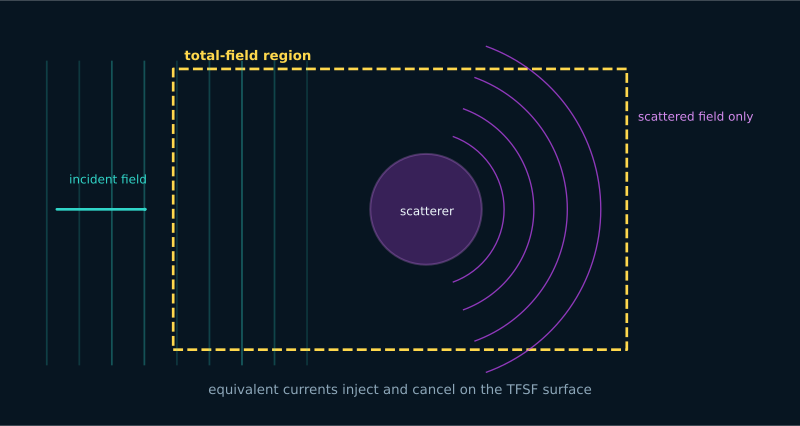
TFSF injection is especially useful when scattered power must be measured without subtracting a large incident field numerically.#
Detector choices#
Detector |
Produces |
Use it for |
|---|---|---|
|
sampled \(E\)/\(H\) in space and time |
animations, transients, custom reductions |
|
complex frequency-domain fields |
phase, impedance, standing waves |
|
integrated instantaneous power flow |
pulse energy and time-domain diagnostics |
|
frequency-resolved complex power |
spectra and \(R/T\) |
|
complex modal amplitudes |
port transmission, reflection, and S-parameters |
|
electromagnetic energy |
decay and stability checks |
Sign and normalization#
For phasors, the time-average Poynting vector is
Detector face orientation determines the sign. For scattering parameters, normalize output mode power by an incident-mode calibration produced with the same source, grid, accumulation convention, and reference plane. The benchmark suite checks phasor/time-domain consistency and passive-power bounds precisely because normalization bugs can otherwise look like excellent device performance.