
Port-mode to central-dipole finite-Q 4D Adam#
Status: running_port_dipole_4d_adam · Adam steps: 38 ·
ideal fidelity: 0.545274 ·
objective: -0.606466
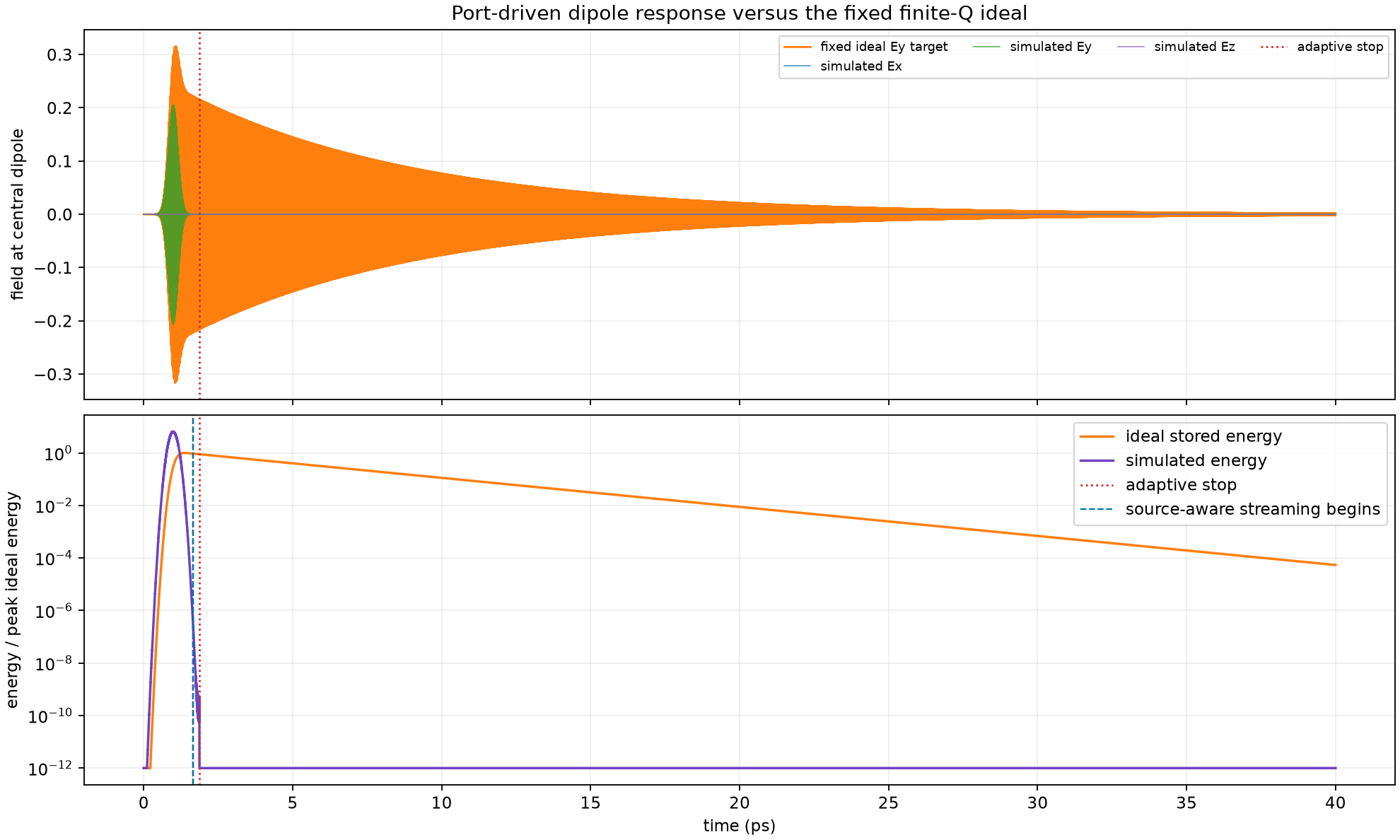
Last realized tape: 1.866 ps · final energy/peak: 9.06e-12 · convergence stop: True
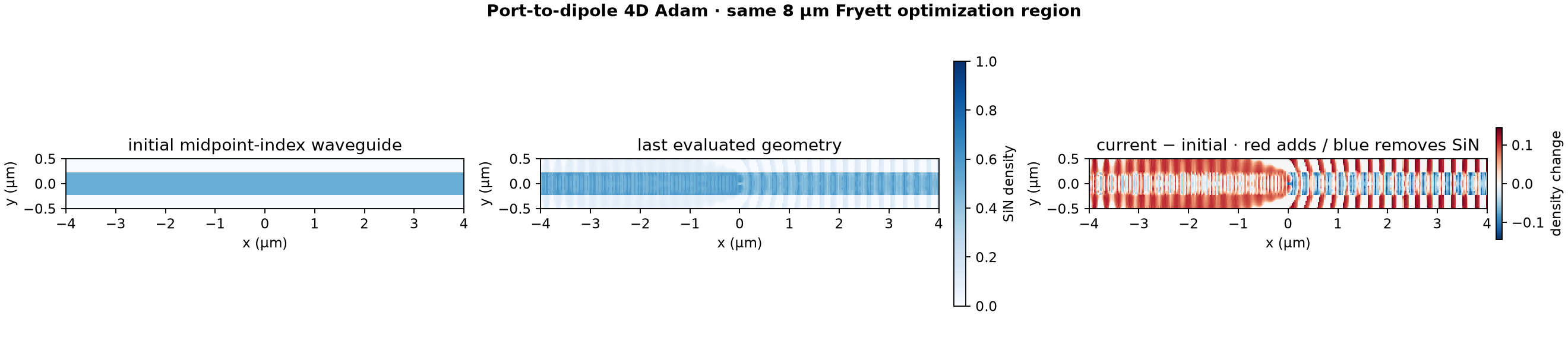
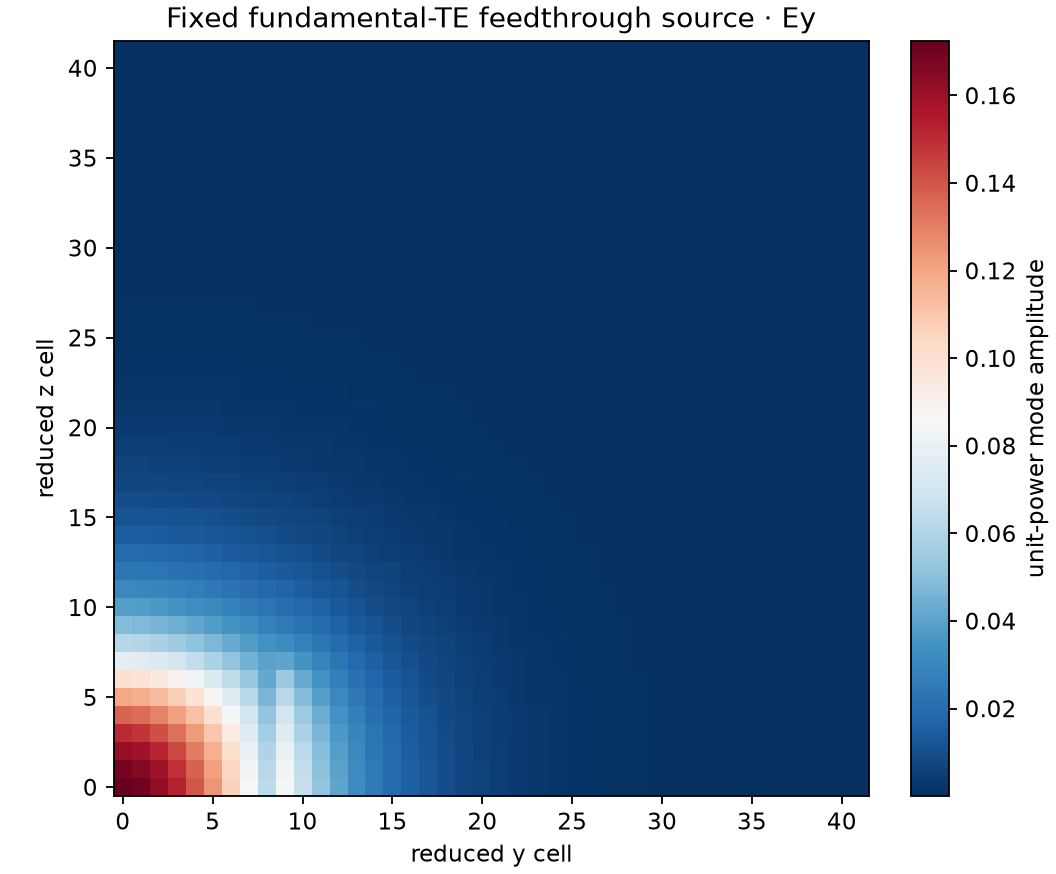
This campaign injects one fixed, directional fundamental-TE mode from the left feedthrough and observes the complete electric vector at a central y-polarized dipole. Only the 6,400 direct 25 nm cavity-density pixels move. There is no source optimization, spatial filter, projection, binarization, line search, trust region, or topology prior.
Note
Every displayed optimizer step is exactly one adaptive forward/adjoint pair. The red stop marker and runtime history show the trajectory actually executed.
Fixed physical target#
quantity |
fixed value |
|---|---|
cavity Q |
10,000 |
normalized mode volume |
1.000 |
physical mode volume |
0.074950 µm³ |
ideal Purcell factor |
759.909 |
beta assumption |
1.0 |
field-amplitude lifetime |
7.857 ps |
pulse spectral width |
1.000 THz |
source-off gate |
1.666 ps |
minimum streaming observation |
0.200 ps |
earliest safe stop |
1.866 ps |
hard simulation ceiling |
40.000 ps |
energy convergence |
current / cumulative peak ≤ 1.0% |
sustained convergence hold |
8 optical periods |
reverse checkpoints |
48 |
Adam learning rate |
1.0e-02 |
The ideal trace is the exact discrete response of a (Q=10^4) one-pole cavity to the delayed Gaussian mode pulse. It includes the prompt guide field during loading and the source-free cavity ringdown. Its absolute amplitude is fixed by the standard (Q/V) Purcell factor and beta one; it is never amplitude- or phase-fitted to the simulation.
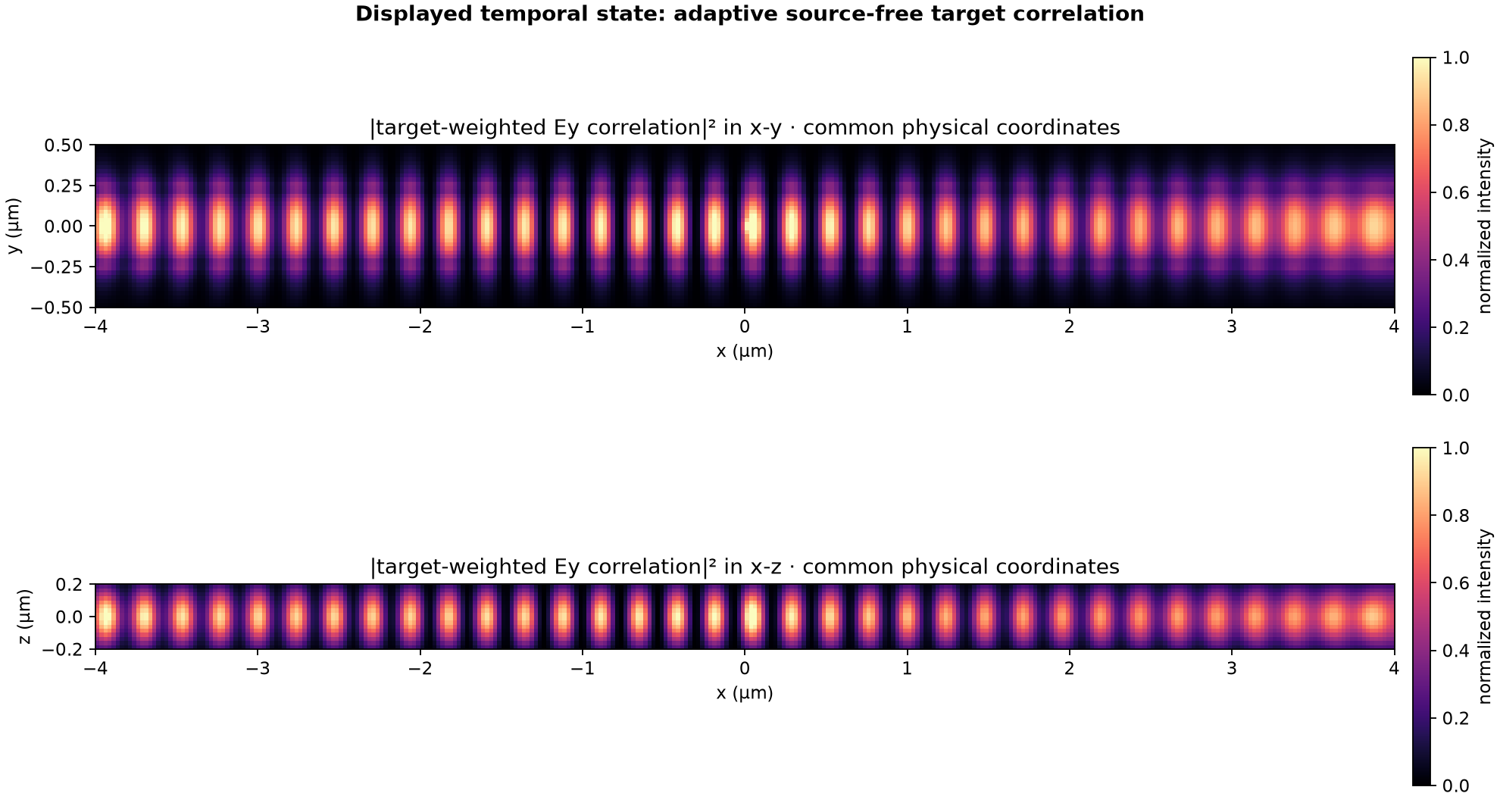
The tape length is selected independently on every step. The convergence latch arms only once the actual Gaussian envelope has fallen below the configured power cutoff and its worst-case propagation delay has cleared. One continuous target-weighted field accumulator then observes 0.2 ps before stopping is allowed. After that the tape ends when full-interior energy stays below 1% of its cumulative peak for eight optical periods, or at the 40 ps safety ceiling. This is the same checkpointed trajectory differentiated by the adjoint—there is no pilot run, restart, or extra forward solve.
Geometry and source#
Optimization history#
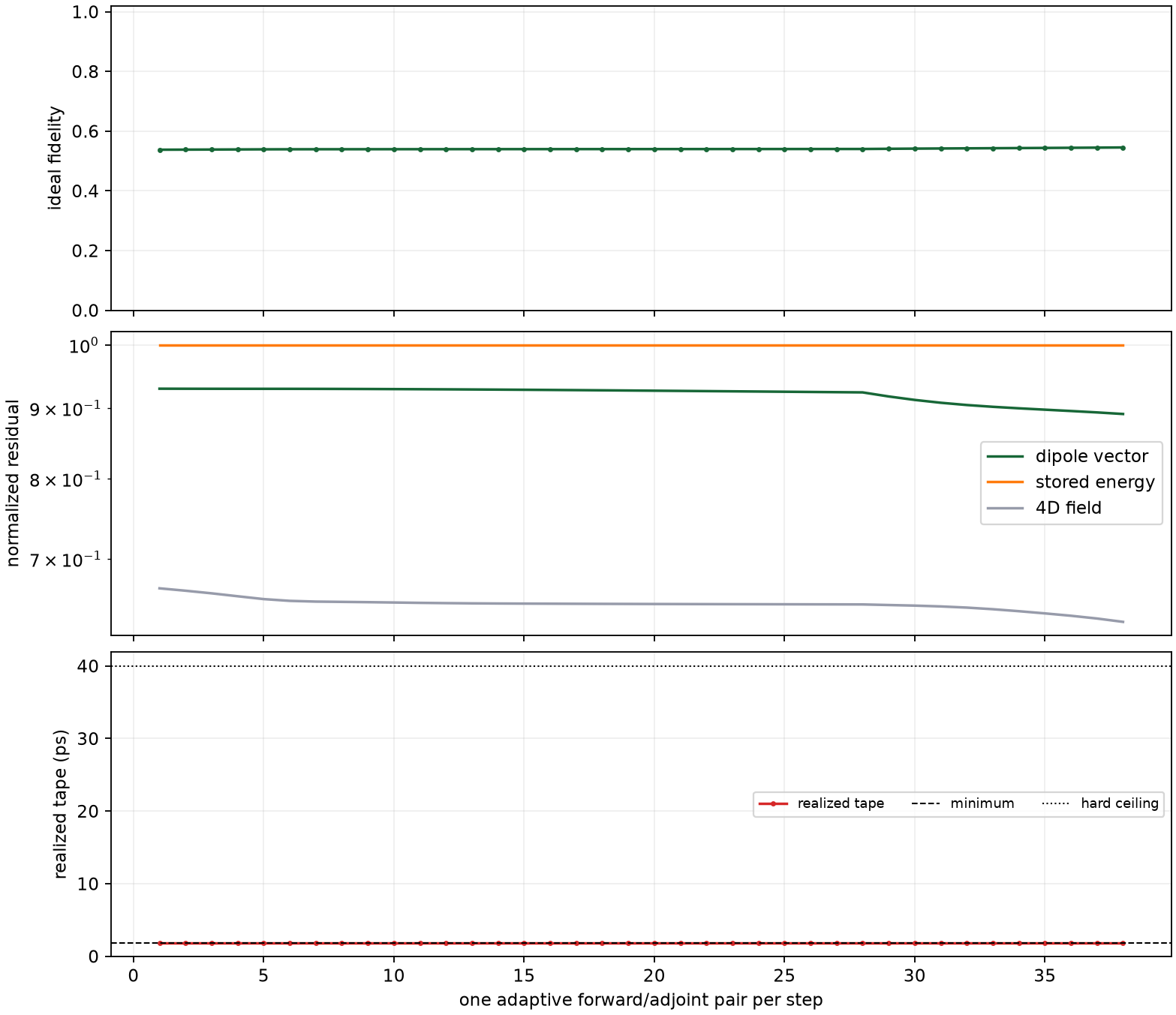
The optimized distance is the equal geometric aggregation of three normalized errors: the full vector dipole waveform, the absolute stored-energy trajectory corresponding to the target mode volume, and the fraction of the six-component 4D field history not explained by one spatial mode carrying the target pole coordinate. The latter is evaluated from streaming sufficient statistics over one continuous source-free interval, not several arbitrary field windows. The ideal fidelity is one only when all three agree.