XYZ-symmetric SiN y-atom temporal-to-pole optimizer#
Worker: not active · stage: pole_guided_purcell ·
status: qualified_success_paused_resumable · checkpoint age: 15.6 min
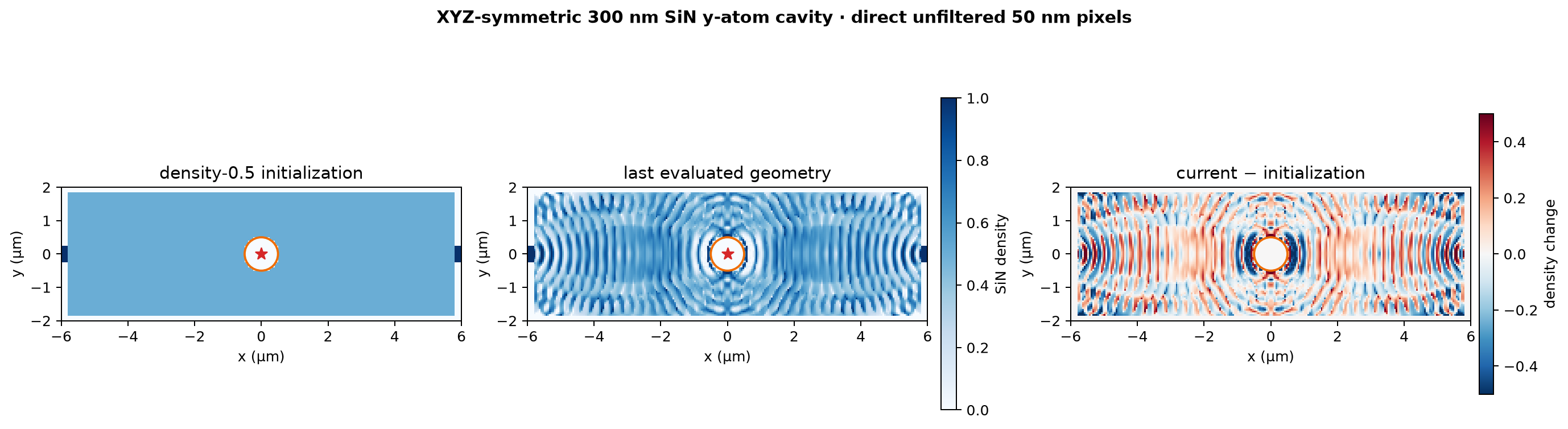
This live campaign drives the even bright combination of the two fundamental
TE-like modes into a 12 µm × 4 µm,
300 nm-thick SiN design. A centered y-oriented atom occupies an immutable
one-micron through-slab air hole. Full x/y/z symmetry leaves one octant and
normalizes the retained source to 1/sqrt(2), so the unfolded coherent pair
has unit total incident power. Raw Adam first minimizes the absolute vector
temporal error. After the temporal metric saturated, the user authorized the pole handoff at step 130. Stage B uses frequency-free,
adaptive-trust L-BFGS-B on the source-normalized resonant port-to-atom
intensity, proportional to beta_wg Q / V_atom by reciprocity. The fitted
absolute atom-pole residue prevents a weakly excited dark mode from winning.
No filter, material projection, or binarization is active.
quantity |
current |
|---|---|
temporal Adam updates |
130 · user-authorized early handoff complete |
pole accepted updates / trials |
34 / 40 |
Q |
10057.2 |
best trusted Q |
10499.3 |
field / energy Q |
10067.2 / 10057.2 |
Q-estimator ratio |
1.001 |
pole wavelength |
776.714 nm |
source-center wavelength |
777.802 nm |
physical mode volume |
28.6969 µm³ |
normalized mode volume |
61.2424 λ_pole³ |
Q / normalized atom volume |
164.301 |
Purcell from Q/V |
12.4854 |
| fitted atom-pole amplitude at source clear | 0.0430857 |
| absolute atom-trace peak / handoff | 0.0992066 |
| source spectral power at pole / center | 0.747055 |
| reciprocal guided-Purcell proxy | 0.00249729 |
| guided-Purcell proxy / handoff | 48.6991 |
| Stage-B volume treatment | telemetry only — reciprocal guided Purcell is optimized |
| three-window V span | 5.33699e-05 |
| ideal temporal fidelity | 0.494579 |
| active objective | -5.99255 |
| maximum last density motion | 0.0136842 |
| trust radius | 0.0136842 |
| hard atom access | 1.000 µm minimum air hole, immutable |
| pixel / grid | 50 nm / [141, 55, 25] |
| non-PML z span / slab-face air gap | 1.50 / 0.60 µm |
| z PML | 0.50 µm per side |
| z-padding convergence audit | not_run |
| 1.50→3.40 µm replay: residual / field-Q / energy-Q change | nan% / nan% / nan% |
| binarization / projection / filter | off / off / off |
| physical waveguide escape eta | not yet measured; outgoing overlap is telemetry only |
Q, V, objective, and optimizer history#
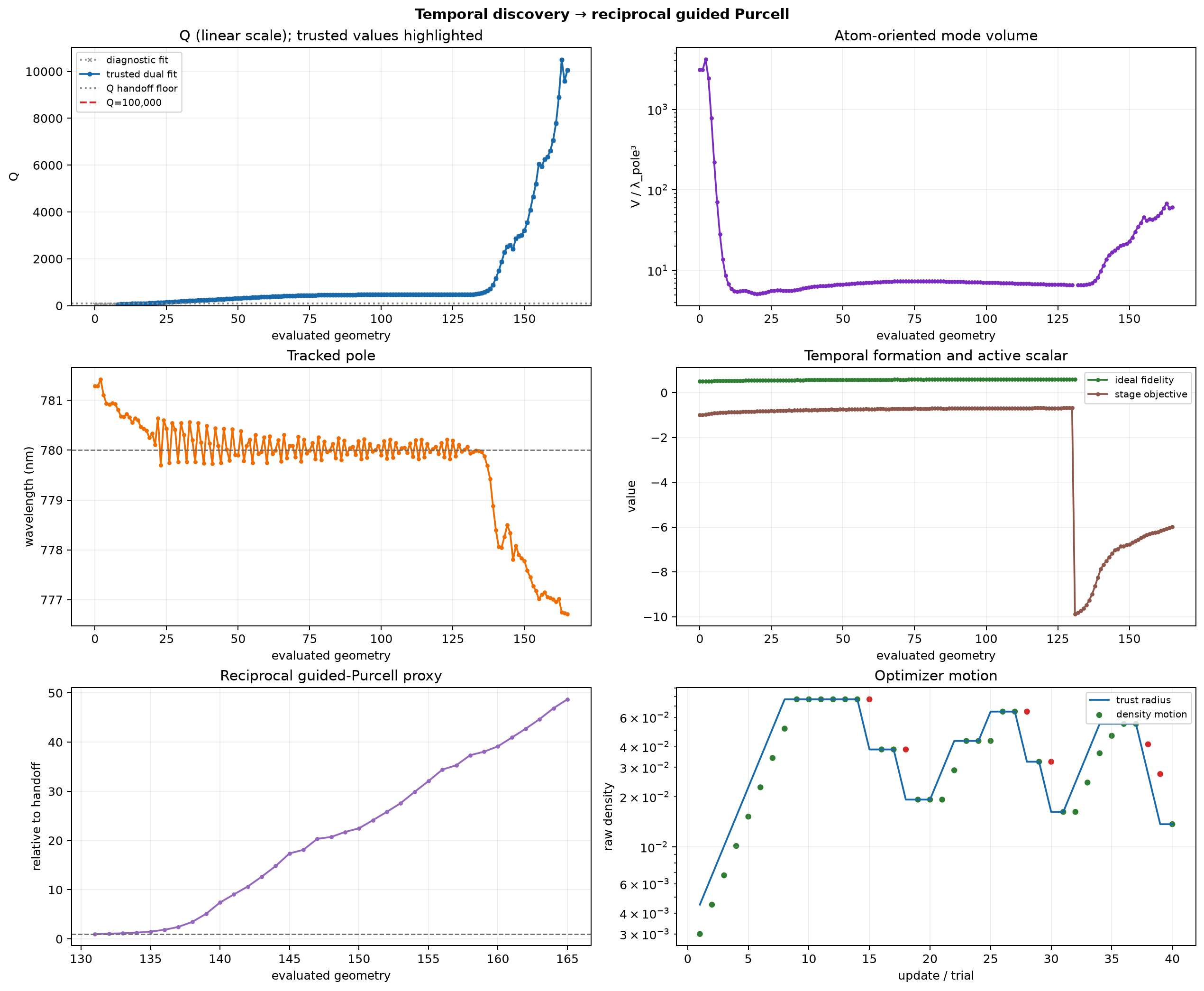
The Q axis is linear. A pole is not trusted until the centered Ey and total energy decay estimates agree. Mode volume uses their same final window and the same fitted pole wavelength; the local permittivity is exactly air by the hard geometry constraint. The rejected direct-Q/V branch reached Q=21,675 but normalized V=31.77 and collapsed the absolute atom field. It is archived as a negative ablation. This live branch was rolled back to the exact update-130 temporal handoff.
Ideal and measured atom response#
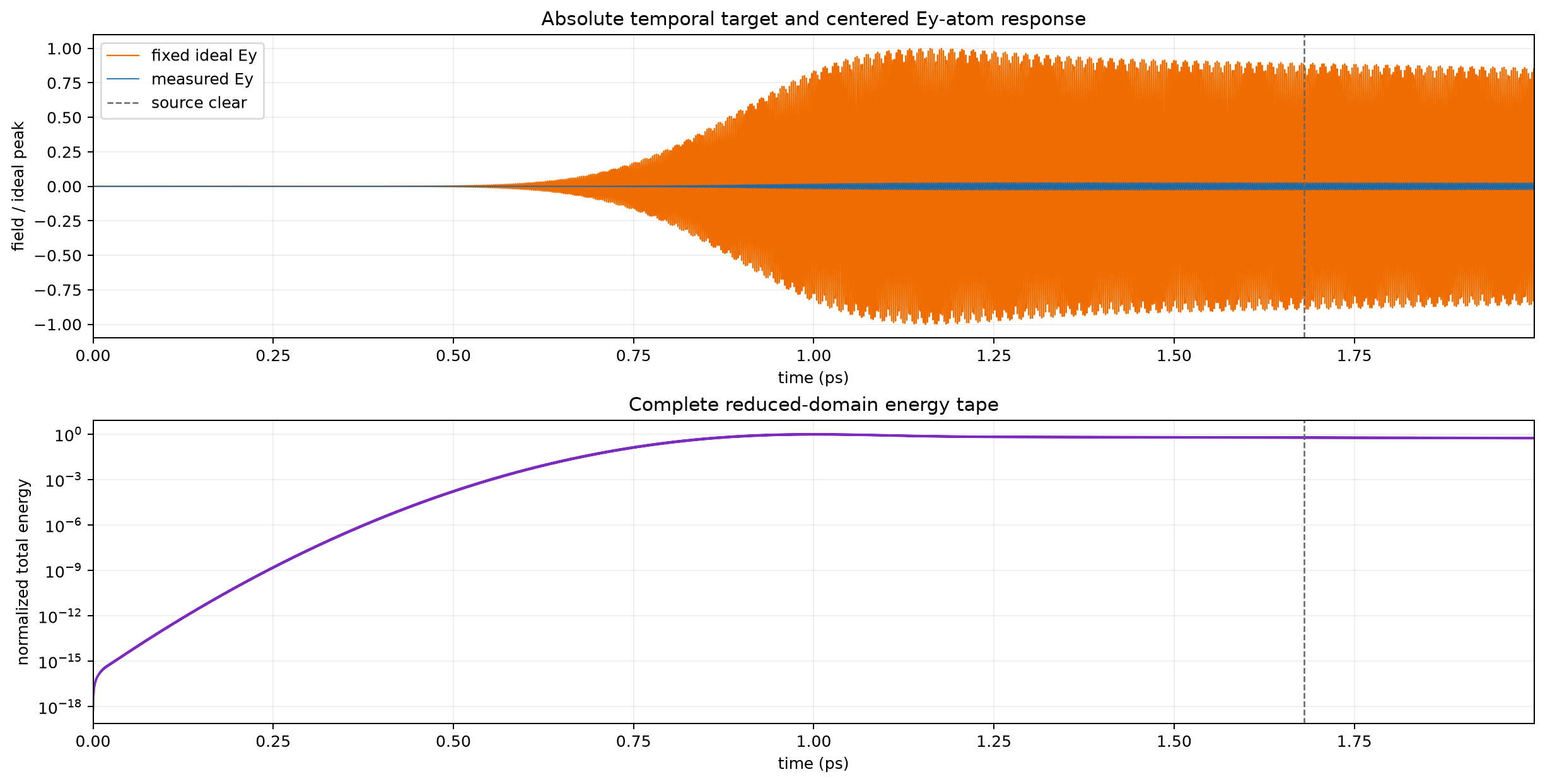
The target has fixed amplitude and phase for Q=10,000, beta one, V=0.1 µm³, and perfect Ey-polarized overlap. It is not rescaled to fit the simulation.
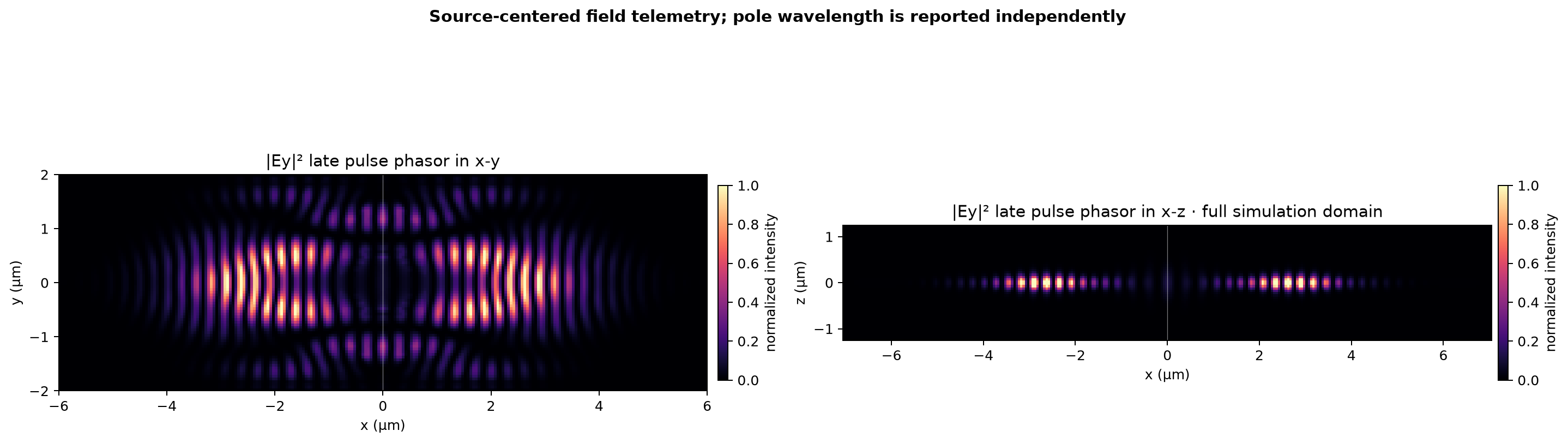
Geometry and fields#