
Pulsed midpoint-guide direct-pixel source/material Adam discovery#
Live optimizer
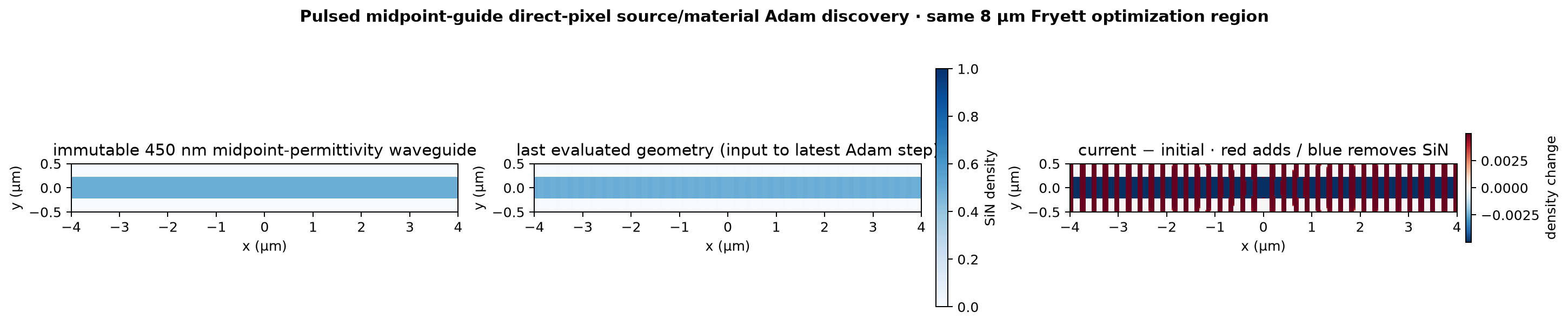
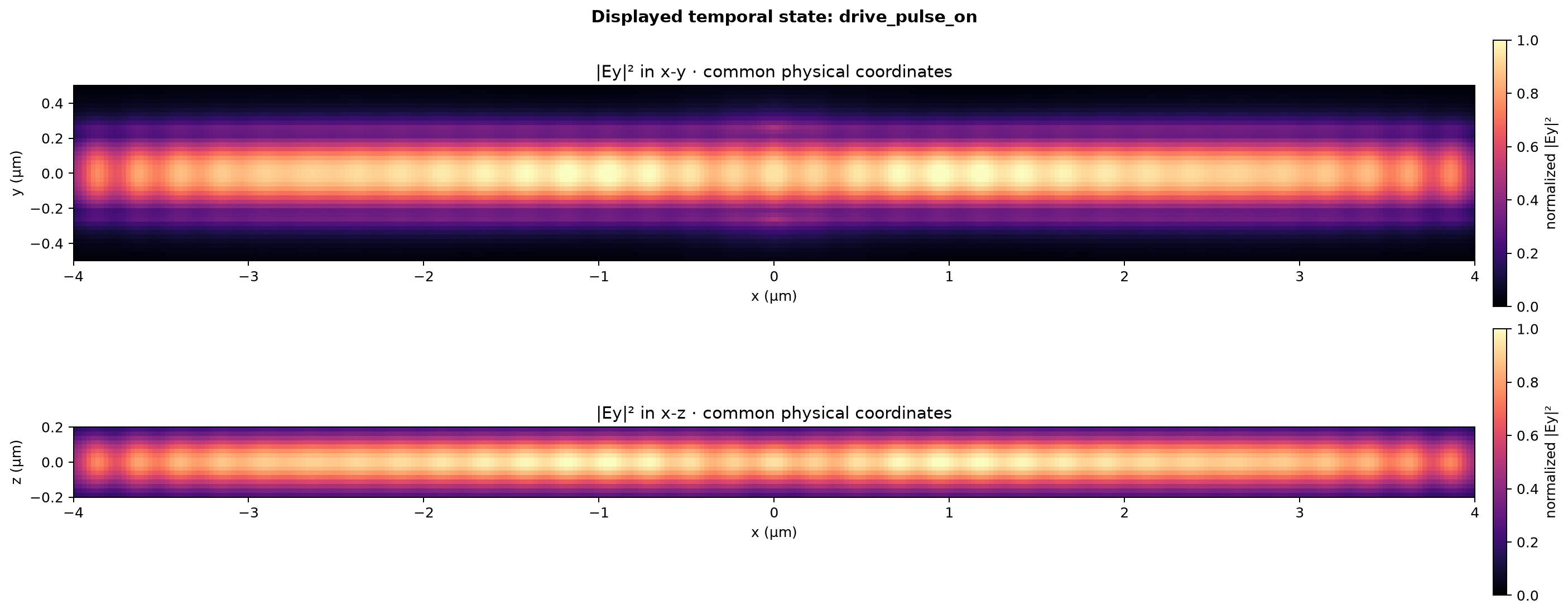
This fresh comparison starts from a 450 nm midpoint-permittivity waveguide (density 0.5 in its core) and its solved fundamental mode current. The drive is a broadband Gaussian pulse, and the fixed ideal-cavity target is recomputed as the exact discrete causal convolution of that pulse with a lossless cosine pole, normalized to unity after the pulse. Maxwell sees the 25 nm material pixels directly: there is no conic filter, projection, or binarization. One reverse pass returns both material and source gradients at the same incumbent; raw Adam moves both blocks simultaneously and unconditionally. The gentler learning rates halve every twenty steps so they descend slowly. One forward/adjoint pair is exactly one plotted step; there is no candidate replay, step rejection, rollback, trust region, beta, or boundary handoff.
State |
Value |
|---|---|
Status |
|
Source |
|
Source spatial profile |
|
Source spatial profile trainable |
|
Active source degrees of freedom |
2700 |
Source coordinate shape |
|
Ex / Ey / Ez coordinate norms |
|
Source current norm ratio |
1 |
Source/reference overlap |
0.99968 |
Source Adam learning rate |
0.0005 |
Detector / target trainable |
|
Temporal observable |
|
Phase |
|
Active coordinates |
|
Completed updates |
2 |
Temporal objective |
-0.99889 |
Whole-trace fixed-waveform fidelity |
0.50028 |
Source-off fixed-waveform fidelity |
0.5 |
Fixed target source-off power (telemetry) |
0.50008 |
Fixed-target gain (ideal = 1) |
0.00056261 |
Fixed-target normalized MSE |
0.99889 |
Normalized temporal residual |
0.99945 |
Full-field coherence |
0.29958 |
Shifted stationarity |
0.2412 |
Q telemetry |
pending |
Normalized V telemetry |
pending |
Active pole tape |
pending ps |
Maxwell-step reduction vs 2 ps |
pending× |
Material continuation stage |
|
Binarization / projection |
|
Bulk gray fraction |
45.00% |
Material initialization |
|
Initial density mean / standard deviation |
0.225 / 0.24875 |
Source initialization |
|
Temporal source |
|
Ideal target |
|
Material spatial filter |
|
Material pixel pitch |
25 nm |
Design width in y |
1 µm |
Joint optimizer |
|
Material coordinates |
|
Material Adam learning rate |
0.005 |
Initial material / source learning rate |
0.005 / 0.0005 |
Material / source learning-rate floor |
1e-05 / 1e-06 |
Learning-rate descent |
|
Adam beta1 / beta2 / epsilon |
0.9 / 0.999 / 1e-08 |
Joint Adam steps |
2 |
Joint gradient evaluations |
2 |
Joint forward evaluations |
2 |
Last material motion |
0.0050053 |
Last source angular motion |
0.021351 rad |
Per plotted optimizer step |
|
Candidate replay / line search |
|
Acceptance / rollback |
|
Source inner iterations |
0 |
Trust region / L-BFGS memory |
|
Displayed objective/fields/source |
|
Updated coordinates |
|
Boundary handoff |
|
Stable binary-topology states |
|
Boundary trust radius |
|
Latest Adam step |
|
Last pole trustworthy |
False |
Latest update wall time |
22.5 s |
Last artifact write |
2026-08-29 19:47:12 UTC |
The authoritative state is
benchmarks/artifacts/invdes_fryett_modal_temporal_modal_unbinarized_joint_adam_v1.npz. This is an independently initialized Adam comparison artifact. Preparing it does not evaluate Maxwell, start a worker, or alter the running nested campaign.
Geometry and exact material difference#
Field used by the temporal objective#
Exact temporal target response#
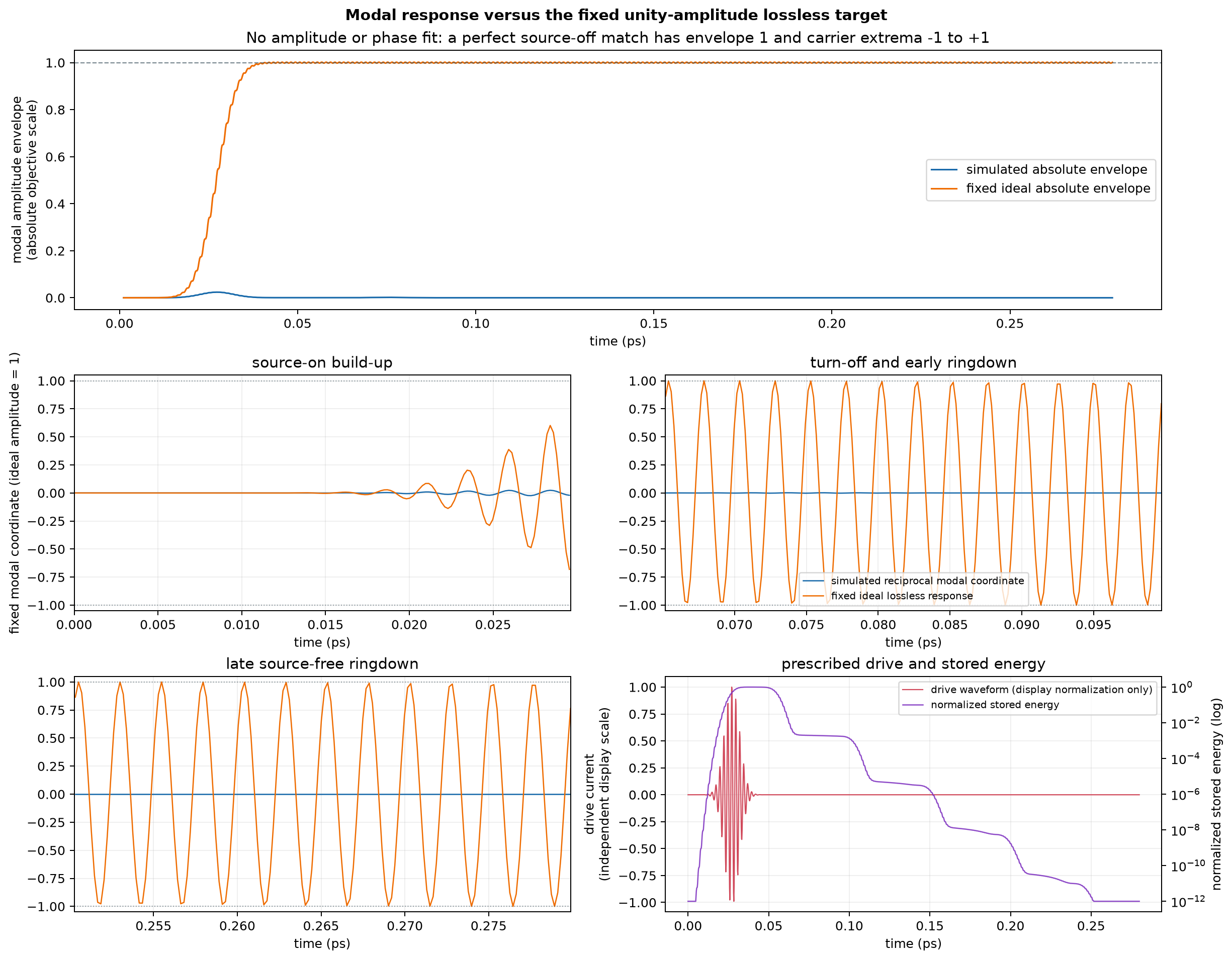
The orange curve is the fixed causal convolution of the prescribed current waveform with the cosine Green function of one lossless pole. It is not the source waveform and is not fitted to the simulation. During the drive it contains the exact causal build-up; after turn-off its extrema are exactly -1 and +1. The blue simulation is plotted in those same absolute objective units, so a smaller blue envelope is a real amplitude error, not a display normalization. The current waveform appears only in the diagnostic panel on its own explicitly independent display scale. The former blue background bands were 4D field-snapshot windows; they were never objective weights and have been removed from this plot to make the absolute comparison unambiguous. Every temporal sample still enters the single normalized mean-square error equally.
Evolving freeform source profile#
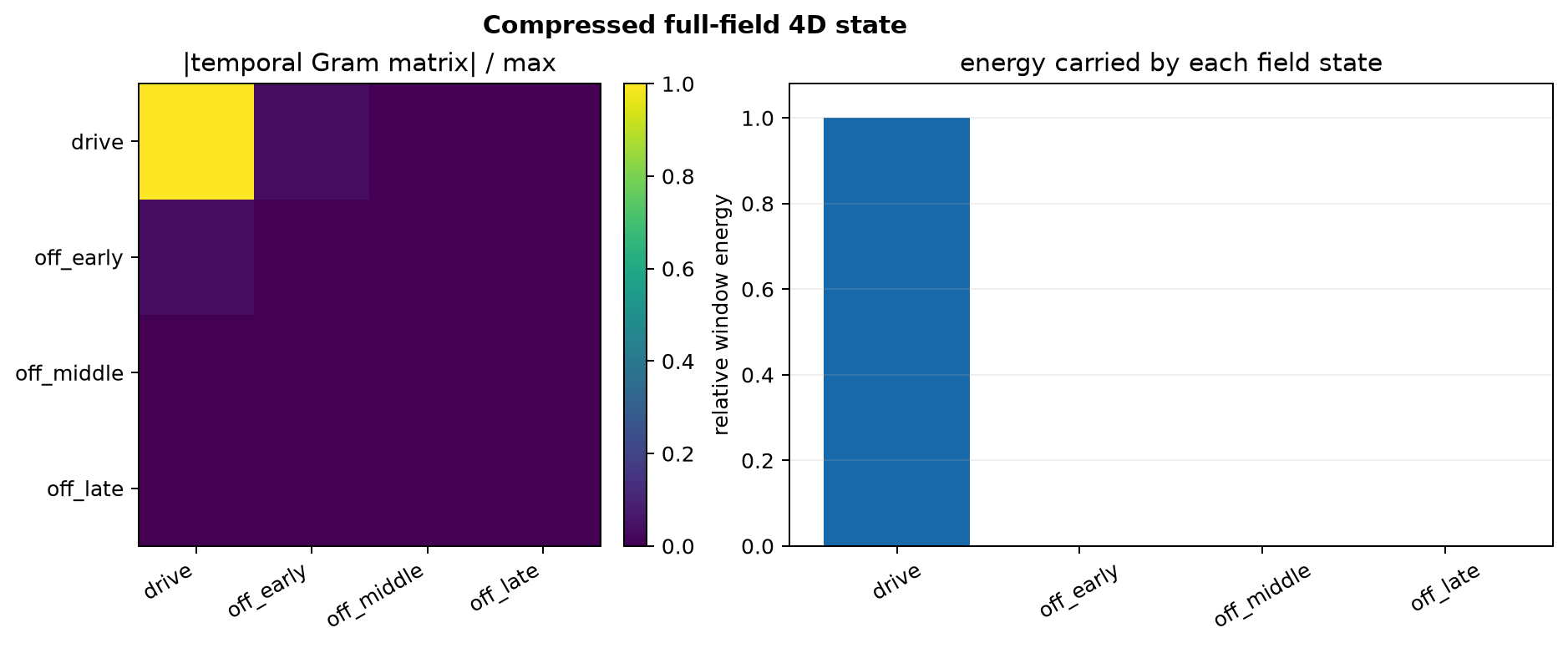
Full-field temporal correlations#
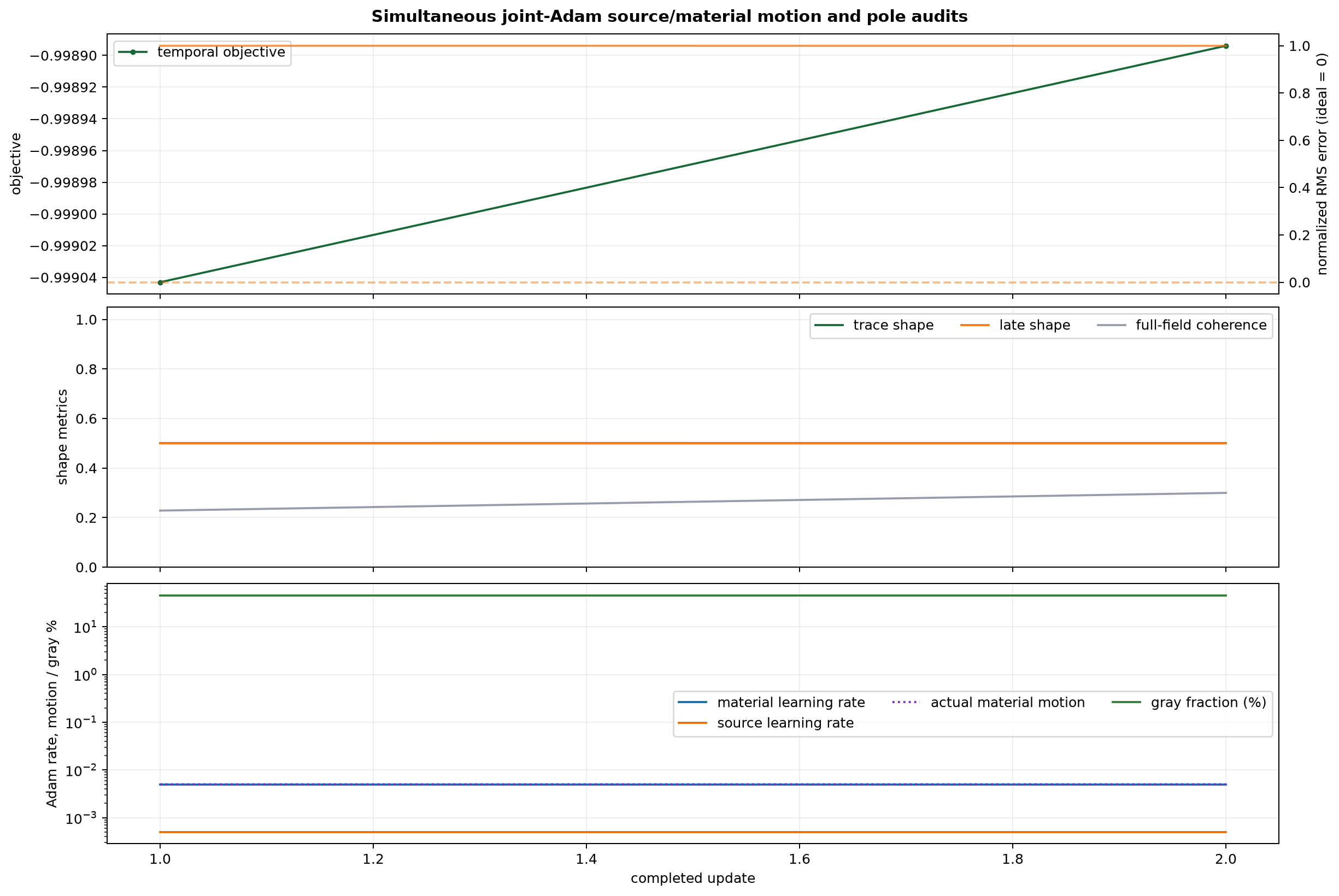
Objective, simultaneous Adam motion, continuous density, and pole history#
Q versus raw joint Adam step — linear scale#
Exact methodology, target response, and moving components#
Purpose of the comparison#
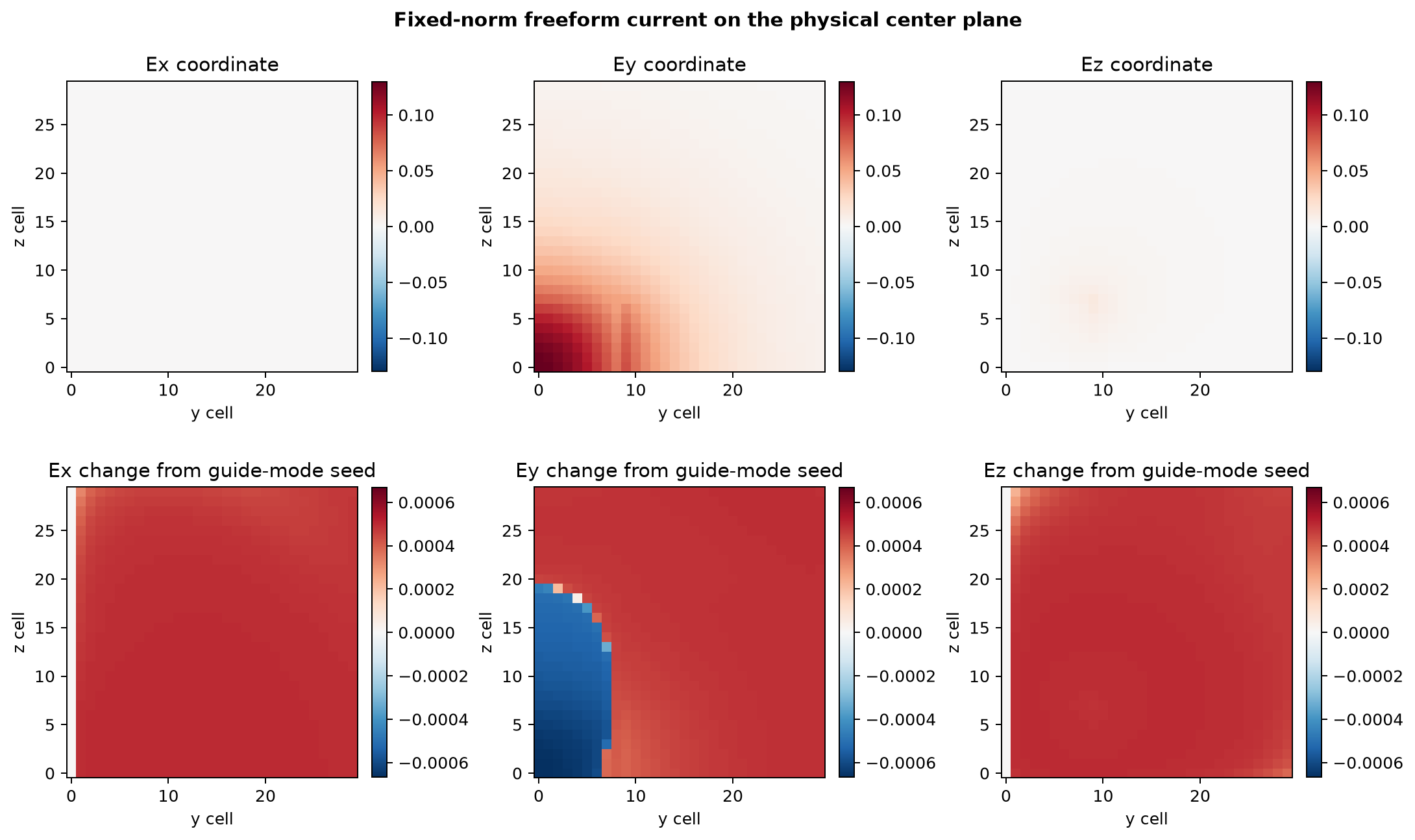
This campaign tests raw simultaneous Adam with a broadband pulse rather than the preceding resonant CW-like burst. The 8 um by 1 um design region begins as a continuous 450 nm waveguide: its core density is 0.5, corresponding to ((\epsilon_{\max}+\epsilon_{\min})/2), and the remaining design cells begin as cladding density zero. The initial fixed-norm real Ex/Ey/Ez current is the solved fundamental TE mode of that same midpoint-permittivity guide. Its 2,700 freeform coordinates remain trainable after initialization.
Raw density obeys
[ 0\leq\rho_{ij}\leq1, \qquad \bar\rho_{ij}=\rho_{ij}. ]
There is no conic filter or other spatial averaging: Maxwell receives each 25 nm density coordinate directly. There is also no projection, beta, gray or binary penalty, continuation schedule, topology gate, or smooth-boundary handoff. Thus single-pixel structure is allowed in this diagnostic campaign.
One fixed temporal objective#
For material coordinates (\rho) and unit-norm source coordinates (u), the reciprocal modal response is (a(t;\rho,u)). The drive is the actual discretized Gaussian pulse (s_m) produced by FDTDX, centered at (f_0) with 35 THz spectral width. The ideal response is recomputed from that pulse, not reused from the resonant burst. For FDTD time step (\Delta t),
[ c_n=\sum_{m=0}^{n}s_m\cos[\omega_0(n-m)\Delta t], \qquad A=\left|\sum_m s_m e^{-i\omega_0m\Delta t}\right|. ]
Using the exact geometry-independent discrete modal impulse coupling (\kappa), the fixed target is
[ a_{\star,n}=-\frac{\kappa}{|\kappa|}\frac{c_n}{A}. ]
This includes the causal pulse-on transient sample by sample. After the pulse, it is a pure cosine at (\omega_0) with unity amplitude. Detector-cadence samples are taken only after forming the full-step convolution. Neither amplitude nor phase is fitted to the simulated trace. The sole optimized scalar, with every temporal sample weighted equally, is
[ F(\rho,u)=-\frac{\sum_n [a(t_n;\rho,u)-a_\star(t_n)]^2} {\sum_n a_\star(t_n)^2}. ]
Q, grayness, source overlap, and pole fits are telemetry or pole-tracking checks, not additional objective terms.
One reverse pass, two gradients#
At Adam step (k), one FDTD trajectory and one reverse pass evaluate
[ F_k,\quad g_{\rho,k}=\frac{\partial F}{\partial\rho},\quad g_{u,k}=\frac{\partial F}{\partial u} ]
at the identical incumbent pair ((\rho_k,u_k)). In JAX this is one
value_and_grad operation with both argument numbers. It is not two adjoint
solves, and neither block sees the other block’s updated value.
The material and source maintain independent Adam first and second moments,
[ m_k=\beta_1m_{k-1}+(1-\beta_1)g_k, \qquad v_k=\beta_2v_{k-1}+(1-\beta_2)g_k^2, ]
with bias corrections and ascent direction
[ d_k=\frac{m_k/(1-\beta_1^k)} {\sqrt{v_k/(1-\beta_2^k)}+\epsilon}. ]
The slower, longer-lived descending learning-rate schedule is
initial material learning rate (\alpha_{\rho,0}=5\times10^{-3});
initial source-coordinate learning rate (\alpha_{u,0}=5\times10^{-4});
both rates are multiplied by (1/2) after every twenty steps;
the material and source floors are (10^{-5}) and (10^{-6}), respectively;
(\beta_1=0.9), (\beta_2=0.999), and (\epsilon=10^{-8}).
This is ten times gentler than the preceding fast random-pixel run at startup, and the four-times-longer plateau prevents both rates from prematurely reaching their floors. There is no controller that increases a rate, adapts a trust radius, or suppresses a proposal.
The material step is
[ \rho_{k+1}=\operatorname{clip}{[0,1]} (\rho_k+\alpha\rho d_{\rho,k}). ]
The source has all 2,700 real Ex/Ey/Ez center-plane coordinates and begins from the midpoint-guide mode described above, while its total current norm remains fixed. The raw source gradient and preconditioned direction are projected into the tangent plane of the unit sphere. The source then moves and retracts,
[ \tilde u_{k+1}=u_k+\alpha_u (I-u_ku_k^T)d_{u,k}, \qquad u_{k+1}=\frac{\tilde u_{k+1}}{|\tilde u_{k+1}|_2}. ]
The source first moment is projected into the new tangent plane after the step. Its elementwise second moment remains the ordinary ambient-coordinate Adam accumulator. Thus this is a practical constrained Adam comparison, not a claim of coordinate-invariant Riemannian Adam.
Step and solve accounting#
Material and source are committed simultaneously and unconditionally. There is no source inner iteration, alternating block solve, L-BFGS memory, trust radius, line search, gain-ratio acceptance test, finite-candidate gate, rejected-step retry, rollback, or candidate replay. Overshoot and oscillation are observable optimizer dynamics rather than events hidden by a controller.
One optimizer step is exactly one forward trajectory and its one reverse pass. The objective, fields, Q telemetry, geometry, and source shown for step (k) are those evaluated at ((\rho_k,u_k)) to obtain that step’s gradient. The resulting ((\rho_{k+1},u_{k+1})) is committed without another solve and is evaluated at the next dashboard step. This standard one-step timing is shown explicitly; the dashboard never presents an unevaluated proposal as if it already had an objective value.
Every fourth committed step retains the existing pole audit. Once a trustworthy Q above 100 is found, the carrier and minimum viable ringdown tape track that pole while the same simultaneous Adam rule and fixed lossless target continue.
Prepared-state contract#
Preparation creates only a CPU-initialized ready_not_started artifact and
static dashboard. It does not evaluate Maxwell, acquire the GPU lock, stop the
running nested campaign, or start optimizer/dashboard services. A later
explicit launch evaluates the baseline first and then starts an indefinite
worker.
Operations#
A bounded manual turn can be run with:
FDTDX_FRYETT_MODAL_SOURCE_CO_DESIGN=1 FDTDX_FRYETT_MODAL_SOURCE_BILEVEL=1 FDTDX_FRYETT_MODAL_SOURCE_UNBINARIZED=1 FDTDX_FRYETT_MODAL_SOURCE_JOINT_ADAM=1 FDTDX_FRYETT_MODAL_TEMPORAL_ID=modal_unbinarized_joint_adam_v1 uv run python -m benchmarks.cases.invdes_fryett_hybrid_scratch.modal_temporal --updates 1
The persistent launcher is scripts/start_fryett_modal_source_joint_adam_campaign.sh.