
Unbinarized source-equilibrated cavity discovery#
Live optimizer
This independent campaign starts from the midpoint-permittivity waveguide and keeps the dielectric as continuously filtered density for its entire lifetime: there is no projection, beta schedule, binary penalty, or boundary handoff. The freeform fixed-norm source is equilibrated at every incumbent and material candidate, while an agreement-controlled trust radius is free to grow from a small start up to the natural density-box diameter.
State |
Value |
|---|---|
Status |
|
Source |
|
Source spatial profile |
|
Source spatial profile trainable |
|
Active source degrees of freedom |
2700 |
Source coordinate shape |
|
Ex / Ey / Ez coordinate norms |
|
Source current norm ratio |
1 |
Source/reference overlap |
0.99186 |
Source angular trust radius |
2.5e-05 rad |
Detector / target trainable |
|
Temporal observable |
|
Phase |
|
Active coordinates |
|
Completed updates |
32 |
Temporal objective |
-0.95732 |
Whole-trace fixed-waveform fidelity |
0.5109 |
Source-off fixed-waveform fidelity |
0.50991 |
Fixed target source-off power (telemetry) |
0.49981 |
Fixed-target gain (ideal = 1) |
0.021636 |
Fixed-target normalized MSE |
0.95732 |
Normalized temporal residual |
0.97843 |
Full-field coherence |
1 |
Shifted stationarity |
0.89801 |
Q telemetry |
238.08 |
Normalized V telemetry |
0.026653 |
Active pole tape |
0.4 ps |
Maxwell-step reduction vs 2 ps |
5× |
Material continuation stage |
|
Binarization / projection |
|
Bulk gray fraction |
48.66% |
Initial guide density |
0.5 |
Initial guide permittivity |
3.0804 |
Design width in y |
1 µm |
Material optimizer |
|
Material coordinates |
|
Material trust radius |
0.03200 maximum density change |
L-BFGS memory pairs |
5 |
Forward-only rejected-step retries |
5 |
Source gradient transform |
|
Source L-BFGS memory pairs |
0 |
Active nested block |
|
Nested Maxwell turns |
322 |
Accepted material commits |
32 |
Active source inner turn |
0 |
Last source move accepted |
False |
Material commit rule |
|
Source projected 10 mrad gain |
2.4041e-07 |
Material trust ceiling |
1 maximum density change |
Uncommitted material candidate active |
True |
Continuation clock |
|
Boundary handoff |
|
Stable binary-topology states |
|
Boundary trust radius |
|
Last candidate accepted |
False |
Last pole trustworthy |
True |
Latest update wall time |
35.73 s |
Last artifact write |
2026-08-29 17:45:38 UTC |
The authoritative state is
benchmarks/artifacts/invdes_fryett_modal_temporal_modal_unbinarized_nested_v1.npz. This is a fresh artifact initialized independently of both the stopped sprint and the preserved thorough nested checkpoint.
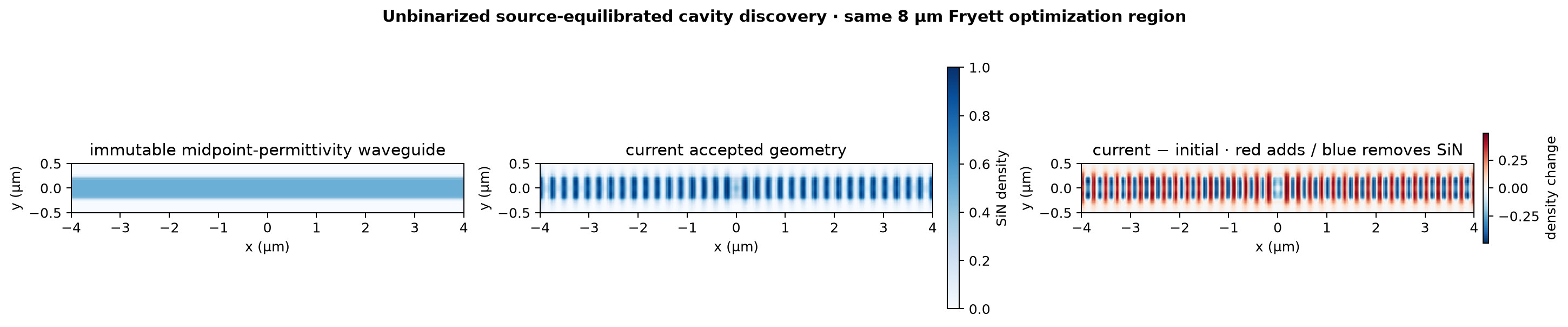
Geometry and exact material difference#
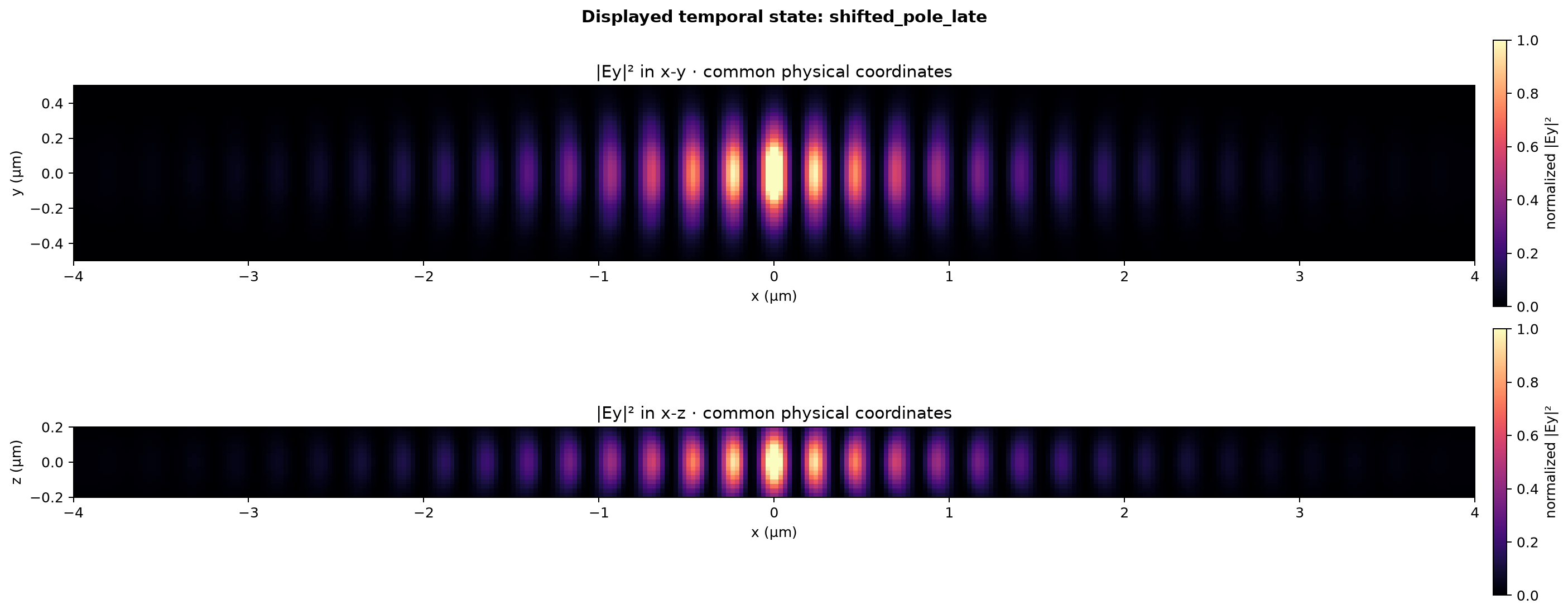
Field used by the temporal objective#
Exact temporal target response#
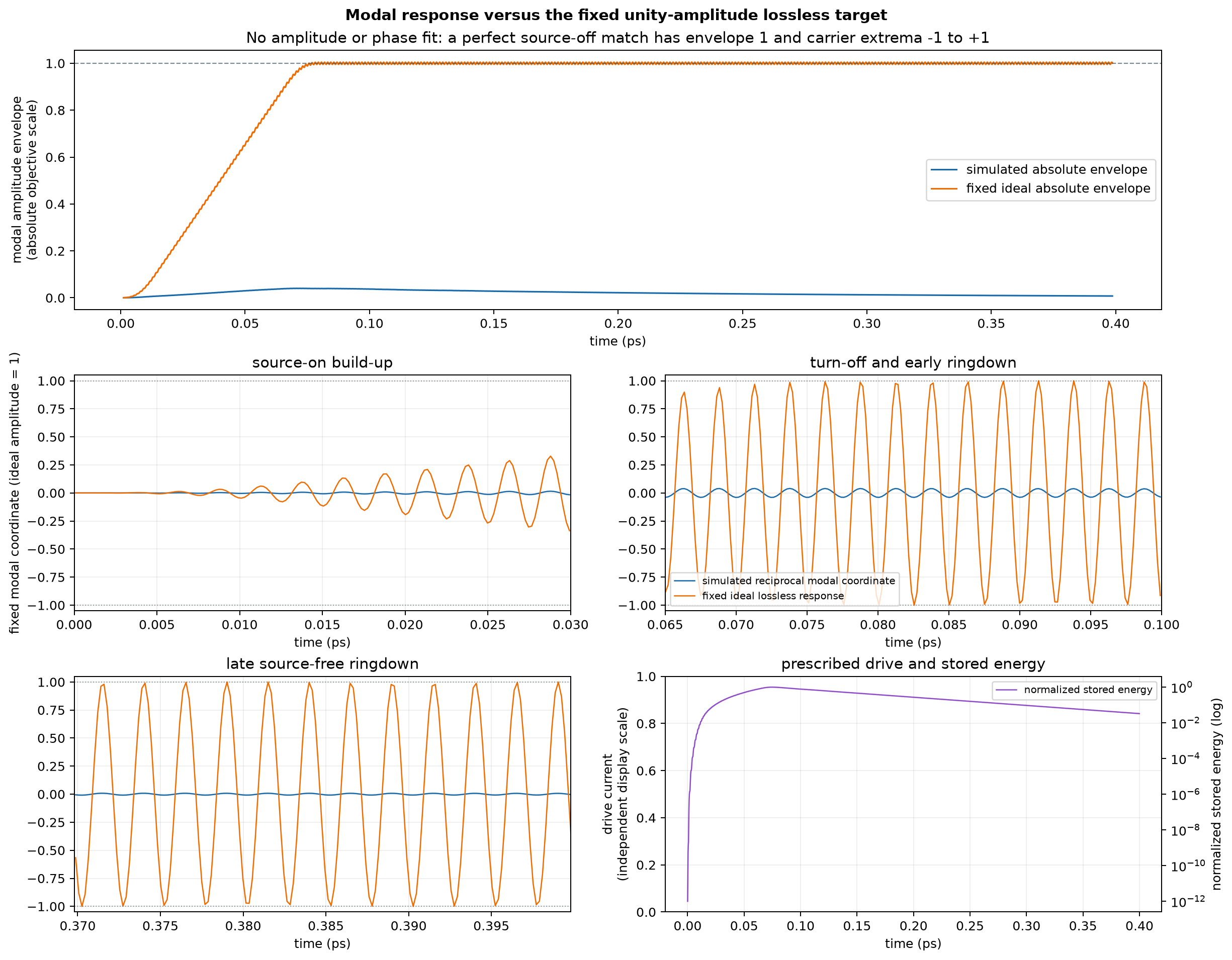
The orange curve is the fixed causal convolution of the prescribed current waveform with the cosine Green function of one lossless pole. It is not the source waveform and is not fitted to the simulation. During the drive it contains the exact causal build-up; after turn-off its extrema are exactly -1 and +1. The blue simulation is plotted in those same absolute objective units, so a smaller blue envelope is a real amplitude error, not a display normalization. The current waveform appears only in the diagnostic panel on its own explicitly independent display scale. The former blue background bands were 4D field-snapshot windows; they were never objective weights and have been removed from this plot to make the absolute comparison unambiguous. Every temporal sample still enters the single normalized mean-square error equally.
Evolving freeform source profile#
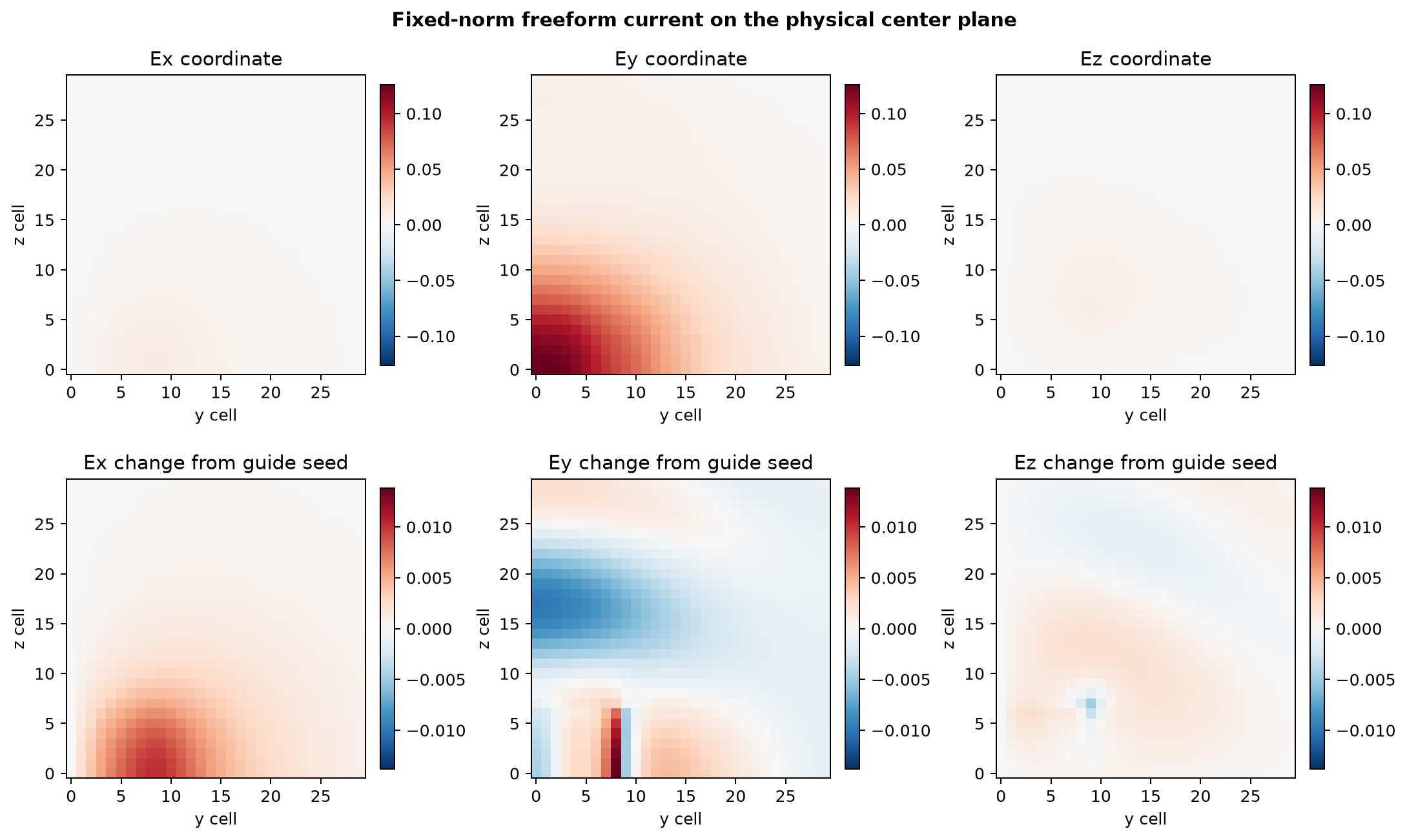
Live nested-source progress#
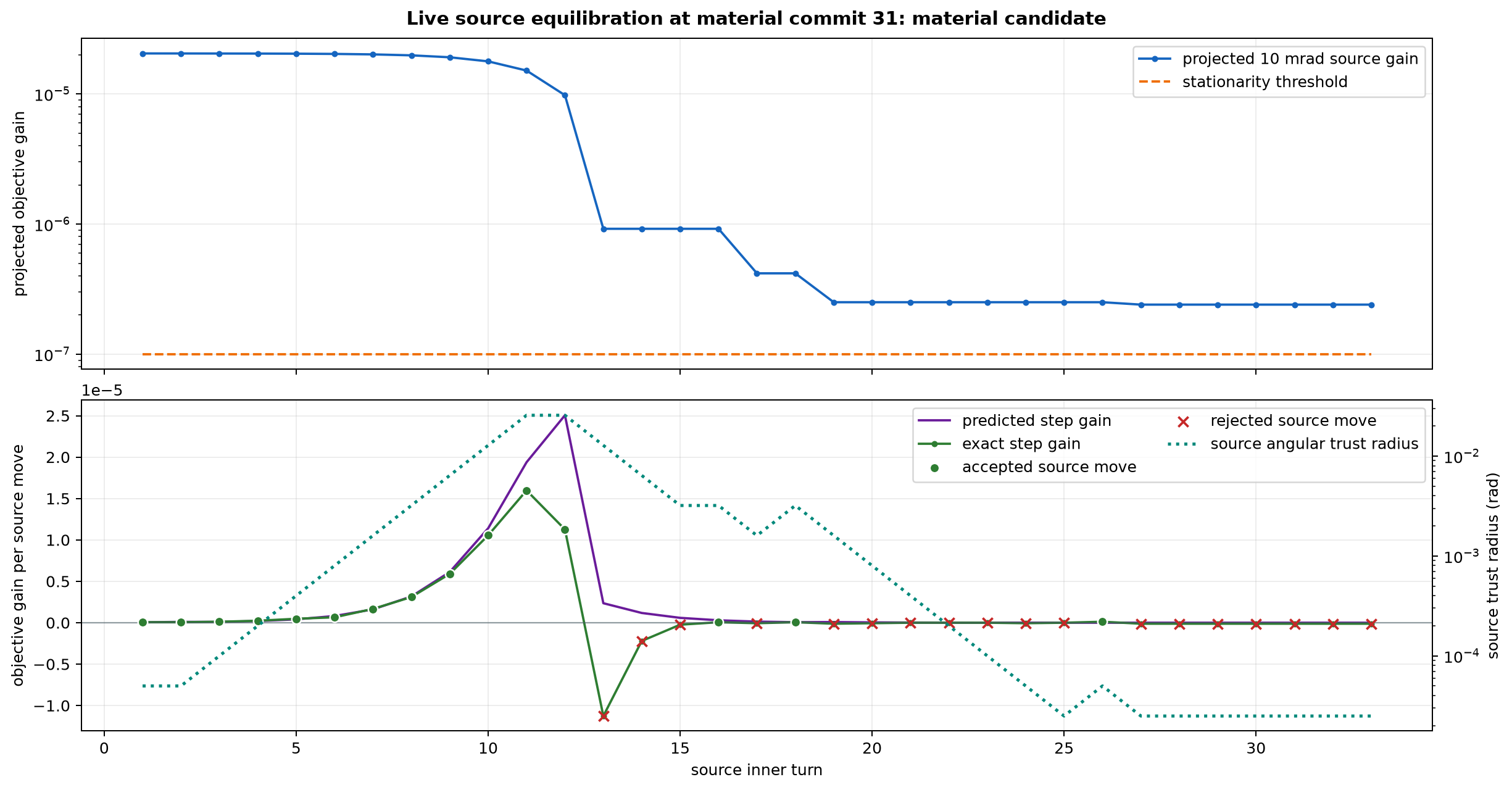
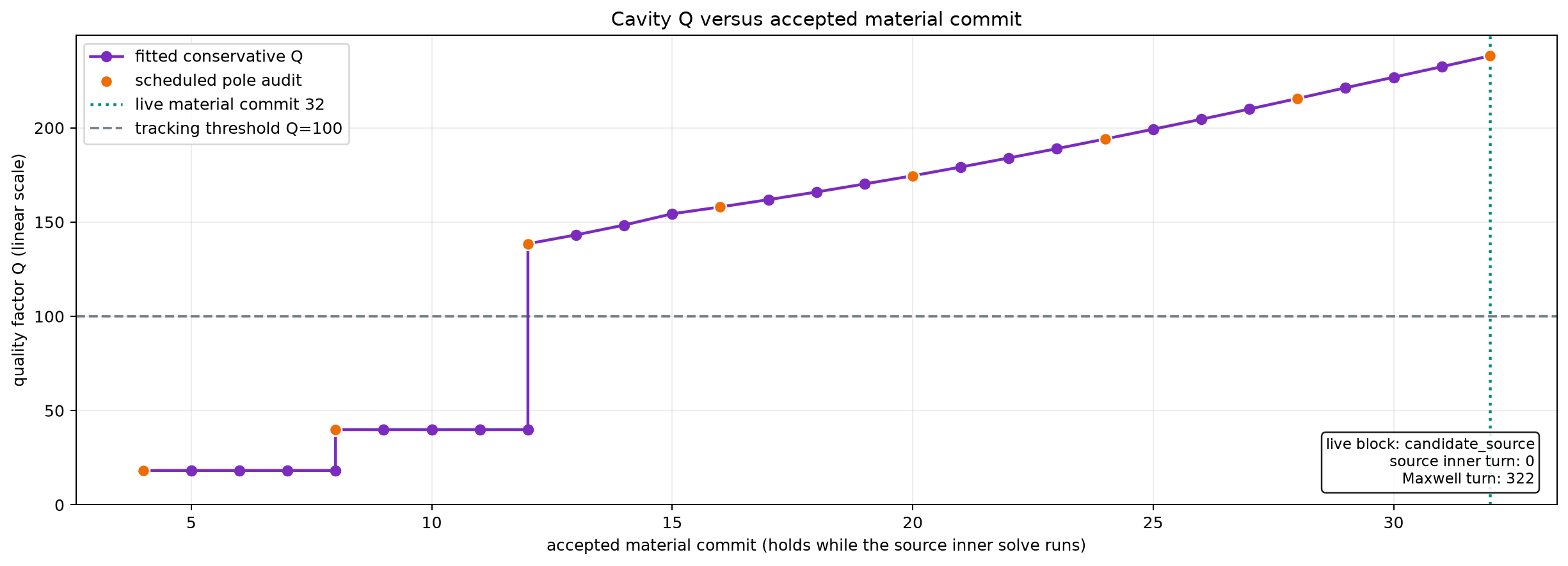
The accepted-material and Q plots keep the same x coordinate while the inner source problem is being solved. This panel advances on every source forward/adjoint turn, so accepted source motion is visible before the next material commit.
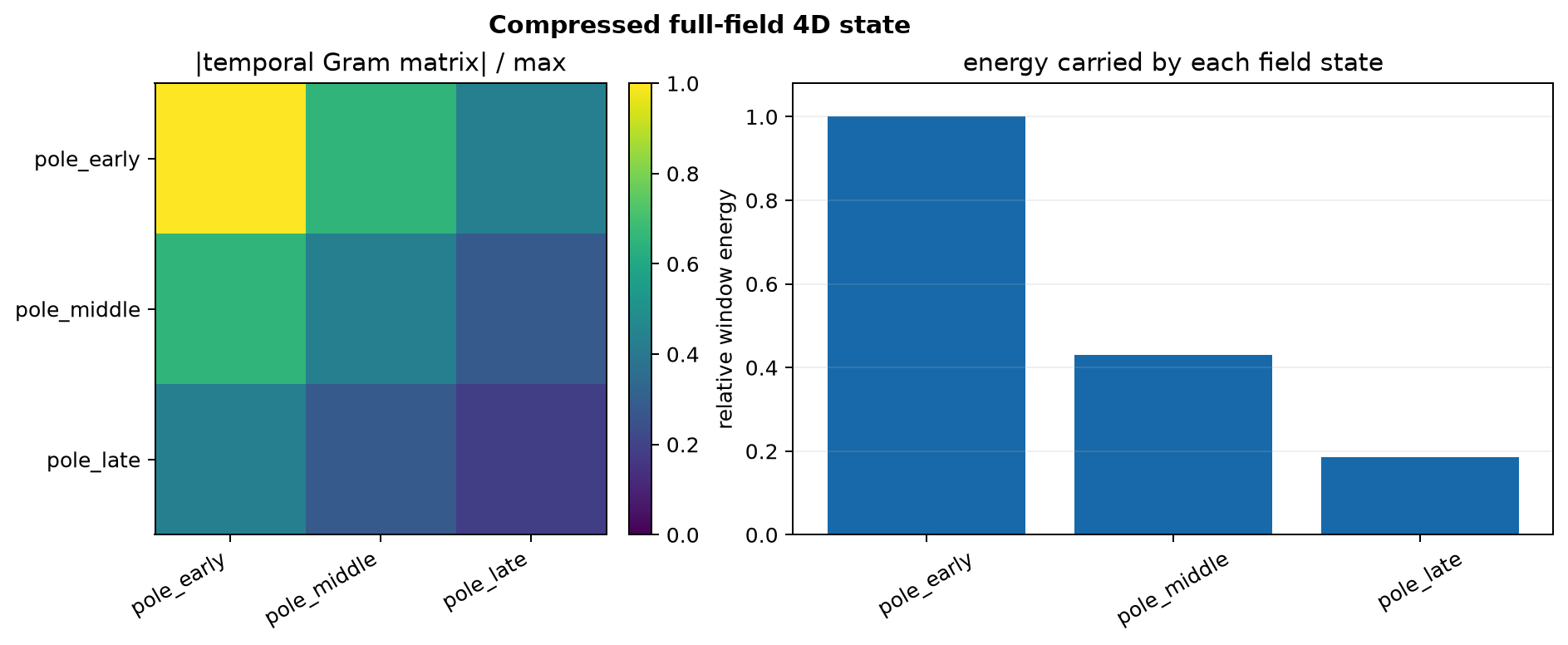
Full-field temporal correlations#
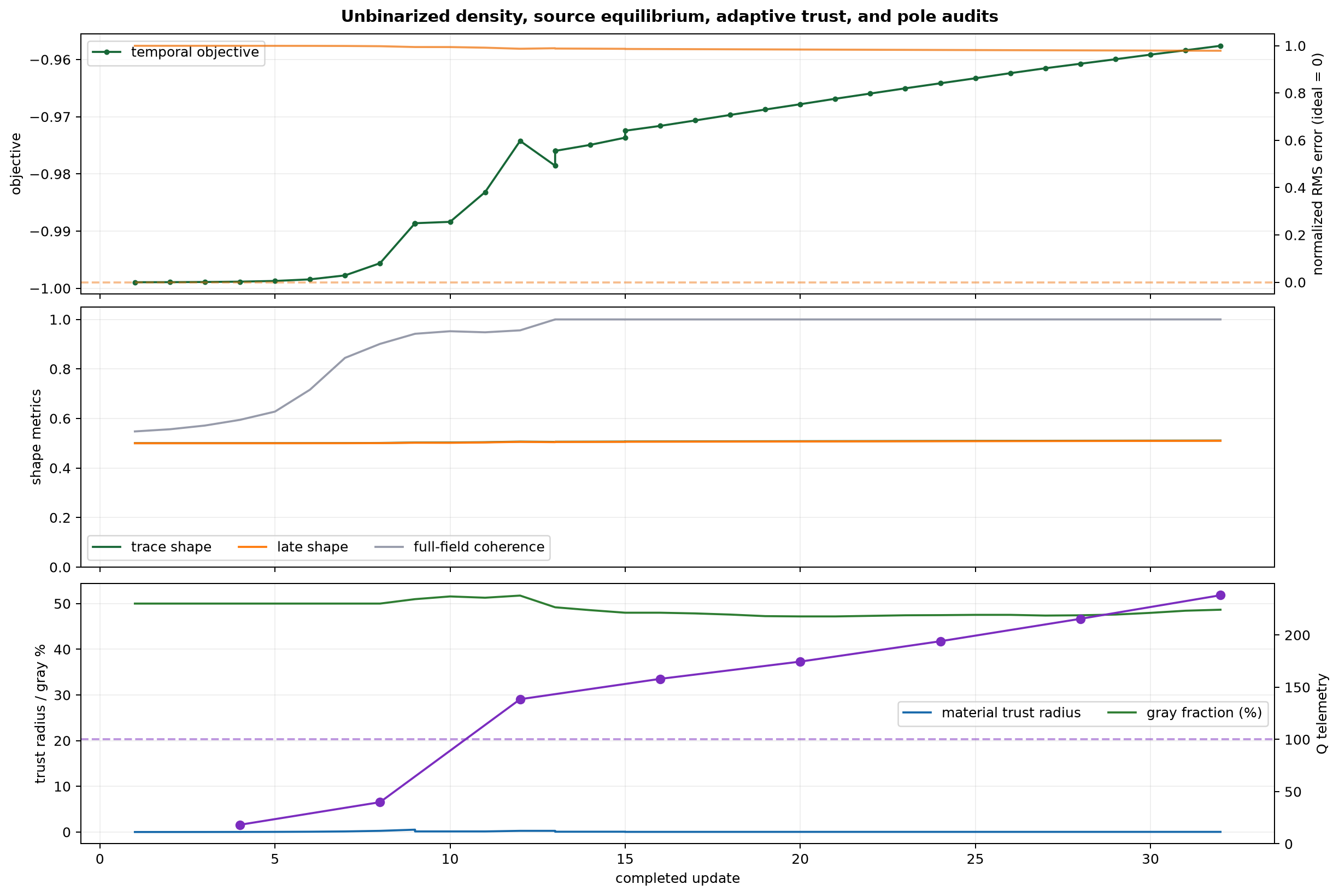
Objective, continuous density, adaptive trust, and pole history#
Q versus accepted material commit — linear scale#
Exact methodology, target response, and moving components#
Question being tested#
This campaign tests whether early projection sharpening was forcing the dielectric to commit before a high-Q collective structure could form. It is a fresh optimization, not a continuation of the stopped frozen-source sprint or the earlier gradual-beta campaign.
The complete 8 µm by 1 µm design region begins as a 450 nm-wide waveguide. Its raw core density is 0.5, corresponding to ((\epsilon_{\max}+\epsilon_{\min})/2), and the initial current is the fundamental TE mode of that midpoint-permittivity guide. The temporal drive is the same finite smooth resonant burst followed by source-free ringdown.
No binarization or moving material objective#
The raw material variables obey only the natural box constraint
[ 0\leq \rho_{ij}\leq 1. ]
A fixed 75 nm conic filter supplies a minimum spatial scale,
[ \bar\rho = K_{75,\mathrm{nm}} * \rho, ]
and (\bar\rho) is sent directly to Maxwell. There is no tanh projection, beta, erosion/dilation threshold, binary penalty, grayness penalty, scheduled decoder change, or smooth-boundary handoff. Continuous filtered density is the terminal parameterization for as long as the campaign runs. Gray fraction is diagnostic only.
Fixed temporal objective#
For a dielectric (\rho) and fixed-norm source coordinate (u), the measured reciprocal modal coordinate is (a(t;\rho,u)). The target is the fixed causal response of one lossless pole to the prescribed current waveform,
[ a_\star(t)=C\int_0^t s(\tau) \cos[\omega_0(t-\tau)],d\tau, ]
where (C) is chosen once so the ideal source-off carrier has amplitude one. Neither amplitude nor phase is fitted to a simulated trace. The only optimized scalar is
[ F(\rho,u)=-\frac{\sum_n w_n [a(t_n;\rho,u)-a_\star(t_n)]^2} {\sum_n w_n a_\star(t_n)^2}. ]
Q, mode volume, grayness, and source/reference overlap are telemetry, not additional objective terms. Once a trustworthy Q above 100 exists, the usual pole tracking and minimum viable ringdown tape remain active.
Nested source/material optimization#
The source has all 2,700 real Ex/Ey/Ez electric-current coordinates on the physical center plane. Its physical norm is fixed, so source steps are tangent rotations followed by unit-sphere geodesic retraction. The temporal waveform, detector, target, and source norm never move.
At every material decision the controller:
locally equilibrates the source at the accepted dielectric;
computes one material gradient at that source equilibrium;
creates one uncommitted material trust-region proposal;
locally equilibrates an independent source copy at the candidate; and
commits both only if the exact source-optimized candidate improves the exact source-optimized incumbent and passes the unchanged field/pole gates.
Source equilibrium requires two consecutive projected-tangent checks. The 10 mrad predicted gain must be below both an absolute (10^{-7}) objective threshold and 0.1% of the source block’s initial projected gain. The float32 resolution and bounded trust-floor exits remain as numerical safeguards. This is a local fixed-norm source optimum, not a global-optimality claim.
At a stationary source, the envelope theorem gives
[ \frac{d}{d\rho}F(\rho,u^\star(\rho)) =\left.\frac{\partial F}{\partial\rho}\right|_{u=u^\star}, ]
so one material forward/adjoint evaluation supplies the correct local outer gradient without differentiating through all source iterations.
Adaptive trust regions without scheduled release#
Material trust starts at a maximum raw-density change of 0.001. Source trust starts at 0.01 radians. Each block uses independent eight-pair L-BFGS memory and the same standard agreement ratio
[ r=\frac{F_{\mathrm{trial}}-F_{\mathrm{current}}} {\nabla F^T\Delta x}. ]
A successful step using at least 80% of its radius grows the radius by 2 when (r\geq0.75). A rejected step or (r<0.05) halves it. There is no Q-based, iteration-based, beta-based, or manually released material ceiling. The only upper material limit is 1.0, the diameter of the raw density box; the source limit is (\pi/2), the natural useful hemisphere of a real fixed-norm source. There is no routine line search, DCT preconditioner, density-motion cap, or cumulative-motion cap.
L-BFGS memory is retained across accepted updates and pole recentering when the coordinate chart is unchanged. Three consecutive rejected trials clear stale curvature. All accepted state, source-inner state, and uncommitted candidate state are checkpointed atomically, and the persistent worker runs indefinitely until explicitly stopped.
Operations#
A bounded manual turn can be run with:
FDTDX_FRYETT_MODAL_SOURCE_CO_DESIGN=1 FDTDX_FRYETT_MODAL_SOURCE_BILEVEL=1 FDTDX_FRYETT_MODAL_SOURCE_UNBINARIZED=1 FDTDX_FRYETT_MODAL_TEMPORAL_ID=modal_unbinarized_nested_v1 uv run python -m benchmarks.cases.invdes_fryett_hybrid_scratch.modal_temporal --updates 1
The persistent launcher is scripts/start_fryett_modal_source_unbinarized_campaign.sh.