Bus + ring transmission spectrum vs Tidy3D#
validated · 2026-08-28
This case compares a local FDTDX result with pinned reference data generated by Tidy3D. The originating Tidy3D example is RingResonator.ipynb, pinned at commit c37c785d52e9.
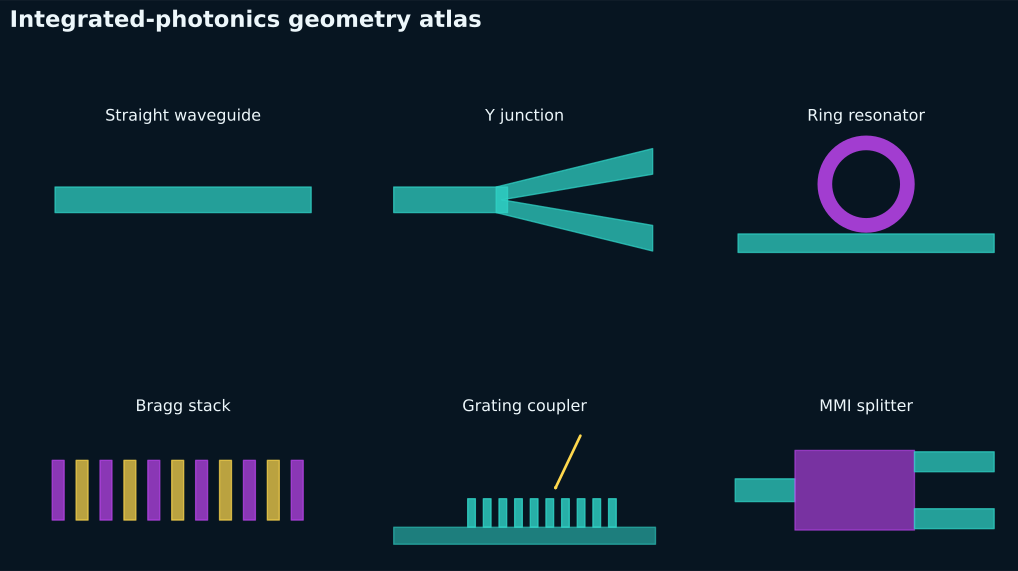
Integrated-photonics geometries covered by the benchmark suite.#
What is exercised#
Coarse bus+ring at 1550nm band. Loose tol (geometry approx + short run_time). Goal is mode-coupled PIC path, not high-Q spectroscopy yet. Ring uses ExtrudedPolygon with subpixel_smoothing=True (Farjadpour fill fractions, supersample=8): improves T_rel_l2 0.036->0.025 and T_max_abs 0.039->0.028 vs the Tidy3D golden compared to binary rasterization.
This case runs at a 0.80 resolution factor. Its declared tolerance scaling is applied by the comparator.
Recorded result#
Metric |
Observed / error |
Reference / limit |
Error |
Effective budget |
Result |
|---|---|---|---|---|---|
|
0.0253855 |
0.25 |
0.0253855 |
0.25 |
PASS |
|
0.0284022 |
0.1875 |
0.0284022 |
0.1875 |
PASS |
The table is rendered from progress.json; it is not a hand-written success claim. For metrics that report an error directly, the “observed” column repeats that error and the reference column is the acceptance threshold.
Reproduce#
uv run fdtdx-bench run --case parity_ring_bus
Implementation and provenance: benchmarks/cases/parity_ring_bus/case.yaml, benchmarks/cases/parity_ring_bus/run.py, benchmarks/goldens/parity_ring_bus.npz.