
Live quasi-2D SiN remote-atom optimizer#
Last rendered 2026-08-22 10:29:25 UTC from benchmarks/artifacts/invdes_sin_quasi2d_remote_atom_ldos_live_v1.npz. The checkpoint
was paused after 41 differentiable evaluations. Evaluation 40 is the last
complete accepted checkpoint; the interrupted evaluation was not committed.
This page deliberately distinguishes the training fit from the final long-run
validation.
Quantity |
Current evidence |
|---|---|
Maximum accepted shifted LDOS |
11.413× vacuum |
Maximum-LDOS row Q |
55584.5 |
Maximum-LDOS row wavelength |
780.132 nm |
Score-trusted shifted LDOS |
11.413× vacuum |
Score-trusted Q |
55584.5 |
Score-trusted wavelength |
780.132 nm |
Latest shifted LDOS |
11.36× vacuum |
Latest Q |
58227 |
Latest wavelength |
780.14 nm |
Accepted / evaluated |
33 / 41 |
Adaptive trust-step scale |
0.134× |
Atom-to-nearest-SiN distance |
500.000 nm |
Independent controls |
379 |
Full grid / retained symmetry |
(464, 156, 64) / x,z (4×) |
Literal quasi-2D geometry#
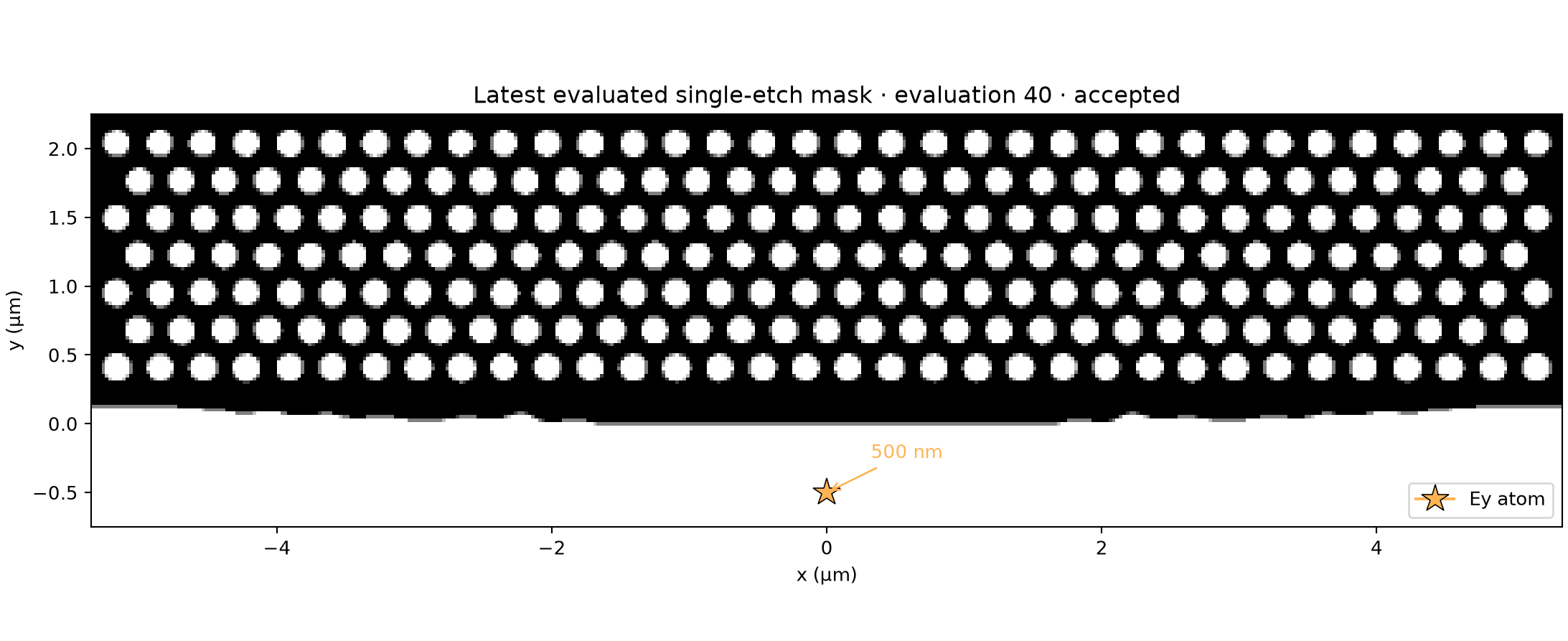
The plotted mask is the latest actual hard forward geometry, whether accepted or rejected; the badge and title state which. It has seven triangular- lattice rows and a curved lower boundary; it is not a nanobeam. All holes and the bulge are optimized in x-y and then extruded through one uniform slab.#
LDOS, Q, and pole tracking#
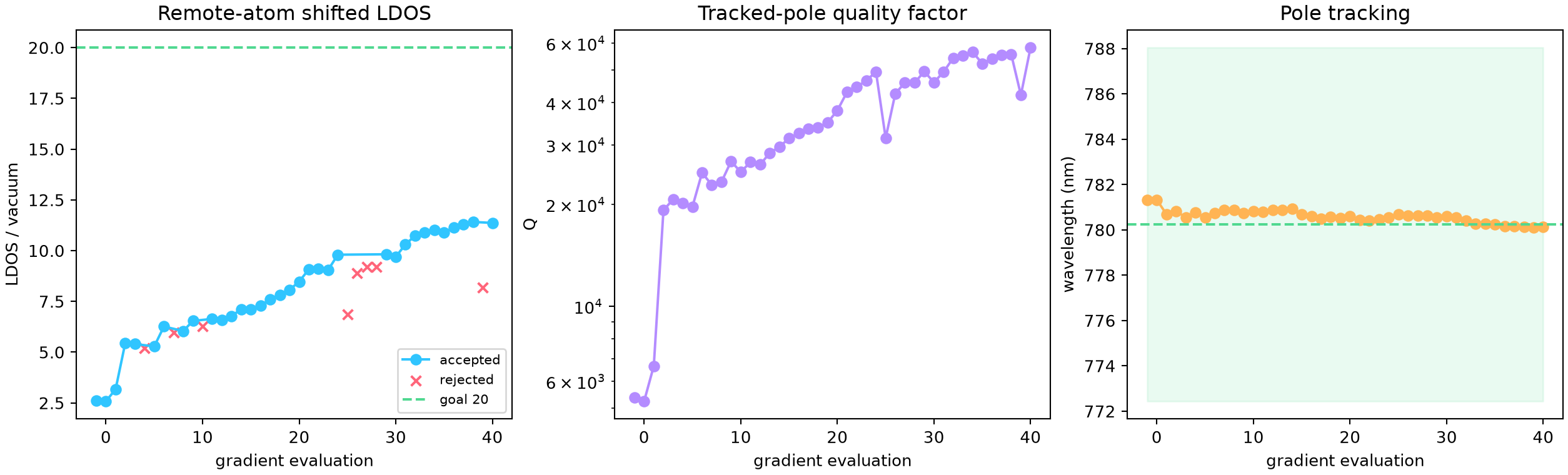
Rejected trust-region trials remain visible. The green band is ±1% around the 780.24 nm atomic transition; the dashed LDOS line is the training threshold, not yet the final claim.#
Latest Ey field#
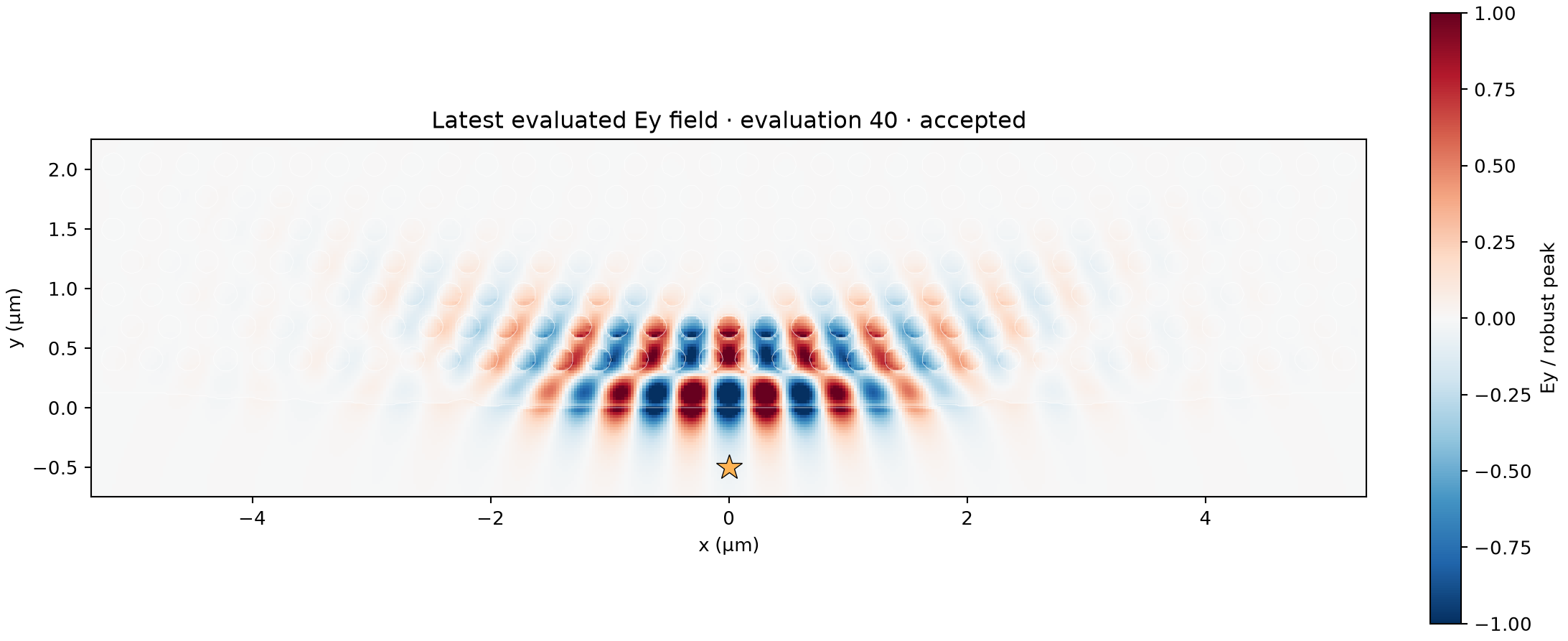
White contours are the literal SiN-air boundary and the star is the remote Ey dipole. The full x plane is reconstructed only for display from the exact x mirror reduction used by FDTD.#
Acceptance contract#
The optimizer may hand off only after its clean tracked pole has LDOS ≥20 and lies within 1% of 780.24 nm. Completion additionally requires a fresh longer remote-dipole forward solve, multi-pole harmonic inversion, a matched vacuum normalization, and a finer-grid geometry/field audit. Until those checks pass, the values above are optimizer evidence rather than a completed-device claim.
Independent validation#
No independent validation artifact exists yet. The optimizer must first reach its training handoff gate.
The final executed notebook will be generated only after this independent audit passes.
The cold seed was a dimensionlessly scaled Zhang-style curved-mirror cavity in
suspended SiN (n=2.05), not a prior
optimized silicon design. Its independent atom-source reconstruction found
LDOS 2.619, Q 5,362, and a 781.33 nm pole before the first gradient.