
Live folded-SiN atom-to-waveguide optimizer#
This campaign folds the optimized Zhang-style SiN curved mirror above and below the atom, leaves the entire left-hand approach channel open, and terminates the right side in one centered SiN waveguide. Every pixel from x=0.5 to 4.0 µm, including the guide-shaped seed, belongs to the inverse-design region; only the straight continuation after x=4.0 µm is fixed. The objective is the physically normalized guided branching ratio—not a field sample—and all other closed-box power is assigned to an explicit loss direction.
Live quantity |
Current evidence |
|---|---|
Guided beta |
23.6% |
Best evaluated beta |
26.4% |
Total LDOS |
1.2586× vacuum |
Guided LDOS |
0.29708× vacuum |
Shifted peak LDOS (fit pending) |
1× vacuum |
Q (fit pending) |
96.9429 |
Pole wavelength |
781.91 nm |
Dominant loss direction |
±z |
Directional loss split |
-x 0.17%, +x radiation 0.00%, ±y 1.64%, ±z 98.20% |
Inner/outer power mismatch |
5.66% |
Output-guide modal index |
1.57004 |
Adjoint updates |
53 / 90 |
Independent topology pixels |
28,696 |
Literal geometry#
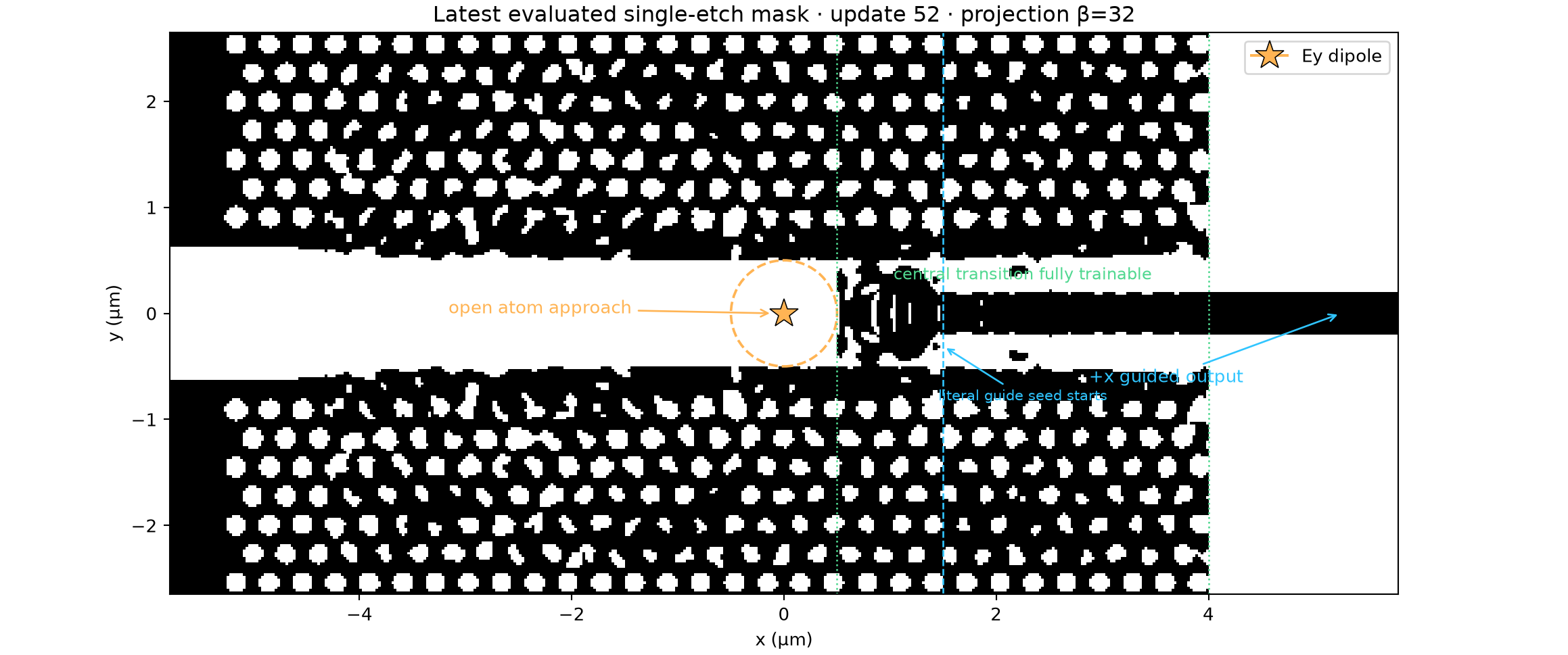
The plotted pixels are the latest geometry actually evaluated by FDTD. The dashed circle marks 500 nm radial clearance; the stricter left access corridor also remains air. The topology is optimized in x-y and extruded uniformly through the slab for fabrication by one etch.#
Geometry audit: sampled nearest-material distance 512.652 nm; left access air True; right guide present True; left guide absent True.
Beta, LDOS, Q, and pole wavelength#
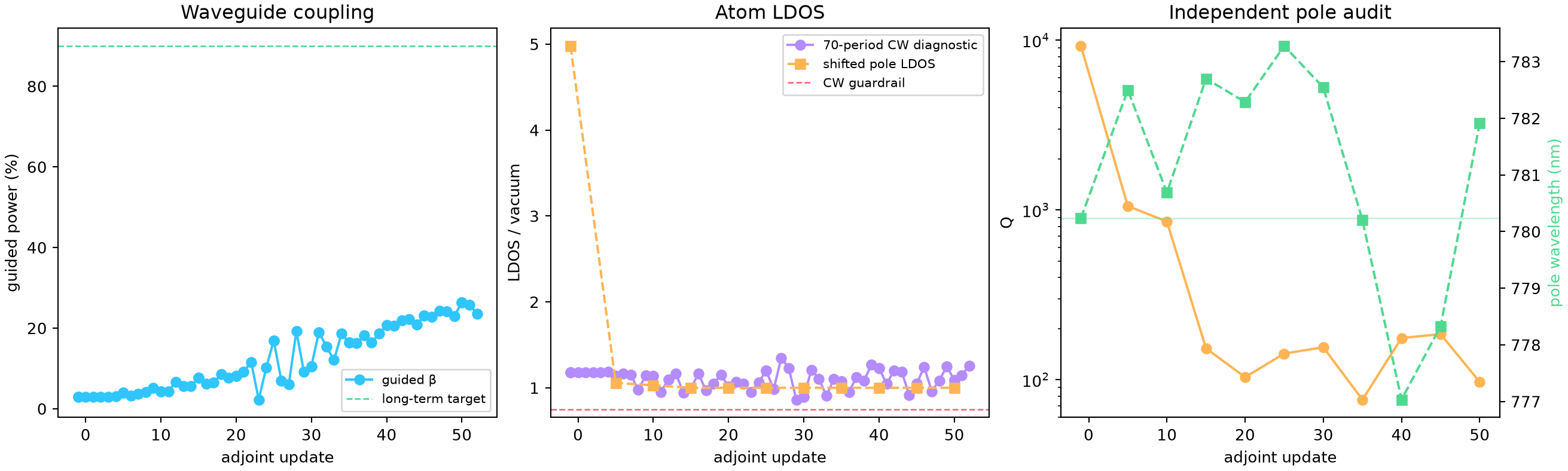
CW adjoints update beta and their finite-time LDOS diagnostic every iteration. A separate 3.5 ps pulse ringdown periodically fits Q, wavelength, mode volume, and shifted peak LDOS, so a beta gain cannot silently hide resonance loss or detuning. For a high-Q seed, the shifted pole value—not a 70-period CW transient—is the meaningful resonant LDOS.#
Where the light is lost#
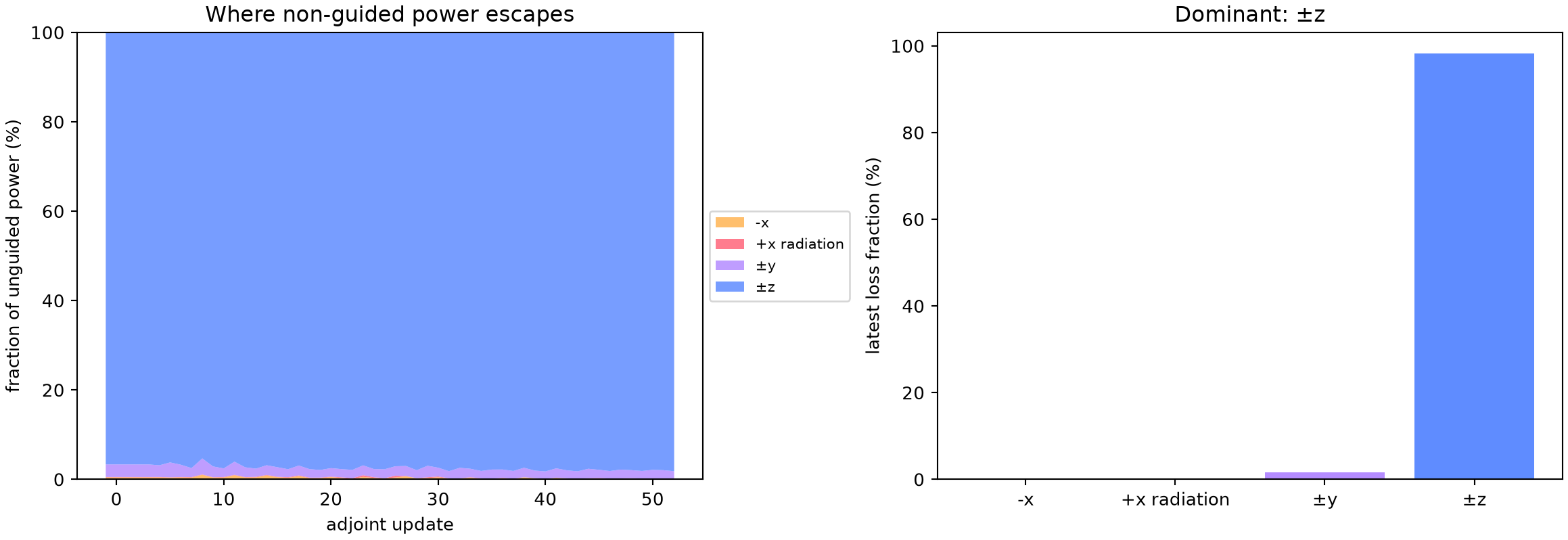
The +x radiation entry excludes the power assigned to the bound waveguide mode. Symmetry-related ±y and ±z faces are restored to their physical power.#
Latest y-polarized electric field#
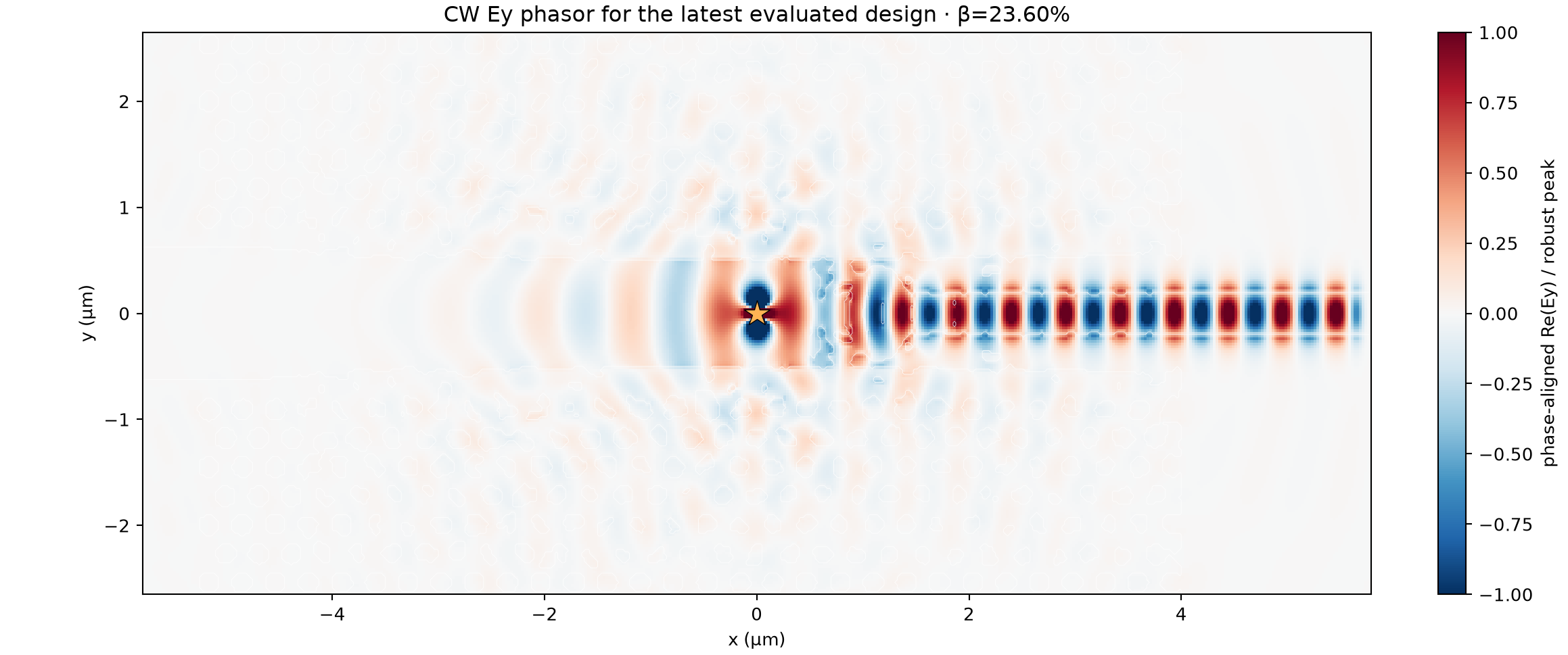
White contours are the literal SiN/air boundary. Only the retained y half was simulated; this plot reconstructs the physical mirror copy for inspection.#
Seed provenance and optimization contract#
The folded seed comes from benchmarks/artifacts/invdes_sin_quasi2d_remote_atom_ldos_live_v1.npz (controls SHA-256
e297925ecd48671c71b1324ac0437069fa0660e80034a30d1169ee4a8e977d1c). Its literal guide begins at x=1.5 µm; the
0.5–1.5 µm region is initially air but fully trainable. Before beta updates the
seed audit measured Q 9242.05,
pole wavelength 780.236 nm,
and shifted peak LDOS
4.9783× vacuum. The short CW
baseline is beta 2.911% and LDOS
1.179; it is not mislabeled as the
steady-state high-Q LDOS.
A 50 nm-radius conic feature filter, erosion/nominal/dilation sampling, and exact-binary straight-through forward solves are used from update zero. A geometry-only inverse-filter calibration makes the nominal projected mask exactly equal to the literal cavity seed before FDTD. The radial 500 nm clearance, open left approach, and terminal guide after x=4.0 µm are reimposed after every filter/projection operation; the intervening transition is never pinned.
The two material-specific precursor campaigns are preserved separately:
This is a live research run, not yet a validated final device. The dashboard reports the latest evaluated design; proposed controls are not credited until their next physical FDTD evaluation.