
Mirror-count doubling ablation#
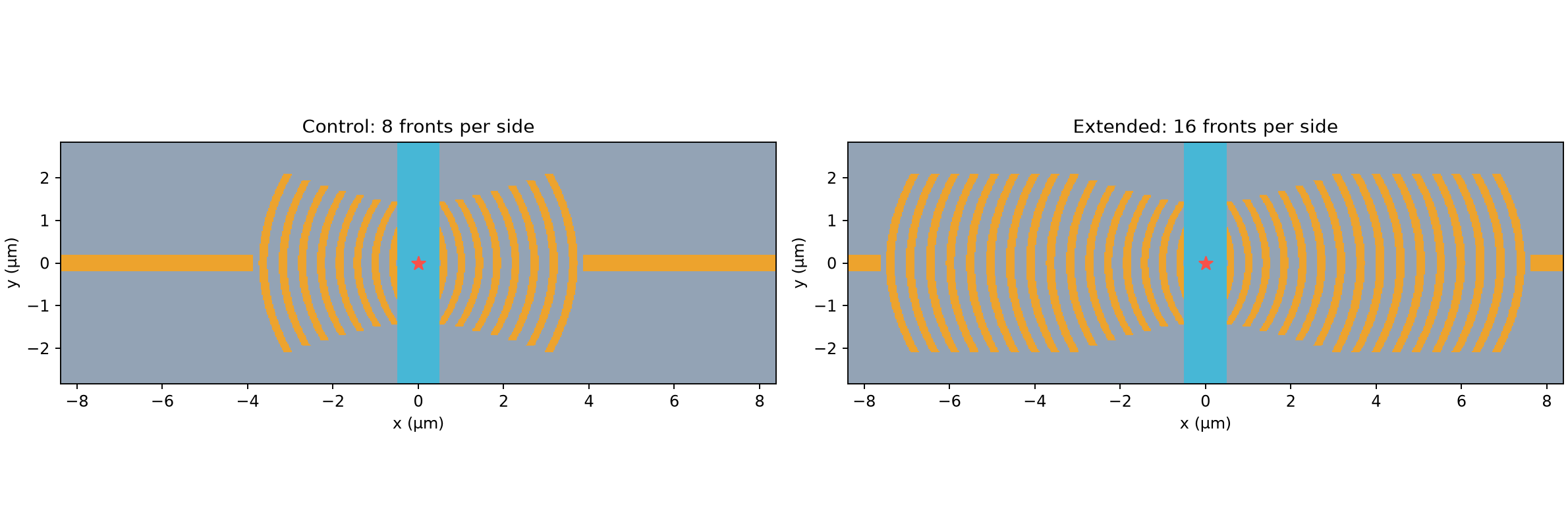
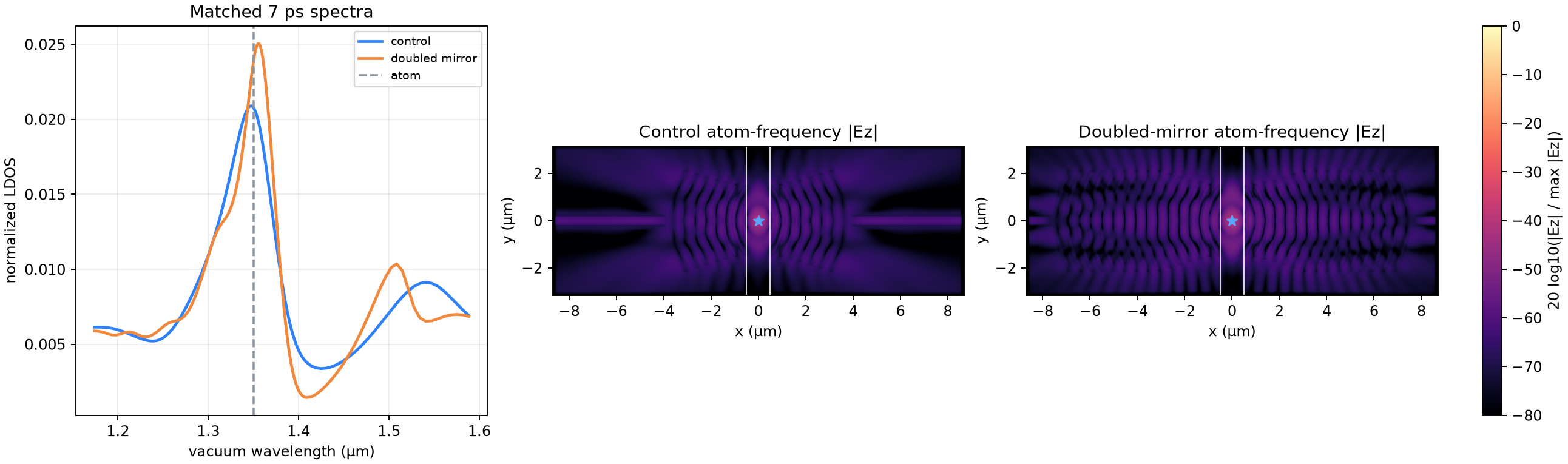
This is a controlled test of whether the selected curved cavity was limited by finite Bragg-mirror length. The original 8 fronts per side are preserved exactly; 8 additional fronts at the terminal period, duty, curvature, and aperture extend each mirror to 16. No defect, inner mirror, slab, material, grid, source, y extent, or fitting rule changes between the two solves.
Metric |
control |
doubled mirror |
ratio |
|---|---|---|---|
fitted Q |
21.068 |
23.67 |
1.123× |
atom-frequency LDOS |
0.020774 |
0.023863 |
1.149× |
near-atom peak LDOS |
0.020896 |
0.025049 |
1.199× |
total guided β |
8.197% |
2.405% |
0.293× |
guided Purcell |
0.0017028 |
0.0005738 |
0.337× |
fractional detuning |
0.551% |
0.073% |
0.132× |
Interpretation: Yes: the added terminal mirrors raise fitted Q by 12.3% and atom-frequency LDOS by 14.9%. They are not a complete device improvement, because guided beta changes by -70.7%.
The matched physical interior is 16.80 × 5.70 × 3.40 µm. The y extent remains exactly 5.70 µm. The x extent is enlarged only if needed to keep the longer mirror and terminal guide away from the x-PML; both control and extended devices are replayed in that identical box.
Integrity checks#
original fronts preserved exactly:
True;y extent unchanged:
True;source control reused in an identical domain:
False;single-etch 2-D extrusion and hard 1 µm all-air gap retained;
grid spacing: 25 nm;
LDOS / outer-radiation frequency counts: 237 / 25;
symmetry:
(1, 1, -1);source winner:
final_audit_5d2d8b7899.