
Lossless temporal-target cavity campaign#
Live optimizer
This is a fresh neutral-start campaign. From its first forward solve it rewards only the amplitude and waveform fidelity of a source-driven lossless single pole, plus full-field spatial coherence. Q, V, and Q/V are telemetry. There is no DCT preconditioner, output-mode term, prescribed period, or staged antenna objective.
State |
Value |
|---|---|
Status |
|
Source |
|
Temporal observable |
|
Phase |
|
Active coordinates |
|
Completed updates |
68 |
Temporal objective |
-0.88434 |
Whole-trace target overlap |
0.94683 |
Source-off/late target overlap |
1 |
Source-off/late target power |
1.636e-05 |
Normalized temporal residual |
0.23057 |
Full-field coherence |
0.99998 |
Shifted stationarity |
0.95662 |
Q telemetry |
2942.8 |
Normalized V telemetry |
1.0855 |
Active pole tape |
2 ps |
Maxwell-step reduction vs 2 ps |
1× |
Projection stage |
|
Projection beta / eta |
48 / 0.50 |
Gray fraction |
37.09% |
Pixel gradient transform |
|
Pixel trust step |
0.08000 |
Boundary handoff |
|
Stable binary-topology states |
0 / 3 |
Boundary trust radius |
inactive until spline handoff |
Last candidate accepted |
True |
Last pole trustworthy |
True |
Latest update wall time |
141.8 s |
Last artifact write |
2026-08-28 20:03:14 UTC |
The authoritative state is
benchmarks/artifacts/invdes_fryett_temporal_temporal_v1_raw_pixels.npz. The former Q/V campaign is a separate stopped artifact and is not used as a seed.
Geometry and exact material difference#
Field used by the temporal objective#
Exact temporal target response#
Full-field temporal correlations#
Objective, binarization, and pole history#
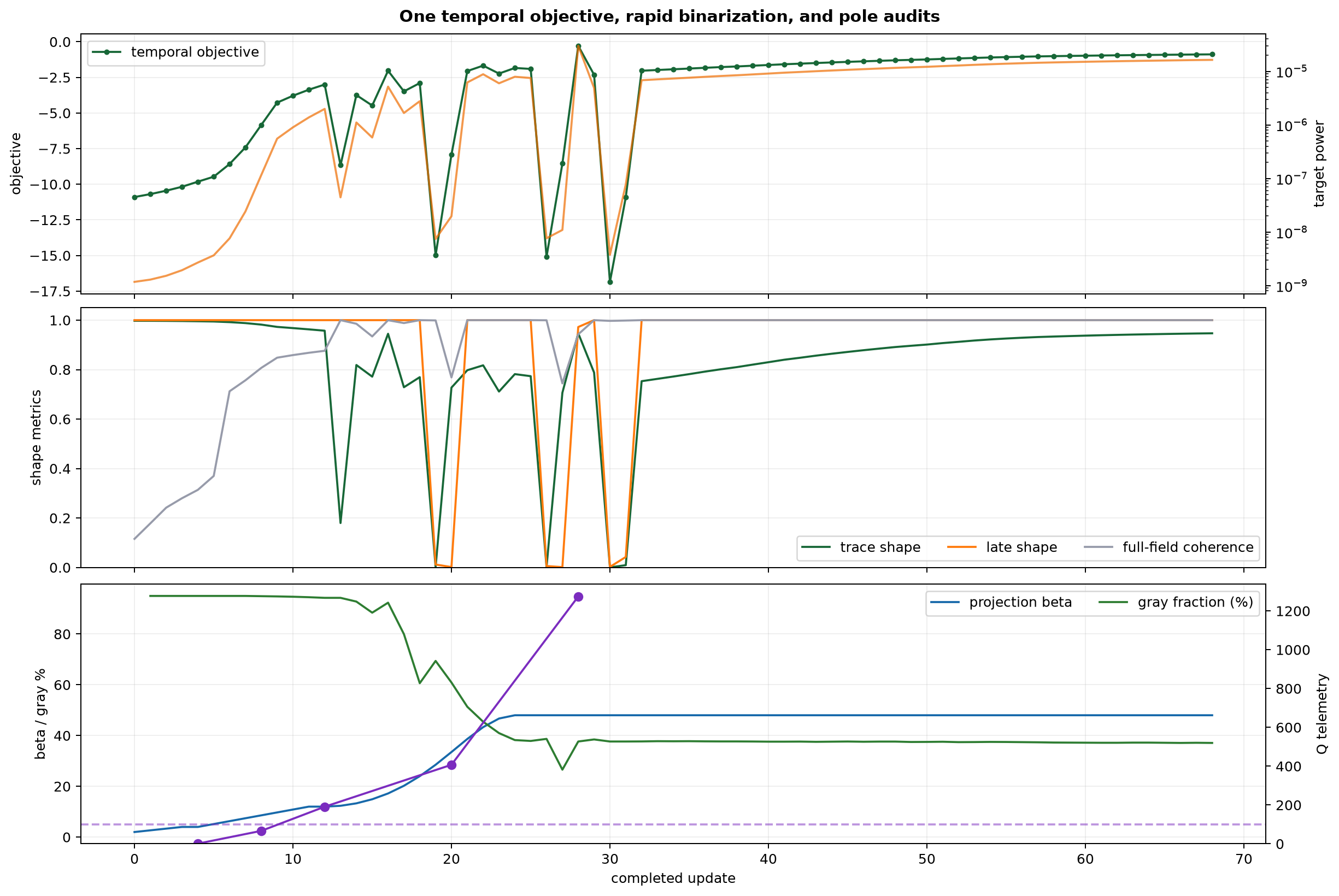
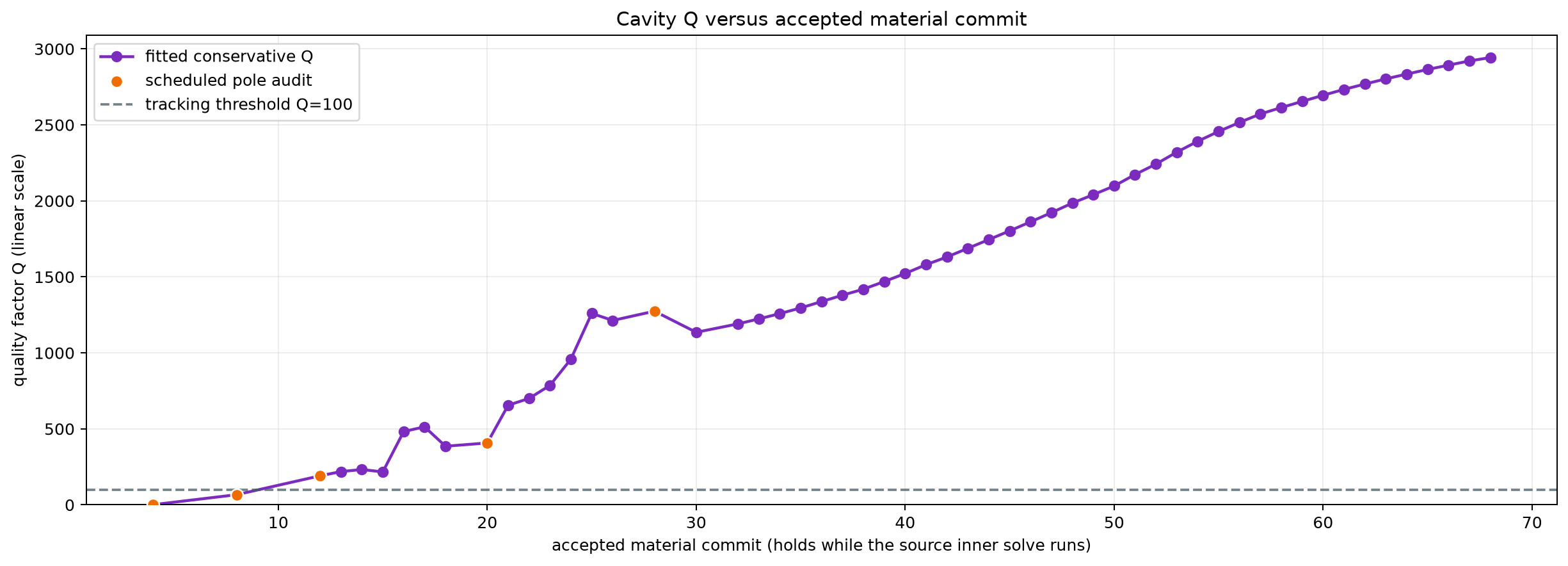
Q versus accepted material commit — linear scale#
Exact methodology, target response, and moving components#
Single hypothesis and single objective#
This campaign deliberately removes the Q/V objective, mode-volume term, DCT preconditioner, output-mode target, prescribed period, and discovery-to-Q/V objective continuation. It asks one question from the first neutral geometry: can raw pixel gradients construct a cavity when every update rewards the exact time dependence of a source-driven, lossless single pole?
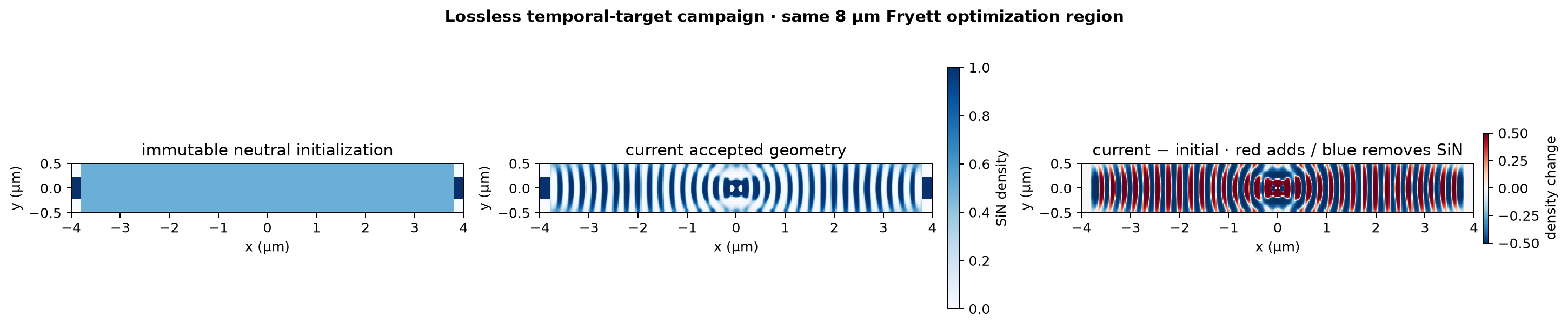
The geometry and Maxwell scene remain the same as the preceding eight-micron Fryett scratch campaigns: an \(8.0\times1.0\times0.40\,\mu\mathrm m^3\) full design box, a reduced \(160\times20\) material array, 25 nm Maxwell cells, \((+x,-y,+z)\) mirror parity, a centered \(y\)-polarized dipole, and the immutable terminal feedthrough. The initial trainable density is exactly 0.5. No old geometry is used as a seed.
Exact target during the emitter pulse and ringdown#
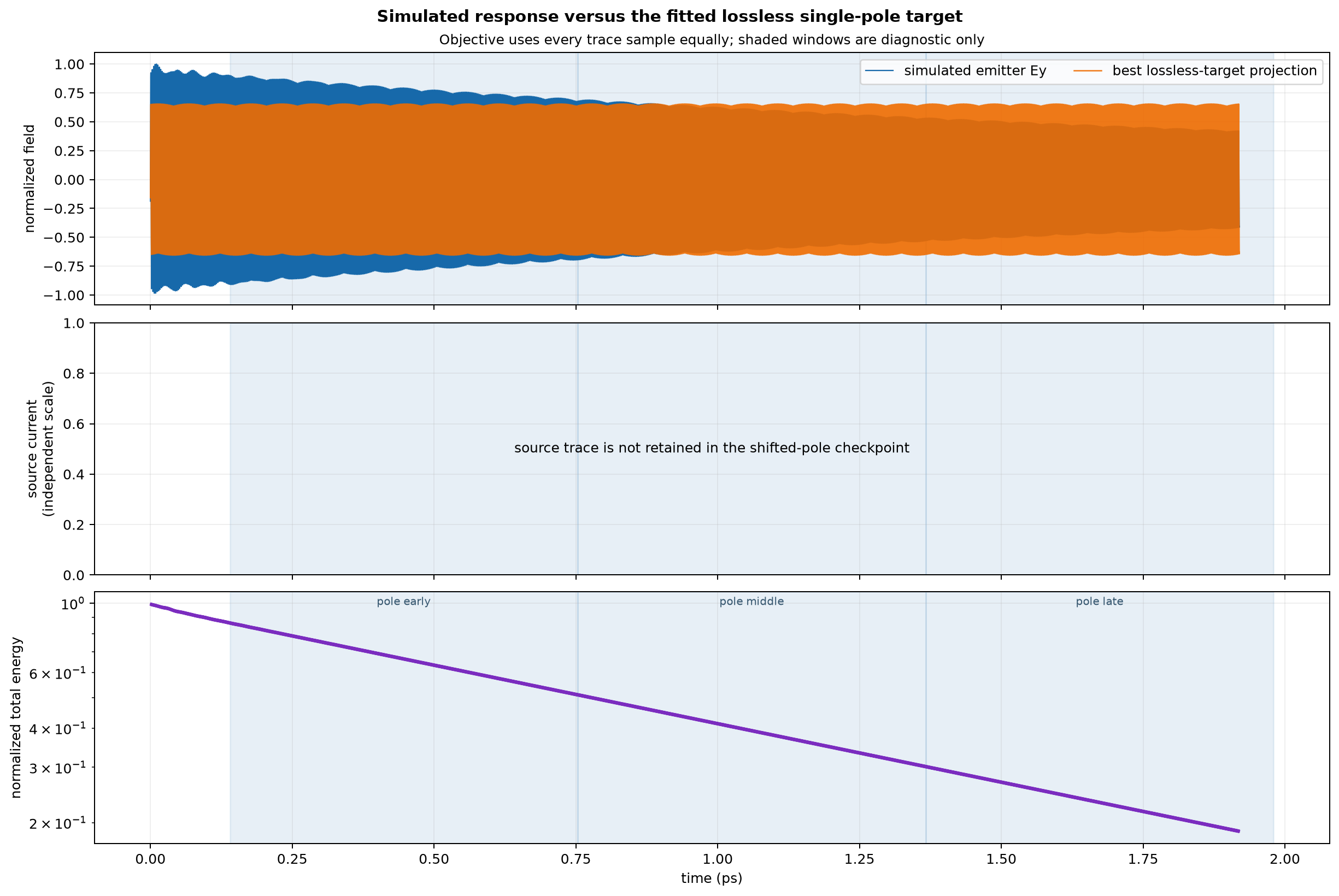
Let \(s_n\) be the known dipole waveform, \(v_n\) the emitter trace in the same scene with no device, and \(\omega_c\) the target carrier. The two causal quadratures of a lossless resonator driven by that source are
The desired temporal subspace is therefore
The vacuum trace represents the prompt emitter-on background exactly. The two convolution vectors represent an arbitrary coupling phase to one lossless cavity pole. After the source pulse, both reduce to a pure sine/cosine at \(\omega_c\) with constant envelope. Consequently the projection includes the physical emitter-on transient instead of incorrectly requiring a sinusoid before the resonator has been driven.
For the simulated emitter trace \(e\), let
be its regularized least-squares projection onto this three-dimensional subspace. Basis columns are RMS-normalized before a \(32\epsilon_{\rm mach}\) ridge is added to their Gram matrix. The dimensionless shape overlap is
This alone would permit the zero-field solution. The amplitude-bearing term is the projected target power after the source has turned off,
normalized by the mean-square vacuum emitter response \(P_{\rm vac}\). The complete fixed-carrier objective is
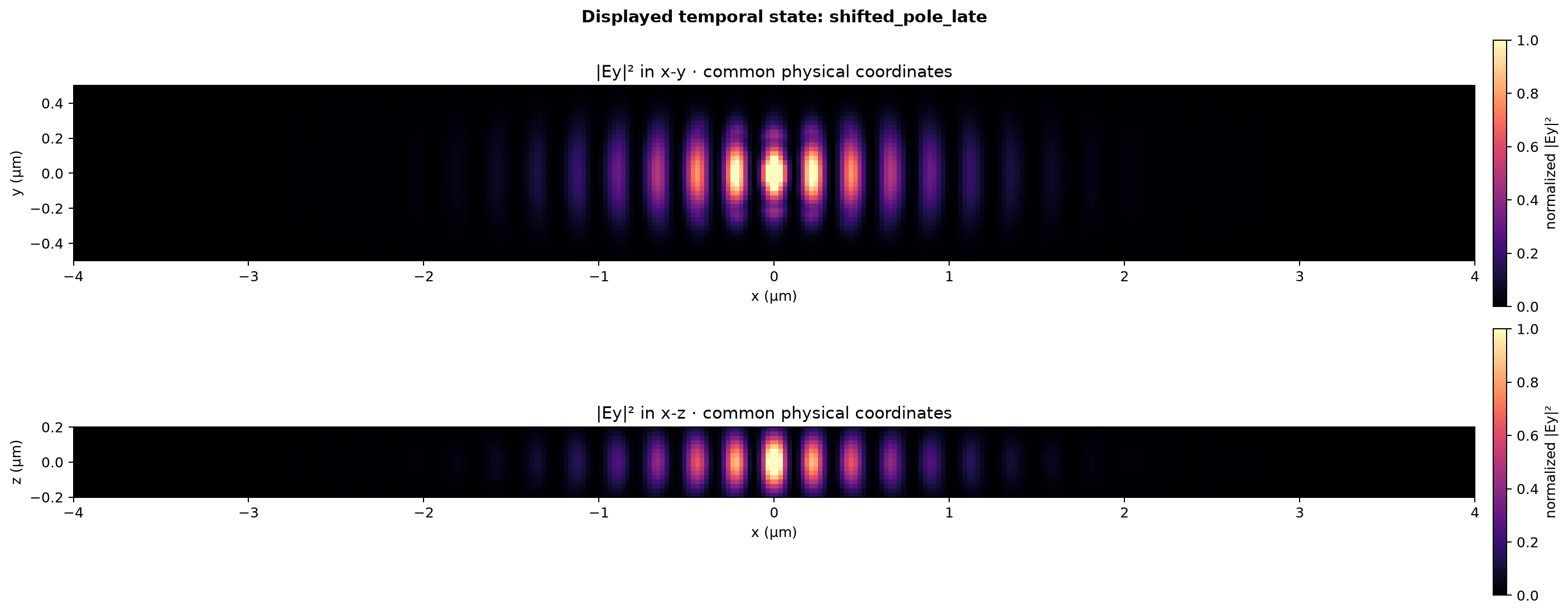
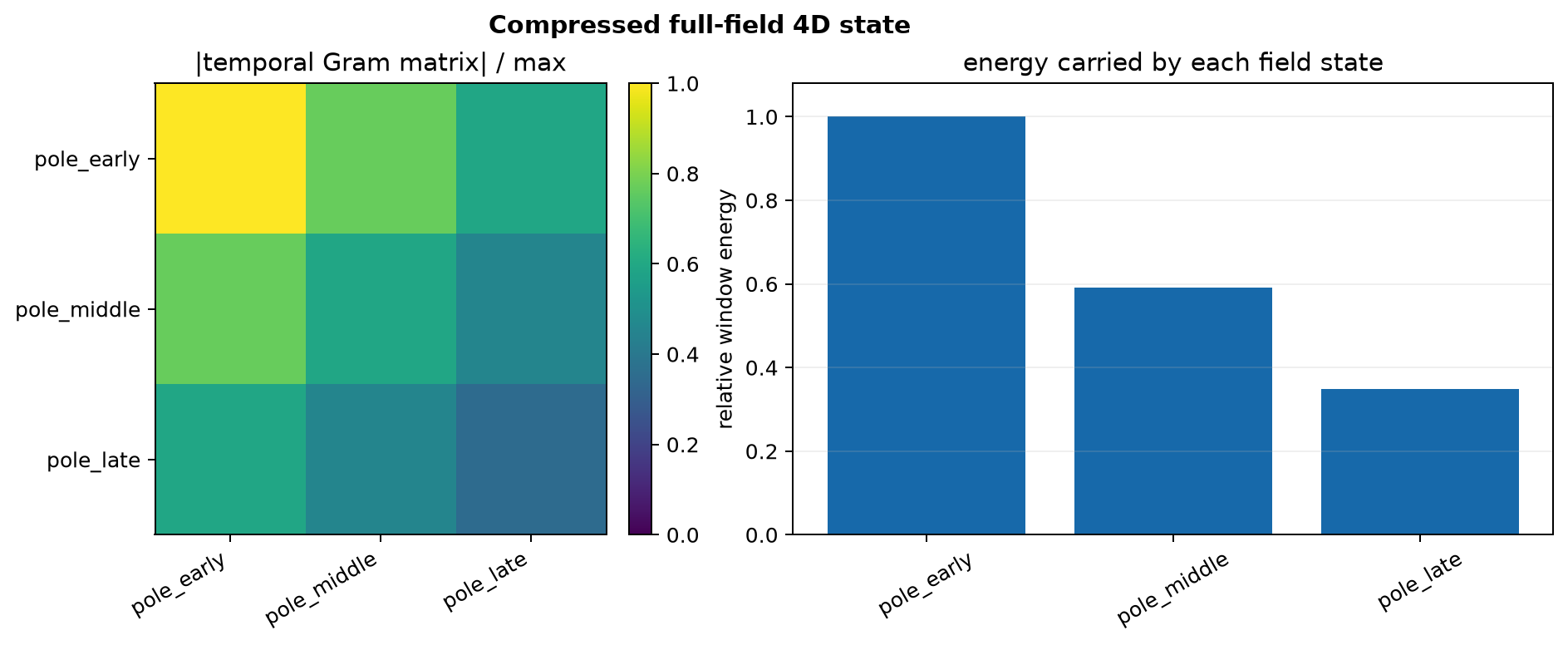
\(\eta_{\rm coh}\) is the energy-inner-product coherence of all six E/H components accumulated throughout the full reduced design volume in one emitter-on and three source-off windows. It is insensitive to the required change in scalar envelope but penalizes a response whose spatial field changes between windows. Thus the first update already asks for a bright, source-driven response that becomes one persistent sinusoid carried by one spatial mode. There is no separate antenna objective or later Q/V objective.
Pole tracking changes coordinates, not the goal#
Every four updates, a source-off replay attempts the existing conservative pole fit. Its duration is not fixed at 2 ps. The controller chooses the shortest reusable tier in
that contains at least 1.5 estimated field-amplitude lifetimes after the source turns off, plus a 0.03 ps margin. The usable interval from 0.14 ps to \(T-0.02\) ps is divided into three equal fit/field windows. Discrete tiers reuse compiled Maxwell programs; a continuously changing tape would lose much of the speedup to recompilation. If an audit estimates a Q that requires a longer tier, it immediately repeats at that tier before it may capture the pole. The same rule applies inside an optimization turn: if either the incumbent or its candidate outgrows the gradient tape, both are replayed on the required longer tier and acceptance uses only those longer-tape scores and pole gates. The short-tape Q can therefore select a validation tier, but it cannot authorize its own acceptance.
This is an accuracy controller, not an unconditional truncation. On the preserved Q=218.83 state, refitting the 0.40 ps prefix gives Q within 0.08% of the 2.00 ps result, with field/energy agreement, residual, and window consistency far inside their trust limits. As Q grows, the selected tape grows automatically. Nothing changes until field and energy fits, window consistency, Q agreement, frequency band, full-field coherence, and adjacent-window overlap pass with \(Q\ge100\). After that event, the carrier follows the accepted pole.
An untrustworthy shifted fit is not a terminal condition. The controller replays the unchanged incumbent through every longer remaining tape tier, up to 2 ps. Each replay repeats the late-window spectral-branch search and pole recentering. The first fit that passes all unchanged physics gates becomes the new tracking center; no untrusted fit can generate or accept a geometry step. If no pixel-phase replay isolates one pole, the same pixels return to the original fixed-carrier temporal objective and continue improving while the four-update audits reacquire the pole. In the later boundary phase, recovery continues on the accepted boundary and recenters on finite in-band estimates. Thus a temporary multimode or poorly resolved trace can cost extra forward solves, but it cannot stop the campaign or weaken the trust thresholds.
The long source-off trace is projected onto
The fitted frequency is stopped-gradient when constructing this coordinate frame; the optimizer cannot improve the score by moving the definition of its target. The shifted objective remains the same amplitude-plus-shape test,
Here the target power is measured over the final half of the trace. A decaying or beating waveform cannot lie completely in the nondecaying sine/cosine subspace, so improving this objective increases lifetime without inserting Q as an optimization term. Q, V, and Q/V remain dashboard telemetry only. The fit and absolute-band penalties are unchanged fail-closed diagnostics.
Raw-pixel geometry and rapid binarization#
The differentiated material controls are the 3,200 identity pixels. The only fixed controls are the terminal feedthrough cells. The proposed pixel direction is exactly
there is no DCT, Fourier, spatial weighting, emitter bonus, momentum blend, or periodic basis. This run is intended to reveal the geometry preferred by the temporal objective without hiding it behind a geometric metric.
The fabrication filter remains because the physical density must have a defined length scale. Projection beta follows
updates 0–3: \(2\rightarrow4\);
updates 4–11: \(4\rightarrow12\);
updates 12–24: logarithmic smoothstep \(12\rightarrow48\);
update 24 onward: \(\beta=48\) with the active geometry fixed at \(\eta=0.50\).
At the measured update time this reaches the mature binary schedule in roughly one hour, not ten hours. The three projection thresholds are not alternated as active geometries: doing so changes the physical device without a parameter step and makes successive objectives incomparable. Candidate steps use an adaptive latent trust radius plus a decoded-density cap
for trustworthy \(Q\ge100\), and 0.10 before capture. This makes realized material motion finer as the pole sharpens. An exact second Maxwell replay remains authoritative. Fixed-carrier candidates require nondecreasing \(J_T\); shifted candidates additionally require a trustworthy same-family pole and at least 0.50 field overlap. There is no Q/V acceptance gate.
Automatic smooth-boundary phase#
Pixels remain active until beta is 48, gray fraction in \(0.1<\rho<0.9\) is at most 4%, and the material-component/enclosed-void signature is unchanged for three trustworthy shifted states. A sign-preserving level set is then fitted to the accepted topology. Six-by-six subcell quadrature produces exact air/solid bulk and differentiable fractional fill only in cells cut by the interface.
The handoff performs a fresh replay at the same Q-selected minimum viable tape. It must preserve topology, every pole gate, at least 90% of late target power, at least 95% of temporal-shape overlap, and 0.90 field overlap. A failed replay leaves the pixel incumbent untouched, clears the three-state readiness count, and continues pixel optimization before trying again.
The boundary phase differentiates the same \(J_S\). A one-cell Gaussian acts only on the boundary-normal gradient to suppress grid-scale zig-zags; topology-safe backtracking and exact Maxwell replay guard every move. The local level-set chart spans \(\pm50\) nm and rebases exactly after 30 nm utilization, so cumulative physical boundary motion is unbounded. This smoothing is not a DCT preconditioner and encodes no period, hole, beam, or taper.
Deliberate omissions#
This first temporal-only run has no mode-volume reward, direct Q reward, Q/V reward, beta-factor term, output-mode overlap, mirror-opening term, periodicity target, or DCT preconditioning. The resulting geometry is evidence about the temporal target itself. Any later geometric metric must be added as an explicit ablation rather than silently folded into this baseline.
Operations#
A bounded manual turn can be run with:
FDTDX_FRYETT_TEMPORAL_ID=temporal_v1_raw_pixels uv run python -m benchmarks.cases.invdes_fryett_hybrid_scratch.temporal --updates 1
The persistent launcher is scripts/start_fryett_temporal_campaign.sh.