
Fields, time stepping, and open boundaries#
This first track answers a deceptively simple question: does a launched wave propagate with the right phase, impedance, energy, and decay?
Start with an empty domain#
Use a pulsed dipole in vacuum, surround the domain with PML, and measure total field energy. A healthy run has finite arrays, develops positive energy while driven, and returns toward zero after the pulse leaves.
uv run fdtdx-bench run --case analytical_vacuum_energy
The recorded tail-to-peak energy ratio is \(4.54\times10^{-5}\), well below the declared 0.2 ceiling. This test simultaneously catches unstable stepping, broken source injection, and gross PML reflection.
Measure a plane wave#
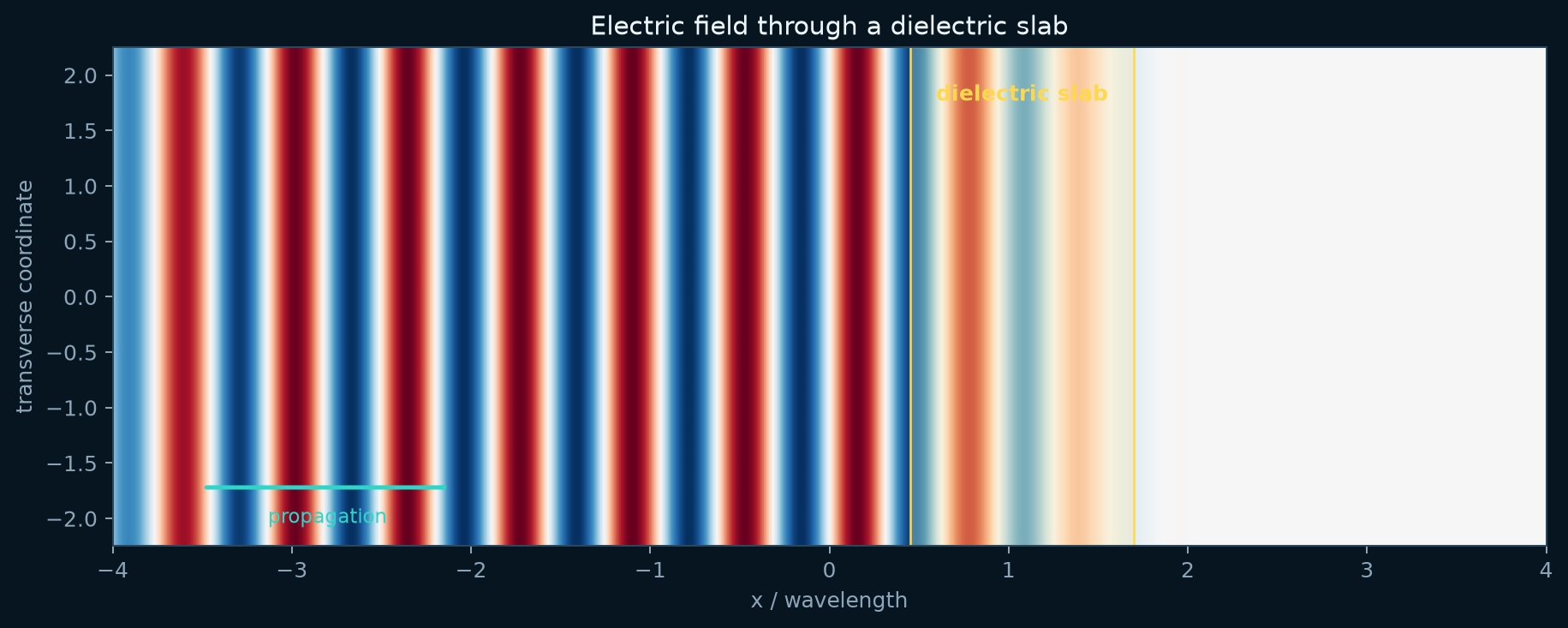
A sinusoidal plane wave adds sharper checks:
vacuum phase velocity should be \(c\);
dielectric phase velocity should be \(c/n\);
\(|E|/|H|\) should match the medium impedance;
polarization and propagation direction should obey the right-hand rule.
uv run fdtdx-bench run --case analytical_plane_wave
uv run fdtdx-bench run --case analytical_plane_source
uv run fdtdx-bench run --case analytical_phasor_poynting
The plane-wave case runs four upstream physics tests. The plane-source case checks injection details, while the phasor case ensures frequency-domain and time-domain Poynting measurements agree.
Change the temporal profile#
Run CW, Gaussian, and custom temporal signals through the same machinery:
uv run fdtdx-bench run --case analytical_temporal_profiles
uv run fdtdx-bench run --case analytical_pulsed_vs_cw
Use a pulse when you need a spectrum from one solve; use CW when a single frequency and clean steady-state phase matter more. A pulse must be long/narrow enough to sample the desired band without exciting grid-scale content.
Stretch the grid#
Finally compare a mildly nonuniform RectilinearGrid against a uniform-grid baseline:
uv run fdtdx-bench run --case analytical_nonuniform_grid
This is important because the local cell widths enter curls, source weights, detector integration, and the Courant limit. Agreement on only one of those paths would not be sufficient.
Convergence habit
For new scenes, repeat at a finer grid and larger PML before increasing domain complexity. If the answer moves more than the scientific conclusion can tolerate, the original discretization was not resolved.