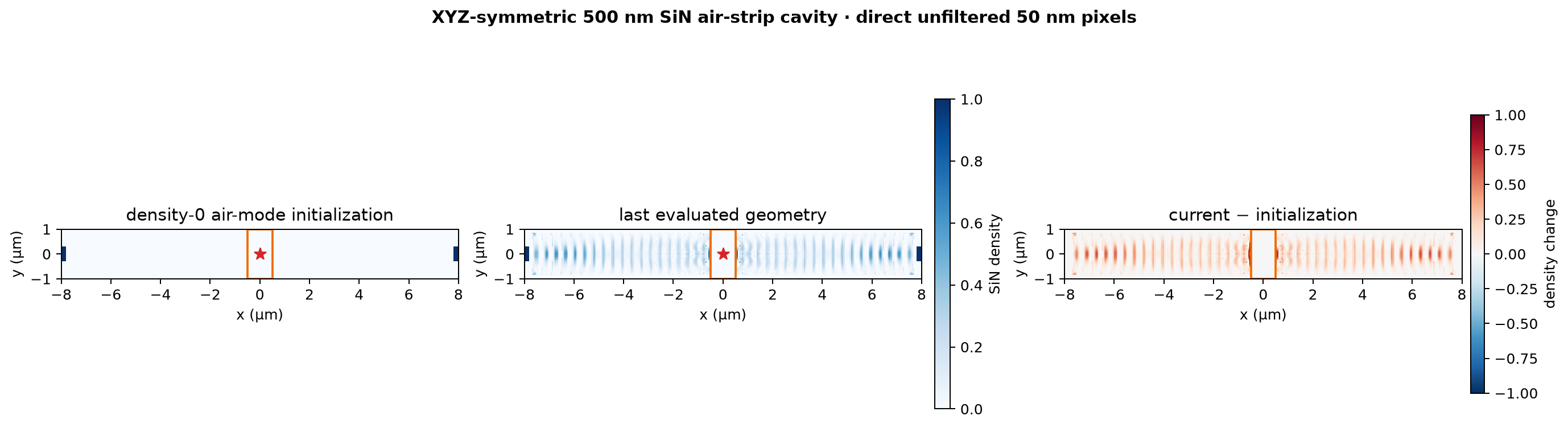
XYZ-symmetric SiN y-atom air-strip volume-constrained Q optimizer#
Worker: not active · stage: pole_q_volume_constrained ·
status: qualified_success_paused_resumable · checkpoint age: 11.1 min
This paused campaign drives the even bright combination of two fundamental
TE-like modes into a 16 µm × 2 µm ×
0.5 µm SiN design. A centered y-oriented atom lies in
an immutable one-micron-wide air strip spanning the complete y width, so the
optical path cannot route through dielectric around the atom. Full x/y/z
symmetry leaves one octant and the unfolded coherent source pair has unit
incident power. Raw Adam first minimizes the fixed absolute temporal error.
At step 50, a trustworthy Q≥100 activates the pole handoff. Stage B jointly optimizes every in-plane density pixel
and one global slab-thickness coordinate while maximizing only the moving-pole
harmonic Q. The design-region thickness moves continuously from 0.2 to 0.7 µm
through a planar subpixel fill; the external 0.5 µm feedthrough remains fixed.
Every
Q direction is projected into the local non-increasing-log(V_atom)
half-space, and a forward replay rejects any candidate above the one fixed
handoff-volume ceiling. The 0.2% allowance is only for estimator noise and
never ratchets. No filter, material projection, or binarization is active.
quantity |
current |
|---|---|
temporal Adam updates |
50 / at least 50 |
pole accepted updates / trials |
118 / 1683 |
Q |
1977.9 |
best trusted Q |
1977.9 |
field / energy Q |
1977.9 / 1978.39 |
Q-estimator ratio |
1.00025 |
pole wavelength |
821.989 nm |
source-center wavelength |
821.842 nm |
design-region slab thickness |
0.7 µm |
Stage-B thickness coordinate / range |
True / 0.200–0.700 µm |
| physical mode volume | 2.33794 µm³ |
| normalized mode volume | 4.20954 λ_pole³ |
| Q / normalized atom volume | 469.918 |
| Purcell from Q/V | 35.7095 |
| cavity-emission probability C/(1+C) | 97.2759% |
| Purcell target / reached | 100 / False |
| lowest Q found with Purcell≥100 | — |
| frozen handoff mode volume | 2.94334 µm³ |
| last candidate volume-feasible | True |
| fitted atom-pole amplitude at source clear | 0.0684753 |
| absolute atom-trace peak / handoff | 0.35553 |
| source spectral power at pole / center | 0.995725 |
| reciprocal guided-Purcell proxy | 0.000204587 |
| guided-Purcell proxy / handoff | 61799.2 |
| Stage-B volume treatment | 2.94334 µm³ handoff ceiling with 0.2% fit-noise allowance |
| three-window V span | 0.000106879 |
| ideal temporal fidelity | 0.489826 |
| active objective | 7.58991 |
| maximum last density motion | 1.19209e-06 |
| trust radius | 0.0003 |
| hard atom access | 1.000 µm full-y air strip, immutable |
| pixel / grid | 50 nm / [181, 35, 27] |
| non-PML z span / material-stack-to-PML air gap | 1.70 / 0.50 µm |
| z PML | 0.50 µm per side |
| z-padding convergence audit | not_run |
| 1.50→3.40 µm replay: residual / field-Q / energy-Q change | nan% / nan% / nan% |
| binarization / projection / filter | off / off / off |
| physical waveguide escape eta | not part of the active objective |
Q, V, objective, and optimizer history#
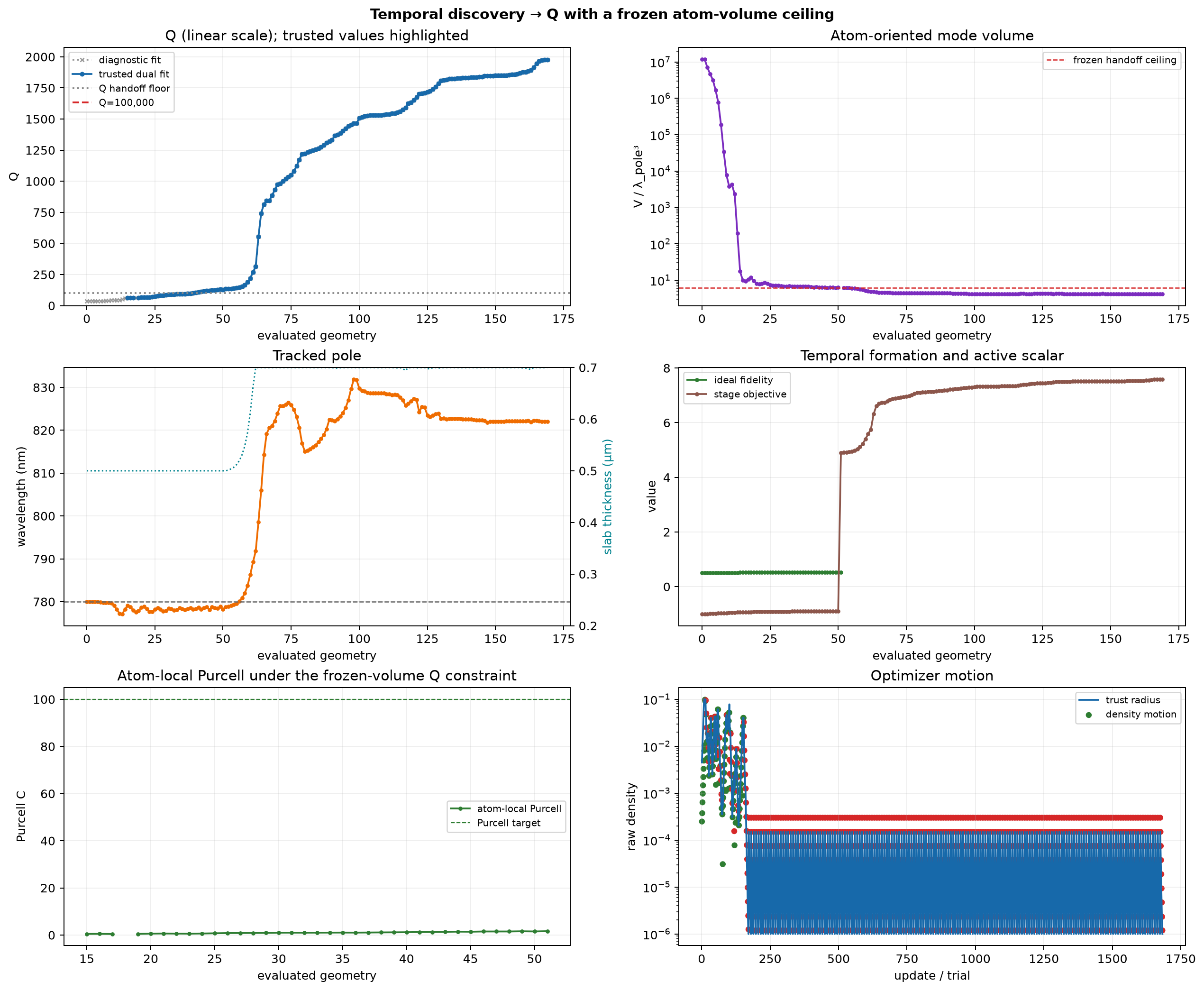
The Q axis is linear. A pole is not trusted until the centered Ey and total energy decay estimates agree. Mode volume uses their same final window and the same fitted pole wavelength; the local permittivity is exactly air by the hard geometry constraint. The first air-strip Stage-B attempt is archived as a negative ablation. Its collection score rose 442.6× and Q rose 268→10,027, but physical atom volume rose 4.289→100.02 µm³ and Purcell only rose 2.26→3.76. Because no parameter snapshot existed at that handoff, this corrected branch starts fresh from a density-zero air design, stores its new handoff explicitly, and then applies the frozen-volume Q controller.
Ideal and measured atom response#
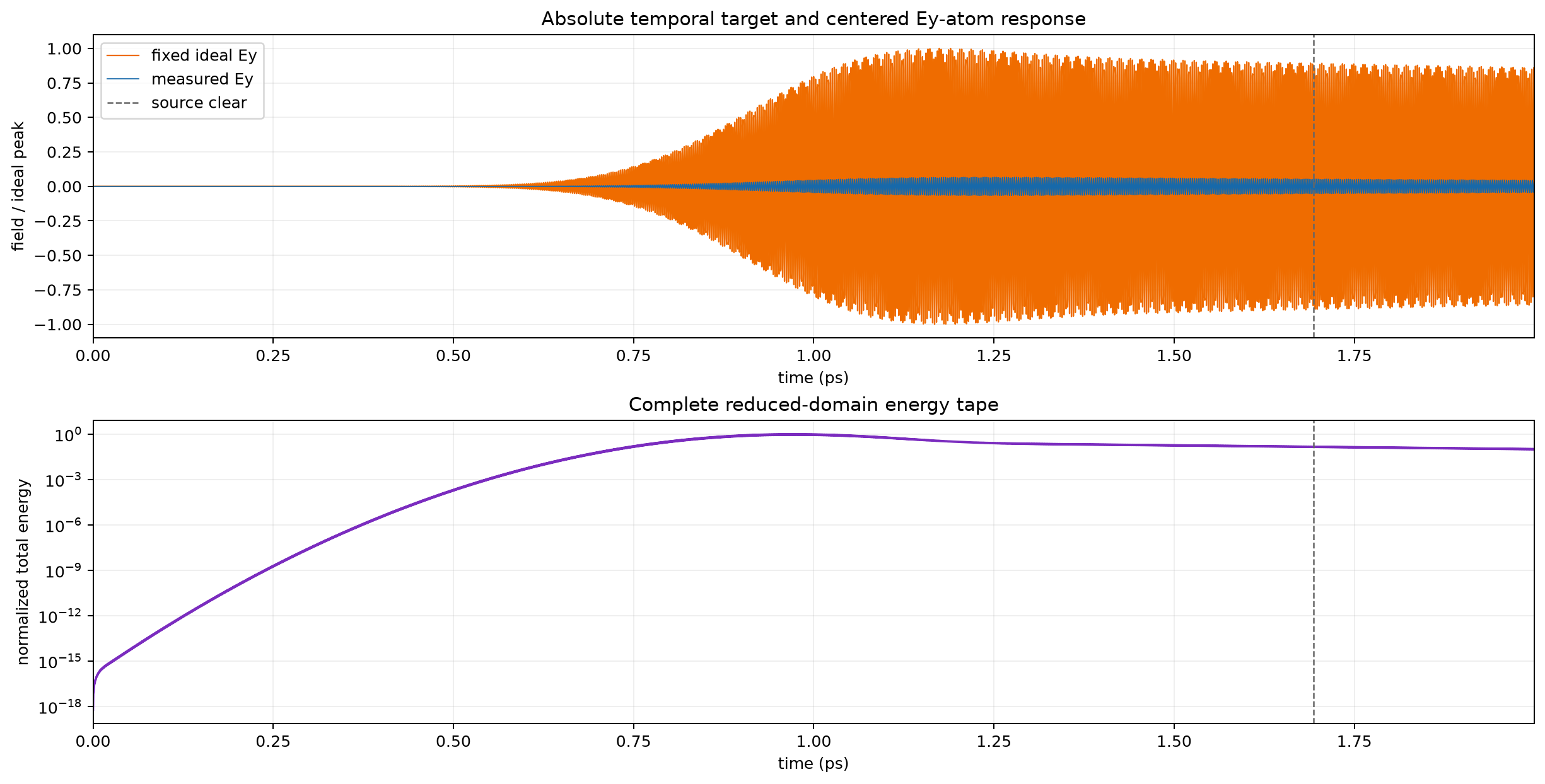
The target has fixed amplitude and phase for Q=10,000, beta one, V=0.1 µm³, and perfect Ey-polarized overlap. It is not rescaled to fit the simulation.
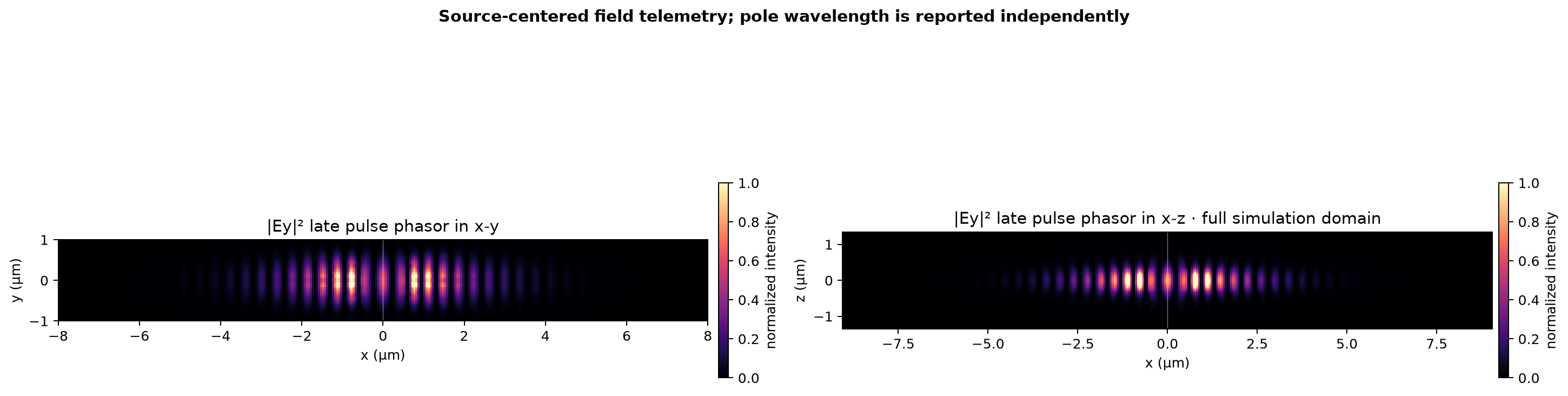
Geometry and fields#