
Frozen shifted-LDOS optimization · remote atom#
Last published: 2026-08-22 10:34:52 UTC. Geometry fingerprint: e6da737c3f981b3f.
This completed research example starts from the unloaded semi-2D
photonic-crystal cavity of
Zhang et al., Scientific Reports 6, 26038 (2016).
The coupling waveguide is absent. A physical Ey-oriented atom is fixed at
(0, -1.75, 0) µm; the nearest allowed silicon point is pinned exactly 0.500 µm
away. The design remains a single 220 nm extrusion throughout. The solver uses
the valid x and z mirror symmetries, retaining one quarter of the full spatial
domain; y is not a symmetry axis for this offset atom/cavity system.
The GPU campaign was stopped by request after its best accepted geometry was replayed and frozen. The full parameter → geometry → simulation → field → analysis workflow is available as an executed notebook.
Current evaluated geometry#
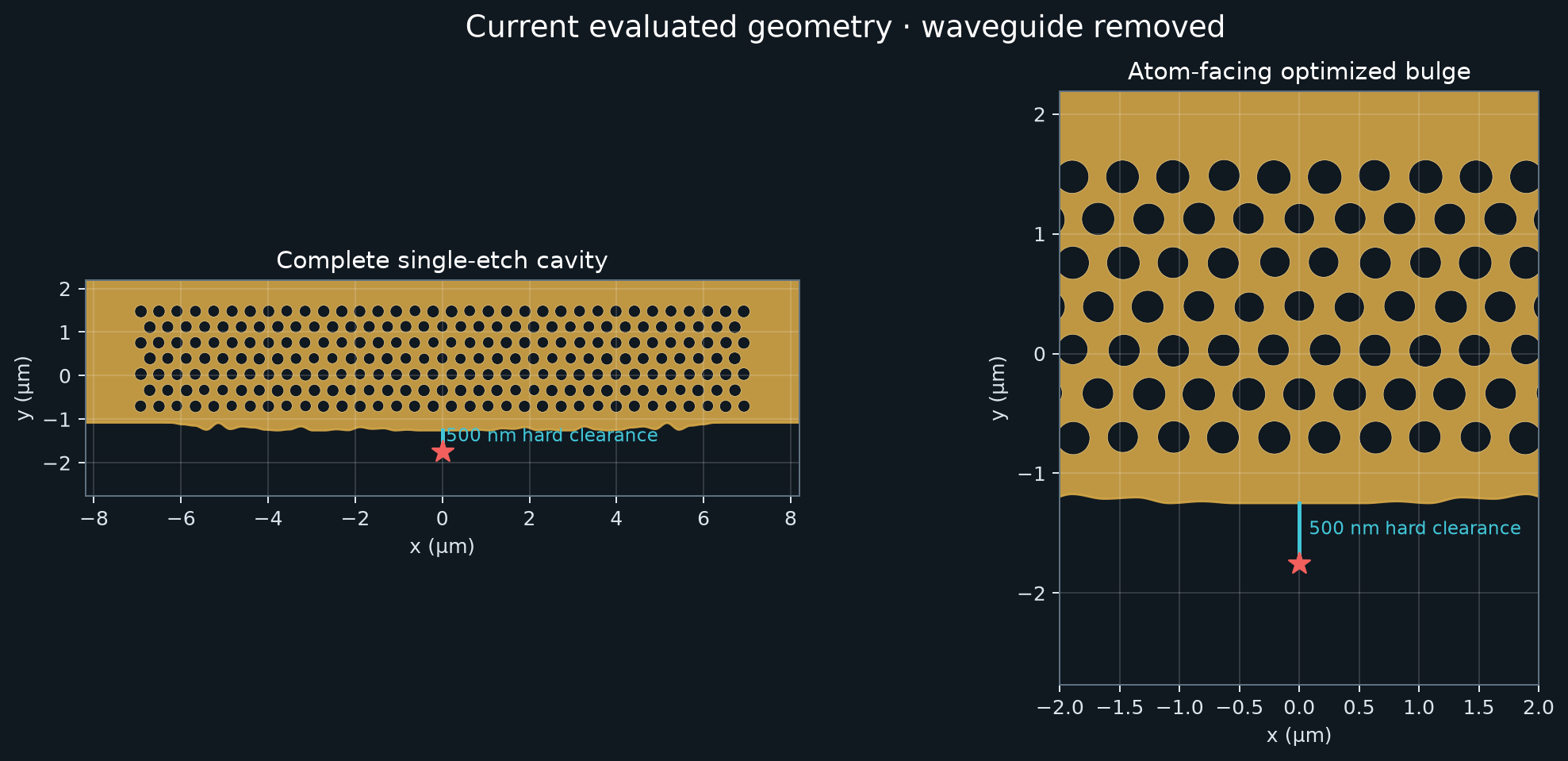
All 235 holes in the selected 7-row mirror are shown. Optimization stores 119 x-mirror representatives and varies every representative’s radius and allowed in-plane position. Twenty-five smooth bulge controls give 379 total degrees of freedom.#
Matched forward screens retained seven of the published ten rows and reduced
the symmetry-reduced grid from 205 × 188 × 32 to
205 × 124 × 32.
At zero controls this compact domain increased shifted LDOS from 1.860 to 1.978
and conservative Q from 10,114 to 11,456, so the crop did not trade away the
tracked atom-coupled pole.
Literal fabrication check |
Current value |
|---|---|
Atom-to-silicon minimum |
0.500000 µm |
Minimum hole ligament |
126.096 nm |
Minimum hole diameter |
249.597 nm |
Physical / independent holes |
235 / 119 |
x mirror / single etch |
True / True |
FDTD symmetry / spatial saving |
x + z / 4× |
Full / simulated grid |
410 × 124 × 64 / 205 × 124 × 32 |
Reverse checkpoints |
64 |
LDOS optimization history#
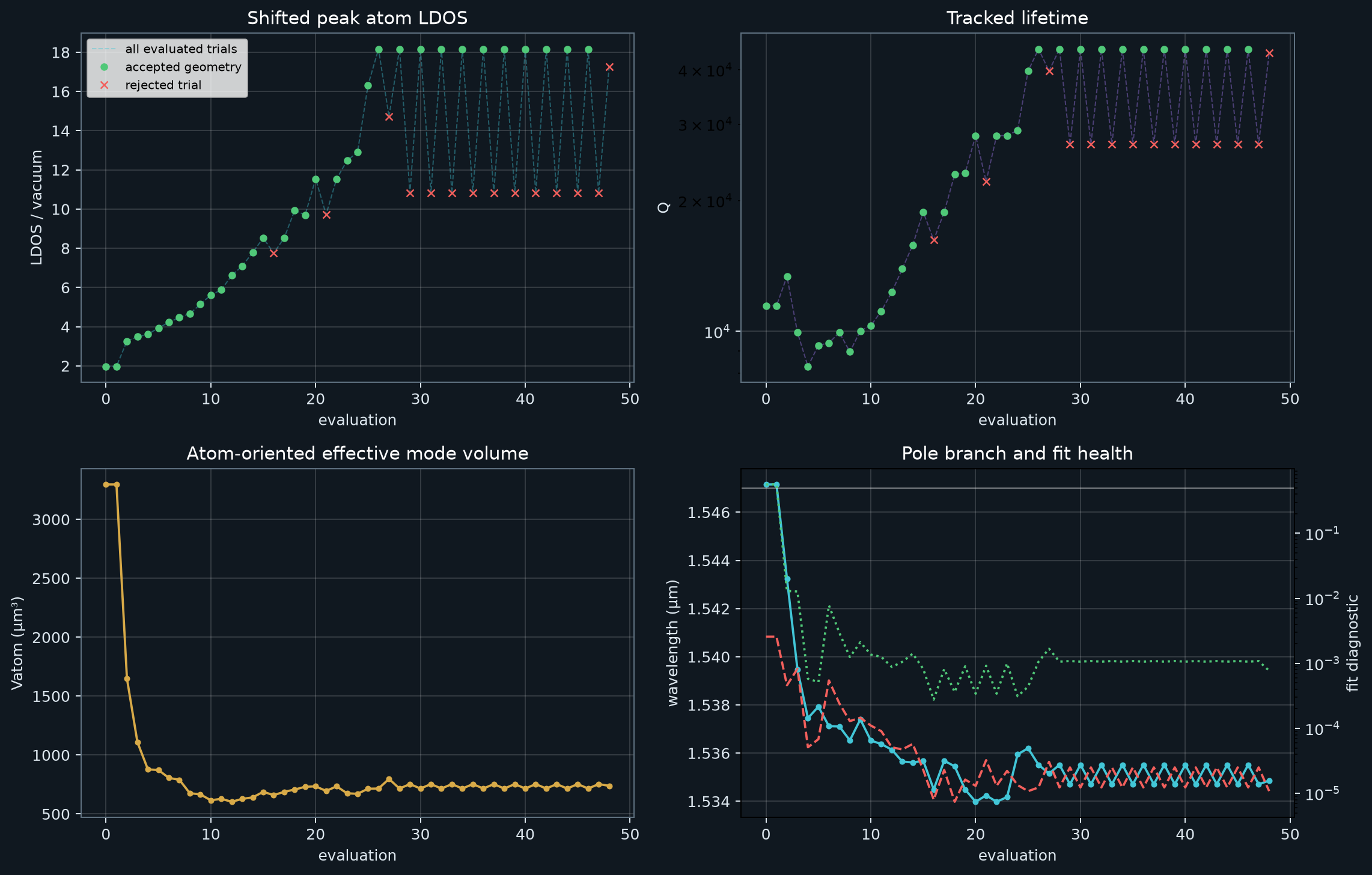
Geometry and fitted metrics are checkpointed atomically after every expensive FDTD evaluation. Green circles are accepted geometries; red crosses are rejected trust-region trials and do not replace the device. The former Q=44,667 / 26,965 alternation was an exact leader/proposal rollback cycle, not pole-fit noise. Half-step backtracking now evaluates a new interior candidate after rejection instead of regenerating the same Adam proposal.#
Fitted quantity |
Latest trial |
Trusted geometry |
|---|---|---|
Shifted peak LDOS / vacuum |
17.253 |
18.166 |
Resonant Purcell contribution |
16.253 |
17.166 |
Conservative Q |
43705 |
44667 |
Atom-oriented mode volume |
738.88 µm³ |
715.89 µm³ |
Pole wavelength |
1.5349 µm |
1.5355 µm |
Atom detuning |
0.7911% |
0.7478% |
Pole-fit residual / consistency |
1.0855e-05 / 0.0007691 |
1.2359e-05 / 0.0010612 |
“Shifted peak LDOS” is the differentiable fitted-pole estimate
evaluated at the real part of the tracked pole. It is not silently labeled as fixed-frequency atomic LDOS; the pole detuning is displayed separately. The implementation is the time-domain analogue of the frequency-shifting strategy of Shaker et al., with a 3% branch window, fit-health gates, and automatic fallback to coherent pole acquisition.
Latest electric field#
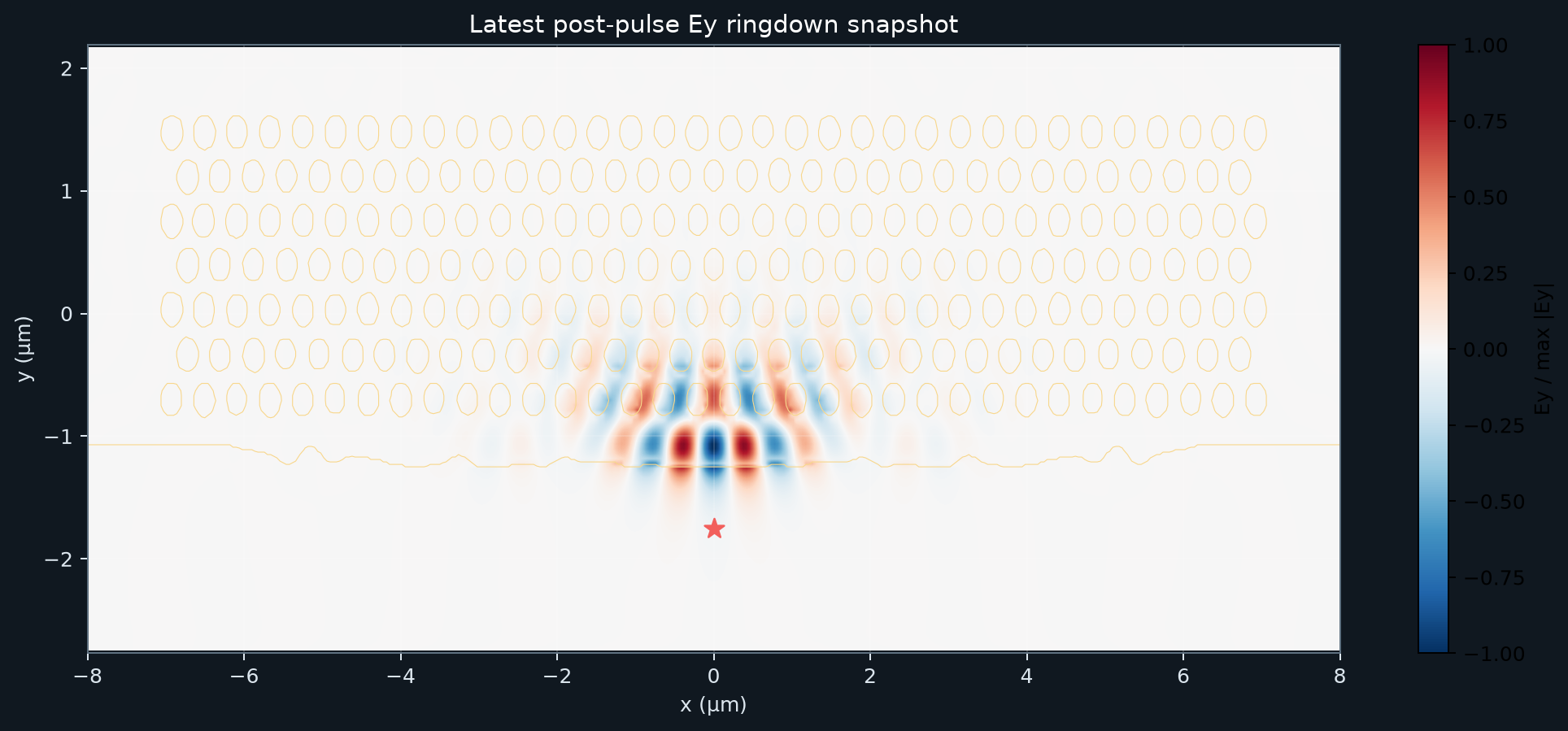
Post-pulse Ey snapshot from evaluation 26; refreshed every 5 evaluations.#
The live field is diagnostic. Final claims require a fresh 20 nm, 8 ps ringdown plus independent energy/flux-Q agreement and matched-vacuum LDOS. The optimizer grid is 40 nm because the reverse solve is automatically kept inside the 12 GiB GPU; analytic subpixel boundaries still move continuously.