
Materials and dispersion#
The simplest FDTDX material is isotropic, nondispersive, and lossless. The validated model extends through conductivity, Lorentz/Drude/CCPR poles, diagonal anisotropy, fully rotated complex tensors, and spatially oriented crystals.
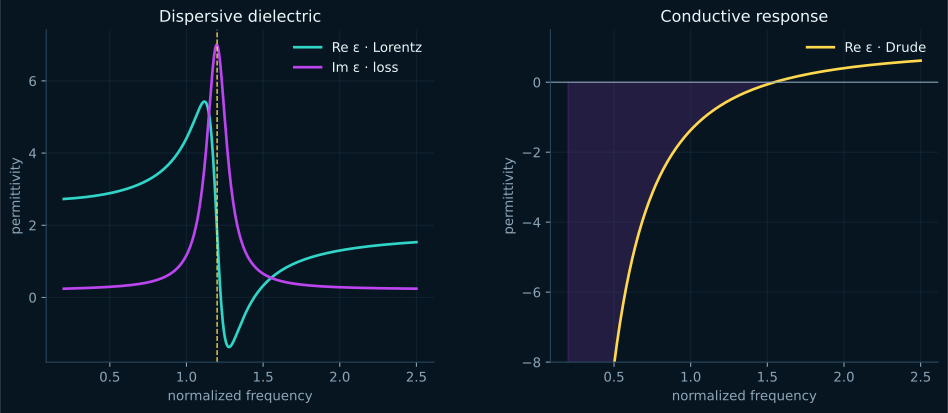
Auxiliary differential equations convert frequency-dependent constitutive laws into local time-domain updates.#
Nondispersive media#
Material(permittivity=...) accepts scalar and tensor-compatible representations. FDTDX applies inverse permittivity at staggered electric-field locations. Magnetic response follows the analogous inverse-permeability path.
Loss#
Electric or magnetic conductivity adds dissipative current. For a good conductor, fields decay over the skin depth
The suite checks both analytical skin depth and a lossy-slab attenuation comparison.
Dispersive poles#
Lorentz, Drude, and complex-conjugate pole-residue models represent common optical fits. Their internal polarization/current states are stepped alongside the fields. Stability requires a time step compatible with both wave propagation and the fastest material pole.
Tensors and orientation#
Anisotropy means \(\mathbf D=\boldsymbol\varepsilon\mathbf E\) couples components. Rotating a principal-axis tensor introduces off-diagonal terms, which must survive voxelization and the time update. Separate validations cover uniaxial birefringence, per-polarization Fresnel behavior, tilted dispersion, and a rotated lossy complex tensor.
Geometry interfaces#
Binary voxelization creates first-order staircasing at curved and oblique surfaces. ExtrudedPolygon can use subpixel smoothing based on fill fractions; this materially improves the ring-resonator comparison. Smoothing changes the discrete model, so use the same policy in convergence studies and optimization.