
4-pair Bragg stack R/T spectrum vs Tidy3D#
validated · 2026-08-28
This case compares a local FDTDX result with pinned reference data generated by Tidy3D. The originating Tidy3D example is BraggGratings.ipynb, pinned at commit c37c785d52e9.
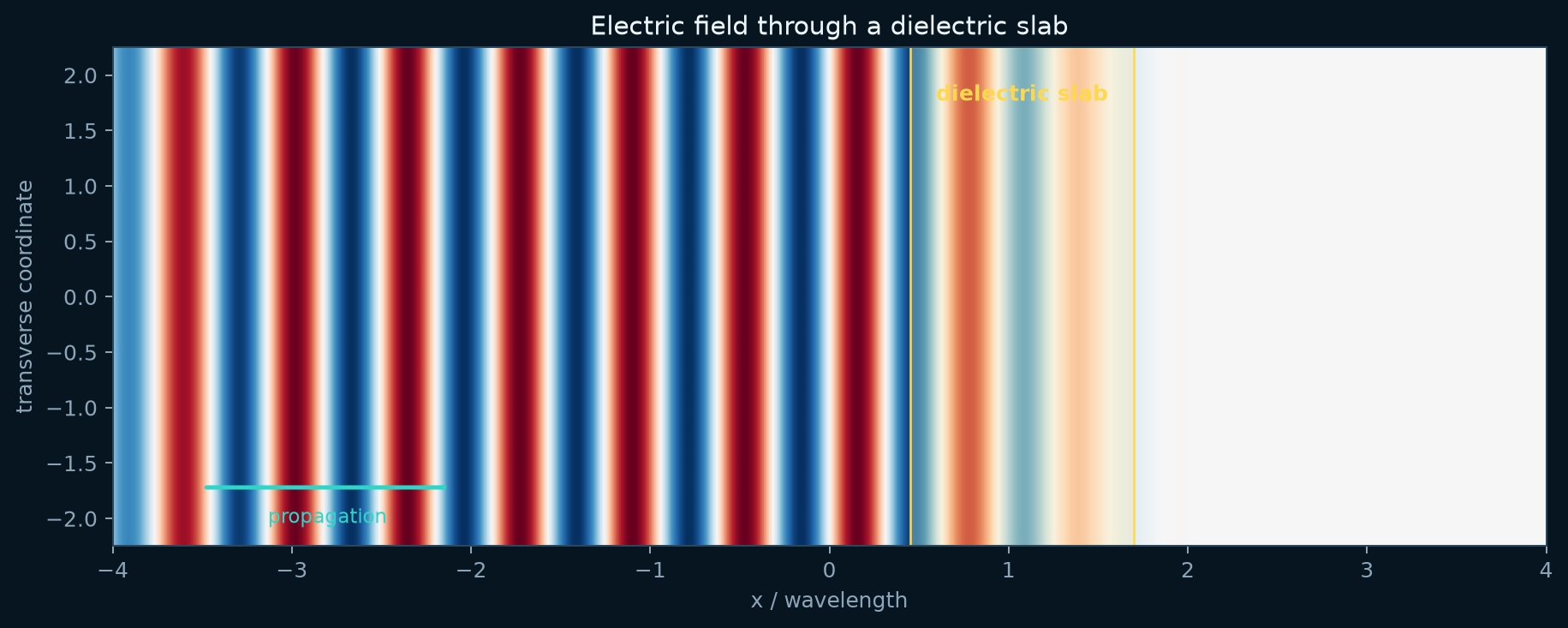
Representative field across a layered material geometry.#
What is exercised#
4-pair quarter-wave Bragg stack, n1=1.5 / n2=2.0, d1=1/(4n1) um, d2=1/(4n2) um, probed at 0.85/1.0/1.15 um. Method: CW Poynting T=S_T/S0 (lossless), R=1-T, transmission-side flux only (avoids vacuum standing-wave E×H bias). Grid spacing r=d2/6 chosen so both layers are exact quarter-wave cells (d1=8r, d2=6r, n1d1=n2d2=250 nm).
This case runs at its declared full benchmark resolution (resolution factor 1.0).
Recorded result#
Metric |
Observed / error |
Reference / limit |
Error |
Effective budget |
Result |
|---|---|---|---|---|---|
|
0.0230984 |
0.05 |
0.0230984 |
0.05 |
PASS |
|
0.0160291 |
0.03 |
0.0160291 |
0.03 |
PASS |
|
0.0274701 |
0.05 |
0.0274701 |
0.05 |
PASS |
|
0.0160291 |
0.03 |
0.0160291 |
0.03 |
PASS |
The table is rendered from progress.json; it is not a hand-written success claim. For metrics that report an error directly, the “observed” column repeats that error and the reference column is the acceptance threshold.
Reproduce#
uv run fdtdx-bench run --case parity_bragg_stack
Implementation and provenance: benchmarks/cases/parity_bragg_stack/case.yaml, benchmarks/cases/parity_bragg_stack/run.py, benchmarks/goldens/parity_bragg_stack.npz.