
Zhang et al. semi-2D PhC cavity#
This page reproduces the unloaded cavity in Zhang et al., Scientific Reports 6, 26038 (2016) and asks a new cavity-QED question: what LDOS does an atom see at the top edge of the now-removed coupling waveguide?
Answer
For a y-polarized atom exactly 500 nm below the cavity edge, with the bus waveguide absent, the resonant LDOS is 82.04× vacuum. This consists of a broadband continuum of 1.02× plus a cavity-mode contribution of 81.02×.
Polarization convention
The paper designs and plots the TE Ey cavity mode, so the cavity-enhanced number below is the Ey-projected LDOS. At the x=0, z=0 symmetry point, the Ex and Ez components of this fundamental mode vanish by parity; an out-of-plane Ez transition therefore does not receive this resonant Purcell term.
Literal geometry#
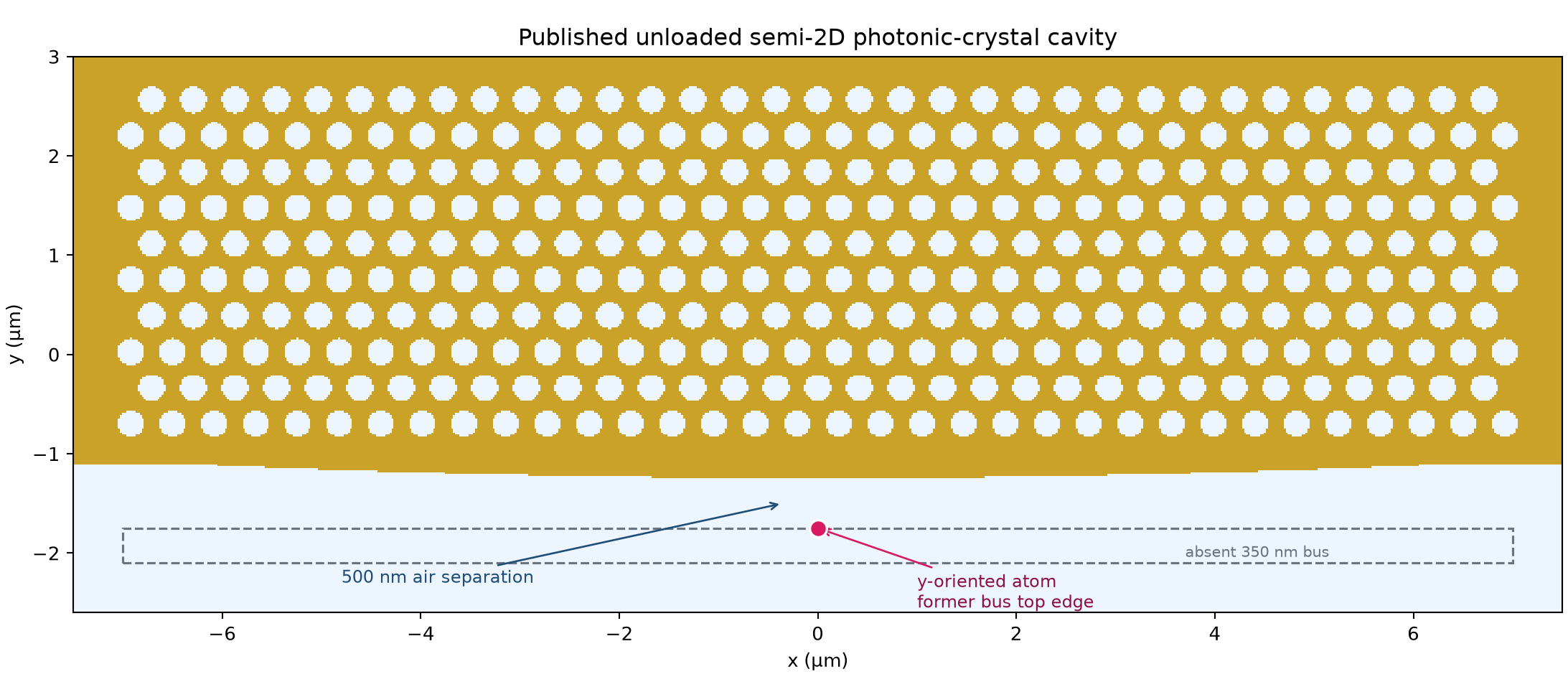
Gold is the 220 nm suspended silicon membrane, pale blue is air, and every hole is part of the actual rasterized FDTD mask. The dashed bus is only a positional reference and is absent from the solve.#
Published input |
Value used |
|---|---|
Silicon slab |
220 nm, n=3.46 |
Triangular-lattice period / radius |
420 / 134 nm |
Rows / rasterized holes |
10 / 335 |
Center → outer edge width |
550 → 400 nm, quadratic |
Taper / total length |
31a / 33a |
Paper fundamental |
1547 nm, Q=6.7e+07 |
Bus-waveguide gap used only for atom position |
500 nm |
FDTDX grid / symmetry |
20 nm conformal fractional-cell / x-PMC and z-PMC |
Results#
Quantity |
FDTDX result |
|---|---|
Resonance wavelength |
1.540689 µm |
Ringdown Q |
6.3655e+05 |
Energy/flux Q |
7.6424e+05 |
Conservative Q used |
6.3655e+05 |
Emitter-oriented mode volume |
2183.4 µm³ |
Continuum Ey LDOS |
1.0201× vacuum |
Resonant modal Purcell term |
81.022× vacuum |
Total resonant Ey LDOS |
82.042× vacuum |
Paper-Q projection (not an FDTDX measurement) |
8528.9× vacuum |
Raw finite-8 ps value at the pole |
1.7255× vacuum |
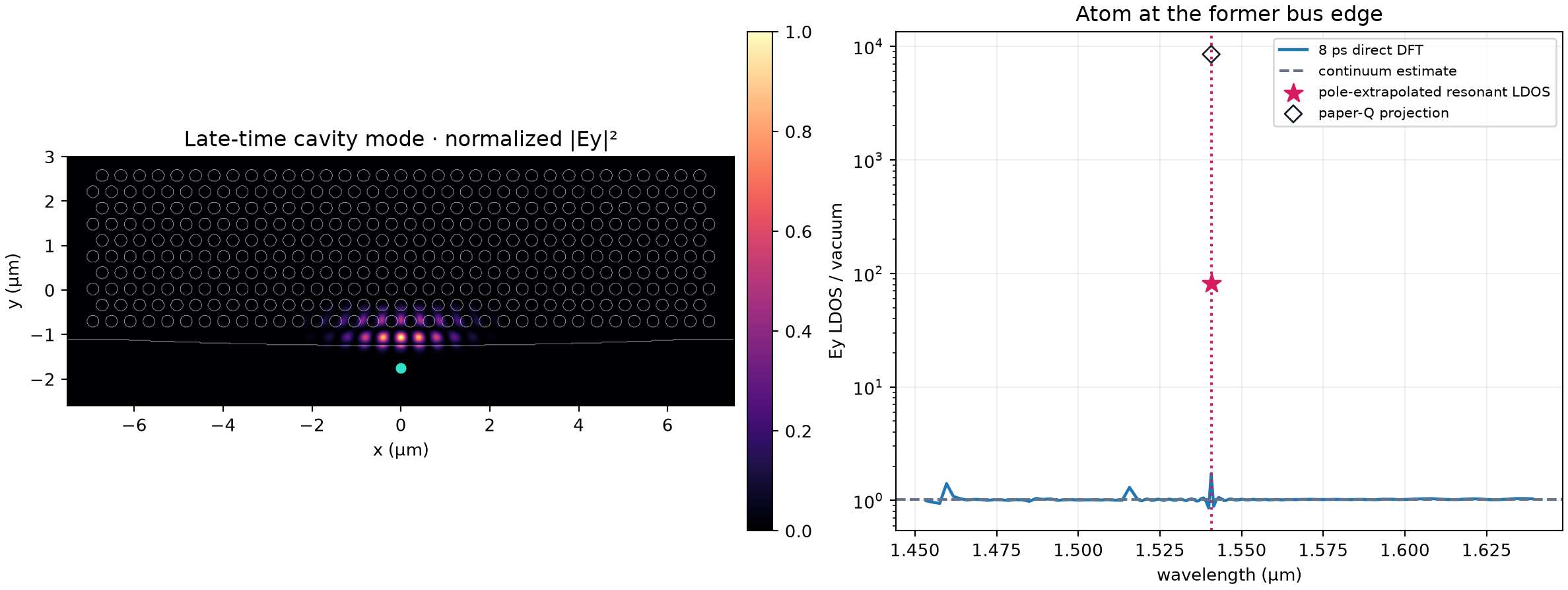
The geometry contour and late-time Ey mode (left); direct finite-tape LDOS and pole-extrapolated resonant value (right).#
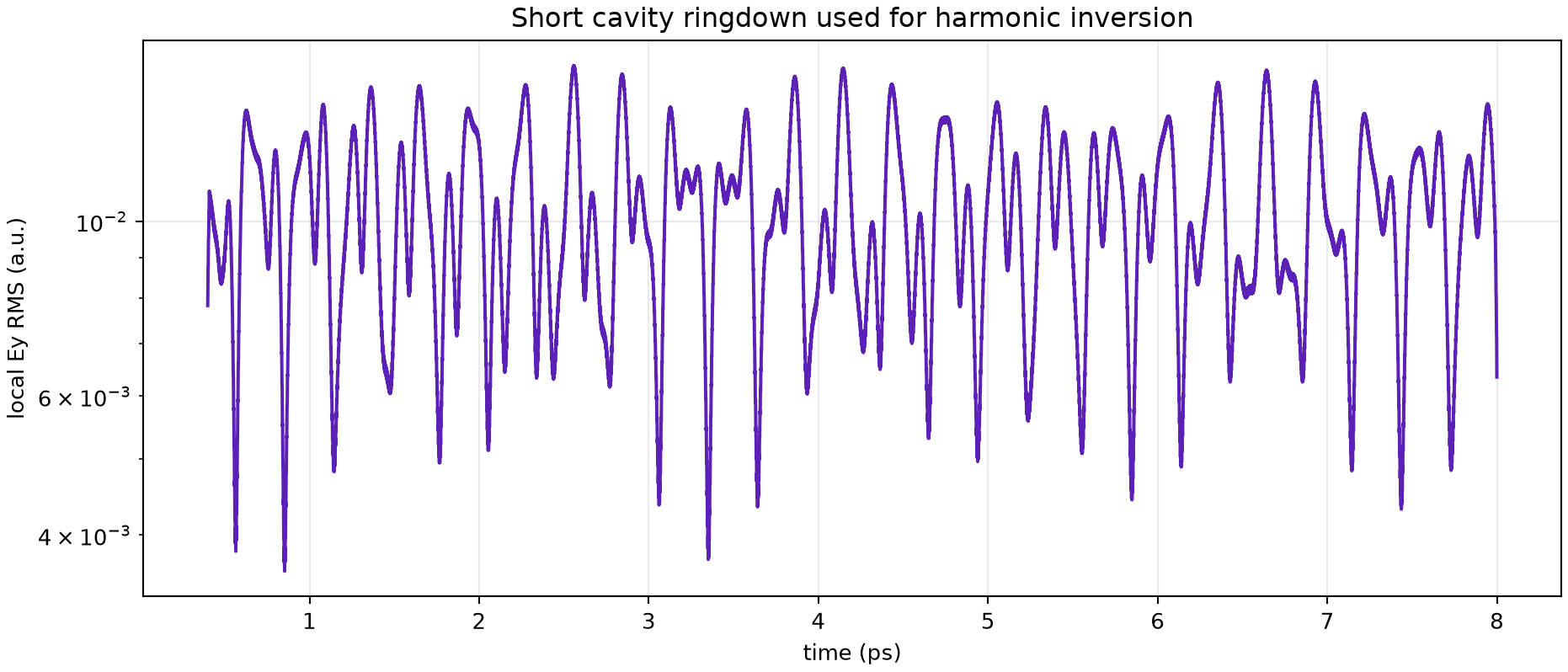
The short ringdown is fitted in the time domain; the reported ultra-narrow pole is not claimed from the spacing of frequency samples.#
Why the raw 8 ps DFT is not the answer#
The paper’s ideal linewidth is only about 23 femtometres. An 8 ps Fourier tape cannot resolve that linewidth, so its peak height is a transient lower bound. The reported resonant LDOS instead uses the fitted pole and the late-time emitter-oriented mode volume,
[ F_{\mathrm{cav}} = \frac{3}{4\pi^2}\frac{\lambda^3 Q}{V_{\mathrm{eff},y}}, ]
then adds the independently measured off-resonant continuum. The Q audit uses
both harmonic inversion and the modal energy-to-radiated-power ratio. The
paper-Q projection answers the separate counterfactual “what if this exact
remote field profile retained the article’s 6.7e7 Q?”; it is labeled and never
substituted for the FDTDX-measured result. The
complete arrays and metrics are stored in
benchmarks/artifacts/paper_semi2d_phc_cavity_ldos_v1.npz.
Reproduce#
.venv/bin/python -m benchmarks.cases.paper_semi2d_phc_cavity.run
.venv/bin/python scripts/generate_paper_semi2d_report.py