
Binary atom-gap antenna coupled to a feedthrough waveguide#
validated · 2026-08-28
This case checks optimization performance: the best objective reached, not geometry identity or convergence speed.
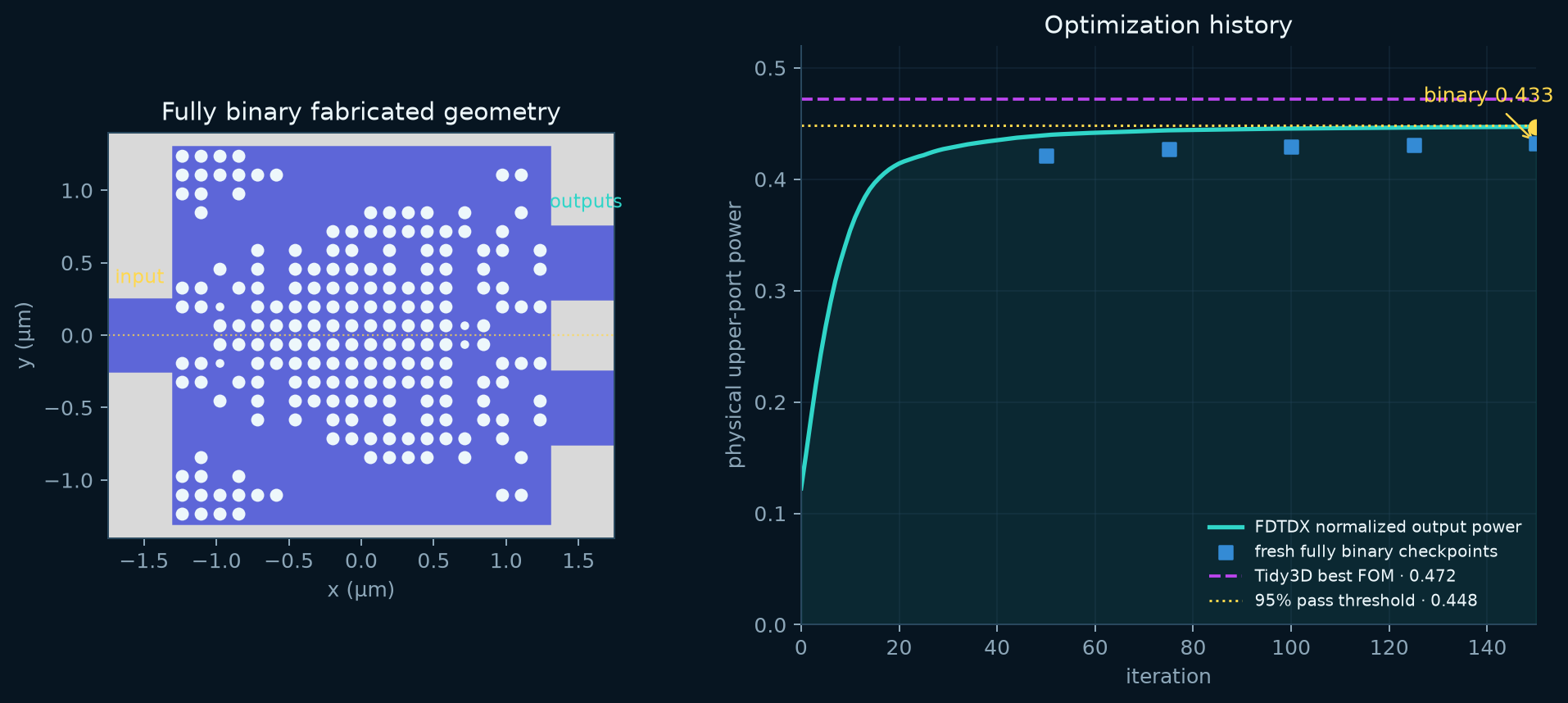
Differentiable inverse-design result and convergence history.#
What is exercised#
Stage one is deliberately ordinary density topology optimization. It starts from a generic nearly uniform control field, maximizes the actual waveguide branching ratio, follows a fixed projection schedule, and ends with an exact binary straight-through mask. No cavity or optimized geometry is used as a warm start. Equal left/right emission is imposed by x symmetry, so a total guided beta of 0.90 means 0.45 into each physical propagation direction.
This case runs at its declared full benchmark resolution (resolution factor 1.0).
Recorded result#
Metric |
Observed / error |
Reference / limit |
Error |
Effective budget |
Result |
|---|---|---|---|---|---|
|
— |
— |
— |
— |
CHECK |
|
— |
— |
— |
— |
CHECK |
|
— |
— |
— |
— |
CHECK |
The table is rendered from progress.json; it is not a hand-written success claim. For metrics that report an error directly, the “observed” column repeats that error and the reference column is the acceptance threshold.
Reproduce#
uv run fdtdx-bench run --case invdes_scratch_atom_beta
Implementation and provenance: benchmarks/cases/invdes_scratch_atom_beta/case.yaml, benchmarks/cases/invdes_scratch_atom_beta/run.py.