
Frozen 150 nm SiN Fourier-to-pixel atom-hole campaign#
This page preserves the terminal checkpoint selected by the user after the trajectory visibly saturated. It is not overwritten by the successor 200 nm campaign.
Executed configuration#
Quantity |
Value |
|---|---|
Material stack |
150 nm Si3N4 slab in SiO2 |
Atom |
z-oriented, 780.24 nm |
Immutable opening |
1.0 µm-diameter through-slab air hole |
Trainable region |
9.6 µm-diameter extruded 2-D mask |
Grid |
25 nm; slab resolved by 6 cells |
Symmetry |
x/y/z, 8× reduced solve |
Parameters |
40,000 Fourier coefficients → 40,000 pixels |
Terminal update |
1283 |
Fourier-to-pixel handoff |
update 991; executed-density RMSE 0.0 |
Initial / best LDOS |
0.537764 / 0.682342 |
Best literal-binary LDOS |
0.682342 |
The fixed-frequency matched-vacuum LDOS improved by 26.9%. The result remains below vacuum and no trustworthy resonant pole emerged. Forty-seven independent pulsed audits were attempted; none passed all field/energy agreement and window-stability gates. The largest fitted candidate Q was 42.53. At the final checkpoint, field- and energy-decay fits gave Q=38.61 and 172.65 respectively, so the conservative Q was not accepted and shifted optimization correctly remained disabled.
Geometry and material stack#
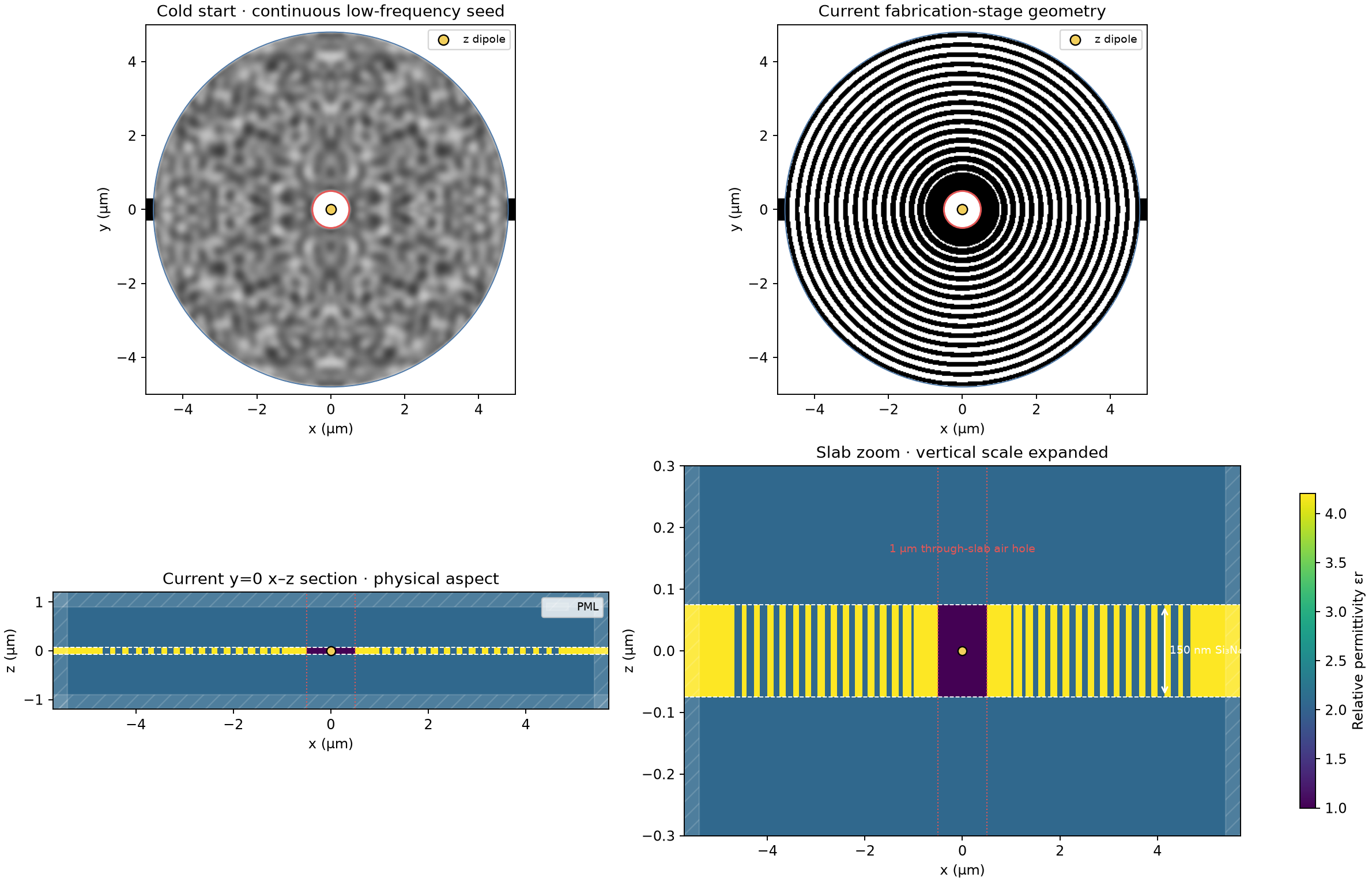
The literal initial and terminal masks and the executed 150 nm xz stack.#
Complete optimization and Q-surveillance history#
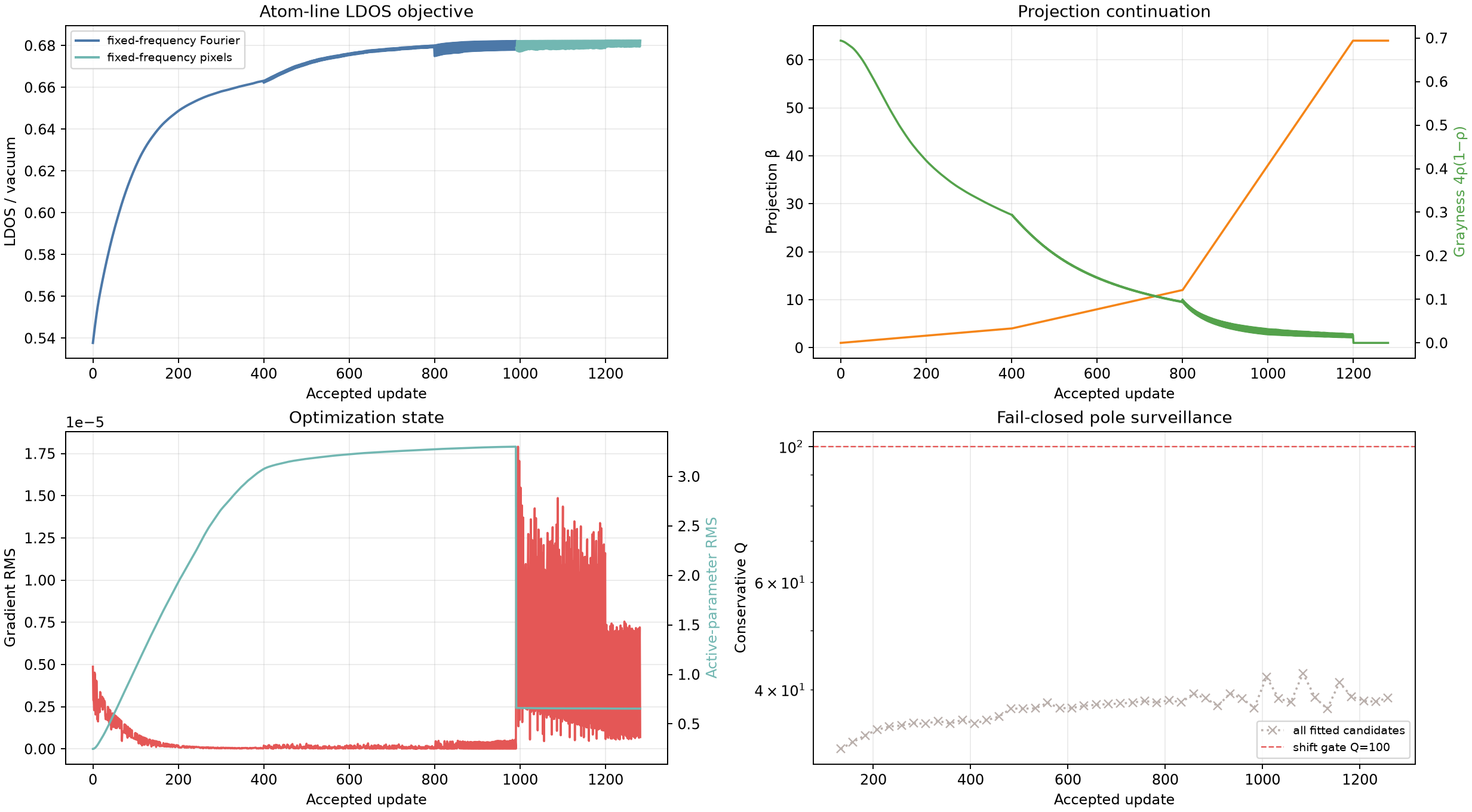
Fourier and pixel stages share one update axis. Candidate pole fits remain visibly separate from trusted fits; no candidate crossed the fail-closed gate.#
Terminal spatial spectrum#
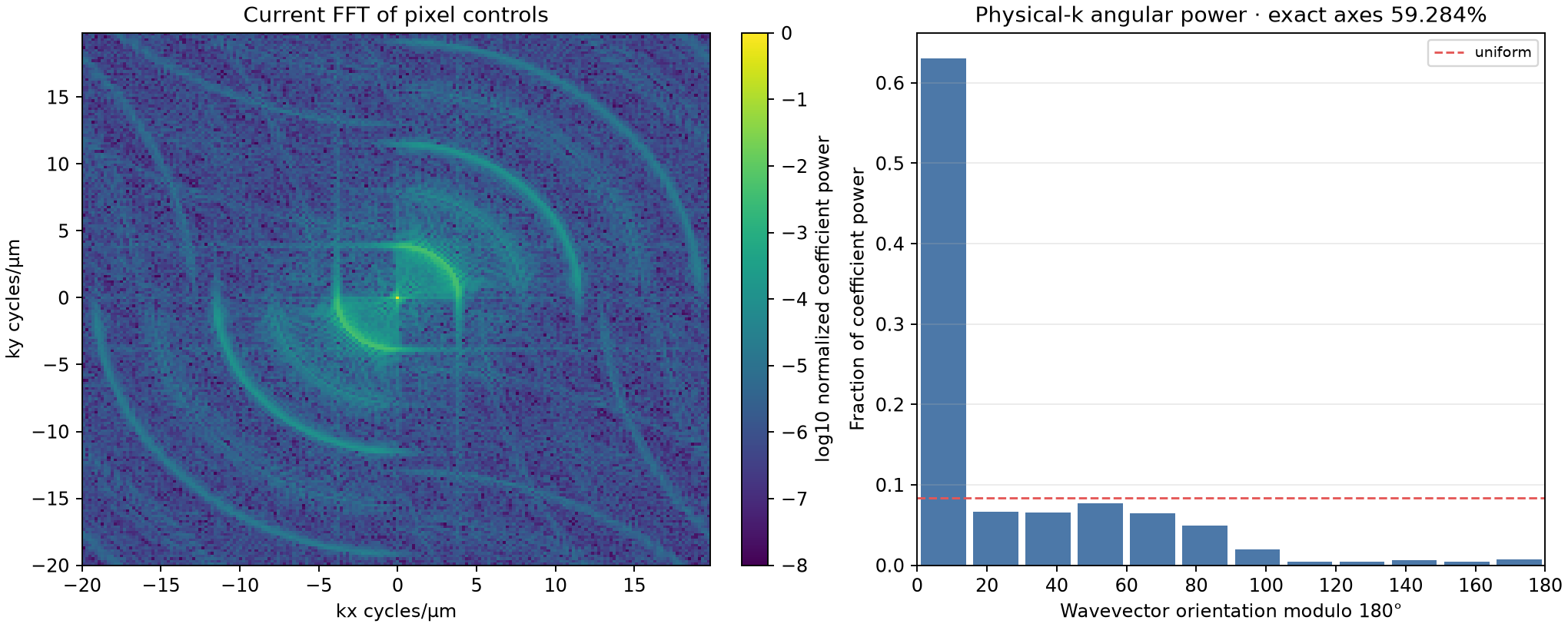
At the terminal pixel stage this is the diagnostic Fourier transform of the pixel controls, not a claim that Fourier coefficients remain active controls.#
Terminal electric field#
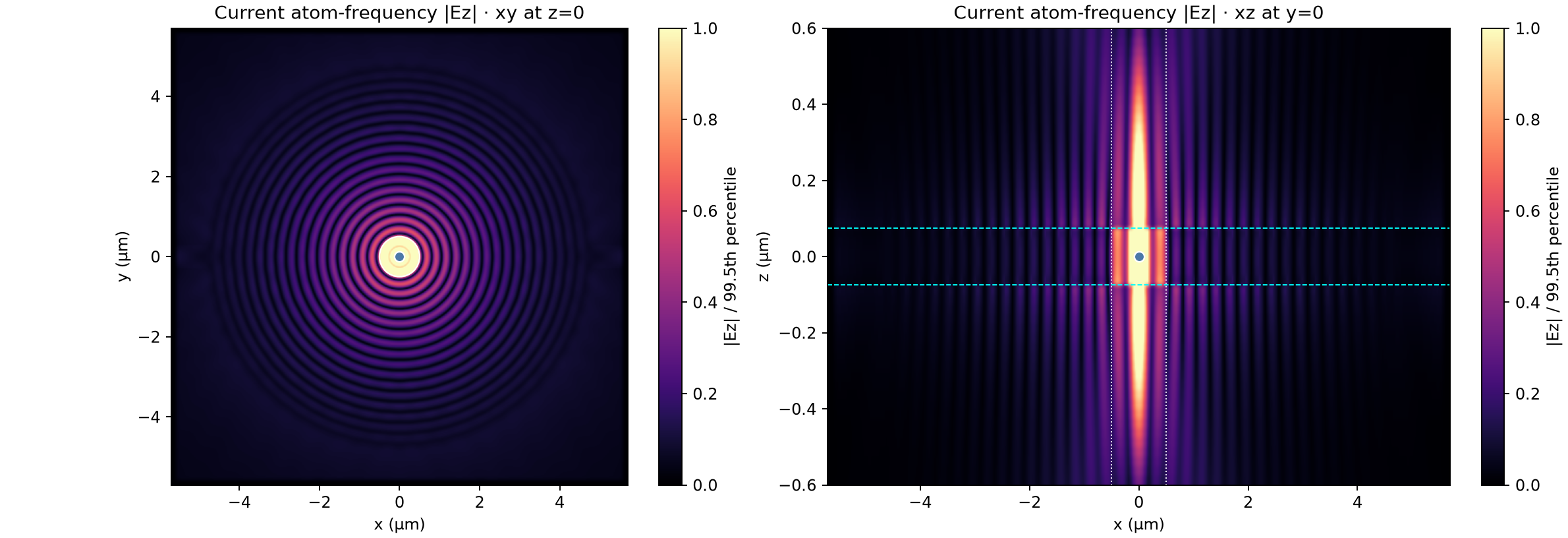
Paired atom-frequency xy and xz phasors from the same executed checkpoint.#
The full resumable artifact is retained locally as
benchmarks/artifacts/invdes_fourier_atom_hole_ldos_sin150_isotropic_v3.npz.