Interfaces, layers, and material models#
Layered media offer exact or semi-analytical answers while exercising almost every material path.
One dielectric interface#
At normal incidence from index \(n_1\) to \(n_2\), power reflectance is
for lossless nonmagnetic media with the appropriate power convention.
uv run fdtdx-bench run --case analytical_dielectric_slab
uv run fdtdx-bench run --case analytical_fresnel_n2
uv run fdtdx-bench run --case parity_fresnel_interface
The upstream-method slab measures \(R=0.04076\) and \(T=0.95924\) against 0.04 and 0.96. The parity case repeats the comparison against a pinned Tidy3D result.
Build a stack#
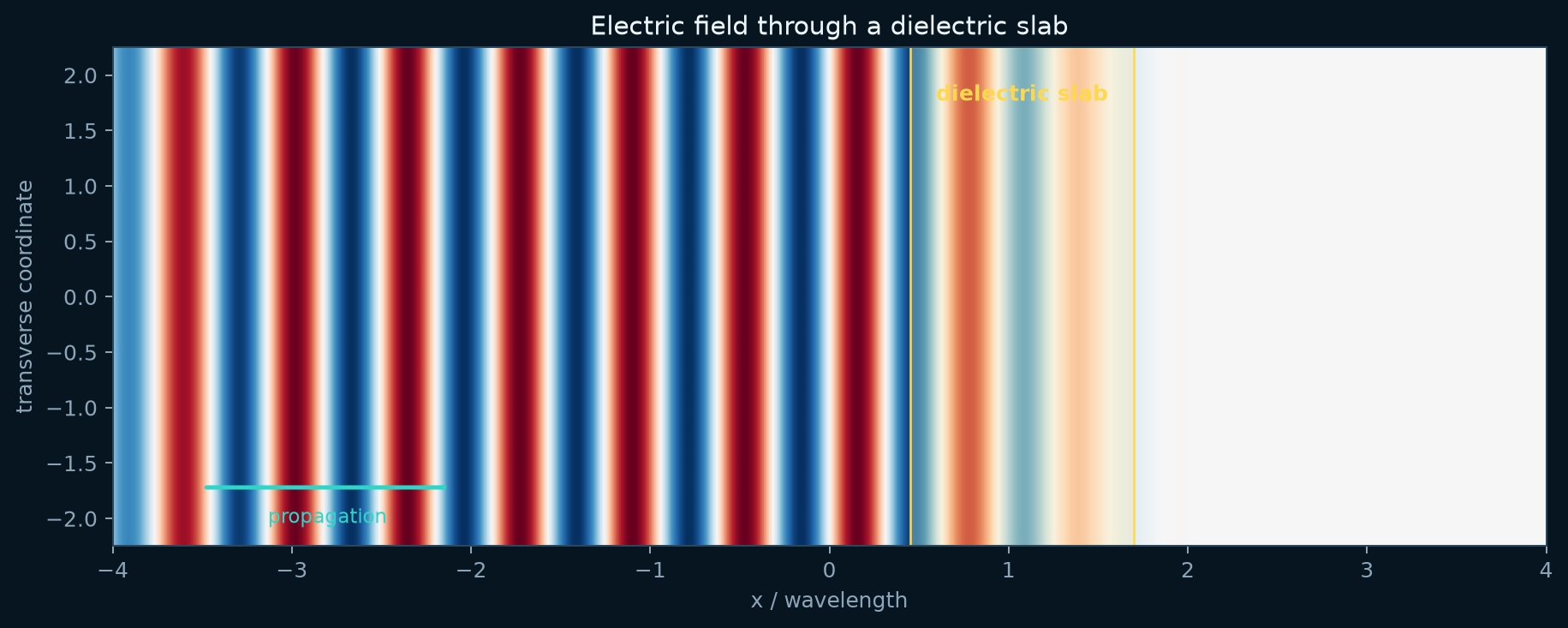
A transfer matrix supplies the independent reference for multiple layers. The Tidy3D parity case then checks the same spectral path against an external solver.
uv run fdtdx-bench run --case analytical_multilayer_tmm
uv run fdtdx-bench run --case parity_multilayer_T
uv run fdtdx-bench run --case parity_bragg_stack
The three-layer Tidy3D comparison records 0.0196 relative-\(L_2\) error and 0.0185 maximum absolute error.
Add conductivity and dispersion#
uv run fdtdx-bench run --case analytical_skin_depth
uv run fdtdx-bench run --case parity_skin_depth
uv run fdtdx-bench run --case parity_metal_reflect
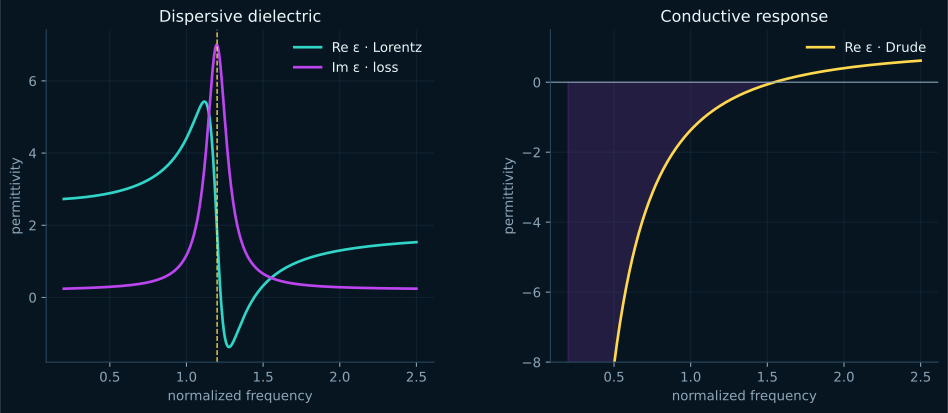
uv run fdtdx-bench run --case analytical_dispersion
uv run fdtdx-bench run --case analytical_dispersive_source
These separate bulk attenuation, interface reflection, auxiliary-pole stepping, impedance, and source correction. A single “metal looks reflective” picture would not distinguish them.
Rotate the tensor#
uv run fdtdx-bench run --case analytical_anisotropic
uv run fdtdx-bench run --case analytical_birefringence
uv run fdtdx-bench run --case analytical_oriented_dispersion
uv run fdtdx-bench run --case analytical_complex_tensor
The final case checks a rotated, lossy uniaxial tensor. It is the strongest guard against accidentally dropping off-diagonal complex terms during material mapping.