
Stopped 200 nm SiN Fourier atom-hole campaign#
This page freezes the 200 nm thickness experiment at the checkpoint selected for replacement by the finite SiO2-clad stack. It remains an exploratory, continuous-density result; it did not run through binarization and is not presented as a finished device.
Executed configuration and outcome#
Quantity |
Value |
|---|---|
Material stack |
200 nm Si3N4 slab in infinite SiO2 |
Atom |
z-oriented, 780.24 nm |
Immutable opening |
1.0 µm-diameter through-slab air hole |
Trainable region |
9.6 µm-diameter extruded 2-D mask |
Grid / symmetry |
25 nm / x-y-z (8× reduced solve) |
Active controls |
40,000 real Fourier coefficients |
Accepted updates |
69 |
Initial / final / best LDOS |
0.517264 / 0.595742 / 0.595742 |
LDOS gain |
15.17% |
Final grayness |
0.6140 |
Final field / energy fitted Q |
34.03 / 65.17, rejected |
The largest apparent conservative Q in three pulsed audits was 174.39, but it failed the field/energy residual and window-stability gates. The optimizer therefore never entered shifted-pole mode. This is the intended fail-closed behavior, not evidence of a Q=174 cavity.
Geometry at the stopping point#
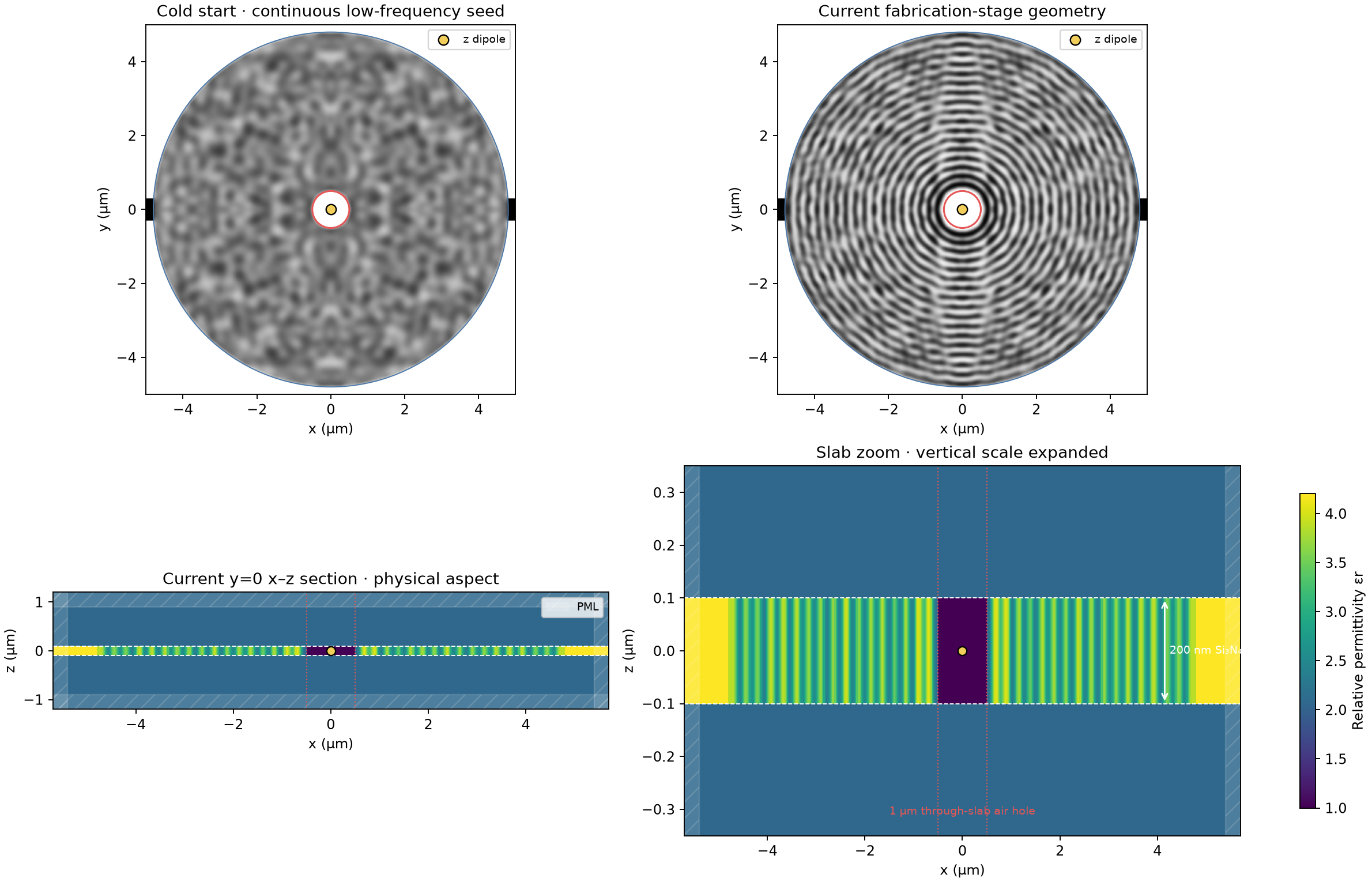
The initial spectral seed, final continuous mask, and literal 200 nm material cross-section at update 69.#
Optimization and pole-audit history#
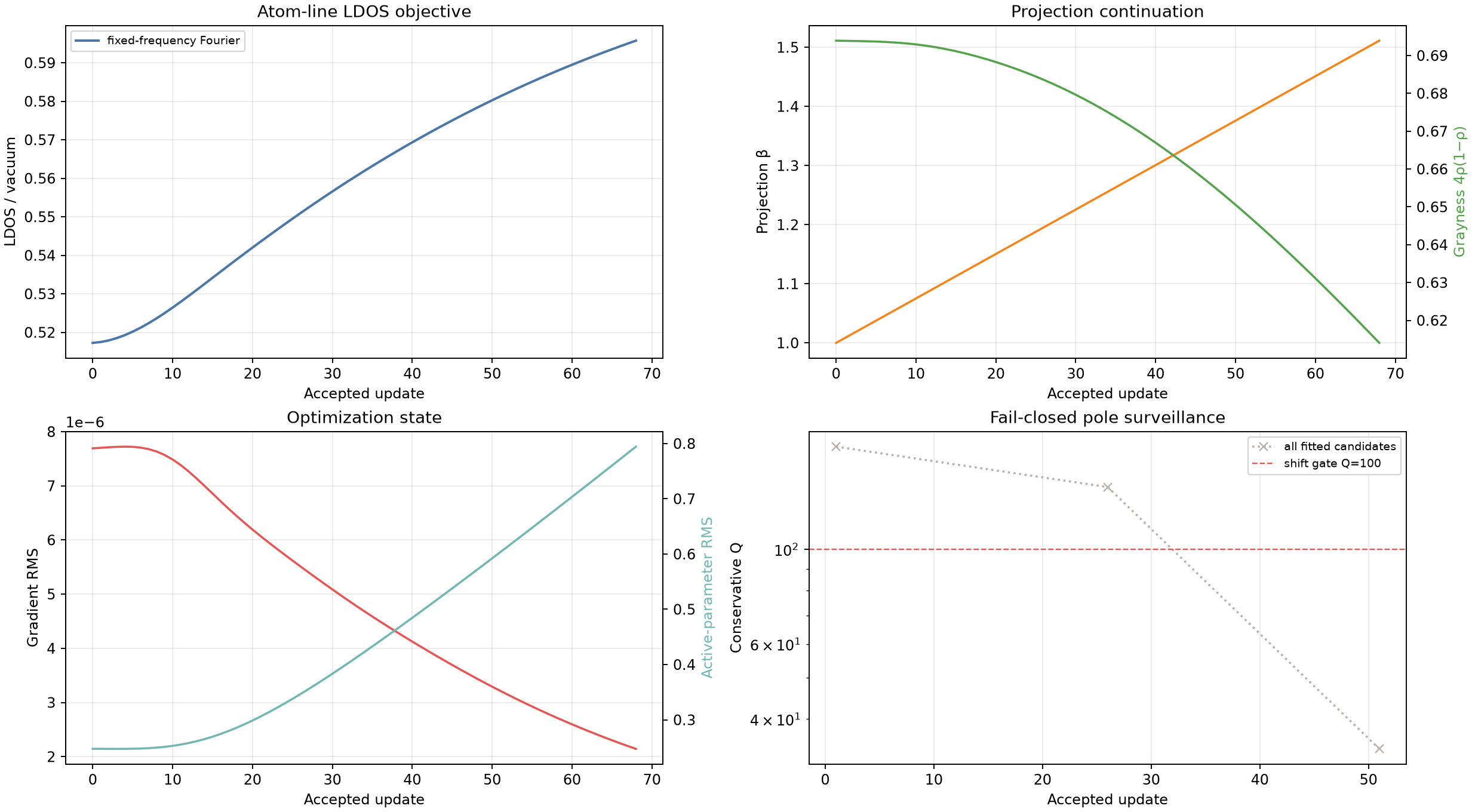
LDOS improved monotonically over the short run. Untrusted Q fits are shown as diagnostics and never used to recenter the objective.#
Spatial spectrum and electric field#
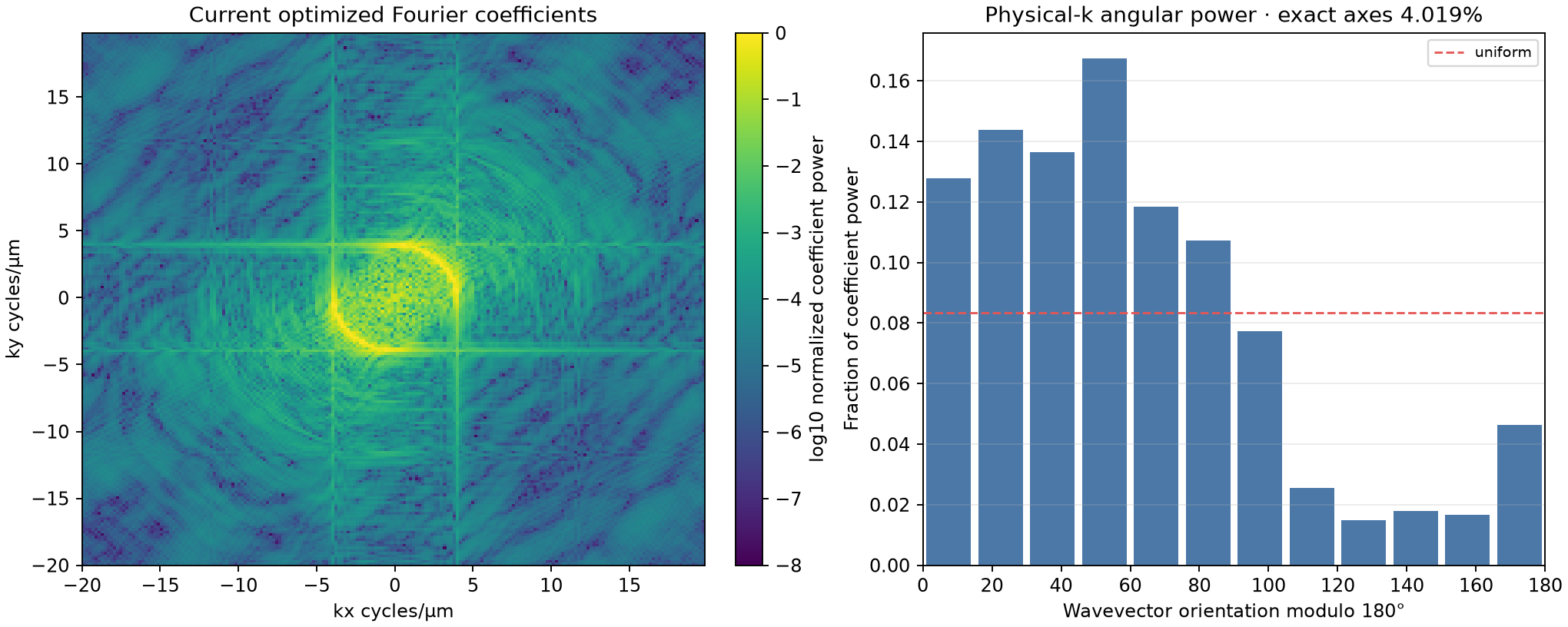
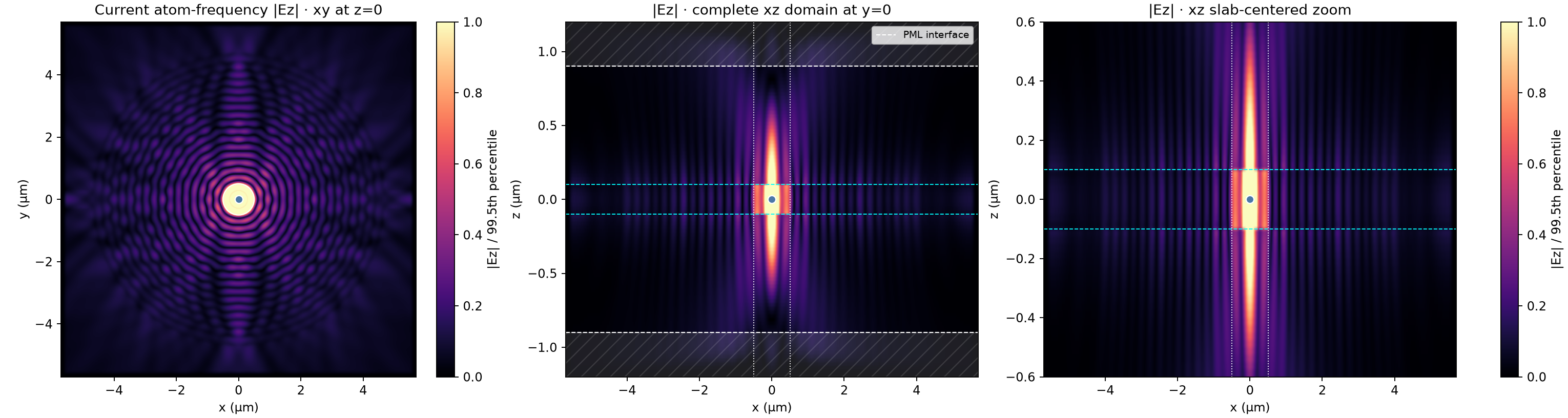
The complete xz panel includes the PML entrances. A stronger validation doubled the physical z interior from 1.8 to 3.6 µm at update 67; LDOS changed only -0.000160% (0.59500849 to 0.59500754). The visible upward and downward field is therefore outgoing radiation rather than a measurable finite-z artifact at this checkpoint.#
The resumable artifact remains at
benchmarks/artifacts/invdes_fourier_atom_hole_ldos_sin200_isotropic_v1.npz.