
Electromagnetics at accelerator speed.
FDTDX is a differentiable finite-difference time-domain solver for photonic simulation and inverse design. This Hood Lab fork develops and tests the solver against analytical physics and pinned Tidy3D reference data.
One computational graph, from fields to designs#
FDTDX expresses geometry, sources, Maxwell time stepping, detector readout, and objectives with JAX arrays. The result is a simulation that can be JIT-compiled onto accelerators and differentiated end-to-end. The Hood Lab fork adds the validation and interoperability needed to use that foundation with confidence.
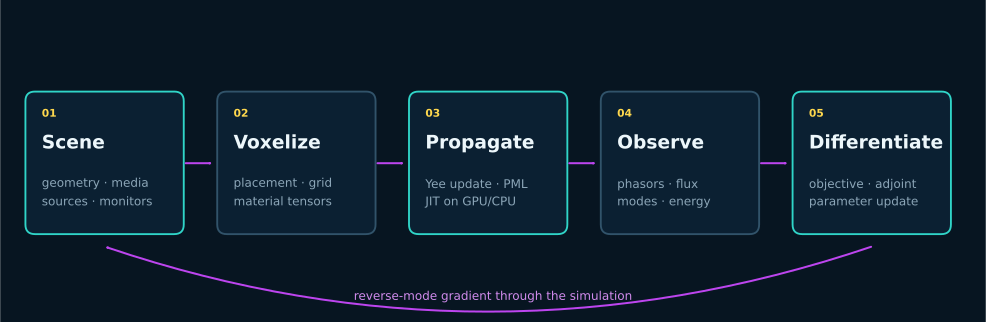
A forward simulation and its reverse-mode gradient share the same JAX-native model.#
JIT compilation, GPU execution, vectorization, and automatic differentiation are part of the numerical model—not wrappers around a separate engine.
Yee-grid electric and magnetic fields, PML and periodic boundaries, dispersive media, anisotropy, phasor monitors, mode sources, and S-parameters.
Optimize material density through a real Maxwell solve. Gradient plumbing is validated; device-level parity is now fail-closed while each reference’s initialization, symmetry, constraints, and FOM are reproduced exactly.
Compose boxes, polygons, cylinders, material tensors, sources, detectors, and boundaries using immutable, transformation-friendly objects.
Every claim here traces to a runnable analytical test or a frozen Tidy3D golden. Coarse-grid comparisons use declared resolution-aware budgets.
MIT-licensed solver code, readable benchmark runners, checked-in compact goldens, and no paid cloud simulation in the test loop.
Choose a path#
Learn the scene → placement → configuration → run pattern with a compact dielectric-scattering example.
Follow Maxwell’s curl equations onto the staggered Yee grid, through boundaries and detector readout.
Work through density filtering, differentiable material maps, objective normalization, and optimization diagnostics.
Browse every currently passing case, exact metrics, implementation paths, and rerun commands. Excluded inverse-design audits remain visible separately.
Compare ten validated forward notebooks, the fitted-Q high-Q cavity optimization, and the fail-closed inverse-design audits with independent forward checks of final binary geometries.
Find every live, paused, stopped, and completed optimization through paired geometry and field thumbnails, then open its full evidence page.
Project identity
FDTDX is the upstream open-source solver created by Yannik Mahlau and collaborators. fdtdx-hoodlab is a research fork that extends and validates it toward Tidy3D-like FDTD coverage. These docs distinguish validated behavior from work still in progress.