
Beta-first atom-gap inverse design#
This is the literal live checkpoint for the simplified first stage: an Ez atom in a hard 1 µm vacuum gap, a 2-D mask extruded through 500 nm silicon, and a fixed 400 nm feedthrough waveguide that continues through both x-PMLs. The three mirror planes reduce the solve to one octant. The physical target is βwg ≥ 90% total, which symmetry divides equally into 45% left and 45% right.
Quantity |
Current value |
|---|---|
Binary coherent-retention updates |
60 / 60 |
Guided branching ratio βwg |
74.78% total (37.39% per port) |
Total normalized LDOS |
1.126 |
Guided normalized LDOS |
0.9173 |
Atom-frequency coherent retention |
0.1039 |
Late-window atom-frequency coherence |
0.4766 |
Gray material fraction |
0.00% |
Projection stage |
7 / 7 |
Campaign phase |
coherent pole acquisition |
Latest audited/ringdown Q |
135.1 |
Latest pole detuning |
3.489% |
Latest pole-fit residual |
15.500% |
Purcell factor |
pending |
Guided Purcell βwg FP |
pending |
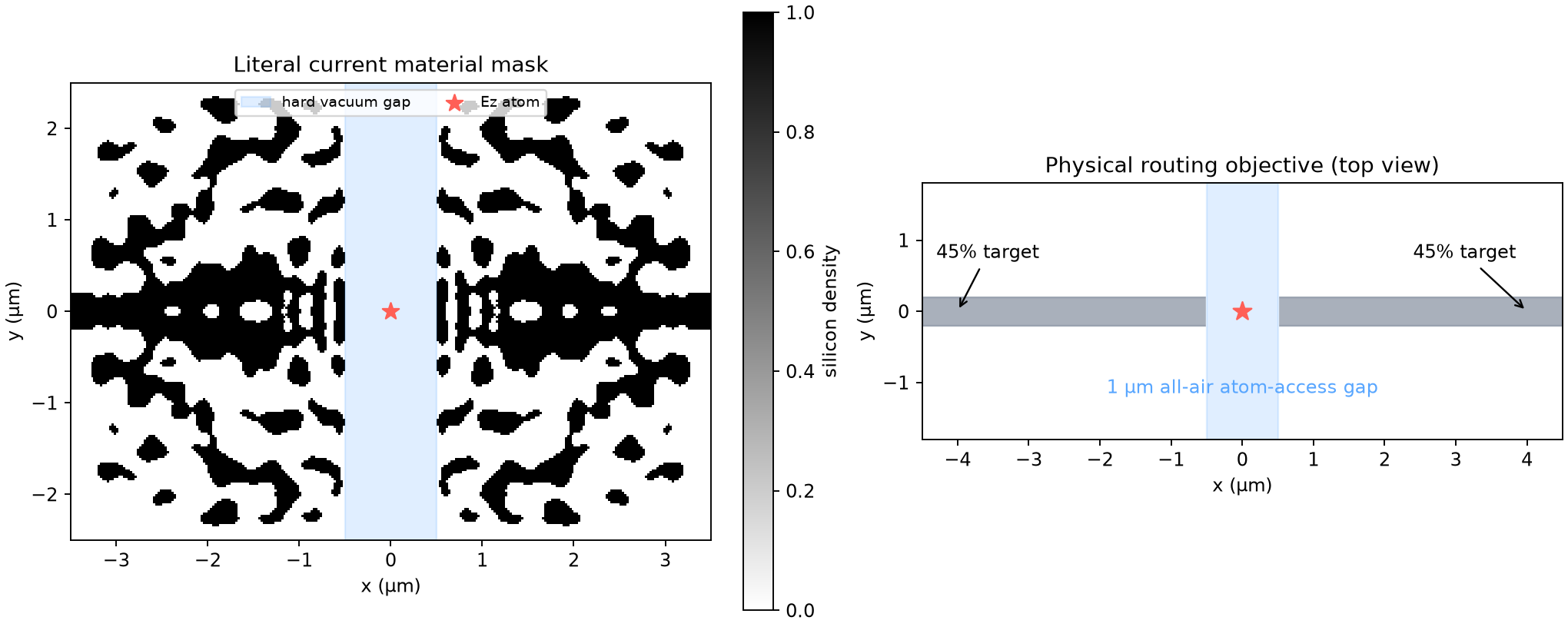
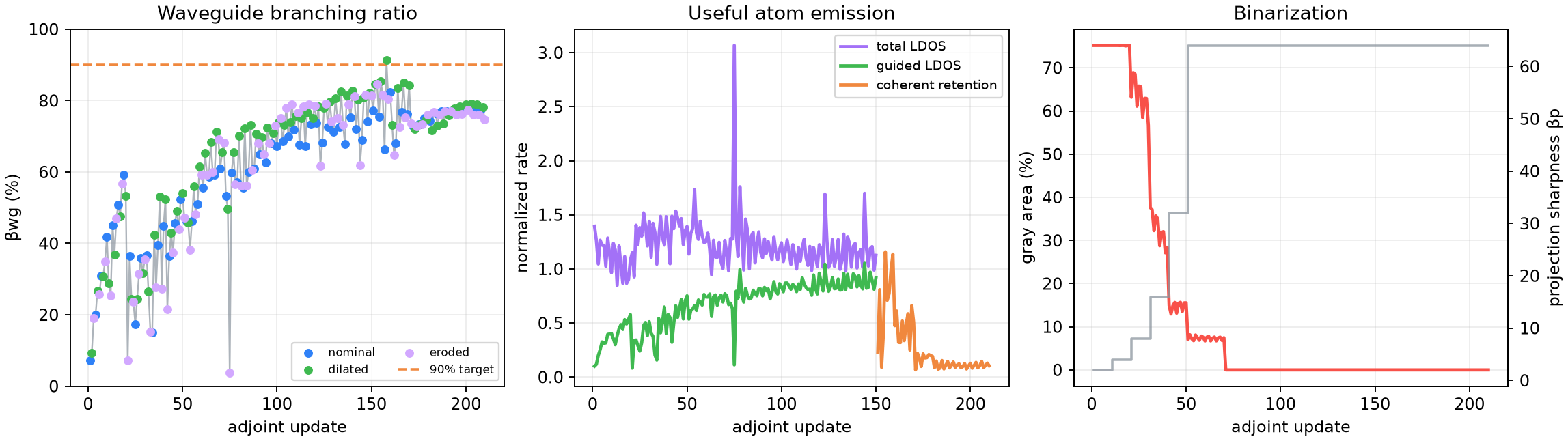
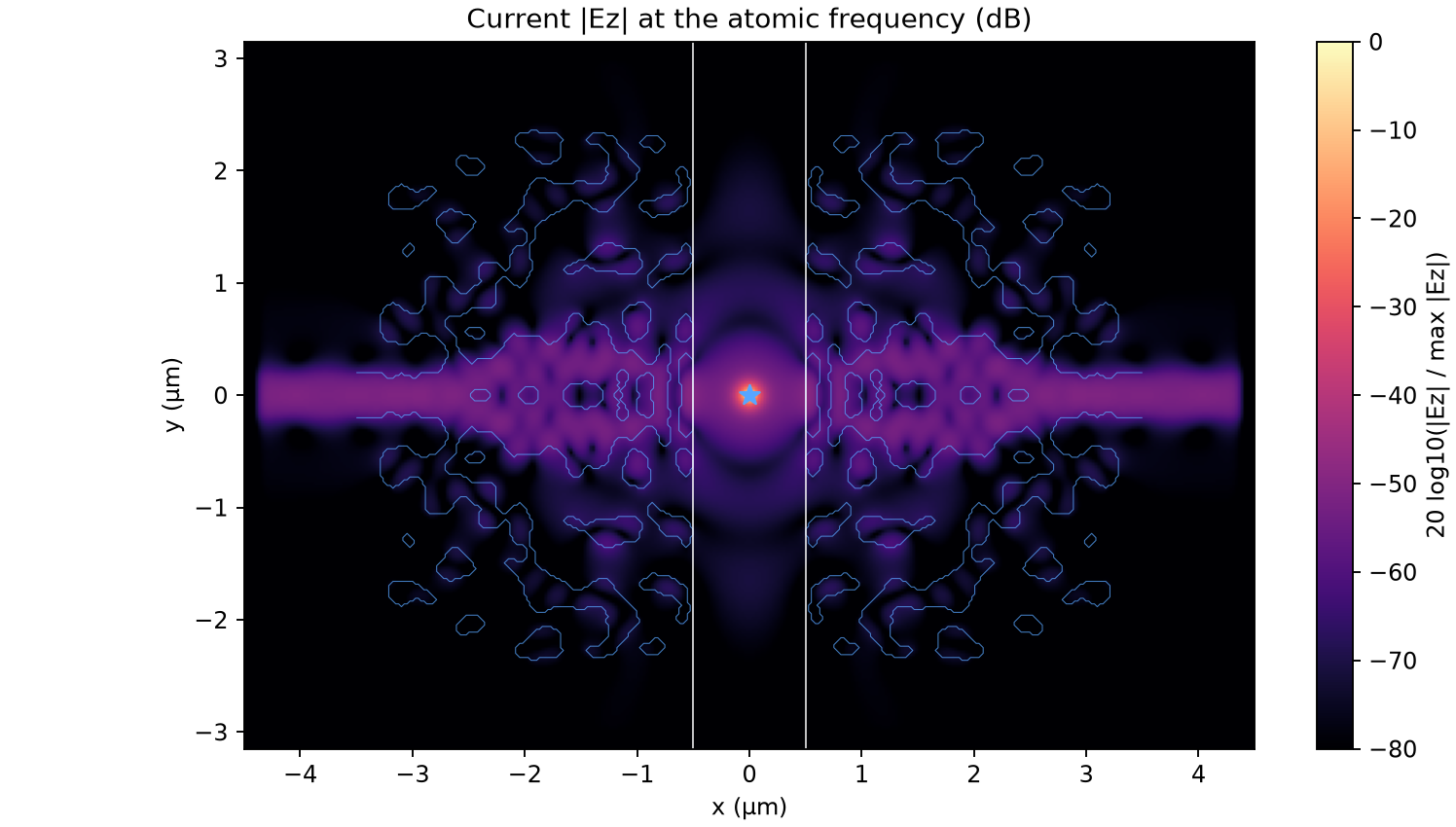
What is being optimized now#
The fixed-frequency LDOS stage produced a broadband router rather than a cavity, so this replacement uses a pulsed solve and coherently demodulates only the atomic frequency. It rewards late atom-field amplitude and retention while constraining exact modal-overlap beta. Every evaluated mask is binary and isolated single-cell solid/void speckle is removed in the physical forward pass. Fitted Q is diagnostic only; a separate 4 ps normalized-LDOS audit must prove a clean Q ≥ 100 pole before shifting. A stricter foundry erosion/dilation audit remains a final acceptance gate rather than being imposed abruptly on this seed.
The state machine is finite: beta binarization → broadband pole audit → binary guided-LDOS acquisition → coherent pole acquisition if the fixed-frequency stage remains broadband → shifted guided-Purcell optimization → independent final validation. A clean pole is required before shifting, and no stage may reintroduce gray material after binarization.