Live curved-mirror cavity sweep#
This is the live evidence page for the fabrication-compatible ((( ))) atom-cavity sweep. Every candidate is a binary 2-D lithographic mask uniformly extruded through one slab, contains the same literal 1 µm all-air gap, uses a z-polarized atom, and is solved in one octant. Refresh for the latest published checkpoint.
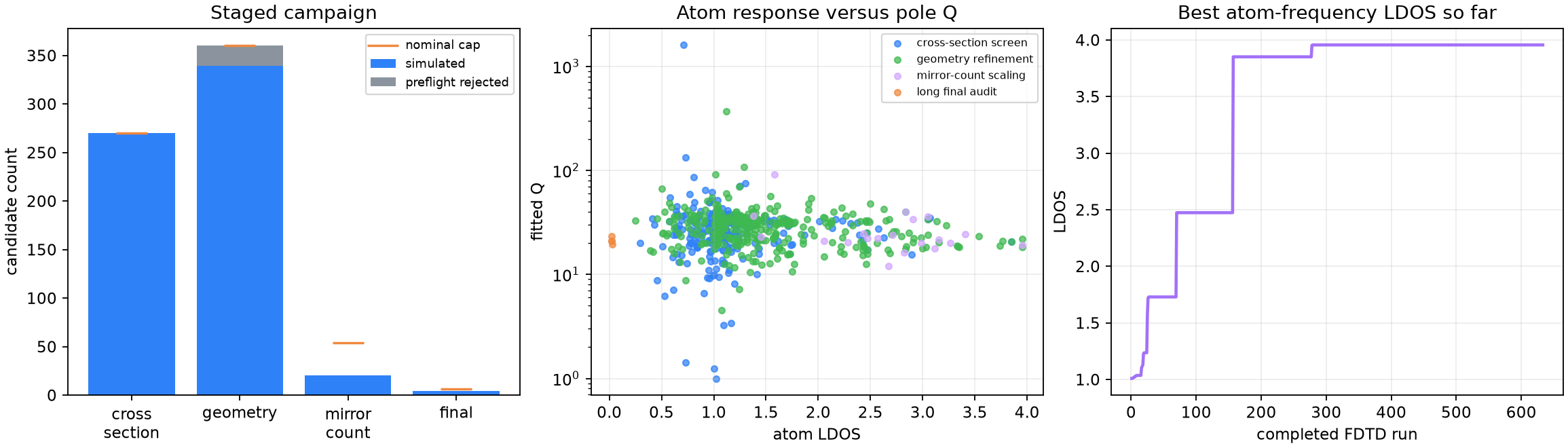
Progress |
Count |
|---|---|
cross-section screens |
270 / 270 |
conditional geometry refinements |
339 / 360 nominal |
mirror-count tests |
20 / 54 nominal |
long Q / field / mode-overlap audits |
4 / 6 |
analytic fabrication rejections |
21 |
all completed FDTD runs |
633 |
current-leader metrics |
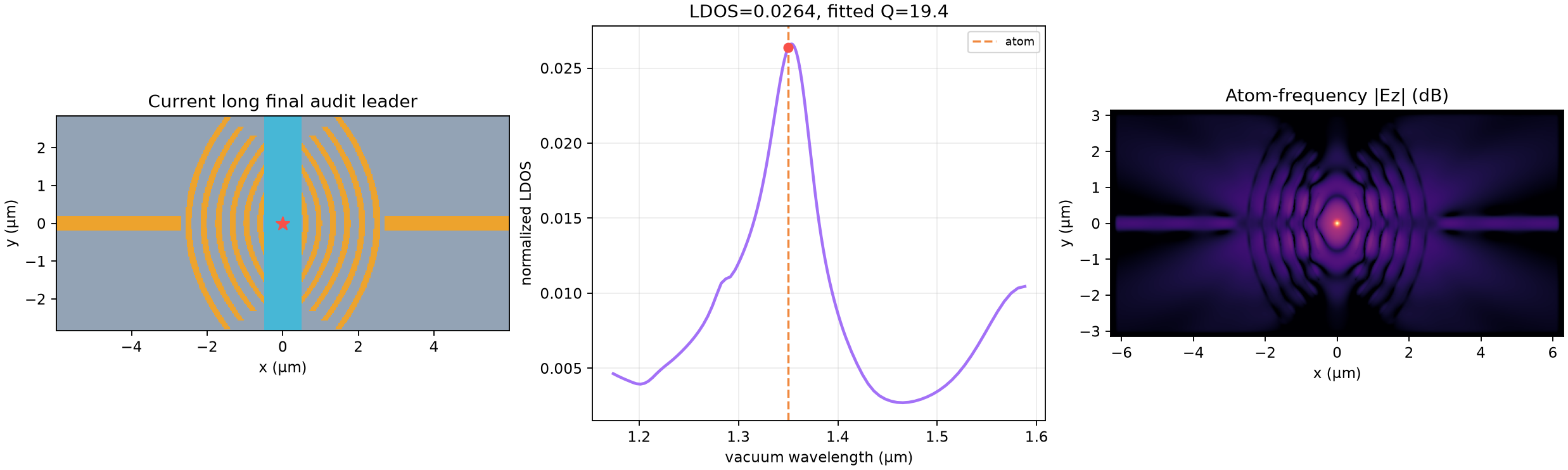
LDOS 0.02636; Q 19.44; detuning 0.04%; βwg 1.35%; guided Purcell 0.0003564 |
Current-leader parameter |
Value |
|---|---|
embedding / material polarity |
n=1.444 / silicon_ribs |
slab thickness |
0.300 µm |
inner → outer period |
0.360 → 0.410 µm |
inner → outer duty |
0.420 → 0.420 |
inner → outer curvature radius |
2.100 → 3.800 µm |
inner → outer aperture |
1.890 → 2.835 µm |
first-front offset / apodization |
0.100 µm / 1.500 |
mirror count / minimum feature |
6 / 0.112 µm |
Exact search space#
The first stage tests six slab thicknesses (150, 200, 250, 300, 400, and 500 nm), three material environments, five inner→outer period bands, and three duty cycles. The material environments are air-clad connected silicon with curved air trenches, SiO₂-embedded isolated silicon ribs, and SiO₂-embedded connected silicon with curved silica trenches. Period bands are 0.29→0.33, 0.32→0.36, 0.36→0.41, 0.41→0.47, and 0.47→0.54 µm; duties are 0.42, 0.50, and 0.58. This gives 270 broad candidates.
For the best member of each of the 18 thickness/environment groups, the second stage tests 20 variants: the baseline; four curvature scales (0.70×, 0.85×, 1.25×, 1.60×); four aperture scales (0.75×, 0.90×, 1.15×, 1.35×); first-front offsets of 0.04, 0.18, and 0.28 µm; apodization exponents 0.65, 1.0, 2.25, and 3.5; period scales of 0.95× and 1.05×; and two opposite ±0.06 inner/outer duty chirps. The third stage checks 6, 8, and 10 mirror fronts. A conservative curved-surface-normal feature calculation rejects anything below 0.10 µm before it reaches FDTD.
Short stages rank clean near-atom poles by exact atom-frequency LDOS, detuning, peak LDOS, spectral contrast, Q, and vertical radiation. Final 7 ps audits add the fundamental feedthrough-mode overlap, total β, guided Purcell, full LDOS spectrum, radiation by face, literal geometry, and Ez field. The 12-hour deadline reserves the last 1.5 hours for those long audits, so conditional caps need not all be exhausted.