Nested source-equilibrated midpoint-guide cavity campaign#
Live optimizer
This inert successor equilibrates a fixed-norm freeform source before every gentle dielectric proposal, re-equilibrates it at the proposal before committing material, and starts a 1 µm-wide density region from a midpoint-permittivity waveguide before a deliberately slow beta continuation and smooth spline-boundary handoff.
State |
Value |
|---|---|
Status |
|
Source |
|
Source spatial profile |
|
Source spatial profile trainable |
|
Active source degrees of freedom |
2700 |
Source coordinate shape |
|
Ex / Ey / Ez coordinate norms |
|
Source current norm ratio |
1 |
Source/reference overlap |
0.98556 |
Source angular trust radius |
8.958e-05 rad |
Detector / target trainable |
|
Temporal observable |
|
Phase |
|
Active coordinates |
|
Completed updates |
170 |
Temporal objective |
-0.95304 |
Whole-trace fixed-waveform fidelity |
0.51202 |
Source-off fixed-waveform fidelity |
0.51138 |
Fixed target source-off power (telemetry) |
0.49996 |
Fixed-target gain (ideal = 1) |
0.023844 |
Fixed-target normalized MSE |
0.95304 |
Normalized temporal residual |
0.97624 |
Full-field coherence |
0.99999 |
Shifted stationarity |
0.87539 |
Q telemetry |
433.94 |
Normalized V telemetry |
0.025308 |
Active pole tape |
0.65 ps |
Maxwell-step reduction vs 2 ps |
3.08× |
Material continuation stage |
|
Projection beta / eta |
59.22 / 0.50 |
Bulk gray fraction |
2.12% |
Initial guide density |
0.5 |
Initial guide permittivity |
3.0804 |
Design width in y |
1 µm |
Material optimizer |
|
Material coordinates |
|
Material trust radius |
0.00362 maximum density change |
L-BFGS memory pairs |
8 |
Forward-only rejected-step retries |
0 |
Source gradient transform |
|
Source L-BFGS memory pairs |
6 |
Active nested block |
|
Nested Maxwell turns |
1142 |
Accepted material commits |
170 |
Active source inner turn |
7 |
Last source move accepted |
True |
Last source exact / predicted gain |
1.1921e-07 / 6.3209e-08 |
Material commit rule |
|
Source projected 10 mrad gain |
8.4675e-06 |
Material trust ceiling |
0.017171 maximum density change |
Uncommitted material candidate active |
False |
Continuation clock |
|
Boundary handoff |
|
Stable binary-topology states |
0 / 3 |
Boundary trust radius |
inactive until spline handoff |
Last candidate accepted |
True |
Last pole trustworthy |
True |
Latest update wall time |
59.59 s |
Last artifact write |
2026-08-29 11:51:38 UTC |
The authoritative state is
benchmarks/artifacts/invdes_fryett_modal_temporal_modal_current_nested_midindex_v4.npz. The active fixed-source modal checkpoint is a separate preserved artifact; preparing this successor neither seeds from nor modifies it.
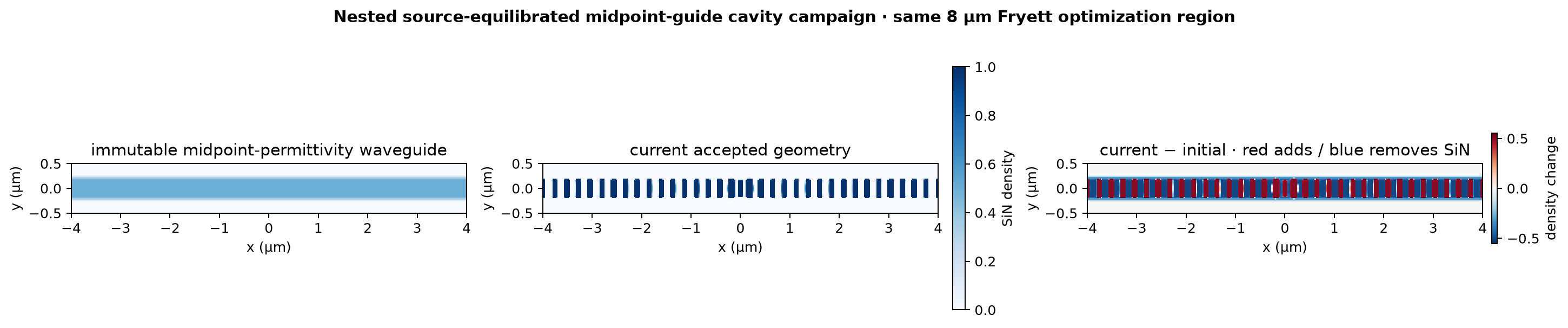
Geometry and exact material difference#
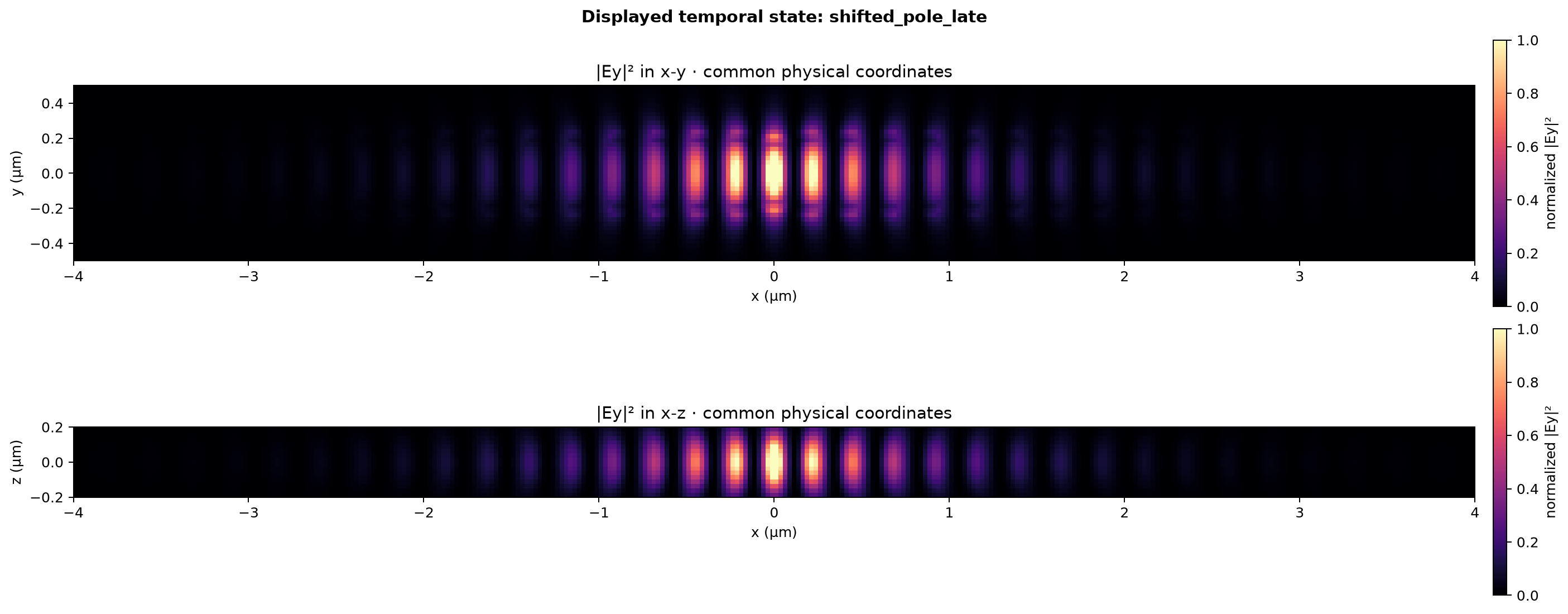
Field used by the temporal objective#
Exact temporal target response#
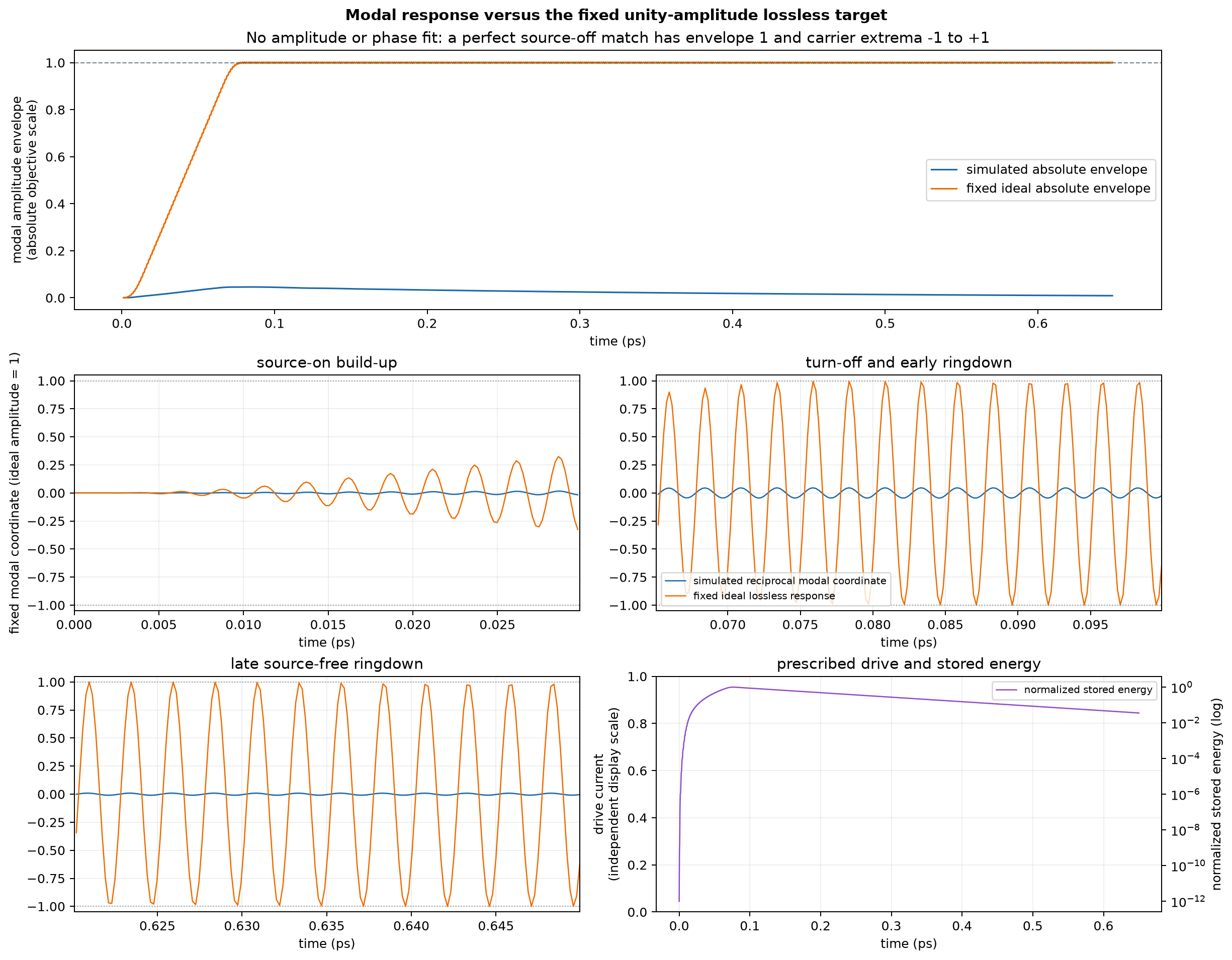
The orange curve is the fixed causal convolution of the prescribed current waveform with the cosine Green function of one lossless pole. It is not the source waveform and is not fitted to the simulation. During the drive it contains the exact causal build-up; after turn-off its extrema are exactly -1 and +1. The blue simulation is plotted in those same absolute objective units, so a smaller blue envelope is a real amplitude error, not a display normalization. The current waveform appears only in the diagnostic panel on its own explicitly independent display scale. The former blue background bands were 4D field-snapshot windows; they were never objective weights and have been removed from this plot to make the absolute comparison unambiguous. Every temporal sample still enters the single normalized mean-square error equally.
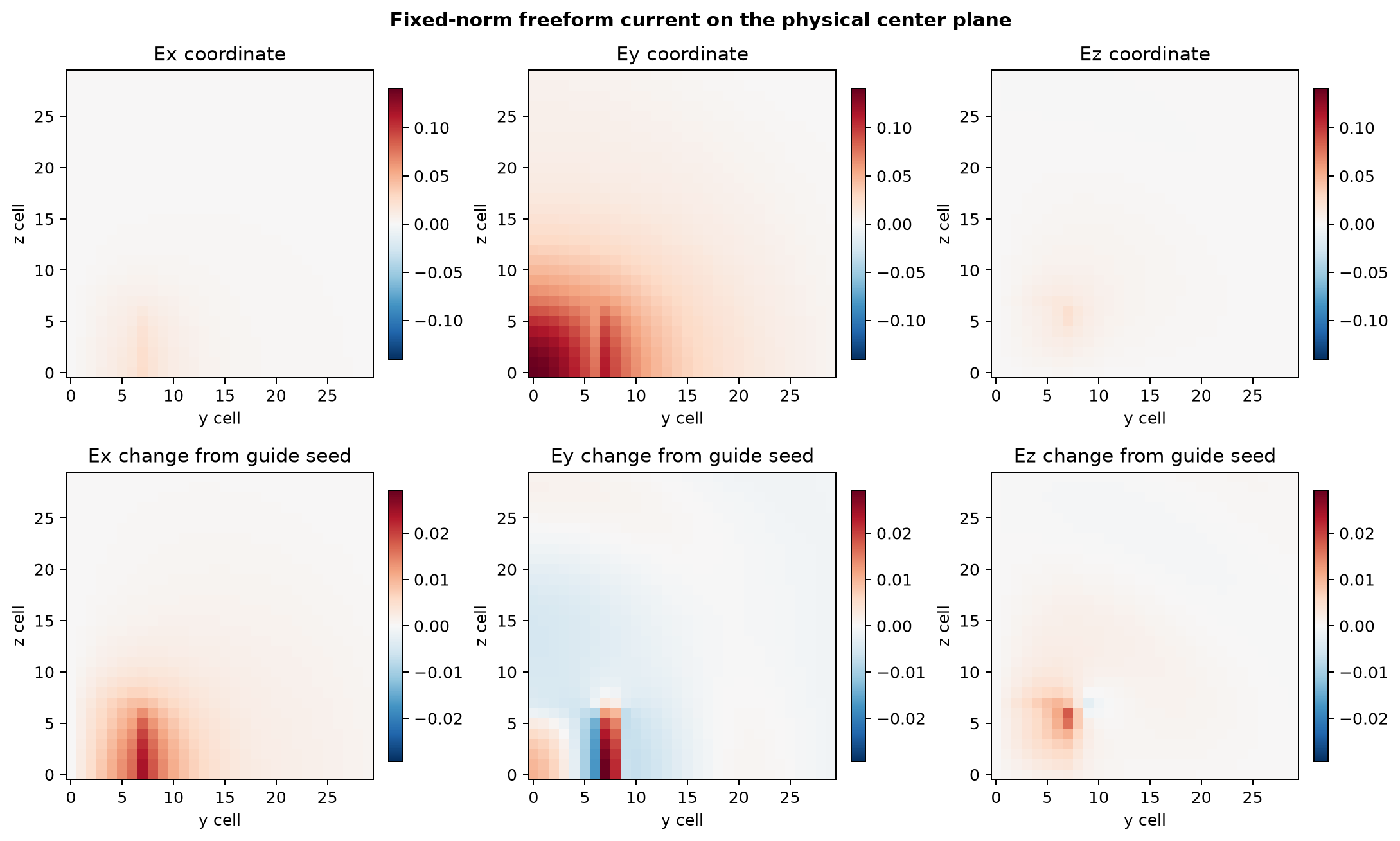
Evolving freeform source profile#
Live nested-source progress#
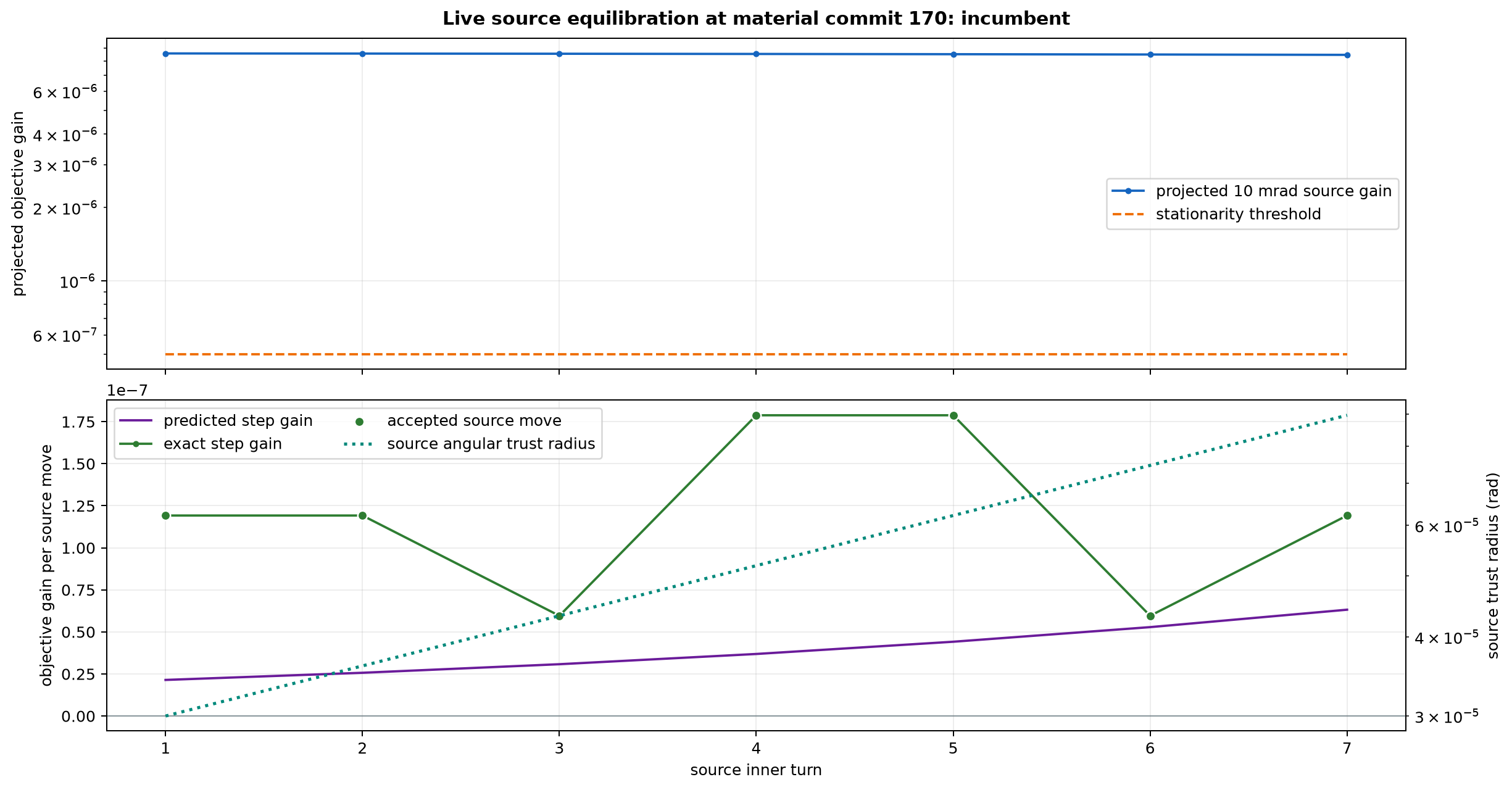
The accepted-material and Q plots keep the same x coordinate while the inner source problem is being solved. This panel advances on every source forward/adjoint turn, so accepted source motion is visible before the next material commit.
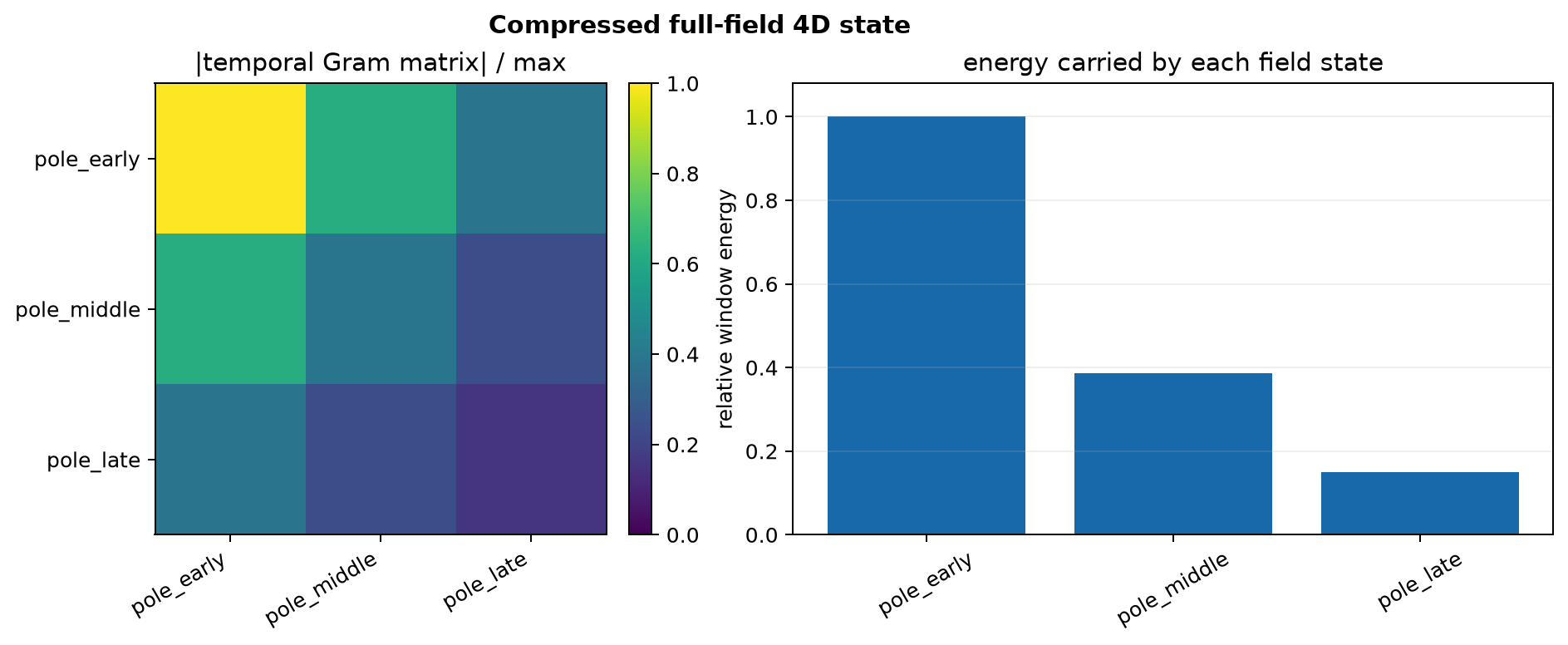
Full-field temporal correlations#
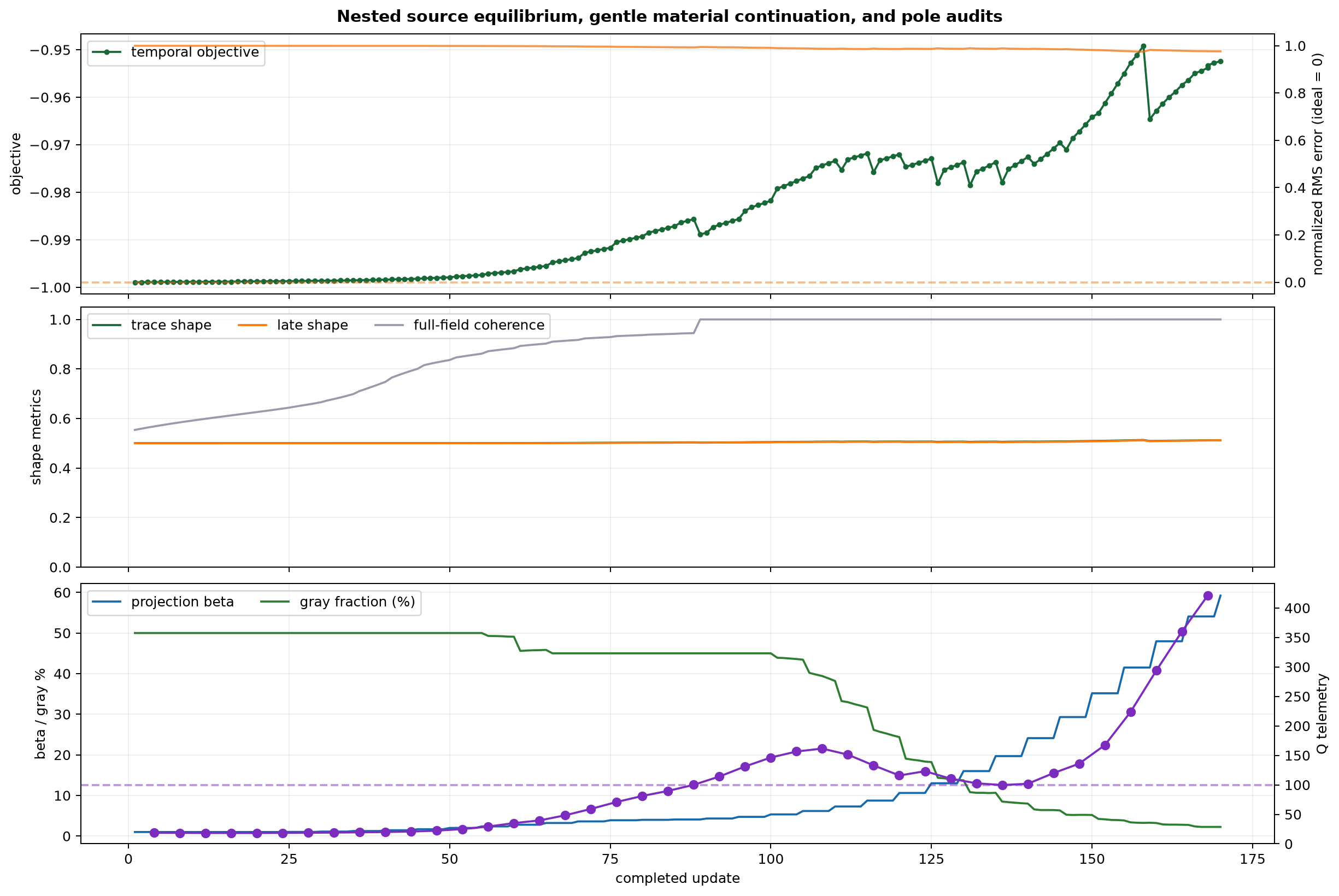
Objective, gradual beta continuation, and pole history#
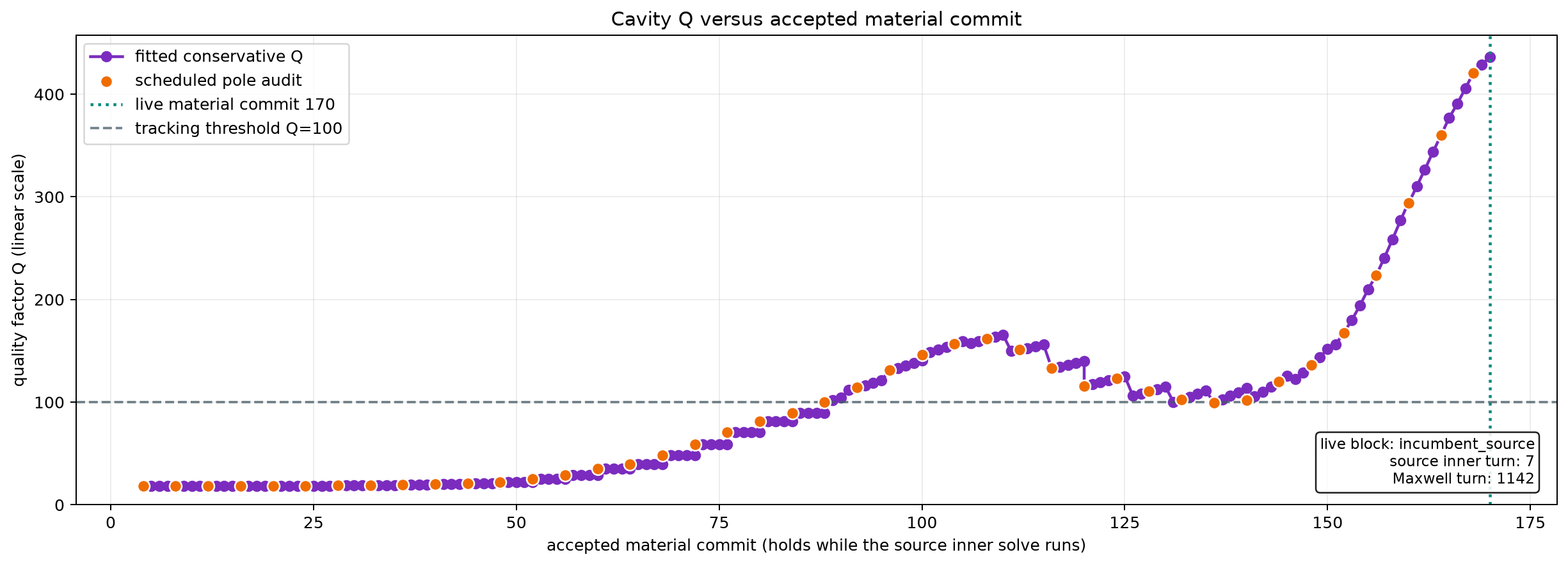
Q versus accepted material commit — linear scale#
Exact methodology, target response, and moving components#
Scientific question and launch state#
This opt-in successor asks whether the dielectric can avoid committing early to an accidentally convenient source. It preserves the 8 µm-long design domain but makes its full width in y exactly 1 µm. Inside that region it starts from one continuous 450 nm-wide guide whose relative permittivity is
[ \epsilon_{\mathrm{mid}}={\epsilon_{\max}+\epsilon_{\min}\over2}. ]
The initial source is exactly the fundamental mode solved on that same midpoint-permittivity guide. The reciprocal detector, fixed-amplitude lossless temporal target, minimum viable pole tapes, and automatic pole tracking remain fixed. The optimization order is:
equilibrate the freeform source for the accepted dielectric;
make one very small, uncommitted continuous-density proposal;
equilibrate a private source copy at that proposal;
commit material only if the source-optimized objective improves;
sharpen density gradually on accepted material commits only;
replay the mature topology into a smooth spline cut-cell boundary chart.
Preparation creates the independent artifact
modal_current_nested_midindex_v4 with status ready_not_started. It does not
run an FDTD baseline, launch an optimizer, stop the current campaign, or alter
the current checkpoint.
Fixed objective and exact resonant-burst response#
The source has a fixed spatial norm but a trainable transverse profile. Its prescribed temporal waveform is a resonant carrier with smooth sin² turn-on and turn-off envelopes,
[ s(t)=a(t)\cos(\omega_c t), ]
where (a(t)) rises and falls over six carrier cycles and is exactly zero for (t\ge80) fs. This is a finite resonant CW burst, not an infinite steady-state solve: the driven part supplies coherent narrowband gradients and the source-free part exposes ringdown and permits Q estimation.
For one ideal lossless pole, an electric-current impulse changes the electric modal coordinate directly, so its causal discrete Green function is a cosine. At FDTD sample (n), the exact target is
[ y_n^*=-{\kappa\over A} \sum_{m=0}^{n}s_m\cos[\omega_c(n-m)\Delta t], ]
with geometry-independent reciprocal source/detector coupling
[ \kappa=\left\langle e_{\mathrm{det}}, \Delta E[J_{\mathrm{ref}}]\right\rangle. ]
The analytic normalization
[ A=|\kappa|\sqrt{ \left(\sum_m s_m\cos\omega_c m\Delta t\right)^2+ \left(\sum_m s_m\sin\omega_c m\Delta t\right)^2} ]
makes the source-free target a nondecaying sinusoid with extrema exactly -1 and +1. The source-on portion is the exact causal build-up rather than a guessed transient. The source and ideal response share a carrier, but are different quantities and are not overlaid in a common amplitude normalization.
The simulated reciprocal modal coordinate (y_n) is divided by that same fixed analytic scale (A). Neither amplitude nor phase is fitted. The sole scalar objective is
[ F(\rho,u)=- {\sum_n [y_n(\rho,u)-y_n^]^2\over\sum_n(y_n^)^2}. ]
Q, Q/V, mode volume, energy, pole-fit residuals, and field snapshots are telemetry and safety gates, not additional objective terms.
Freeform standing-mode source#
The source is a center-plane electric-current sheet with one real coordinate for every Ex, Ey, and Ez Yee degree of freedom on the physical non-PML 30 × 30 cross-section: 2700 coordinates. Area whitening and sphere retraction keep its integrated current norm exactly fixed. It starts as the solved midpoint-guide mode but can evolve to any real transverse standing-mode cross-section, including a defect-plane cross-section of a Bloch cavity. It cannot paint a longitudinal Bloch envelope or increase total source power. A generic traveling Bloch wave would require complex quadratures; this campaign targets a reciprocal standing cavity.
Nested source equilibrium#
For dielectric coordinates (\rho), define the source-envelope objective
[ \bar F(\rho)=\max_{|u|_2=1}F(\rho,u). ]
At an inner stationary solution (u^*(\rho)), the envelope theorem gives
[ \nabla_\rho\bar F(\rho) =\partial_\rho F(\rho,u^*(\rho)). ]
One forward/reverse FDTD pair supplies the gradients with respect to all source and all material coordinates, but it does not solve the nonlinear source maximization in one shot. The campaign takes source trust-region turns until the allowed fixed-norm source gradient is small, both at the incumbent and at each uncommitted material candidate.
For normalized source (u), the allowed gradient is
[ g_T=g-u(u^Tg). ]
The stationarity diagnostic is the maximum first-order gain predicted for a 10 mrad source rotation, (0.01|g_T|_2). It must remain below both the absolute and relative threshold for two consecutive adjoint evaluations. A candidate inherited from the already-equilibrated incumbent can therefore finish after two checks when its projected gain is already numerically negligible; the controller no longer forces unsuccessful source motions merely to satisfy a turn count. Source proposals use eight-pair L-BFGS, tangent projection, geodesic sphere retraction, and an adaptive angular trust radius. Source amplitude is fixed.
Trust-region convergence also has a numerical floor. When the angular radius has contracted to its minimum, two unchanged exact replays whose predicted gain is smaller than one float32 objective ULP certify numerical stationarity. As a final deadlock guard, six consecutive finite rejected trials at the minimum radius advance the outer material problem with an explicit recorded reason. These exits do not claim an exact zero source gradient; they state that the inner problem cannot make a resolvable accepted move at its configured trust tolerance. Every accepted source move resets both counters.
Once the incumbent source is stationary, one material adjoint produces an uncommitted candidate (\rho’). The source is equilibrated again there, and the commit compares like with like:
[ \Delta\bar F= F(\rho’,u^(\rho’))-F(\rho,u^(\rho)). ]
The candidate is accepted only when (\Delta\bar F>0), its predicted material gain is positive, the trust agreement is at least 0.05, and the pole, field, and topology gates pass. Rejection leaves the accepted source, geometry, continuation clock, and beta unchanged.
Continuous-density discovery and gradual trust release#
Discovery uses all 160 × 20 density pixels in the x/y symmetry-reduced representation of the full 8 µm × 1 µm region (equivalent to a 320 × 40 full grid). No terminal design pixel is pinned. The initial raw density is 0.5 inside the 450 nm guide and 0 in its cladding; the material interpolation
[ \epsilon(\rho)=\epsilon_{\min} +(\epsilon_{\max}-\epsilon_{\min})\rho ]
therefore makes the starting core exactly (\epsilon_{\mathrm{mid}}). A 75 nm conic fabrication filter couples neighboring pixels before a tanh projection. There is no DCT preconditioner and no imposed periodicity.
Material trust is dimensionless: it is the maximum proposed change of any raw density coordinate. It starts at 0.001, has a floor of 0.0001, and can reach at most 0.05. A smooth accepted-material clock releases that ceiling over the first 120 committed material steps. Conservative Q telemetry imposes an additional ceiling:
Q below 100: at most 0.005;
Q from 100 to 300: logarithmic interpolation from 0.005 to 0.015;
Q from 300 to 1000: logarithmic interpolation from 0.015 to 0.030;
Q above 1000: gradual release from 0.030 toward 0.050.
An accurate, trust-boundary-using accepted step grows the active radius by 1.20; rejection halves it. There is no Q-dependent density cap and no routine multi-point line search. L-BFGS memory is not reset when beta changes.
Slow beta schedule and spline-boundary handoff#
Beta is held at 1 through accepted material commit 20. It then changes only once every five accepted material commits: logarithmic smoothstep plateaus move from 1 to 4 by commit 80, and from 4 to 64 by commit 180. Eta remains 0.5. Source inner turns, candidate equilibration, and rejected material proposals do not advance beta. When beta changes, the accepted source is re-equilibrated before the next material proposal.
At beta 64, three trustworthy states must have at most 4% gray cells and stable topology. The campaign then replays that density into a topology-guarded cubic spline level-set boundary. FDTD receives 4 × 4 inverse-subpixel cut-cell area fractions, so bulk islands are exactly binary and only cells intersected by the smooth physical boundary can be gray. The same temporal objective and nested source-equilibrium logic continue in this boundary stage.
Fixed and moving components#
Fixed:
grid, stack, symmetry, PML, 8 µm × 1 µm region, and terminal feedthrough;
initial 450 nm midpoint-permittivity guide and its solved starting mode;
source plane and support, resonant-burst waveform, turn-off time, and total source-current norm;
reciprocal detector and analytic unity-amplitude target;
absence of amplitude/phase fitting, DCT conditioning, prescribed period, output coupling, mode volume, Q/V, or late-power objective terms.
Moving:
the 2700 real fixed-norm source coordinates during each inner solve;
all 160 × 20 symmetry-reduced filtered density controls during gradual discovery;
after handoff, the topology-preserving smooth spline boundary controls;
independent source and material L-BFGS memories and adaptive trust radii;
after trustworthy Q exceeds 100, the tracked carrier and minimum viable pole tape selected by scheduled Shaker–Johnson-style pole audits.
Dashboard interpretation#
The temporal figure preserves objective units. Its top panel shows absolute one-carrier-period RMS envelopes; zoom panels show the source-on, turn-off, and late-ringdown carrier with one y scale and ±1 reference lines. A perfect late response touches both lines. The current waveform is shown only on an independent diagnostic scale. Field-snapshot windows remain available in field and Gram diagnostics but are not background bands in the waveform plot and do not weight the objective.
Operations#
A bounded manual turn can be run with:
FDTDX_FRYETT_MODAL_SOURCE_CO_DESIGN=1 FDTDX_FRYETT_MODAL_SOURCE_BILEVEL=1 FDTDX_FRYETT_MODAL_TEMPORAL_ID=modal_current_nested_midindex_v4 uv run python -m benchmarks.cases.invdes_fryett_hybrid_scratch.modal_temporal --updates 1
The persistent launcher is scripts/start_fryett_modal_source_bilevel_campaign.sh.