
No-slot atom-hole waveguide inverse design#
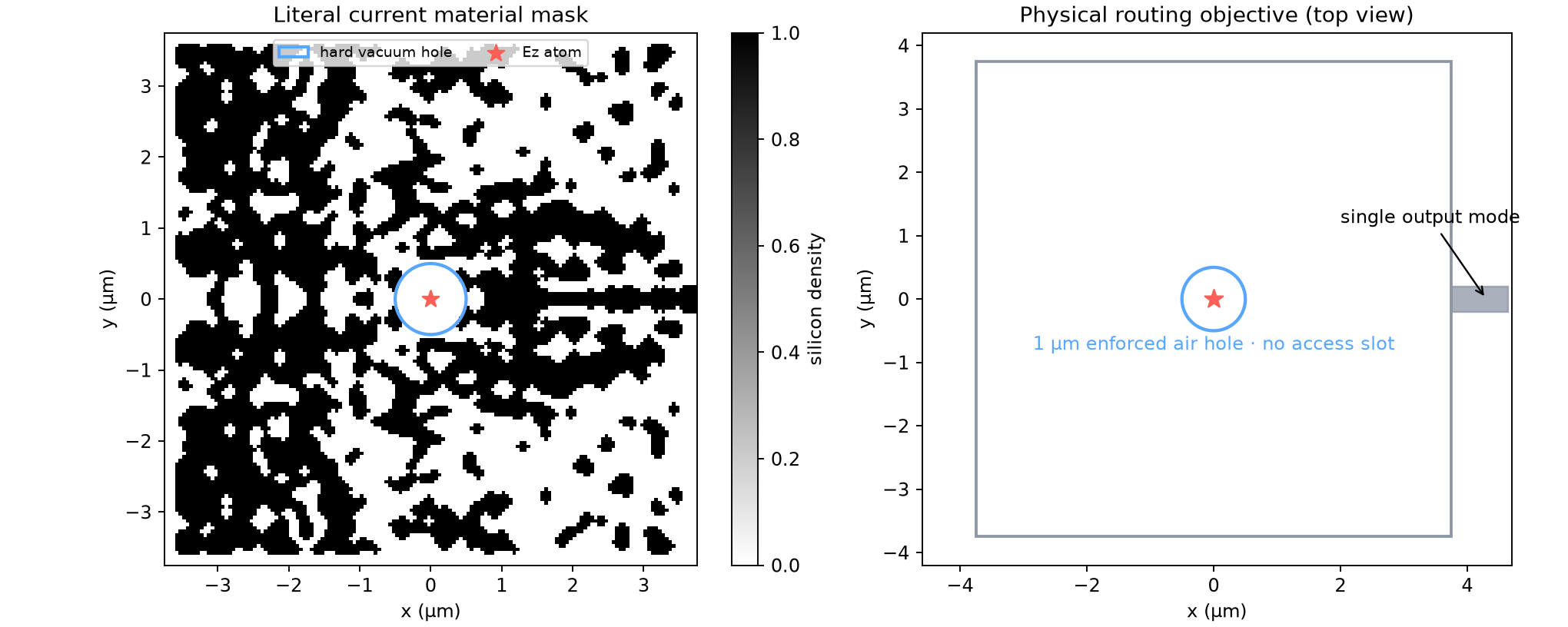
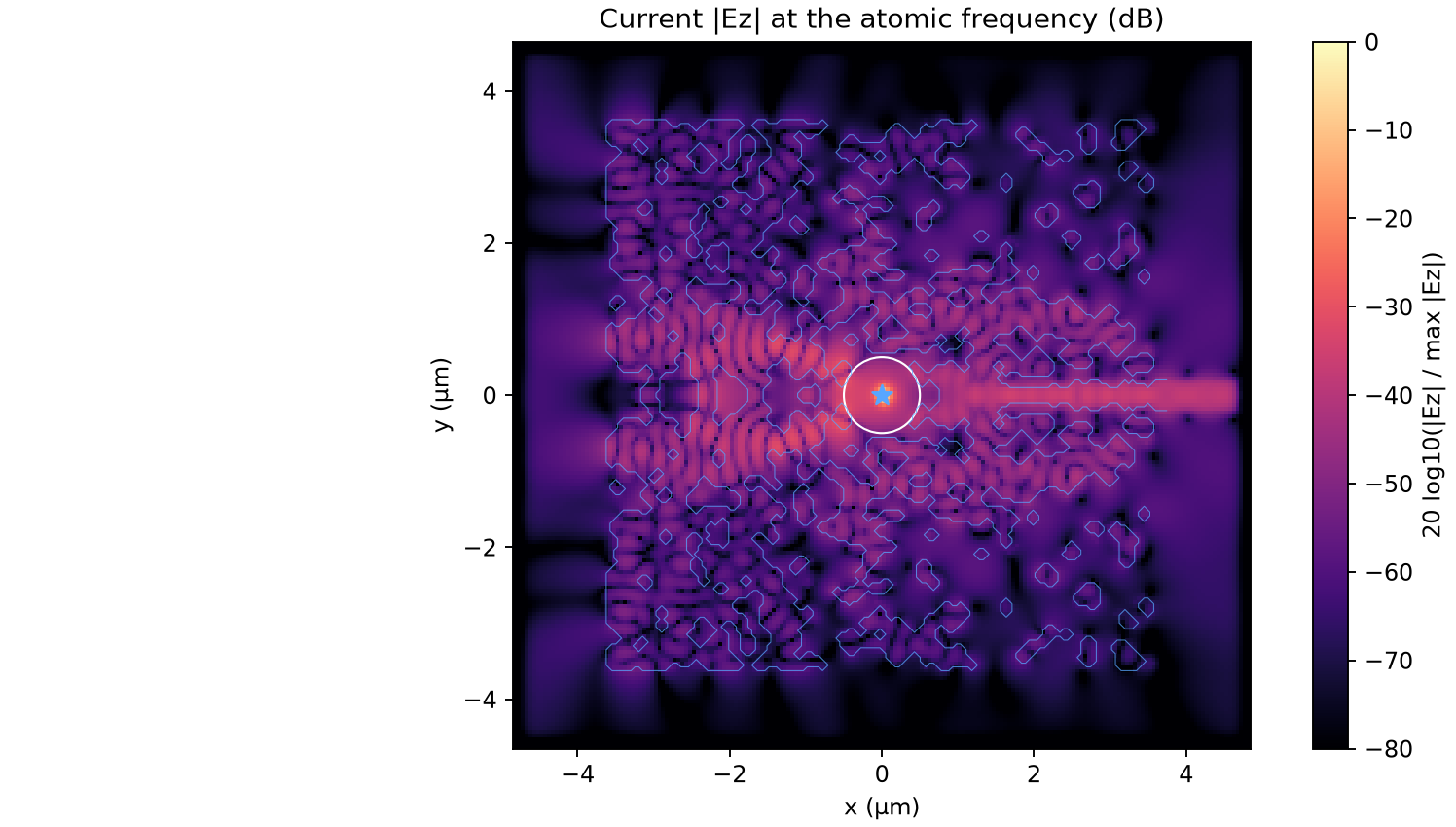
This is the live checkpoint for a z-oriented atom in a hard 1 µm-diameter central air hole. A 7.5 × 7.5 µm free-form silicon mask is extruded through a 500 nm slab and attaches only to one 400 nm right-hand waveguide. There is no atom-access slot and no left waveguide. The y and z mirror planes reduce the solve by four; x is simulated explicitly.
Quantity |
Current value |
|---|---|
Ordinary beta adjoint updates |
550 / ∞ |
Guided branching ratio βwg |
81.47% into the single right-hand guide |
Rejected nonphysical beta samples |
44 |
Latest raw modal-power excess |
0.00% |
Total normalized LDOS |
0.3775 |
Guided normalized LDOS |
0.3075 |
Atom-frequency coherent retention |
pending |
Late-window atom-frequency coherence |
pending |
Gray material fraction |
0.00% |
Projection stage |
7 / 7 |
Campaign phase |
binary beta and pole search |
Latest audited/ringdown Q |
21.31 |
Latest pole detuning |
4.125% |
Latest pole-fit residual |
13.946% |
Purcell factor |
pending |
Guided Purcell βwg FP |
pending |
What is being optimized now#
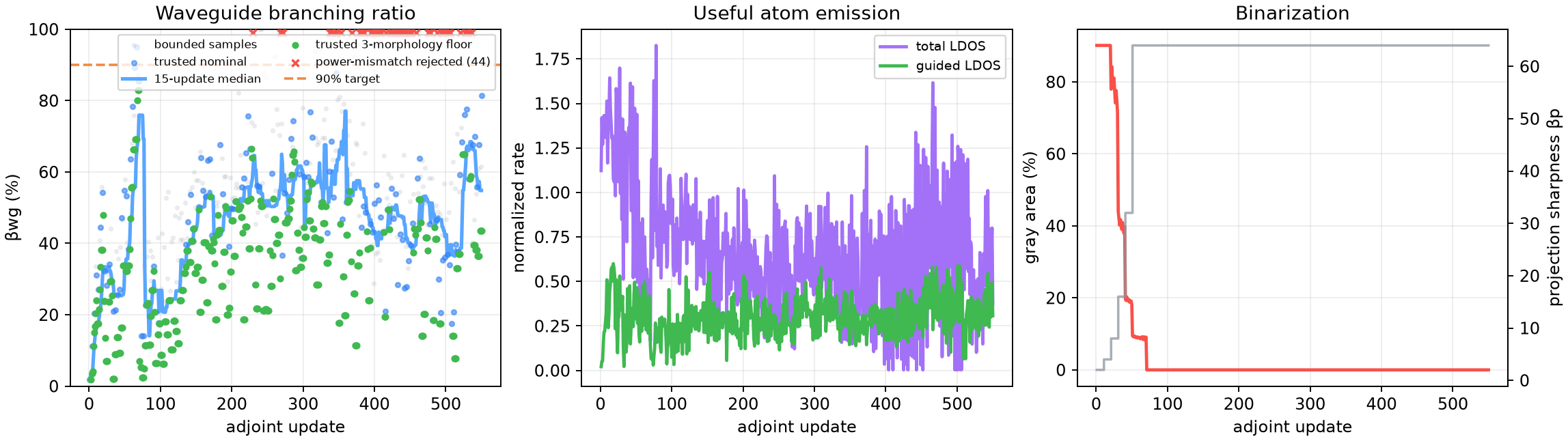
The objective is the passive, energy-bounded right-waveguide branching ratio; there is no LDOS guard rail. A separate penalty rejects any modal/closed-surface power mismatch that would imply beta above 100%. Projection sharpness first follows a finite 90-update schedule; the optimizer then remains exactly binary and continues beta updates in 20-step blocks. A fresh 4 ps broadband audit after every block controls the handoff—neither iteration count nor a noisy instantaneous Q can activate shifting.
The state machine is deliberately simple: beta optimization and binarization → perpetual exact-binary beta with independent pole audits → unbounded shifted-LDOS optimization. A clean Q≈100 pole is required before shifting, and no stage may reintroduce gray material after binarization.