
Unqualified success — component-aware Yee atom-strip Q/V cavity#
Worker: not active · stage: spline_boundary_q_over_v ·
status: unqualified_success_stopped_resumable_tidy3d_validated · checkpoint age: 3006.0 min
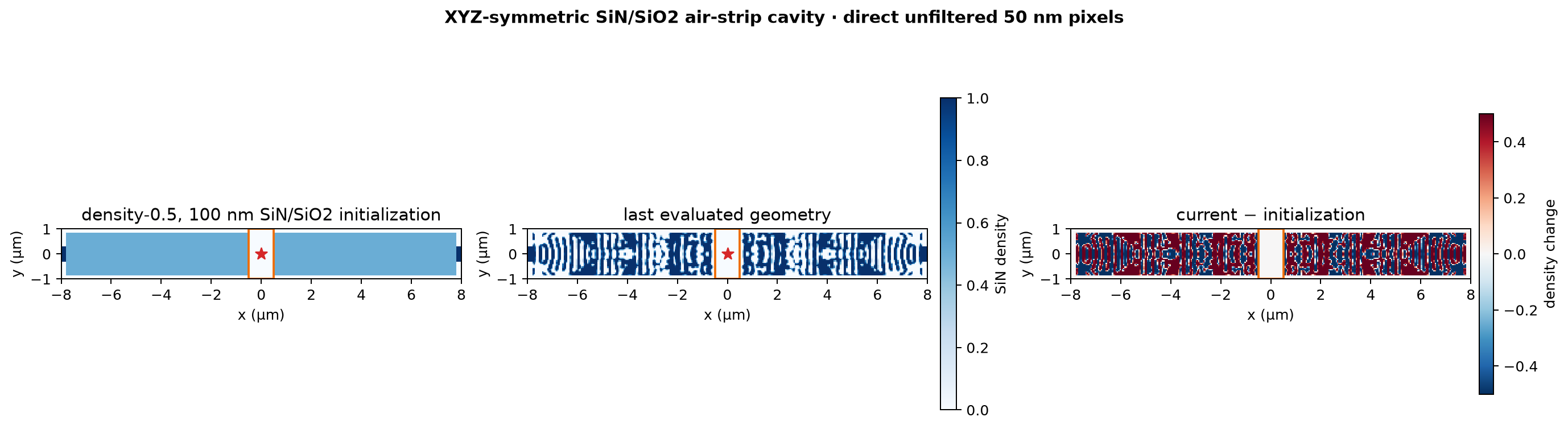
This completed campaign starts from density 0.5 in the same 100 nm SiN / 300 nm-per-side SiO2 geometry and immutable one-micron atom access strip as the successful predecessor, but every forward and adjoint solve uses the upgraded fixed component-aware Yee material operator from the first step.
Stage A uses raw Adam against the exact absolute atom-field temporal trace of
the Q=10,000, V=0.1 µm³ ideal pole. After the temporal objective plateaus with trustworthy Q≥100, direct Q/V begins. Stage B then
uses adaptive-trust L-BFGS-B to maximize only
log(Q_harmonic)-log(V_atom/(lambda_pole/n_air)^3). Direct density pixels
train while both stack thicknesses remain frozen until pixel-only Q/V plateaus.
Stage C then enables both thickness coordinates, analytically preserves the
physical density at beta=1, and starts gradual unfiltered tanh continuation.
Each fixed-beta Q/V subproblem reaches either strict convergence or less than
1% gain over a settled full L-BFGS memory before beta rises by 1. Binary bulk is
replayed as a topology-free smooth cubic-spline phase field only when binary
readiness and a fixed-beta Q/V plateau coincide. Its controls may fuse or erase
islands while retaining subpixel cut cells. The current rollback-safe boundary
fork optimizes log Q / normalized atom volume; Q, atom volume, and Q/V remain measured
on every trusted replay. No spatial filter is used.
Unqualified success · frozen at accepted update 2562
The exact stopped geometry is independently replayed in Tidy3D: Q=3894.36, V=5.99346 (lambda/n_air)^3, Q/V=649.767, Purcell=49.3764, and wavelength=826.213 nm. The complete optimizer state and smooth-boundary geometry are preserved for later continuation.
quantity |
current |
|---|---|
temporal Adam updates |
285 · plateau not detected (0/0 trend samples) |
pixel-only Q/V accepted / transition |
0 / objective plateau |
pole accepted updates / trials |
2277 / 14 |
Q |
5779.2 |
best recorded Q (trust gate shown above) |
5807.83 |
field / energy Q |
5835.29 / 5779.2 |
Q-estimator ratio |
1.00971 |
pole wavelength |
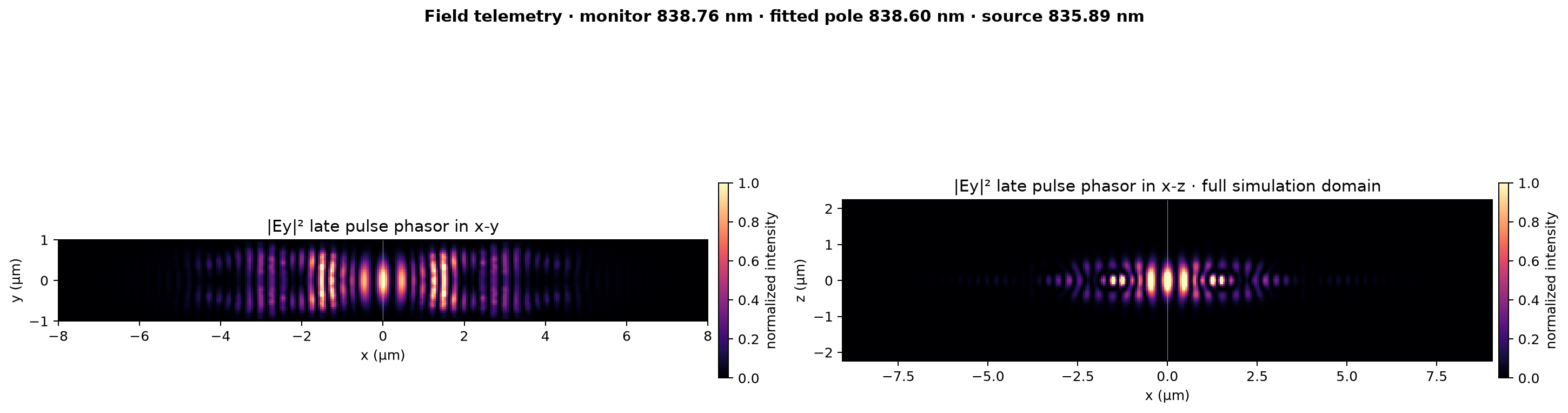
838.603 nm |
source-center wavelength |
835.887 nm |
field-monitor wavelength |
838.757 nm |
design-region slab thickness |
0.3 µm |
Stage-B thickness coordinate / range |
True / 0.050–0.500 µm |
SiO2 thickness per side |
0.35846 µm |
Stage-B SiO2 coordinate / maximum |
True / 1.000 µm |
stack-thickness constraint |
t_SiO2 − t_SiN ≥ 0.050 µm |
SiO2 full width |
2 µm |
joint-stage SiO2 width coordinate / range |
False / 2.000–2.000 µm |
physical mode volume |
2.72015 µm³ |
normalized mode volume |
4.61236 (λ_pole/n_air)³ |
Q / normalized atom volume |
1259.03 |
Purcell from Q/V |
95.6749 |
fitted atom-pole amplitude at source clear |
0.010666 |
absolute atom-trace peak / handoff |
0.248671 |
source spectral power at pole / actual carrier |
0.99402 |
reciprocal guided-Purcell proxy |
4.50459e-05 |
guided-Purcell proxy / handoff |
5.76308 |
Stage-B volume treatment |
none — log Q / normalized atom volume is optimized |
three-window V span |
0.00598368 |
active Q/V run time / window |
2.75 / 0.8 ps |
gradient backend / storage |
|
structural backend decision |
|
exact reversible PML tape size |
11.1157 GB |
frozen measured value+gradient speedup |
5.25199x |
Q/V fit start / nominal lifetime per window |
0.35 ps / 0.125 τ_amplitude |
precision-triggered tape growths |
0 |
final ringdown field-power / energy fraction |
0.540161 / 0.536943 |
finite-step adjoint direction verified |
False |
ideal temporal fidelity |
0.487369 |
active objective / value |
log Q / normalized atom volume / 7.1381 |
stage plateau / reason |
False / |
plateau samples / evidence window |
0 / 0 |
objective slope / detectable slope |
— / — |
trust-floor restarts since progress |
0 / 2 |
practical fixed-beta Q/V gain over one memory |
—% / 1% limit |
practical plateau samples / required |
0 / 11 |
practical trust radius still expanding |
False |
healthy / cumulatively pruned curvature pairs |
0 / 846 |
L-BFGS / current-gradient predicted-ascent ratio |
1 |
replay-triggered curvature recoveries |
144 |
maximum last density motion |
1.84178e-05 |
trust radius |
1.25e-05 |
binarity score (1 is binary) |
0.990384 |
trainable gray fraction (0.05<rho<0.95) |
1.49073% |
archived tangent-stage Q/V floor |
309.567 |
projection beta / eta |
32 / 0.5 |
fixed-beta accepted Q/V updates / transition |
0 / objective plateau |
material parameterization |
|
hard atom access |
1.000 µm full-y air strip, immutable |
pixel / grid |
50 nm / [181, 35, 45] |
non-PML z span / material-stack-to-PML air gap |
3.50 / 1.24 µm |
z PML |
0.50 µm per side |
z-padding convergence audit |
|
1.50→3.40 µm replay: residual / field-Q / energy-Q change |
nan% / nan% / nan% |
binarization / material projection / filter |
True / False / off |
physical waveguide escape eta |
not part of the active objective |
Q, V, objective, and optimizer history#
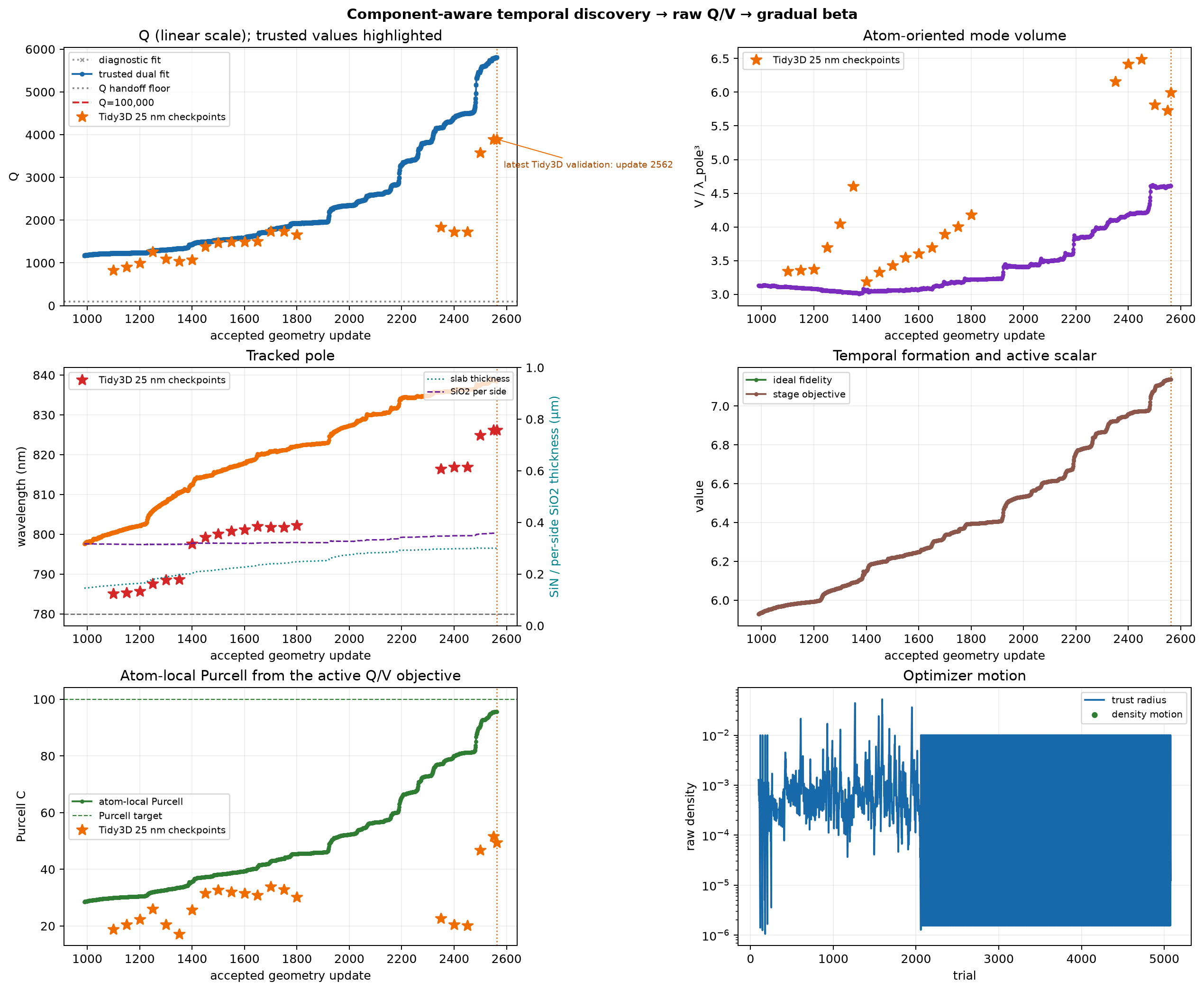
The Q axis is linear. A pole is not trusted until the centered Ey and total energy decay estimates agree. Mode volume uses the geometric mean of their three same-pole windows and the same fitted pole wavelength; the local permittivity is exactly air by the hard geometry constraint. This is a clean restart and contains no metric history or optimizer memory from the legacy staircase campaign. The predecessor remains preserved on its own dashboard for comparison.
Independent Tidy3D checkpoint trend#
The horizontal coordinate is the global accepted geometry update, not a renumbered index into the bounded history buffer. The latest orange marker validates checkpoint 2562; the current FDTDX geometry is update 2562. The shaded tail therefore contains 0 accepted updates without an independent Tidy3D replay.
Orange stars are independent 6 ps Tidy3D replays on one fixed 25 nm uniform grid. They use each checkpoint’s accepted 50 nm smooth-boundary cut-cell density and optimized vertical stack. This is a controlled trend check, not a spatial continuum extrapolation. Markers are intentionally not connected: Tidy3D evaluated only the listed immutable checkpoints.
checkpoint |
FDTDX λ (nm) |
Tidy3D λ (nm) |
FDTDX Q |
Tidy3D Q |
FDTDX V/λ³ |
Tidy3D V/λ³ |
FDTDX Q/V |
Tidy3D Q/V |
Tidy3D/FDTDX Q/V |
|---|---|---|---|---|---|---|---|---|---|
1100 |
800.442 |
785.086 |
1225.92 |
826.67 |
3.11071 |
3.34574 |
394.097 |
247.082 |
0.626956 |
1150 |
801.384 |
785.353 |
1230.58 |
902.376 |
3.09284 |
3.35614 |
397.879 |
268.873 |
0.675766 |
1200 |
802.182 |
785.639 |
1235.6 |
992.741 |
3.08324 |
3.3739 |
400.748 |
294.241 |
0.73423 |
1250 |
806.05 |
787.652 |
1286.43 |
1261.75 |
3.05731 |
3.69109 |
420.772 |
341.837 |
0.812404 |
1300 |
808.208 |
788.505 |
1308.11 |
1093.37 |
3.04234 |
4.04394 |
429.968 |
270.372 |
0.628819 |
1350 |
810.444 |
788.688 |
1335.99 |
1039.18 |
3.02226 |
4.59962 |
442.051 |
225.928 |
0.51109 |
1400 |
812.357 |
797.561 |
1431.55 |
1077.22 |
3.05115 |
3.18546 |
469.182 |
338.167 |
0.720758 |
1450 |
814.585 |
799.298 |
1496.72 |
1378.14 |
3.0498 |
3.33001 |
490.762 |
413.854 |
0.843289 |
1500 |
815.767 |
800.103 |
1535.29 |
1472.94 |
3.05762 |
3.42809 |
502.118 |
429.668 |
0.855712 |
1550 |
816.911 |
800.824 |
1565.05 |
1493.07 |
3.0687 |
3.54953 |
510.003 |
420.639 |
0.824777 |
1600 |
817.833 |
801.222 |
1587.01 |
1491.39 |
3.06638 |
3.60404 |
517.552 |
413.811 |
0.799555 |
1650 |
819.947 |
801.986 |
1654.75 |
1502.05 |
3.07799 |
3.6958 |
537.609 |
406.422 |
0.75598 |
1700 |
820.763 |
801.752 |
1788.53 |
1733.35 |
3.17373 |
3.89096 |
563.541 |
445.482 |
0.790505 |
1750 |
821.178 |
801.82 |
1832.37 |
1732.04 |
3.18356 |
4.00448 |
575.573 |
432.526 |
0.751471 |
1800 |
822.196 |
802.201 |
1928.84 |
1659.53 |
3.22293 |
4.18287 |
598.475 |
396.744 |
0.662925 |
2350 |
835.771 |
816.442 |
4162.63 |
1839.01 |
4.10013 |
6.15712 |
1015.24 |
298.681 |
0.294197 |
2400 |
836.389 |
816.924 |
4403.37 |
1726.55 |
4.18306 |
6.42061 |
1052.67 |
268.907 |
0.255454 |
2450 |
836.389 |
816.906 |
4500.53 |
1726.75 |
4.21186 |
6.48931 |
1068.54 |
266.091 |
0.249023 |
2500 |
837.506 |
824.921 |
5493.24 |
3575.55 |
4.60441 |
5.81117 |
1193.04 |
615.288 |
0.515731 |
2550 |
838.678 |
826.249 |
5784.12 |
3892.22 |
4.60391 |
5.73195 |
1256.35 |
679.039 |
0.540485 |
2562 |
838.603 |
826.213 |
5807.11 |
3894.36 |
4.61236 |
5.99346 |
1259.03 |
649.767 |
0.516085 |
Fixed-geometry source-carrier audit#
At accepted update 2379, one forward-only replay held the geometry, material stack, pole-fit center, and tape fixed while moving the broadband mode-source carrier from 811.754 nm to 835.887 nm. The fitted pole changed by 0.0000%, Q by +0.0364%, normalized V by -0.0189%, and Q/V by +0.0554%. The alternate fit remained valid with field/energy residuals 5.57e-06/0.00207. No optimizer step was taken. This verifies that source recentering improves excitation and telemetry without creating the measured cavity eigenmetric.
Ideal and measured atom response#
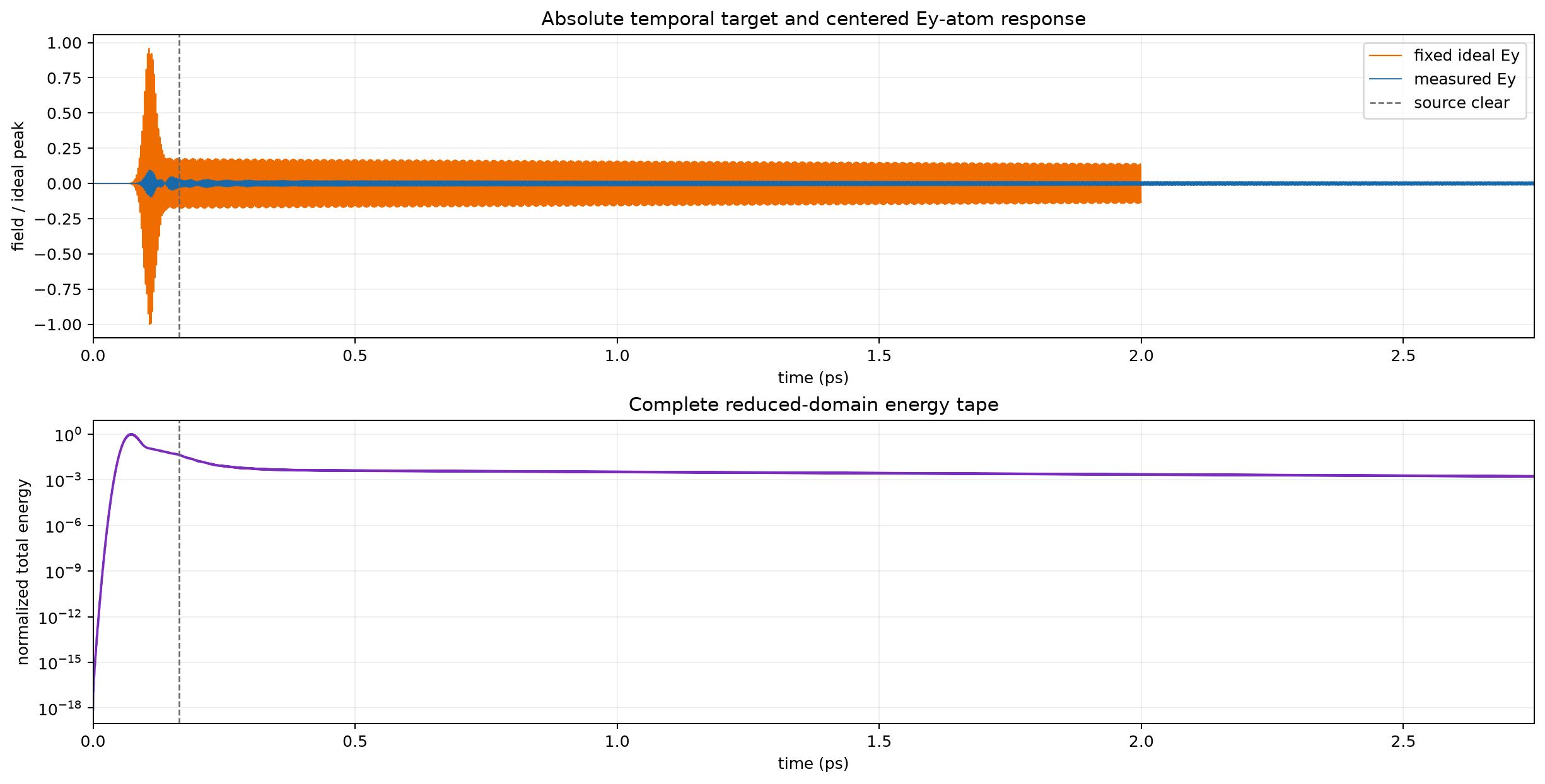
The target has fixed amplitude and phase for Q=10,000, beta one, V=0.1 µm³, and perfect Ey-polarized overlap. It is not rescaled to fit the simulation.
Geometry and fields#
Downloadable layout#
Layout status: authoritative smooth-boundary GDS. The ZIP includes the GDS, JSON stack/metric manifest, and README. Before the spline handoff the GDS is intentionally marked as a thresholded preview; after handoff it is the fabrication-oriented smooth boundary representation. GDS is planar, so use the manifest for SiN and SiO2 thicknesses.