
Live 8 × 8 µm y-dipole SiN/SiO2-slab atom-slot optimizer#
Worker: not active · stage: projected_q_over_v_continuation ·
status: running_fixed_beta_pure_q_continuation · checkpoint age: 1503.2 min
This independent clean restart starts from a uniform density-0.5
SiN topology inside a planar SiO2 stack. The oxide occupies the complete x–y
simulation plane, including the x and y PML cells. An explicit immutable air
body cuts the full strip -0.5 µm < x < 0.5 µm through the oxide, SiN, and
complete transverse/PML extent. A centered y-oriented atom and symmetric
TE-like source select the Ey cavity family. Full
x/y/z symmetry retains one octant of the 8 ×
8 µm physical design.
Stage A uses raw Adam on the fixed absolute Q=10,000 ideal atom time trace.
Once temporal improvement clearly slows with a trustworthy Q≥100, Stage B
switches to adaptive-trust L-BFGS-B on pure same-pole harmonic Q using only
the raw 50 nm SiN pixels. The next diminishing-return handoff unlocks SiN and
per-side SiO2 thickness while preserving t_SiN + 2t_SiO2 ≤ 1.000 µm.
Gradual fixed-beta continuation and then topology-free smooth cubic-spline
boundary optimization follow under the same pure-Q scalar. Q/V, atom-local
volume, Purcell, fields, pole continuity, and trust health remain live
telemetry.
The separate 12 × 4 µm first-step air-strip-width sweeps compare independent density-0.5 temporal seeds from 1.0 to 2.0 µm for 100 nm SiN and 300 nm SiN without altering this archived campaign.
quantity |
current |
|---|---|
temporal Adam updates |
197 · plateau not detected (16/20 trend samples) |
pure-Q substage / accepted since temporal handoff |
joint_stack / 55 |
pole accepted updates / trials |
825 / 6702 |
Q |
4011.8 |
best recorded Q (trust gate shown above) |
4153.47 |
field / energy Q |
4305.52 / 4011.8 |
Q-estimator ratio |
1.07321 |
pole wavelength |
834.441 nm |
source-center wavelength |
827.606 nm |
field-monitor wavelength |
834.383 nm |
design-region slab thickness |
0.427735 µm |
Stage-B thickness coordinate / range |
True / 0.050–0.500 µm |
SiO2 thickness per side |
0.215482 µm |
Stage-B SiO2 coordinate / maximum |
True / 0.475 µm |
stack-thickness constraint |
t_SiN + 2t_SiO2 ≤ 1.000 µm |
SiO2 x–y extent |
complete simulation plane, including x/y PML |
air-strip cutout extent |
complete y/z simulation span, including PML |
physical mode volume |
35.2435 µm³ |
normalized mode volume |
60.6586 (λ_pole/n_air)³ |
Q / normalized atom volume |
68.473 |
Purcell from Q/V |
5.20332 |
fitted atom-pole amplitude at source clear |
0.000565168 |
absolute atom-trace peak / handoff |
0.234464 |
source spectral power at pole / actual carrier |
0.961621 |
reciprocal guided-Purcell proxy |
7.04699e-08 |
guided-Purcell proxy / handoff |
0.5224 |
Stage-B volume treatment |
none — pure log harmonic Q is optimized |
three-window V span |
0.0578487 |
active Q/V run time / window |
2.65 / 0.8 ps |
gradient backend / storage |
|
structural backend decision |
|
exact reversible PML tape size |
10.9784 GB |
frozen measured value+gradient speedup |
—x |
Q/V fit start / nominal lifetime per window |
0.25 ps / 0.125 τ_amplitude |
precision-triggered tape growths |
4 |
final ringdown field-power / energy fraction |
0.430423 / 0.40645 |
finite-step adjoint direction verified |
True |
ideal temporal fidelity |
0.493914 |
active objective / value |
pure log harmonic Q / 8.3317 |
stage plateau / reason |
False / |
plateau samples / evidence window |
16 / 20 |
objective slope / detectable slope |
— / — |
trust-floor restarts since progress |
0 / 2 |
practical fixed-beta Q/V gain over one memory |
0.0592407% / 1% limit |
practical plateau samples / required |
11 / 11 |
practical trust radius still expanding |
True |
healthy / cumulatively pruned curvature pairs |
1 / 544 |
L-BFGS / current-gradient predicted-ascent ratio |
0.135332 |
replay-triggered curvature recoveries |
72 |
maximum last density motion |
0.0262905 |
trust radius |
0.00376506 |
binarity score (1 is binary) |
0.984335 |
trainable gray fraction (0.05<rho<0.95) |
2.12515% |
archived tangent-stage Q/V floor |
43.2415 |
projection beta / eta |
15 / 0.5 |
fixed-beta accepted Q/V updates / transition |
16 / objective plateau |
material parameterization |
|
hard atom access |
1.000 µm full-y air strip, immutable |
pixel / grid |
50 nm / [101, 95, 35] |
non-PML z span / material-stack-to-PML air gap |
2.50 / 0.82 µm |
z PML |
0.50 µm per side |
z-padding convergence audit |
|
1.50→3.40 µm replay: residual / field-Q / energy-Q change |
nan% / nan% / nan% |
binarization / material projection / filter |
True / True / off |
physical waveguide escape eta |
not part of the active objective |
Q, V, objective, and optimizer history#
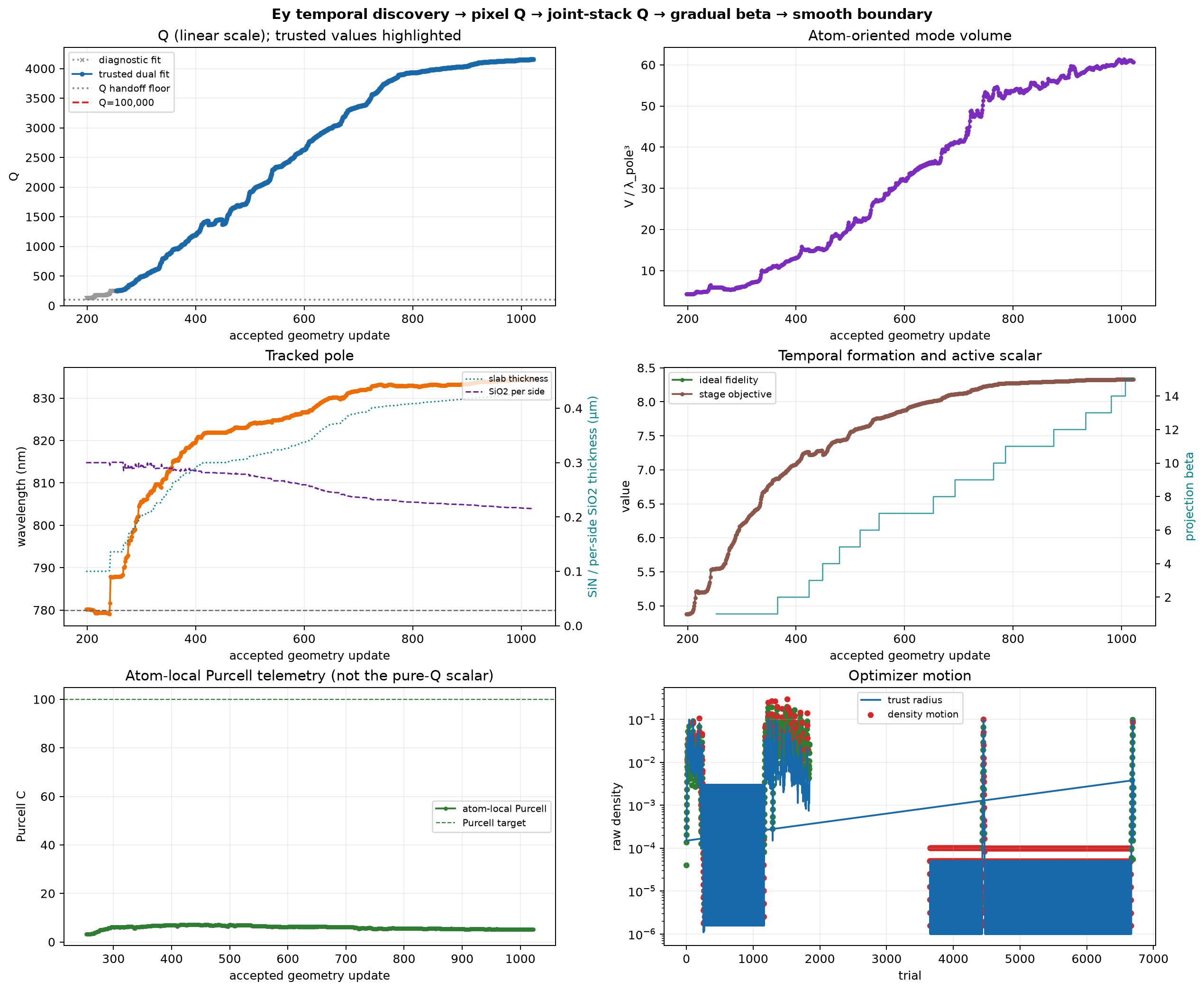
The Q axis is linear. A pole is not trusted until the centered Ey and total energy decay estimates agree. Mode volume uses the geometric mean of their three same-pole windows and the same fitted pole wavelength; the local permittivity is exactly air by the hard geometry constraint. This run imports no geometry, pole state, or optimizer memory from earlier campaigns.
Ideal and measured atom response#
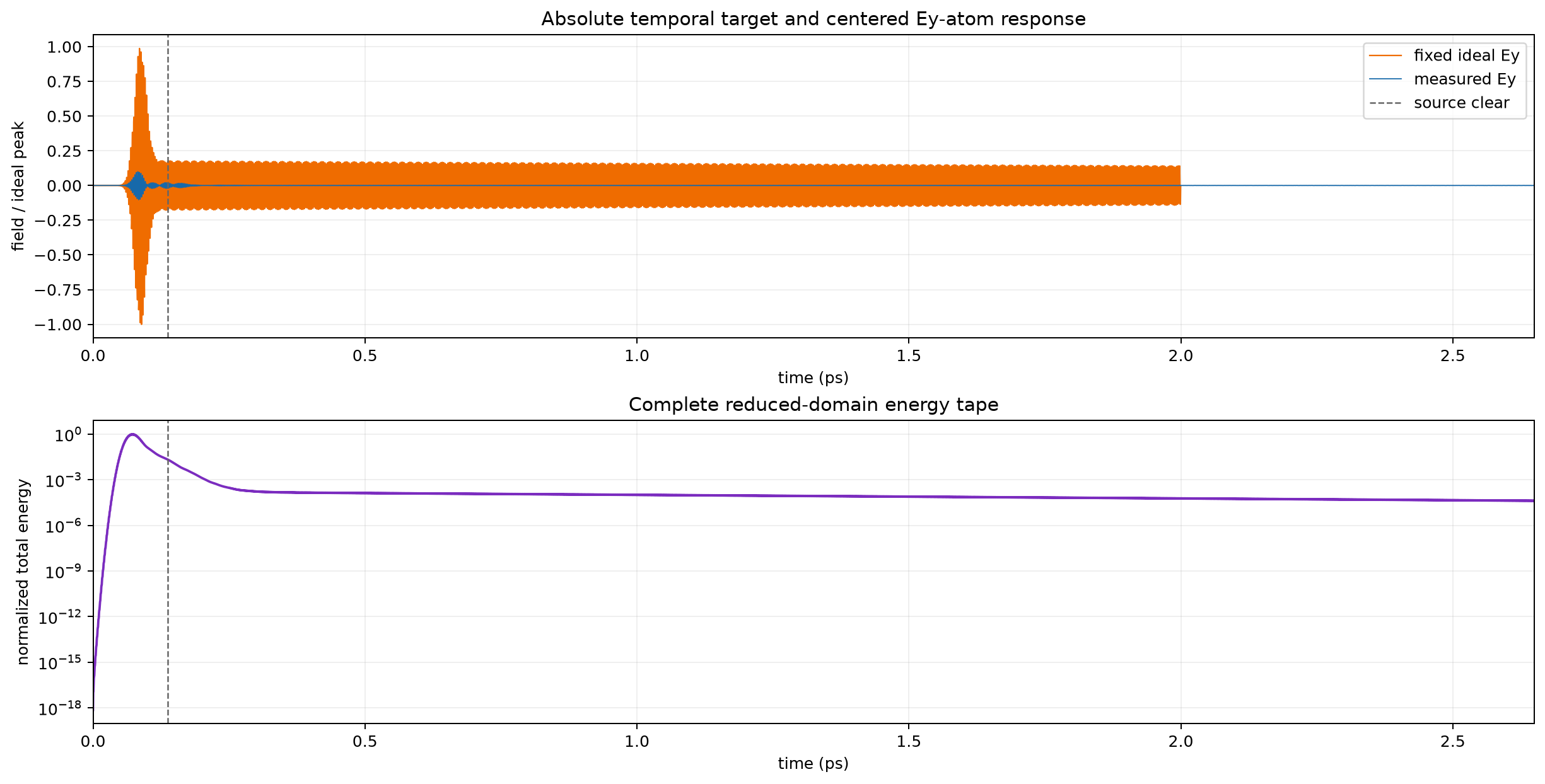
The target has fixed amplitude and phase for Q=10,000, beta one, V=0.1 µm³, and perfect Ey-polarized overlap. It is not rescaled to fit the simulation.
Geometry and fields#
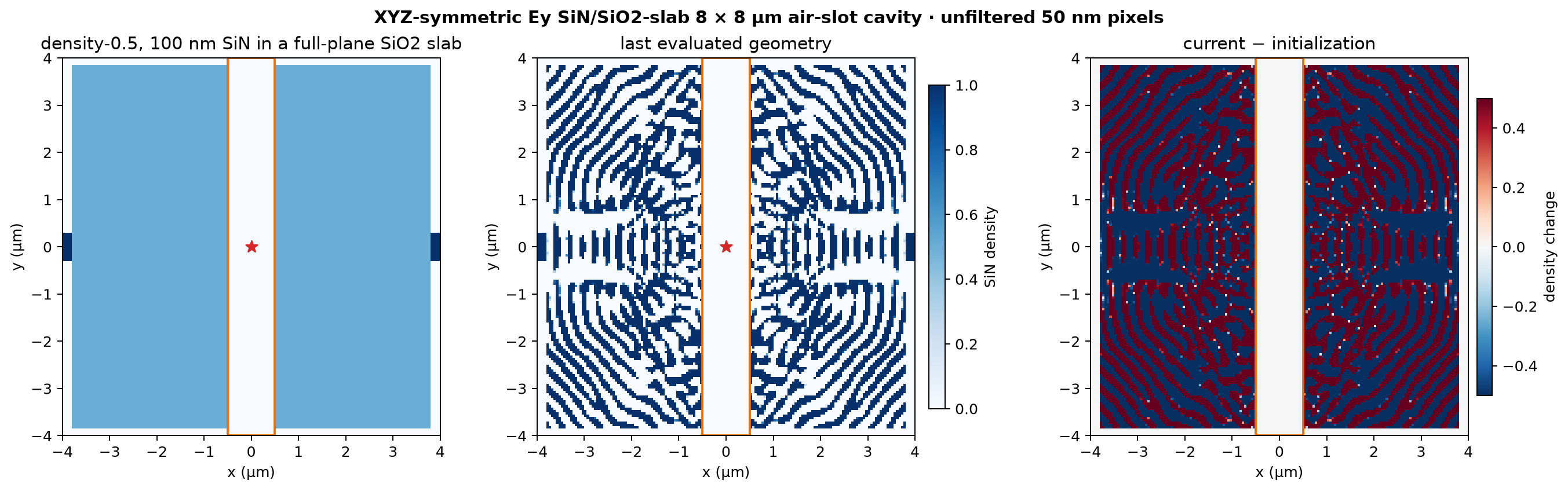
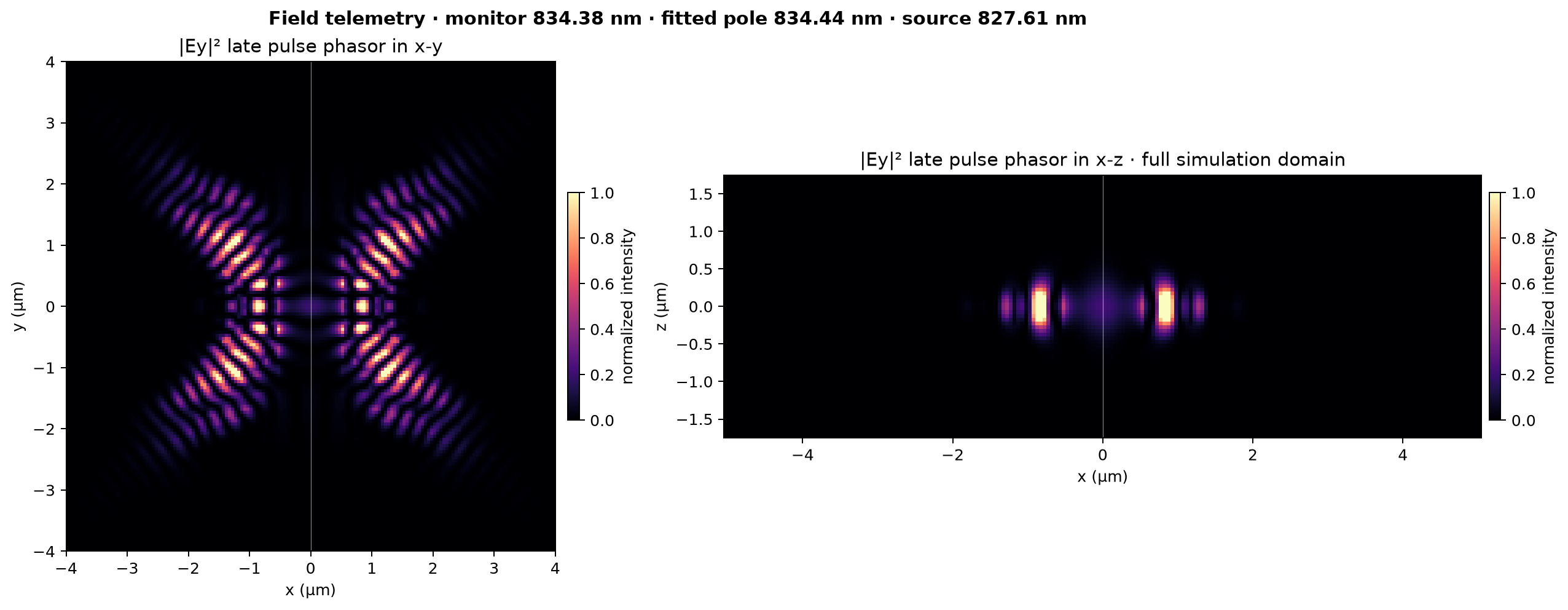
Downloadable layout#
Layout status: provisional density-0.5-contour GDS preview. The ZIP includes the GDS, JSON stack/metric manifest, and README. Before the spline handoff the GDS is intentionally marked as a thresholded preview; after handoff it is the fabrication-oriented smooth boundary representation. GDS is planar, so use the manifest for SiN and SiO2 thicknesses.