
300 nm SiN atom-strip first-step seed-width sweep#
Status: complete · progress: 11 / 11 widths complete · updated: 2026-09-05 14:22 UTC
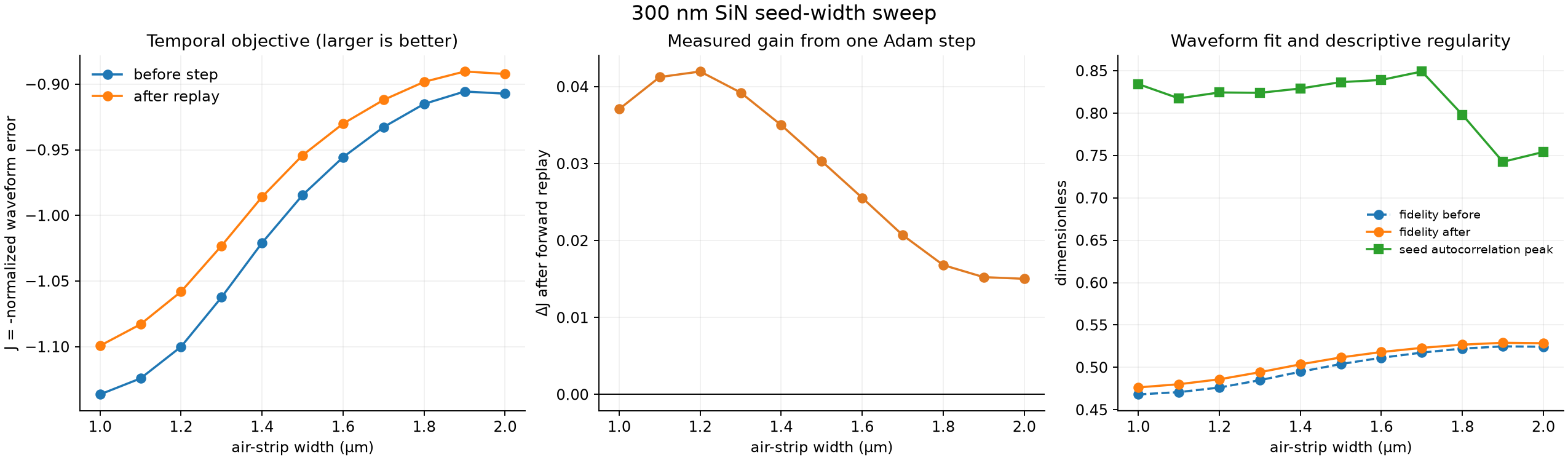
This controlled sweep asks only how the first temporal-gradient seed changes when the immutable atom-access strip is moved from 1.0 to 2.0 µm. Every point starts independently from density 0.5; no geometry or optimizer state is carried from one width to the next.
The common stack is a 300 nm SiN film embedded between 300 nm of SiO2 per side, with SiO2 filling the complete x-y plane (including x/y PML) and air outside the finite stack in z. The physical design region is 12 × 4 µm and the retained simulation uses x/y/z symmetry with an Ey atom response. The hard air strip cuts through the complete SiO2/SiN stack.
The reported objective gain is not inferred from the gradient. It is measured by a fresh forward replay after the single raw-Adam update.
Download the numerical sweep table · Read the exact method · Compare with the 100 nm SiN sweep
air strip (µm) |
J before |
J after replay |
ΔJ |
fidelity after |
dominant lag (µm) |
correlation peak |
|---|---|---|---|---|---|---|
1.0 |
-1.13638 |
-1.09929 |
0.0370809 |
0.476351 |
0.25 |
0.8342 |
1.1 |
-1.12419 |
-1.08294 |
0.0412439 |
0.48009 |
0.25 |
0.8174 |
1.2 |
-1.10005 |
-1.05808 |
0.0419695 |
0.48589 |
0.25 |
0.8244 |
1.3 |
-1.06237 |
-1.02314 |
0.039229 |
0.494282 |
0.25 |
0.8239 |
1.4 |
-1.02091 |
-0.985904 |
0.0350026 |
0.503549 |
0.25 |
0.829 |
1.5 |
-0.984511 |
-0.954203 |
0.0303079 |
0.511718 |
0.25 |
0.8366 |
1.6 |
-0.95567 |
-0.930118 |
0.0255519 |
0.518103 |
0.25 |
0.8391 |
1.7 |
-0.932727 |
-0.912024 |
0.0207032 |
0.523006 |
0.25 |
0.8491 |
1.8 |
-0.915083 |
-0.898271 |
0.0168115 |
0.526795 |
0.25 |
0.7981 |
1.9 |
-0.905602 |
-0.890362 |
0.0152406 |
0.528999 |
0.25 |
0.7425 |
2.0 |
-0.907259 |
-0.892234 |
0.0150253 |
0.528476 |
0.25 |
0.7542 |
Objective comparison#
Updated geometries#
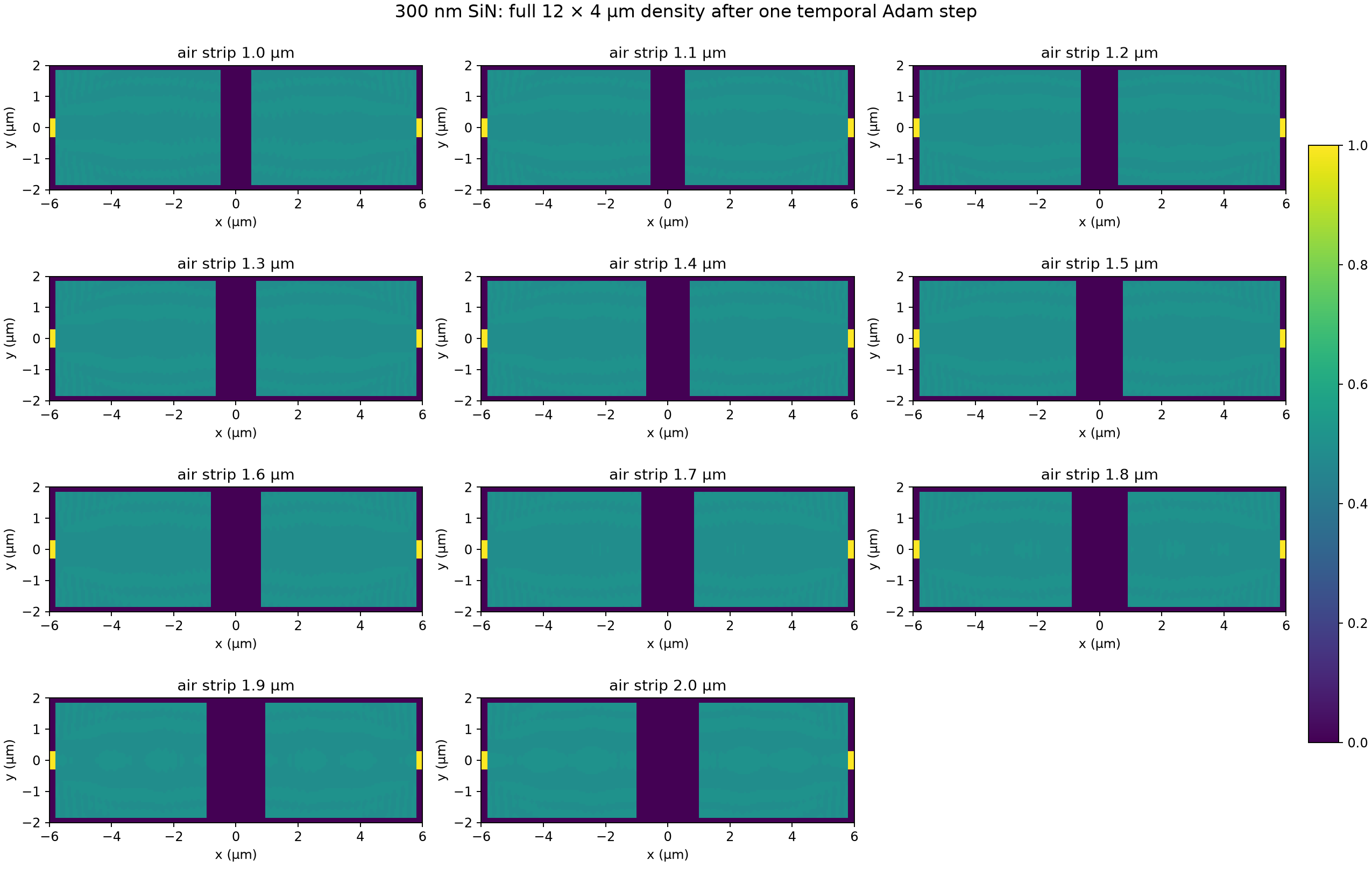
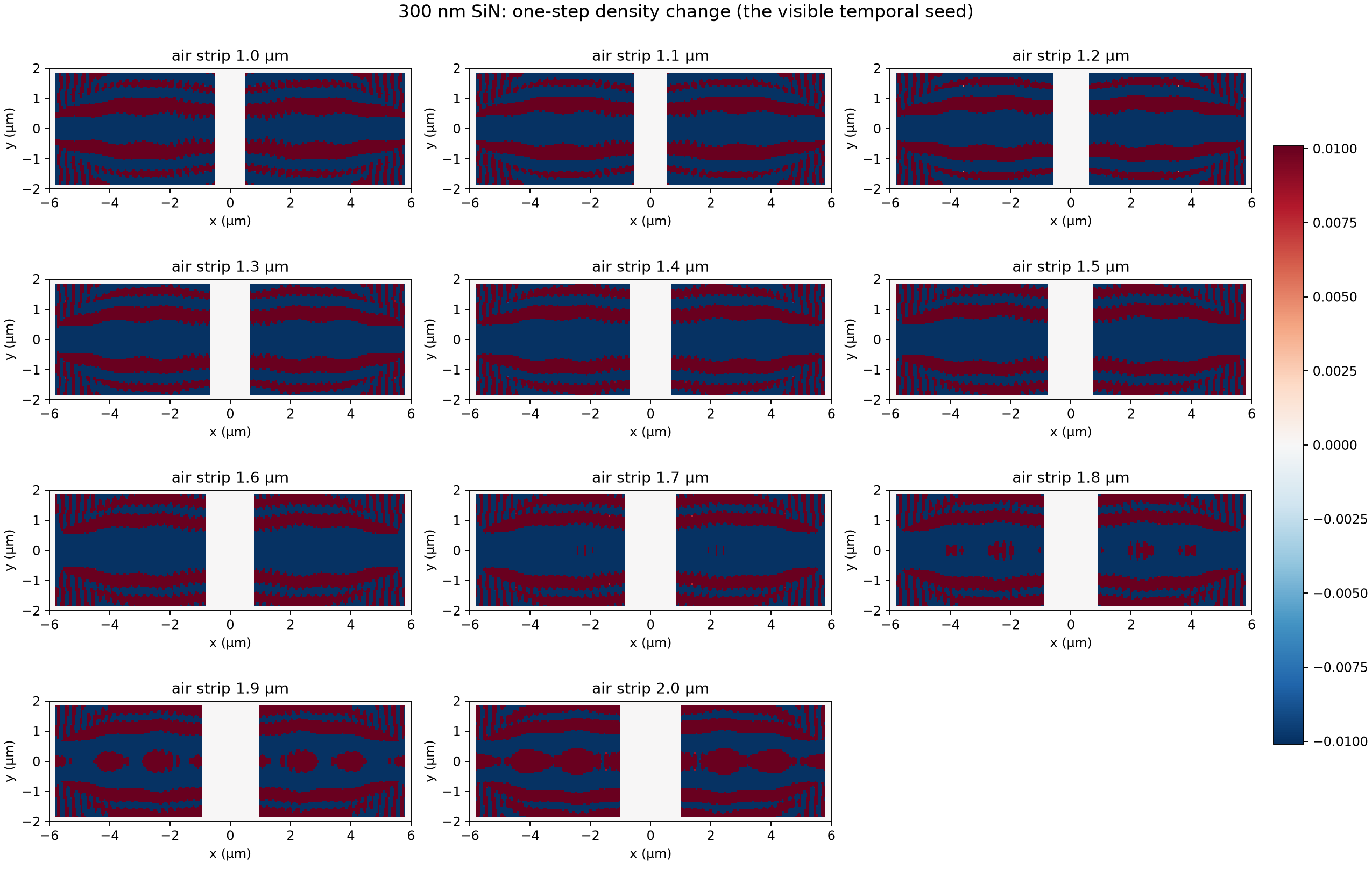
The density panels use the physical 0-to-1 scale. Because this is exactly one step from 0.5, the second atlas is the more sensitive view of the emerging seed.
Geometry differences#
Longitudinal regularity telemetry#
Interpretation guardrails#
Larger \(J\) (less negative) and positive \(\Delta J\) mean a better match to the fixed ideal waveform.
The density-change panels compare the actual first Adam moves. Fixed air and feedthrough pixels remain unchanged.
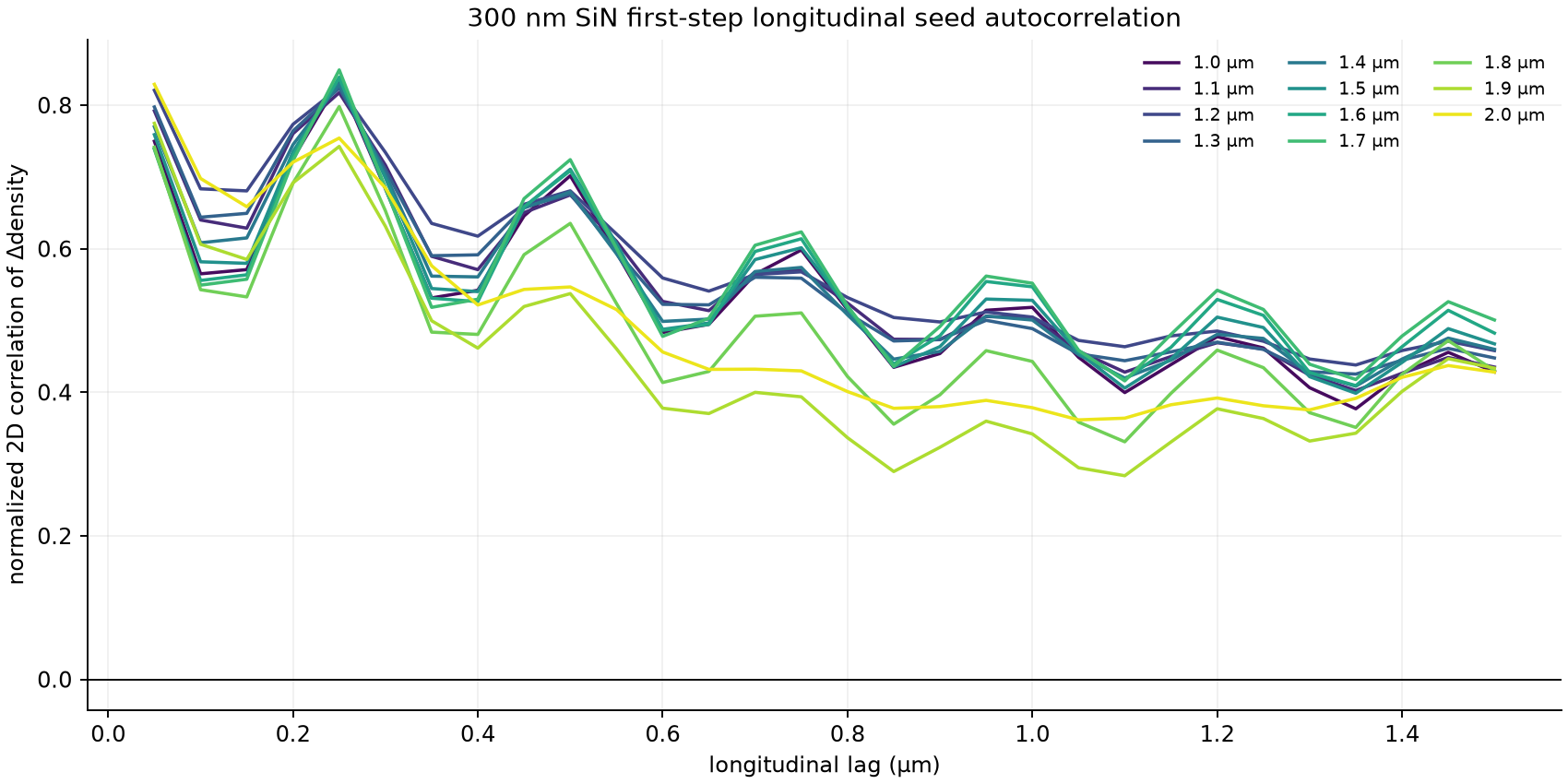
The autocorrelation peak is descriptive only. It summarizes repetition in the complete two-dimensional update and does not rank, select, or modify a seed.