
Adaptive nanobeam waveform frontier#
The former Q≈30,000 stop was an objective/controller plateau, not a physical ceiling. The old scalar had turned off Q pressure while 87.0% of its remaining loss came from an already-passing spatial match. The replacement keeps a carrier-transported temporal target at twice the measured Q, advances it automatically, and treats loading, mode identity, and frequency as buffered constraints.
Live quantity |
Current state |
|---|---|
Controller |
running · adaptive carrier-transported Q waveform |
Numerical checkpoint |
8 · 2026-09-05T14:09:33.803902Z |
Accepted / attempted |
8 / 8 |
Carrier-tracked short-tape Q |
40999.4 |
Best exact-replay feasible Q |
40999.4 |
Adaptive Q target / re-anchor point |
59727.4 / 53754.6 |
Wavelength / drift |
1551.882 nm / -10.990 nm |
Reciprocal loading / hard-floor margin |
0.268710 / 7.59% |
Self-referenced mode mismatch / gate |
0.000020 / 0.250 |
Decoded trust radius / last material motion |
0.0025000 / 0.0025000 |
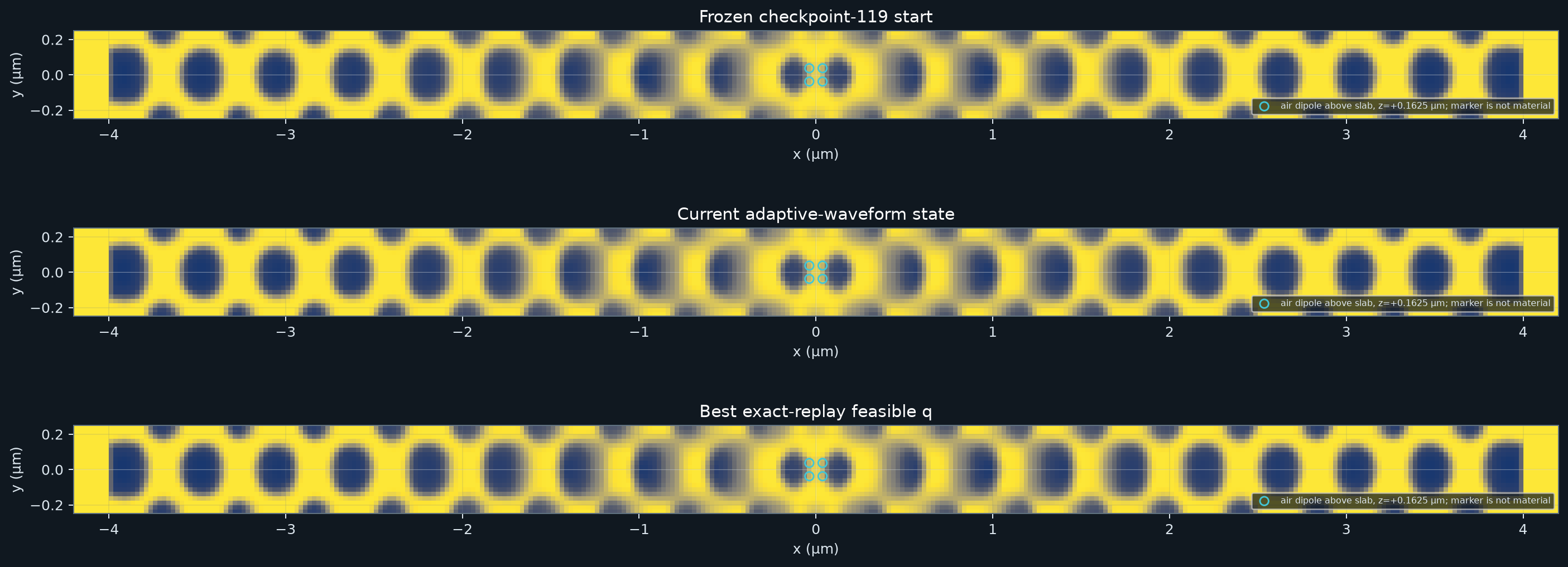
Yellow is material density, not optical intensity. The hollow cyan symbols mark the elevated air dipole and do not add material. The center remains trainable.#
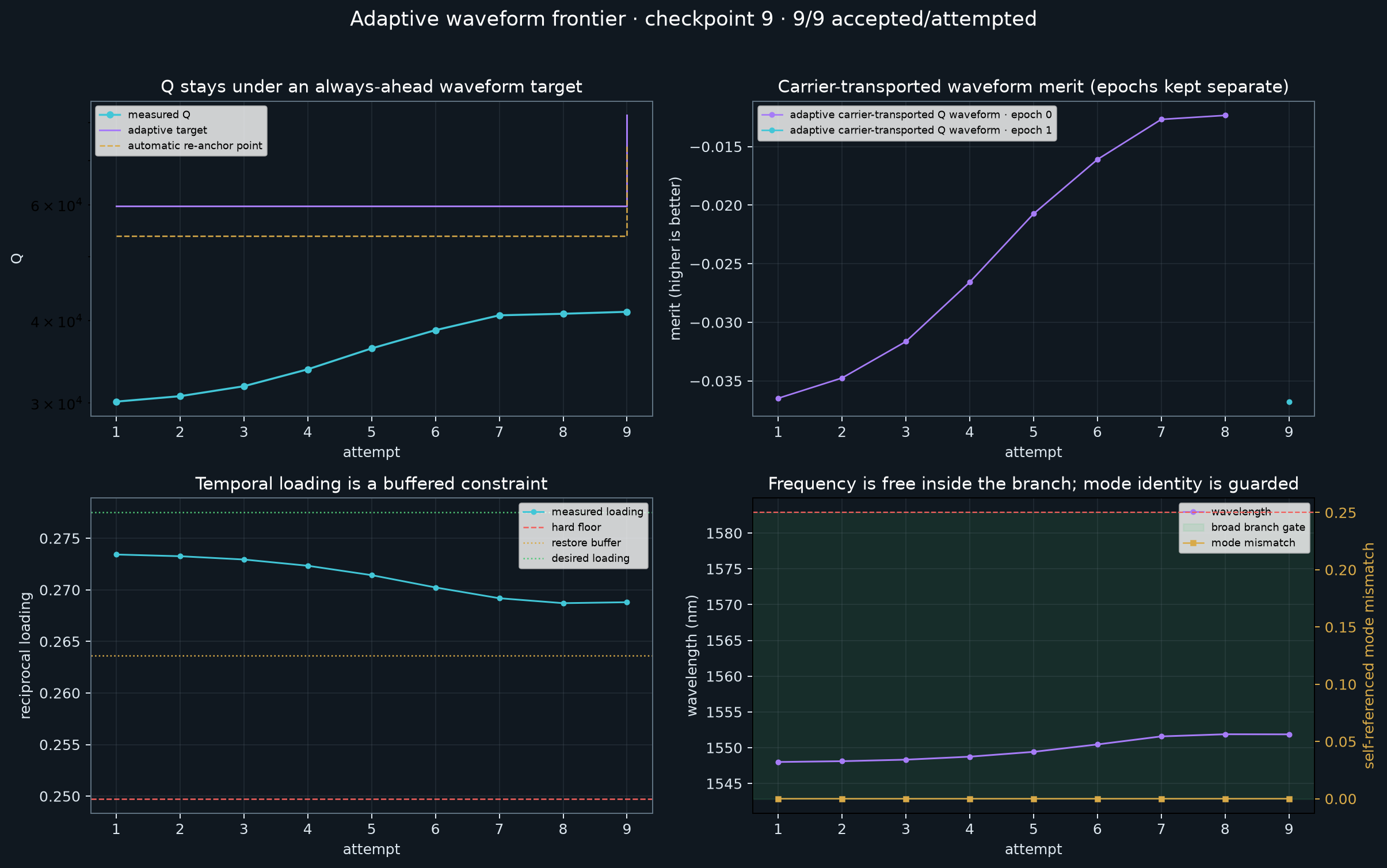
Waveform merits are split at every target/phase epoch, because scores from different moving targets are not directly comparable.#
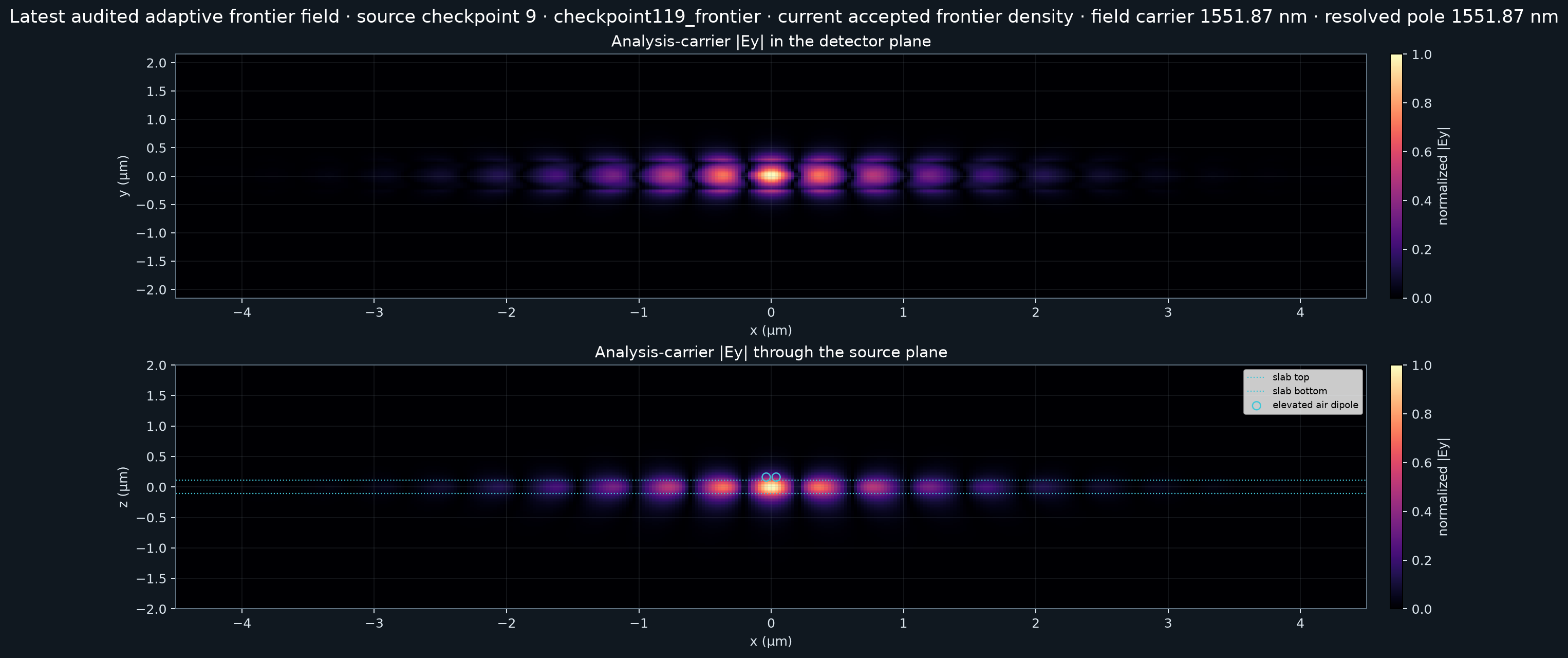
Same-lineage forward field from checkpoint 8; lag 0 checkpoint(s). The service serializes this forward replay between five-step optimizer chunks, so field capture never competes with an adjoint solve for GPU memory.#
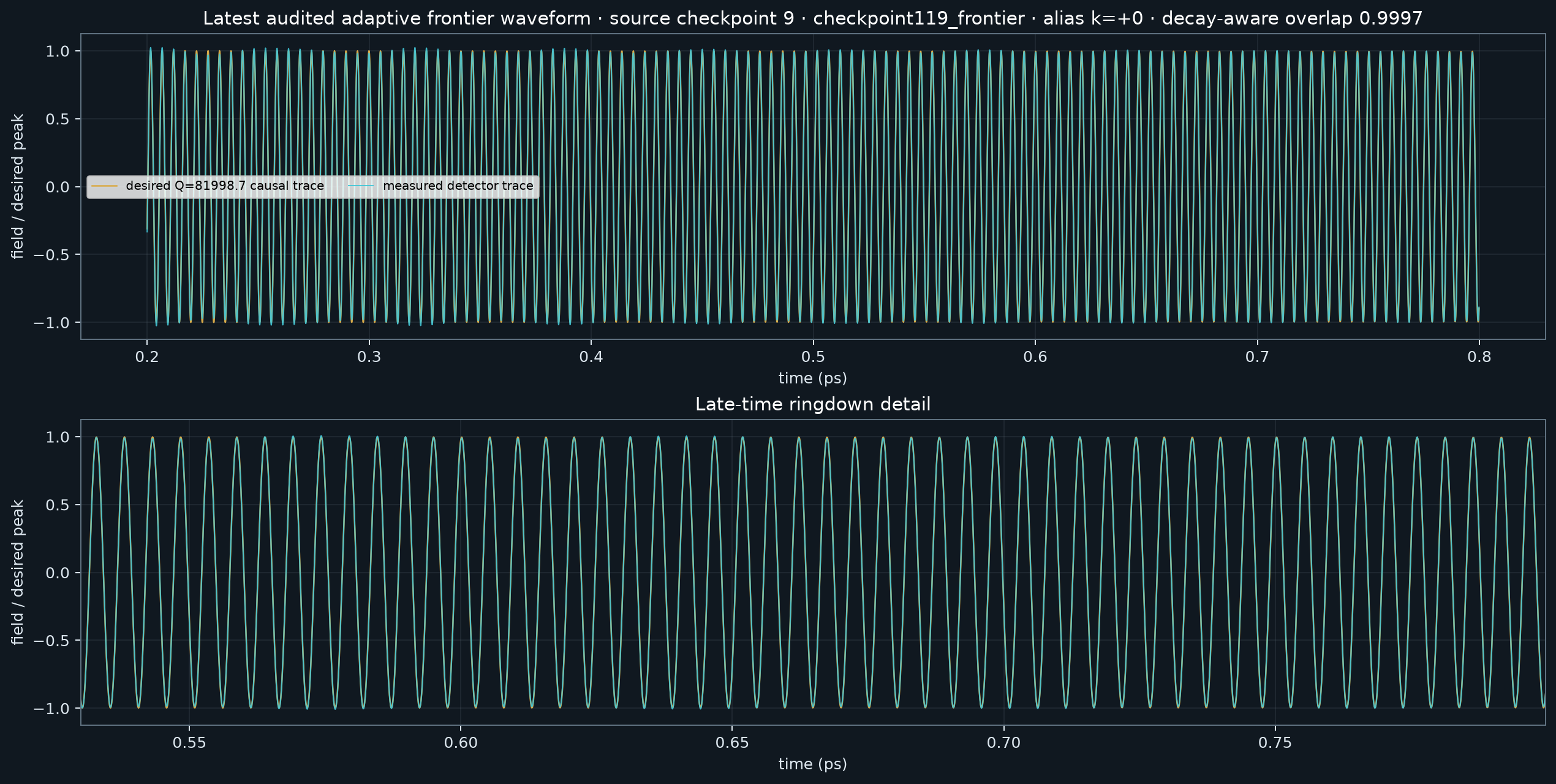
The trace uses the same checkpoint provenance as the field panel.#
What caused the plateau#
The one-sided Q=30,000 waveform target was already saturated: its contribution was only 0.12% of the final loss and the total-gradient cosine with direct log-Q was −0.0158.
Exact higher-target replays raised Q at every tested material radius; the largest one-step test gained about 782 Q while loading changed by only −0.000146.
Repeated unchanged forwards were bit-identical, excluding carrier-fit noise at this state.
The old random escapes moved material 49–490× farther than productive local steps and its escape counter was not reset by later progress.
The current controller does not know the reference optimum. It re-anchors at 90% of a target that is always twice its own measured Q. Frequency is unpenalized over the inner 36 nm-wide window; only a smooth warning near the ±20 nm branch boundary acts on it.
Qualification remains pending#
The values above come from the differentiable 0.8 ps optimization tape. Final success still requires a fresh independent 3 ps replay with Q≥130,767.7, conservative Q≥122,324.0, reciprocal loading≥0.249708, and mode volume≤0.047055 µm³. No short-tape value is silently called final.
Last dashboard render: 2026-09-05 14:11:51 UTC.